A long time ago in a Galaxie far, far away

Galaxie

Truly wonderful the mind of a child is. – Yoda

A long time ago in a Galaxie far, far away . . .

A little girl clutches Mama Bear and Papa Bear. Baby Bear has accidentally been flushed down the toilet.  Clad in a mod red pantsuit instead of a long white dress, and with hair too short for cinnamon buns on the sides of her head, the little girl is nevertheless a princess of sorts, if not a rebel. Yet.

“Stand right there and smile,” says the little girl’s grandmother, who snaps a picture. The little girl really cannot not see the camera, as the sun is in her eyes. She smiles anyway.

Behind her stands the Galaxie  – a 1964 Ford Galaxie 500 that the little girl’s Granddaddy bought, used, for her Grandma. The exterior of the car is red. The interior is red, the fabric of the seats trimmed with silver cord.  The Galaxie doesn’t have power steering or air conditioning. In the summer its windows must stay rolled down if the people inside are to survive. Once it lost a hubcap and the girl’s Granddaddy had to run after it in the city streets.

Yet the Galaxie represents power, things far beyond the little girl. Ford Motor Company named it for the Space Race before the success of the United States over the Soviet Union, which came to pass in 1969, when Neil Armstrong and Buzz Aldrin walked on the moon. The little girl has no memory of this event but likes watching Star Trek with her dad: “Beam me up, Scotty.” She sings The Jetsons theme song:  “His boy, Elroy . . . .” She loves the Jetsons’ dog, Astro. Space gets up close and personal in March of 1970, around the time this picture is taken. A total eclipse occurs in the southeastern United States. The little girl’s family and all the neighbors run out of their apartments in an excited frenzy to watch it. A hush, a stillness, falls over them as the bright day goes as dark as night. The sun disappears,  becoming a mere halo around the huge, black moon. 

“Don’t stare at it,” says Grandma, drawing the little girl close. “It will hurt your eyes.”

The little girl stares anyway, because it is so strange to see the sun go dark.

The world was changing fast. So was my universe. In the year following the eclipse, my grandfather retired. He’d been a shipbuilder since World War II. “We turned out ships in three months in during the war,” I recall him saying, “when it used to take a year.” The war had been over for twenty-five years and it was time to go home; my grandparents packed everything, loaded the Galaxie, and returned to the remote outskirts of Aurora, North Carolina – a tiny town named after the Roman goddess of the dawn. I thought at first it was named for Sleeping Beauty.

My summer voyages began. There on the old dirt roads where my dad ran and played as a child, I learned how to drive with that Galaxie. It was, after all, more indestructible than the Death Star. It was still running after the birth of my first child. My grandparents finally gave it away to the man who hauled trash off for them.

It’s probably running still, somewhere.

Which is more than can be said of our spacecraft.

slice-of-life_individualEarly Morning Slicer


Six-word memoir

Words pour in

“What do you love best? How can you use the things you love to represent you, to describe who you are, in just six words?”

I pause to let the fifth graders think.

“One thing that I love,” I continue, “is the sound of cicadas. Have you heard that sound?”

Hands shoot up. I nod to a girl who replies: “Those bugs that buzz really loud.”

“Yes. Every spring I look forward to hearing the cicadas again – they will buzz all summer long. They remind me of summers spent with my grandparents. The sound was deafening in the thick woods around their home. Hearing cicadas now makes me feel happy and safe, no matter what else is going on. It’s one of the things I love best. So I might try to write my six-word memoir about the sound of cicadas.”

With pencil on paper, using the document camera, I write:

Nature sings to me. I listen.

I see heads nodding.

“I might keep working these six words to see if I can make them represent me better. I might decide to work on another idea. Today you will make a list of things that you love – maybe things you love to do, or favorite objects, or even dreams you have of things you want to do or be – and think about how each thing represents you. Then we will work on capturing and hammering out those descriptions in just six words.”

Off they go around the room, to brainstorm.

I brainstorm, too. What else can I write? What’s another example I can give them?

Well, as far back as I can remember, I loved reading and writing – it’s who I am. It’s what I do. It’s why I’m in this very room this very minute, teaching it.

I think about it all night, and am ready for the next lesson.

“So, ladies and gentlemen, yesterday we brainstormed ideas for writing our six-word memoirs. We thought of things we love and how they might represent us. I thought of something else to represent me. Let me ask you: What do you think represents me? Think about what I do and what you know about me.”

A boy waves his hand: “I know! Harry Potter!”

The class giggles and a few say, “Yessss!”

I laugh. “Excellent. But think bigger than Harry Potter, if possible! Think about who I am and what I do.”

A quiet girl’s hand sneaks up. “You teach reading and writing.”

“There you go. I’ve loved reading and writing all my life. I think this idea might be a great choice for a six-word memoir. It really describes who I am. I have to think now about how to capture this idea in six words.”

With pencil, paper, and the document camera, I write:

I read, I write, I am.

Heads nod – and an image materializes in my mind just then.

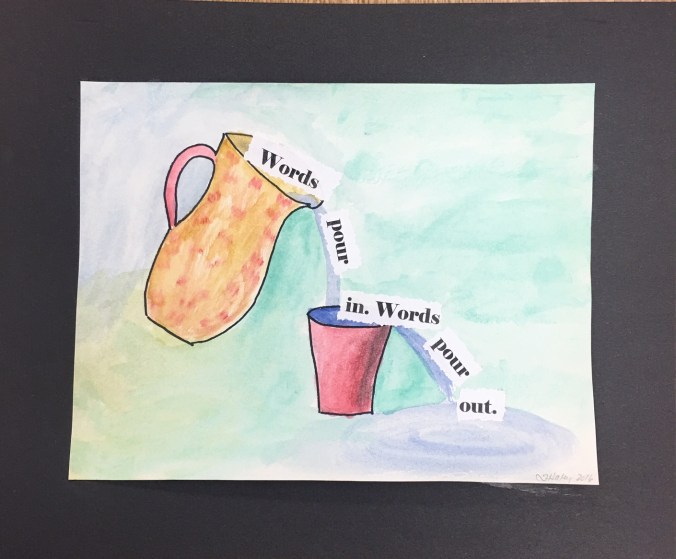
A pitcher, a glass, water pouring . . . .

“I just got an idea of how to make this better!”

I write:

Words pour in. Words pour out.

The children study these words.

“What do you think this means, ladies and gentlemen?”

A boy says, “First you wrote I read, I write, I am and you said you could make it better so I think you mean that if words pour in, you’re reading, and if words pour out, you’re writing.”

Across the room, faces light up.

I smile. “Well done. For a few minutes, share your ideas with your partner and talk about possible ways to begin writing your six-word memoir. Then we’ll all write.”

I listen as the ideas flow in and out, with a hum as vibrant as that of cicadas.

(If you’re interested in reading an earlier Slice on the sound of cicadas: Cicada rhythm)

slice-of-life_individualEarly Morning Slicer

But I’m not a teacher

Encourage

He’d saved his own money to buy me a Christmas present. He told his dad he wanted to go to the bookstore, so his dad took him.

He bought me a picture instead of a book and watched with great pride as the clerk wrapped it.

“I got it for my mom,” he told the clerk.

“Oh, she’ll love it!”

He clasped it to his heart all the way home.

He burst into the house, calling, “Mom! Mom! I got you a present!”

His dad said, “Son, just put it under the tree. It’s for Christmas.”

“I want to give it to her now!”

“All right,” I said,  sitting down on the couch. My little boy scrambled up beside me. “I’ll go ahead and open it, if that’s what you want.”

He watched my every move as I unwrapped the paper and pulled out the matted picture bearing the quote: A teacher in wisdom and kindness helps children learn to do exactly what they thought could not be done.

I didn’t know what to say for a moment.

“It’s beautiful, honey,” I said, hugging him. “Thank you so much.”

“Do you love it, Mom?”

“I do … but I’m not a teacher.”

My son surveyed me with huge dark eyes that seemed far older than his six years: “Oh yes you are, Mom.”

At the time, I wasn’t even a college graduate. Teaching wasn’t on my radar. Thirteen years, a degree, and another baby later, I actually became a teacher. In all of those education courses that required me to describe my educational philosophy, I wrote: A teacher is an encourager, recalling that solemn little face, those big eyes, the absolute conviction shining in them. Children, sometimes, are the greatest of sages, the most profound of prophets.

Three more years, and the boy graduated college himself with a degree in history. “What am I going to do for a job?” he asked one afternoon, a slight hint of anxiety in his voice.

“Teach,” I answered, smiling.

He didn’t smile back. “But I’m not a teacher.”

“Oh yes you are, Son.”

Before the summer ended, he had a job teaching social studies at his old high school. When he went to set up his classroom, he cleaned out the cabinets and found old tests – including his own.

He also became a soccer coach, taking his team to the championships and winning regional Coach of the Year this past season.

We didn’t seek teaching; it found us. We’ve done exactly what we thought could not be done – we do it every day, all over again.

And every day is new, if not easy; every day offers wisdom, beckons kindness, invites us to believe in others, in ourselves, every moment a chance to create, to reinvent, to overcome. It can be done.

Encourage one another.

slice-of-life_individualEarly Morning Slicer


Lighting the way

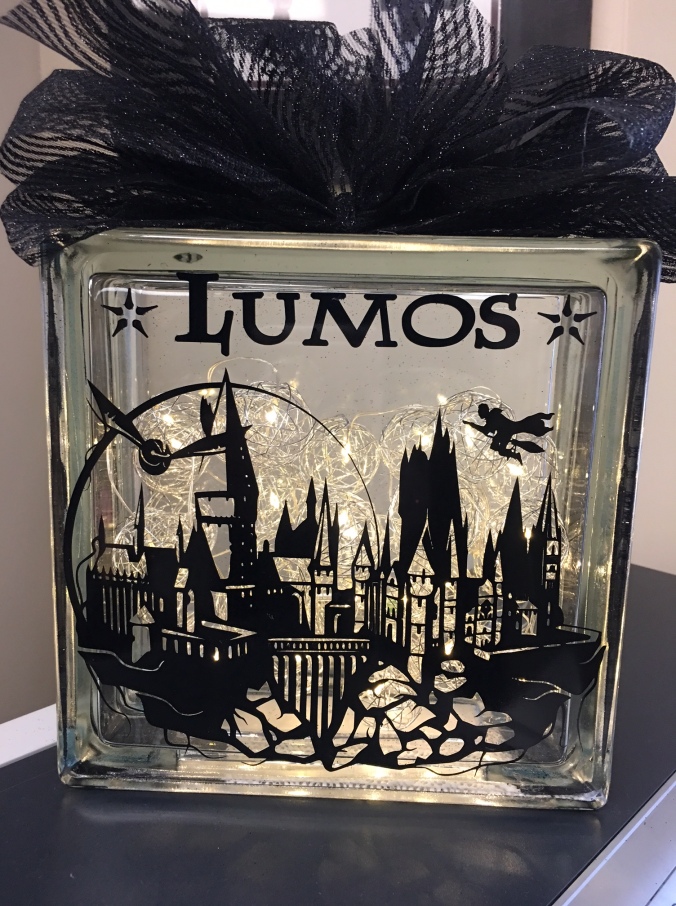
Lumos

Yesterday a fifth-grader caught me in the hallway:

“Mrs. Haley, do you have a copy of Harry Potter and the Chamber of Secrets in your room?”

 “I have two copies. Ask your teacher if you can walk with me to get one.”

He did. As we walked, I said, “The Chamber of Secrets is a great book. I enjoyed it more than The Sorcerer’s Stone.”

“Yeah, I haven’t read Chamber of Secrets. I saw the movie and my favorite part is when Harry gets the cloak of invisibility and finds that mirror where he sees his family.”

“Ah, the Mirror of Erised … I just read that aloud to two classes at another school last week while they were studying fantasy.”

In that chapter, Harry receives the cloak of invisibility at Christmas with an anonymous note explaining that it had belonged to his father; he is admonished to “use it well.” He sneaks around Hogwarts, hidden by the cloak, and ends up in a remote, off-limits part of the building in what appears to be a storage room. He finds a large, ornate mirror. Erised backwards is desire – looking in the Mirror of Erised shows a person the deepest desires of his or her heart. Harry’s family is dead; he desperately wishes he could have known them. He is transfixed by their images in the mirror – they wave at him, and his mother wipes away her tears as she smiles at Harry.

I think, as I rummage through my basket of Potter books, Fascinating how it’s the humanity that draws us, more than the magic. 

“Here you, go,” I say to the student. “The Chamber of Secrets.”

His face lights up when I place it in his hands. “Thanks, Mrs. Haley!”

“Read it well,” I call after him, as he walks away, flipping pages.

I look around my room, my own chamber decorated with Potter memorabilia that draws children from across grade levels. They love to drop by to show me their owl collections, to ask if I’ve read The Cursed Child, to share anything Harry Potter that they’ve recently acquired. The Harry Potter club meets here twice a month, students from third through fifth grades, and we talk so much more about what motivates the characters than the magic they employ.

My Lumos glass box gleams in the corner by the doorway. I think of all the times that teachers might wish we had magic wands to show us everything the kids need, to fix all that needs fixing. I recall J.K. Rowling’s quote from her 2008 Harvard speech, now connected to her Lumos charity on behalf of children:

“We do not need magic to transform the world. We carry all the power we need inside ourselves already.”

It’s apparent whenever I read with the kids, whenever the Potter club meets and someone has an epiphany about a character, whenever I walk into a classroom to write with students and teachers. The essence of teaching, of reading, of writing more than anything else, is the connection of human minds and hearts. It’s all part of same story, the triumph of the human spirit. Teach it, read it, write it well – tap into all you’ve known, all you’ve loved, all you’re wrestling with, and watch their faces.

It’s all inside you. Light the way.

slice-of-life_individualEarly Morning Slicer


Spectacle

Glass doors

Untitled. SupportPDXCC BY

“Bye, Mrs. Haley!”

“Thank you, Mrs. Haley!”

The fifth-graders hugged me as they left summer enrichment camp. Their parents, present for camp graduation, made a point to speak to me, too:

“Thanks so much for this experience. My son loved it  – he wants it to last all summer!”

“My girl wants to come back next year!”

I laughed, shaking hands with the gracious parents, all the while basking in an inner glow: I did it! I successfully organized and taught this thing!

Just then, I spotted a student’s notebook left on the floor.

Oh, no! She’s going to need this  – the whole point of compiling it is to have a resource in sixth grade!

I glanced through the glass lobby doors. My student was with her mom, getting into a blue Honda. I snatched the notebook up from the floor. If I hurried, I could catch them before they pulled away.

I sprinted for all I was worth across the crowded lobby and – BAM!

For a nanosecond, I wasn’t sure what had happened. That sound was immense. Then I realized: I was the sound.

I found myself lying on the cold stone of the lobby floor.

There were loud gasps, maybe even a small scream.

“Mrs. Haley!”

That’s when I knew: I had run full blast into the closed glass door.

In a lobby full of parents and kids.

I sat up. Deep, throbbing pain spread across the bones of my face. I quickly ran my tongue over my teeth – were they knocked out?

No, they were intact.

Get up! said my brain. Before anybody comes over here.

Squaring my shoulders, I popped up from the floor, grabbed the notebook I’d dropped, OPENED the glass door, and scurried through to the blue Honda.

My student and her mom looked at me dubiously as I approached the driver’s side. The mom slid the window down.

“Um, your daughter forgot her notebook,” I said, holding my nose with one hand. Blood  seeped through my fingers. I extended the notebook with the other hand.

“Uh – thanks,” said the mom, taking it from me.

“Hey, Mrs. Haley, your nose is bleeding!” said my student, craning over in the front seat for a better look.

“Yes, I know,” I answered, “but it’s fine. Enjoy the rest of your summer!”

I slunk back into the building where people stood, gaping. Giggles rippled through them. Without making eye contact, I marched past them into the bathroom to survey the damage.

I didn’t look too mutilated. The nosebleed was already slowing.

The bathroom door opened and one of my colleagues came in.

“Are you okay?” she asked.

“I think so,” I said. I leaned closer to the mirror. “Oh, no – look! My nose is turning black already!” How bad will the bruising be? Will I have two black eyes?

“Let me see,” said my colleague. She came up close to scrutinize my nose. She touched it gently.

I winced.

A grin spread over her face.

“That’s ink from the newspapers you were holding!” She doubled up with laughter.

This is just great. Assured that my nose was going to be fine, I had no choice but to return to the lobby after I washed away the ink and the blood.

Most of the folks had cleared, thankfully. Only my colleagues remained; they’d propped open the offending glass door. “You need to see what you did to the door,” one of them told me.

I went to check it out, wondering if I’d somehow managed to hurt the door more than it had hurt me.

And there on the clear glass before me was a perfect mask of my face, thanks to the foundation I wore. An oval with two eye-holes, a complete set of lips in faint lipstick, even the little vertical lines in my lips, all captured there on impact better than any artist could have painted.

As I stared in horror at this specter of my visage, one of my colleagues called, “Here’s looking at you, kid.”

They all howled while I frantically wiped my phantom make-up mask from the glass.

“One thing’s for sure,” one of them said, wiping her eyes, “no one will ever forget this camp graduation!”

Indeed. The success of the camp itself is not a topic of conversation anymore, but as for me – I’m legendary.

slice-of-life_individual


Writing the truth

i-like-my-mom

Ernest Hemingway once said that it is the writer’s job to tell the truth. In A Moveable Feast, he describes his process:

“All you have to do is write one true sentence. Write the truest sentence that you know.”

I am sharing here one of the truest pieces of writing I have ever seen.

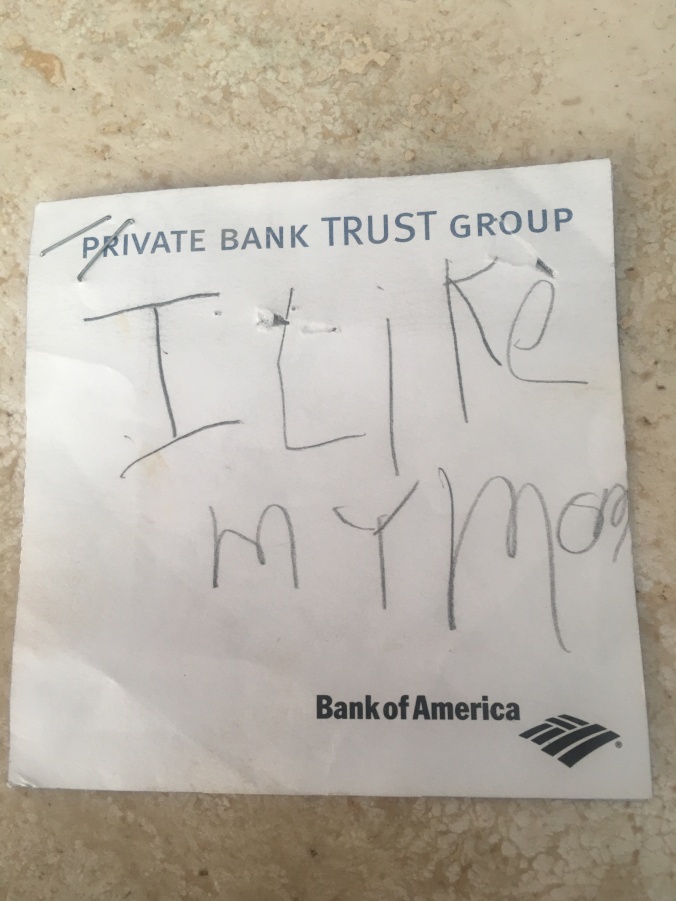
The background: When he was small, our younger son often went with my husband to church early on Sunday mornings. The little fellow sat in the church office and busied himself with writing sticky notes that he delivered to me on my arrival.

I saved them – they’re all in the bottom of my jewelry box.

This one is my favorite. As you can see, the note says “I like my mom.”

Not love, mind you . . . .

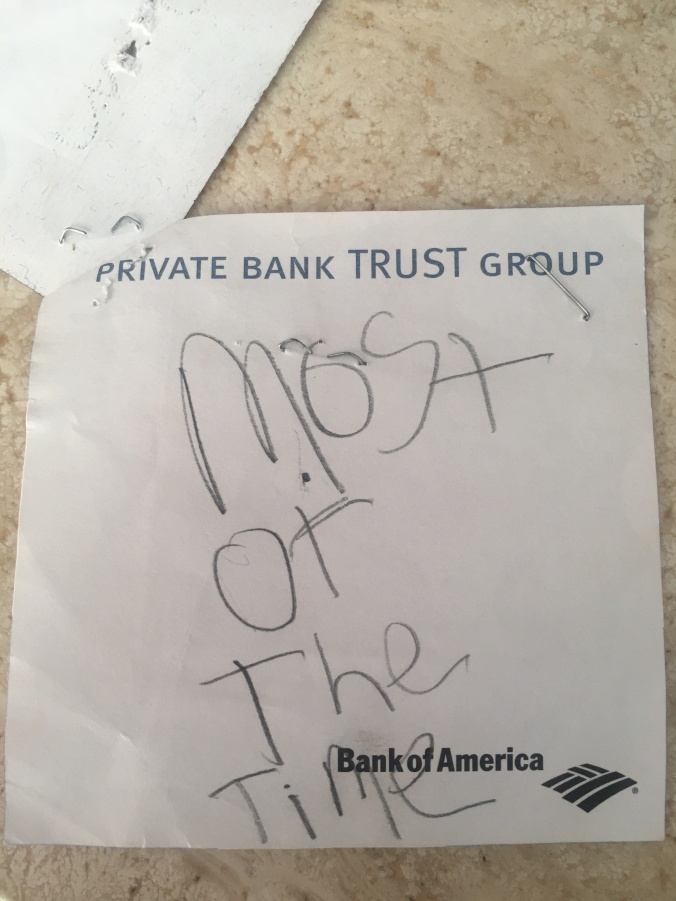
But this is a two-pager (see the staples?). The sentence continues on Page Two:

most-of-the-time

“I like my mom – most of the time.”

I ask: Has a truer sentence ever been written?

slice-of-life_individual

Service

The restaurant was packed with the after-church crowd on Sunday. The boy halfway wondered if he should have chosen a different place for lunch, but he had a hankering for a steak today. 

The waitress took a long time getting to him for his order; he suspected it might take forever before his food actually arrived. Well, I’m really in no hurry, he told himself. That steak better be good, though.

The noise got to him a bit. Clinking glass at tables where busboys hurried, a screaming toddler, the hum of conversations, bursts of laughter, too-loud music. Why do restaurants continually raise the volume of the music above the volume of conversation? thought the boy. People are just about shouting to each other! 

The host passed his table, followed by an elderly woman with a walker who gingerly navigated the tables and chairs to be seated a short distance away from the boy. He sipped his sweet tea, wondering if he should make it last, as a refill any time soon did not seem like a remote possibility. The restaurant must be short-staffed today, or something.

The woman with the walker was alone. I wonder why? mused the boy. Is she a widow? Maybe she doesn’t have children. Maybe her husband is in the hospital. Or maybe a nursing home. It’s Sunday; maybe she’s been to see him, or maybe she’s going to see him after lunch.

It bothered him that this woman was alone.

It did not bother him that he was alone. Sometimes he ate with friends after church and sometimes he just enjoyed solitude. I am young, though, he thought. She is old. She should be with someone.

Maybe someone is meeting her here.

No one did.

The woman’s long wait jangled his nerves. He forgot that he, too, was receiving terrible service today; this old woman deserved better treatment. 

His steak eventually arrived. It was good. He savored every bite. When the bill came, he asked the waitress:

“Do you see that woman over there,  by herself?”

“The one with the walker?”

“Yes. Bring me her bill, too, please. I am buying her lunch today.”

And so he did. He left the restaurant feeling peaceful inside, before the woman knew her lunch was paid for.

His story brought tears to my eyes. The boy is just nineteen, a college student, working his first steady part-time job.

“You have one of the best hearts of anyone I’ve ever known,” I told him. “You truly do.”

He half-smiled like my father used to, sometimes.

“It was the only thing I could do for her, Mom.”

And, sated with steak, he went upstairs to the quiet sanctuary of his room, humming his favorite tune, the first one he ever learned.

Amazing Grace.

slice-of-life_individual

Crossing the bay

cape-charles-beach

Chesapeake Bay, Eastern Shore, Virginia. Ken LundCC BY-SA

But such a tide as moving seems asleep,
   Too full for sound and foam,
When that which drew from out the boundless deep
   Turns again home.

-Alfred, Lord Tennyson, “Crossing the Bar”

I walked the little beach many times in the five years I lived in Cape Charles. With the ebb and flow of the tide, tiny periwinkle snails bury themselves in the sand. Gulls hovering overhead cry in their piercing, lonely voices. Storms churn the Chesapeake Bay, stirring its hidden contents so that afterward, treasures can be found on the shore – sand dollars, whole and unharmed, prizes to a beachcomber. I collected many.

I was alone on the beach the day I saw the old train coming to the end of the line at the harbor. I’d never seen it come through – Cape Charles is a tiny railroad town that almost didn’t survive the loss of the industry.

Where’s that train going? I wondered. Has it gotten on the wrong track? There’s nowhere to go – nothing but the bay ahead of it. Will it turn around, somehow? Or back up? 

Is it going over the edge, into the water? 

The train kept rolling forward, slowing to a stop at last.

I relaxed.

And the train began to float away from the land, as if by magic, as if it were Chitty Chitty Bang Bang, sprouting a flotation device.

It’s on a barge!

I watched, marveling, as the train sailed out into the bay, a majestic, most rare sight. I imagined visiting fishermen looking up from their bait and tackle to gawk as the train drifted by their boats.

There was something poetic about it, both grand and poignant, filled with awe and tasting of sadness. The gulls cried; a salt-tinged breeze caressed my face. I watched as the train grew smaller and smaller on the bay, until I could see it no more, and turned again home.

slice-of-life_individual


Titanic relic

pier-54-april-2012

Pier 54,  April 21, 2012 – exactly one hundred years after the sinking of the Titanic.

Arriving by bus in New York City, the tour guide said, “This is Hudson River Park.”

Looking through the window, I saw a sign: Chelsea Piers.

Chelsea Piers – why does that sound so familiar?

The words buffered around my brain for a second or two, retrieving the information: Chelsea Piers is where the old old ocean liners docked. 

Pier 54 is where the Titanic survivors were delivered by the Carpathia – hey, that’s exactly a hundred years ago this week!

I scrambled for my phone and opened the camera.

I took the shot just as we passed.

There is no magnificent dock anymore, only a corroding steel arch standing like a neglected, tired sentinel as people go about their daily lives. It’s hard to imagine this unremarkable structure as a portal to luxury, to adventure, to the stuff dreams were made of over a century ago.

C.S. Lewis wrote in The Voyage of the Dawn Treader, in the chapter entitled “The Dark Island”:

“Do you hear what I say? This is where dreams  – dreams, do you understand – come to life, come real. Not daydreams: dreams.”

In other words, nightmares.

I tried to envision the crowd, the men in overcoats, the women in long dresses, everyone wearing hats, as the Titanic survivors disembarked on April 18, 1912. It was night. For a fleeting second, I could sense the darkness, the shattered dreams, the unspeakable horror of watching that massive, beautiful ship break apart in the icy sea, taking so many passengers with her to a deep, watery grave. The nightmare was real; it would never leave the survivors.

In an instant, the darkness vanished, my glimpse of long ago ended. I blinked in the broad daylight. As my bus sailed on, I studied the photo. A bright light shines in the very center of the arch, which once bore the words White Star. I cannot tell if my camera was poised just right to reflect a flash in the window, to be captured perfectly in the middle of that haunting remnant, or if it is a phenomenon of light from some other source; nevertheless it shines like the sun over this relic of ruin, like day following night, driving the nightmares, the ghosts, away, hallowing this entrance to another time.

slice-of-life_individual


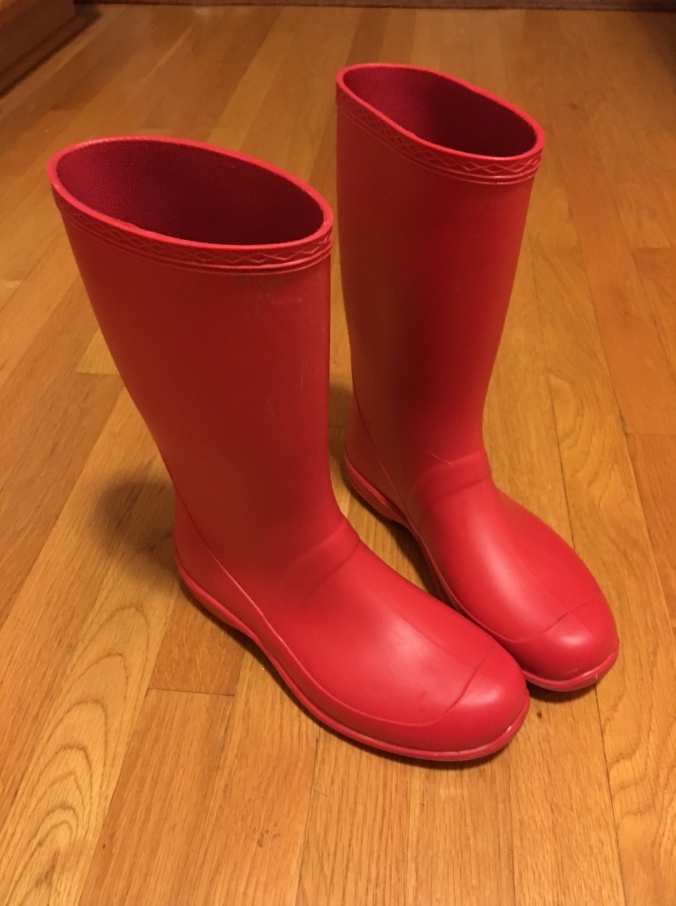
Red rubber boots

red-rubber-boots

It is Sunday, the day my Granddaddy is off from work at the shipyard. It is the day we usually walk to the playgrounds behind the churches across the busy city street, my small hand clasped in his large one, as we wait for the traffic light to change. Today it is raining and we can’t go out. I sit by his recliner on the braided rug beside his feet – he wears black lace-up shoes every day – and sigh.

“What’s the matter, Duck?” he wants to know. Sometimes he calls me Duck, sometimes he calls me Pig. I do not know why. He just does.  It makes me feel warm inside.

“Granddaddy, the girls in kindergarten have red boots to wear when it rains. I don’t have boots.”

“Oh, I see. I guess you been wanting some of those boots?”

I nod my head and crawl up into his lap. “Yes, Granddaddy. For a long time.” His black leather cap is on the side table by the recliner. I pick it up and put it on my head. It smells like him. A little Vitalis and a lot of goodness.

He wraps his arms around me. “Tell me about these boots, what they look like.”

“You can pull them over your shoes … ” I begin.

He got them for me, of course, those red rubber boots that I proudly wore to school and stored on the bottom shelf in the cloakroom, beside the boots of the other girls.

At the time he got them, I did not know that his retirement was imminent, that within the year he’d move back home to the far reaches of eastern North Carolina, three hours away. I would only see him a couple of times a year from then on.

I grew up. I had children of my own. When I went to visit Granddaddy, I sat on the stool by his recliner, as close to him as I could get. He patted my arm. We sat this way for a long time, without any conversation, just being together.

“You remember them red rubber boots I got for you?” he asked eventually. His blue eyes twinkled at me. Every now and then, across the decades, he’d mention those boots.

“Oh, yes, Granddaddy. I remember. I loved them so much.”

He chuckled, patting my arm with his large, wrinkled hand.

He was retired for thirty years, living to be almost 93.

I had nearly forgotten the red rubber boots when I happened to see a pair at the store a year or so ago. They were so like the boots he gave me when I was five.

“Ah, Granddaddy,” I whispered. “You’re never far away.”

I bought them.

They protect me from the rain; they keep me grounded, connecting me to the earth that my grandfather loved, for he was a lifelong farmer even though he had to find better-paying work to provide for his family. The color brightens the gloomiest day. I wear my boots with deepest gratitude for a humble man who knew about sacrifices, great and little, fiercely proud that his blood flows in my veins.

I remember, Granddaddy. I always will.

slice-of-life_individual