Hey it’s me I’m trying can’t you see that you’re my everything you center my small world even if I don’t have words I adore you beyond measure I know you’re busy but I am here believing in you and your love for me
believing in you and your love for me I know you’re busy but I am here I adore you beyond measure even if I don’t have words you center my small world you’re my everything can’t you see that I’m trying it’s me Hey
Micah, 8 1/2 months. How you adore your parents. How your family loves you so.❤ Franna
While working outside around the house, I paid no attention to the little brown rock in the driveway.
Until it hopped.
On closer inspection: Not a rock. A tiny, rust-colored toad, pretending to be a rock.
Reminded me, for just a fraction, of story characters who magically transform themselves into creatures or objects to avoid detection from enemies…
I leaned in while trying to maintain a respectful, non-threatening distance.
“You’re doing a magnificent job of it,” I told the toad.
Of what? its tiny taciturn face seemed to ask.
“Of pretending to be a rock,” I said.
It sighed (I think).
What gave me away?
“Well, rocks don’t hop.”
Its expression: pure disdain.
“Toads don’t talk, either,” it said, as it turned and hopped away across the hot pavement.
Okay…so this story may not be toadally true…
The toad. Less than one inch long. Stone-faced, isn’t it. Can’t decide if I’d call it Rusty or Rocky. Or perhaps just Fowler, as it appears to be a Fowler’s toad, with poisonous warts…fun fact: apparently ALL toads are poisonous. Not highly toxic to humansthrough touch, only if ingested (gulp). Think of those I caught as a child and brought home in my metal Peanuts lunchbox amongst the crusts of my PB&J (toadally true. Honest).Would make for fun fiction writing with students when they study animal defense mechanisms: The Revenge of the Toads…
*******
with thanks to Two Writing Teachers for the weekly Slice of Life Story Challenge and, of course, to the toad
Rest is not idleness, and to lie sometimes on the grass under the trees on a summer’s day, listening to the murmur of the water, or watching the clouds float across the sky, is by no means a waste of time.
—John Lubbock
haiku story poem
dog days of summer triple-digit heat index white haze cloaks the air
one can drown in it too hot for lying in grass even in the shade
lethargic rhythms settle on all living things except for insects
unrepentant sun shimmers on dragonfly wings iridescent darts
buzzing cicadas in feverish frenzy sing of love high in trees
remaining unseen falling silent before storms darkening the skies
as lightning’s forked tongue snakes from the heavens to earth (thunder, they told me
when I was a child, is just the angels bowling; that’s their pins, crashing)
—the heat breaks at last like evening revival saving weary souls
murmuring water seeps into my dreams ephemeral streams
This week I read that you can tell how long it’s been since a field has been reclaimed by forest. If the forest has a lot of pines, maybe twenty years. If there are more hardwoods than pines, maybe forty years.
We own a tiny of patch woods behind our house. Beyond that is a field (not ours). Once upon a time, this was all field, and long before that, all forest.
I cannot recall what these trees looked like when our house was new, twenty years ago. I can see we have quite a few hardwoods now in our tiny bit of forest.
This week one of our pines toppled in a wind gust preceding a thunderstorm. The trunk’s resting partly on the fence (which is holding up, surprisingly). On the other side, the treetop is a shattered, mangled mess. My plant identifier app tells me it’s a loblolly pine with Crown Gall caused by bacterial infection. It must have been slowly starving for water or nutrients. The extent of its brokenness there on the grass makes me wonder how much the tree suffered and if others of its species tried to help or not (trees do this for one another).
At any rate, it’s gone. A fat sand-colored dove lands on the fence to survey the damage also. Maybe it is simply paying respects.
There is nothing I can do. The fallen tree will have to be cleaned up. I imagine the confusion of rabbits, the next time they come out to nibble clover and find this mess. I turn to go back to the house, whereupon I discover a curiously bright and fresh plant quite to itself where the pinestraw ends and grass begins.
Sweetgum. A baby hardwood. Encroaching toward the middle of the yard.
I look at back at the grown sweetgums waving their starry leaves from among the cedars and pines. I imagine the mother tossing her seeds as far she could (not very far, only a few feet; maybe birds or animals helped but the wind apparently didn’t, not much).
Still. Cannot help thinking about that reading I’ve just been doing…as in, this cheery neon-green baby being a strategic move in the decades-long hardwood takeover and that sick pine, an occupational casualty.
I wonder what the trees tell one another, what old secrets live deep in the understory.
I wonder what the dove knows, and the wind, as it blows.
Something of belonging and primeval balance, surely.
with thanks to Chris Margocs for the “Be still” invitation and to Margaret Simon for the “Presence” offering on behalf of our Spiritual Journey writer’s group on this first Thursday in July
Back in March of 2020, four days into COVID-19 lockdown, I wrote a post entitled Be still. It was based on Psalm 46:10, a verse with special significance to me since I was about thirteen, when a youth group leader gave me a little decorative plaque bearing the first line: Be still and know that I am God. The plaque hung on the wall of my bedroom throughout my tumultuous teenage years until I married and left home at twenty. I had no inkling, then, that my young husband would go into the ministry two years later or that we would eventually have two sons, the older of whom would become a pastor and the younger, a music minister and worship leader.
Throughout the decades I’ve received numerous gifts which have borne those words: Be still and know that I am God. The verse keeps returning to me. A few weeks ago my Sunday School co-teacher brought a handful of cards printed with Bible verses, held them out to the class facedown, and had each of us draw one. I drew Psalm 46:10. Be still and know that I am God.
I could write a lot about those eight words, having to do with trusting God in times of trouble and God’s unfailing faithfulness. Overcoming fear and despair. Carving out time away from the demands, vitriol, and horrors of the world. Finding peace in the rhythms of nature surrounding my home in the countryside (I have written a lot about that, actually).
But those eight words are only the opening line.
“Be still and know that I am God. I will be exalted among the nations, I will be exalted in the earth!” —Psalm 46:10 (ESV)
The verse is a call to be in awe of the power of God, to be a people who carry forth the message of godly peace to the world, by which wars will cease (v. 9), and by which God will be exalted. It is a declarative, definitive statement. On the part of God: It shall be. On the part of humanity: Be awed.
Awe has been my guiding word for the past two years. It is likely to remain so as long as I live. In the context of inherent awe and Psalm 46:10, words of the song “Above All” by Michael J. Smith come to mind:
Above all powers, above all kings Above all nature and all created things Above all wisdom and all the ways of man You were here before the world began
Above all kingdoms, above all thrones Above all wonders the world has ever known Above all wealth and treasures of the Earth There’s no way to measure what You’re worth…
Be still and know…God is above all.
My theologian son is studying the work of Eugene Peterson (1932-2018), minister, author, poet, and Professor of Spiritual Theology, Regent College, Vancouver. We have recently been discussing The Message: The Bible in Contemporary Language, Peterson’s idiomatic paraphrase of Scriptures, apparently written out of frustration with people not reading their Bibles.
Here’s Peterson’s paraphrase of Psalm 46:10:
“Step out of the traffic! Take a long, loving look at me, your High God, above politics, above everything.”
I cannot think of a more timely message.
I return now to the original Be still post I wrote on March 17, 2020, during the early days of the pandemic. We thought school would be closed for two weeks. We had no idea of all that lay ahead. Extended isolation. Loss. Rampant fear. Exacerbated discord. Death, violence, rage, destruction. War. Rising inflation.
Consider the verses immediately preceding Psalm 46:10, from the ESV translation:
The nations rage, the kingdoms totter; he utters his voice, the earth melts. The Lord of Hosts is with us; the God of Jacob is our fortress. Selah (6-7).
And then we are told Be still and know that I am God.
Who is above all.
I thought about linking Smith’s song here. Psalm 46 is, after all, a hymn.
I am linking another song instead, one of my longtime favorites for its plaintive beauty and quiet, meditative message—a little rest stop for the soul on the arduous spiritual journey through life in this world that God, incomprehensibly, still loves.
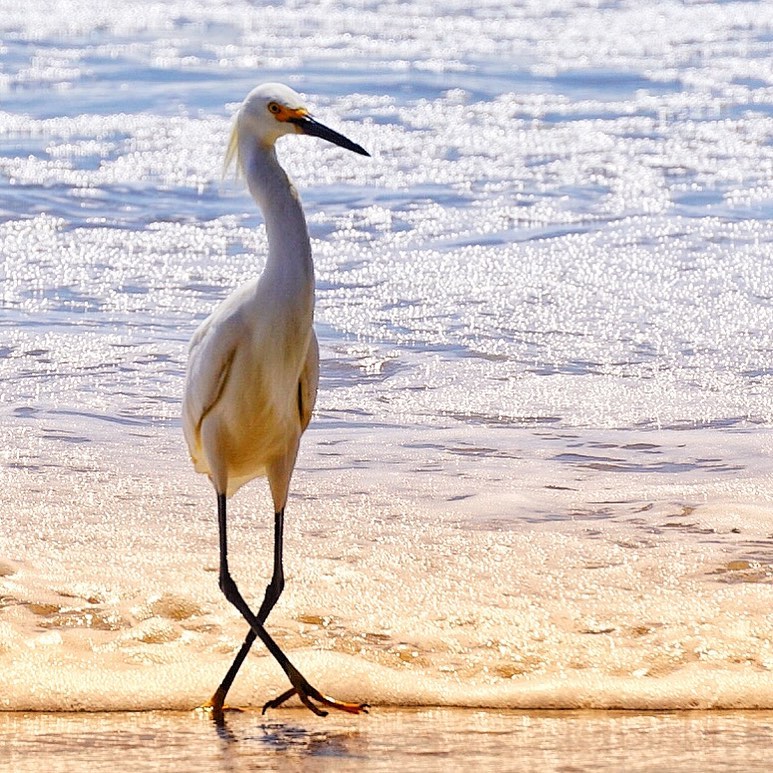
Lone snowy egret by moonstone sea genuflects in pious homage. Opalescent baptism on the wings of no regret.
*******
Thanks to Margaret Simon who shared Kim’s breathtaking photo for “This Photo Wants to Be a Poem” at Reflections on the Teche.
I love symbolism and am awed by certain images that come to mind during composition:
Egrets, snow, opals, and baptism all symbolize purity. So does the sea; it cleanses itself.
Egrets and moonstone are linked to balance. The colors on the water in this photo brought moonstone and opals to mind—they are gems of light-play. Note the posture of that bird.
Egrets also symbolize piety. They prefer solitude.







 lit bits and pieces