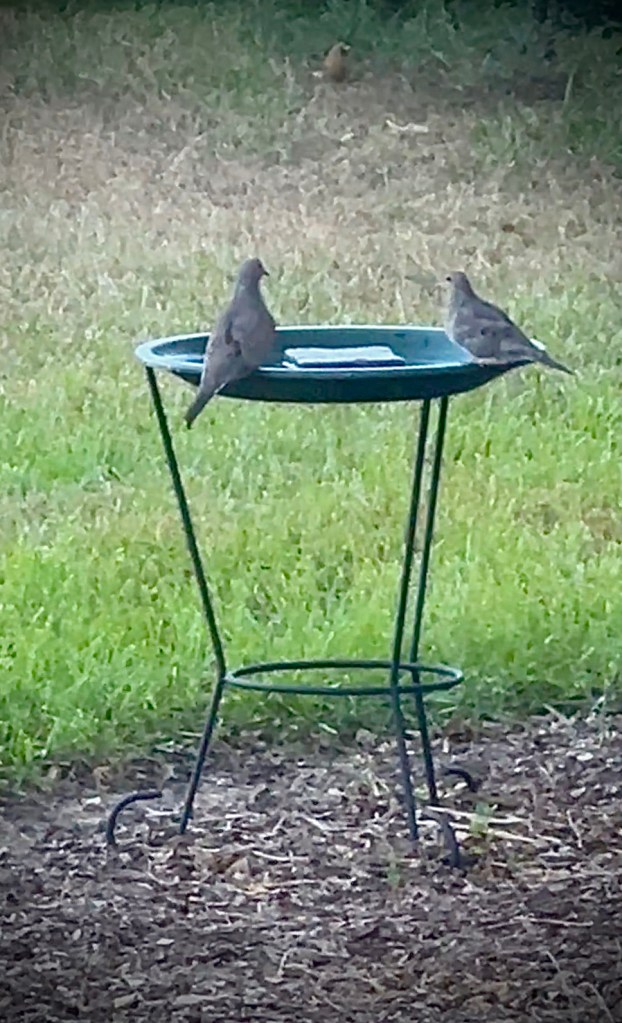
They adore my birdbath. Sometimes three of them cram in together. I think of the ancient Roman Baths, a place to gather and socialize, to share the events of the day while washing the grime away.
One dove tends to linger longer than the others, immersed in the water, fluffed to the size of a chicken.
As if staking claim to her personal pool.
Other birds do not know what to think about it. Occasionally another will land, say, a female cardinal. She sits cautiously, eyeing the dove. After a furtive sip she flits away.
The dove stays put. Doesn’t move a feather. Rather regal.
What I find most compelling is the effect of seeing the doves, of knowing they will come.
They represent peace, of course. Even if I didn’t know this, I think they’d impart it to me. They don’t fuss. They are gentle. Peaceable. Beautiful, in their impeccably smooth, pale-sand plumage. Restful, there in the still waters.
Most often I see two together, surely a mated pair, and the carol plays in my head: On the second day of Christmas my true love gave to me two turtledoves and a partridge in a pear tree.
Infinite symbolism, really. Spiritual, biblical…a sign of covenant. Of blessing.
In these days leading up to another heart surgery for my husband, when life is hitting the pause button yet again, the daily descent of doves in the evening imparts a calm I cannot fully articulate. I watch for them and they come. I refill the water for them and they savor it.
They do not know they’re between hunting seasons. It resumes here in early November.
I can’t bear to think of it, my sweet and precious birds. I didn’t even know until today that one of your collective nouns is a piteousness. To me it’s an unspeakable pity to kill such lovely and harmless creatures. So much in this world is a shattering, scattering pity.
Like the doves, none of us can know what lies ahead of us, all around us, in wait for us.
That thought was behind the closing stanza of a poem I wrote yesterday:
Yet again I cope with life on pause redirecting my energy, because no one can know what tomorrow will bring only certainty that birds still sing, still sing Come evening, a settling of doves upon my birdbath. Oh, my loves, my loves—
Life is passing by
How I need this daily descent of doves. Their stillness, their peace.
My weary spirit rests with them in these moments and is refreshed.
See you at the baths tonight, my dears.
If you look closely you can see the female cardinal in the background, wondering if she might gather at the water, too.
*******
with thanks to Two Writing Teachers for the Tuesday Slice of Life Story Challenge
Don’t know why. Not anxious or worried. No thoughts churning.
After an hour or two of tossing and turning, I give up.
I toss the covers, grab my robe (plush emerald green, floor-length, with a hood; wearing it makes me feel like an ancient Celt).
Don’t need to turn on the hallway lights. There’s already light. Thin and silvery, from the blind-occluded windows. The moon is waxing. Hunter’s Moon and supermoon in the making, the biggest and brightest of the year.
The heat comes on for the first time this season. New HVAC system hardly makes a sound. Just the faintest hum.
Don’t know why I peek through the blinds of the kitchen window, toward the east. Habit? Curiosity? Expectancy? This is where I recently saw the nutria, a thing I never saw before, out in the yard by the birdbath. In daylight, though. What should be here in these predawn hours?
No creatures, but the stars above are spectacular.
Mars and Jupiter are easy to spot. Orion’s belt, three brilliant rhinestones. Sirius, the Dog Star, brightest of all, seems to be calling…
The pull is immense. 2:15 a.m. is too early to be so wide awake and far too early to be outside, but why not go see what I can see?
I turn on the back deck light for moment to be sure no creatures are afoot (say, a nutria, a skunk, a coyote; granted, I’ve not seen the latter in my backyard, but they’re known to be around).
No creatures. I switch off the light and slip out into the chilly stillness, glad of my heavy robe.
The moon peeks through the tops of tall pines. If it were not obscured, I could read a book by its silver-white radiance.
For a minute I play with my Skyview phone app, identifying constellations and stars with which I am not so familiar (Procyon, in Canis Minor; its name means before the dog. I like this. I’ve been trying to convince my husband to get a puppy since Dennis the dachshund moved out with our newlywed son).
Then I just listen. The night is so still about me. Close. Hushed. Breathless. Again that word comes to mind: Expectancy. In the distance, the low hooting of an owl.
Right about then is when I see movement above the trees in the eastern sky. Something gliding from the south.
A pale outline, conical, almost like the nose of a blimp. That’s my first thought: Blimp.
I can only see the nose. The rest is shrouded.
White-veiled, ethereal, sailing northward above the horizon… a giant ghost ship navigating the sky.
—What am I seeing?
I manage to shoot a quick video:
I want to follow it, to see where it goes, but it’s quickly gone.
I need to know.
Back in the house, I start researching comets. Surely that’s what this is? I have never seen anything like it. The video doesn’t capture the enormity of it nor its spiritlike quality.
Turns out that comets are predicted this week. In astronomy, their sighting is referred to as an apparition. Fitting. This apparition doesn’t seem to match the descriptions I’m reading. I learn that there’s supposed to be an Orionid meteor shower caused by the tail of Halley’s Comet in a few days, but the comet itself isn’t supposed to be visible again until 2061.
The universe plays by its own rules. Dances to its own inner tune. I missed the aurora borealis last week, the northern lights flinging their colorful fringes this far south, and I was saddened. One day, I’m determined, I shall see them in all their wild, diaphonous glory.
For the moment, I’ll be trying to solve the mystery of the heavenly body I saw on this cold, still morning when I could not sleep and was drawn to the exact spot at the exact time to witness its appearing.
Awed to my very bones.
*******
with thanks to Two Writing Teachers for the Tuesday Slice of Life Story Challenge (my experience this morning reminds me that writing is also about showing up to see what comes)
I happened to catch sight of it through my kitchen window.
A big brown creature in the yard, over by the birdbath.
First thought: Neighbor’s cat.
But in the milliseconds it takes to process thought, I knew the creature was too big, too low to the ground, too oddly-shaped, too uniformly brown to be the cat.
Oh! A groundhog.
They’re pretty common around here, usually sighted standing up by the roadside like little totems.
The groundhog sniffed the air like a dog…what does it smell?
I grabbed my phone for a photo. Better yet, a video…the granddaughters will want to see this…
The groundhog bunched itself up. Humpbacked, it made an about-face and trotted away alongside the fence toward the woods.
That’s when I saw its tail.
A very long, very ratlike tail.
You are not a groundhog.
Their tails are furry. Wider, flatter.
Clearly not a beaver, although, come to think of it, how does one tell a beaver from a groundhog unless one actually sees the tail?
What ARE you, strange creature?
A muskrat.
I showed the video of the muskrat to my husband.
“It’s HUGE!” he said. “I thought muskrats were a lot smaller.”
“It has that rat tail,” said I.
I showed the video to friends at church.
“It’s not a muskrat,” said one, an avid outdoorsman. “It’s a nutria.”
My husband and I have lived in these parts for over thirty years and have never seen a nutria before (to our knowledge; maybe a former “groundhog” or two may have been this creature instead?).
We had never even heard that nutria live ’round here.
My daughter-in-law, a Louisiana native, knew it right away: “Oh, a nutria rat!”
I looked them up.
Nutria have frothy white whiskers and giant, terrifying orange teeth. They live in marshlands. This one was headed back through the woods toward a field; marshes are nearby, but in all the recent rains, everything out here is marshy. Nutria also detroy wetland ecosystems (I learned on Wikipedia that Louisiana loses wetland acreage the size of a football field every hour). Needless to say, the creature is a rodent. Invasive. A nutria can weigh upwards of twenty pounds. They carry diseases that can be transmitted to humans.
I stopped reading these fun facts and switched to symbolism instead.
In various cultures, nutria stand for good luck. Balance. Humility. Resourcefulness. Strength. Resilience. Prosperity. The interconnectedness of all things.
I’ll be honest: It had a rather friendly face (I couldn’t see the teeth).
Its rather inocuous name means “mouse-beaver.”
In Brazil, however, nutria are called ratão-do-banhado: big swamp rat.
I gotta say the Brazilians hit the tail—er, nail—on the head.
*******
with thanks to Two Writing Teachers for the Tuesday Slice of Life Story Challenge
This week, my friends from across the country have reached out to see if my family and I are okay in the wake of Hurricane Helene.
We are. Here in central North Carolina we did not suffer damage like the western part of the state, where many people are dead and many more are still missing. East of us, a tornado flattened buildings in a city where my youngest son once served as a church worship leader.
Speaking of my son: He was in the North Carolina mountains when the storm struck. He and his bride spent the last day of their honeymoon without power, food, and water, trapped by downed trees on the only path to the main road. After someone eventually arrived with a chainsaw, my new daughter-in-law navigated their journey out by using her phone to pull up road closings.
They were fortunate to even have cell service. Thoughout the region, service failed just when it was needed most. It has yet to be restored in many places, meaning that families and friends still cannot communicate with loved ones.
Travel remains precarious. 300 roads are still closed, many of which are shattered with portions and bridges washed away. Mudslides added to the havoc of catastrophic flooding. The picturesque little village of Chimney Rock has been wiped out; “there’s nothing there,” says one eyewitness, except muddy brown water and debris choking swollen Lake Lure. A clogged sea of splintered wood and trash. A friend of mine was in Boone like my son during the deluge and saw a house carried off by the river; it floated away before her eyes. Asheville, a favorite destination and home to the famous Biltmore, is devastated. My husband and I watched the news unfolding and saw this beautiful city submerged. It looks wartorn. We no longer recognize the familiar streets where we love to walk. Recovery will extend well into next year, meaning that the major tourist season and local income is also destroyed.
We North Carolinians know that bodies are still being recovered (some from trees) and that the extent of the damage is not fully depicted in the news.
Words that keep recurring in the reports are transformed and changed. The mountain communities have been “utterly transformed and cut off from the outside world.” An artist with the River Arts District of Asheville, a hub of warehouses converted to thriving studios, galleries, music venues, and businesses, spoke to its ruination: “This changes everything.”
Loss does change everything. Life is forever categorized into before and after. Overcoming is a long, arduous journey, moment by moment, like breathing. Even though restoration may eventually diminish the pain of loss, soul-scars remain with us as long as we live. We are changed.
For those of you who pray, please do so for the victims of Helene. For those of you with means, please offer any help you can to organizations taking donations for those who have lost all. My school, my church, my community are doing so.
I think of the process of refining gold. I will not apply it to suffering and loss but to the effort of alleviating them. In this act, I believe, we are most transformed… in responding to the alchemy of the Spirit working in us to love our neighbors as ourselves.
It changes everything.
with thanks to all of you reached out to check on my family this week and to my fellow Spiritual Journey writers
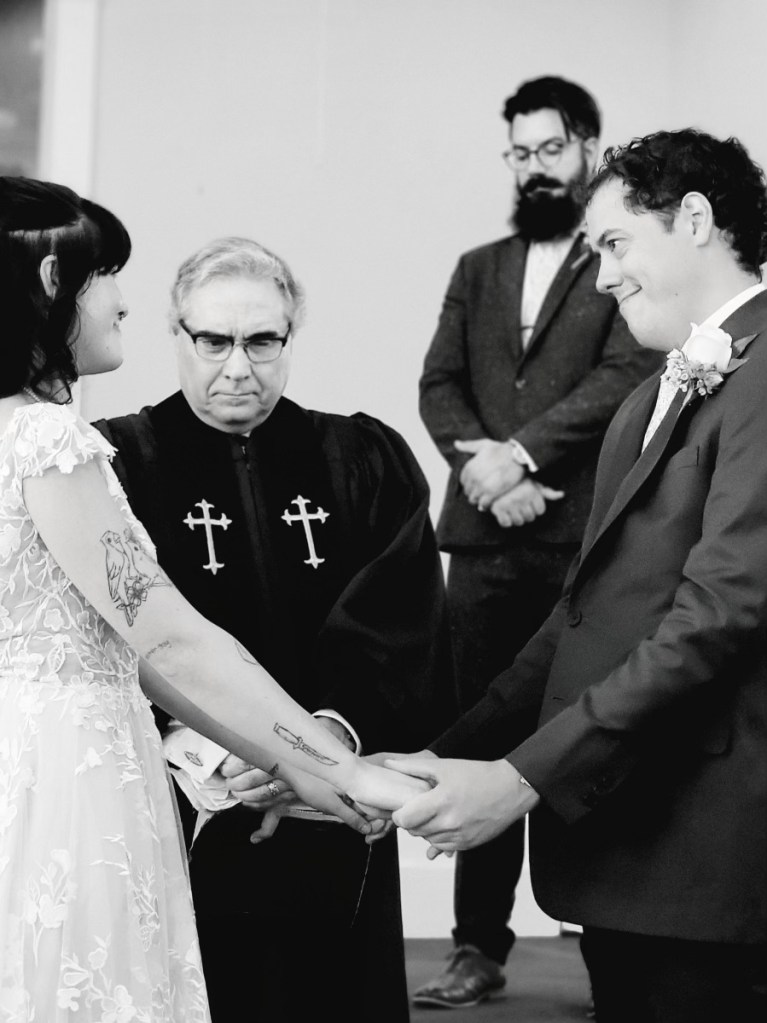
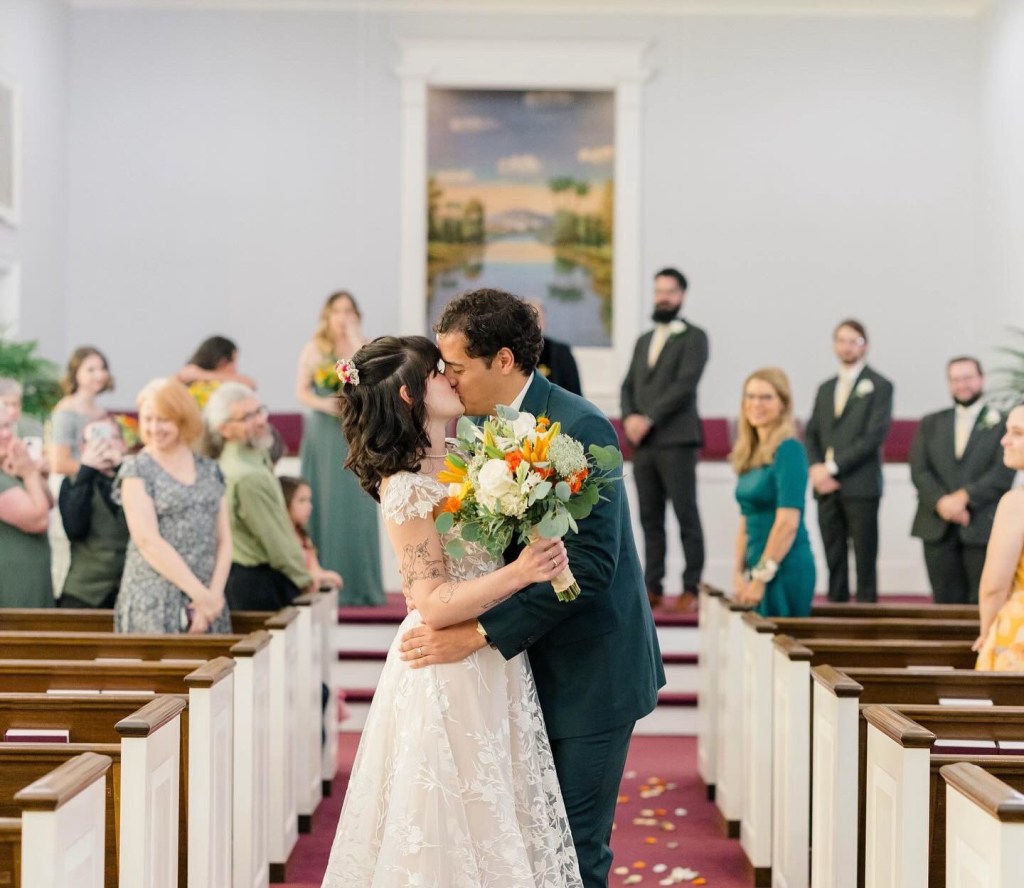
My boy walked me down the aisle and seated me at the second pew, in the same spot where I sit each Sunday while his father preaches. In the same spot where I sat while I was expecting him and felt him stop moving whenever the piano was played, where I knew he was listening to the music before he was ever born. In the same spot where I sat with him in my arms for the first time during worship, when he was four days old.
I rested in the remembering.
I rested in the preparations being complete, and the long-awaited moment at hand.
I rested in the expression on my boy’s face, making his vows to his bride. I have never seen a groom with so tender a countenance. I marveled, and rested.
I rested, and rejoiced, that his father lived to officiate after suffering such serious health setbacks in recent years.
His father began to cry during the ceremony.
I rested in that love. In the overcoming. In the triumph.
I rested in the presence of my husband’s sister, that she traveled to be here, that she reminded my boy of his grandmother who loved him so. Ma-Ma is here, you know, she told my boy just before the wedding. She cried, too, over how much he looks like her mother.
I rested in the knowledge that my sister-in-law remembers her mother every time she sees a cardinal, her mother’s favorite bird. A symbolic bird, representing Christ. I remembered that my sister-in-law and my boy were holding Ma-Ma’s hands when she died. I rested in the serendipity of my boy’s bride choosing her wedding gown before she knew it was named “The Cardinal.” It happens to be her own grandmother’s favorite bird.
I rested in the significance of my boy’s precious bride wearing her grandmother’s pearls and my earrings, the third bride in the family to do so, after my first daughter-in-law and my youngest niece, who came with her new baby to see her cousin married. I recalled buying those earring for my twenty-fifth wedding anniversary.
I rested in that.
I rested in the timing, in late September marking the births of my grandfather and my husband as well as the loss of my father, and that it now marks new joy.
I rested in the day, in the glorious cusp-of-autumn sunshine, in this season of scuppernongs and piercing calls of red-shouldered hawks. I rested in the symbolism of wildflowers that my new daughter-in-law loves so well; although delicate and fragile, they are incredibly adaptable and resilient. They represent delight of the soul. She carried wildflowers; they were the pattern of my boy’s tie. Her dress and their wedding rings also bear vines—a symbol of deep spiritual significance.
I rested in the Scripture my husband read, from the second chapter of the Song of Solomon, the first time he’s ever used it in a wedding:
My beloved spake, and said unto me, Rise up, my love, my fair one, and come away. For, lo, the winter is past, the rain is over and gone. The flowers appear on the earth; the time of the singing of birds is come, and the voice of the turtle is heard in our land; The fig tree putteth forth her green figs, and the vines with the tender grape give a good smell. Arise, my love, my fair one, and come away.
I rest in the fact that my boy and his bride reside just four minutes away from me.
And I rest in the vows that they wrote and spoke to each other, and in the invisible thread that pulled them together, drawn by the hand of God.
Yes.
I rest in the litany of it all.
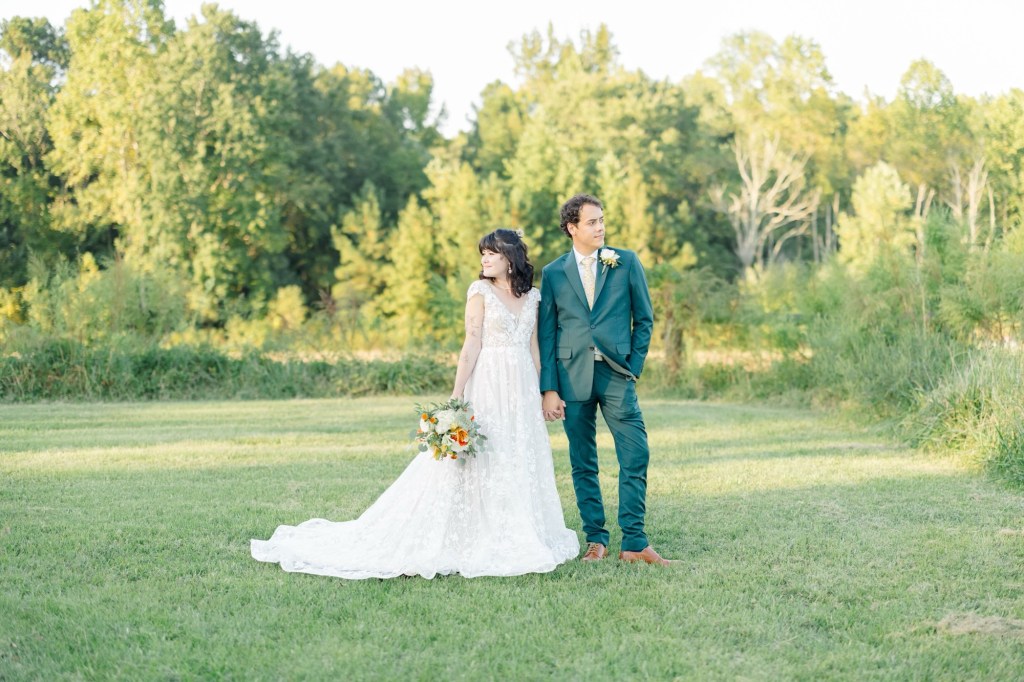
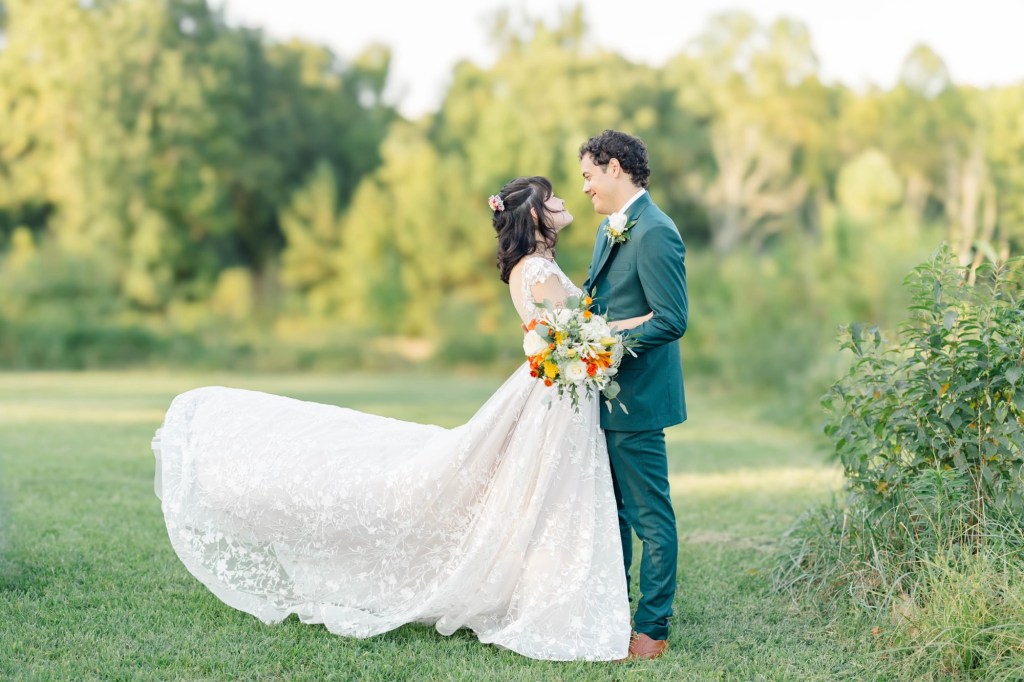
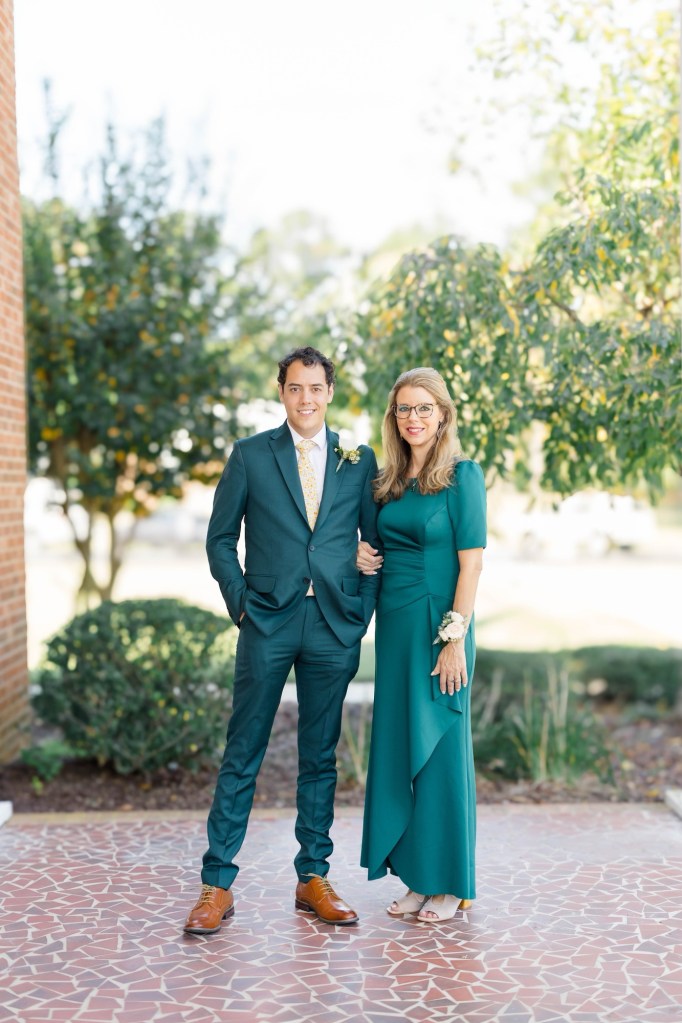
My boy and me in front of the church after the ceremony. Behind us is the parsonage where we lived when he was born.
Photos by Kailey B. Photograhy
*******
with thanks to Two Writing Teachers for the wonderful sharing-place known as the Tuesday Slice of Life Story Challenge

 lit bits and pieces