Serene senryu

For peace at day’s end
speak little; hold your truths close.
Let sleeping dogs lie.

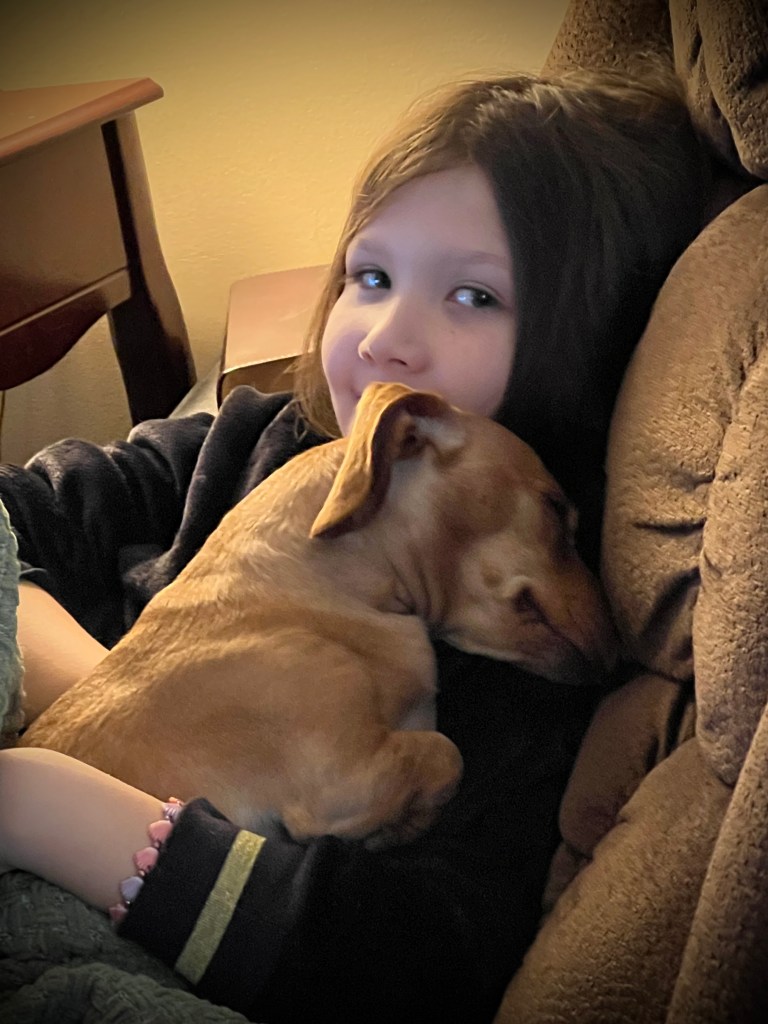
My granddaughter, Scout, with Dennis the dachshund during a sleepover.

Senryu is Japanese poetry of three lines and 17 morae (syllables), usually arranged 5-7-5, similar to haiku. Traditional haiku is focused on nature, whereas senryu reveals something about the nature of humans in a lively, funny (often “punny”), dark, or ironic way.

Seemed a symbolic way to capture this serene Slice of Life scene.

*******

Composed for Day 8 of the Slice of Life Story Writing Challenge with Two Writing Teachers

To build or not to build

Those of you who’ve followed my blog for a while will know that I chronicle the return of house finches to my front door wreath every March. These little songbirds typically build a nest before I know it; they’re incredibly surreptitious. This has been happening for several years. A little pair actually slept in the wreath at night all winter before last, as if staking their homestead claim.

Last April, a tragedy struck and the finches have been scarce ever since. One day, five tiny, beautiful fledglings were thriving in the nest; a week later, all five died without warning. I found them with their yellow beaks opened wide to the sky, quivering; took me a minute to realize they were dead and full of maggots. This was the second seasonal brood for these parents. They’d built the nest and laid the first set of eggs before the end of February (“seems awfully early,” I wrote in my notes). Two of those fledglings died. The very day I removed the nest with the two dead fledglings in it, the parents rebuilt. They worked feverishly, laid five new blue eggs, hatched them, and lost every baby within a couple of weeks.

Seven dead babies in a season…too much for me, maybe for the parents. They vanished. There was no rescuing the wreath; it had to go, nest, dead babies, and all.

For the remainder of the summer my front porch was silent. No melodious trills of finch song. My granddaughters and I watched the bluebirds out back raise two broods (bluebirds are amazingly tenacious, territorial, and extremely loyal to their breeding grounds; they watch us as much as we watch them, almost as if to say Hello, what are you people doing in our yard?).

But the finches are shy. Nervous, even. They nest near people as a defense against predators, but they don’t want to be near people.

Ever since I took down my Christmas wreath and hung an old grapevine wreath with silk magnolias, I’ve been watching and wondering: Will the finches return this year? If they do, will the eggs hatch and will the babies be okay? If not…I don’t think I can handle the grief. I always protect the porch and door for them and yet this thing happened. As much as I love these birds, as precious as they are, I’d rather they nested elsewhere than endure it again.

I realize this is my own defense mechanism. An attempt to protect my heart.

Then, at the very end of January, I thought I heard a familiar Cheep! at my door.

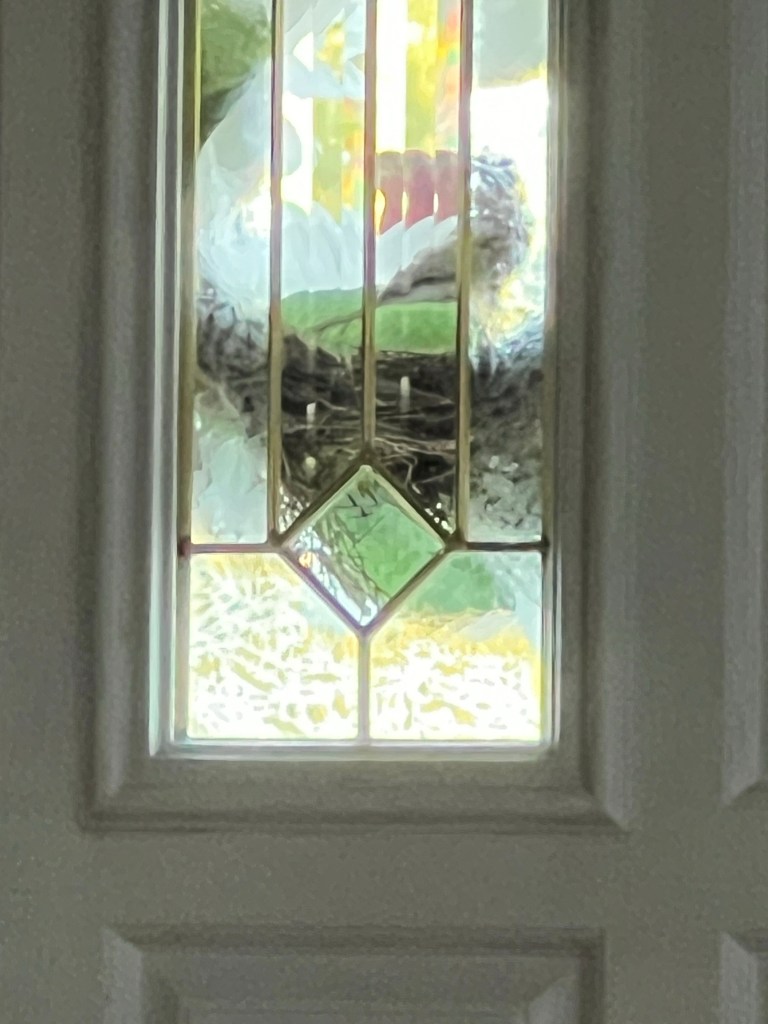
Through the beveled window, I saw a shadow moving in the wreath…

Could it be?

It was.

A male house finch.

He was there and gone.

I know he was scouting the nest site.

I’ve seen him a time or two since. He comes punctually between 4:44 and 4:54 in the evening.

Three weeks later, on February 20th, he brought his mate:

The female is in silhouette; the male’s head is facing the camera—his chest is extraordinarily red (looks like there’s three of him, but that’s just the beveled glass).

I suspect they’re having ongoing discussion about nesting in this wreath:

What do you think, honey? Prime location…

Hmmm. I don’t know. I definitely don’t like this glass. Too cool to the touch with way too much movement on the other side. I must have absolute privacy for incubating my eggs.

Right, right, right. Well, you know we don’t usually build here in the curve anyway. We build on top! Lots of privacy up there!

Weellll… it just feels a little too narrow. A little more space, a little more cover, that’d be nice...

This past Tuesday, March 5th, I saw a little bird tail busily moving at the upper right side of the wreath… same spot where last year’s ill-fated nest was built.

Yet no nesting material has been laid.

And so I wonder. Will they actually build here? They clearly want to. If so…when will it start in earnest? Will they decide this wreath just won’t do, after all? Is it not quite time yet? There’s nothing random about birds, their actions, or their inner clocks; their precision is astonishing.

Dare I, dare I even hope, that they are still in the planning phase? Maybe with a week or so to go, and that there will be eggs, possibly hatching at Easter?

Time will tell. I daren’t make predictions…I’ll just keep watching and waiting…

I should just take the wreath down and let them go. It would be easier.

Oh, but love isn’t easy, is it, little finches.

*******
Composed for Day 7 of the Slice of Life Story Challenge with Two Writing Teachers

Universe of possibility

Children
we realize
behind those eyes
lies a universe of
possibility

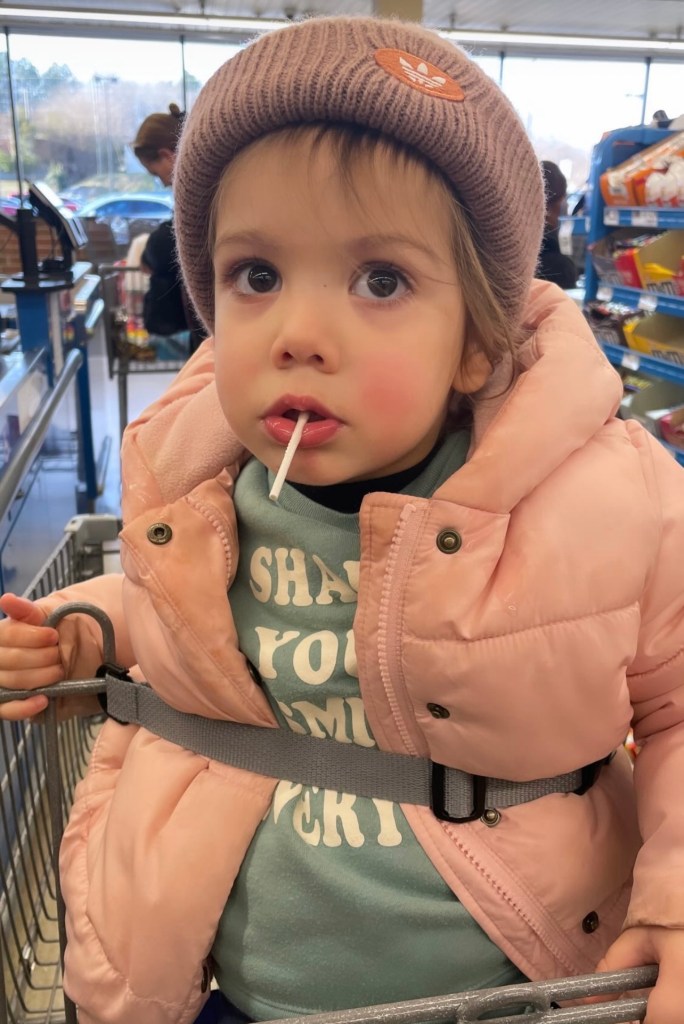
My granddaughter, Micah, age 2.

As educators, writers, human beings…let us not fail to see the value and potential of every child.

Let us not fail to help them see.

With thanks to two fellow Slicers in the daily March challenge:

Margaret Simon, for continous inspiration with the elfchen or “elevenie” poem form; and Thomas Ferrebee, for the phrase “universe of possiblities” in his post yesterday, describing a Chilean rhubarb plant.

With special thanks to my precious Micah-roni for exponentially expanding my universe, and who spent all day Tuesday with me, which explains the brevity of this post.

*******

Composed for Day 6 of the Slice of Life Story Challenge with Two Writing Teachers

Verily

On Day Two of the Slice of Life Story Challenge, I had a lot of fun playing with backwards names (You, reversed).

Today I am thinking about family names and the legends or lore surrounding them.

My mother had a unique name. My Grannie named her after her sister, Verlee. When I was little, Mama explained her name to me: It’s from the Bible. From the word “verily.”

Verily is an archaic English translation of several different Hebrew and Greek words throughout the scriptures. It means truly or certainly.

Grannie had six children by the time she was twenty-two, during the Great Depression. My mother was the last. They had a hard, hard life. I only know bits and pieces of their story; most of those who lived it are gone now. They experienced a lot of loss. A baby boy, Thomas, coming a year before my mother, died when he was a few days old. Grannie spoke of him to me when I was a child: I felt so empty, coming home without him. She never forgot him.

Mama said that when she was born Grannie brought her home from the hospital in a basket.

These images have lived in my head for years and years.

Quite some time ago, I started crafting a story about a family…not my mother’s, but with a few borrowings. I have a long version (incomplete) and a short story version. Every once in a while I go back and tinker with the tale , to see what the characters are up to…

Since the word came to mind today, I’ll share a little excerpt.

From my short story entitled “Verily, Verily”

One afternoon, when we was playing school on Grandma’s porch, a long black car that looked like it ought to belong to the mill owners pulled up.

Out stepped Mama.

At first I hardly knowed her. She didn’t look much like herself. Pure skinny for one thing, her legs just little bitty bird’s legs beneath the dress that the ladies’ sewing circle made and carried to the hospital for her. Her face, all sharp edges. Her eyes had changed the most. Huge, wild, like some hunted creature was looking out of Mama’s eyes.

When she seen us up on the porch, she tried to smile, but them too-big eyes filled with tears. “Well, girls – ain’t you even going to come hug your Mama’s neck and see what I brung you?”

Me and Artie May flew down the steps to throw our arms around her. Mama felt like paper and twigs, like a good breeze would carry her rattling away. She couldn’t hug us back very much because of the basket over her arm. Whatever she had in there was covered up with blankets.

“What is it, Mama? What’d you bring us?” shouted Artie, jumping up and down, trying to see inside the basket.

“Goodness, Artie May,” said Mama, “you don’t mean you’re just happy to see me on account of the surprise, are you?”

I felt happy to see Mama but I wanted to know what was in that basket, too. Just then, I seen something move under the blanket.

“Mama, you got a puppy in there!” I hollered.

Mama smiled then but her eyes didn’t smile with her. “No, Ollie Fay, it ain’t a puppy. It’s better than that. Come see.”

She kneeled in the yard. Artie May and me crowded close. Mama didn’t even smell like herself no more; she smelled like the inside of medicine bottles and new cotton cloth. I wondered what on earth could be better than a puppy, except maybe two puppies, as Mama pulled back the blankets.

Artie went Ohhhhhh and I ain’t never been more shocked in my life, to see a baby asleep in that basket. It had a round pink head with a little bit of dark fuzz for hair.

Mama said, “Girls, this here’s your little sister.”

Me and Artie just stared and stared before Artie finally asked, “What’s her name, Mama?”

“Well, I wanted to name her something from the Bible. I thought on it a long time and decided to call her Verilee.

Now, I knowed something of Mary, Martha, Ruth, and Hannah, but I ain’t never heared of no Verilee in the Bible before. Artie must of been thinking the same thing, because she asked, “Who was Verilee in the Bible, Mama? What did she do?”

I guessed, on account of the basket: “She was Baby Moses’s sister.

Mama shook her head. “No, Ollie Fay. That was Miriam. There won’t nobody named Verilee in the Bible. I took it from something Jesus said: ‘Verily, verily, I say unto you, he that believeth on me hath everlasting life.’”

Then Mama’s mouth started wobbling.

Grandma spoke from the porch: “Rose.” We got so caught up with the baby none of us even knowed she’d come out. She stood there with her arms crossed over her bosom. “That’s it, Rose. He’s gone and you know there ain’t no suffering where he is. Call the child whatever you want, she’s a sign that life goes on. We can only pray it ain’t always going to be so everlasting hard. Get in the house, girls, your supper’s on the table.”

Hmmmmm.

Maybe it’s time to tinker some more? Hammer out the many kinks and let these characters get on with their lives?

Verily, I say to y’all… that might be a whole lot of story.

My Grannie holding my mother, 1941.

*******
Composed for Day 5 of the Slice of Life Story Challenge with Two Writing Teachers

A thought: Dialect is often discouraged in writing because it’s hard do to well and can be challenging for readers. But sometimes that’s how the story wants to tell itself.

Wedding music

Do you remember
riding around in my car
singing gospel songs

the old ones you loved
since you were a little kid?
Folks always told me

you have an old soul.
I said you were seventy
the day you were born.

Yet you’re still so young.
I wouldn’t trade anything
for hearing your voice

singing harmony
on those beautiful faith-songs
my own Granddaddy

would have known and loved.
Here’s another thing I want
you to remember:

I am forever
proud of your talent, your heart
for other people

your service to God
and the comfort you’re giving
to those suffering

their greatest losses.
You are a gift to us all.
And now, a blessing

comes to you straight from
Heaven, another of my
prayers answered.

I worried that you
wouldn’t meet anyone while
working funerals.

Me of little faith.
Never expected a girl
driving the hearse to

the crematory
would find you there and begin
a new life story.

As the families make
preparations for your day
I can’t help hearing

your voice echoing
from long ago when we rode
in my car, singing

that old-time song called
“Wedding Music” and you said
“Mom, this harmony

is so beautiful.”
It’s what I pray for you now
my beloved son

and your bride-to-be:
beautiful harmony for
your life together.

My son and his bride-to-be. Photo: Kailey B. Photography

The referenced song my musican son loves:

*******
Composed for Day 4 of the Slice of Life Story Challenge with Two Writing Teachers.

Tip: Try writing a story-poem in haiku syllables.

XIII and XIX

One recent early morning, I sat down at the kitchen table to write some poetry just as my husband turned on the TV. I caught the word cicadas.

I abandoned my laptop to come watch the segment:

“2024 is going to be a banner year,” announced the newscaster, “a rare co-emergence of two periodical cicadas: a seventeen-year brood and a thirteen-year brood…

A chart appeared on the screen:

Brood XIIIBrood XIX
Emerges every seventeen yearsEmerges every thirteen years

“They make the most beautiful sound I’ve ever heard,” said a second newscaster.

“Said no one ever,” joked the first.

The whole news crew burst into laughter.

“But it IS a beautiful sound!” I said to their guffawing faces.

I know the sound is a harsh rattle. Loud. Discordant. Metallic. Strange.

I don’t expect everyone to like it.

I’ve loved it since I was a child.

I wasn’t aware I loved it when I spent brutally hot summers deep in the country with my grandparents, where an old dirt road and a ditch were all that kept their yard from being swallowed up by a towering deciduous forest. From those dense, mysterious depths emanated a deafening buzz, hundreds upon hundreds of cicada-songs swelling and subsiding in synchronized rhythms, the background music of my happiest childhood days.

Time passed. As my grandparents grew older and my visits rarer, I’d realize the meaning of the rhapsody. Cicadas play love songs with all their might. They know their time is short.

At nineteen I was hospitalized with a high fever. My father and mother both accompanied me, clearly concerned about my condition. They sat by my bedside while I lay shivering under layers of blankets, too tired to talk, to move, to care about anything. Afternoon melted into night. It was winter. The heater in the room kicked on with a buzz so like the cicada chorus of my childhood summers that my shivering eased almost instantly.

They’re calling me, I thought. The cicadas. They’re taking me to Granddaddy’s and Grandma’s, and I’ll be safe there.

This flooded with incomparable comfort and indescribable joy.

Then… if I’m dying, it’s okay, as long as there are cicadas.

And I fell asleep.

When I woke in the morning, my fever had broken.

I didn’t know, at nineteen, that cicadas are a symbol of resurrection and immortality. I didn’t know the many legends and lore surrounding the insects, such as the myth of Aurora, goddess of the dawn, doomed to fall in love with a mortal who inevitably grew old. She obtained immortality for him without thinking to secure eternal youth. Soon there was hardly anything left of him but his voice, continually singing his lamentation and love, so she finally turned him into a cicada.

Note: Aurora is the name of my grandparents’ hometown, where I spent those childhood summers steeped in cicada song.

Back to the present…

After that news segment, I had to do a little research.

Scientists say that these perodical broods, XIII and XIX, haven’t coincided since 1803 and won’t do so again until the year 2245.

They’re calling this a “cicadapocalypse” of maybe a trillion bugs…but not all in the same place (in case you’re thinking biblical plague). One’s called the Northern Illinois Brood (XIII) and the other, the Great Southern Brood (XIX). If my calculations are right, this brood appeared the summer that followed my sickness at nineteen (same as the brood numeral). I got married that August, when they would have been in full throttle. The time before that, I’d have been seven and hearing them at my grandparents’.

On the day the segment aired with newscasters poking fun at the sound, I happened to be taking part in an Open Write at Ethical ELA. Host Leilya Pitre introduced the Naani poem form, which orginated in India: four lines consisting of 20-25 syllables total. The poem isn’t restricted by theme, subject, or metric pattern. Leilya challenged participants to scroll through social media or the news to find four phrases to make a Naani.

My lines had just been delivered to me, before I even read the prompt.

Once again, the Magicicada were at work in the background rhythms of my life.

From This Morning’s Newcast

Brace yourself:
the cicadas are coming…
the most beautiful sound
I’ve ever heard.

—I don’t know about you, but I can hardly wait for cicadapocalypse.

Cicada vunerable after metamorphose. Joi. CC BY 2.0

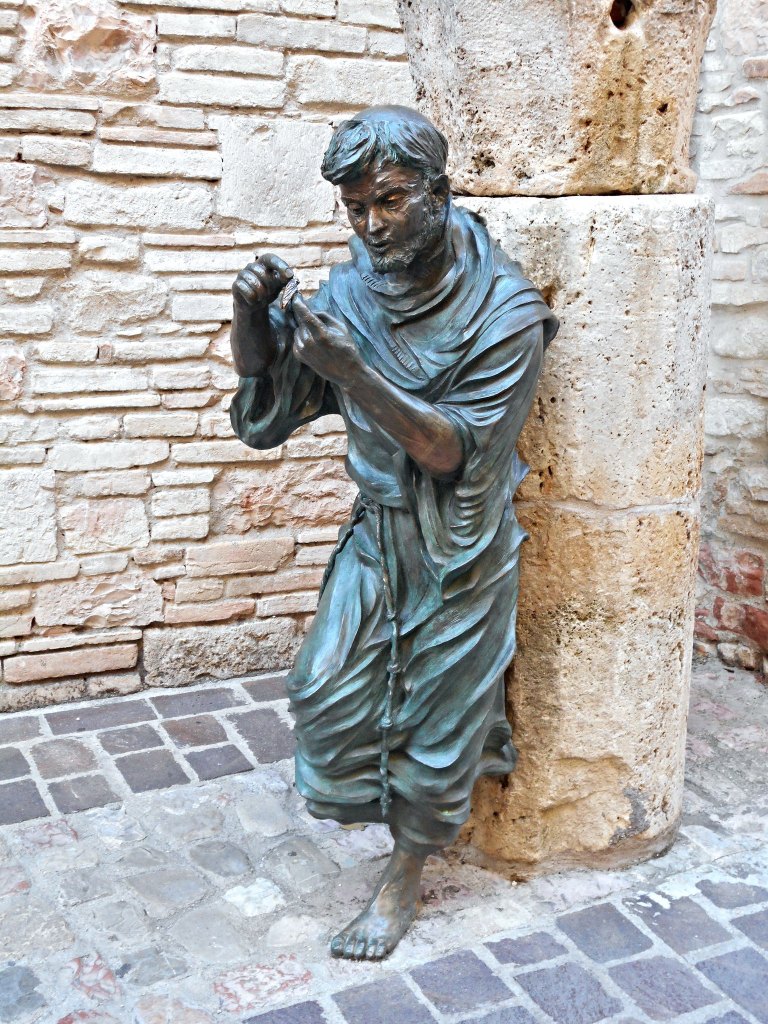
‘Saint Francis with cicada’ – modern bronze statue by Fiorenzo Bacci – Friary of Santa Maria degli Angeli at Assisi. Carlo Raso.

Legend has it that Saint Francis heard a cicada chirping in in a fig tree and called it to him, saying “Sing, my sister cicada, and praise the Lord thy Creator,” and it obeyed, sitting on his hand.

*******

Composed for Day 3 of the annual Slice of Life Story Challenge with Two Writing Teachers.
Q: What’s YOUR favorite insect? Why?

You, reversed

Yesterday morning during a read-aloud that mentioned “Backwards Day,” I watched students getting into the concept. One boy twisted his sweatshirt around so that he could pull the hood over his face. He took off his sneakers and tried, unsuccessfully, to put them on his feet backwards (note: these are second graders). Others said “What a terrible story!” meaning, of course, “What a great story!” And the guest reader, Gabby, said her name was “E-Bag,” to howls of kid-laughter.

It took me back to my own childhood, when a friend and I decided to call each other by our backwards-names: I was Narf. She was Irret.

Hysterically funny! So utterly original!

Until I mentioned it to my father, who burst my bubble: “I did that when I was a kid, too.”

“Oh,” I mumbled. So much for inventing one’s own new fun thing.

“Yeah,” Daddy went on, matter-of-factly, “I was Nodrog.”

NODROG?!

I collapsed in the floor, convulsing with laughter.

It sounded almost like a sci-fi/fantasy name. What would a character named Nodrog be like? Would he be an inept superhero who was basically good-hearted but forever blundering (à la Inspector Clouseau)? Or a giant, rugged, comic book character, a cinderblock kind of robot whose foosteps shook the Earth?

In either case, nothing like Daddy, with his silvery crewcut, work uniform, and photo gray eyeglasses. Who knew he’d actually been a real kid?

After the second-graders and “E-Bag” stirred the old memories, I found myself wondering:

What would a character named Narf be like?

Associations like Nerf and Nerd crowd my mind… but perhaps these are useful.

Maybe Narf would be athletic. Very fast and agile (I was a fast runner as a kid, whenever asthma didn’t do me in, but never really athletic, emphasis on never). I should like to think a facet of myself could be so skilled at sports, in something greater than Tetherball (if you know what this is, you are, like me, from a bygone era).

Or maybe Narf is from another world (my favorite kind of story!). This spawns all sorts of questions: How would Narf get to our world? And why? What would Narf’s world be like? Should we go there instead? Is it in danger of being destroyed? Is Narf on some kind of mission? Can Narf operate advanced technological devices and spacecraft, or even build them? … the possibilities here are endless…

Somehow I cannot think of Narf as an elegant being, except for maybe graceful while playing sports, but more likely a scrappy player. I can, however, envision Narf as something else entirely, a comical character wearing a big fascinator with giant, garish fruits fashioned from sponge (toldja those first associations might be useful).

And then I wonder…would Narf be my alter ego? My evil twin? (I accused my own children of having one).

—OH OH OH OH—

As the wan light began to fade, they stood side by side on a dune looking out over the desolation. Nothing but rippled sand to the smoky white horizon. No other living thing in sight. This was once the shoreline of the Great Sea, long since dried up.

Nodrog broke the deafening silence: This is where we must go our separate ways.

Narf nodded. After a moment, she spoke: Will we ever meet again?

She knew the answer.

Not in this world, Child. It is the last day. The end of Drawkcab.
You must remember what you have been taught.

His spear fell into the sand. He was already fading like the light, becoming the mist, same as all the others. Her hands shot out, grasping at nothing. She could not hold him.

Nodrog was no more.

She bent, picked up his spear, and leaned on it, weeping.

We will meet again, she said aloud, sure that he could still hear — is it not the last sense to go?

We will meet again, she repeated, louder, if not in Drawkcab, then Drawrof. Yes. Drawrof.

And she set out over the dry Great Sea-bed, shells crunching under her feet.

—What shall I do with them now, Nodrog and Narf? Should these newly-materialized characters live out their whole story, somehow?

Ot maybe I’ll save the names for a different manifestation, in case Nodrog and Narf should come to me in the form of, say, two pet dachshunds.

Somewhere, Daddy is shaking his head about all this.

In amusement.

I’m sure of it.

Life can only be understood backwards; but it must be lived forwards.” sylvar. CC BY 2.0.

*******

Composed for Day 2 of the annual Slice of Life Story Challenge with Two Writing Teachers.

Q: Where might your name in reverse take you?

Zen

Zen is the Japanese pronunciation of a Chinese word, ch’an, which comes from a Sanskrit root meaning “thought,” “absorption,” or “meditation.” And meditation is at the heart of Zen, along with an emphasis on self-control and insight.
—Vocabulary.com

adjective
INFORMAL
1. peaceful and calm.
—Dictionary.com

I feel so calm
in this space

the teachers say
whenever they stop by
my room
during the day

a shared space
where three of us
keep lamps burning
on our desks
in all our comings
and goings

a safe place
to rest and gather
one’s thoughts
in the cool shadows
or to decompress
from all the stress

to eat some chocolate
perhaps
or to have a voice
that’s valued
or just to know someone
is listening
without judgment

we can often answer
each other’s questions

but not always
no, not always

the important thing
is that they feel comfortable
asking

and that they feel welcome
to just be

for a while
in our circle
of lamplight

they are
the heart
of this hallowed place

—my room
during the day
whenever the teachers
stop by and say
I feel so calm
in this space.

*******

As one of three instructional coaches working from the same room, I know the needs in schools are great. If student needs are to be met, teacher needs must be met first.

Beginning with what I told a panel of professional educators in a recent interview: We need each other.

In that same vein: Today I rejoin the online community of Two Writing Teachers for the Slice of Life Story Challenge…

a safe place
to rest and gather
one’s thoughts


or to decompress
from all the stress

to have a voice
that’s valued
or just to know someone
is listening
without judgment


we can often answer
each other’s questions


but not always
no, not always


the important thing
is to feel comfortable


and welcome
just to be


for a while
in this hallowed place…

A place of peace, carved out just to be, and be here, for one another.

As teacher, writers, human beings.

I know I need it.

Darkness into light. jasleen_kaurCC BY-SA 2.0.

For exponential growth: Write

I started this blog, Lit Bits and Pieces: Snippets of Learning and Life at the end of March 2016. At the time I was supporting elementary teachers with the implementation of writer’s workshop. In my own ongoing search for resources to share, I discovered the Two Writing Teachers site, a veritable treasure trove of ideas, recommendations, experiences, and, most of all, encouragement for teachers to first be writers themselves. This resonated deeply with me for several reasons, beginning with the logic of the thing: How can one teach writers without BEING a writer? Truth is, this been happening forever, so let me rephrase: How can one be an EFFECTIVE teacher of writers, without being a writer? Without walking the walk in real-writer shoes, wrestling with ideas, hammering out clunky sentences until these ideas shine, spawning new ideas even in the act (the wondrous alchemy of the true process)?

The answer’s pretty obvious.

Furthermore, most fellow teachers I encountered felt that they weren’t “good” at teaching writing (language matters; we would soon shift this concept to teaching writers) and that they weren’t “good” writers themselves. Dare I say this had more to do with the way we were/were not taught when we were in school, or how we were shaped by our educational experiences with writing, i.e., as an inescapable (odious?) chore, or the simple fact that no one ever modeled the real (vibrant and powerful) process for us?

Ok, I’ll say it: All of the above.

I will also say that teacher feedback can change the world, one child’s heart at a time.

I was nine, just starting the fifth grade. My class had created “All About Me” booklets. In that era, teachers still wrote in red ink on student work (!!!!) but in this instance, it wasn’t bloody slashes, deconstruction, destruction. I’d written about my struggle with asthma, how it kept me from fully participating in physical activities like running. I described the medication my parents gave me in those pre-inhaler days: liquid Benadryl, “clearish red, and it burns like fire when I swallow it.” Alongside this paragraph, my teacher wrote: “What wonderful detail! You’re a strong writer. Keep writing!”

It was the first time my writing had ever been praised…the first time I recall any praise given to me in my early school years (there are certainly stories to tell about the times I was shamed by teachers; perhaps I’ll dust off those memories and let them live again, or maybe I’ll just let those old bones lie where they are). My point here is that in the very moment I read my teacher’s response, my writer-soul quickened. Writing would be a Presence in my life ever after. Writing would always seem to pursue me, draw me, push me, pull me. It would grow me. It would deepen me, sharpen my senses…I would learn things about myself I did not know. I would realize my affinity with nature. Writing would lead me over and over to awe.

It would lead me, in a roundabout way, to becoming an educator after my children were born and in school. It would lead me to supporting other educators in unique ways. It would lead me to create a blog to “practice what I preach” and enable me to join online writing communities like Two Writing Teachers, where educators write a Slice of Life Story every Tuesday and commit to a monthlong writing challenge every day in March. For, again: How can one be an effective teacher of writing without first being a writer?

There’s so much more to say about sharing our writing in community without judgment, about our stories connecting us in ways greater than blood and sinew, about empathy knitting our heartstrings together not merely to survive but to live. To overcome. To celebrate, to rejoice. To grieve, to rage. There is more to say about students coming to realize the power of their own ideas and their own voices through writing, alongside teachers who are doing the same. There is more to say about the brokenness of systems—educational, governmental, societal, fill in the blank.

Here’s where I’ll stop this post, but not my writing…I may rest for a season or two, but I shall never stop writing, because it is, like prayer, the impetus of growth and change for the better.

Starting from within.

*******

with thanks and love to all at Two Writing Teachers, with the advent of the March Slice of Life Story Challenge this Friday. Join and prepare to share...find your writing, your teaching, your heart, your life, transformed.

February elfchen poem

Today on Ethical ELA’s Open Write, my friend Margaret Simon invites fellow teacher-poets to compose elfchen, also known as “elevenies,” poems of eleven words. Margaret says that the basic elfchen rules can be found on Wikipedia; she shares these guidelines:

Line 1: One word
Line 2: Two words about what the word does.
Line 3: Location or place-based description in 3 words.
Line 4: Metaphor or deeper meaning in 4 words.
Line 5: A new word that somehow summarizes or transforms from the original word.

This is a first for me, never having attempted an elevenie before. Although I love forms with word and syllable counts, the seemingly-simple, enchanting elfchen proved deceptively difficult!

February Elfchen Chain

February
gray desolation
brightened by bluebirds
and sudden pink blossoms
overcoming

winter
gusting winds
squeak naked branches
against each other, awakening
desire

greenness
seeps imperceptibly
to the edges
Nature revels in pre-season
preparation

One of my bluebirds, February 10, 2024.