Suddenly sunflowers

Where I live
rolling fields
of soybeans, tobacco,
and occasionally cotton
are the familiar.
I imagine
it all looks like
a patchwork quilt
of various textures
and patterns,
from the sky.
Driving by
the pastures
where the pair of old mules
lived and died,
on my way back to school
at summer’s end,
I see something
unexpected.
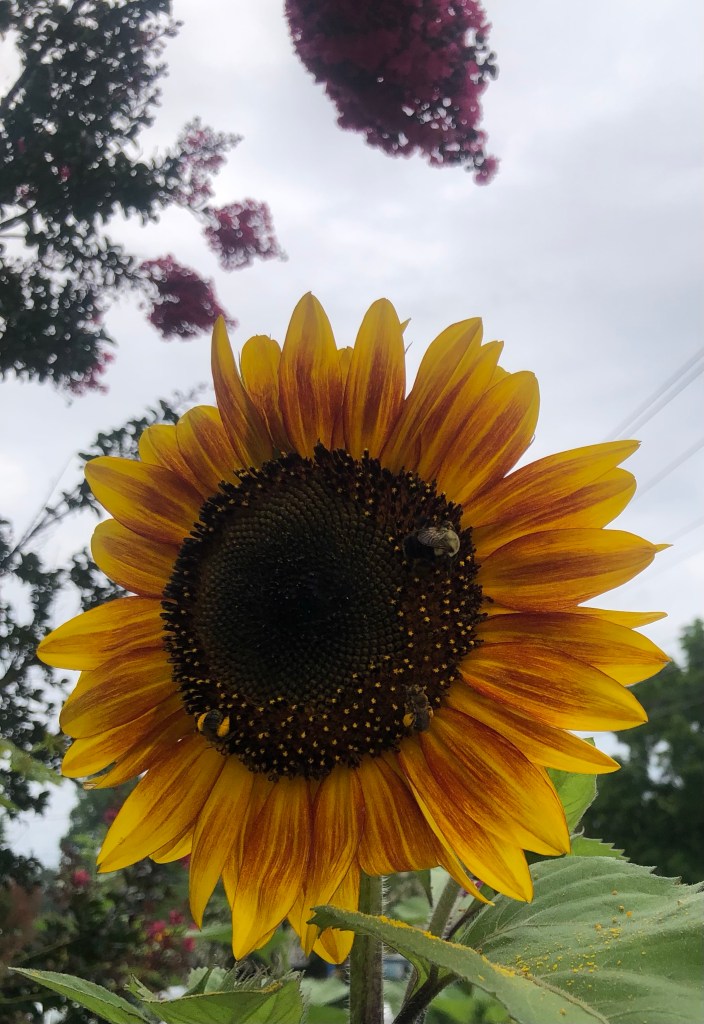
Sunflowers.
Tall and tangled,
bordering a garden.
Light-seeking sentinels
with open faces
and inner resources
as myriad
as seeds.
At sight of these
yellow-petaled suns
my heart leaps
a little.
Is this what they’re mostly for,
sunflowers?
Beyond seed, oil, fiber,
beyond cleansing the soil
and waters
of nuclear radiation,
burning with their own
silent, mysterious fire
just to inspire?
I realize as I drive
backroads I’ve not driven
in a while
that they are everywhere.
All around me.
Whole fields of them
where I’ve never seen them
before.
They buoy my spirit.
Whatever task
lies before me,
I am up to it.
I stop at a store
to buy sunflower seeds
for my workday lunch salads,
as if channeling
the power of the sun
while remembering
what Van Gogh said,
as he painted:
The sunflower is mine,
in a way.

*******

My first encounter with sunflowers was in childhood summers spent deep in the countryside. My grandmother’s brother, who suffered trauma at birth and who lived alone in the old homeplace with his siblings looking after him, planted sunflowers in his garden. I marveled at their towering height and how their faces always followed the sun. Fields of sunflowers have indeed been planted to remove toxins from the soil after nuclear radiation. They are cleansing, healing, and surprisingly buoyant: their stems were used as filler for the first life jackets.

There could hardly be a more encouraging motif as the new school year gets underway.

Thanks to Two Writing Teachers for the space and invitation to share these noticings in the weekly Slice of Life Story Challenge.

Last hurrah

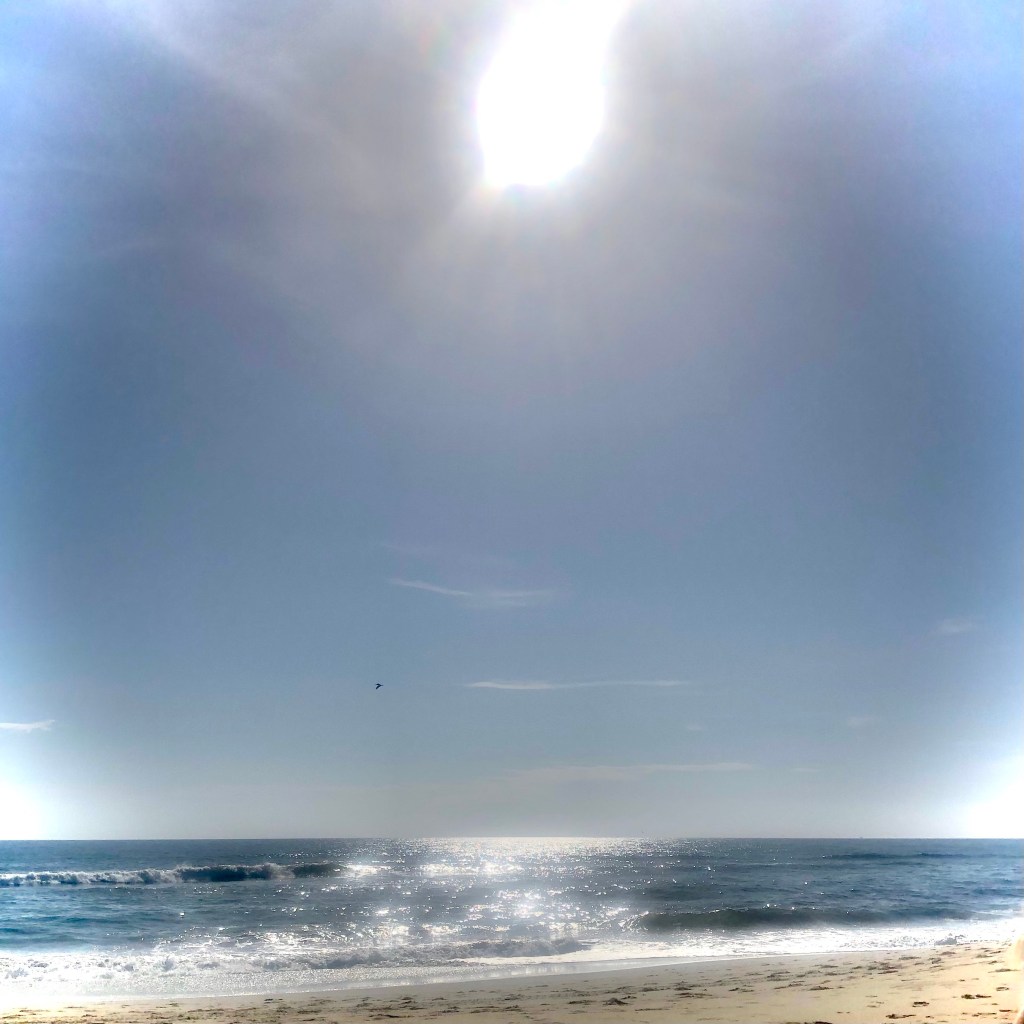
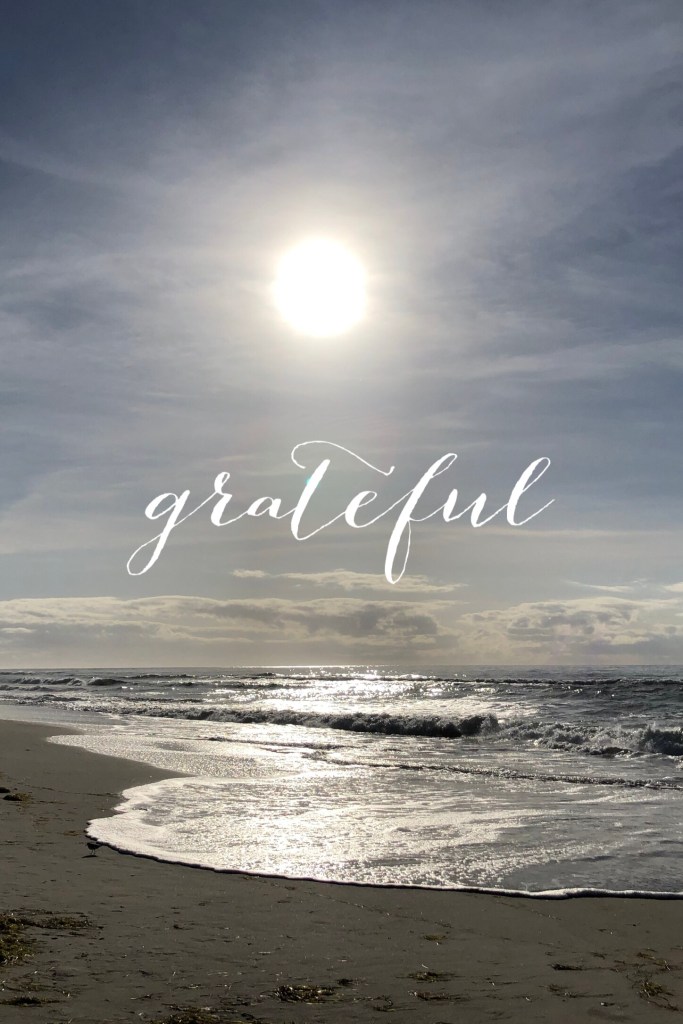
Twenty-four hours ago I woke with the sun by the sea, rested and at peace with the world. I spent a few hours sitting at the ocean’s sandy altar beside my beloved sister-in-law, who’s like my own flesh and blood, speaking of the past, present, and future. Remembering loved ones lost. Cherishing new little ones, our children’s’ children. Hardly any other people were out and about; the beach seemed to be our own for these few sacred hours.

“Look! Dolphins!” my sister-in-law pointed. Out in the glimmering, watery distance, a distinctive leap…dolphins, navigators of the deep, ancient symbols of protection.

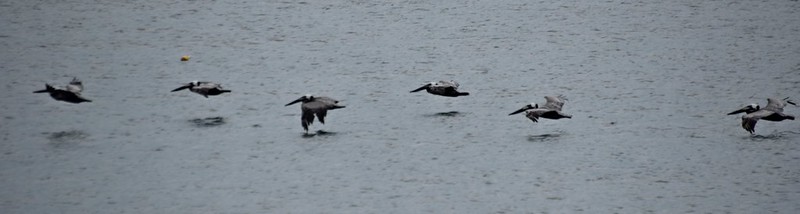
Just above the surface, gliding with astounding grace despite their unwieldy appearance, brown pelicans. Flocks of them. More than I’ve ever seen at one time before. Breaking their flight with dives and a mighty splash of white spray, catching fish and bobbing for a while in the waves.

Pelicans, a symbol for resourcefulness. And sacrifice. Legend has it that mother pelicans sacrifice themselves for their young, if need be. They wound themselves to feed their children with their own blood. They are social birds which hunt cooperatively—representing teamwork. Community.

Twenty-four hours ago, I sat breathing the same salt air as the pelicans, stood in the same sparkling waters as the dolphins.

Today I pack my bags, load my car, and return to school, masked. COVID rages on. Many unknowables lie ahead.

Yet I remain at peace. Diving, leaping, or gliding, I shall navigate as called for in the ebb and flow of moments. Children await, life awaits, time does not. The ocean remains. A reminder of constancy, of strength.

Here’s to the mighty plunge.

Low-flying pelicans. Tony Alter. CC-BY

*******

with thanks to Two Writing Teachers…strength and protection to all in this uplifting community of teacher-writers, seasoned navigators of life and story-sharing.

Shedding

Let me preface this post with a restated confession: I am not exactly a fan of snakes.

But they, like all of nature, have lessons to teach, if one is willing to learn.

I hope to always be teachable, so…

Early in the summer I found a snakeskin in my garage. Just a little one, but still.

A few weeks later, I found another.

This morning, I found a couple more.

So.

Snakes seem to have been vacationing in my garage. Let us think on that momentarily versus thinking that they’ve taken up permanent residence there.

Here is why I say this: The skins, I’m pretty sure, belong to smooth earth snakes. I’ve seen a couple over the past year or so, which is saying something: These are nonvenomous, shy, fossorial snakes that don’t like to be seen. The first one I saw was dead, lying across my sidewalk after a rainstorm. Pale gray body. I thought it was a worm until I saw the tell-tale scales. The second one was stretched out in my flowerbed mulch, black tongue flickering in and out “smelling” the air, trying to determine what I was. That’s it for my lifetime earth snake sightings. Two. They are uncommon, tiny creatures…just the size of these silvery skins left behind.

So they live in the ground around my home, harmless little things, going about their business of eating earthworms and itty bitty snails or whatever.

And coming into my garage to moult.

Which is nevertheless discomfiting. For me, anyway. Not for the bashful snakes.

I don’t especially want one to come all the way inside and hang out or anything.

But they do have me thinking (among many things) about shedding one’s skin. Metaphorically, that is. As in, what sorts of things I wrap around myself and cling to when I could be letting go and growing. Mindsets, habits, beliefs, assumptions, what have you. Which things actually nourish me, and which actually constrain me? Which are beneficial, and which are harmful? What do I need to shed and leave behind, to better move forward?

I suppose this thinking occurs because summer is waning. I return to work next week not knowing what the year ahead will look like, other than back to masked here in my district. I think about the possibility of a full return to virtual learning. It is more than a great many teachers can take. Yet… we got through last year. The children got through. There were good things in spite of the trials; there were surprises. Many from the children and most concerning ourselves. School of 2020-2021 took a toll on everyone. We had to shed quite a bit of familiarity and comfort to get things done. But we did it. We grew.

I don’t wish for a repeat any more than I wish for snakes to be summering in my garage. I cannot ignore the timing of COVID rearing its more-venomous-than-ever head again when we thought it was on its way out, just when we are on our way back into the schools. I now have a granddaughter starting kindergarten. Her little sister will be born this fall. There’s always a lot at stake when it comes to children—in the words of Herbert Hoover (ever how unpopular a president he was in his day): “Children are our most valuable resource.” There’s nothing more precious. They represent our tomorrows; they are the culmination of our yesterdays. We have to shed the fear of failing them. Not assuming the worst, or that “we can’t,” but doing daily, as only that given day dictates, what must be done for their care and nurture as well as for our own. We have to be… well, “as wise as serpents.” When it comes to plans, we have to hold on loosely, ever how painfully contrary it is to our nature.

This summer I had plans for household repairs and updates. That was before the dryer quit working. Followed by the air conditioning during the hottest week of the year (of course). Followed by turning on the water one morning and nothing coming out of the faucet; the pump died.

I did repairs, all right. Just not the ones I planned.

But I got through. I now have a new dryer and water pump. The AC unit didn’t have to be replaced, thank heaven. All is working well. Throughout this whole process I thought about adapting. I dried clothes out in the hot sun. I remembered how my grandparents never owned a dryer. I thought about that one window air conditioner they had (late in their lives) against a sweltering Carolina summer and no AC at all in the old Ford Galaxy 500; I once left a stack of 45 RPM records on its back deck under the windshield. They melted. They warped and ruffled like clam shells. I’ve never had to pump or draw water in my life, but I had plenty of bottled water and didn’t have to miss my morning coffee while waiting on the new pump.

So I attempt to bring the lesson of shed snakeskin to a point here: In the discomfort is growth. Newness lies ahead; it approaches incrementally as we scratch away at the constraints and setbacks of now. Endurance is possible. We certainly know this. Sometimes the thing that needs shedding most is our perspective…

Meanwhile, I go back to cleaning out my garage, another thing I hadn’t planned to do right now, but the snakeskins sparked it. Time to purge what needs to go and put up a shelf to keep everything else off the floor. I am working on it. Hot, tiresome, dusty work, but I can see my progress.

And it feels good.

Thanks to the snakes.

******

thanks also to the Two Writing Teachers community, where writing our way through is a way of life…courage and strength to all.

Culinary adventure

“Cooking is an art, but all art requires knowing something about the techniques and materials.”

—Nathan Myrhvold, former Microsoft CTO and author of Modernist Cuisine

At a restaurant during our recent vacation, my health-conscious husband ordered a black bean burger. I don’t recall him ever eating one before. For the better part of his life, he’s been a hearty meat eater. The man loves food…his reaction upon tasting this vegetarian concoction: “AMAZING! I can’t believe how good it is!”

Then, with a subtle batting of his eyes: “I wish you could make these.”

—Was that a throwing down of the gauntlet, at my very feet?

Call it inspiration, determination, seeking to please, or self-challenge, whatever: I decided on the spot. I would do this.

I’ve never made black bean burgers before.

As a rule, I don’t like veggie burgers. They’re mushy. The whole idea of a burger is, you know, substance.

And so I do my research. I find a recipe entitled “The Best Black Bean Burgers I’ve Ever Had.” Seems a reasonably good starting point (why settle for less than the best?).

It doesn’t seem too complicated, really. While I organize and prep the ingredients, however, doubts seep in…if this tastes awful or falls apart, maybe we’ll go get Mexican

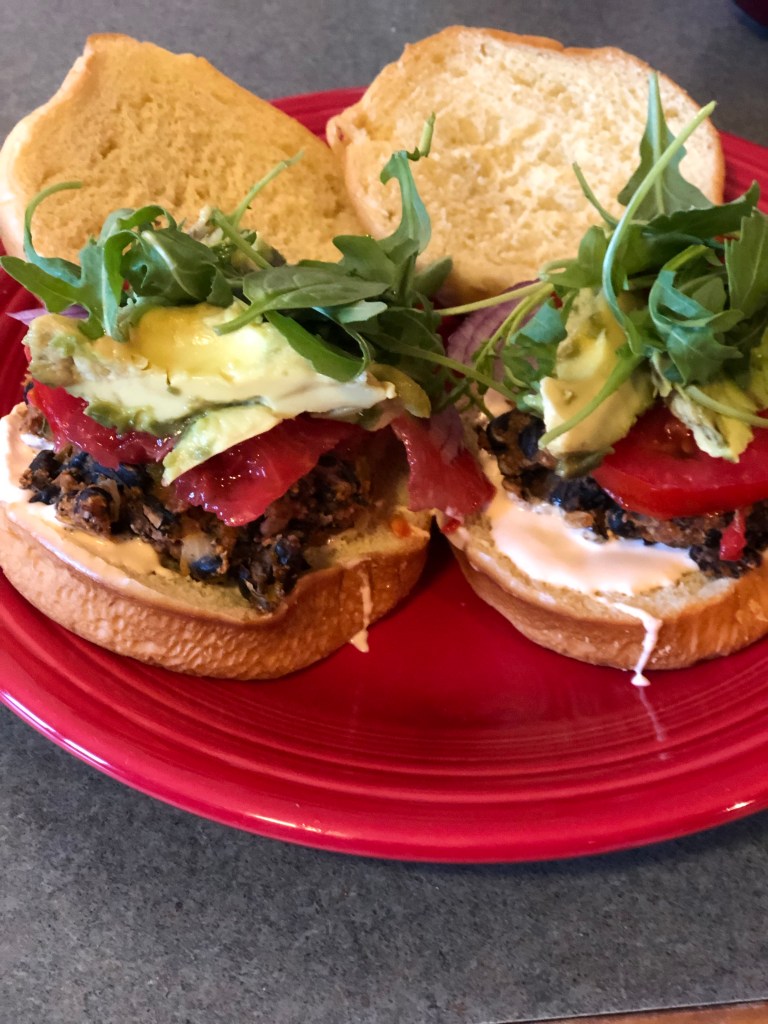
I learn a couple of things in this new undertaking. It’s essential to get as much moisture as possible out of the beans. The drier they are, the better the texture, so the recipe says. Not only do they need to be drained, rinsed, and patted dry, they need to go in the oven on a baking sheet for a few minutes. I discover that cumin, smoked paprika, chili powder, and Worcestershire blended with the dried beans create a surprisingly grilled taste.

One big concern: Will the burgers hold together after baking? Sometimes my regular hamburgers don’t. Not enough bread crumbs, maybe? How did my Grannie ever make those phenomenal, flavorful burgers of my childhood? She could have sold them and made a mint. I’ve never been able to duplicate them. The scent of Worcestershire stirs the memory with a wave of intense longing…

Furthermore, I’ve decided not merely to make these black bean burgers, but to recreate the one my husband thought was so amazing. I’ve looked up the restaurant menu for the toppings: avocado, tomato, arugula, red onion, spicy mayonnaise.

— What IS spicy mayonnaise?

More Googling. Mayo mixed with hot sauce, apparently.

“Hey,” I say to my husband, who’s washing his hands after cheerfully helping to shape the patties for baking, “pick the hot sauce you want to go in this ‘spicy mayonnaise.'”

He has a whole collection of hot sauces.

He picks Texas Pete.

All righty then.

And, if nothing else turns out…we do have gorgeous homegrown tomatoes that have been given to us. They are another reason I love summer, these tomatoes. I think, as I slice into their luscious redness: We could just have cheese and tomato sandwiches in case of disaster…

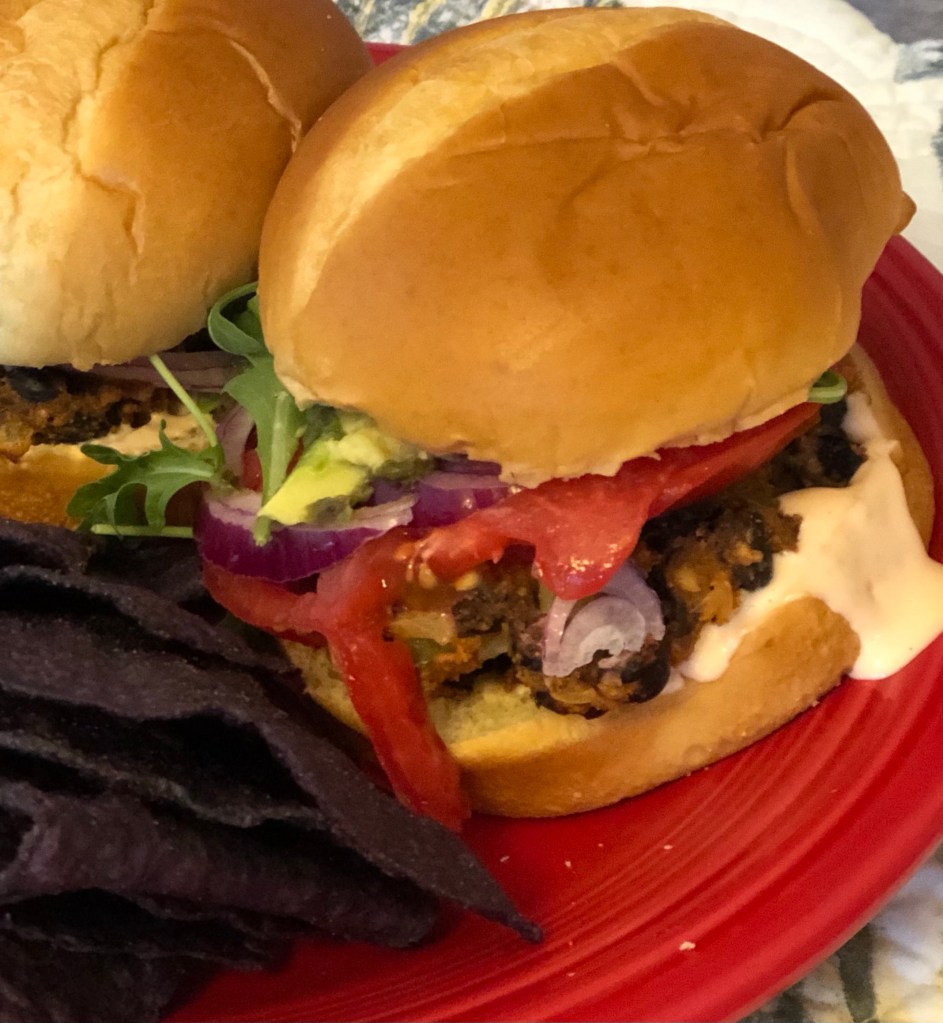
My husband has also chosen Brioche buns: “The bread at the restaurant was really, really soft.”

We take the burgers out of the oven and—wonder of wonders!—they hold together when we lift them off the pan.

I put them on the buns, layer on the toppings. They’re pretty, but the final test awaits…

My husband takes a bite.

He closes his eyes.

“This is the BEST. THING. I. HAVE. EVER. HAD.”

High praise from my former give-me-steak-and-fries guy.

He eats every blessed crumb for the next three meals.

—Mission accomplished.

The black beans combined with finely chopped onion and green pepper create good texture, much like a tender hamburger.

Pretty proud of my culinary work.

*******

As an educator I could make many analogies between this experience and teaching or writing. We see effective or impactful things that we wish to duplicate. Things we’ve not tried before. It’s daunting. Risk of failure is involved. So is risk of succeeding, if you will. There’s an art and science to writing and teaching, just as with cooking. Myhrvold’s quote on knowledge of techniques and materials at the top of this post struck me as foundational; this is the beginning of process. Knowledge combined with a spirit open to experiment can yield surprising results and discoveries; what you experience and create will not be exactly like your model nor a complete replication what others have done before you. It shouldn’t be. You are making something your own. The work reflects the uniqueness of the artist.

Wishing sustained strength and inspiration to all my fellow teachers preparing to return to school with the residual effects of 2020 still lingering. Here’s to aiming for the best. And to our own learning.

with thanks to Two Writing Teachers and the Slice of Life writing community, ever a safe, nourishing place for creative strivings and growth.

Sidewalk angels

Asheville, North Carolina.

First vacation in two years, owing to my husband’s cardiac surgeries and the pandemic. He wants to see the mountains. They remind him of his childhood. They’re in his blood, like rivers and bays are in mine.

We’re not campers, though. We stay in town.

Late arrival, chilly summer rain, deserted city streets. Apparently everything closes early on a Sunday night. Downtown is eerily vacant, as if we’ve landed in a time warp or the Twilight Zone. Where have all the people gone? We walk in the desolation, huddled under our umbrellas.

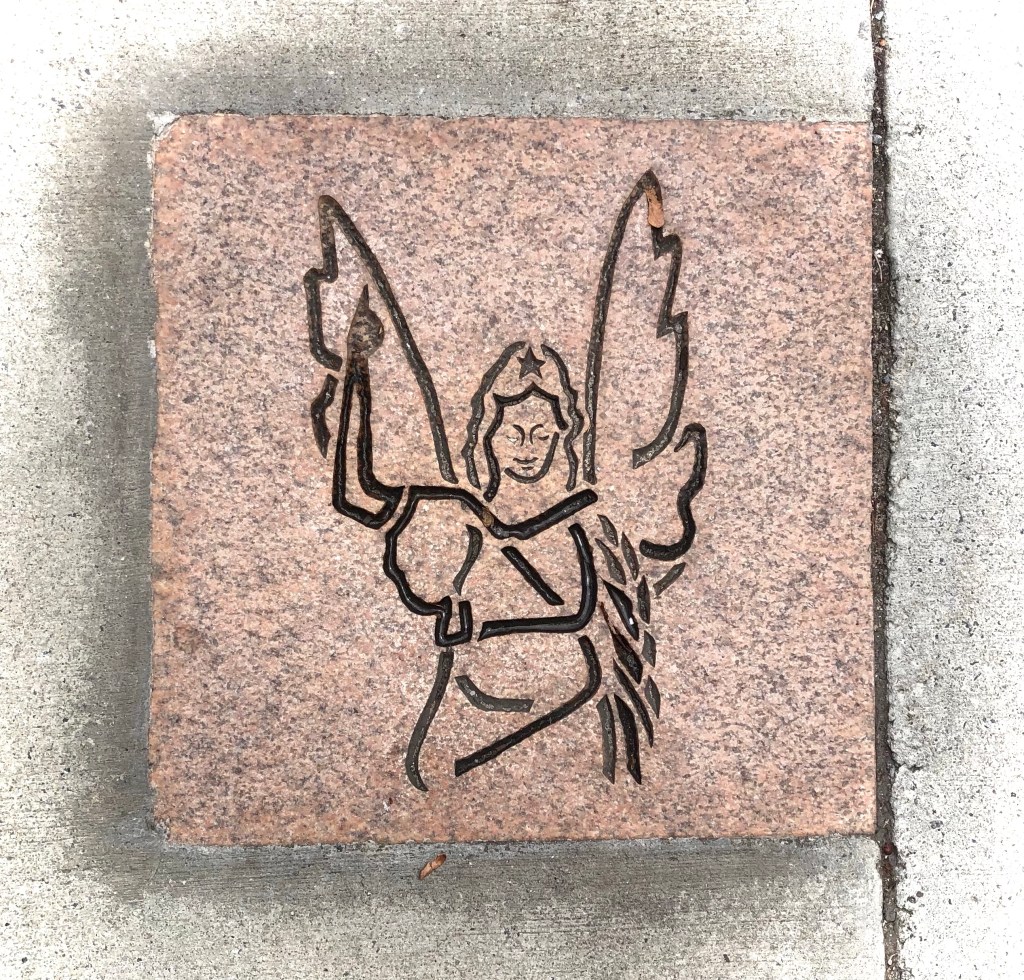
On the sidewalks, random pink granite squares bear strange designs of some secret code: a feather, a horseshoe…

“Did you see that angel?” I ask my husband. I think I recall seeing this here before, on a previous visit.

“No. Where?”

“Back there, on the sidewalk. An angel pointing up, with a star on its head. We just passed it. I’m sure it has something to do with Thomas Wolfe. You know, ‘Look Homeward, Angel’…”

“Oh yeah, I bet it does.”

The rain slacks off. We round a corner to discover people dining under a café awning. A stocky, stubble-faced man lurches along the sidewalk from the opposite direction; his countenance lights up when he sees my husband: “Kris Kristofferson! Jerry Garcia! Can I get your autograph?” He fairly ripples with his own merriment.

Aside from the mountain panorama, this may well be the highlight of the trip for my hoary-curled, gray-bearded husband. Never mind that he’s a Baptist preacher. He’s a lifelong fan of these artists. He laughs: “My autograph won’t get you very far, brother.”

As we press on, trying to determine if any other restaurants are open, I glimpse blanketed bodies nestled in recessed shop doorways. The homeless, sheltered from the weather, settling in for the night ahead. Disparity, like cold mountain rain in midsummer, seeps all the way to my bones. I shiver.

They are still cocooned there the next morning when my husband and I hunt for coffee and bookstores, navigating around other vacationers who are now out and about, pushing their dogs in strollers. One lady on the sidewalk has risen and is sitting by her rolled blankets with a small basket by her side and a little black dog in her lap. Over the course of the next two days, as we try to decipher the odd hours of stores and restaurants (we discover that some are closed on Mondays, others on Tuesdays and Wednesdays, and that some don’t open even when their signs said they will; how apropos is the ‘Stay weird, Asheville’ slogan?) —we see this petite lady several times. She remains there on the sidewalk by the same shop while other people of the street come and go, apparently checking in with one another. She is of indeterminate age. Slight wrinkles, blondish hair pinned up. Blue eyes. The little black dog stays right with her, cuddled close, never making a peep, watching the world walk by. I note that they get visitors. Some bring food. As my husband and I wait for the walk signal to cross the street, a young man from the Ben & Jerry’s shop comes out with a tiny cup of ice cream for the dog. I wonder how often he does this, how many other shopkeepers share in this caring…

I wonder how long this lady has been here, what her story is, if she has any family, if she’s ever stayed at a shelter. Not all shelters are safer than being on the street, especially with COVID. I find myself trying to imagine her daily life, her subsistence, the haunting freedom of living on the street; in the lyrics of Kristofferson: “Freedom is just another word for nothing left to lose.” She doesn’t appear to ask anyone for anything although she has a red plastic container sitting out for donations. I begin to worry about someone taking it from her…

On our last day, as my husband and I approach, she greets us: “Good morning.” She smiles. I know she’s recognized us as having passed this way before. It’s a familiar, familial tone. Full of warmth, the way a mother speaks to her waking children.

We respond in unison: “Good morning!”

“Your little dog is precious,” I say. “And so good.”

“Thank you.” Her voice is raspy but pleasant. “She’s a girl.”

“Such a sweet girl! What’s her name?”

“Raspberry.”

My husband and I learn the woman’s name, too. We chat with her for a moment. My husband takes some cash from his wallet and puts it in the red tub where the woman has an inconspicuous cardboard sign with the words ‘Thank you and God bless youG. and Raspberry’ written in red marker, accompanied by a small drawing of a cross.

We say our goodbyes. The image of Raspberry’s moist dark eyes stays with me as my husband and I walk our last through this beautiful city of Look Homeward, Angel: The Story of a Buried Life. Wolfe set the novel in a fictionalized version of Asheville, his hometown, to explore the “strange and bitter magic of life.

G. and Raspberry remain on my mind as we head homeward through the majestic blue-shadowed mountains. What is homeward if you have no home? Which way do you look then?

I have infinite questions, but this I know: there’s more than one sidewalk angel in Asheville.

*******

It is estimated that over half a million people in the United States experience homelessness. This includes those in shelters, transitional housing, and hotels and motels paid for by charities or government programs as well as those who sleep in cars, parks, camps, and places not meant for human habitation. While many misconceptions persist, among the the primary causes are lack of affordable housing, poverty, disabilities, and domestic violence.

The pink granite squares with designs in Asheville’s sidewalks are part of the Urban Trail, comprised of thirty different stations with sculptures representing historical periods. The Trail tells the story of the city’s past. The angel represents The Times of Thomas Wolfe, 1900-1938.

Right now, as the sun rises in my part of North Carolina, it’s raining again; I wonder how G. and Raspberry are faring this morning.

with special thanks to Two Writing Teachers for providing a venue for sharing Slices of Life.

What’s in a name poem

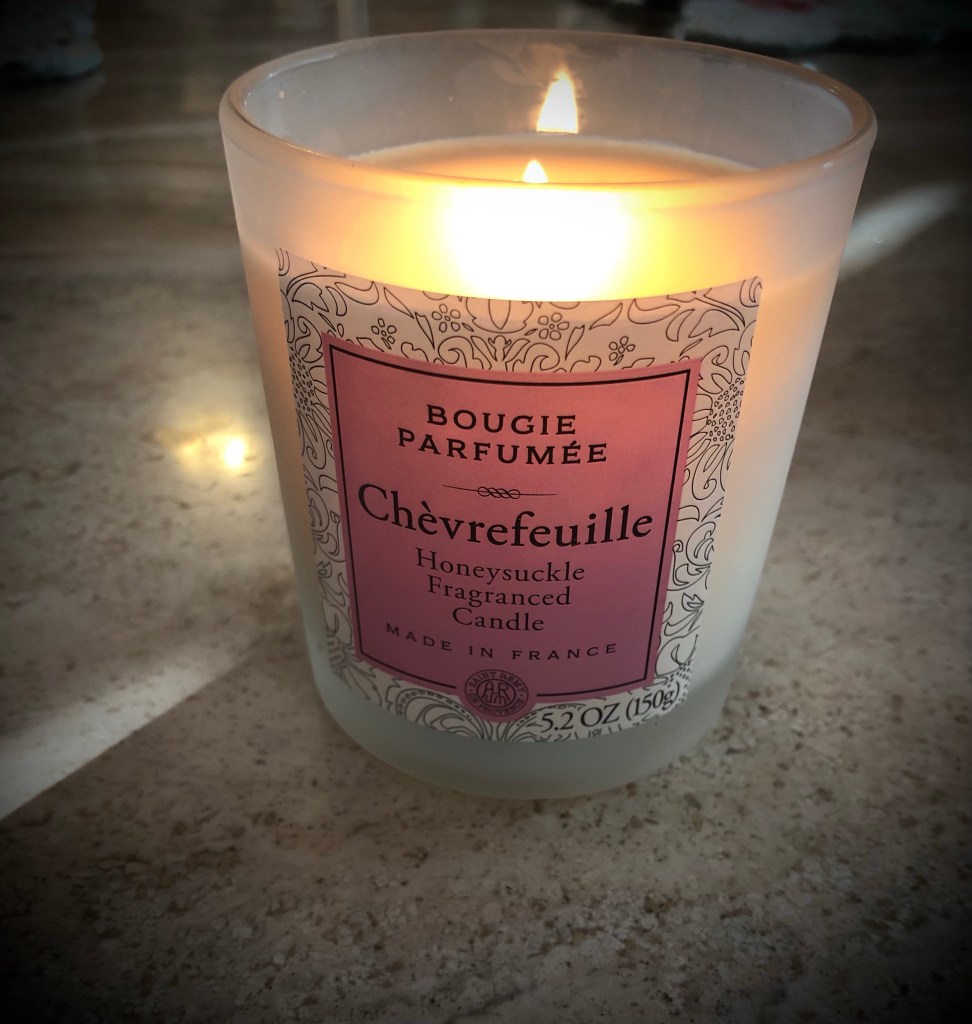
I love the mid-monthly Ethical ELA Open Write for educators. The kickoff for July is hosted today by Mo Daley, who offers the invitation to explore your name, and who you are, through poetry.

I happened to write a post about my name in March: Frances. This morning I rework it here, with a few more layers of meaning…

Early morning
before the dawn
as first birds begin to sing

I light a candle
on my table

I sit
by its wavering halo
to write
about my name.

In the beginning
I didn’t even know
it was my name.

My kindergarten teacher, Mrs. Brown, 
called the roll: 
Frances?…Frances?

She finally narrowed her eyes at me: 
Aren’t you Frances?

Sitting before her at a tiny table, I blinked: 
No. I’m Fran.

An inauspicious start
to my academic career.

The first shaky foot
on the lifepath
of learning who I am.

I didn’t love it at first,
my name.

Early on
(sometime after kindergarten,
that is)
Daddy told me
it was after his mother,
Ruby Frances

Grandma

my consummate storyteller
avid letter-writer
daily diarist
devout reader
tireless defender-angel
Grandma

On the day you were born
I stood at the nursery window

and cried.

You looked
like a little angel.

Grandma

My life’s memories
begin in her arms
on her lap
being rocked
in time to the beating of her heart
and the cadence of her voice
singing
Jesus loves me, this I know
or reading reading reading
until I could recite
the rhyming stories
by heart, page by page
long before I went to school

Grandma

who read the entire Bible aloud
several times over
to Granddaddy
who could not read it 
for himself

Grandma

who was named
after her beloved Papa,
Francis

a very religious man

who nevertheless hung himself
on a tree in the woods
in front of her childhood home
when she was just sixteen

Grandma,

I asked, when I was around sixteen,

did you know
that the name Frances
means ‘free’

or ‘one who is from France?’

We talked about it in French class
today

—Does it? I didn’t know.
I loved taking French

—You took French? Really?

—Yes. Such a beautiful language

I didn’t tell her
we got to choose French names
for class
and I chose to be Renée 
without realizing 
that it means born again

or that the kids back in elementary school
could never get our name right:
Hi, France! they’d cheerfully greet me.

I’d grit my teeth:
It is Fran
or Frances.
Not ‘France’.
I am not
a country.

No one else in school
had my name.

It wasn’t cute or popular
since maybe 1886

not to mention
the spelling problem
such as on labels
from the pharmacy:
Francis

Does the world at large
not understand
or care
that the feminine spelling
is with an e?

I wanted to hurl
those little orange bottles
through the window

along with my problematic name

until the day I was teaching
a group of little Spanish-speaking girls
how to read English
and one of them grabbed my badge
to decode my name:
Fran

Very good! That’s really my nickname.
It’s short for Frances.

Ooooo, breathed my little student.
That sounds just like ‘princess’.

In all my years
I’d never thought of that

even though Princess Diana’s middle name
was Frances

and I have to laugh a little now
because Daddy always said
You ought to take Spanish instead of French,
it would be more useful.

He couldn’t have been more right, alas.
He usually was.

I wonder what he’d say now
if he knew my DNA tests
reveal a dollop of French ancestry
that he very likely
passed down…

and as I’ve been writing
the sun has risen
bright and ever-new

a red dragonfly
lands on the little statue of Saint Francis
by my front steps

never minding that I’m not Catholic

nesting birds find sanctuary here
on my porch
along with a host of small creatures
seeking a resting place
even the occasional stray cat in need
for whom I leave fresh water.

The candle’s wavering halo
is invisible now
in the sunlight spilling
through the windows

as I write about my name
this inheritance
I’ve come to treasure
at last

and it just so happens
that the candle’s fancy label says
chèvrefeuille
French for “honeysuckle”

the flower and scent
of happiness
of hardiness
of devotion
and everlasting bonds

like a legacy of love

and unseen angels

that are
always near.

Note on red dragonflies, mentioned also in my most recent post: I’ve seen them for the first time this summer. They’re stunning and in some cultures, considered a sign of the sacred.

Out of the shadows

Late June afternoon on the porch. A long-settling stillness, the day’s brilliance deepening to amber, shadows slanting across lawns and pavement, a cool pre-dusk breeze riffling trees and wind chimes, carrying the sound of a child calling in the distance. It’s not a child; it’s a little goat from a neighbor’s pen, hidden in a patch of woods. Bleating for its supper, I suspect. Startlingly humanlike voice. A neither-here-nor-there sound, disembodied, suspended in the air like time itself, clinging to these green and gold moments, unwilling to let go…

“Mom, let’s go for a walk,” says my youngest son (aka Cadillac Man).

I grab my shoes.

Walking beside me along our neighborhood street, my boy speaks, as he always does, of music. Songs he is learning, one he wants me to practice with him (it has to be simple for me. He can sing any part he likes in any key he likes; he can play anything he wants on the piano or guitar). I say I’ll try. He speaks of his new job at the funeral home; we reflect on the recent death of a beloved friend who’s the same age I am. Fresh-grated sadness, still surreal.

As we talk I note that no neighbors are out and about this afternoon. We seem quite alone. At one house, pool towels draped over the front railing billow in the breeze. American flags on front porch flagpoles ripple and flap with crisp smacks. A couple of cicadas rattle from high in the trees that frame backyards. Our long shadows stretch out on the pavement before us, where flecks of quartz wink; when my boy and I turn at the road’s end, the shadows disappear.

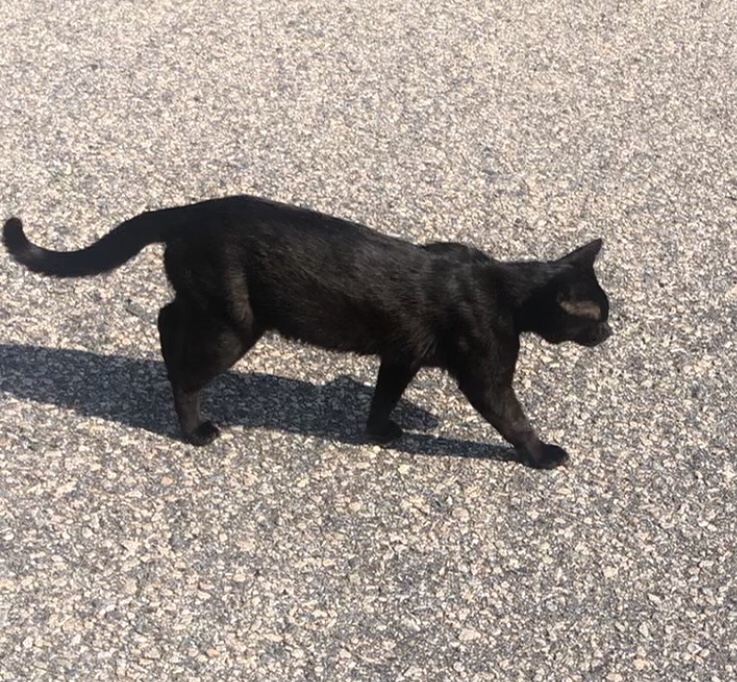
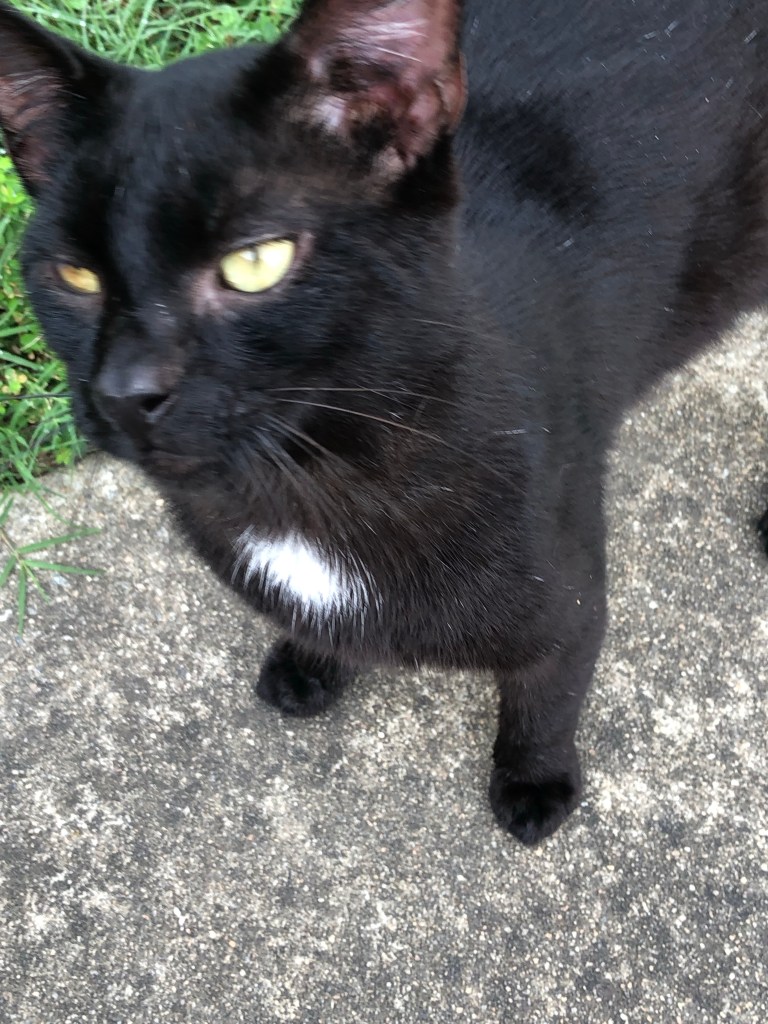
We pass a row of cypresses where there’s sudden movement in the grass. A black shape materializes, runs after us, crosses right in front of us…

Good thing we aren’t superstitious.

A young black cat, meowing.

“Awww,” says Cadillac Man, as it rubs against his legs. “What a sweet little cat.”

It comes over to me, rubs against my legs, purring madly.

We are devout dog-people. I can’t have a cat. I’m allergic. I learned this at age five or six when my family took in a stray Siamese (Mr. Cat, we called him) that took refuge on the stoop of my childhood home during a storm. Swollen eyes and asthma didn’t stop me, however, from bringing home a black kitten nobody else wanted when I was in college…

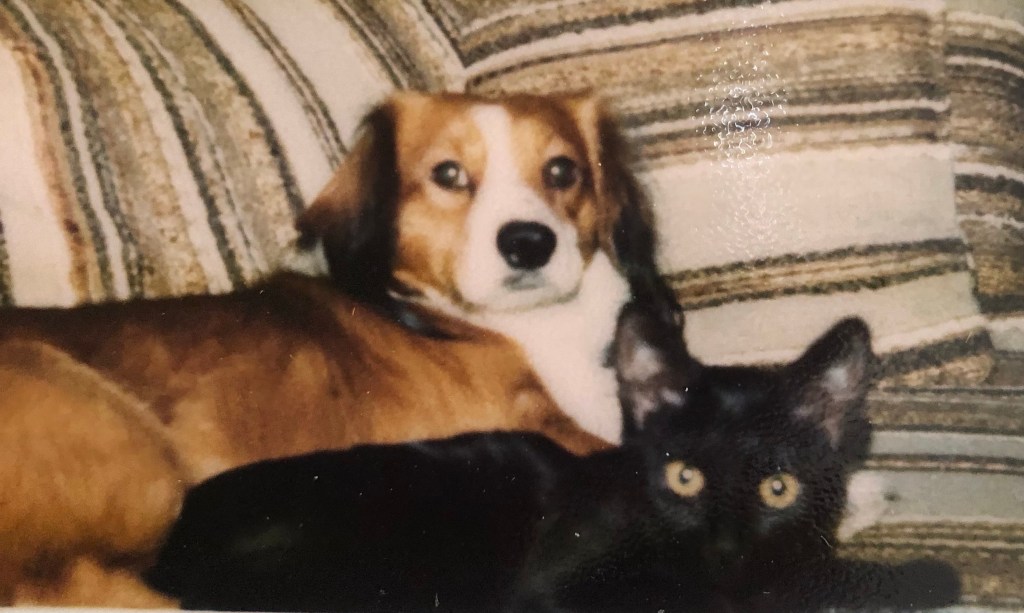
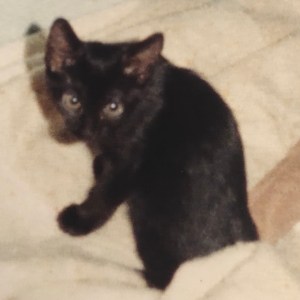
“It looks so much like my cat Moriah,” I tell my son. The name came from a magical cat in The Forgotten Beasts of Eld, a book I read when I was about twelve.

Cadillac Man bends down, picks up the creature. “I would keep it if you could breathe.” The little cat nestles against him. Animals love my boy. They seem to sense his gentle spirit.

After a moment, the cat twists to get down. Cadillac Man releases it.

“It looks kind of thin. I wonder if it’s hungry…” Do moms always think about this first? Is this our deepest default, this hard-wired compulsion to feed all little living things, to keep them living?

The cat sits looking up at us with big, unblinking, green-yellow eyes. Meow.

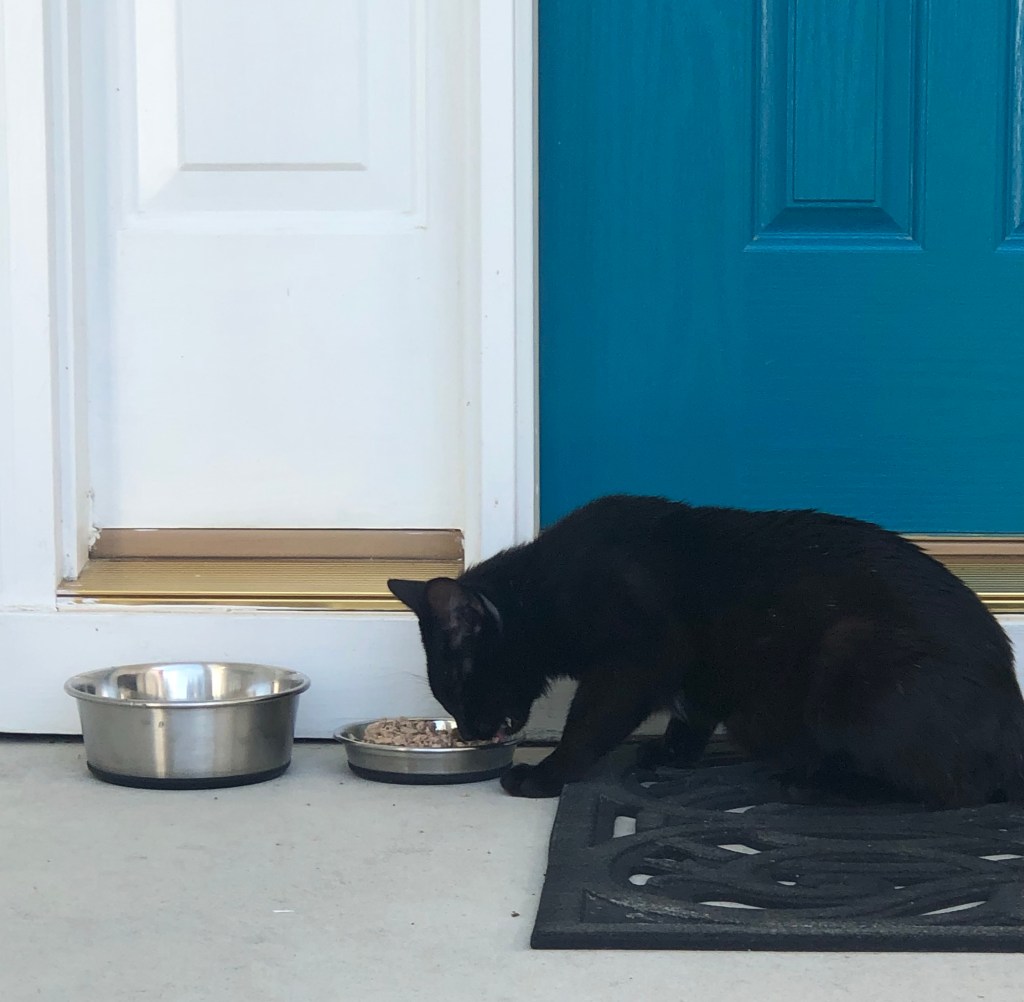
And it trots right beside us, like a good dog would, back to our driveway where I feed it some of Dennis the dachshund’s steak-flavored food in an old dish.

“I hope it stays,” says Cadillac Man. “It can be an outside cat.”

I examine the cat as it eats. “It has all its claws.”

“We should name it,” says Cadillac Man.

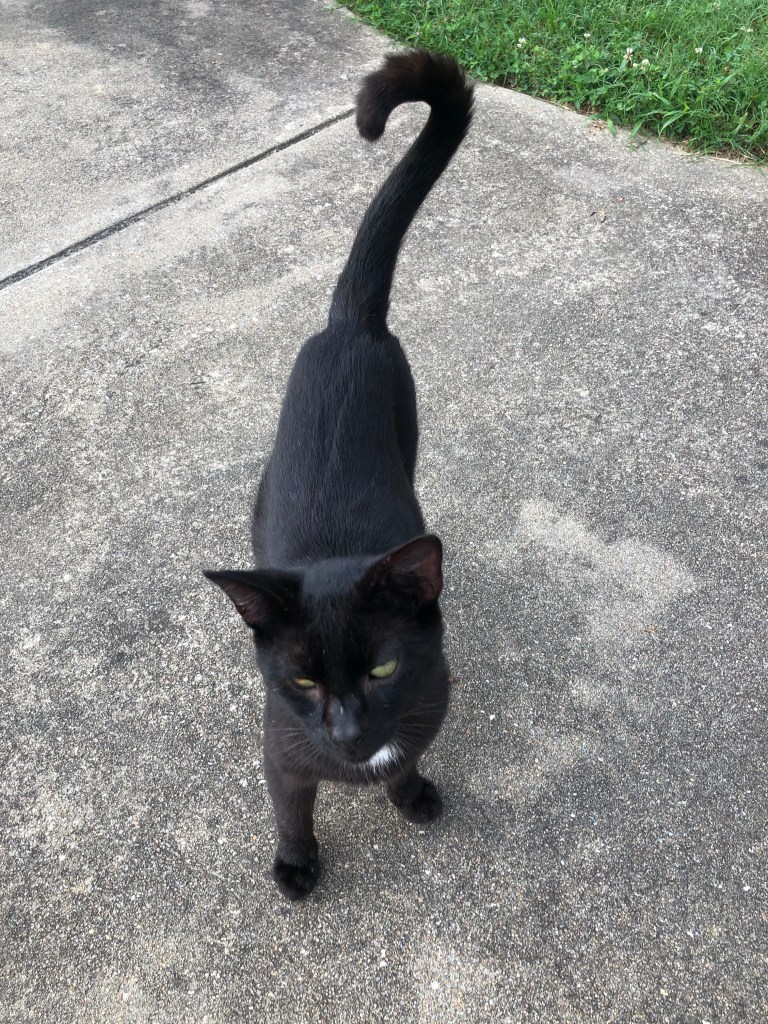
“Look how rusty its fur is in the sunlight,” I observe. “Black cats aren’t exactly black. It’s a genetic mutation of the tabby pattern. See the faint rings in its tail, there at the tip? So much like Moriah, only she was smaller and didn’t have a tail…” another mutation. She was the last kitten left in the Free Kittens box on campus the day I found her and took her home. Shelters say black cats are the hardest to find homes for; no idea on stats of cats with stumps for tails…

“We aren’t naming it Moriah, Mom.”

“Of course not. She was one of a kind and besides, this one’s a boy.”

Cadillac Man is silent for a moment. The cat has nearly finished his steak dinner. “Well, you know it has to be a musician’s name…”

This is what he does. Since childhood he’s named pet fish after bass singers; his dachshund, after drummer Dennis Wilson of The Beach Boys.

I can see what’s coming: “Brian, I suppose?”

Cadillac Man smiles. “Not quite. I christen this cat Douglas.

Brian Wilson’s middle name. I was close.

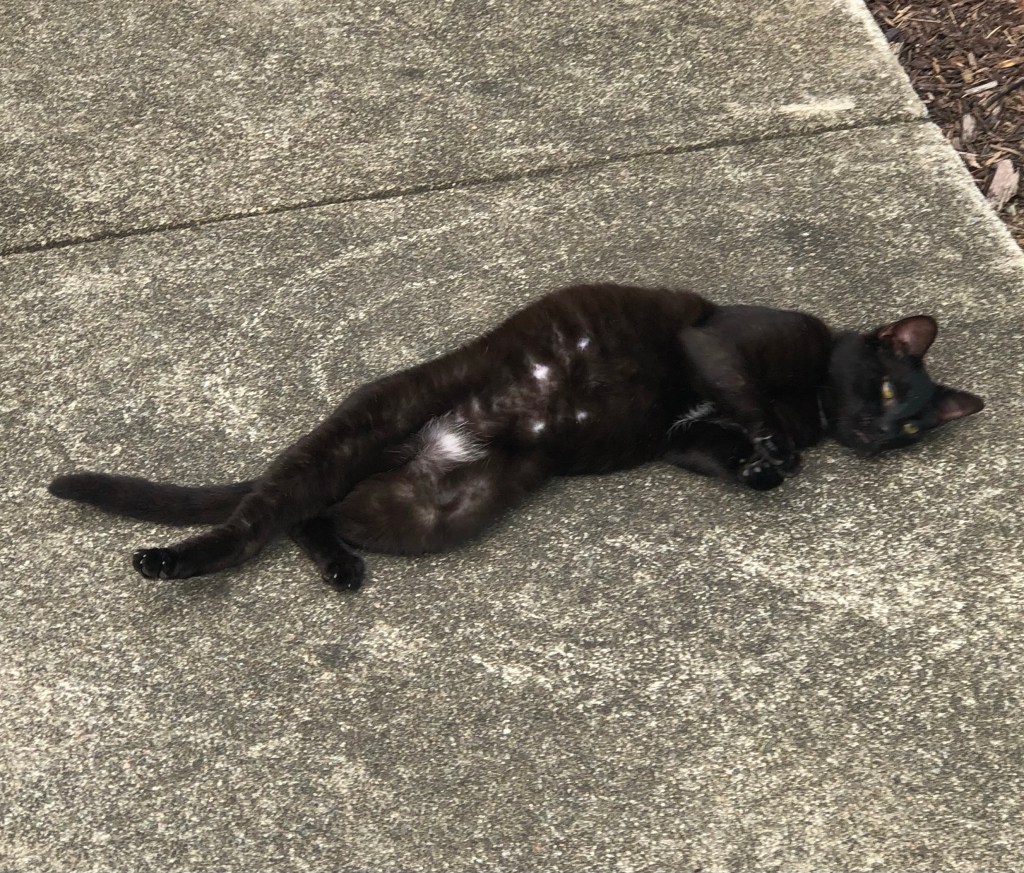
After licking the bowl clean, Douglas follows us up the sidewalk, cutting in front of Cadillac Man to roll over just like Dennis the dachshund does for a belly rub.

“Awww,” says my boy, rubbing the proffered belly. “Listen—he’s purring like a truck!”

Indeed he is.

It’s getting late. We need to go in to wash up and have our own supper, so we stroke Douglas one last time. I make sure to wash my hands well, with extra soap.

We peek out of the windows from time to time. Douglas is lying on the porch, and then he’s gone.

But not really.

He’s curled up under the rocking chair, sound asleep.

When he wakes, I take one of Dennis’ soft blankets out and put it in his chosen sleeping spot. Douglas sits on it at once.

“There,” I tell him. “Now you know that if you need a safe, comfortable place to sleep, you have one. If you’re hungry, I’ll feed you whenever you come around. I’ll leave water out for you. It’s summer, see…”

Douglas purrs as if he understands…and maybe he does, for the next morning he comes to polish off a whole bowl full of food, and he’s waiting in the driveway to greet us on Wednesday night when we return from prayer meeting.

And then he vanishes.

A day passes, and another, and another. No Douglas.

It storms. Thunder, lightning. Rain gushing from the gutters.

I hope he’s all right, wherever he is. If he belongs to someone, I hope he’s back home and happy. We ought to have named him Macavity, the Mystery Cat.

I shake out his blanket, fold it, replace it. I toss yesterday’s water from his new dish and refill it with fresh.

I think of Mr. Cat. Of Moriah. So long ago.

I wonder if it’s absurd to keep leaving fresh water out for a cat that may never return.

But I do it anyway, because I told Douglas I would.

I also told Cadillac Man we could have named him Question Quigley (from Harry Potter) for that tail

The best shot I could get of his face; Douglas kept trying to rub against me while I attempted to take his picture

Asking for a belly rub

For comparison: my cat Moriah, almost forty years ago, with my childhood dog, Bagel

—OH, and P.S. Guess who came for dinner last night?

Memories, like little shadows, return, too.

*******

And so it is that black cats are my favorite, despite their long-maligned history (another reason I feel concerned for Douglas). I wrote another take on them if you’re so inclined: 13 Ways of Looking at a Black Cat Crossing Your Path in the Time of COVID-19 While Driving to School to Teach Online Near Halloween of Election Year 2020.

with special thanks to the Slice of Life community at Two Writing Teachers.
We are our stories.
A walk back in time

After many years of mentioning it, my husband and I finally visited the Country Doctor Museum. Off the beaten path in a nearby town, the museum consists of three small buildings, one of which is a combination of two actual 19th century doctors’ offices. The museum began as a memorial to rural physicians, expanding over time to include the nursing profession, home remedies, and the apothecary. It now houses an impressive collection of artifacts from the 18th to early 20th centuries.

I expected to learn things. I didn’t know, for example, that this is the oldest museum in the United States dedicated to the history of rural healthcare, or that it’s been taken over by my alma mater, East Carolina University. The docent said: “That saved us during COVID. We had the funding to reopen. Many private-funded museums could not.”

I mourned the loss of museums that had to close for good as we crossed the threshold of the apothecary… where an otherworldly, unanticipated, delicious strangeness awaited on that side of the portal…

A mammoth cabinet of gleaming cherry wood with ornate scrollwork, sunbursts, and Victorian spindles runs the length of the left wall. On its shelves, behind glass doors, stand hundreds of large jars bearing white labels and names of their contents—assorted dried herbs, powders, and liquids—in large black script: Crocus, Cloves, Mace, Valeria, Aq. Rosa., Pond’s Ext., Sol. Benedict Quantitative, Lotio Pilocart Morrow, Pepsengia. Some labels look new; others appear to be timeworn, the lettering nearly illegible. The docent speaks in a low, unmodulated voice about paregoric, opium, mercury, and poisons that were often part of remedies mixed by the apothecary, dispensed to a largely illiterate population which couldn’t read labels. In order to prevent overdose, some of the pills were fashioned into tiny black coffins.

As I look at these coffin-pills, trying to imagine ingesting such a thing, the docent points to the show globes in the cabinet. Tall, decanter-like vessels of different-colored liquids—green, yellow, blue, red—stacked upon each other in rounded triple towers. They seem art deco or like something from the 1960s. “Show globes are an official symbol, like the striped pole is to the barber,” says the docent. “People entering a town would know this is where to find the apothecary. The show globes were displayed in the shop’s front window, and every color had a meaning. The apothecary kept a recipe for mixing dye in water and a guide for when to display certain colors. Red, for example, would warn travelers that there’s widespread sickness in this town, an epidemic…”

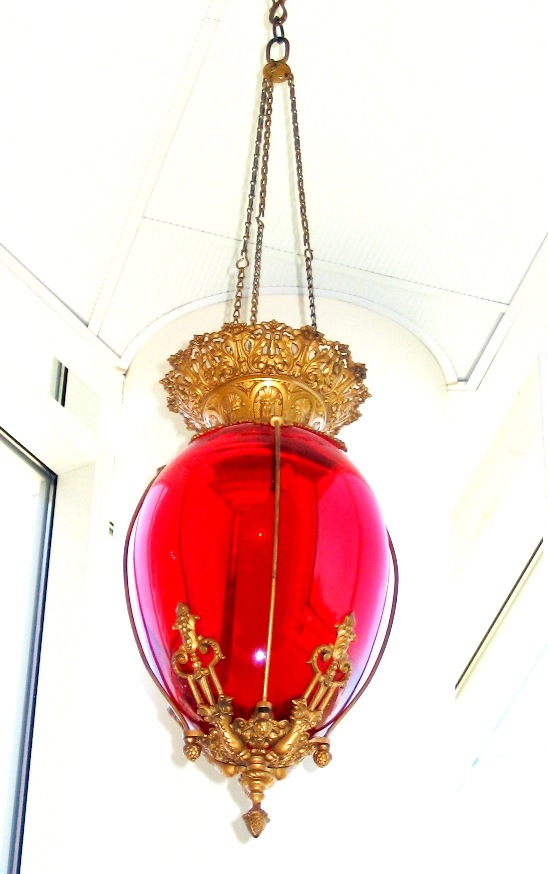
I turn to see a large, single-tier show globe with antique bronze trim sitting alone on a pedestal behind me. Full to the brim with bright red, transparent liquid.

Of course, I think. The docent is wearing a mask. I wonder if the all the museum guides came by cover of night in March of 2020 to mix this red solution. And if it will remain red until COVID-19 makes its full departure.

Hanging show globes were sometimes mounted in the apothecary’s shop window.

The docent is now speaking of bloodletting and leeches.

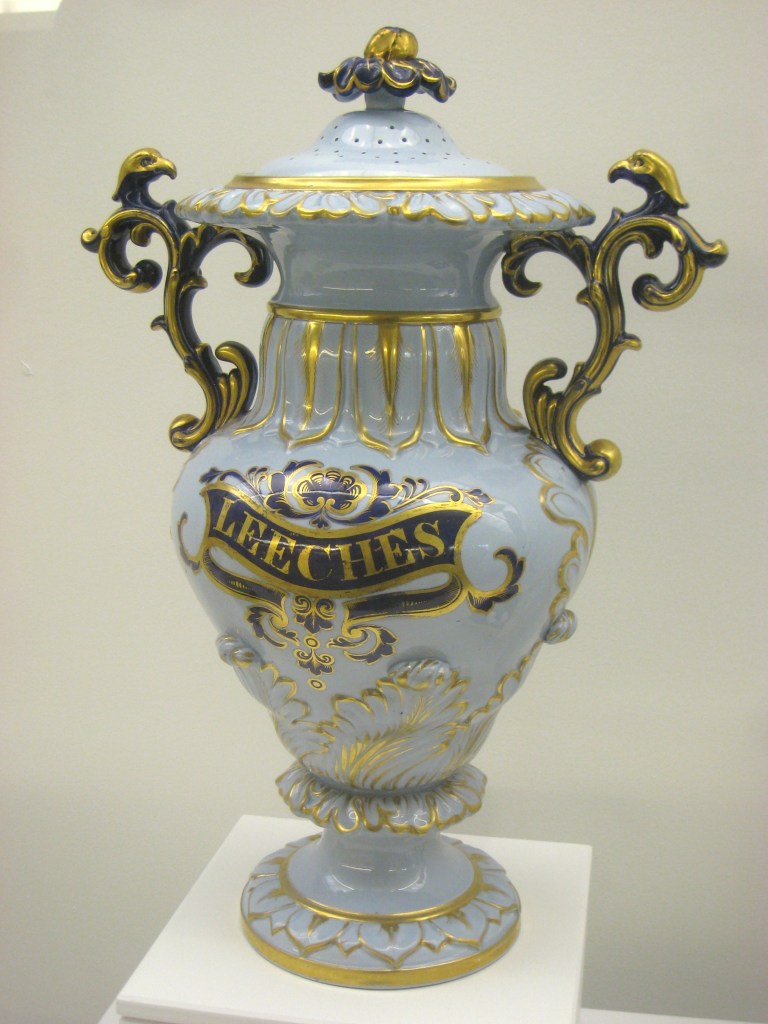
There are, in fact, live leeches on display. They’re floating contentedly in a clear glass bowl of water beside a large vase decorated with a delicate floral pattern…along with the word LEECHES in utterly incongruous, glorious gilt adorning a black banner.

The museum’s leech jar is very similar to this, only with a sweet pattern of tiny pink flowers and vines.

“The apothecary kept leeches in leech jars such as this…” the docent is saying. “It was advertising. The fancier the jar, the better the quality, people believed…”

I’m awed by the jar, that it was designed solely to hold worms. Albeit important ones… and I read once, somewhere, that leeches are amazing escape artists: A more recent druggist had a leech that chewed through a modest gauze lid covering; he found the escapee several days later, lounging on the turntable of his record player.

The docent continues: “Leeches are still in use today. We had a plastic surgeon visit once. He told us of reattaching someone’s ear and using a leech there to increase the blood flow for healing…leeches are often used when fingers are reattached…you don’t feel the leech, of course…”

We are about to move into the next room where there’s a real human skull and kits of amputation tools from the Civil War era, but I want to linger here, I have a thousand questions about the tinctures and remedies and practicesand I want to study the magnificent 1700s era painting on the right wall, above the counter where the apothecary would make pills by mixing powders and dough, rolling and cutting with a pill-roller. The artwork depicts Christ as an apothecary, with elaborate calligraphy in old German. It presides over the whole room.

But time does not wait; it moves on and so must I… prying myself away from the painting and jars and show globes, I content myself with the knowledge that a healing-herb garden waits at the end of the tour. I hurry into the next room just to make the intriguing discovery that I am now standing in the office of a Victorian doctor whose not-very-common surname is my own maiden name.

What a peculiar sense of belonging…and, I think, beginning, of something I’ve yet to name.

*******

I plan to write more about the painting on Thursday.

You can visit the Country Doctor Museum online to learn more and to view many fascinating artifacts.

Memory, like morning (on the day of a friend’s funeral)

with thanks to Denise Krebs who shared the hay(na)ku form on Ethical ELA today.

First draft:

On waking before dawn on the morning of a beloved friend’s funeral

Memory
Like morning
Shimmers with light

Gathering
For Christmas
Across the years

You
Playing Santa
Giver of gifts

Laughter
Colorful, bright
Exquisite as snow

Stories
Like wine
Better over time

Dinners
Savored moments
Ending too soon

Envisioning
Your eyes
Always Christmas-bright

Awe
At love 
Given so freely

Embracing
Many others 
Ever-widening circle

Gathering
Together today
In your memory

Celebrating
Your life
Colorful, bright, exquisite

Testimony
To faith
In Lord Jesus

Returning
your body
to your homeplace

Earth
Where our
Young selves walked

Gathering
For Christmas
Across the years

Now
In springtime
Oceans of flowers

Bloom
Like promises
Around your grave

Friend
No good-byes
Only more homecomings

Rising
From darkness
In heaven’s embrace

Memory
Like morning
Shimmers with light

Sustaining words

As I turned the pages of my academic planner from April to May, I discovered a quote from Buddhist nun Pema Chödrön…

You are the sky. Everything else is just the weather.

The implication is to just be. To remain. To not worry about things beyond your control. The storms of life may rage and wreak havoc, but not indefinitely. They pass. And they’re interspersed with moments of incredible beauty. The sky exists above clouds. It is the sphere through which the sun, moon, and stars pass…what would it mean, then, to “be the sky”? I feel more posts coming on this later…

Meanwhile, more Chödrön:

Each moment is just what it is. It might be the only moment of our life; it might be the only strawberry we’ll ever eat. We could get depressed about it, or we could finally appreciate it and delight in the preciousness of every single moment of our life.

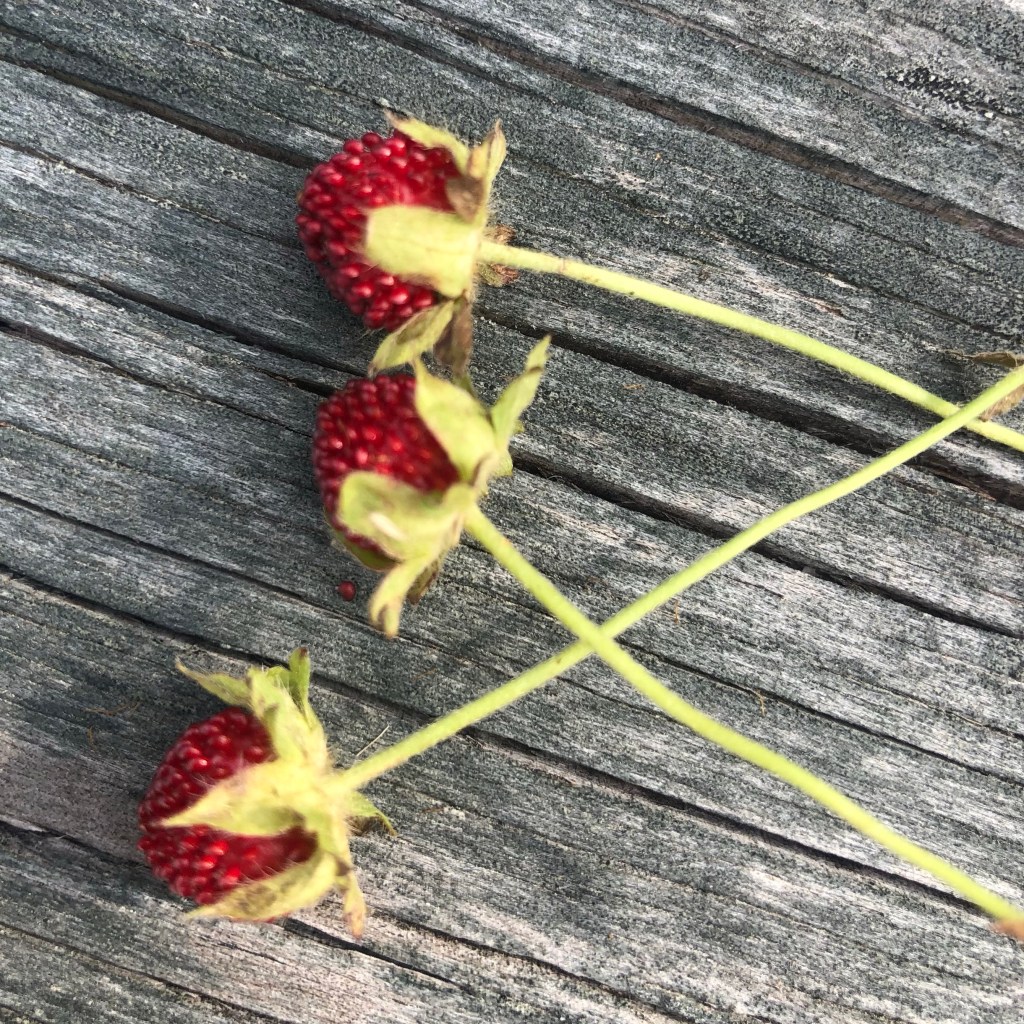
On Mother’s Day my family gathered for lunch. Sunday afternoons have an ethereal quality; they are not your ordinary afternoons. They beckon sleep, or reading, or other quiet pleasures; they also offer an outlet for expending physical energy and embracing joie de vivre, joy of living. After lunch my granddaughter, age five, needed to “run and get her wiggles out.” Her mother and I watched her running through a sea of white clover in my backyard. I’d been irritated that our lawn service hadn’t yet cut the grass but as I breathed the sweet, clover-perfumed air, I thought How perfect is the fragrance of this day. My daughter-in-law and I began identifying all the different types of plants growing with the grass in my yard with the “Picture This” app on our phones: Tall goldenrod. Spreading hedgeparsley. Ryegrass. Bluegrass (who knew?). Posion ivy on the far corner of the fence under the pines (lawn crew must be notified). Woodsorrel. Wild geranium. And wild mock strawberries, which enchanted my granddaughter. She picked them and carried them around, tiny red fruit in a tiny pink hand… my son said, “I never knew those grew here!”

There are a lot of things we never realize. Such as the value of simple moments, in the living of them. We cannot imagine how the memory of these will remain with us, like the sky, for our lifetime.

One more quote…

Rejoicing in ordinary things is not sentimental or trite. It actually takes guts. Each time we drop our complaints and allow everyday good fortune to inspire us, we enter the warrior’s world.

One of the thick, spiky weeds we identified on our backyard exploration is a species of “Everlasting.”

I said to my daughter-in-law: “I had no idea so much poetry lived in the grass.”

I think about all that would have been lost in these dappled Sunday afternoon moments, if the grass had been cut like I’d wanted. My granddaughter didn’t complain. She savored it all, blue eyes as brilliant as the sky above.

I do not know what tomorrow will bring. For now I only know we stand as we are, in our shared sky and story, moments in the making, entering the warrior’s world, a family of everlastings like those growing in the universe beneath our feet.

Where nothing is ever really ordinary.