The acrostic is an ancient poetic form, appearing in Scripture and as prayers in medieval literature. On Day Five of National Poetry Month, I use it to announce a family celebration…with a little wordplay…
Although I planned to resume writing of Easter’s Bounty in the nest on the front door wreath, Unprecedented number of little blue eggs—five!— Now, instead, I ask you to picture my family Doing a bun dance over the holiday, At least in our hearts, at this New-life announcement on Cookies and a special T-shirt: Expecting! —Exponential Easter joy!
First, the finch eggs in the nest on the front door. The fifth egg appeared this morning. We usually get three or four.Abundance!
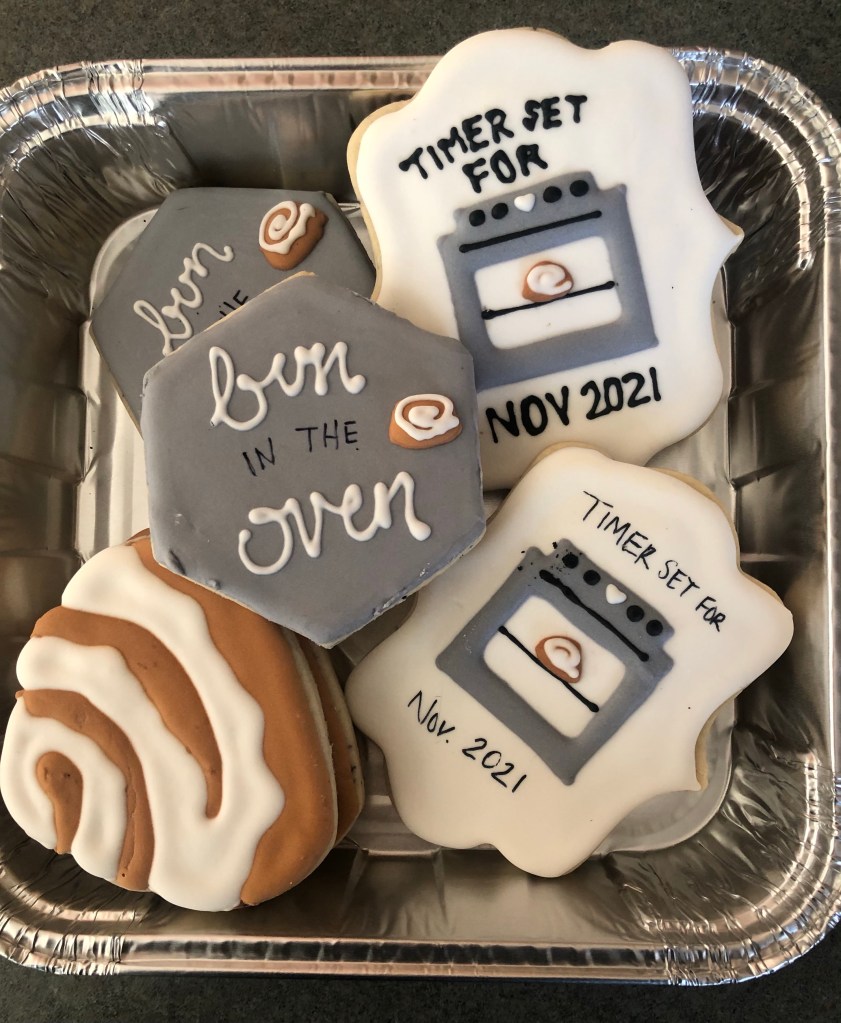
Now for the cookies: My daughter-in-law and granddaughter made them to announce the special news to my husband and me over Easter weekend …aBUNdance!
My granddaughter’s face was radiant, delivering those cookies at our family dinner. In this photo she is crying on first hearing the news. She threw herself into my son’s arms. The desire of her little heart, granted; abundant joy.
Next-to-the last day of March. Early morning. Still dark. Chilly.
I sit at my laptop, sipping coffee, catching up on my Slice of Life blog comments. The neighborhood rooster across the street crows for all he’s worth.
My husband comes into the kitchen: “Is she up yet?” he whispers.
He means our granddaughter. She spent the night. We stayed up way late watching Frozen II (again). We watched her dancing to the ending credits soundtrack, performing her own astoundingly artistic interpretation, cheeks pink, blue eyes glowing…followed by punchy laughter before the crashing.
“Not yet,” I whisper back. He retreats to his study to work on sermons.
Shortly, though, she here she comes, a gift of the dawn, Aurora’s child, barefoot in a blue flannel gown, cloaked in long, disheveled hair, ethereal smile of joy illuminating the semi-dark kitchen. Favorite lines of a Billy Collins poem come to life:
But tomorrow dawn will come the way I picture her,
barefoot and disheveled, standing outside my window in one of the fragile cotton dresses of the poor. She will look in at me with her thin arms extended, offering a handful of birdsong and a small cup of light.
My radiant dawn-child climbs into my lap. I let her read my post about Dennis the dachshund and his toy moose. At five, she reads with exactly the right inflection in exactly the right places, decoding beyootiful without batting an eye.
“That rascally Dennis!” She laughs aloud.
My husband returns, his own face alight at sight of her. “There she is!” he exclaims. “I’ve been waiting for you, Sugar Magnolia.”
He sings the opening line of the Grateful Dead song:
Sugar Magnolia blossom’s blooming…
Just so happens that our granddaughter’s middle name is Magnolia. A nod to her Louisiana heritage. A native tree here in North Carolina, too.
I think how, less than two years ago, my husband wasdead, until EMS and CPR brought him back. I think of all he’d have missed…
What matters is that we’re here together now, today, in this moment. The Grateful Alive.
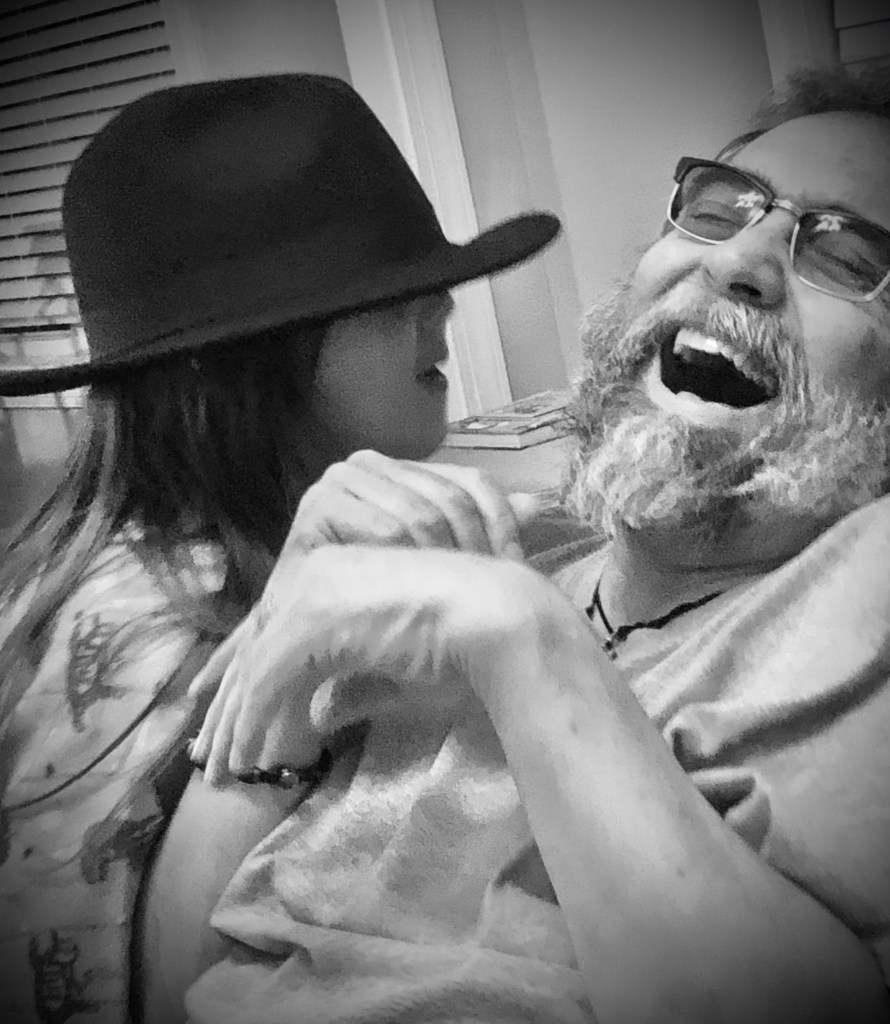
Sugar Magnolia, in one of Grandpa’s hats
When we are dressed for the day, she asks: “Can I pick out your earrings? And your necklace?”
“Certainly.”
She picks the magnolia. She and my son gave it to me for my birthday last year.
She hands me the necklace, watches me clasp it, smiles with satisfaction.
She will look in at me with her thin arms extended, offering a handful of birdsong and a small cup of light…
Just beyond the bedroom door, from the windows in the foyer, birdsong.
The finches.
I waited for them all of March, in vain. Then, here at the very end, within the space of these last twenty-four hours, a nearly-complete nest rests on my front door wreath. More on this tomorrow, when I write with the Spiritual Journey gathering on the first Thursday in April…for now all that needs to be said is that the finches always come to my door, every year except this last one. They vanished without warning, without a trace, during COVID-19. Now they’re back, making their home in the wreath.
The magnolia wreath.
Front door wreath and nest-in-progress
Magnolias, magnolias, everywhere…
They are tougher than they look. The oldest flowering plants on Earth. A symbol of love, longevity, perseverance, endurance.
It’s that word that captures me: Endurance.
It is the end of March.
We’ve endured the COVID pandemic for a whole year.
We’ve endured the reinvention of life as we knew it, school as we knew it, teaching as we knew it.
My family has endured distance, isolation, individual private battles…and we all get our second round of vaccinations over these next two days.
My husband has endured. He is alive.
My granddaughter has endured. She is the light of our days.
The finches have endured. They have returned to resume nesting.
This is my last post for the Slice of Life Story Challenge; for thirty-one consecutive days, I’ve endured. My writing has endured.
I wrote a lot of memoir in the Challenge, for memories endure. I wrote of a walled garden and roots and the need to get out of the comfort zone; I did that with some of my writing. I think now of my magnolia metaphor and look back at its deep roots in my childhood. Southern heritage. My grandmothers, steel magnolias (although they wouldn’t have thought it of themselves). Women who endured wars, deprivation, unspeakable losses. The stand over the landscape of my life like the old magnolia trees near their homes, their churches. They were the encompassing, protective shadows against the burning sun and sweltering heat, the solid coolness of the earth under my feet, where lie the curious, fuzzy seedpods of my existence, my remembering, my gratitude, my faith. From these branches waft the eternal fragrance of sacrificial love and forgiveness; nothing on God’s Earth smells as sweet.
One final curious image—it persists, so I have to figure out if and how it will fit here: When I was very small, I spent a lot of time with Grandma, Daddy’s mother. She and Granddaddy lived nearby in city apartments until he retired and they moved back home to the country when I was six. In this scene, I am around four, I think:
I am waiting in the hall for Grandma. She’s turning the lights out; we are getting ready to go. She calls my name from another room. I call back: “I am here.” My voice keeps bouncing, off the walls, off the stairs going down, down, down, into the darkness; we have to go through it before we can get to the door and the sidewalks and the sunlight outside.
“Grandma!” I cry. More bouncing voice, hollow, strange.
She’s there in an instant. “What’s the matter?”
“What is that sound?”
“Oh, honey, that’s just your echo.”
She calls out, “Hello”…her voice bounces, just like mine.
“Echoooo…” I call. Echooo-ooo-ooo, says the shadow of my voice, rolling down the stairwell.
And I am no longer scared, because now I know.
What does this have to do with magnolias?
Only that we are on our way to the park, where she would offer me bread to feed the ducks, which would come to eat from my hands, from my little extended arms…and where the magnolias still grow in abundance. The memory is a cup of light I carry with me, just as the echo of her voice remains, just as I find myself echoing her, for we are always echoes of the ones we love most. As blood circulates in our veins, so do remembered light and beloved voices, long past shadows and silence. These are things that endure.
Grandma’s homeplace was named for the dawn, by the way. She’s literally Aurora’s child.
But tomorrow dawn will come the way I picture her…
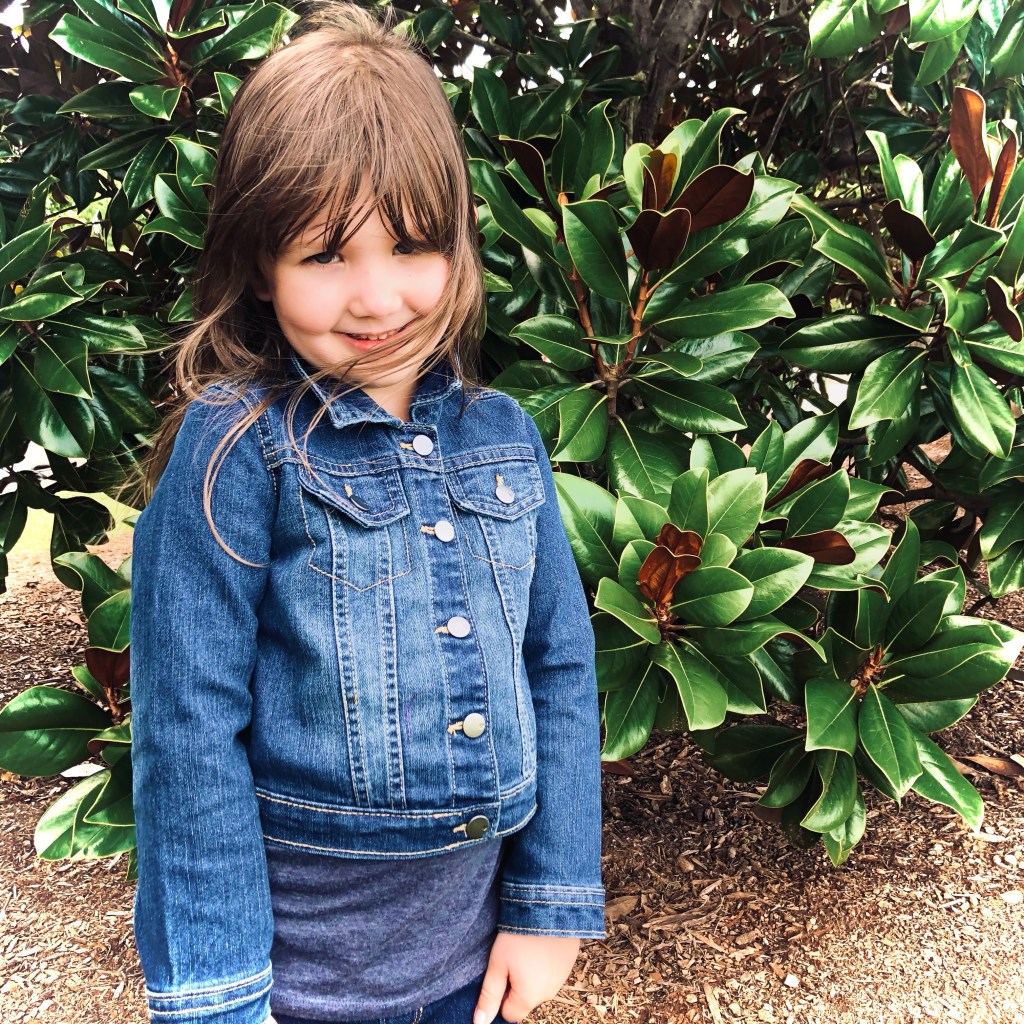
“Stand right there, honey. Let me get your picture by that tree,” I tell my granddaughter, on our first trip to the park.
It’s a different park. A different tree.
But still, and always, a magnolia.
Our Sugar Magnolia, by “her” tree.
*******
With abiding gratitude to the community at Two Writing Teachers during the annual Slice of Life Story Challenge, which concludes today. It was a joy to write alongside you every day in the month of March. Thank you for every cup of light you offered; I will savor the echo of your voicesfor many days to come.
She spies the box on the top of the shelf in “her” room (I call it the “Spare Oom,” kindred Narnians):
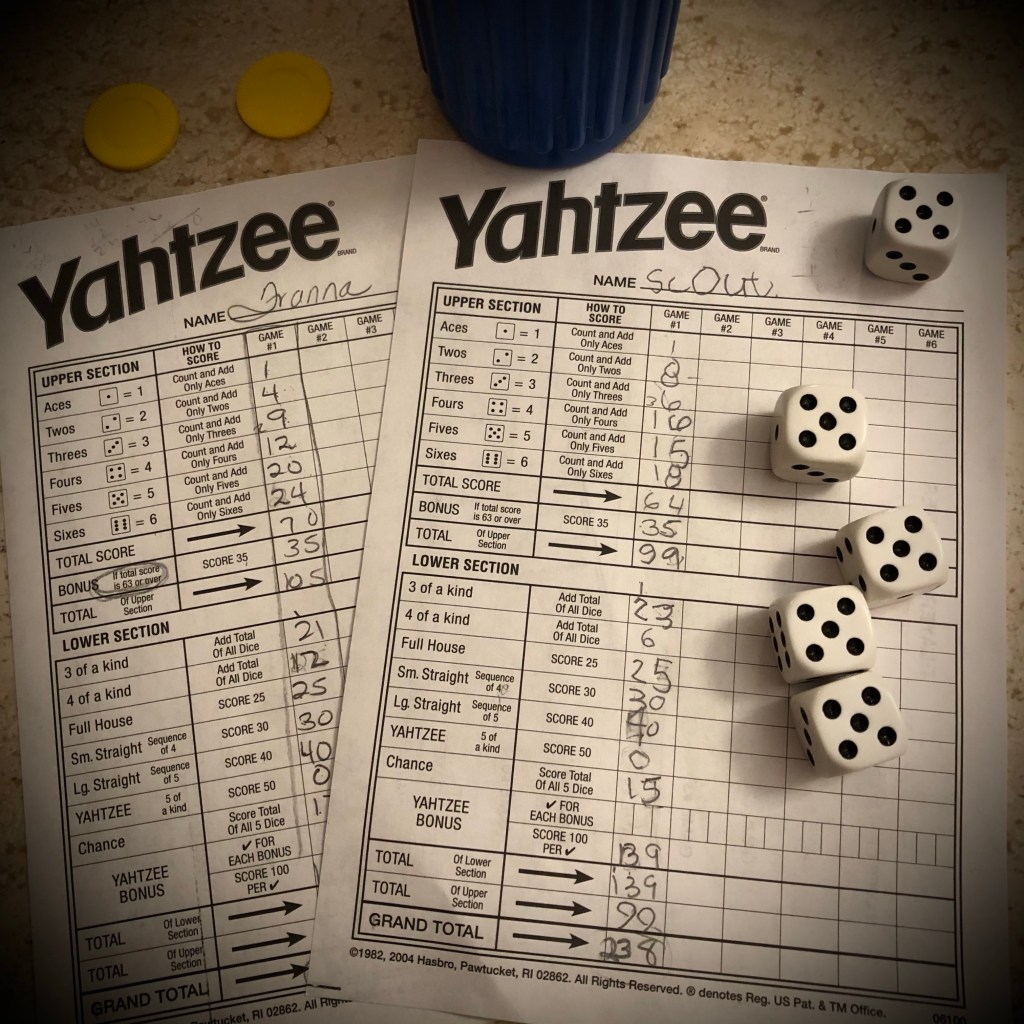
“What’s that game, Franna?”
“Oh, that’s Yahtzee. I used to play it all the time when I was growing up.”
“How do you play?”
Sounds like an invitation to me.
I reach past Spy Alley, Catchphrase, Trivial Pursuit, the chess set, and Twister (that game floored her. Really. Not just trying to be punny).
Dear old Yahtzee.
The dice rattle inside the box…and I remember…
Whole afternoons elapsing on the worn living room rug, sunlight waning behind the lace curtains, sometimes distant thunder beyond the rain-slapped windows, none of it mattering in the wide circle of lamplight where my sister and I hunched over the scorecards. The exultant cry or groan of despair, depending on whose throw landed all five dice on the same number. Yahtzee!
Evenings in my aunt’s spotless, light-dimmed, vanilla-scented den, legs criss-crossed, drinking Dr. Pepper in glasses with curiously-cylindrical ice cubes clinking (ice-makers were uncommon, then). The lovingly-fierce competition between my young aunt and uncle, their laughter, their encouragement: Good choice, Hon. Sometimes you just have to take it on Chance…
The look of perplexity on kids’ faces at math camp when I bought out the box after a lesson on probability; their brows furrowing as they learned the terminology: three of a kind, four of a kind, full house, small straight, large straight; their faces soon glowing with new zeal; shouts of YESSSS! accompanying fist punches in the air…
Hours at the kitchen table, the warmth of butter-yellow walls, my mother blowing on the dice, sending my sister and me into giggles; we start blowing on our dice, too. Come on, sixes, come on, sixes…years later, as I leave the house for a date: my mother at the kitchen table with a friend from across the street, whose story I never fully knew, only that she’d suffered a mental breakdown and had been taken in by relatives. Her hands shake as she lights one of my mom’s Salems, blue eyes wide and a little too bright, a nervous smile flickering across her face as the dice roll in her favor. Swirls of white smoke heavy in the air, floating after me on the sound of my mother’s cackling laughter, hilarious in itself, uniquely uninhibited, ever-gleeful…
So much depends on the rolling of the dice, on the way you choose to take what comes.
I lay out the pencils and scorecards, scoop up the dice, place them in my granddaughter’s little cupped hands.
“All right, Baby. Let me show you how to play.”
*******
The annual Slice of Life Story Challenge with Two Writing Teachers is underway, meaning that I am posting every day in the month of March. This marks my fifth consecutive year and I’m experimenting with an abecedarian approach: On Day 25, I am writing around a word beginning with letter y.
It was a glorious fall afternoon when I took my youngest son, then four, on a quick trip to the hardware store. I was preparing to paint some baseboards in the house.
He was playing his favorite video game: Banjo Kazooie.
“You’ll have to pause that,” I told him. “We have to go buy some paint supplies. You can play it when we get back.”
“Okay,” he replied with good humor, “I’ll put it on the Eyes.”
The Eyes meant the pause screen where these colorful creatures called Jinjos just sit, blinking their big eyes.
My boy loved the Eyes. Would often pause the game just to watch them.
I could not see why the Eyes were so enthralling, but… moms are busy people, and I had things to do.
He paused his game with a last loving look at the Eyes, and off we went.
The round trip took about fifty minutes.
Upon arriving home, I thought it odd that a random piece of wood was lying on the back deck. It wasn’t there when we left…
Odder still: the back door standing ajar.
And that the bottom of it had been split wide open… hence that random piece of wood, and more pieces, in the doorway.
I couldn’t quite make sense of it.
I stepped into the house.
The comforter from my little boy’s bed lay in a heap in the middle of the living room. The soft blues, green, yellows, and oranges so out of place, there…
The TV was gone.
And the Nintendo.
In those split seconds, you don’t think I am currently messing up a crime scene, here in my house.
You think, What am I seeing? What has happened here?How much more…?
You go running room to room to find out.
It took only seconds to ascertain. All the TVs, gone. Older son’s gaming system, gone. Husband’s desktop computer, too. One pillowcase from my bed gone; bedclothes rumpled and mattress shifted where…where someone must have run hands underneath (do people really hide cash under their mattresses nowadays?).
My wedding rings still lying on the dresser in plain sight (I was planning to paint, remember) but the closet door open and my husband’s jewelry box, containing some of his deceased father’s cufflinks along with the shells from the twenty-one gun salute at the military funeral…gone.
“Mama! Mama!” My son’s voice, in the living room.
I race back down the hall.
He’s standing, facing the spot where the TV used to be. He looks up at me, confused:
“Where are the Eyes?”
That’s when it all snapped into focus:
“I have to call the police, honey. Bad strangers came and took the Eyes…”
*******
Shortly after that is when the nightmares started. They lasted long beyond the years of child night terrors. Waking up believing someone was in the room, when no one was.
He couldn’t understand it, why bad strangers would come and take the Eyes. He asked over and over: “Why?”
We eventually replaced the Nintendo, eventually got another Banjo Kazooie game.
But a young, tender psyche paid a price. It was violated, just as our home was violated.
Bad strangers haunted his dreams for years.
One might expect that he’d grow up hardened, possibly angry, understandably mistrustful.
He is none of those things. The nighttime xenophobia never diminished the brightness of his being.
In his twenties now, my son is a gentle spirit. Kind, quiet and deliberate, with a quick, razor-sharp wit. He’s our musician, listening over and over to rhythms and patterns and chords that he can replicate on a number of instruments. A singer, a natural harmonizer; I know he hears things many of us do not, or maybe it’s just that he hears them differently and more beautifully. At seventeen, he achieved a childhood dream: He got a position as a church music director.
He’s recently left it for another calling. A full-time job, see.
Part of it involves going into people’s homes to take away something precious.
I don’t imagine many young people dream of going into the funeral home business but that is what my youngest has chosen. He refers to it as “a ministry.” He now encounters strangers in their time of greatest need, speaks words of comfort to them, enters their homes, and helps to carry their loved ones away for final arrangements. On these “death calls” he leaves our house wearing a tie, dressed in his best, out of respect for the strangers he will encounter and their dead.
He is at peace with himself and with others. A calming presence.
It occurs to me that the opposite of xenophobia is philoxenia, “friend to strangers.” It is the basis of the Biblical word translated as hospitality.
A good stranger, then, to the people he encounters. Once he saw an elderly lady with a walker eating alone in a restaurant; he paid for her meal along with his own, and left without telling her.
My precious boy, overcoming the darkness, being a light in so many ways… has it ever occurred to you that you are the Eyes.
To this day, the boy loves “the Eyes” – he even has a stuffed collection of Jinjos. In the video game Banjo Kazooie, the player must find where the witch has hidden the Jinjos, and rescue them.
*******
The annual Slice of Life Story Challenge with Two Writing Teachers is underway, meaning that I am posting every day in the month of March. This marks my fifth consecutive year and I’m experimenting with an abecedarian approach: On Day 24, I am writing around a word beginning with letter x.
On the last Sunday in July, 2019, my husband went to the gym after church. He had a great workout on the stationary bike (always proud of accomplishing five miles in fifteen minutes).
He got in his truck to come home.
That is the last thing he remembered for a long time.
At the house, our dog went crazy, barking. Someone in the driveway. Police officer: Your husband’s had an accident. Do you have a way to the hospital… truck ran off the road into the woods…appears to have been a medical event…sorry, I don’t know how bad it is. EMS was working on him when I left…
Both of our grown boys happened to be home that afternoon. We rode together to the ER, not knowing what we’d find.
My reeling mind wondered if their black suits were clean…in case…
At the hospital, a nurse was waiting for us. She ushered us into a side room.
Massive heart attack, said the ER doctor, but he’s alive. He wasn’t when EMS got to him.He was in cardiac arrest. They did CPR, defib…they are heroes…heroes…
Heart attacks killed his father and grandfather in their fifties.
After emergency surgery, he underwent induced hypothermia to allow his brain time to rest from the trauma. No one knew how long he’d gone without oxygen. EMS had arrived on the scene quickly, as the station is just up the street from where the truck ran off. My boys and I learned that their dad endured forty-five minutes of CPR and ten – TEN – shocks from the paddles. We would learn that his sternum was broken. Attending CICU physicians warned: After hypothermia, we’ll do a waking test. There’s no guarantee he’ll wake, or how extensive the damage will be to his brain…
As we endured those long hours, we learned that his truck was barely dented as it ran off the road, that it stopped just short of a deep ravine in the woods. We were told that he swerved into oncoming traffic and back into his lane before running off on the right. He never struck another vehicle. People behind him called 911. One thing different, and all would be different…
As one doctor said: Everything aligned for him. Everything.
He did awaken. He knew us. He was soon able to ask, in a raspy voice after coming off the ventilator: What happened?
It would be a long recovery involving another hospital stay and more surgery…but he recovered.
He could remember leaving the gym, but he could not recall anything from earlier that month, or from many months before. All of his long-term memory remained intact; all his stories, all his sports trivia and stats. There was just a period completely erased, leading up to the heart attack. He could not recall a thing from our family vacation to the beach earlier in July, the glorious time we had.
The brain’s way of protecting itself from pain, our oldest son said. I had a professor who told us about this in class. It’s not good to try to make a person remember…
He didn’t recognize the scenery on the way home from the hospital: Why are we turning here? Everything looks so new…have I seen this before?
The doctors said, Some memories may return as he heals. Some may not. It’s hard to say; everyone is different.
After a couple of months, he returned to his work at the church. He’s a minister. The number one question people had after he began regaining strength: Did he see anything? when he was… you know… ‘gone’? I mean, he IS a pastor… such curiosity tinged with hope, in that questioning.
All he could remember, much to people’s disappointment: It was just like going to sleep. No pain, just fading into sleep.So peaceful.
Then one day he saw pictures of our family vacation and recognized the giant tortoise we chanced upon at a roadside display: I remember that!
Random bits returned to his mind, here and there.
Then on another day, much later, he told me: I heard voices.
What do you mean, you ‘heard voices’?
When my truck ran off the road.When everything was going dark.
What did they say?
They said, “He’s in trouble. We have to get him off the road.”
Did you…did you recognize the voices? Do you think that maybe…well, it could have been just the EMTs…
He shook his head. All I know is, I heard them when I was driving and I thought, if I can just get over there to the grass, to that little hill… where that sunset is…everything will be okay.
He left me staring after him as he headed out to the park for the eight-mile hike he makes now, several times a week.
He’s in trouble. We have to get him off the road…
Everything aligned for him. Everything.
I ponder the mystery of memory, and the miraculous…in ceaseless awe that he is returned to us, restored, rejuvenated, whole.
In his own words, with his characteristic wit and big, contagious laughter,as “a member of the Lazarus Club.”
*******
Photo is entitled “The Day Black with Night” and is in the public domain on Creative Commons with this verse: “Go for help to Him who makes Orion and the Pleiades, by whom the deep dark is turned into morning, who makes the day black with night; whose voice goes out to the waters of the sea, sending them out over the face of the earth: the Lord is His name.” —Amos 5:8.
The annual Slice of Life Story Challenge with Two Writing Teachers is underway, meaning that I am posting every day in the month of March. This marks my fifth consecutive year and I’m experimenting with an abecedarian approach: On Day 22, I am writing around a word beginning with letter v.
She loves jokes. She just doesn’t get the delivery.
“Okay, okay,” I say. “You’re going to have to practice. Let me tell you a joke that will CRACK PEOPLE UP. My mother used to laugh every single time. It was the best joke.” (Really it is the only one I can remember at the moment).
Her blue eyes shine. She bounces. “Tell me!”
“First I have a question: Do you know what unique means?”
She looks puzzled. “I don’t think so.”
“It means one of a kind, a thing that is different from anything else in the world.”
“Oh, like very special.”
“Yes! Exactly! Unique means very special and not like anything else. So are you ready for this joke?”
She nods. “Ready!”
“Here goes… How do you catch a unique animal?”
She pretends to think, hand on chin. “I don’t know!”
“You neek up on it. Get it?”
She looks blank.
“Like, you sneak up on it but instead of ‘sneak’ you say ‘neek’: You neek up on it…”
“Ohh, you take off the ‘s’ and… neek!” She dissolves in giggles.
We practice this over and over:
How do you catch a unique animal?
You neek up on it!
She belly laughs, every time.
When my son and his wife come to collect her, she runs to them with glee:
“Franna taught me a joke!”
“Great,” says my son, with absolutely NO enthusiasm. “She likes jokes, Mom; she doesn’t get how to tell them…”
“Ahem,” I warn. “She’s been working hard on this.”
I am sure I detect a tiny sigh, but my son says: “Okay, let’s hear it.”
“How do you catch a unique animal?” She can barely contain herself. Wait for it, wait for it…
Her parents look at each other and shrug.
“We don’t know. How do you catch a unique animal?” asks her mom.
“YOU NEEK UP ON IT!”
They crack up, and the look on her face…priceless.
Little unique creature. You neek up on my heart, over and over and over again.
Kinda like that joke.
My son says: “She just keeps telling it over and over, Mom. We’ve heard it a million times. It was funny like the first two times, but…”
“It’s her joke. Let her enjoy it.”
She’s a masterpiece in the making, see. At age five, she’s read Charlotte’s Web. Independently, with some questions about how to pronounce some words…I wondered how much she understood, really, but then my daughter-in-law tells this story: They were baking the other day and my unique animal was rolling out her dough with extreme care.
“Oh, you’re doing a nice job,” said my daughter-in-law.
“Thank you,” said my granddaughter, sprinkling flour. “It’s my magnum opus.”
“Your… what?”
“Magnum opus. It means ‘great work’.” And she patted away at the dough.
Great work…like mastery of that joke.
Dear, dear Charlotte… messages from one unique animal to another… magnum opus, indeed.
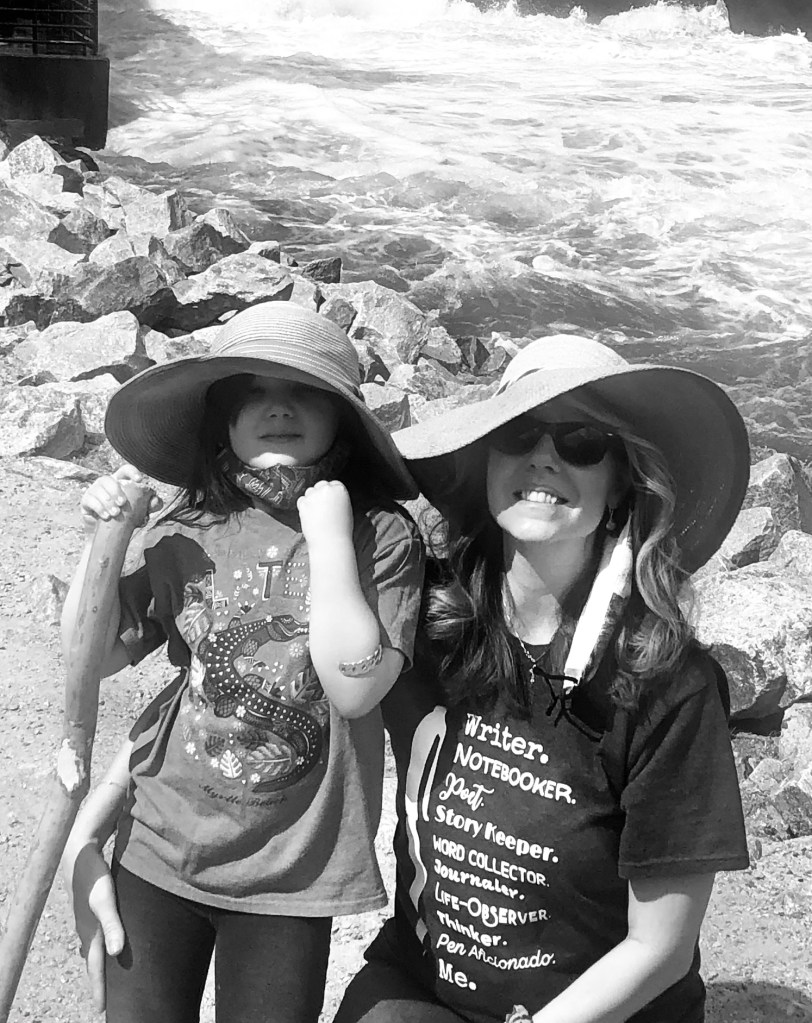
A unique moment with my unique granddaughter. We went to see the waterfall at the park. She’s holding my husband’s walking stick and wearing my “fancy” watch on her left arm, plus one of my sunhats. We pulled our masks away for the photo.
*******
The annual Slice of Life Story Challenge with Two Writing Teachers is underway, meaning that I am posting every day in the month of March. This marks my fifth consecutive year and I’m experimenting with an abecedarian approach: On Day 21, I am writing around a word beginning with letter u.
While National Mental Health Awareness Month (May) is still weeks away, the COVID-19 pandemic has called greater attention to the need for support. Youth.gov explains the purpose of the national focus: “Mental Health Month raises awareness of trauma and the impact it can have on the physical, emotional, and mental well-being of children, families, and communities.”
I note that children are mentioned first. They are at the mercy of the grown-ups, and when the grown-ups in their lives are suffering, children suffer. They often don’t understand or have a framework for understanding, not for years to come, or maybe ever. To a child, your norm is your norm. You have little to no power of your own. Think of how long the Turpin children suffered, before one managed to escape and get help.
Last month, in the neighborhood of the school where I work, a little girl was found dead with her mother in an apparent murder-suicide. I didn’t know this child; she wasn’t one of our students. But I have mourned her, mourned for whatever she suffered in her short life, mourned that a mother, unable to cope with whatever lies in her untold story, would resort to taking the life of an estranged partner and then her child.
People speak of unbreakable bonds, of the ties that bind. Sometimes those threads are very, very fragile.
Some of the threads running through the background are beautiful and bright, even as the family portrait bleeds away from the canvas.
Sometimes destruction doesn’t come all at once, but by a long, slow unraveling.
Threads
This morning I trimmed the threads off of my patchwork writing journal.
As I balled them up to throw them away
I realized the tangle of color in my hand.
They spoke to me: Remember?
Oh yes, I used to see you all over the floor when I was a child.
Rolling lazily across the hardwoods when we walked by
or nestled in the frayed carpet of the living room.
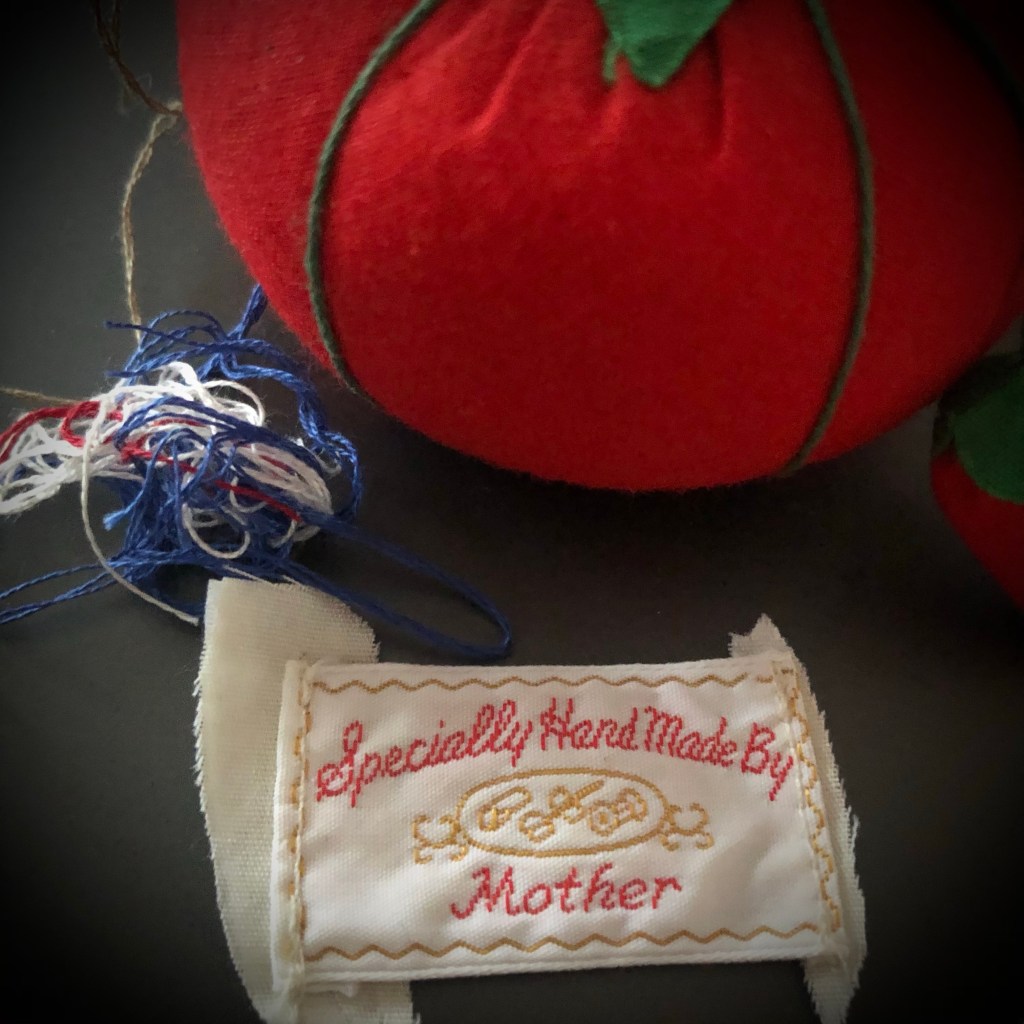
Fragments of my mother’s handiwork
vestiges of the artist she was
crafter of clothes we wore
tailor for many more.
Who’d have believed that such a creator
could destroy so completely?
A family of threads, each one its own vibrant color
in seams ripped apart
scattered far and wide
drifting on
and on
and on.
*******
The annual Slice of Life Story Challenge with Two Writing Teachers is underway, meaning that I am posting every day in the month of March. This marks my fifth consecutive year and I’m experimenting with an abecedarian approach: On Day 20, I am writing around a word beginning with letter t.
The poem has been sitting as a draft for exactly two years today while I pondered publishing. I wrote the original draft as a participant in professional development for literacy coaches, of all things. I can’t remember the prompt now, only that we were to share our poems with a colleague.
Is there a childhood toy that stands out in your memory? For me, that’s Snowball.
He’s one of my first experiences with loss.
*******
Kindergarten. Show-and-Tell. It is my favorite part of the day and today I am especially excited: I’ve brought Snowball, my toy dog. He sleeps with me every night, he eats with me, he does everything with me except take a bath, because Mama says that will ruin him.
This is Snowball, I tell my friends, sitting in a circle on the rug for Show-and-Tell.
I hold him up.
Oooooos and aaaahhhhs, because Snowball is so beautiful. His yellow ears and tail are made of ‘real’ fur. One ear has a little bit of ketchup on it from falling into my plate while I was eating fries. His stuffed body is woolly white, which is why I’ve named him Snowball.
I tell my friends: I saw him on a shelf at the store and Grandma bought him.
They all want to hold him and stroke his silky ears.
When recess comes, I decide to take Snowball out to the playground.
We have a really tall sliding board on our playground. It’s red and silver, not so shiny.
We take turns. I hand Snowball to a friend and climb, climb, climb to the top of the slide. Whoosh! It’s almost too fast, but SO fun. I make sure to hold my feet high for sailing over the mud puddle at the bottom, that worn-out place made by many, many feet landing there.
An idea: Snowball should have a turn.
Hey, Snowball wants to slide! I say.
My friends hop up and down. Let him slide! Let him slide!
Susan E. is standing beside me. When I climb up and I let him go, you catch him for me, I tell her.
I will! says Susan E. She moves toward the bottom of the slide.
I walk around to the tall, tall ladder. You will LOVE this! I tell Snowball. I give him a squeeze.
I climb, climb, climb, hanging onto the rail with one hand, onto Snowball with the other.
At the landing, I call down to Susan E.:
Are you ready?
Yes! She leans over the puddle with her hands held out.
I’m gonna count to three and let him go!
Okay! Susan E. shouts up.
One
two
three…
here he comes!
I release him.
Snowball slides so fast, so much faster than me…bumpity-bump…
—Susan! calls a friend from the sandbox.
Susan E. turns her head.
—Susan! I cry from the top of the slide.
But it’s too late.
NOOOOOO!
With a soft splash, Snowball lands in the mud puddle.
—SNOWBALL! I slide down like a crazy person, scrambling, clawing…
Susan E. stands there, frozen. Then I’m sorry! I’m sorry!
I lift Snowball out of the puddle. He’s soaked through. His woolly white body is gray-brown; dirty water drips from his beautiful silky ears. They’re flat against his head, silky no more.
Sobbing, I carry him back to the classroom. I wrap and wrap him in paper towels. I cry the whole walk home after school.
Mama, I think. Mama will fix him.
When I get home, I pull the wet paper towels off to show her Snowball’s mushy, muddy body.
Honey, I can’t fix him, she says. He is ruined.
ruined
ruined
ruined
—Can’t you just put him in the washer and dryer? I am crying so hard that I can hardly speak.
It is my fault.
my fault
my fault
She shakes her head. He’s not meant to be washed that way. He’d probably come apart.
She says we have to throw him away.
I beg, I cry, but Mama says there isn’t any choice. It has to be done.
I wrap Snowball back in the muddy paper towels. I hold him close one last time, shaking with terribleness. I am sorry, Snowball. I am so sorry. I will always love you.
I lay him in the trashcan.
I cry in my bed all night long. Snowball is not there, will never be there again, to comfort me.
*******
Is it childish that, five decades later, writing the memory, I still cry...
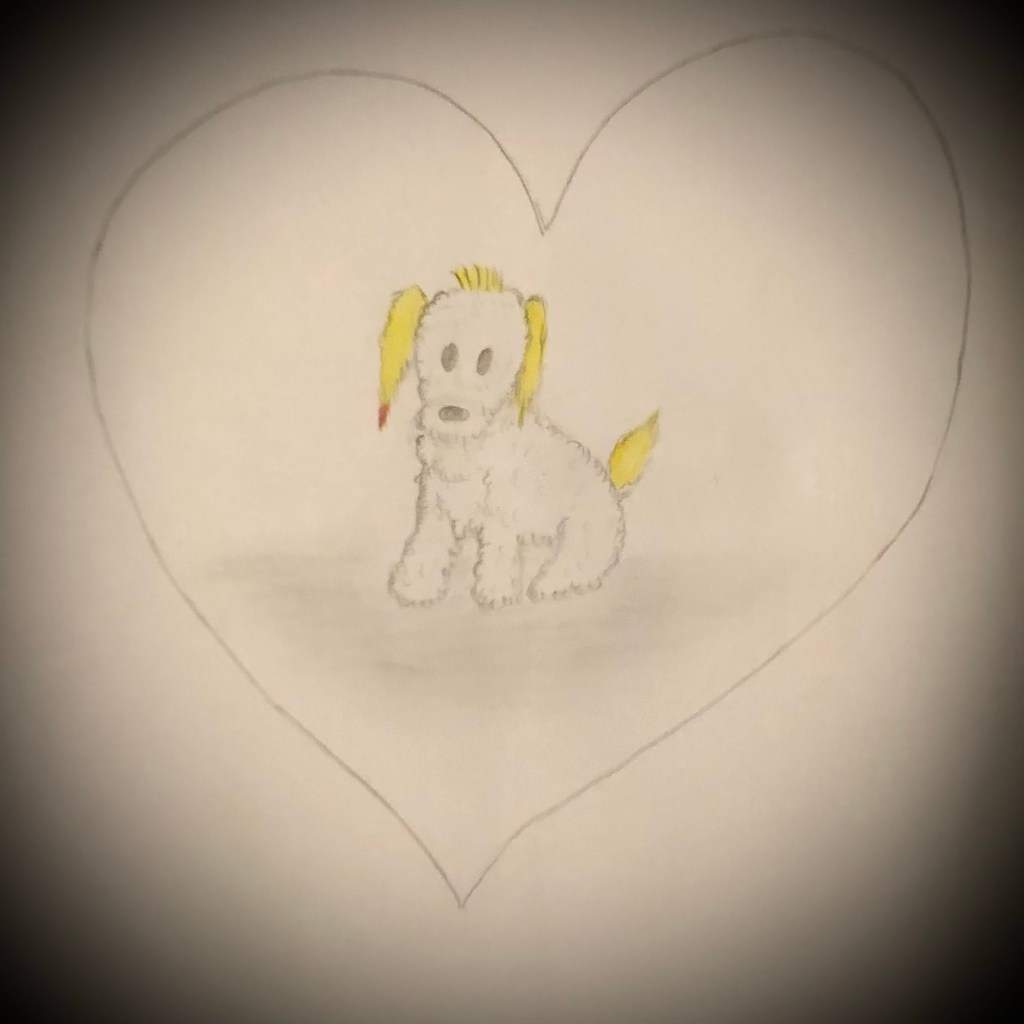
I once drew him for students during writing workshop, when they asked if I had a picture. Even the ketchup on his ear.
*******
The annual Slice of Life Story Challenge with Two Writing Teachers is underway, meaning that I am posting every day in the month of March. This marks my fifth consecutive year and I’m experimenting with an abecedarian approach: On Day 19, I am writing around a word beginning with letter s.
Warning: I am sorry for what you are about to read. I was sorry I lived it, at the time.
When my grandparents moved “back home” to the rural countryside after Granddaddy’s retirement, they began converting a bedroom to a bathroom in the house where they raised three children in the 1940s and 50s. I was around six when this particular event occurred. I couldn’t imagine a house without a bathroom (or a phone, but that comes later). My dad told stories of growing up without a bathroom: everyone took turns bathing in a tub by the heater in the living room, behind a blanket hung from a string. So, up to this point, there was an outhouse in use; I have no memory of that, but…
The perfectly beautiful, modern bathroom was soon finished at my grandparents’ home, although they occasionally referred to the toilet as “the pot” throughout the remainder of their years. I can’t recall seeing the chamber pot ever again. Thank heaven.
*******
The annual Slice of Life Story Challenge with Two Writing Teachers is underway, meaning that I am posting every day in the month of March. This marks my fifth consecutive year and I’m experimenting with an abecedarian approach: On Day 16, I am writing around a word beginning with letter p, which could really have gone in a number of directions here…
Special thanks to Kim Johnson for the invitation to write a vivid childhood memory this week on Ethical ELA, inspiring this poem.
It looks like a glass teardrop there in my hands. I tip it this way and that, watching the tiny white pieces inside floating up and down in the clear liquid, catching the light and glowing with bits of colored fire. I’ve never seen anything so magical.
“Grannie, what IS this?” I breathe. I can see it’s a necklace. It has a little cap of silver leaves and a silver chain.
She understands. “A floating opal,” she replies, rummaging through her jewelry box.
I can’t look at anything else.
I wonder about the liquid. Is it water? From where? A magic spring bubbling up in a wizard’s garden? What if it isn’t water but tears cried by an enchanted princess and collected in the teardrop-shaped globe as a powerful talisman? Why is the opal in little pieces and how can there be such fiery red, blue, and green in its luminescent whiteness? Colored fire burning in water…is there a spell on this floating opal? What does it MEAN?
I don’t even realize how spellbound I am, or how long I would sit staring at this otherworldly object, until Grannie speaks, breaking the hypnosis:
“You can keep it, if you want.”
*******
I’ve loved opals ever since. Their beauty, their symbolism, their lore. They’re said to be stones of emotion, freedom, and independence; that certainly sounds like my Grannie, who had a fiery streak herself. It sounds like what she may have wished for me. Opals also have a mixed-bag reputation of misfortune and hope, and once it was believed that an opal wrapped in a bay leaf would render a person invisible; it was accordingly dubbed patronus furum, “patron of thieves,” says the International Gem Society.
Come to think of it, I never did ask Grannie how she came by this floating opal…not that she would have taken it. Surely not. But as freely as she gave it, I wonder: Might it have belonged to my Papa G’s first wife who died years before? A floating opal necklace like this dates to the 1940s…
No matter, really, as was it my grandmother’s to give thirty-something years later, and I was the receiver.
Recently I stumbled upon this story about opals I’d never heard before One more mesmerizing, mysterious thing… courtesy of the International Gem Society:
In a chapter of Sir Walter Scott’s 1829 gothic novel, Anne of Geierstein, we learn the unusual story of the enchanted and mysterious Lady Hermione.
The grandmother of the titular character, she appeared to possess magical powers. At times, she seemed more an indefatigable spirit — an ignis fatuus or will-o’-the-wisp — than human. She always wore in her hair a golden clasp with an opal that “amid the changing lights peculiar to that gem, displayed internally a slight tinge of red like a spark of fire.” This gem seemed to reflect her moods, showing “a twinkling and flashing gleam which seemed to be emitted by the gem itself” whenever she became animated or agitated, “as if it sympathized with the wearer’s emotions.”
On the day of her daughter’s christening, drops of holy water struck her opal, which “shot out a brilliant spark like a falling star, and became the instant afterwards lightless and colorless as a common pebble.” Hermione then collapsed. Two hours later, all that remained of her was a handful of gray ashes.
So. A grandmother, a granddaughter… named Anne.
Let me just say that Ann is my middle name.
I will not even address the name Hermione in this legend; I will just let Harry Potter fans savor that on a whole ‘nother level with me.
And let me also say that somehow, in the passing of the years, Grannie’s floating opal got misplaced. When one of my babies snapped the chain long ago, I put the teardrop pendant somewhere for safekeeping. I finally found it in a little heart-shaped velvet case inside a larger jewelry box.
The globe had separated from the silver-leaf cap. The liquid had dried up. All that remained were the little pieces of broken opal.
Tears welled in my eyes; I couldn’t help wondering if the opal stopped floating when my Grannie died.
But, if I ever write a fantasy someday, you can be sure a floating opal will play a significant role.
*******
The annual Slice of Life Story Challenge with Two Writing Teachers is underway, meaning that I am posting every day in the month of March. This marks my fifth consecutive year and I’m experimenting with an abecedarian approach: On Day 15, I am writing around a word beginning with letter o.










 lit bits and pieces