The kitten’s song

My favorite teaching moments are those when classroom teachers have invited me in to model the writing process. This occurs a lot less than it used to, as writing workshop in my district has been replaced by a curriculum with embedded writing. I’ve been remembering those moments lately. I miss walking in with a list of ideas for students to choose from. I miss drafting and revising in front of them while they ask questions and make suggestions regarding artistic or stylistic choices. I miss hearing the flood of their own ideas, their own experiences … and sharing mine with them through writing. Perhaps that’s what led me to go back and reread those mentor texts.

The writing of this one was, to me, the most memorable. I wrote it over several days for a fifth-grade class studying memoir. I explained that one way to make memoir come alive is to pick a moment of strong emotion and pull the readers in so that they feel it, too. I asked if they wanted me to write about a moment from my life when I was happy, sad, embarrassed, angry, or afraid.

They were tough. They said: “A time when you were sad. Make us cry.”

Okay …

They chose, from the topics I gave them, ‘the sick kitten.’

And so I walked back into my memory, and wrote.

Here’s “The Kitten’s Song,” with a bit more polish at every writing (for revision is never really over, is it).

*******

Free kittens – take one.

I saw the sign propped on a chair at the entrance of my college cafeteria. A disheveled guy—another student, I guessed—stood there holding a cardboard box. I hurried over to look inside:

One dark little ball of fur.

“Is that the last kitten you have?”

“Yeah,” he replied. “No one wants her because of her tail.”

“What’s wrong with her tail?”

The guy scooped up the kitten and showed me her backside. She didn’t really have a tail. Just a stump.

“What happened to her?”

“She was born this way. The only one in the litter like this.”

The tiny black creature sat looking up at me with big yellow eyes. She meowed.

Poor little unwanted baby.

There was, of course, only one thing to do:

“I’ll take her!”

I named her Moriah after a magical black cat in a wizard story, The Forgotten Beasts of Eld.

When she was nine months old, Moriah had seven kittens. Some were solid black, like her; the others had gray and white stripes. The three boys had long tails but the four girls had stumps like their mother.

All of the kittens were beautiful to me. The day after they were born, my mother and I were admiring them when we realized something was wrong.

In the bed I’d made out of a low box lined with a soft blanket, Moriah lay nursing her babies. The smallest kitten, the runt, had been pushed away by her bigger brothers and sisters. This tiny ball of gray and white fuzz rested at the side of the box by herself. When I picked her up, I saw a big open sore where her tail was supposed to be.

“Mom!” I cried, showing her the raw place. “Look at this! What happened?” A horrible thought entered my mind. “Do you think something did this to her? Did Moriah —would Moriah — bite her kitten’s tail off?”

Mom shook her head. “Gracious, no. I think the kitten was just born like this and we didn’t notice until now. Looks like her tail never finished forming. Could be spina bifida. It happens to human babies sometimes, when their spines don’t seal all the way. It’s probably because of Moriah’s tail defect, as she’s passed on to her daughters.”

“Will it it heal?”

“It might. We’ll have to keep an eye on it.”

“Poor little thing,” I mourned, stroking the kitten’s head with one finger.

I tried to help. I put the kitten in the pile of her brothers and sisters so she could get to the milk. They still pushed her away. I moved the biggest kitten, who loudly complained, and put the runt kitten in his place, but she didn’t try to nurse.

“What are we going to do, Mom? If she doesn’t get any milk, she’ll die.”

Mom said, “Bring her to the kitchen. I’ll get a medicine dropper.”

I came to the kitchen and sat at the table, holding the kitten. She weighed no more than an egg, just a soft warm spot in my hand. Her day-old eyes were still closed. Mom washed the medicine dropper we used when we had earaches, then she took some milk from the refrigerator and warmed it in a pan on the stove.

The kitten purred in my hand, a pleasant little vibration, and I suddenly felt that she needed a name.

If I name her, maybe she’ll get well and strong.

I was trying to think of a name when Mom handed me the dropper filled with milk.

“Feed your baby,” she said.

The dropper seemed too big for the kitten. When she opened her pink mouth, my heart leaped with hope, but she only made a cry, the tiniest cry I have ever heard in my life, so small that it was hardly a sound at all.

“Mom, I can’t do it.” By now my hands were shaking.

“Give her to me,” said Mom.

My mom could fix anything. Once she rewired our oven all by herself. She made a lot of our clothes and took in sewing for other people. She could mark patterns on fabric, cut it to precision, and every piece turned out exactly right. As I watched that tiny gray-and-white kitten in my mother’s capable hand, I was sure Mom could get her to take the milk.

I remembered a song then, from a movie I watched with Mom when I was little. The movie was her favorite, The Sound of Music, and this the song I loved best:

 Edelweiss, edelweiss,

every morning you greet me.

Small and white, clean and bright

You look happy to me.

Blossom of snow, may you bloom and grow,

bloom and grow forever …

It’s about a little flower that grows on the Alps of Austria where the movie is set, but for me, in that moment, the kitten became Edelweiss. It was a perfect fit. As Mom tried to get the kitten to drink from the dropper, I sang the song over and over in my mind like a prayer:

Blossom of snow, may you bloom and grow,

bloom and grow forever …

The milk only ran down the sides of the kitten’s face. When I looked at Mom, her mouth was set in a straight line. A tear rolled down her cheeks like the beads of milk on the kitten’s.

After a minute, my mother said, “She’s already gone.”

“NOOOOO!” I wailed. “Keep trying!”

“It wasn’t meant to be, honey. She was too sick.”

We held her for a moment and cried.

I wrapped Edelweiss in one of Daddy’s white handkerchiefs and buried her in the backyard. I found a nice rock in the yard with a flat surface and painted a little white flower on it. I put it on the grave and cried there a long time, for Edelweiss, for everything that has to die. Moriah came to sit on the ground beside me, a warmth at my side, purring deep and strong. She looked up at me with winking yellow eyes and all I can imagine is that she was saying Thank you.


Many years later, I wonder about that rock, if still sits in its special place, if the sun and rain have erased my painted flower. In my memory, the kitten named Edelweiss hasn’t faded. She stirs whenever I start thinking life’s not fair. I remember how she purred. You look happy to me … I don’t know if that is strange or not. I just know that Edelweiss, who only lived a day, is somehow part of me, always.

Whenever I hear her song, I remember.

*******

Photo: Kittens 001. Bryan Price. CC BY-SA

Stayin’ alive

The master says it’s glorious thing to die for the Faith and Dad says it’s a glorious thing to die for Ireland and I wonder if there’s anyone in the world who would like us to live.

—Frank McCourt, Angela’s Ashes

A friends tells me she can’t turn on the news at home anymore because her first-grader is terrified of catching “the cronavirus.”

I remember that terror …

It began with nosebleeds. I had so many as a child that the pediatrician told my father the vessels in my nose might need to be cauterized.

“Carterized? What is that?”

“Burned.” Said my father, before thinking better of it.

Burned?

BURNED?

I lived in mortal terror of having another nosebleed, of having the inside of my nose burned.

I told my Sunday School teacher about it: “My nose might have to be carterized if I don’t stop having nosebleeds.”

“Well, it’s better to have a vessel burst in your nose than one in your head.”

A vessel can burst in my HEAD? What does that mean? What happens to you if a vessel bursts in your HEAD? Do you die?

My head felt weak. I tried not to move it very much.

“Why are you walking so stiff and hunched up?” snapped Mom.

And then there was the sign in the church stairwell:

FALLOUT SHELTER

“What’s a fallout shelter?” I wanted to know one evening after supper when our neighbor walked across the street to play Yahtzee.

“Oh, a place where people can go if there’s a nuclear bomb, to be safe from the radiation,” said Mom, taking a drag of her Salem.

“Yeah, and this is the first place that would be attacked,” said our neighbor, shaking the dice, “with all our military bases and being so near D.C.” The dice rolled across the table. “Damn! Nothin’! I guess I’ll have to take it on Chance.”

How will we get to the fallout shelter to be safe, if it’s blown apart?

Why do we live here?

Nuclear bombs… the vessels in my nose, the ones in my head … what’s gonna blow first? What will happen to me? How’m I gonna stay alive?

—Yes, I remember the terror. To this day.

—Remember the children.

Photo: Fallout. m anima. CC BY

Dear Boy

A good dog is one of life’s greatest gifts. Today’s post is dedicated to Rin, my husband’s childhood pet.

Dear Boy,

It is late. I am thinking about you sleeping upstairs. I wish I could get up there like I used to; I feel I should be near you tonight.

But I content myself with knowing that you are here and safe.

I think about the first time I saw you.

There you came with your mom and dad, looking at all my brothers and sisters at the place where we were born. As soon as I saw you, I knew: That is my Boy. That is my Boy. I ran straight to you, your arms went around me, and that was the moment we began. How excited you were to give me my name. Rin Tin Tin, you said. He was famous and you look just like him!

I was just happy because you were happy.

Do you remember taking me to classes? I do. How proud I was to learn what you wanted, to make you so pleased with me.

I’d do anything for you, my Boy. I hope you know.

I remember that bad time when I was still a very young dog and you were so sad. When your dad left for work and never came back. I knew you were hurting and afraid; that’s why I stayed so close. I gave you all the comfort I knew how, the warmth of my body, the occasional lick for reassurance. I watched you while you slept in case you woke and needed me.

You’re my everything, Boy. You always were.

Remember how you’d throw a stick for me to fetch, over and over and over, because I never got tired of it? How I miss that! I will still fetch for you, Boy, if you would only let me. That’s why I keep finding sticks and bringing them to you even though I understand you don’t want me to run. I know I am slow and yes, it hurts my old hip—but it is what we do. It is what we always did. So much fun, so much joy. If I could have fit your basketball in my mouth all those hours and days and weeks and years you were out on the backyard court, I’d have played that with you, too. But it was enough for me just to run beside you.

Perhaps tonight I will dream of those days, when we ran and ran and you got tired but I never did. I am tired now. I want you to know that whatever comes, Boy, I would do it all again. Every bit of it.

You’re my life, Boy. I love you so.

Now I lay me down to sleep. I’ll wait for you in the morning.

Goodnight, Boy.

Rin

*******

On the morning after the Boy and I got married, his mother found Rin unresponsive. He’d had a stroke. He died later that day at the vet’s office.

He was thirteen.

I’ve always believed you knew that you finished your job, Rin. You saw the Boy safely off to his adult life on the last day of your own. Thank you, Rin Tin Tin, good and faithful servant, for giving him your all.

The Boy loves you still.

Spittin’ image

Memoir is probably my favorite kind of writing.

It’s like small moments on steroids. When I write myself back into childhood, scenes, conversations, little forgotten details are pumped full of meaning, for I have the advantage of understanding so much more than I did then . . .

This event occurred when I was seven or eight. As I write, I think of how we don’t know all that children are experiencing or how they’re trying to navigate life. Families don’t make perfect portraits. There are so many reasons why.

We are our stories.

With that in mind I’ve opted to change family names here. It gives me the final shot of courage needed to share “Spittin’ Image.”

*******

We are going to visit my grandfather.

Not my Daddy’s daddy, my Sunday-afternoons-in-the park Granddaddy who bought me red rubber boots when I started school because all my kindergarten friends had them and I wanted them, too.  We are going to see my Mama’s daddy.  I don’t know him very well. He came to visit us once, sat in our living room chair with his hand stuck out so that when I ran by, not paying attention, not being careful, his cigarette burned me.

Mama says he lives in a hospital.

I don’t know why anyone would live in a hospital. I don’t want to go see him, don’t know why we have to go.

My mother gets snappy: “He’s your granddaddy—you’re going!”

My aunts are taking us because Mama doesn’t drive. She doesn’t know how.

“Last time I seen Daddy, he was looking better,” says Aunt Bobbie, who’s driving us in her maroon Ford LTD, a Marlboro sticking out from the first two fingers of her right hand on the steering wheel. I see her mouth in the rear-view mirror. There are little pucker lines around her lips. “I believe he’s eating good. Acted happy to see me, too.”

Aunt Imogene—Genie, I call her—is riding shotgun in front of me. She takes a long drag on her own cigarette. I slide over so I can see the thick white smoke pouring out of her mouth and how it all goes right up her nose, like a waterfall in reverse. It’s neat to watch. About ten minutes pass before she speaks; Genie never does anything fast.

“Waaaay-yelllll…” says Genie, stretching the word well into four or five syllables, “at least we know he’s taken care of at the Home.”

Beside me in the backseat, Mama puts a Salem Menthol in her mouth and flicks her lighter, inhales. She doesn’t do fancy stuff with her smoke. She is quiet.

She is often quiet.

The ride takes forever. Finally Aunt Bobbie says, “We’re here,” and we pull into a parking place bordered by pine trees.

Mama drops the butt to the ground and grinds it into the gravelly dirt with her sandal. This is my grandfather’s Home, I guess, but Mama told me it was a hospital, so I’m confused. When we go in there are many small rooms but no bright lights, no doctors in lab coats, no nurses wearing white dresses and little caps. There’s a lot of wood paneling. The Home makes me think of a really big cabin but the people here don’t look like campers. Some are in wheelchairs, some are standing. Some are in pajamas. Not all of them are old. They stare at us as we go by and I don’t like the feel of their eyes.

Aunt Bobbie leads the way, down a hall, around a corner. I peek in one room and see a man with long white hair lying in bed with his mouth open, but he’s not asleep.

I want to run out of here.

Genie says, “Waaaay-yelll, hey, Daddy.”

He’s sitting in an armchair in a little living room area, holding a lit cigarette in the first two fingers of his right hand. All of his fingers have yellow stains. His nails are brown and long, and the ashes on that cigarette are the longest I’ve ever seen; why don’t they fall?      

Genie hugs him. Aunt Bobbie hugs him. He says “Hey” to them in a high, raspy voice. He doesn’t have much hair. His face is long, kind of yellowish, kind of gray, with brown spots. His clothes have spots, too, except that they’re actually small holes. From dropping cigarettes. Or ashes.

Mama is hanging back but Aunt Bobbie pulls her over.

“Daddy, look who come to see you. Beverly Ann.”

“Hey Daddy,” says my mother, bending to hug him, then stepping back. “How are you doing?”

My grandfather looks at her, his daughter, my mother, and I can tell he doesn’t know her.

Next thing I know, she’s yanking on my arm.

“I brought your granddaughter to visit.” She tugs. “Come on, give your granddaddy a hug.”

I do not want to.  I don’t move. I just look at him.

Genie pokes me from behind.

“Go and see him,” say my aunts. “He’s your granddaddy.”

I already see him and he sees me. For a minute I look into his eyes—they are big, green like moss—and the emptiness there makes me think of a hole in the ground that has no bottom. Or the time Daddy was holding me when he opened the medicine cabinet and its mirror reflected into the mirror over the sink. Mirror, mirror, on the wall . . . it became a mirror, mirror, mirror hall, reflected mirrors going on and on and on, growing tinier and tinier, like a never-ending nothingness. I’m frightened of my grandfather’s eyes, frightened that he’s looking at me with them, that something about them makes me think of my mother.

Then they light up. He knows me! He holds out his hand—not the one with the cigarette, I have my eye on that one—and calls to me:

“Beverly Aaaannn…” he says, drawling like Genie does.

“No, Daddy,” says Aunt Bobbie, “this is Beverly Ann’s daughter. That,” she points to Mama, “is Beverly Ann.”

He keeps right on staring at me.

He doesn’t get it. He thinks I am my mother. When she was little.

I hug him because I have to, because the sisters, his daughters, are making me. His skin is cool and frog-like. When I pull away, he’s still looking at me.

 Am I supposed to love him? I don’t know him. And he doesn’t know me.

We don’t stay long. As soon as we’re outside, Genie bums a light off Mama, who’s shakily firing up another Salem. Genie sucks deep, does her dragon-smoke thing, nods at me.

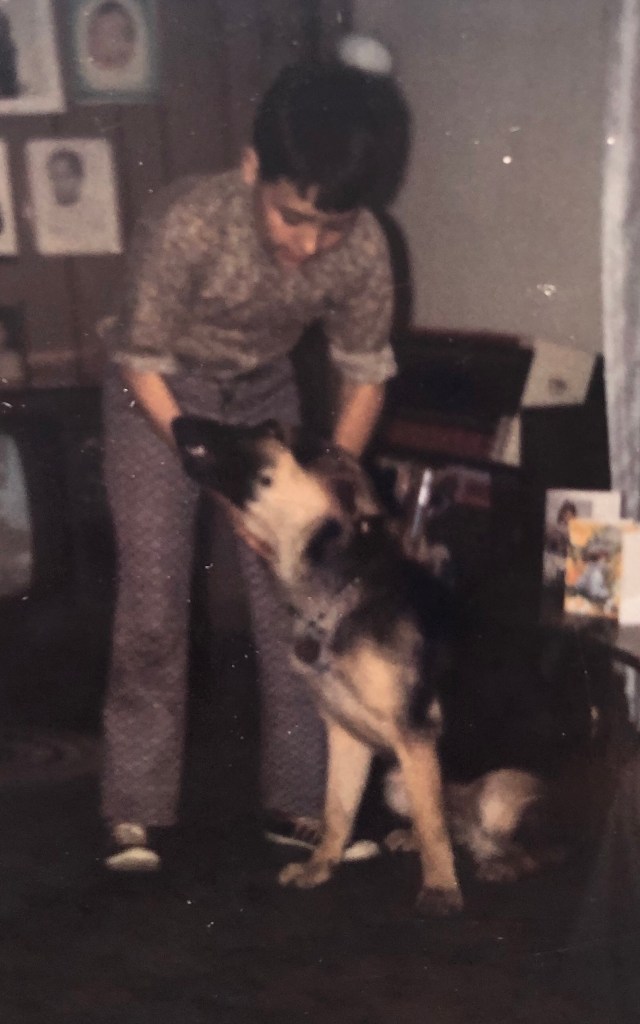
“I’ve said it a thousand tiiiiiimes, you are your Mama’s child, that’s for sure. Spittin’ image.”

“Ain’t she though?” agrees Aunt Bobbie.

I walk beside Mama. The aunts move ahead of us. Hoping they won’t hear, I whisper: “Why did he think I’m you, Mama?”

“His mind’s not right. Never has been,” she says, taking a drag, looking off in the distance at nothing in particular. “I really wasn’t around him much. I was a little girl when he left home.”

“Why did he leave?”

She turns her eyes on me. Dark brown eyes, like mine, and for a second they have that bottomless look. She’s slow to answer but not in the way that Genie is slow to do things. She takes another long drag.

“Grannie sent him away because he tried to hurt her.”

“Were you sad?”

“No.” Then, softly: “I was scared of him.”

Aunt Bobbie cranks the maroon LTD; Genie is getting in the front passenger side. Mama looks back at the Home and I wonder what she’s thinking. As I reach for the door, I catch my reflection in the backseat window. I glimpse the pines and the cloudless blue sky behind me. Crows fly overhead, cawing loudly. Yes, I do look a lot like my Mama. Even I can see that.

I feel shaky, too. I lean in to look closely at my own eyes, hoping to God I never find them so empty.

My new name

All the world’s a stage,
And all the men and women merely players;
They have their exits and their entrances;
And one man in his time plays many parts

—Shakespeare, As You Like It

Life’s transitions tend to sneak up on us.

For example, when it dawned on my oldest son that high school wouldn’t last forever and beyond it was college plus this thing called The Rest of Your Life, involving responsibility and duty, he looked at me with big brown eyes full of gloom: “I don’t want to grow up.”

Alas. It happens.

But he found his way. Last fall he simultaneously started the pastorate, married, and became the dad of a beautiful four-year-old girl. That’s a lot of transitions in one fell swoop, and he’s embracing them all. He’s thriving.

One man in his time plays many parts . . .

All of a sudden, his father and I have reached the grandparent stage of life. While it’s the loveliest transition, I can’t keep from thinking, with a pang, How did I become this old? Truth is, there’s exactly the same age difference between my grandmother and me as there is between me and my new granddaughter. It shouldn’t seem so astonishing.

The hardest transition isn’t mine, however. It’s my granddaughter’s. She loves to come over, loves to climb in my lap with a book as much as I loved climbing into my Grandma’s with one. All of this is glorious fun. No, the hard part is what to call me. She’s used to saying Miss Fran:

“Miss Fran, I’m hungry!”

“Oooo, Miss Fran, I like your nails. Can you paint mine?”

“Can we have a popcorn party and watch Frozen again, Miss Fran?”

“Let’s go outside and blow bubbles, Miss Fran!”

She likes telling everyone that I am her grandmother now. She even likes pretending to be me. My son said that after I broke my foot she went clomping around their house with one rain boot on, saying “I’m Miss Fran!” Yikes.

This transition away from Miss Fran has proved challenging. But she’s working on it.

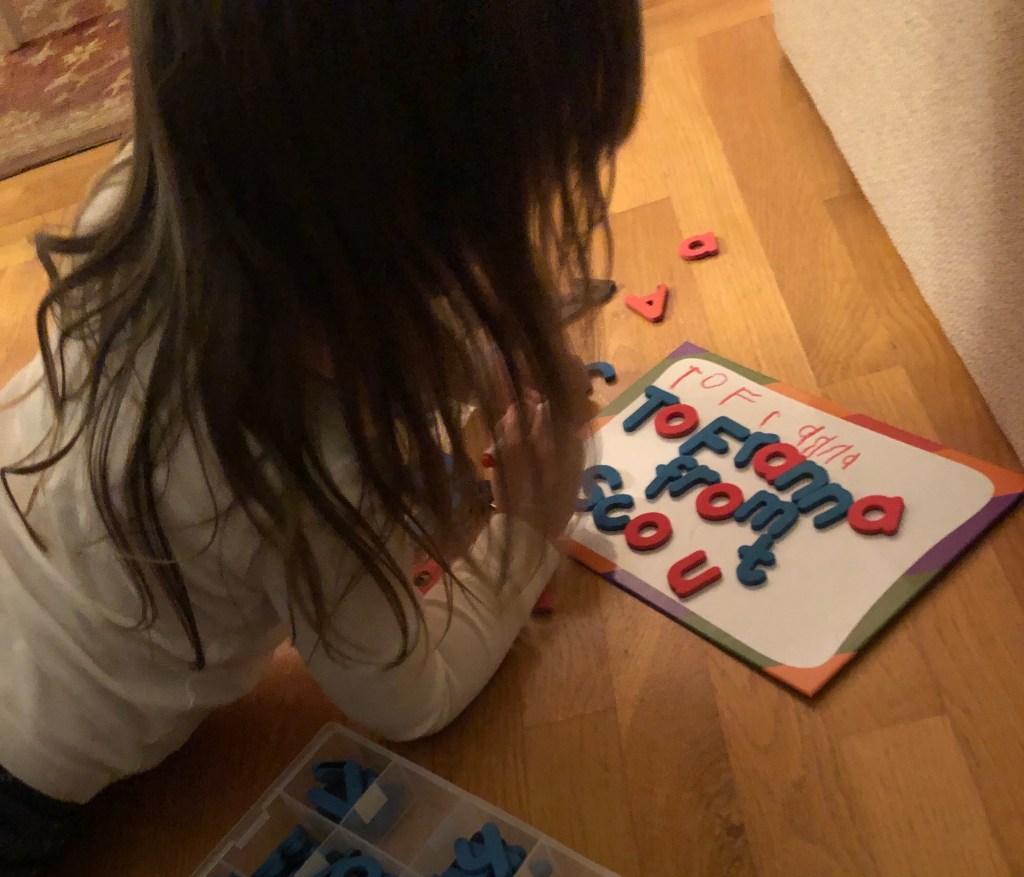
The other night she asked me to spell words for her with magnets on a whiteboard. I did, without realizing that she intended to copy them with a marker.

Here she is, writing with utmost care. A message to me.

With my new name, for the new role I get to play in her life:

Franna.

Life just gets grander.

I asked her if she wanted to spell “Franna” with one ‘n’ or two. She chose two.

A matter of heart

Better is the end of a thing than its beginning, and the patient in spirit is better than the proud in spirit.

-Ecclesiastes 7:8

Last week didn’t start so well.

On Sunday, I broke a bone in my foot while simply walking (and falling, somehow) down the garage steps.

I’d already taken Monday off to attend my brother-in-law’s funeral but spent it on my couch instead with my newly-damaged foot elevated, commiserating with my husband, whose leg has developed a discolored, painful bulge—the leg from which veins were removed for his bypass surgery last fall. It’s not a clot, and that’s all we know until his appointment this week.

“I never would have believed that I wouldn’t be able to attend my own brother’s service,” he sighed. It’s a seven-hour round trip; neither of us was up to it.

I surveyed our legs, propped on the same stool. His left, my right. Mirror-images of each other. Except for my orthopedic boot.

I sighed, too, the entire left side of my body sore from overcompensating for the right. “I know. This is like being eighty years old or something.” Which is decades away…

Our college-student son, passing through the living room, quipped in his deadpan way: “Well, at least you’ll know what to expect when you are eighty.”

So. That was Monday.

On Tuesday I returned to work. It happened to be the 100th day of school, meaning that most kindergarten and first grade students (and many of their teachers) came dressed as old people. White hair, glasses, wrinkles sketched with eyeliner, canes galore.

For a split second, I mused: Who wants to live to be a hundred?

But the kids were adorable, their teachers were having fun, and God knows we all need to have more fun at school. Too much of it isn’t.

That is where my mind was when a little “old” person wandered up to me in the lobby where I rested on a bench between the arrival of buses, my morning duty.

A kindergartner. Big, mournful eyes moving from my boot to my face: “Are you all right?”

“Oh yes! I am fine,” I said, touched by the obvious concern in that small voice.

“What happened to your foot?

“Well, I broke a bone in it.”

“Does it hurt?”

“No, really, it doesn’t. The boot is a cushion for it, see, and it doesn’t hurt at all right now.”

A flicker of relief across the little, made-up old face. The tiny pseudo-centenarian went on her way.

That was Tuesday.

And Wednesday, and Thursday, and Friday. Everywhere I went, the kids wanted to know: What did you do to your foot?

I shared the X-ray with some of them, saw the fascination in their eyes.

Some didn’t ask anything. They came up to me just to say I hope you will be okay. I hope you feel better.

As I labored up and down the staircases, one careful step at a time—the elevator at school is BROKEN—I thought a lot about the curiosity and compassion of children, how natural these things are for them, how comfortable children are with asking and expressing. If we can preserve, nurture, stir curiosity and compassion through all of their formative years … what a different culture, what a different world, it would be. Possibly our greatest work.

The week ended much better than how it began. Not because of satisfying still more curiosity about my broken foot with ongoing questions, or the taste of true human compassion at its purest. Not because I made it through the first week of recovery, although that was a glad milestone. No. Friday was a day of festivities, of celebration, all shining from the children’s faces.

“Happy Valentime’s Day, Mrs. Haley!” called the little ones when they passed me in line in the hallways, inviting me to their classrooms to share their candy, their cupcakes, their joy.

Valentimes. The mispronunciation seems almost poetic. As in, these times are made for Valentines. Definitely for love.

Oh my, thank you, I’ll come see your goodies but you keep them; they were given to you.

You yourselves are gifts enough to me, children.

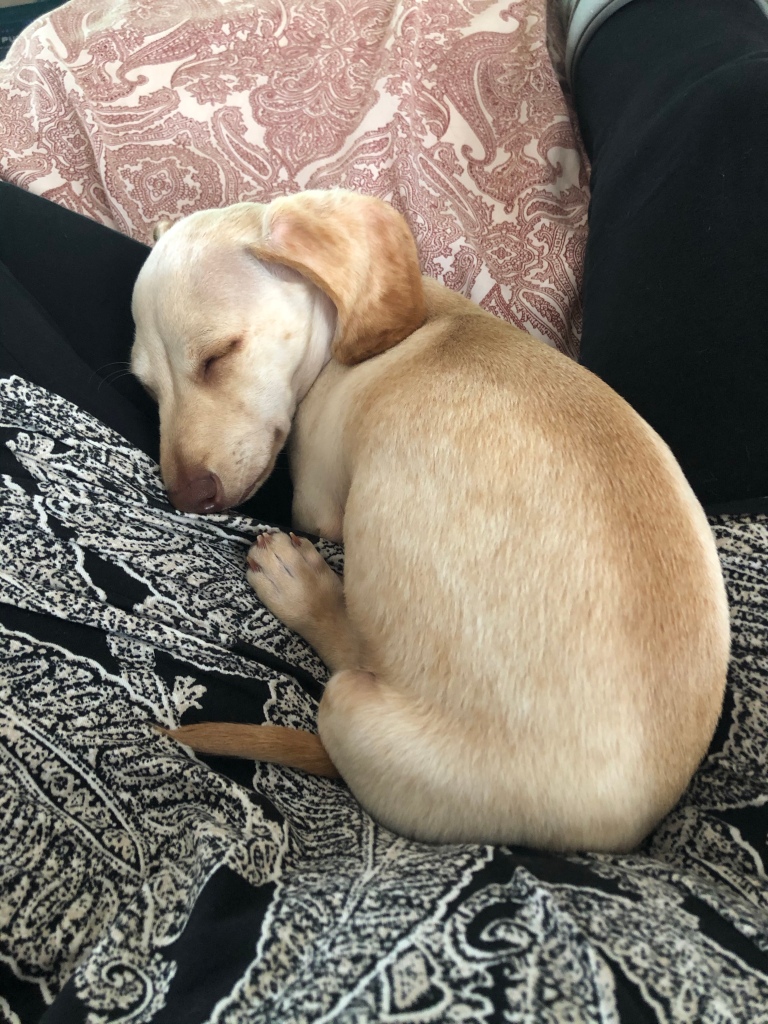
You as well as puppy therapy. ❤️

Dennis the dachshund takes turns between my lap and my husband’s while we prop our legs.

Twist of fate

For all the clear memories I have of moments and conversations in years past, I cannot quite recall how this happened two days ago…

Early Sunday morning. Tote bag with Bible and Sunday School lesson, studied and ready to teach. Annotated cantata book for Easter drama practice, ready for first rehearsal and casting. So much to do. So much to think about. Mind full of minutiae to remember. Let me put all this in the car, lest I forget something… wait, the sweet pickles for lunch. I forgot to take them to church with the sandwich stuff for rehearsal. Let me put the jar in my bag. There. Ready…

Opening door. Garage steps, red brick. Car is right there, I will put everything in the backseat floor…

—Falling. Fast.

Everything in my hands scatters across the cement floor; I watch the music book and all my papers sliding away with remarkable speed.

I cry out. I don’t know if it’s during that split-second fall, or on impact.

A snap.

Sharp pain in my right foot… I am only wearing socks, no shoes.

My son, Cadillac Man, is there in an instant. He heard me fall.

I am clutching my foot. It’s bad.

—Mom, is that blood dripping down your bag?

No. Pickle juiceget my Bible out of there.

And get your father.

His father tries to help me up but I can’t stand and he can’t be pulling on me; he is still healing from bypass surgery.

Don’t touch me, I tell them. I don’t know how to move. I have to figure it out.

I crawl back in the house. I take off my sock.

My foot looks intact.

I will try to stand…

Knife-like stab.

No.

My husband and son do not know what to do. It is Sunday morning; one is a pastor, the other, a music director. They each have church services waiting,

Go, I say. I have to figure this out. Maybe it will be better by the time you get back. If not, you can take me to an urgent care. Just go.

They go.

I wait until they’re gone to crawl down the hall and, sitting in the floor, change from pajamas to street clothes, for I know I’ll be going somewhere about this foot.

Suddenly everything is exponentially harder than it was.

That’s when I cry.

*******

X-rays reveal that I broke the fifth metatarsal on my right foot. The tech tells me I snapped it and I say yeah, I heard it. Now I am in a boot for six, eight, ten weeks; who knows? These things are slow to heal, says the orthopedist.

And no driving with the boot, she adds.

So now my husband and son must take me to and from work, every day for weeks on end.

I cannot do this, I say to myself.

But I walk, lopsided, imperfect, maddeningly slow in my Frankenstein boot, out of the office. My husband takes me home.

I watch the countryside whizzing past the passenger window. I know what this is shaping up to be. A hard lesson in dependence, at the least. It’s not like I haven’t lived this before. Seventeen years ago, just after my father died, I broke my foot—the same foot, different bone—while preparing to direct a church play. This second time occurs just after my husband’s brother died. Déjà vu. A curious twist of fate. None curious-er. I am seventeen years older; this is going to be harder.

—Well. It’s just going to have to be one deliberate step at a time.

Oh, how much I take for granted.

Today, back to work.

Just a good bit slower than before.

Of the earth

Midway through lunch, the din in the cafeteria is too much. The new boy brings his tray to where I’m standing:

Can I sit here at this table?”

It’s an empty table, save for my phone, closed laptop, electronic entry key, all the things I carried with me because I didn’t have time to put them in my room before this daily duty.

I consider his brown eyes, looking up at me. Pleading.

I consider his boisterous classmates and the seat he left behind.

“Are you moving yourself here because you feel it’s a safer place for you to be right now?” I ask.

He nods.

“All right. That seems like a good choice.”

His face breaks into a grin. He sits.

And the questions start: What kind of phone is that? Do you have a dog? Do you like Doritos? What kind do you like best? What’s your favorite color? Where are you from? How old are you, twenty-nine? Forty? Older?

How old are YOU? Eight? Did you move over just here to ask me all these questions?

He just smiles and takes a swig of his strawberry milk.

Then:

“Mrs. Haley, what’s your favorite snake?”

“What? My favorite SNAKE, did you say? Yikes—I don’t …”

Of course I am about to say I don’t like any snake whatsoever, but something in his expression stops me. “Um, do you like snakes?”

He nods. “I like pythons.”

Heavens. I refrain from telling him about a man I saw on the news this week. He happened to find a boa constrictor in his couch and had no idea how it got there or from whence it came.

He’s watching my face. A keen observer, this child. He’s waiting for my response.

I could say I like green snakes, but I don’t. I could say I like black snakes because my granddaddy said they eat rats and mice, so don’t ever kill a black snake. I think about the copperheads Granddaddy killed on the dirt road where his barefoot grandchildren ran in the summertime. I think about the coiled baby water moccasin I found in front of the kitchen cabinets when my first son was just three, and I how I was about to pick it up, thinking it was an odd piece of rope . . . until I almost touched it. And saw its eyes. Or that time I was cleaning the attic and discovered a complete shed snakeskin; I nearly knocked a whole new exit in my ceiling, trying to scramble out of there . . .

I DO NOT LIKE SNAKES.

But this boy with the strawberry mustache is waiting. His eyes are shining.

And then I recall a little creature lying across my sidewalk a couple of weeks ago. So little that I thought it to be a large worm at first; it was the same pale tan. I noted a faint pattern of scales on it. Could it be a snake? I looked it up. It was. “Smooth earth snake.” They are shy; they live mostly in the dirt around trees and bushes. I’d just had all the old bushes around my house pulled up. Apparently this little fossorial serpent was disturbed, or even damaged, as the equipment pulled away deep, tangled roots. For whatever reason, it crawled out in the open only to die there on the sidewalk. Who knows, maybe it was just trying to get to safety.

—Poor little snake. The only one I’ve ever mourned.

I look at the boy. He’s new here. He’s been uprooted.

Perhaps he did come to this table for safety, after all.

Even as I begin to speak, I think of earth and geosmin, the organic element in soil that humans can smell to something like the trillionth degree (we can detect one tablespoon in three Olympic-size swimming pools) and why that should be, unless it’s because we were meant to live close to the earth, that we came from the earth, and to the earth we will return. A curious kinship with that little snake. With all living things.

“My favorite snake is the earth snake. It’s very small. Have you heard of it?”

He wants to see a picture, so I do a search on my phone just as it’s time for classes to clean up and go outside for recess. To run, to play, to breathe the fresh air, to enjoy being children . . . how well I remember.

The silence in the cafeteria now is too much.

Photo: Smooth Earthsnake. Cygnus921. CC-BY

Lost

It started with a feeling.

It led to a word.

Lost.

It led me to look for a beautiful book, The Lost Words.

I couldn’t remember where I put it.

I looked everywhere.

It’s lost.

Ah. A theme.

Maybe it’s the dreary January dusk, or the drizzle, or Monday.

Maybe it’s the news. Lost lives.

Maybe it’s growing older and being reminded of things I loved long ago, like koalas, because of a book my grandmother read to me, and wondering how many koalas are left in Australia now. Wondering if there are enough eucalyptus trees left in that charred landscape to keep them alive.

Maybe it’s everything.

So much is lost.

I am not lost.

Just caught in layers of lost, like being wrapped round and round with invisible tulle.

It’s there.

I feel it.

Cocoonish.

That’s what sent me searching for The Lost Words as reading it suited my mood. The book is a glorious creation based on words that are disappearing from the dictionary. Words about the natural world that children don’t know anymore. Lyrical verse, majestic illustrations, making something beautiful of something lost . . . it was calling me to reread it. The very thing I needed.

But I can’t find it or remember where I last left it.

It’s really lost.

Naturally that beckoned lost associations. Lost people, lost friends, lost dogs, lost moments, lost time, lost things. Lost opportunities. Lost relationships, lost trust. Lost vision, especially in the educational world of late. Lost sense, lost direction. Lost ideas that I didn’t write down (although I am better about it now than I used to be). Lost dreams, so vivid and clear — what great stories they would make! — disintegrating as I wake, alas. I can’t seem to hold onto the dream and wake up; too often I am left with odd fragments.

But even in my tulle-swathed, piece-y malaise, never lost hope. No, not that. Never lost faith. Never lost love, because, if it’s love, it’s there forever.

I lost interest in reading tonight. So, I write.

Never lost words, not for me. Not yet. They find me, somehow.

And tomorrow I’ll find that book.

Photo: Lost. gwenole camus. CC BY-SA

From ashes of auld lang syne


embers

New Year’s Eve. The wind gusts in the night beyond the bedroom window. I sit at my scarred old vanity, watching a tiny hand-me-down television. I am fifteen, this room is my inner sanctum, so I am surprised when Daddy brings me a slice of frozen pizza that Mom heated up for a late snack. “Something to munch on while we wait for midnight,” he says, and departs. My heart is stirred by this gesture. I don’t know why. I can’t even say if it’s a pang of happiness or sadness.  I take a tentative bite of the pizza and resume watching the movie Come Back, Little Sheba. I am safe and warm, the pizza is unexpectedly tasty, yet I shiver. The desolation of the characters and their story pierces me. How could things be so wrong? Would Sheba—a missing dog—ever come back home?

The wind moans under the eaves; I can’t stop this seeping inner chill.

Midnight arrives. I should say something to my parents.

I go down the hall to the living room, where they are turning off the big TV. “Happy New Year,” I say. 

They are stretching, yawning: “Happy New Year, Sugar. Good night.”

We head for our beds.

The ringing of the phone wakes me from a deep sleep.

I sit straight up. A phone call at this time of night—morning, rather—can’t be good news.

I wait in the dark, pulling the blankets around me, as my father’s footsteps hurry down the hardwood hallway to the kitchen. He answers the phone, hurries back down the hall to get my mother.

I hear her crying.

Heart pounding, halfway not wanting to know but also realizing I’ll have to face whatever it is sooner or later, I get up and go to the kitchen.

Mom is hanging up the phone, tears streaming.

“Grannie’s house caught fire. They all got out but the house is gone.”

I am suddenly weak. I need to sit down. I do, right there on the kitchen floor.

How did this happen? I want to know but can’t bring myself to ask.

My grandparents have been sent to the hospital for monitoring; within a couple of hours, my aunt arrives to stay with us. She is weeping, nearly incoherent, her clothes reeking of smoke. A charred, overpowering smell. 

The smoke woke me up, she sobs. Thank God for the phone in the bedroom. She tells us that when she picked it up to dial 911—the brand-new emergency number—the receiver was almost too hot to  touch. Coughing, knowing she had to get out, she opened her bedroom window and crawled through to the porch roof. There she found Grannie and Papa G. Within minutes, the fire trucks arrived, ladders went up, and my family was ushered to safety. As she speaks, I see hoses dousing orange flames that illuminate the icy black night.

Jenny was still in there, sobs my aunt.

Her beloved Siamese cat, twelve years old.

Three firemen held me back, she says, choking on her words, and I envision how hard my aunt fought to go back for Jenny. She’s a sizable woman; it probably took everything those three firemen had to restrain her until the fire was out and they could search. 

My aunt, middle-aged, unmarried, never having had children, dissolves in anguish: They found her body under my bedroom window.

Jenny, she sobs over and over in my mother’s arms. I am sorry, Jenny.

I am now as cold as ice, shaking uncontrollably.

—Come back, little Sheba.

*******

The question we all had: How did the fire start?

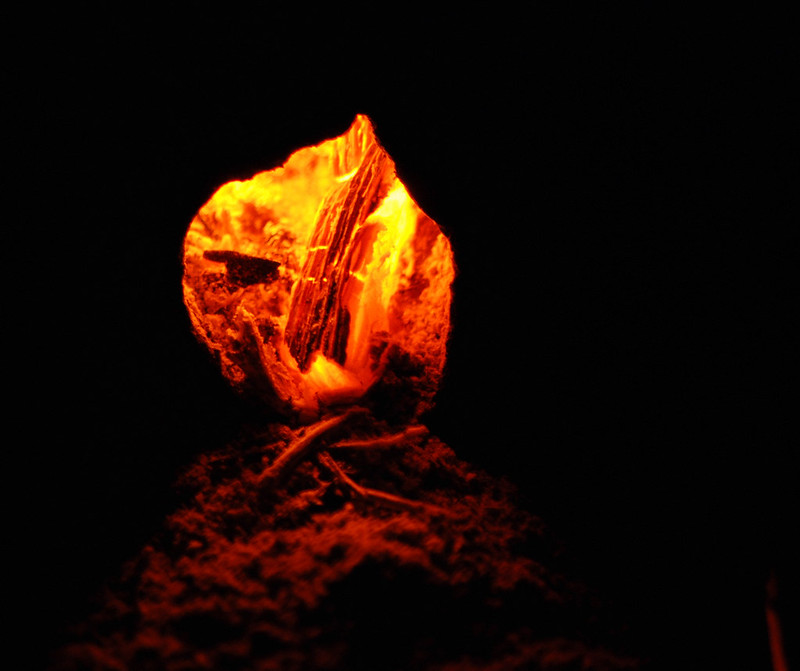
It was an old two-story house, drafty, with a curious assortment of doors and rooms. A chimney stood in the wall between the living room and Papa G’s little dressing room on the ground floor. As that New Year’s Eve was excessively cold and windy, my grandparents burned logs in the living room fireplace. They extinguished the fire before they went to bed but the wind gusted hot embers back down the chimney with enough force to blow the old plate off the wall at its back. The embers landed on the dressing room rug, directly under the room where my grandparents lay sleeping.

On that long-ago New Year’s Day, extended family gathered to survey the damage. Wooden doors on the ground floor were burnt completely through their middles but still held onto their glass knobs, like ravaged ladies saving their diamonds at all costs. The pantry where I stood so often as a young child, opening all of Grannie’s stopper spice bottles to smell the contents—cloves were my favorite—was destroyed by soot and water. The avocado-green telephone in the kitchen had melted down the wall like something out of a Dali painting. 

That phone, more than anything, sent my fifteen-year-old mind reeling. The horror of that much heat. That much danger, the near escape. The ruin of it all, the losses. Jenny. There would be no going back. No coming back.

The old house, the old year, a portion of my childhood lay in ashes. 

But my predecessors were survivors. They left a legacy of rising above, of carrying on. They knew, well before that night, how to bring something new from the old, something beautiful out of desolation. To my astonishment, the house was restored and refurbished more elegantly than before; my grandparents and my aunt lived there for many more years. 

We don’t go back, no. We can’t.

But we go on. 

It’s a long time since I was fifteen, straddling the transition from childhood to adulthood, coping with the temporal nature of life and its losses, but I believe that New Year’s fire marked the true beginning of my resilience, faith, courage, and, when needed, my fighting spirit. My inheritance. It’s carried me through every year since, even this last, in the greatest crisis of my adult life. Once again, my family survives, only this time I’m the older generation. We recoup, we go on to whatever this new year holds for us.

Perhaps it’s overcoming that sparks the memory. 

It’s auld lang syne, my dears, auld lang syne, beyond the darkest night, the ashes of what was. And not forgotten.

I rise and walk into the new carrying you with me, always.

Photo: Embers. Brian Douglass. CC BY