The tree I’d be

Cypress trees.jpg

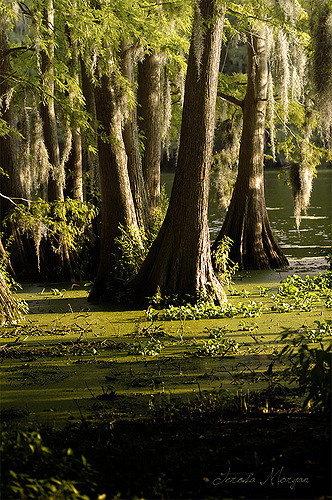
Sunlit Cypress. Teresa PhillipsCC BY-SA

A few days ago,  I happened upon this captivating tweet:

I am well on the way to becoming a tree myself. I put down roots. I sigh when the wind blows. My sap rises in the spring and I turn towards the sun. Which tree would I be? Definitely a walnut tree.

-Roger Deakin, journal entry for April, quoted by writer Robert Macfarlane, Twitter, 04/04/2018

Macfarlane then asks: “Which tree would you be and why?”

—A cypress.

That was my immediate thought.

But why?

After all, one of my favorite scents is Fraser fir (the predominant Christmas tree in North Carolina). I vacuum the stubby needles at holiday’s end and try not to empty the canister for as long as possible, because the fir fragrance fills the air with every subsequent use. The trees of my childhood are dogwood, pine, live oak, magnolia, sweet gum. I have early memories of sun-dappled sidewalks covered with “helicopters”—one-winged seeds, or samaras—that spiral down from maple branches. I tossed the helicopters again and again, as high as I could, to watch them swirl like propellers. Crape myrtles lined my grandparent’s yard; I climbed their smooth trunks, sat in the crooks of their branches, countless times.

Why does cypress come to mind first, then?

Poets and writers, you know when an image appears so vividly that it holds some significance begging to be explored . . . .

For starters, my image is of Taxodium distichum, more commonly known as a bald cypress, or, my preferred name, a southern-cypress tree.

It’s rooted in the swamps of the southern United States, where my roots are. A tree at home in water, in rivers. I grew up in a place called Tidewater, entered the world in a hospital named for its proximity to water: Riverside.

My first recollection of the word cypress was my grandparents’ reference to a place on beyond where they lived, where the little dirt road curved past canals and thick woods that had grown to obscure stately houses: up Cypress Swamp, they’d say. Grandma’s best friend from first grade, who grew up to marry Grandma’s brother, was from Cypress Swamp. As a child, standing on the dirt road, looking through the treetops, if the sun was right, I could glimpse a bit of one old, abandoned house—a roof of cypress shingles.

The word sounded poetic to me even then: cypress. Like a whisper. Like something inviting. Maybe magical.

Although, through the ages, a cypress was usually associated with funerals and mourning. My affinity for the tree is clearly fused to my eastern North Carolina heritage, a reminder of the generations that have gone before me. My family tree, so to speak. It is ancient. Maybe nothing encapsulates that so well as this passage from Our State magazine, in which the author chronicles his boat journey on a river through a cypress forest:

 Many of the trees here must have witnessed those long-vanished species. They would have nodded over Native Americans in dugout canoes. They would already have been tall when the Lost Colony was lost, when the Mayflower sailed, when Attila the Hun was on the move. A few might have stood when Christ was born.

-T. Edward Nickens, “In Search of Methuselah,” Our State, June 8, 2016.

They live for so long, cypress trees, due to their ability to withstand storms; they thrive despite adverse growing conditions. Cypress wood is hard, strong, water-resistant—hence those shingles on the old country houses still standing as a forest  grows up around them. Those hand-hewn shingles sheltered the life therein. Like Noah’s ark, made of gopher wood from an unknown tree that some researchers speculate to be . . . cypress.

I cannot say the adversity, the storms, in my own life are any greater or worse than those weathered by other people I’ve known. I can only say that I’m still here. I view the cypress not as a funeral tree but one that preserves, celebrates, and affirms life; that, ultimately, is the whole reason why I write, why this blog exists at all.

On a fanciful note: Earlier I mentioned the word cypress sounding magical. When I was a child I loved the Chronicles of Narnia. I still do. In these books, C.S. Lewis borrowed from Greek mythology to depict dryads and hamadryads, the spirits of trees that took the form of young girls with their particular tree’s physical characteristics: a birch-girl dressed in silver, another with hair like long, willowy branches. Does a cypress call to me, then, because I am tall (5’8″ in bare feet)? That’s taller than the average American woman (5’4″) but not dramatically so. There must be something more, then, as to why the cypress chooses me, something unique to the tree and to me, other than our having southern roots in watery regions.

The knees.

In cypress forests, knobby projections stick up from the water. Theory has it that those “knees” help the tree breathe, enabling it to take in more oxygen. I don’t know how much truth lies in that theory, but I can tell you this: For my entire childhood I suffered from asthma and the only way I could sleep at night, the only way to breathe, was by curling up in a ball with my knees drawn up under me.

So, yes, my knees helped me breathe.

*******

In the old places

where the water stands still

they live on

holding all their stories

not evergreen

but ever-enduring

reassuring

reaffirming.

With every breath

drawn on their knees

they whisper,

“Remember.”

Real

and ethereal

—if I were a tree

a cypress

I’d be.

Cypress trees - pink

“When we are present in each moment, the past gently rolls up behind us and future slowly unravels before us.” echorooCC-BY

Relics

Mom's empty room

Mom’s empty room. The_DoodlerCC BY_SA

So many stories 

in every room

in every thing.

A lifetime packed

tight in every closet

in every drawer

for even in the time

of abundance 

the memory of deprivation

remained.

A lifetime of love

recorded in cards and letters

all saved 

even poems 

I don’t remember writing.

The photos of my children

so carefully preserved

growing up all over again

here in my hands.

Their father captured 

as a  little boy

in black and white

long ago.

His own father in uniform

smiling, alive

his olive-green dress hats

sealed in a bag 

on a shelf 

deep in her closet.

The ghost of holidays past

pulled from the attic 

with childhood toys

long forgotten.

Tarnished silver in the kitchen

and a fine layer of dust

on the crystal. 

Cookies in a jar

grown stale 

maybe in hopes of

grandchildren coming.

Things with no explanation

only wonder 

as to what they are

and what they’re for. 

So many stories

in rooms once beautiful

in every thing crammed

holding on, holding on

in the hidden places.

A lifetime packed

with living

and loving.

Decades of

acquiring

prospering

overcoming

remembering

all dismantled 

and disposed of

in the space of

a single afternoon.

New life

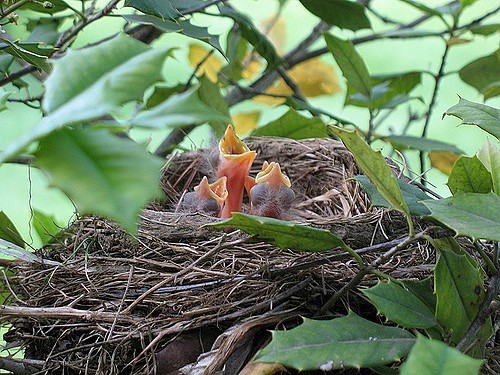
Baby robins

Baby robins. DanCC BY

Easter morning.

I have a new spring wreath for the front of the house. I should have put it out before now. What’s taken me so long?  

I step out onto the wide front porch, wreath in hand. It’s chilly out here. A light fog hovers;  I shiver in the pre-dawn grayness. The smell and taste of salt from the Bay hangs heavy in the air. I will hurry, as there’s lots to do to be ready for the sunrise service down on the beach. Waking, feeding, and dressing a toddler takes time. Maybe I will wait until after the service to show him his Easter basket . . . 

The old wreath on the front of the house is in terrible shape. I’m ashamed of how it looks, that I’ve left it up for too long. It’s a grapevine with flowers and greenery at the bottom center, behind two white stuffed geese wearing blue bows around their necks. Except that the geese are gray now, speckled, mottled by the elements, and the blue ribbon is faded almost to colorlessness. 

I reach for the old wreath and something dark flies out, startling me so that I drop the new wreath onto the porch floorboards.

A bird. 

I notice, then, the rim of a nest tucked into the wreath’s artificial greenery, behind the stuffed geese. The dry grass of the nest blends in with the bits of fake Spanish moss.

And I hear squeaks.

Standing on my tiptoes to peer into the nest, I see four baby birds. They’re still mostly pink skin, with just the beginnings of dark, downy fuzz. Their wide yellow beaks open.

Mama, feed us. 

I stand, hardly daring to breathe, watching, awed by this new life. How fragile it is. What a precarious place for it to be, for this wreath is attached to the house by just one nail. If it doesn’t hold . . . I cannot bear to think of it.

I retrieve the dropped wreath and step slowly, carefully away. Mama Bird is somewhere nearby, fussing and fretting over the safety of her babies. I will leave them in peace.   

As place my hand on the handle of the old door, I think about this big old house, how long it’s been standing, the storms it’s weathered in a place where storms tend to be more violent due to the proximity to the sea. That it’s a strong shelter, a parsonage provided free to my husband, our little boy, and me. I am going to worry about those baby birds on the front of this house, but I have to believe that the sheltering grace will extend to them, cover them, as it has done for me. 

The sun is just beginning to pierce the fog as I take one last look, as Mama flies back to her own, and Papa Bird shows himself for the first time, landing on the white porch rail by the column, his head cocked, watching me. In the pink light of a new day, I think of the old words: “Behold, I make all things new.”

Doesn’t matter how old, faded, ruined, broken . . . new life begins in the most unexpected ways, in the shabbiest of circumstances. 

Easter morning.

I wipe my tears. I go back inside, new wreath in hand, to my own new life.

Last times

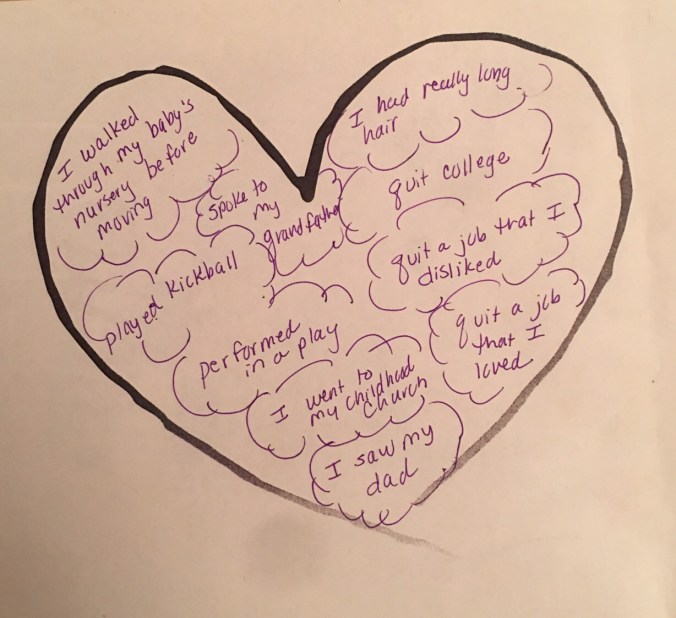
To commemorate my last post of the month-long Slice of Life Story Challenge with the Two Writing Teachers community—this is my second year of completion—I write about “last times.”

Yesterday I shared the “first time” heart map template from Georgia Heard’s Heart Maps: Helping Students Create and Craft Authentic Writing. I use these templates when I lead professional development for teachers in writing; it’s astonishing how often I hear teachers say, “I used to love writing but I don’t do it anymore.” More frequently, I hear: “I’m not good at teaching writing.”

The first step is simply to start writing.

The first and last time maps are excellent guides for this, and, furthermore, when teachers have taken these back to their classrooms, they tell me they’ve been amazed at what they learned about their students: “One of my boys wrote ‘the first time I rode a camel’. The class was so intrigued that he had to tell the story right then! We never would have known this if we hadn’t used the first times map.”

On to last times . . .

Here are mine, maybe to be spun out into full stories, one day:

The last time I walked through my baby’s nursery before moving. My older of two sons was born when my husband was in his first pastorate. The parsonage where we lived was a former sea captain’s house, built in 1915 (the year my grandmother was born), two blocks from the Chesapeake Bay. The congregation was mostly elderly; there hadn’t been a baby in the church, or the parsonage, for a long time. I was just twenty-two when my husband and I moved in, and I got to choose the wallpaper for the bedrooms. For the room that adjoined the master bedroom, I picked an ivory paper with little muted-red hearts between dusty blue stripes. A year later, I bought ivory crib sheets and bumper pads along with coordinating quilts and wall decor all adorned with these same little rustic hearts, teddy bears, and rocking horses. Our son was three when we left the Eastern Shore of Virginia to serve a church in North Carolina. I walked through the empty nursery last, where the only the little hearts remained on the walls; I stood there, running my fingers over them, and wept.

The last time I had really long hair. From kindergarten and first grade, when my hair was cut in an assortment of horrible shags, not to mention my cowlicks, I wanted long hair. By fifth grade, it was finally beginning to happen. In sixth and seventh grade, my hair reached down to my waist, was parted in the middle and as straight as a stick. In eighth grade I had a crush on a boy in my algebra class. He sat behind me. He’d speak to me occasionally, sometimes asking for help (which shows what dire straits he was in, to ask ME for help with algebra). I decided to cut my hair solely to get this guy’s attention . . .

The last time I played kickball. That was about a week ago! Due to a series of unfortunate events, there was a shortage of substitute teachers at my school on fourth grade’s quarterly collaborative planning day. I found myself taking a class to recess. It was a sunny, first true spring-like day, and the kids produced a kickball. “Mrs. Haley, will you pitch for us? Pleasepleasepleaseplease?” I haven’t played kickball since I was ten years old . . . but I was good at it, so . . . I took my place on the pitcher’s mound. My beginning teacher in kindergarten, walking past the game with her class on the way to the gym, stopped to gleefully take pictures.

The last time I quit a job I disliked. I’d had enough. I told the employers so and walked out. I never went back. Better things came along. Since then, when colleagues and friends have spoken of how much they detest their jobs, I’ve asked: What are you going to do about it?  Life is too short to be spent doing something that makes you miserable every day.

The last time I performed in a play. I was in my second year of college. I planned to be a theater arts major, having performed in numerous high school productions, and I’d just auditioned and been accepted to the American Academy of Dramatic Arts in New York City. This really sounds like a story of beginnings, doesn’t it? To stay immersed until I left on this huge new venture, I performed in community theater. At the audition for the very next play, after receiving my letter of acceptance to the Academy, I walked in, saw the handsomest man I’d ever seen in my life . . . and got married that summer instead of going to acting school.

The last time I went to my childhood church. My husband and I attended the service honoring my retiring childhood pastor, who’d become mentor to my husband, the last of over fifty young men my pastor ordained into the ministry. The church building was large; I remembered how, as a child, I’d occasionally run upstairs—there were flights and flights of stairs, some of them not adjoining; I’d have to run across some entire floors to pick up other staircases—and I’d go as far as I could, up to a little door with a dark window. I tried the doorknob. It was locked. I wondered: What’s behind there? Can I go any higher? Is God on the other side, somewhere? Who keeps the key?

The last time I spoke to my grandfather. He was dying of lung cancer, at ninety-two. He stayed at home with hospice care and refused morphine. From his years around loud equipment in the shipyard, Granddaddy was notoriously hard of hearing. He never talked on the phone for this reason, but one day when I called to see how he was, he answered the phone. Grandma had stepped outside. I talked to him for just a few minutes, almost shouting into the phone so he could hear me. He understood every word. I said, I love you, Granddaddy. You’re safe in God’s hands. He said, emphatically: I love you, Honey, and there’s no better place to be.

The last time I saw my dad. It was the week of July 4th. I’d come home with my boys to stay a few days, as Daddy wanted to take us to the shipyard to see the fireworks. He was retiring at the beginning of October, after almost forty-one years as a security guard, so this would be the last time, the only time, we’d get to do this. There’s a lot to the story that I’m not up to telling, even now; maybe one day . . .  so we went, my boys and I. As I sat there in the dark, watching the sky explode in lights over the vast, beautiful river of my childhood, sipping the ginger ale Daddy brought to share, I thought: Surely this is the beginning of better times. Daddy’s going to have more time to spend with us now. In my heart, I celebrated for him, that his working days were just about done, that soon he could take it easy and enjoy life . . . I could never have imagined it would be the last time I’d see him.  In September, just three days before he was to retire, he died with a massive heart attack. In uniform, on his way to work.

Writing about last times can be so hard, so hard, so hard.

But not always . . . as my workshop participants tell me, there’s that last car payment, that last mortgage payment, causes for celebration, indeed. Maybe even a step toward health, as in the last time someone smoked a cigarette.

So I close my thirty-one day writing streak, celebrating that I made it to the last post, celebrating my fellow Slicers who did the same, who wrote alongside me, who walked a part of the journey with me every day. Here’s to writing, friends. Here’s to sharing each other’s stories as long as we can, though perhaps not daily until next March.

Thank you all.

Here’s to your first and last times, to what’s in your heart, and to life.

Keep trusting.

The locket

She stands at the counter, admiring the jewelry. If  Papa were here, he’d get a necklace for me, she tells herself. I know he would . . . I’d keep it in the jewelry box he gave me for Christmas. 

But Papa was gone. Back to the hospital, again. She knew he feared going and she feared it for him, not knowing exactly what treatments he was being given, only that his face was whiter, more hollow, on every return, his blue eyes sadder. 

Her own eyes blur. Wiping away the tears, she finds her uncle, the store owner, leaning over the back of the wooden counter.

“Hello, dear. You like the jewelry, don’t you?”

She nods, tries to smile.

“Tell you what—I’ll give you a piece. Choose the one you like best.”

Her tears flow in earnest then. 

She chooses the locket.

*******

She was fifteen. The year was 1931. A year later, her beloved Papa would commit suicide on his sixtieth birthday, just weeks before she graduated from high school.

I wonder if she wore the locket as she sat by his casket in the living room overnight, or to his funeral.

When I was fifteen, she gave the locket to me:

I open the locket to find a black substance on the left side.

“I thought you said there was a picture of you in here!”

“It’s so old. That picture has turned darker and darker over the years,” she explains.

The image is completely obscured. 

“What did the picture look like, Grandma?” I ask, mourning the loss of it.

“It was a school picture. I had wavy blonde hair. It was pretty.” She smiles slightly as she picks the decayed photographic material out of the locket with Granddaddy’s pocket knife. She rubs the locket with a cloth until it gleams, and then she places it in my hands. 

“I know you’ll take care of it, my dear,” she says. 

As I clasp it, she draws me into her arms. I lean against her like I did when I was smaller, breathing in the light fragrance of her Avon cream sachet. 

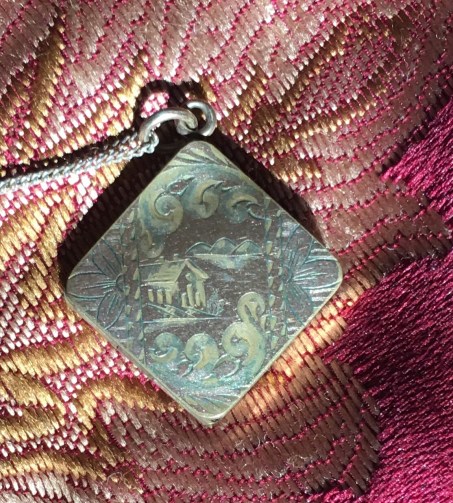
The locket is around 87 years old now. It’s made of brass, remarkably shiny, unmarred, despite its age. The front surface is finely etched with antiquated swirls and flowers, and if you look very closely, in the center there’s a house with a little fence and mountains in the background along the horizon.

Grandma, what a prophetic symbol for you, in so many ways.

The Great Depression was a year underway when her uncle gave her the locket. In 1936, my grandmother married my grandfather. My father was born ten months later. To me, the house on the locket represents their rural North Carolina homeplace;  it’s where Grandma’s heart was when Granddaddy, unable to “make a go of it” with tenant farming, sharecropping, and odd jobs, found employment almost two hundred miles away at the Newport News shipyard and moved his family. He was working there when Pearl Harbor was attacked.

Grandma was expecting her second child that year:

We stayed in an upstairs apartment and it was so hot. I could look through the window to see the ice truck making deliveries. People couldn’t get refrigerators because of the war; if you had one, it didn’t have a motor. We used them like iceboxes. I’d stand at that window thinking,  I’d give anything for a piece of that ice right now . . . . 

And she longed to go home.

Those mountains on the locket’s background symbolize numerous obstacles, hardships, trials, everything from the loss of her father to the Depression and the war (her brothers served in the Army and the Marines) to the ten years she did live back home, raising the children while my grandfather commuted from the shipyard on weekends. It was hard, all of it. She endured. The brass locket shines almost like gold—beyond the things of home, beyond every mountain to be scaled, hope always shines bright, not dimming over time. My grandmother’s faith would be challenged; she’d outlive two of her three children, but her faith would hold.

Home, endurance, overcoming, hope, faith, love. All of these are her legacy to me.

And the stories.

All old things have a story. Grandma’s locket is a tangible reminder of the stories she lived and told to me. It even opens like a book for pictures or tiny mementos to be placed inside; pictures of my two boys when they were babies are in it now.  The locket is the story of who I am, where I have come from, where I am going. I like to think that as the generations rise and fall, the locket will be passed down again and again, and that our stories will go on, and on, and on.


Blanket

I am more tired than I realized.

I wake up early every day, around 3:30. Not intentionally; I just do. Instead of lying awake or drowsing for another couple of hours, I get up and write. It’s the perfect time, before my menfolk and canines begin to stir.

My early mornings are a logical reason to be tired.

And spring break is still a week away. The last mile is always the hardest . . . .

And I am twenty-five days into a thirty-one day writing streak, the Slice of Life Story Challenge, which requires an extreme level of thought-immersion and attention to the minutiae around me (everything is a writable moment). My receptors must be wide-open all the time. This, however, is a good kind of tired. Even though I am mentally composing while I’m sleeping.

And I am fighting an allergy or a cold; I feel it lurking around my edges. My boys, when they were small, used to say, “I am catching up to a cold.”

And it’s been a long winter. There may be a few snowflakes tonight. Spring hasn’t fully sprung. There’s still a lot of darkness.

And my family marks a year of losing loved ones, young and old, sudden and by inches with dementia. My husband, his sister, and I need to finish cleaning out their mother’s house.

The dogs, knowing I’m the mom of everything, trail my every step. Henry wriggles like a worm, with an insatiable need for pats, for attention, and even poor old Nikolaus, his eyes like clear marbles full of misty clouds, is still able to scamper behind me in hopes of a treat.

And so, I’m tired.

Yesterday, being Saturday, I did something I almost never do:

I finished my post and went back to bed.

My husband, who’s now been up for a short while, reading in the study, comes looking. “Oh, you’re back in bed?”

“Just for a little while,” I say.

“Okay.” He closes the door.

I pull the blankets up to my chin. So cozy. I drowse. I hear bits of blog posts echoing in my brain.

The door opens. Older son. Henry’s so-called “dad.”

“Are you sick, Mom?”

“No. Just resting.”

“Oh, okay.” He goes to fix his breakfast. He loves a big breakfast. His brother won’t eat until lunchtime.

Snuffling outside the door. Henry. He usually begins to grumble-half-whine to come in and snuggle to me, or to sleep on my bed if I am getting ready for work. Today he must sense something. He goes away. Unusual.

Distant clanking in the kitchen. Muffled voices. Footsteps in the hallway.

The door opens. Younger son, Cadillac Man.

“Mom?”

“Yes?”

“Are you okay?”

“Yes. Just resting.”

“Okay. Lowees.” This is how he first said ‘I love you’ when he was a baby. Lowees. It immediately became part of the family lexicon. We all say it to each other. His father reminds me again and again that Cadillac Baby said it to him first.

“Lowees,” I say.

I can’t stay here long. None of them will be able to take it. There’s too much to do, anyway. There are places to be.

But I pull the covers partway over my head, sinking into the warmth, the softness, savoring the moment, grateful for the web of words knitting itself from random scraps in my mind, for the abiding blanket of love wrapped over and around my life.

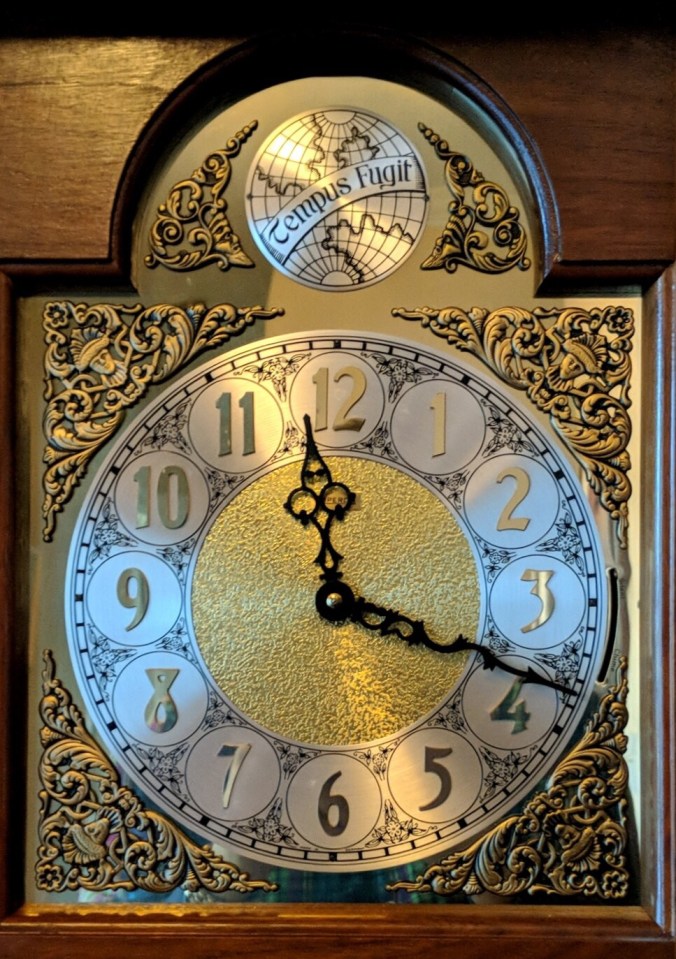
Tempus fugit

Tempus Fugit

(Time Flies)

They should still be preschoolers

singing in the children’s choir

round-faced cherubs, both

ever so serious.

Time flies.

Or

children on vacation

tasting salt on their tongues, brine in the wind

with sand on their toes, in their hair

eating pickles from a jar.

Time flies.

Or

teenagers at Bojangles’

laughing, cutting up

marching in the band, going to the prom

still singing the old hymns together.

Time flies.

Or

college kids, going their separate ways

friends temporarily parted

by finding their own paths, until

one ended on a fresh spring night.

Time flies. 

She wrote that he was part

of her favorite childhood memory.

On the eve of her funeral, he dreamed

he heard her singing

of the ocean.

Time flies

Time flies

Time flies.

*******

One year ago today, my younger son (the Cadillac man) lost his childhood friend in an accident. 

She was eighteen. 

The angel’s pedicure

img_4489

My son, the Cadillac man, and I stand looking at the angel statue.

Specifically at her pink toenail polish.

“Really?” he says in disgust. “Painted toenails?”

I giggle. “I know! How many depictions of angels have you seen with painted toenails?”

He shakes his head. “I’ve never seen an angel with feet.”

I start to laugh, but . . . the way he says that . . .

He turns, walks off in his unassuming, old-soul way. I watch him go, wondering.

I said depictions.

He said he’d never seen an angel with feet.

Not that he’d never seen an angel.

Happy St. Patrick’s

Happy St Pat's

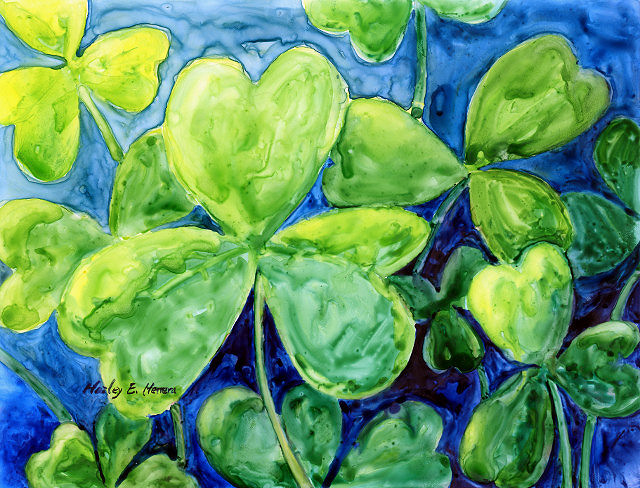
Happy St. Patrick’s Day. Hailey E. HerreraCC BY

Last year on this day, I wrote about being St. Patrick’s granddaughter.

My grandfather, born in 1906 in the far reaches of Beaufort County, North Carolina, was named Columbus St. Patrick. (Read the post if you like).

You’d think our family would be Catholic, celebrating this day with the best of them, but we aren’t and we don’t. What a mystery, his having that name. Legend has it that his grandfather came to America from Ireland, but records are sketchy. One of these days I’ll have my DNA tested by Ancestry.com to prove how green my blood really is (it’s metaphorical, Mr. Spock. Although being related to you would be . . . fascinating).

I love Irish things. My wedding band bears a Claddagh. Hearing an Irish tenor takes my breath, stirs my soul, fills me with an ache, a longing. Whenever I visit New York City, I have to stop by St. Patrick’s Cathedral; I could stay inside indefinitely, savoring the profound beauty, the grandeur, the reverent hush. It’s one of my all-time favorite places. I adored Frank McCourt and met him years ago when he came to speak at North Carolina State University—it was snowing that night. Magical. I have a shamrock growing in a pot on my kitchen table and I even had an Irish Setter once. His name was Dublin. I grew up eating Irish potatoes grown by my grandfather or from the potato sheds of his farming community; Granddaddy’s pronunciation was ishe (for years I thought he was saying ice) potatoes. I’d love to visit Ireland.

I thought, to commemorate this day, that I’d post a lovely quote from St. Patrick and reflect upon it, maybe in verse.

This, however, is the quote I found, and for the life of me (remember the Irish keen sense of humor), I can’t find another one to top it at present.

So, Happy St. Patrick’s Day, one and all—with a special nod to Harry Potter fans:

Do you suppose it’s true, that St. Patrick was a Parselmouth, and his Muggle friends never knew?

~David J. Beard (1947–2016), tweet, 2012 March 17th

saintpatrick


The birthday

Birthday fairies

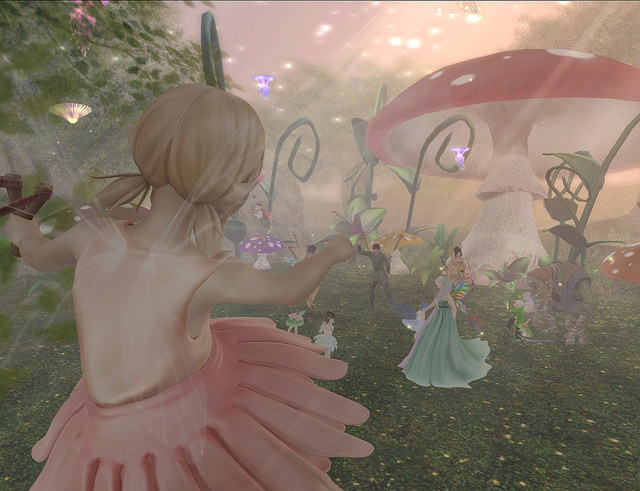
Birthday Party – Fairies Watch Over Us. Alicia ChenauxCC BY-SA

I recently wrote about a professional development activity at my school —”finding your why”— based on the work of Simon Sinek. The principal led staff in recording life moments that left us changed, somehow. These peaks and valleys don’t have as much to do with who we are and what we do, but why.

Here’s one of my childhood valleys, and how it shapes my why even now.

The setting is my birthday. I believe I was turning ten (double digits), or maybe it was twelve (the last birthday before becoming a teenager); it’s odd that I can’t remember, because I didn’t have many birthday parties. I don’t know exactly why my mother decided to throw this one, but it seems turning ten or twelve is right.

I just remember . . . well, here, see for yourself:

More and more people cram into our small living room. Extended family members, some kids from the neighborhood, a couple of friends from school and church. Mom has balloons up, has put out party hats and noisemakers. A stack of  presents in brightly-wrapped paper grows larger. I haven’t received this many presents for my birthday before. 

I don’t even know what to do with myself, what to say to everyone. What are they going to do besides eat cake and watch me open presents? Is this going to be any  fun for them? I grow more uncomfortable each minute. When the doorbell rings, I run to open it, to have something to do.

And there he stands.

I can’t believe it.

What are YOU doing here?” I shout. 

My party guests turn to see what’s going on.

He looks down at me with those glittering, snake-green eyes. He’s not smiling. “Your mother invited me.”

“MOM!” 

Oh, she’s right here beside me.

“Come on in,” she says to the meanest boy in the neighborhood. 

I can’t stand him.

He’s awful. 

He’s maybe thirteen, lives next door with his dad, and when I’ve been outside playing with my sister or other neighbor kids, he’s made fun of me, called me names. He threw my bike once, took a ball and wouldn’t give it back. He acts like he hates me and I’ve never done anything to him; I try not to get near him.

AND HERE HE IS AT MY PARTY.

AND SHE DIDN’T ASK ME.

 “Mom!” I suddenly quit caring that everyone else is watching. I stomp my foot.”Why’d you invite him? I don’t want him here! It’s not fair!”

The boy looks like he really doesn’t want to be here, either.

Go! Just go! I want to scream. My heart pounds hard.

My mother looks at me. A long, dark look, her brown eyes nearly black. Her face is tight.

He’s here because I want him to be. You. Will. Be. NICE.”

She ushers him into the crowd of guests, introduces him.

I am stunned.

I almost can’t enjoy the cake, the presents, or any of it, partly because of him, but mostly because of her.

She didn’t tell me, then, in front of our family and friends, that his mother had left his father, that he was having a hard time living with his dad.

I saw a hateful bully; she saw an angry, hurting boy. Who probably felt unwanted before this party.

I saw injustice; she saw a chance for grace. And redemption.

I saw myself; she saw another.

When I saw this boy again, he didn’t call me a name. He didn’t try to terrorize me. He greeted me, not in an especially friendly way, but at least with some decency.

He never mistreated me again.

I think of “Sleeping Beauty,” the only story I remember my mother reading to me when I was little. How the fairies came to bestow their gifts on the newborn Princess Aurora, how an uninvited evil fairy, angry, shows up to curse the baby to an early death, how the last fairy intervenes and lessens the curse.

My mother intervened to lessen the curse.

For him. For me.

This one tiny episode is among my life’s greatest in seeing the story behind injustice, a deep lesson in empathy, in forgiveness, in choosing to take the high road even when you’re hurt. That what’s fair is not always what’s right, and that what’s right isn’t always fair.

A valley that shapes my why, even now.

And maybe this memory calls me to write it for another reason. Maybe because, in real life, good people, like good fairies, go wrong sometimes, and it helps to remember them the way they were.

Before the greater valleys to come, before the brokenness.

That’s what this birthday party has become to me now—a fragment of the good, to keep.

“The world breaks everyone and afterward many are strong at the broken places.” 

-Ernest Hemingway, A Farewell to Arms