Eagles

I grew up in the city, a child of sidewalks, stoplights, bridges, and clattering trains. I could walk to church, to the 7-Eleven for Slurpees or candy, to Woolco buy the latest hit song on a 45 RPM record, and to all three public schools I attended from kindergarten through twelfth grade.

The memories of nature from my neighborhood, other than the maple tree which dropped its leaves in the front yard every fall, are the gray roly-polies I played with on the concrete steps at the back door, the slugs I salted to watch them dissolve (sorry, slugs), ants, and eastern tent caterpillars with their beautiful rainbow patterning. I caught them put and them into recycled butter tubs with lids, to be disappointed when they turned into such plain moths. Oh, and the random mouse that got in the house to startle my mother, who screamed. And the ditch rat that got into my bedroom… another story for another day, that.

I know there were birds. There had to be birds.

I can’t remember them.

I longed to live in the country, with my grandparents. Even though the mosquitoes, yellow flies, and ticks might eat me alive, I could find tiny gray toads the size of my thumbnail. I would marvel at the dazzling colors of dragonflies, once I got over my terror of them. Hummingbirds zoomed past me for my grandmother’s flowers, never minding my presence, their emerald and ruby feathers gleaming like jewel-fire. Cicadas rattled the earth and my heart with their rhythms. There were deer, rabbits, snakes (alas!), and birds, always birds, chattering and singing incessantly in the dense woods…

The longing never left me, so when my husband and I settled in the countryside, I knew I was home. I rejoiced that our boys would grow up treasuring a closeness to nature…

So I thought.

The oldest always wanted to live in the city (is this always the way? Wishing for the exact opposite of what we have?).

He grew up. He went to the city.

He was miserable.

He came back…got married, became a father…

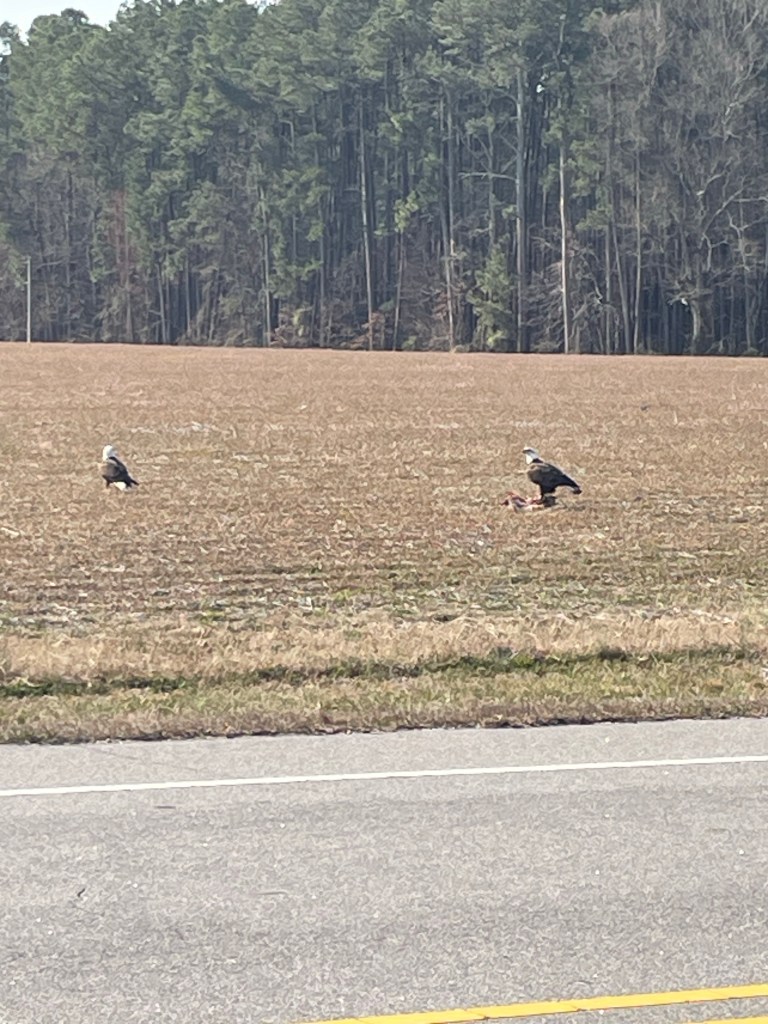
He texted me a photo recently, with tremendous excitement: Look what I just saw!

A barren field along a deserted country road…

Where stood two bald eagles.

His eyes sparkled when he saw me later: They were huge! So beautiful…

It is better than I ever dreamed, this life, here in the country.

Isn’t it, Son.

*******

Composed for Day 22 of the Slice of Life Story Challenge with Two Writing Teachers

Franna’s house

Last Saturday morning my son texted:

Micah put her shoes and jacket on and now she’s standing here saying “I want to go to Franna’s house.”

My response?

“BRING HER!”

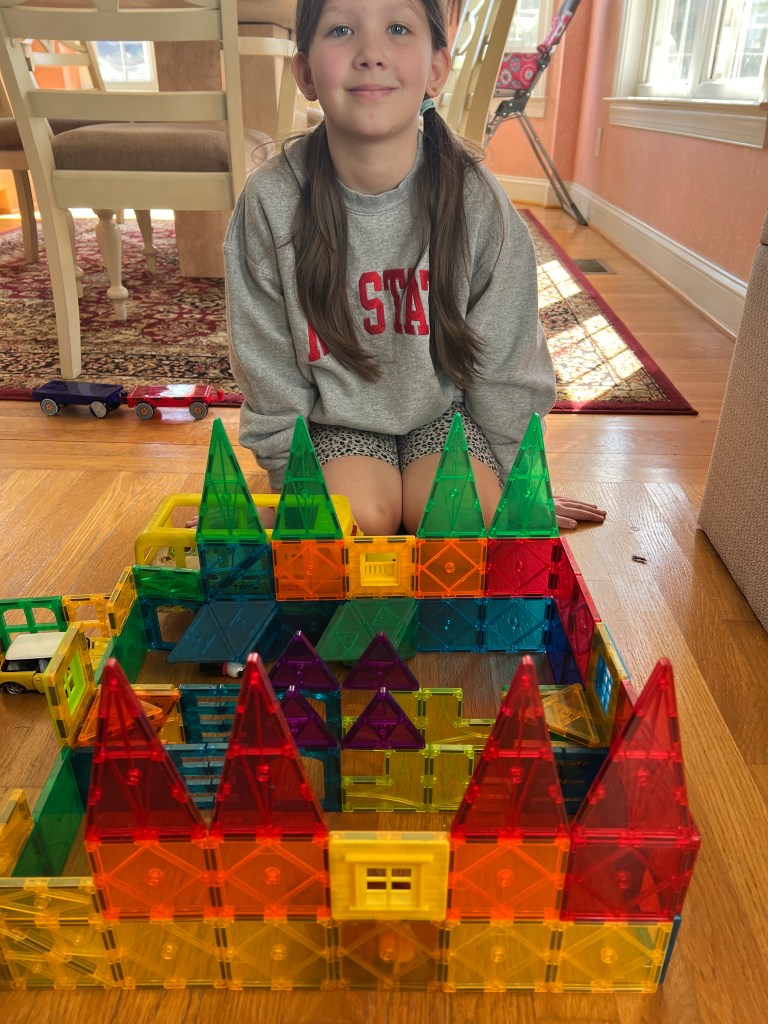
And so Micah and her big sister Scout came over for yet more adventures.

I feel a celebratory pantoum coming on…

At Franna’s house
We play all day
Singing a hundred songs
Wearing Franna’s jewelry

We play all day
We hide in our bedspread fort
Wearing Franna’s jewelry
While building our castles

We hide in our bedspread fort
We eat up all the ice cream
While building our castles
It’s always a magical time

We eat up all the ice cream
Singing a hundred songs
It’s always a magical time
At Franna’s house

— as magical for Franna as for her girls. ❤

*******

Composed for Day 21 of the Slice of Life Story Challenge with Two Writing Teachers

Jewels

On March 17th I typically write a post contemplating my obscure Irish roots while celebrating the novelty of my grandfather’s middle name: St. Patrick. Yes. For real. No one knows why, my down-east North Carolina Methodist Granddaddy hated it, and by my lifetime he’d legally changed it to the initial S.

I love the uniqueness of it. I cannot let the day pass without saying that Columbus St. Patrick Brantley’s name remains a treasure to me, a jewel in my family’s living memory, a perpetual mystery in our supposed non-Catholic history.

Here is where I diverge from my norm to chase, not a name, but a word: jewels. In keeping with the day, of course. The first jewel I’m after is brilliant language, and the Irish are rich in that. It glimmers in every bit of their wit, storytelling, poetry, and song.

In 1996, Frank McCourt’s memoir Angela’s Ashes burst upon the world and won the Pulitzer Prize. As soon as I learned of the book, I had to have it. Reviewers raved about McCourt’s narrative voice: Stunning. Lyrical. Dazzling.

So I got my own copy. From page one…spellbinding. My concepts of writing and memoir were forever changed; McCourt’s Irish voice has never left my head.

Of his many glorious phrases, one that returns to me most often comes from the scene where young Frank is in the hospital recovering from typhoid fever. In the room next door is a girl recovering from diphtheria. They can’t see each other, but she calls out to him. She says she has a book about the history of England with her, if he’d like to read it. He does. Books are treasures to him; his impoverished family doesn’t own any. The girl sends the book to him via the nurse, Seamus, who delivers it most reluctantly, complaining because it’s about England “after all they did to us” and that there “isn’t a history of Ireland to be had in this hospital.”

McCourt writes:

The book has the first bit of Shakespeare I ever read:

I do believe, induced by potent circumstances
That thou art mine enemy
.

...I don’t know what it means and I don’t care because it’s Shakespeare and it’s like jewels in my mouth when I say the words.

Jewels in my mouth…

I knew exactly what he means. I loved Shakespeare from my own first encounter. The last line of Sonnet 73 is the heartbeat of most everything I do in life, certainly of the things I write: To love that well, which thou must leave ere long. Jewels in my mouth, in my heart…the bequest of beautiful language.

McCourt eventually left Ireland for America where he became a high school English teacher. He’d regale his classes with stories of his childhood, and they’d say Hey Mr. McCourt, you should write a book.

So he did.

Angela’s Ashes.

And so the world is changed.

That is the power of story.

That is the second jewel from McCourt: Story. Specifically, writing of your own life.

In his final memoir, Teacher Man, he’s become a creative writing teacher. He’s trying to inspire students to write about their lives when they think there’s nothing interesting to say. He tells them: Every moment of your life, you are writing. Even in your dreams, you’re writing…Dreaming, wishing, planning: it’s all writing, but the difference between you and the man on the street is that you are looking for it…realizing the significance of the insignificant, getting it on paper. You might be in the throes of love or grief but you are ruthless in observation. You are your material. You are writers and one thing is certain: no matter what happens, you’ll never be bored again. Never…nothing human is alien to you.

Jewels. Your words, your story, your every moment. All priceless.

I met Frank McCourt in the winter of 2000 when he visited North Carolina State University. I went despite a falling snow. I took my oldest son with me and we listened to McCourt speak of his books and devastating childhood in Ireland. We listened, and marveled. We listened, and wondered about the story of our own origins on The Emerald Isle.

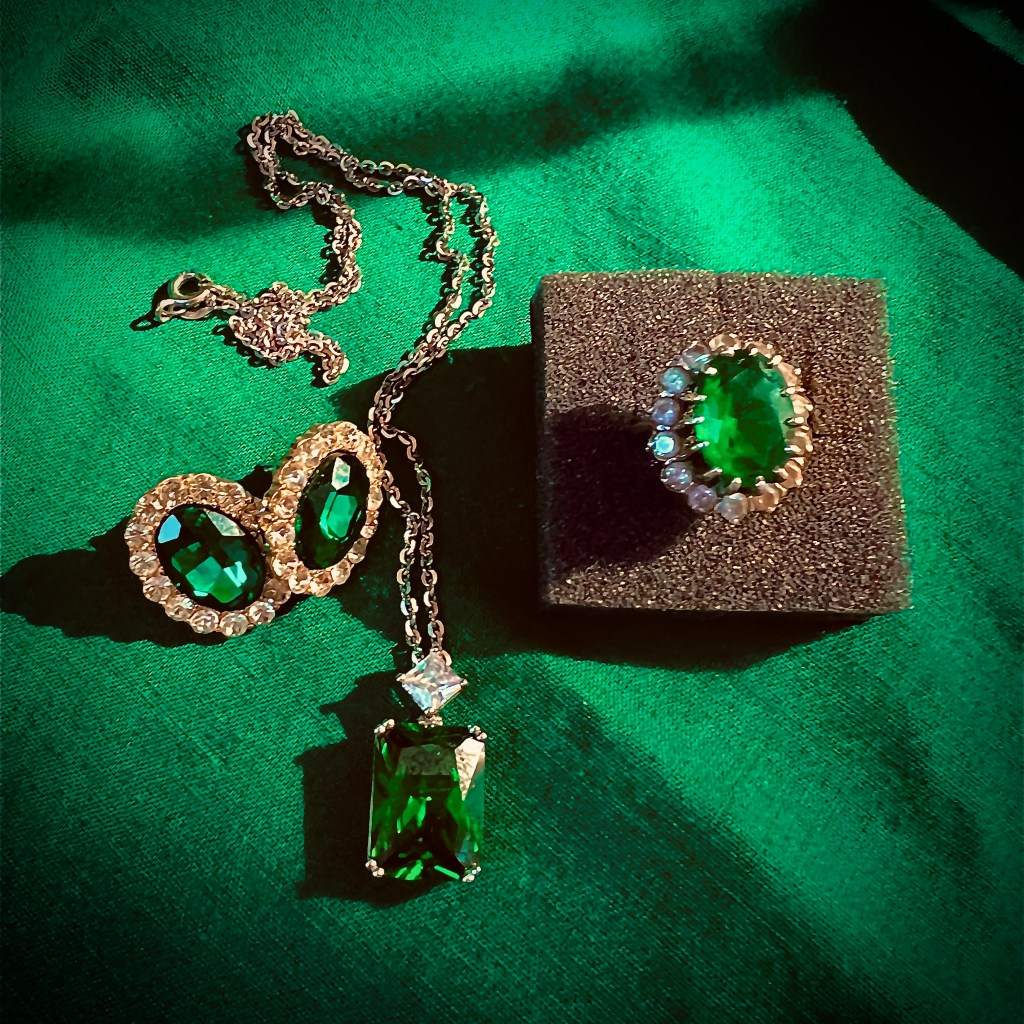
Which brings me to my final set of jewels for today: Christmas before last, my husband gave me a necklace and ring. His sister, without knowing or discussing it with him, gave me earrings. The jewelry, all bearing my birthstone, emerald, are a startling match. My sister-in-law chose the jewelry for me because she loves the color. My husband said, These are to remind you that one day, I’ll take you Ireland.

Where, I imagine, the voices of my distant ancestors still whisper in the wind…perhaps when I go, if I am very still, I might hear them…learn from them…

Until then, and always, I shall be about the excavation of my own story-jewels, with McCourt’s words echoing in my brain and my curious link to St. Patrick forever pulling at my heart.

As for today… here’s to proudly wearin’ o’ the green.

*******

Composed for Day 17 of the Slice of Life Story Challenge with Two Writing Teachers

*******

Works cited:

McCourt, Frank. Angela’s Ashes: A Memoir. New York, Scribner, 1996. (Pages 195-196)

McCourt, Frank. Teacher Man: A Memoir. New, York, Scribner, 2005. (Pages 244-246)

Rosary beads

a backwards story

Let them be a memento of the first day I came to see you and of God’s divine grace.

I shall keep them for you until such time that you can understand the story.

I picked them up, brought them home, and washed them. Never mind that we’re not Catholic, your father and grandfather being Baptist preachers.

Considering the significance of my visit, their appearing seemed a rare and holy thing.

A set of rosary beads, right there in the parking lot, with no one else in sight. Perhaps meant for a child, as the beads are plastic, mostly bright blue, with six orange, three green, and a little white crucifix.

When I left the hospital to head home, the rain had ended. The sun sparkled on the wet pavement. My heart danced with the beauty of the day, of the whole world. I stepped gingerly around puddled water shimmering with rainbow swirls, and that’s when I saw it.

Grandparents and grandchildren are a special gift to each other, especially if many years together are granted. Time to love, to live all our own stories, to always be close ’til you’re all grown up and I must go… this is my prayer.

I sat in a chair and your dad placed you in my arms. Joy and awe flooded my very soul…my cup runneth over, and over. I could have held you forever and it wouldn’t have been enough.

And there you were…so little, so perfect…I’d cried when your dad texted the first photos on the previous day. Now, seeing you with my own eyes, I could hear my grandmother’s voice, her narrative: You looked just like a little angel. And that’s exactly how you looked to me, my beautiful Micah. A heavenly being sent straight from the hands of almighty God.

Down came a gentle rainfall, spattering the windshield as I flew to the hospital that morning…once I answered the COVID questions and passed the temperature check upon arriving, I was allowed to go the room.

The end of October is a lovely time of year here in North Carolina, when the sky takes on sapphire hues. I wore a light raincoat because the meterologists predicted sprinkling.

I had to wait until the day after you were born to come see you.

You came during the pandemic. The world struggled with masks and distancing. The hospital limited visitors to two a day…and your dad counted as one.

My grandmother loved to tell me the story of my birth. I shall love telling you yours.

Me holding Micah for the first time.

*******
Composed for Day 9 of the Slice of Life Story Challenge with Two Writing Teachers

Wedding music

Do you remember
riding around in my car
singing gospel songs

the old ones you loved
since you were a little kid?
Folks always told me

you have an old soul.
I said you were seventy
the day you were born.

Yet you’re still so young.
I wouldn’t trade anything
for hearing your voice

singing harmony
on those beautiful faith-songs
my own Granddaddy

would have known and loved.
Here’s another thing I want
you to remember:

I am forever
proud of your talent, your heart
for other people

your service to God
and the comfort you’re giving
to those suffering

their greatest losses.
You are a gift to us all.
And now, a blessing

comes to you straight from
Heaven, another of my
prayers answered.

I worried that you
wouldn’t meet anyone while
working funerals.

Me of little faith.
Never expected a girl
driving the hearse to

the crematory
would find you there and begin
a new life story.

As the families make
preparations for your day
I can’t help hearing

your voice echoing
from long ago when we rode
in my car, singing

that old-time song called
“Wedding Music” and you said
“Mom, this harmony

is so beautiful.”
It’s what I pray for you now
my beloved son

and your bride-to-be:
beautiful harmony for
your life together.

My son and his bride-to-be. Photo: Kailey B. Photography

The referenced song my musican son loves:

*******
Composed for Day 4 of the Slice of Life Story Challenge with Two Writing Teachers.

Tip: Try writing a story-poem in haiku syllables.

XIII and XIX

One recent early morning, I sat down at the kitchen table to write some poetry just as my husband turned on the TV. I caught the word cicadas.

I abandoned my laptop to come watch the segment:

“2024 is going to be a banner year,” announced the newscaster, “a rare co-emergence of two periodical cicadas: a seventeen-year brood and a thirteen-year brood…

A chart appeared on the screen:

Brood XIIIBrood XIX
Emerges every seventeen yearsEmerges every thirteen years

“They make the most beautiful sound I’ve ever heard,” said a second newscaster.

“Said no one ever,” joked the first.

The whole news crew burst into laughter.

“But it IS a beautiful sound!” I said to their guffawing faces.

I know the sound is a harsh rattle. Loud. Discordant. Metallic. Strange.

I don’t expect everyone to like it.

I’ve loved it since I was a child.

I wasn’t aware I loved it when I spent brutally hot summers deep in the country with my grandparents, where an old dirt road and a ditch were all that kept their yard from being swallowed up by a towering deciduous forest. From those dense, mysterious depths emanated a deafening buzz, hundreds upon hundreds of cicada-songs swelling and subsiding in synchronized rhythms, the background music of my happiest childhood days.

Time passed. As my grandparents grew older and my visits rarer, I’d realize the meaning of the rhapsody. Cicadas play love songs with all their might. They know their time is short.

At nineteen I was hospitalized with a high fever. My father and mother both accompanied me, clearly concerned about my condition. They sat by my bedside while I lay shivering under layers of blankets, too tired to talk, to move, to care about anything. Afternoon melted into night. It was winter. The heater in the room kicked on with a buzz so like the cicada chorus of my childhood summers that my shivering eased almost instantly.

They’re calling me, I thought. The cicadas. They’re taking me to Granddaddy’s and Grandma’s, and I’ll be safe there.

This flooded with incomparable comfort and indescribable joy.

Then… if I’m dying, it’s okay, as long as there are cicadas.

And I fell asleep.

When I woke in the morning, my fever had broken.

I didn’t know, at nineteen, that cicadas are a symbol of resurrection and immortality. I didn’t know the many legends and lore surrounding the insects, such as the myth of Aurora, goddess of the dawn, doomed to fall in love with a mortal who inevitably grew old. She obtained immortality for him without thinking to secure eternal youth. Soon there was hardly anything left of him but his voice, continually singing his lamentation and love, so she finally turned him into a cicada.

Note: Aurora is the name of my grandparents’ hometown, where I spent those childhood summers steeped in cicada song.

Back to the present…

After that news segment, I had to do a little research.

Scientists say that these perodical broods, XIII and XIX, haven’t coincided since 1803 and won’t do so again until the year 2245.

They’re calling this a “cicadapocalypse” of maybe a trillion bugs…but not all in the same place (in case you’re thinking biblical plague). One’s called the Northern Illinois Brood (XIII) and the other, the Great Southern Brood (XIX). If my calculations are right, this brood appeared the summer that followed my sickness at nineteen (same as the brood numeral). I got married that August, when they would have been in full throttle. The time before that, I’d have been seven and hearing them at my grandparents’.

On the day the segment aired with newscasters poking fun at the sound, I happened to be taking part in an Open Write at Ethical ELA. Host Leilya Pitre introduced the Naani poem form, which orginated in India: four lines consisting of 20-25 syllables total. The poem isn’t restricted by theme, subject, or metric pattern. Leilya challenged participants to scroll through social media or the news to find four phrases to make a Naani.

My lines had just been delivered to me, before I even read the prompt.

Once again, the Magicicada were at work in the background rhythms of my life.

From This Morning’s Newcast

Brace yourself:
the cicadas are coming…
the most beautiful sound
I’ve ever heard.

—I don’t know about you, but I can hardly wait for cicadapocalypse.

Cicada vunerable after metamorphose. Joi. CC BY 2.0

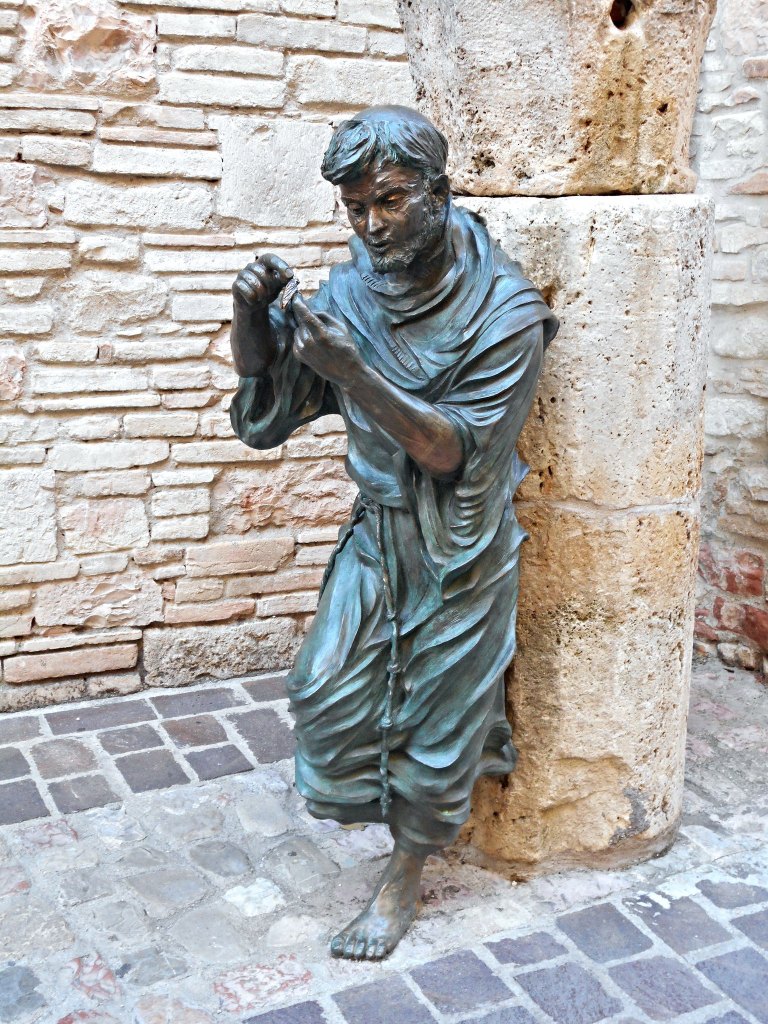
‘Saint Francis with cicada’ – modern bronze statue by Fiorenzo Bacci – Friary of Santa Maria degli Angeli at Assisi. Carlo Raso.

Legend has it that Saint Francis heard a cicada chirping in in a fig tree and called it to him, saying “Sing, my sister cicada, and praise the Lord thy Creator,” and it obeyed, sitting on his hand.

*******

Composed for Day 3 of the annual Slice of Life Story Challenge with Two Writing Teachers.
Q: What’s YOUR favorite insect? Why?

You, reversed

Yesterday morning during a read-aloud that mentioned “Backwards Day,” I watched students getting into the concept. One boy twisted his sweatshirt around so that he could pull the hood over his face. He took off his sneakers and tried, unsuccessfully, to put them on his feet backwards (note: these are second graders). Others said “What a terrible story!” meaning, of course, “What a great story!” And the guest reader, Gabby, said her name was “E-Bag,” to howls of kid-laughter.

It took me back to my own childhood, when a friend and I decided to call each other by our backwards-names: I was Narf. She was Irret.

Hysterically funny! So utterly original!

Until I mentioned it to my father, who burst my bubble: “I did that when I was a kid, too.”

“Oh,” I mumbled. So much for inventing one’s own new fun thing.

“Yeah,” Daddy went on, matter-of-factly, “I was Nodrog.”

NODROG?!

I collapsed in the floor, convulsing with laughter.

It sounded almost like a sci-fi/fantasy name. What would a character named Nodrog be like? Would he be an inept superhero who was basically good-hearted but forever blundering (à la Inspector Clouseau)? Or a giant, rugged, comic book character, a cinderblock kind of robot whose foosteps shook the Earth?

In either case, nothing like Daddy, with his silvery crewcut, work uniform, and photo gray eyeglasses. Who knew he’d actually been a real kid?

After the second-graders and “E-Bag” stirred the old memories, I found myself wondering:

What would a character named Narf be like?

Associations like Nerf and Nerd crowd my mind… but perhaps these are useful.

Maybe Narf would be athletic. Very fast and agile (I was a fast runner as a kid, whenever asthma didn’t do me in, but never really athletic, emphasis on never). I should like to think a facet of myself could be so skilled at sports, in something greater than Tetherball (if you know what this is, you are, like me, from a bygone era).

Or maybe Narf is from another world (my favorite kind of story!). This spawns all sorts of questions: How would Narf get to our world? And why? What would Narf’s world be like? Should we go there instead? Is it in danger of being destroyed? Is Narf on some kind of mission? Can Narf operate advanced technological devices and spacecraft, or even build them? … the possibilities here are endless…

Somehow I cannot think of Narf as an elegant being, except for maybe graceful while playing sports, but more likely a scrappy player. I can, however, envision Narf as something else entirely, a comical character wearing a big fascinator with giant, garish fruits fashioned from sponge (toldja those first associations might be useful).

And then I wonder…would Narf be my alter ego? My evil twin? (I accused my own children of having one).

—OH OH OH OH—

As the wan light began to fade, they stood side by side on a dune looking out over the desolation. Nothing but rippled sand to the smoky white horizon. No other living thing in sight. This was once the shoreline of the Great Sea, long since dried up.

Nodrog broke the deafening silence: This is where we must go our separate ways.

Narf nodded. After a moment, she spoke: Will we ever meet again?

She knew the answer.

Not in this world, Child. It is the last day. The end of Drawkcab.
You must remember what you have been taught.

His spear fell into the sand. He was already fading like the light, becoming the mist, same as all the others. Her hands shot out, grasping at nothing. She could not hold him.

Nodrog was no more.

She bent, picked up his spear, and leaned on it, weeping.

We will meet again, she said aloud, sure that he could still hear — is it not the last sense to go?

We will meet again, she repeated, louder, if not in Drawkcab, then Drawrof. Yes. Drawrof.

And she set out over the dry Great Sea-bed, shells crunching under her feet.

—What shall I do with them now, Nodrog and Narf? Should these newly-materialized characters live out their whole story, somehow?

Ot maybe I’ll save the names for a different manifestation, in case Nodrog and Narf should come to me in the form of, say, two pet dachshunds.

Somewhere, Daddy is shaking his head about all this.

In amusement.

I’m sure of it.

Life can only be understood backwards; but it must be lived forwards.” sylvar. CC BY 2.0.

*******

Composed for Day 2 of the annual Slice of Life Story Challenge with Two Writing Teachers.

Q: Where might your name in reverse take you?

Fallow

Halfway between work and home
I noticed the field.
How could I not, such vibrant green
popping against the panorama
of brown grass and tired trees
giving way to winter.

I needed this shot
of unexpected freshness
after these first days back
to full-time work
with my husband at home
in the middle of a slow recovery
from spinal surgery.

The waning afternoon light
slants gold across the green
and there, there,
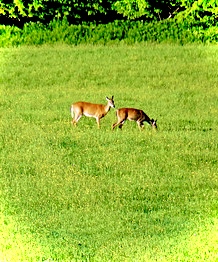
clear as day, two deer
graze, gilt-edged
and peaceful
and perfect

as if it isn’t hunting season
as if carcasses of their kindred
aren’t lying mangled by the roadside
within their view
as if the long in-betweenness of
hours and days and seasons
and breaths
is no consequence

as if all that matters
is this field left fallow

for their sustenance

and now
mine.

NS-01036 – Whitetail Deer. archer10 (Dennis) CC BY-SA 2.0

Whitetail Deer.TexasEagleCC BY-NC 2.0

If you build it…

The Birdbath

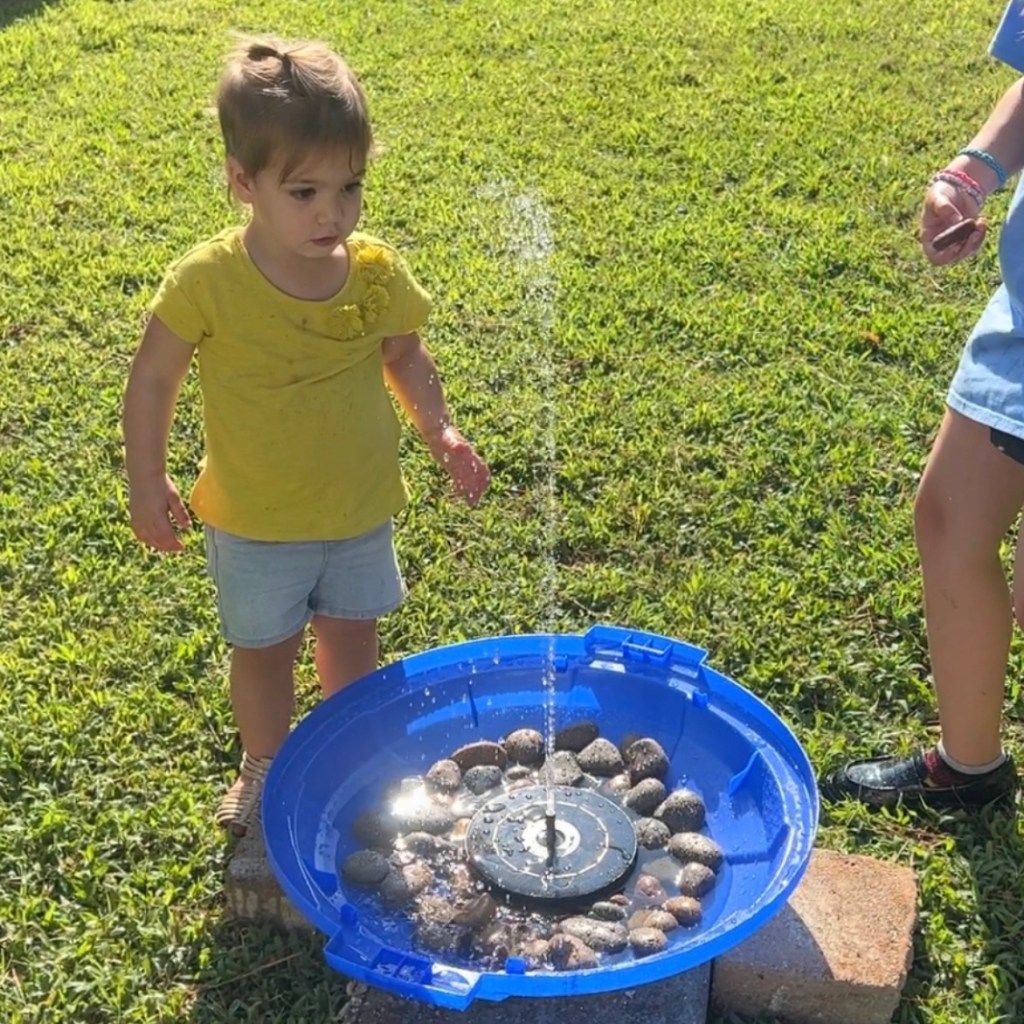
We built it, we three
my sweet granddaughters and me
fountain birdbath, see

spray sparkling in sun
although birds have yet to come
awe, already won

My little bird-girl Micah, 20 months

*******

with thanks to Two Writing Teachers for the weekly Slice of Life Story Challenge
Doing great things

for Micah

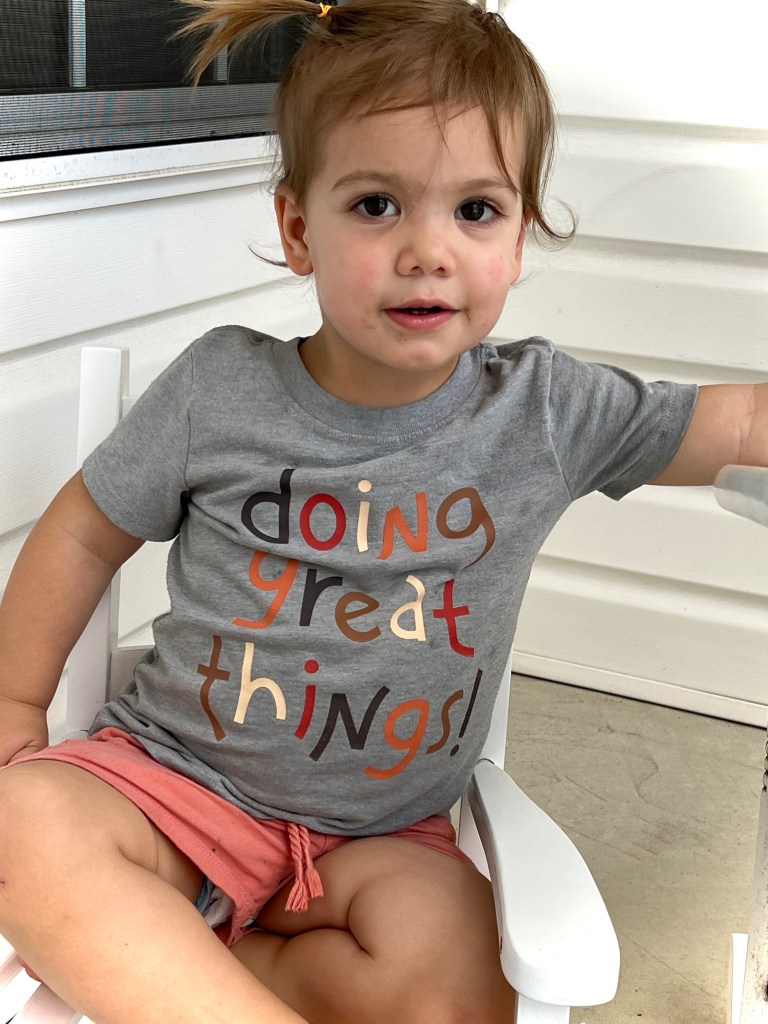
Once upon a time, which is now, the second summer of your being, you reign supreme in the province of Franna’s house. Each day holds untold wonders. Every moment is rimmed with pure gold; with every tick of the clock, you are gaining strength and power.

Speaking of which: You are enchanted by the grandfather clock in the foyer, even though it’s not working at present. You have discovered, if you stand close enough and jump hard enough, the bells will chime for you.

You are so proud of the two ponies you wear in your hair. When you are in your bed, fighting sleep, you pull the ponies out.

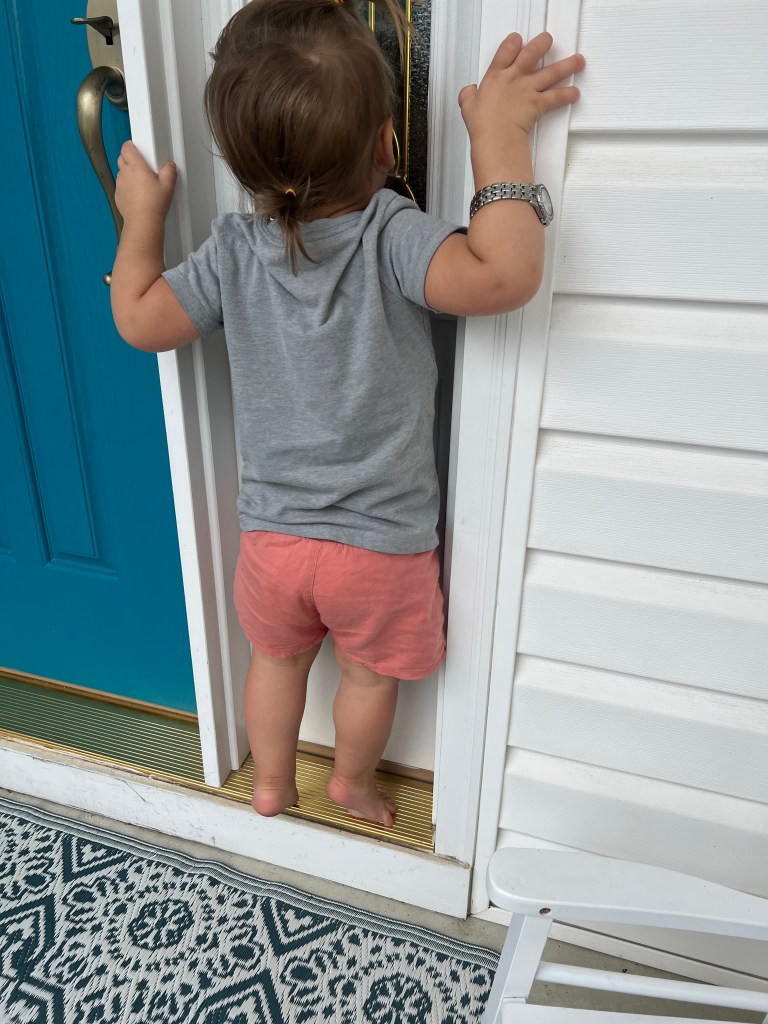
You are a study in language acquisition and word associations. Homonyms don’t throw you. Rock, for example. You understand perfectly well it means the big gray thing out by the woods as well as the movement of the white chairs on the porch. It’s one of your favorite things to do; a dozen times a day, you have your hand on the front door handle, asking to rock.

Another dozen times a day, you hold your hands up to me (got you) with the directive Watch. Birds. And I hold you at the windows where we watched the bluebirds going in and out of their house from early spring to summer, feeding two successive broods of babies until they fledged and flew. You mimic my whisper: Watch. Watch. You became especially fond of the Dada bird, so vibrantly blue, and you knew he was helping to feed his babies (often with a big bug in his beak).

Then you see Grampa in the rocking chair. He’s wearing his big black wristwatch. Your big brown eyes (so like your father’s, so like mine) miss nothing: Grampa watch. A thought flickers across your face. I get it, you say. Back in the house you go, looking for my watch on the kitchen table where it’s charging in a patch of sunlight. You slide it onto your little arm and hold it up with pride: Watch.

You don’t yet know about time. Tempus fugit, says the face of the grandfather clock. Time flies.

You will know this soon enough. For now you are exploring all the windows of your world. On tiptoe.

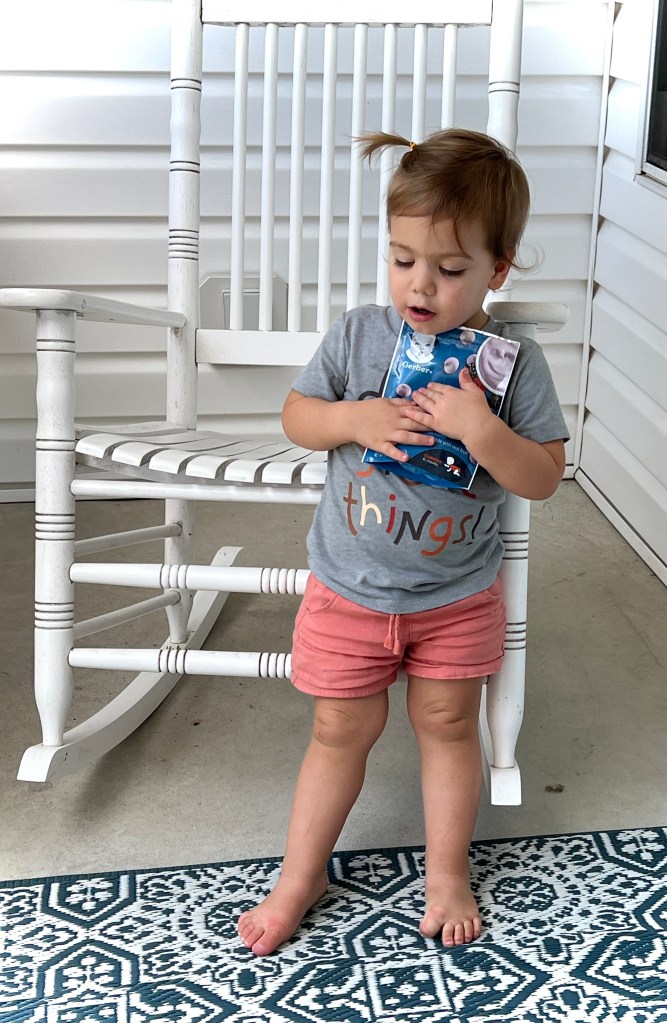
You know love. You rock your dolls (babies). You see the Gerber baby on the packet of yogurt melts that Franna always, always keeps on hand. Awww, Baby, you say.

You hug the Gerber baby, too.

Your curiosity knows no bounds. It outweighs your fears. You say loud when a plane flies over; you cover your ears, but you love planes. When they disappear from view, you say Bye, plane. You keep looking for another.

This week a helicopter flew over Franna’s yard and utterly captivated you. You are grappling with that word, helicopter (Franna understands it even if others can’t yet).

The hammering of the new deck construction is loud but you have found a just-right seat on the telescope base to watch the man working.

The Lowry organ in Franna’s living room is way too loud for you so we don’t turn it on; you are perfectly happy sitting on the bench, pressing the silent keys, flipping the couplers (that control pedals, special effects, swell, and great) up and down. That is, in fact, what you call the organ: up down.

You are learning to question. If a toy rolls under a table or bed: Where’d it go? When there are no birds outside the window, you call in your singsong voice: Birds, where are you? When you want to watch a music video on my phone, you pat my pockets or stick your hands between the sofa cushions: Where is it? Phont. I get it.

For you adore music. You sing. You dance. You ask for specific song videos (we know exactly what these are, don’t we): Na Na Na, Sunny Day, Shine, Ba Ba Minion, Giant, B-I-B-L-E. Not to mention do-do-do-do-doot-doot-do Bluey on TV.

You play drums with spatulas on my big kitchen bowls. One two, you say. We are working on three four.

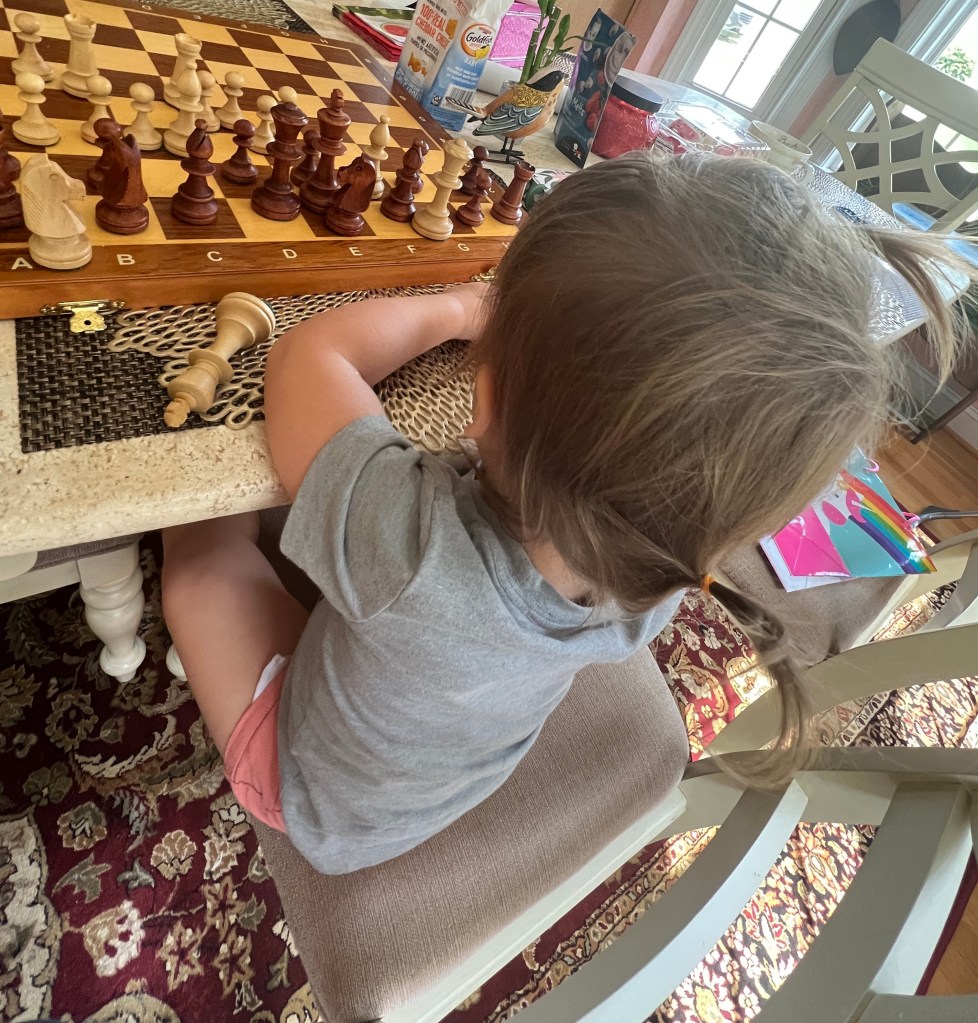
You want to do the things you see your big sister doing. This summer, at age seven, she taught Franna how to play chess.

You are determined to play, too.

One of your newest words is try. You so want to do things for yourself. At twenty months you aren’t a baby anymore. Although you still like to be held. A lot.

You try. You watch. You shine. You show your love by curling your little body around your Franna so you can’t be put down. So Franna holds you for as long as you like.

Your Dada tells me that you are refusing naps at home and that you lie in your crib crying Frannaaaaaa…!

This is a great thing to your Franna. A very great thing.

Every moment of every day, you are doing great things.

I write them here for you, thinking of all the great things yet to be.

For that is what grandmothers are, memory-keepers.

Until the time your memories become your own, while we live this story of our beautiful once upon a time, which is now, oh, I cherish the keeping.

*******

with thanks to Two Writing Teachers for the weekly Slice of Life Story Challenge