Turtle meditation

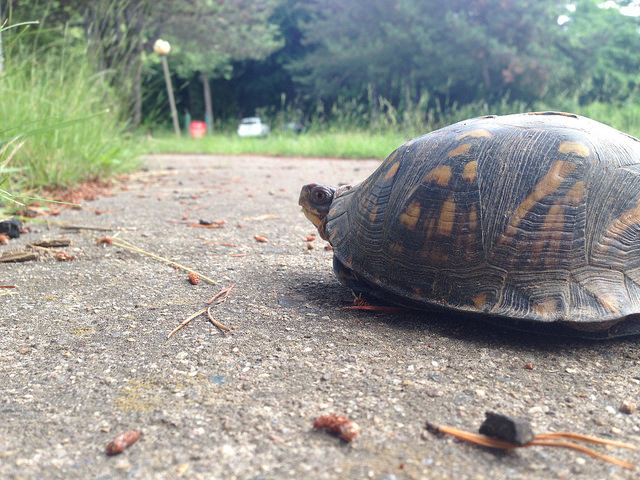
It’s almost summer here in rural North Carolina, which means two things: tobacco is lush in the fields, and turtles are busily crossing the roads.

Which also means that turtles are frequently run over by inattentive drivers.

There by the roadside, these wounded creatures die. Sometimes they leave a trail of blood on the pavement where they dragged themselves to the other side. Any roadkill is disturbing to see, but something about the inner pinkness of the turtle showing through the broken shell pieces troubles me immensely.

Maybe it’s because the shell, perfectly designed to protect the turtle, failed to do so.

But turtle shells are not meant to withstand the weight of a vehicle.

The pinkness represents vulnerability to me; I automatically begin thinking of other vulnerabilities due to failures of structures meant to protect or to edify.

Brokenness occurs on many levels in societies. Governments fail to protect the people, businesses fail to protect employees, family members fail to protect one another.

As an educator, an instructional coach, I see how expectations grow greater all the time and how the weight rests heaviest on teachers. I worry about the cracks, the brokenness, the damage – for, you see, the children are the most vulnerable part, the part we cannot afford to lose.

Any alleviation of this weight, any solution to such brokenness, lies first with the drivers.

Whomever and wherever you are.

Pay attention.

Reflect: Lucy Maud Montgomery wrote: “All things great are wound up with all things little.” Consider the brokenness around you. Repairs and healing will not be complete in a day. Where’s a small place you can begin, in a small but positive way? Positive results only come from positive words, ideas, and actions – and awareness. 

slice-of-life_individual

In-between places

Gloomy forest

Gloomy forest. gorchakov.artemCC BY

I read the final page and close the cover. The idea of being separated from someone you love intensely, whether by distance, time, or circumstances, comes with a stab so sharp that it almost isn’t bearable.

Never mind that The Time Traveler’s Wife is fiction. The frequent separation of Claire and Henry, especially their final one, is crafted with this piercing truth, the longing for the “in-between” period to be over so that the characters can be together again. Sometimes the interim lasted for years.

While Claire and Henry usually had the advantage of knowing the duration of their separations thanks to his time traveling, the rest of us don’t get such clear glimpses of the future. We have to endure the various in-between stages of our lives, not knowing how long they’ll last, not being able to speed up time, not knowing the outcome, often having little or no control.  These in-between places are often laced with deep aching, a sadness and desperation at being apart from someone we  love. Existence is as flat and barren as a desert. The emptiness is huge, frightening; we want to rid ourselves of it before it consumes us. The scope of this in-between-ness is too much for us. The loss cannot be dealt with as a whole but only lived through in chunks  – a day, maybe just an hour, at a time.

There are in-between places other than those of relationships. The loss of a job, long illnesses, hardships, disasters – all can be dark places that sap our strength, sometimes with no foreseeable guarantees that all will end well. Living in these situations is like navigating a dark, unfamiliar forest. Not knowing which way is the shortest or best way out, we often go in pointless circles without realizing it.

I recall an in-between place that’s quite different. It’s remained in my mind since I was a child, on my first reading of The Magician’s Nephew.

It’s called The Wood Between the Worlds.

In the attempt to move from our current world to another by wearing magic rings, two children land in a sort of “connector” place. Here’s how C.S. Lewis describes it:

It was the quietest wood you could possibly imagine. There were no birds, no insects, no animals and no wind. You could almost feel the trees growing . . . a pool every few yards as far as his eyes could reach. You could almost feel the trees drinking the water up with their roots. This wood was very much alive. When he tried to describe it afterwards Digory always said, “It was a rich place: as rich as plum-cake.” 

Digory discovers that he’s not frightened, excited, or curious. He’s forgetting why he’s there and what he knew of his own life, even his mother, who’s dying.

If anyone had asked him: “Where did you come from?” he would probably have said “I’ve always been here.” That was what it felt like – as if one had always been in that place and never been bored although nothing had ever happened. As he said long afterwards, “It’s not the sort of place where things happen. The trees go on growing, that’s all.”

Not the sort of place where things happen, but things go on growing around us while we are numb, sleepy. Who among us hasn’t experienced this?

Digory has an epiphany nevertheless – he tells his companion, Polly:

That’s why it’s so quiet and sleepy here. Nothing ever happens here. Like at home. It’s in the houses that people talk , and do things, and have meals. Nothing goes on in the in-between places, behind the walls and above the ceilings and under the floor, or in our own tunnel. But when you come out of our tunnel you may find yourself in any house. I think we can get out of this place into jolly well Anywhere!

Digory is right. The rest of the book deals with the results of his and Polly’s choices, both wise and foolish, but suffice it to say that they get out of The Wood Between the Worlds to witness the birth of a brand-new world.

Narnia.

Here’s another illustration, not out of fantasy.

My family once decided to travel from Raleigh, North Carolina to Boston by train. There was a problem with the train at the first segment of the trip – it had to be made by bus. Arriving at a different station, we boarded the train at last.

What we didn’t realize is that the train would stop at every major station on the East Coast even when no one was getting off or boarding. Long into the night we rode, stopping in deserted stations, sometimes for an hour or more. Bleary, exhausted, regretting our choice of transportation, we wondered how long this train would sit in this place where nothing was happening, and why.

I fell asleep.

The first light of dawn woke me. I looked through the train window at gray nothingness to see a shoreline slowly materializing. After having come through the unsightly backsides of major cities for most of the trip, this was unexpected. The sky turned pink, the sea rose-gold and sparkling, with the rising of the sun.

It was breathtaking, one of the most glorious sights I’ve ever seen.

After nineteen (eternal) hours on the train, we arrived in Boston.

The trip home was longer, as another train’s battery died and our train had to deliver a new one to them.

The point is that while the in-between places are static, and we often arrive in them for indeterminate stretches of time, they do serve a purpose. We can rage at the nothingness there, fervently railing at the passing of time, or sink into numb paralysis for the duration. Or we can see the in-between places as connectors, the temporary segue from one phase of our lives to another. Away from the energy, the hustle and bustle of life in this world, the in-between place may be one of needed rest, one of learning, reevaluating, recharging, restoring, until the path becomes clear and we can move on with living where the action is.

The next destination may not look like what we imagined.

It could, in fact, be far more glorious than we ever dared to hope.

Reflect: What in-between places have you experienced in life? What stories can you tell about enduring and getting through to the other side? If you are in an in-between place now – strength to you. It is temporary.  Reorient yourself; think, and begin preparing for what is waiting for you just ahead – be ready to meet it.

And write!

A time to break down, a time to build

Old hotel

Old hotel. PhillipCC BY-SA

To every thing there is a season, and a time to every purpose under the heaven . . . a time to break down, and a time to build up . . . . 

Ecclesiastes 3:1, 3b

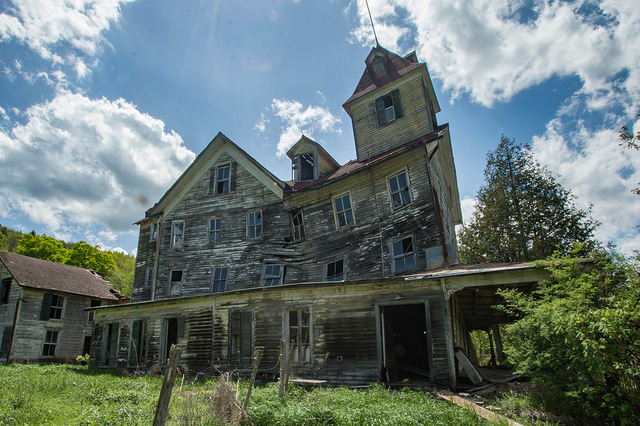
Along the country byways where I live, there are lots of old houses and barns in various stages of falling down. There’s an odd elegance to the sway of a gray weatherboard structure still holding its own, somehow, after decades, maybe even a century, of standing. Eventually, the wood returns to the earth, and the earth, in time, takes it back into itself.

I don’t know why I love dilapidated houses and barns so much, beyond their elegiac grace. I do not know why I find pictures of abandoned structures like schools and churches so compelling. Eerie and haunting, too, but mostly intriguing. Perhaps it’s due to my love of story, my wanting to know who was there, when, and why the places were abandoned – where did all the people go? Is there no one left who cares any more?

I only know that there’s a time to break or tear down, just as there is a time to build.

This doesn’t just apply to old, unsafe buildings.

It might apply to us, as we age. With time our bodies break down, albeit slowly, as they are not meant to keep going forever. Sorry, I do not have a build parallel for this.

It might apply to systems, procedures, approaches that once worked and don’t anymore – a time to examine, evaluate, break down and build anew.

Which begs the question: When is it time to break down? To build?

When the structure is dangerous, apt to cause harm, can no longer be used for the purpose it was originally intended, needs far too many reinforcements, has limited or no more effect, the time has come to break it down.

It’s the inevitable, really.

If a purpose remains, and a structure is needed, it can be built fresh. Stronger, more durable, more appropriate, more effective, more creatively, sometimes even simpler than what was there before.

Take stock around you. What’s falling down? What needs to go? What needs to stay, be scrapped, be rebuilt altogether from the ground up? If it’s not working, why, and where should you begin?

And do you mean for what you build to last for a day, a year, or a lifetime? The planning and the vision make all the difference. The foundation is the most essential part.

Consider who you’re building for, and why.

You’ll find the way.

It may be time.

Mastering the monster

School bus

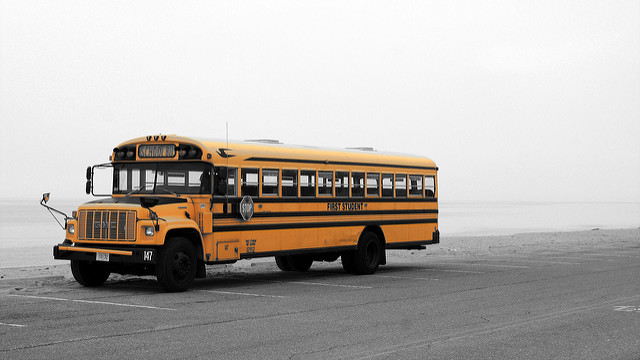
Bus #147. SebamirumCC BY

Life takes many unexpected twists and turns – a friend of mine says, “Life is one wild ride.” The mysterious is frequently interwoven with the breathtaking, the brightest moments often collide with the darkest, and the greatest desires of our hearts almost always involve epic challenges.

It took me the better part of two decades to finish college, for example.

I married at twenty, quitting college with a year and a half of coursework in general studies and theater arts. My boys were born. My husband completed two degrees needed for his work. I took a variety of jobs, all the while wanting to return to college myself, taking a class or two whenever and wherever I could. Sometimes I dusted off the old textbooks and plays, reread portions, dreamed of going on with my education.

When my younger son started kindergarten, I took a part-time reading remediation position that became full-time, until the program was cut after a couple of years.

“I’d like to keep you on, if you’re willing to take a teaching assistant job in first grade,” my principal told me. “Furthermore, there’s a distance education cohort beginning for paraprofessionals to get teaching degrees. You should pursue this – you’d be an excellent teacher.”

I pondered the prospect. A teacher. At the elementary level? I don’t know. High school English, maybe, but . . .

“It’s a consortium,” the principal went on. “If you’re a full-time teaching assistant, our county qualifies you to attend with financial aid. The books are even covered.”

Here it was, the long-awaited chance to finish school, only it didn’t look exactly like what I imagined.

The principal noted my hesitation. “It’s a perfect opportunity. What are you waiting for?”

Turns out that the program had K-12 reading certification built in.

That was the tipping point.

I love roller coasters. They climb and climb, gaining momentum, then – wooooosh. Hold on tight, as you don’t know what’s coming next – a pretty good metaphor for the wild ride of life. I applied to the program, got in. I loved my classes, my advisor, my instructors, my classmates. Returning to college was exhilarating.

Until.

“Of course, as a full-time teaching assistant in our county,” my principal said, “you’re required to get bus driver licensure.”

WHAT? 

I’m not overly fond of driving in the first place. The idea of maneuvering something as big as a bus, loaded with kids, being the only adult responsible . . .

“I’m not sure I can do it,” I said, going cold and clammy. My stomach lurched like it does after a sudden twist on a coaster, only worse.

The principal smiled. “Yes, you can. Look at it as something that gets you where you want to go.”

That’s what it came down to. If I wanted to finish school, to teach – which I now wanted to do more than anything, the ultimate situational irony – then I would have to face the big yellow monster.

My dad had driven a school bus when he was in high school. So had his sister. Back in their day, students were drivers. Daddy told stories about students tampering with the governor so the buses would go faster – I could envision the buses bumping down the country dirt roads, whipping around the bends in thick clouds of dust, kids bouncing wildly. He told the tales with glee; I listened in horror. While I darkly imagined Daddy’s great amusement on learning that I’d be driving a bus, if he’d lived to see it, this connection to him helped, if only the tiniest bit.

Look at it as something that gets you where you need to go.

I couldn’t let a bus stop me from finishing school or embarking on a whole new career that stretched out before me, glimmering and beckoning like the sea.

I signed up for the training.

The trainer started off with lots of stories, such as a driver once tipping a bus over by trying to avoid a squirrel, which is why we should never swerve if an animal runs in front of the bus.

I put my head down on the desk.

Then there was the first exam: Memorizing all the parts of the bus, how these parts are connected, what these parts do and why, what every light means. This was conducted by walking with the instructor, pointing everything out and giving an oral explanation. A written exam was also given.

I briefly considered failing these exams but my pride wouldn’t let me.

The training culminated in behind-the-wheel practice with the instructor, who asked: “Ever driven a Mercedes before?”

“No sir,” I answered.

He chuckled. “You’re about to now.”

I thought he was joking.

He wasn’t.

The bus I learned to drive on was made by Mercedes-Benz – who knew? It almost drove itself.

I managed to get this monstrous thing, this almost-airplane, through the narrow tree-lined streets of the nearby little old southern town without doing harm to anything until the instructor said: “All right, make a stop. Let these imaginary kids off the bus.”

I made the stop, opened the bus door. The flashing lights came on, the stop sign came out. I even counted imaginary heads.

For the first time, I thought: I’ve got this. It’s not so bad.

Then, as I closed the door to move on, the instructor said, “STOP!”

“What?!” I jumped a little in my seat. I stood on the brake.

“You just ran over a child,” said the instructor.

“I – what? How? I counted all the imaginary heads!”

“You didn’t check your mirrors. Kids can hide close to the bus and you’ll never see them if you don’t check all those mirrors. That’s why they’re there. Kids have been killed that way.”

I returned to work that afternoon in the deepest funk. A teacher assistant colleague greeted me: “Hey, how’d the training go?”

I sighed. “Not great. I ran over an imaginary child.”

My colleague grinned. “How did the imaginary parents take it?”

I laughed in spite of myself.

Still, I put myself on the prayer list at church. Seriously. The youth minister consoled me: “Look, when the time comes, God will give you driving grace.”

He was right.

The first time I had to drive, on my own, with real kids, it wasn’t a magnificent Mercedes bus but an old “cheese box,” as the kids say. I boarded with driving grace in my head and rosary beads in my pocket, given to me by a friend – and I’m not even Catholic.

I – and more importantly, the kids – lived to tell about it.

In fact, my driving the first-graders on their field trip to the movies (a trip of about three miles, consisting of three turns, one of which I took too close with a back wheel going over the curb, causing the bus to sway and the kids to scream), made their writing journals. When the teacher asked them to write about their favorite part of the trip, our entire class wrote various versions of this, with various spellings: “My favorite part of the field trip was when Mrs. Haley drove the bus.” On all the pages I was depicted at the wheel of the big yellow monster, my hair flying in the breeze for some reason, and smiling.

In the eyes of the kids, apparently, I was a great success.

I consider my mastery of the yellow monster my most dubious achievement, closely followed by my passing a college course on golf. No animals ever ran in front of me, all the kids got home, and other than the door handle rolling off one day and causing me to drive back to school with the stop sign out and all the lights flashing so that every car on both sides of the road pulled over, I am happy to report that I only had to drive a handful of times without incident until I finished the teaching degree and moved on, when I no longer had to drive a bus.

It did, indeed, get me where I needed to go.

Those obstacles that stand in the way of what we want, where we want to go – there’s no shortcut, no way over or around them. The only way is through, even when it doesn’t seem feasible, beneficial, or possible.

Whatever it is, whether it looms in front of you, in your past, or inside you, face your monster. Look it in the eye.

Then make up your mind to master it.

Grace be with you.
Song of invisibility

I sit straight up in bed. “Oh dear.”

My husband jumps: “What’s wrong?”

My brain can’t form thoughts yet. I was dreaming about . . . something. Whatever it was has already melted away.

He repeats: “What’s wrong?”

“I don’t know. I am – startled.”

My husband sighs, turns over, goes back to sleep.

I can’t. I lie there with my heart pounding.

I’ll write for a while, I decide.

The predawn house is dark but for a nightlight in the hallway. I creep around, wraith-like, to avoid waking the three sleeping dogs. Heading toward the kitchen, I hear it, loud and clear, as if it’s on the front porch, trying to find a way in:

Whip-poor-will, whip-poor-will, whip-poor-will . . . .

My favorite onomatopoetic sound in all the world. I’ve not heard a whippoorwill that close to the house before.

Is that what woke me? 

And then I start thinking about symbolism, so while my coffee brews, I look up whippoorwills on the laptop. Chilling stuff. Harbingers of death, disasters, impending trouble. Being visited by a talking Raven might be more desirable.

Whip-poor-will, whip-poor-will, whip-poor-will . . . .

Okay, it’s a captivating sound, more enchanting than haunting, I think, pouring cream in my coffee. I’ve loved the call of the whippoorwill since I first heard it, the summer after I moved to rural North Carolina. It dominates a warm country night, an energetic, compelling song rather than a plaintive one. It makes me want to stand still and listen for a long, long time. I continue my online reading, how the whippoorwill is referenced over and over in story, song, and poetry. Folks, it’s really a mating call. That bird isn’t going to be lonely for long.  

And then I read: A group of whip-poor-wills are called a “seek” or “invisibility” of whip-poor-wills.

My imagination takes flight. Those are magical words.

“Seek” implies “seeker,” someone on a quest, not to mention Quidditch. Few words have greater magical connections than “invisibility” – it’s a coveted power. Granted, in this context invisibility and seek define a homely, nocturnal bird that is rarely seen and which is simply  seeking a mate with its fervent night song, but still . . . could there be something more?

I’d awakened with a sense of imminent danger, bolting upright in bed. Oh dear, I’d said, just as I crossed the line between sleeping and waking (this a hypnopompic state; I looked it up just now).  While I cannot remember a dream-creature – or any shadow-people, for the true paranormal enthusiasts out there – attempting to do me harm, I do wake sometimes because of a dry, rubby cough, thanks to the flu earlier this year and my latent asthma. I wonder if irregular breathing is the root of this.

What an unromantic notion.

Whatever the reason:  Suppose the whippoorwill arrived at my house not as a portent of doom but as a protector, a preventive force. What if it knew to sing its song – because, let’s face it, that song is all about life and reproduction, not death – to wake me at the very moment before disaster struck? Exactly what, then, did it seek to drive away or undo – and why? What did my evaporated dream have to do with it?

Whip-poor-will, whip-poor-will, whip-poor-will . . . .

Ah, here are better words to describe the call: Ethereal. Otherworldly. 

A little bit of magic in the still of the night from the seek, the invisibility – although I always hear only one.

I sip my coffee, smiling at my flight of fancy.

Although it could be something more . . . .

slice-of-life_individual

Elegy written in the countryside

Tobacco barn

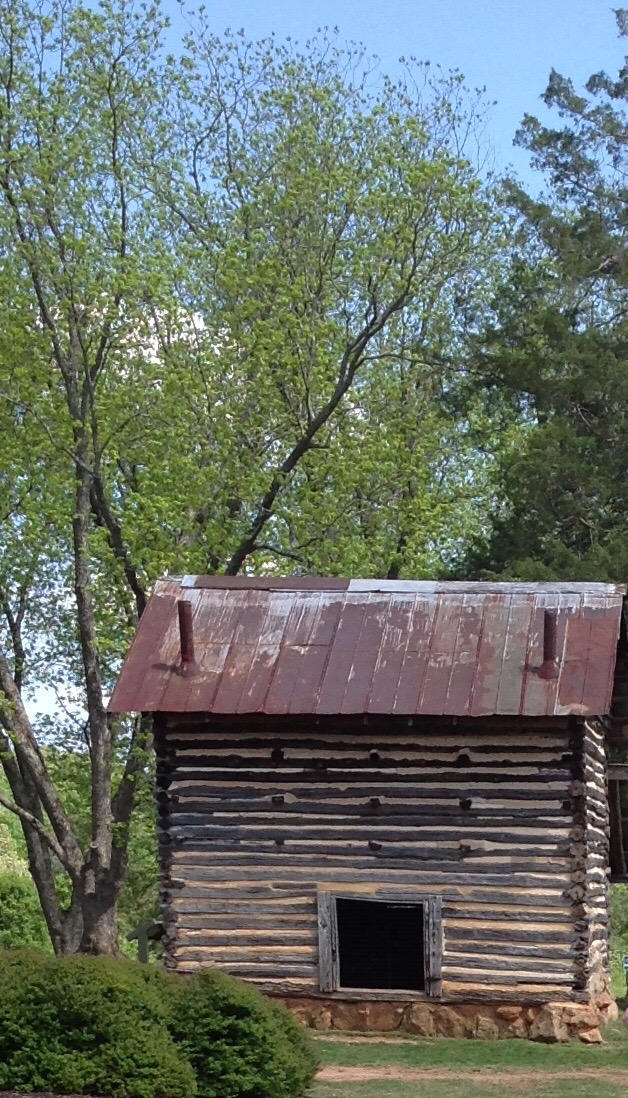
A friend tells the story of a visitor from England who, while riding through our rural North Carolina community, asked: “What are all those quaint, narrow houses in the fields?” My friend chuckled: “Those aren’t houses – they’re tobacco barns.” 

I thought: They’re really elegies written all across the countryside.

I love tobacco barns. Within a short radius of my home stands a grand one with a shiny tin roof, another crumbling in a timbered wood, and another housing two mules – seeing this makes me feel as if I’ve stepped back in time. So, with serious apologies to Thomas Gray, I attempt to pay homage to tobacco barns on this last day of National Poetry Month.

Along the winding roads, bereft, they stand
Beyond their use, and most beyond all care,
Just empty shells of creaking wood, unmanned;
Gone gold, within, leaves sweetness in the air.

The fires no longer burn, nor flues convey
The curing smoke, the farmer’s cash-crop dreams;
Those hands and hearts that worked all night and day
Lie spent, burned out, unremembered, it seems

But for the spectral structures standing yet,
Hand-hewn ghosts, whispering to passers-by:
“Press on, work hard before your sun shall set,
Live, love, build well.” – I hear the old barns sigh.

Reflect: What in your landscape, your neck of the woods, speaks to you? What does it say? Why? Listen – and write. 


Celebrate today

Dogwood

Dogwood. JenniferCC BY

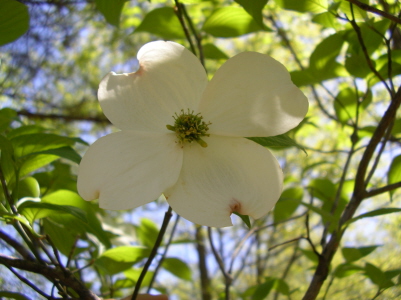
The first day of April – glorious. A sky as blue as it ever gets, hardly a cloud to be seen. Dogwoods and redbuds, bare just days ago, flowering profusely. On the breeze, the scent of blossoms, almost like perfume – winter daphne, I think.

All marking the end of desolation. Nature composes a theme of renewal with color, fragrance, amber light and birdsong.

At the close of the day, I celebrate its beauty. I celebrate the inherent message of hope with the arrival of another spring. Even the news carries a rare inspirational story about a man opening his front door to find his dog, missing for four years, back home on the porch. He sat down and the dog put her head in his lap – what an emotional celebration that must have been.

Today is also the first day of National Poetry month. I have recently discovered a lost booklet of poems that I wrote as a teenager. All things considered, this particular poem struck me as one appropriately celebratory  – winter is over, spring has returned; a lost dog has returned home; my lost poems are found.

I wrote it when I was sixteen. Back then, I called it “Yesterdays.”

Yesterdays are gone

Leaving nothing but memories behind

And, if meant to be, a chance for tomorrow.

So weep no more

For what once was,

For it may be

Once again.

Celebrate today.


Suncatcher

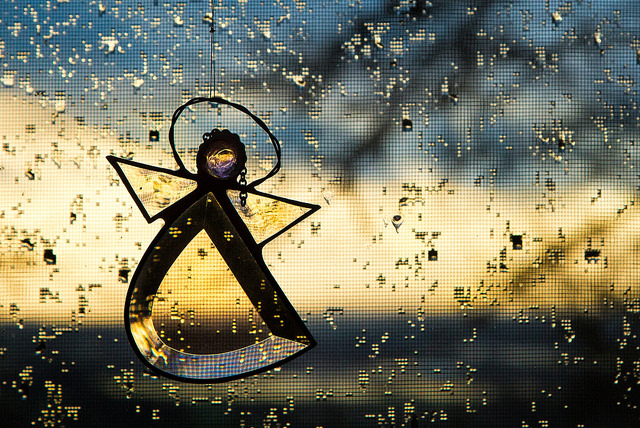
Sun angel

Sun angel. Sheila SundCC BY

 Into each life some rain must fall
But too much is falling in mine
Into each heart some tears must fall
But some day the sun will shine
Some folks can lose the blues in their hearts
But when I think of you another shower starts
Into each life some rain must fall
But too much is falling in mine.

-Allan Roberts

Yesterday morning the sun beckoned from among striated clouds, streaking the sky with silver and gold. Birdsong—it’s a brand-new spring. The scent of fresh-cut grass from the day before lingers, and nothing takes me back to my childhood and my father quicker than that sweet green fragrance.

Even as the sun shone, a soft rain pattered down.

In my heart, in the hearts of my community, too much rain is falling.

Yesterday we buried a young lady who grew up here, was one of us, was an only child and grandchild. She was a college freshman, eighteen, a year younger than my second son, his childhood playmate and lifelong friend. She went to church with us all of her life, sang in the choir, and was beautiful. She caught the light and scattered it like a faceted gemstone quietly scatters tiny, vivid rainbows on objects close by.

Death, when it comes suddenly to someone so young and full of promise, can only be likened to a great ripping apart.

She is ripped away.

The church was full and overflowing an hour before the service. People stood around the walls of the sanctuary, packed the fellowship hall, lined every hallway on both sides throughout; a huge crowd waited outside because there was no more room.

My husband officiated. He was at the hospital the day this child was born. He ended the eulogy with a little twist of Shakespeare: “Good-night, sweet princess; and flights of angels sing thee to thy rest.”

As the crowd walked to the burial site, the sun shone for all it was worth. The clouds were gone; a warm breeze ruffled dresses, suit jackets, hair.

Even so, the rain will fall within us for days and days to come, yet it doesn’t mean that our little suncatcher won’t keep catching and scattering the light in the quiet way she always did. More light than ever is reflected in the myriad drops of rain, like iridescent droplets of diamonds quivering with celebration that she lived, that she was a gift.

She will always be.

slice-of-life_individualEarly Morning Slicer


O. Henry

O. Henry grave 

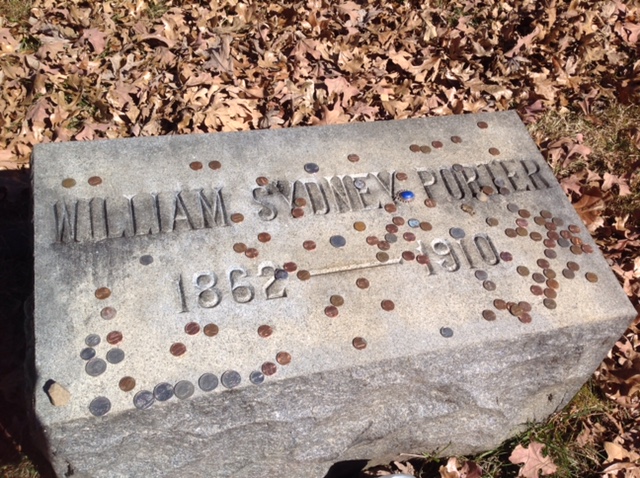
Fall comes early in Asheville, North Carolina. The air is chilly when I get out of the car at the cemetery to visit the grave. I think of winter coming, of Christmas, of this writer’s most famous work. I take a picture, marveling at the coins spread over the gravestone. As I turn to go, a frigid wind gusts, scuttling leaves over the ground and across the driveway.

Leaves . . . I remember that story.

O. Henry’s headstone is covered in coins, mostly pennies, which usually add up to $1.87 –  the amount of money that Jim and Della had at Christmastime in his famous short story, “The Gift of the Magi.” This shortage of money is why Jim sold his gold pocket watch to buy combs for Della’s beautiful hair, and why Della cut and sold her hair to buy a platinum fob chain for Jim’s prized watch. Their sacrificial love for one another has made the story an enduring classic.

There is another story of O. Henry’s that I love almost as well.

I remembered it as I planned to write “Oh, Henry,” yesterday’s post about my son’s dog. I should write about O. Henry next, I smiled to myself. A little word play with the titles. How enticing.

That’s when I thought about the fallen leaves blowing over the writer’s grave.

I scrounged up my old paperback copy of O. Henry’s short stories and reread “The Last Leaf.”

In this tale, two young artists live in a three-story Greenwich Village building. One of them becomes sick with pneumonia. She watches the leaves dropping from an ivy vine against the wall just outside of her window, convinced that she will die when the last leaf falls. To her astonishment, the last leaf hangs on through high wind and rain. To make a short story shorter, the leaf remains because an old artist in the building crawled up a ladder in the dark of a raw November night and painted it on the wall with the vine. The girl begins to recover and the old man, Behrman, dies of the pneumonia he catches from being out in the weather while painting that night.

The old artist had always wanted to paint a masterpiece and never pulled it off – but the last lines of the story have the roommate telling the recovering girl about the leaf: “Didn’t you wonder why it never fluttered when the wind blew? Ah, darling, it’s Berhman’s masterpiece – he painted it there the night the last leaf fell.”

Self-sacrificial love at work again – but there’s more to it.

That leaf symbolized hope, sparking the desire to strive, to overcome. The old artist’s small gesture inspired the young artist to keep living.

This leaves me thinking, in the course of our days as teachers, as writers: Are we not the artists who paint the pictures of possibility, of hope, in the minds of others? Do we spark in others a desire to strive, to reach for what’s beyond their grasp, or to hang on only long enough until this, too, shall pass?

Our masterpieces may never be world-famous; they may be as simple as knowing the right word, the right idea, the right vision, the right story, and sharing it when it is most needed. Inspiration leaps from one heart to another, creating something to hang onto, outlasting high winds and rain. We may never see the full effect of our work, but that’s all right.

We paint the leaves where we can.

I close my old paperback book.

O. Henry, I am so thankful you were here.


slice-of-life_individualEarly Morning Slicer


The storm passes by

Church after tornado 6-18-13

Our phones are popping at the same time:  “Take cover immediately . . . .”

Outside, the wind gusts; objects are striking the building, the windows.

We quickly gather the children who’ve come for Vacation Bible School – there’s about seventy of us in all – and they get down on the floor, balling up with their heads against the painted cinderblocks of the main hallway.

The wind is roaring now. The electricity goes out. The emergency lighting flashes on, bright as spotlights, adding a stark, garish quality to faces and bodies. The fire alarm goes off, a deafening blare, as it’s right above us. A boy with hearing aids rips them out of his ears.

The children are still, silent, as heavy objects strike windows in classrooms – will the windows shatter? For a split second I am tempted to look out and see if Miss Gulch is riding through the air on her bicycle just as she morphs into the Wicked Witch of the West.

Instead I kneel over several children as a shield, leaning my head against the cool concrete wall.

These walls are solid, I think. Safe.

But just around the corner in the fellowship hall is a hutch with a large, framed photo of the church when it was nearly flattened by a tornado twenty years ago.  

Minutes are eternal when destruction is banging on the door.

If we die, I think, at least we are in church.

My husband, the pastor, prays aloud.

The wind soon abates, dies away.  

We go outside to find long strips of vinyl from someone’s home strewn in the parking lot. Big pieces of plywood from who knows where are lying against the building. Shingles are scattered about like fall leaves. The trashcans are way across the graveyard – we trek over to fetch them and we see the gap in the woods where the tornado came through. It cut a path through the cemetery, knocking down a line of gravestones. Silk and plastic flowers, little angel statues and other loose memorials left by families for their loved ones are blown everywhere.

The children retrieve and replace them.

Parents begin arriving, alarmed. Others in the community come to see if everything’s okay.

Just as we are leaving, I turn back toward the church – “Look!”

Arcing up from the woods across the street to the woods behind the cemetery, in the sky directly above the church, a rainbow gleams.

All is well.

slice-of-life_individualEarly Morning Slicer