One recent early morning, I sat down at the kitchen table to write some poetry just as my husband turned on the TV. I caught the word cicadas.
I abandoned my laptop to come watch the segment:
“2024 is going to be a banner year,” announced the newscaster, “a rare co-emergence of two periodical cicadas: a seventeen-year brood and a thirteen-year brood…
A chart appeared on the screen:
| Brood XIII | Brood XIX |
| Emerges every seventeen years | Emerges every thirteen years |
“They make the most beautiful sound I’ve ever heard,” said a second newscaster.
“Said no one ever,” joked the first.
The whole news crew burst into laughter.
“But it IS a beautiful sound!” I said to their guffawing faces.
I know the sound is a harsh rattle. Loud. Discordant. Metallic. Strange.
I don’t expect everyone to like it.
I’ve loved it since I was a child.
I wasn’t aware I loved it when I spent brutally hot summers deep in the country with my grandparents, where an old dirt road and a ditch were all that kept their yard from being swallowed up by a towering deciduous forest. From those dense, mysterious depths emanated a deafening buzz, hundreds upon hundreds of cicada-songs swelling and subsiding in synchronized rhythms, the background music of my happiest childhood days.
Time passed. As my grandparents grew older and my visits rarer, I’d realize the meaning of the rhapsody. Cicadas play love songs with all their might. They know their time is short.
At nineteen I was hospitalized with a high fever. My father and mother both accompanied me, clearly concerned about my condition. They sat by my bedside while I lay shivering under layers of blankets, too tired to talk, to move, to care about anything. Afternoon melted into night. It was winter. The heater in the room kicked on with a buzz so like the cicada chorus of my childhood summers that my shivering eased almost instantly.
They’re calling me, I thought. The cicadas. They’re taking me to Granddaddy’s and Grandma’s, and I’ll be safe there.
This flooded with incomparable comfort and indescribable joy.
Then… if I’m dying, it’s okay, as long as there are cicadas.
And I fell asleep.
When I woke in the morning, my fever had broken.
I didn’t know, at nineteen, that cicadas are a symbol of resurrection and immortality. I didn’t know the many legends and lore surrounding the insects, such as the myth of Aurora, goddess of the dawn, doomed to fall in love with a mortal who inevitably grew old. She obtained immortality for him without thinking to secure eternal youth. Soon there was hardly anything left of him but his voice, continually singing his lamentation and love, so she finally turned him into a cicada.
Note: Aurora is the name of my grandparents’ hometown, where I spent those childhood summers steeped in cicada song.
Back to the present…
After that news segment, I had to do a little research.
Scientists say that these perodical broods, XIII and XIX, haven’t coincided since 1803 and won’t do so again until the year 2245.
They’re calling this a “cicadapocalypse” of maybe a trillion bugs…but not all in the same place (in case you’re thinking biblical plague). One’s called the Northern Illinois Brood (XIII) and the other, the Great Southern Brood (XIX). If my calculations are right, this brood appeared the summer that followed my sickness at nineteen (same as the brood numeral). I got married that August, when they would have been in full throttle. The time before that, I’d have been seven and hearing them at my grandparents’.
On the day the segment aired with newscasters poking fun at the sound, I happened to be taking part in an Open Write at Ethical ELA. Host Leilya Pitre introduced the Naani poem form, which orginated in India: four lines consisting of 20-25 syllables total. The poem isn’t restricted by theme, subject, or metric pattern. Leilya challenged participants to scroll through social media or the news to find four phrases to make a Naani.
My lines had just been delivered to me, before I even read the prompt.
Once again, the Magicicada were at work in the background rhythms of my life.
From This Morning’s Newcast
Brace yourself:
the cicadas are coming…
the most beautiful sound
I’ve ever heard.
—I don’t know about you, but I can hardly wait for cicadapocalypse.

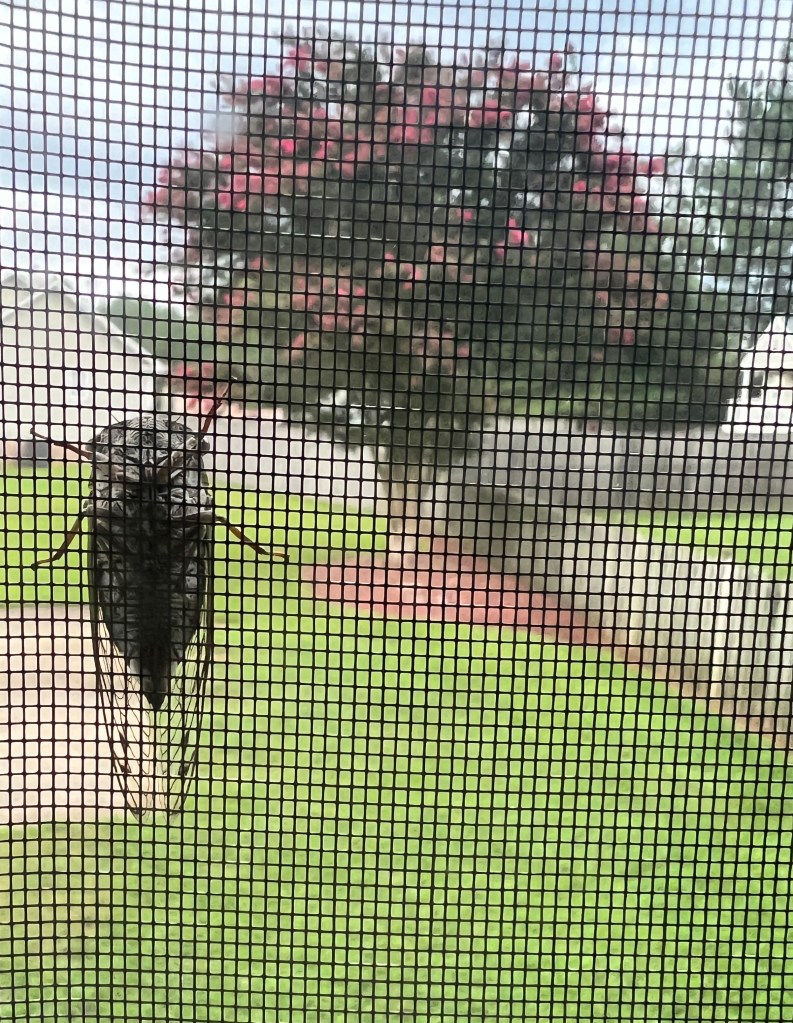
Cicada vunerable after metamorphose. Joi. CC BY 2.0
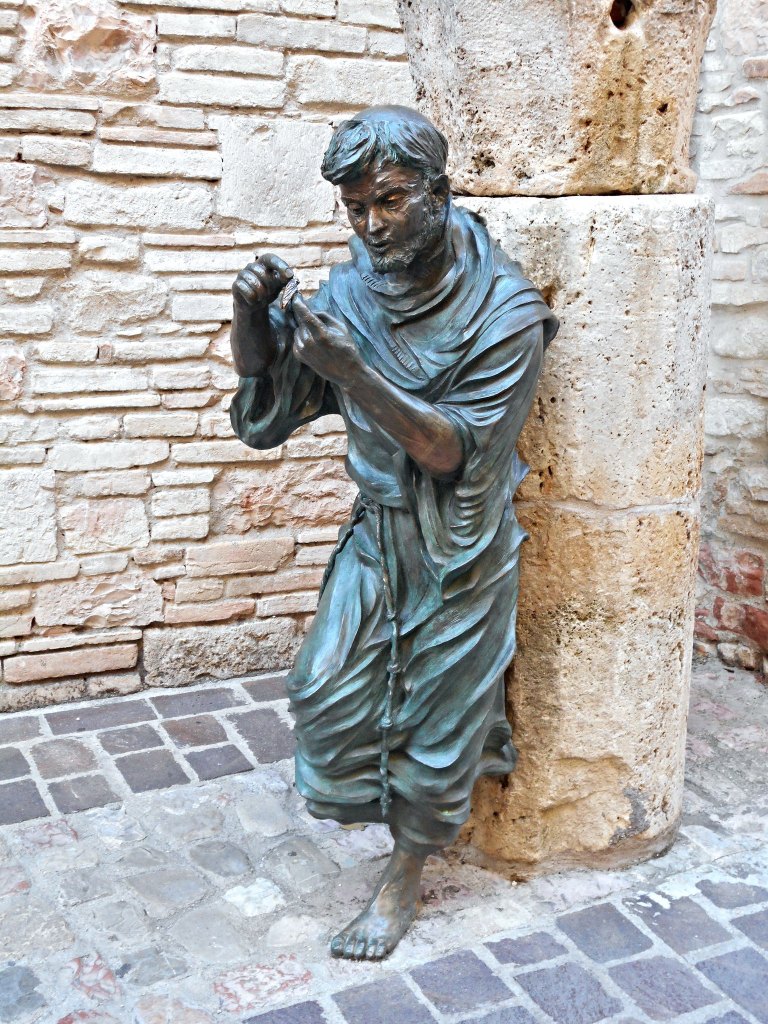
‘Saint Francis with cicada’ – modern bronze statue by Fiorenzo Bacci – Friary of Santa Maria degli Angeli at Assisi. Carlo Raso.
Legend has it that Saint Francis heard a cicada chirping in in a fig tree and called it to him, saying “Sing, my sister cicada, and praise the Lord thy Creator,” and it obeyed, sitting on his hand.
*******
Composed for Day 3 of the annual Slice of Life Story Challenge with Two Writing Teachers.
Q: What’s YOUR favorite insect? Why?













 lit bits and pieces