Nurturing the summer soul: Spiritual journey

Peace

Last day at the beach
I wake far too early
but I make the coffee anyway
and take a cup to the top deck

I sit in the chair
facing east
drinking in
the deepness
of solitude
the blessedness
of silence

Earth stirs a little
and sighs
like a baby in its sleep

Just ahead, high over the sea
Venus glitters and winks

I am the bright and morning star
I know you are

My waiting soul
cannot think
of anything else it wants
or needs
as black silhouettes
of pelicans
fly soundlessly by
against the sky
pinkening with light

Sunrise
signifying the end
of night

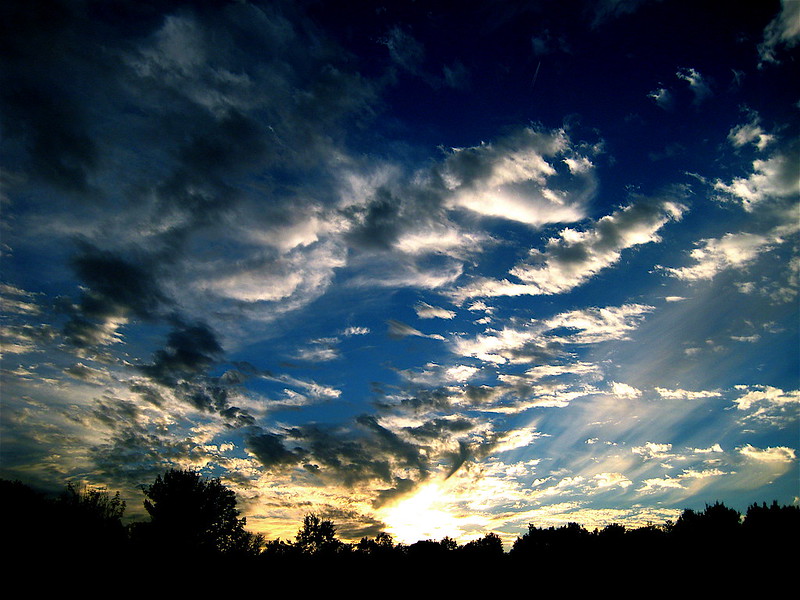
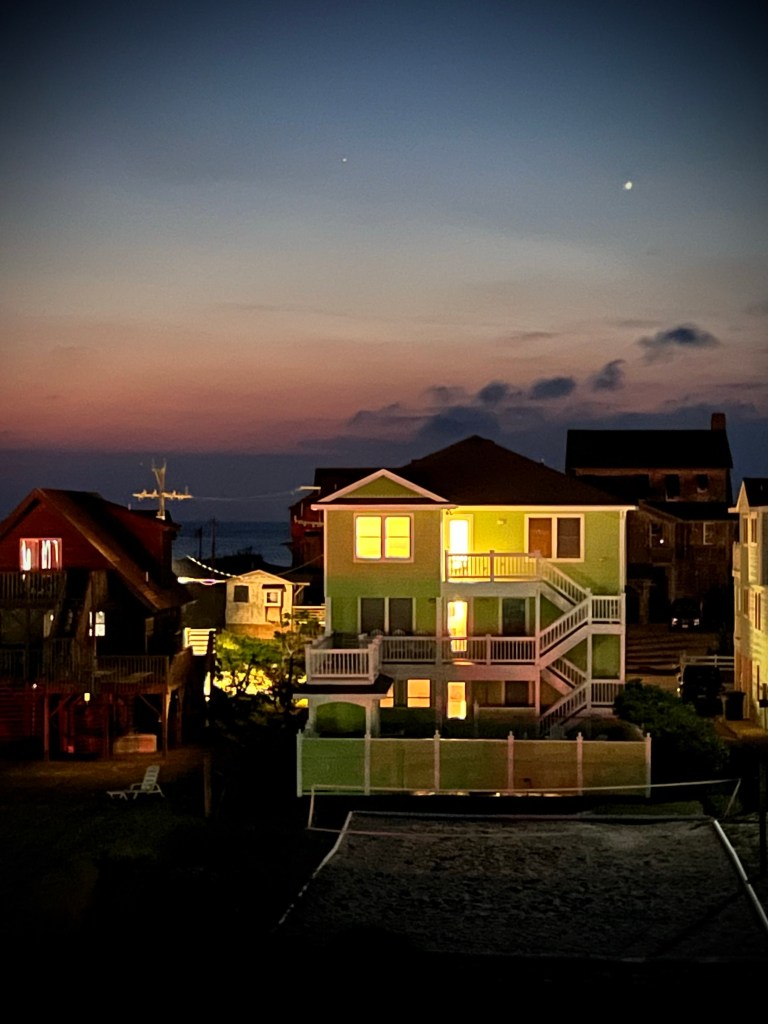
My view this morning: Venus over the Atlantic just before sunrise

Pelicans, while not in this particular shot, are plentiful here. As the sky grew lighter they appeared in silhouette, gliding gracefully against it. The pelican is an ancient symbol for Christ, often depicted in Christian art.

Revelation 22, the last chapter of the Bible, references the River and Tree of Life, the healing of the nations, the end of night, and the return of Christ with the words “I am Alpha and Omega, the beginning and the end, the first and the last…I am the root and offspring of David, and the bright and morning star(13; 16).

The best I can do is to describe this morning scene. The sense of peace, so often fleeting or not to be found when Earth is wide awake and churning, was honestly too deep for words. I shall hold these moments in my mind for returning to when my soul needs more nurturing, long past summer.

—with thanks to Carol Varsalona for the theme and for hosting the Spiritual Journey writers on this first Thursday in August.

Solitary existence: the hummingbirds

Hummingbirds lead a solitary existence.

I saw one hummingbird out back last week, darting about the pines. It turned in my direction, tiny pale-bellied fairy-creature suspended in midair, as if to acknowledge my presence across the yard before zipping away. I wondered if it was making some kind of request. The next day I bought a feeder and hung it outside my kitchen window; within moments, a tiny female landed to sip my homemade nectar.

The next day another female arrived. I watched the two of them competing for turns at the feeder. All day they chase each other away, each still managing to land and feed for the few seconds it takes to sate a creature so tiny. One tentative male finally showed up today, his ruby throat resplendent in the sunlight. I haven’t managed to get a photo of him yet. I hope he’ll return, despite these territorial females.

There’s a lot I didn’t know about hummingbirds. They’re curious. They watch me through the window as I’m watching them. I read that they’re highly intelligent; they learn to recognize the person who feeds them and may even remind this person if their sugar water is running low. They are not social, not flock birds. When they migrate to Mexico in the fall, they go it alone. Why does this pull so terribly on my heartstrings? I cannot shake the image in my mind of this tiniest of birds flying so far by itself.

They do not think of themselves as fragile. They are not lonesome.

It’s what they do. They lead a solitary existence.

With that, the hummingbird memory stirs.

Summer, long ago. Riding in Grandma’s rocket-red Ford Galaxie 500 along the dusty dirt road to her sister’s house. The Galaxie doesn’t have power steering or air-conditioning so the windows are down and Grandma has a Kleenex stuffed into her cleavage to catch the trickling sweat. Fortunately Aunt Elizabeth only lives about a mile away, in a little bungalow house with square tapered columns, off to itself by cornfields and groves of hardwoods. There’s a path in the grass of her yard where her old maroon car (I think it was maroon, either a Ford or a Chevy, I can’t recall exactly) is parked by the weathered outbuilding. Grandma and I park behind it and walk in the shade of the trees to Aunt Elizabeth’s back porch.

Everything is old. The porch floorboards, the screen door that squawks on opening and closing, the tiny, cramped kitchen, the worn linoleum revealing a slightly swayed floor, the living room with braided rugs…it’s a dark house, faintly musty. The smell of Time hangs in the air, unmoved even by the square electric floor fan humming on high speed. Aunt Elizabeth is pleased to see me. She opens her arms to give me a hug and kiss. Her pale cheek, faintly mottled with reddish freckles, is cool. She’s two years older than my grandmother. She asks how my Daddy is, says she sure does miss him, oh, she used to enjoy having him over to eat…

Aunt Elizabeth doesn’t have children. Not any that lived. When I first asked about it, Grandma told me of her sister’s two premature, stillborn babies. Tiny things, said Grandma; she was there when it happened. She held them, grieved for them. Aunt Elizabeth was married to Granddaddy’s youngest brother, who died before I was born. He suffered from some kind of condition doctors could never figure out. Without any warning, he’d lose consciousness and collapse. It happened numerous times until the day he had a spell and couldn’t be revived.

So my great-aunt, in her sixties, lives here alone, way out in the country where, in the 1970s, people still don’t have telephones; they drive to each others’ houses to visit and catch up on news. It is good that a few of her eight siblings live close by, that grown nieces and nephews make a point to come by to see her when they can. Aunt Elizabeth gardens, cans her vegetables and preserves in glass jars for storing on her kitchen shelves, drives to town, tends to herself, is completely independent, yet it seems a solitary existence to me. As she chats with Grandma I wonder if she’s lonesome, if she still misses her husband, gone for so long, and if she’s sad about having no children or grandchildren of her own. She hands some bubblegum out to me and I know she got it because she knew I was coming.

When our visit is over, we all walk out on the porch — that’s what you do, in the country. You walk out and wave until your visitor drives out of sight. Unwritten etiquette. Everyone does it. Same for throwing your hand up to any other car you pass on the road.

But Grandma and I don’t leave yet, because of the hummingbirds.

They’re everywhere.

Aunt Elizabeth has strung up several red and yellow plastic feeders around her porch. At every one is a horde of the tiny birds, dipping in and out. The air vibrates from the rapid fanning of their wings; I feel the circulation, a coolness against the heavy summer humidity.

I am awed. I have never seen anything so magical before. I can’t even count how many hummingbirds.

The sisters, in their delight, laugh like young children.

—It comes back to me, watching the few contentious hummingbirds outside my window almost half a century later. I didn’t know how rare a thing it was, then, the communal gathering of hummingbirds. I remember my great-aunt, not with pity. I hear the musical sound of her laughter and the humming of all those tiny wings there on her porch….knowing that in the long enduring of life’s losses and trials come moments of pure enchantment and abundant richness.

I shall need more feeders.

*******

with thanks to Two Writing Teachers for the weekly Slice of Life story-writing invitation

Hey, hummingbird

gogyoshi: a Japanese poem with a title and five lines

Hey, Hummingbird

as if accepting southern hospitality
(always dependent on sugar)
my new enchanting friend
stops by to sip and sit a spell
throughout the summer day

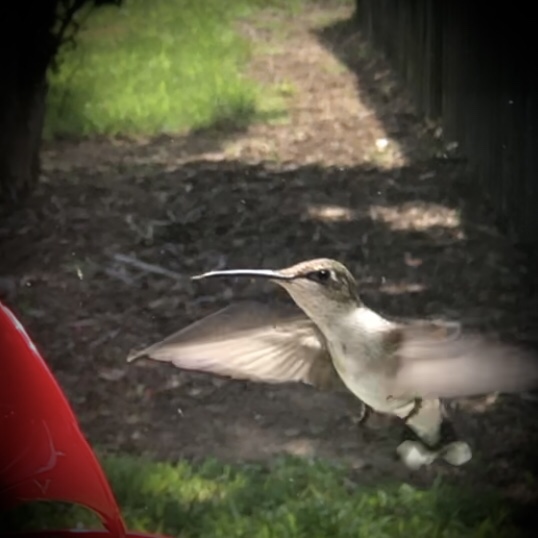
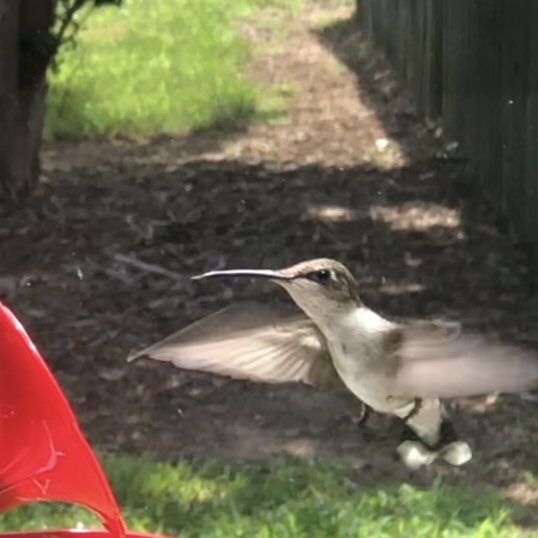
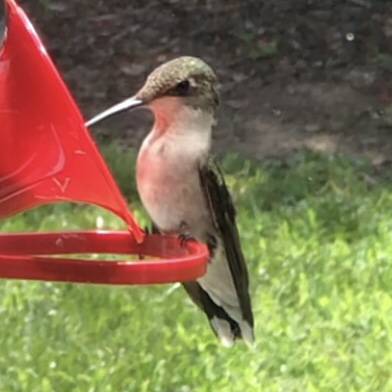
Female ruby-throated hummingbird.
She began visiting within moments after I put out the feeder.

The offering

July morning
before the dawn
I step outside
with the dog

night clings
like a heavy curtain
silhouetting trees
against indigo sky

waning gibbous moon
gleaming bright
bathing the earth
in silversoft light

that’s what draws me
the ethereal glow
and a strange star
above the moon

the dog is here
on practical business
trotting out in the yard
obediently
—he is not mine
but he loves me so
he lived here
not so long ago;
he belongs to my son
away on vacation—

the dog
is like the morning
velvet charcoal
silent
peaceable
watchful
I can barely glimpse
the glow of his white breast
out in the darkness

a whippoorwhill calls
from the pines
while I try to discern
what star that is
so bright above the moon

—Jupiter
king of the planets
and there in the east
Mars, glittering red

the ancients could read
their preordained ritual
but I, in the silverdark Now,
cannot

—a loud animal cry
shatters the stillness

No!
I know without knowing

—here comes the dog
shy and humble creature
who’s not really supposed to run
on his congenitally malformed
frail back legs

here he comes, running
as hard as he can
through the shadows
charcoal in charcoal
soft shape in his mouth

No! No!

how is it that
this most benevolent creature
who’s never done another harm, never
should be ceremoniously dropping
a rabbit at my feet

no, no, I cry
horror and awe intermingled
at the unnecessary death
that he can even catch a rabbit

—incongruous,
how Elvis starts singing in my brain
as if this act
is the sole measure
of a dog’s worth

for here stands The Dog
magically transformed
from meek pet
to mighty hunter
bringing the solitary catch
of his life
to me

a blood offering
under the waning gibbous moon
beneath the winking planet-king

oh beautiful dog
oh beautiful rabbit

I am sorry.

I could never be
a god.

July morning. Jupiter above the waning gibbous moon.

Eternal summer: memoir poem

with thanks to Jennifer Guyor Jowett for the Open Write invitation on Ethical ELA today: “Share your summertimes with us, whether it’s within the memories of your childhood or the place you are in right now. Take us there. Include sensory details to evoke the spirit of your summer.”

I have written lot about my childhood summers. Today I try a bit of reframing and recapturing the magic…

*******

Eternal Summer Reigns

Daughter of Eve from the far land of Spare Oom where eternal summer reigns around the bright city of War Drobe, how would it be if you came and had tea with me?

—Mr. Tumnus to Lucy, The Lion, the Witch and the Wardrobe

I live it every day of my life, summer.

By some great magic I am still a child
returning to my grandparents’ house
so deep in the country some people say
it’s at the end of the Earth

for me, ever the beginning

a place of woods, holding their secrets close
a place of enchantment, outside of Time
a place of belonging, of sacrifice

where ghosts of the past live again
in Grandma’s stories

there’s her Papa, tending bees
never getting stung
her Mama, picking cotton
and dipping snuff

her brothers and sisters
(eight in all)
playing softball
or piling in the goat-cart
to be pulled by a white mule
named Jenny

there’s my grandfather and his brother
courting my grandmother and her sister
gathering at friends’ houses
singing and make taffy

my father, being born
in a tenant farmer’s house
—Cotton-Top, they call him,
for the color of his hair
when he is a toddler

babies born into the family
some stillborn
(Daddy’s voice…Would have been
so interesting to see
what my double first cousins
would have looked like
if they’d lived)

—I live them every day,
the stories.

I am the stories.

Every day I am a child
unpacking my suitcase
for the summer
welcoming the ghosts
walking the old dirt road
eventually covered with gravel
from phosphate mining rejects

bits of ancient history
crunch beneath my feet:
shark’s teeth, some tiny and sharp,
some as big as my small palm;
coral skeleton, white chunks
embossed with lacy flower designs;
whale eardrums, curiously curved fossils
—with these, whales heard
their own stories, too
now, they are 
part of mine

and above all, above all
from the surrounding woods, bending near
keeping their secrets close
the crescendo and decrescendo
of cicadas

the true song of summer
and the sun
and living
and dying

and returning.

By some great magic I am still a child
still listening, still living summer every day
and forever
in that sound.

My grandmother in the summer of 1959, years before my birth. This is the setting of my idyllic childhood summers to come, beginning a decade and a half later. I would stay for a couple of weeks each year and never wanted to leave. Grandma fostered my love of reading, writing, and story. She drove me to the tiny county library at the beginning of my summer visits and helped me haul out the armloads of books I selected. She saved magazines, Mini Pages, and National Enquirers all year long for me.

We walked the old cemetery in the clearing diagonally across from where she sits in this photo and the graveyard of the church around the bend, where her parents are buried. As we read the stones, the blazing sun casting our shadows across them, Grandma told me the stories.

The fossils in the gravel of the poem were real. I found handfuls of them in the road here when I was a child.

Cicadas are an ancient symbol of immortality and resurrection. I write of them often because of their connection to this place. Their loud, rattling chorus was ever-present in the background of my childhood summers; the sound remains one of the most comforting on Earth to me. It’s a call of the sun, love, belonging, and home. There’s a myth about the goddess of the dawn, Aurora, asking Jupiter to grant immortality to her lover, which he did, only the goddess forgot to ask Jupiter to also grant her man eternal youth. Her beloved continued aging until Aurora finally turned him into a cicada. If you look closely at depictions of Aurora, you will see the cicada. Why tell this story here? This morning, before the dawn, before the cicadas woke to sing, I saw Jupiter shining high beside the moon. Then I sat down to write to this prompt of summer celebration, reliving halcyon childhood moments with my grandparents at their home, a place where my generational roots run deep in the earth, where my father grew up…an old, far place in the east, named Aurora.

For me, ever the beginning. Eternal summer reigns.

*******

thanks also to Two Writing Teachers for providing a place to share our stories – for we ARE our stories
Toadally true story

While working outside around the house, I paid no attention to the little brown rock in the driveway.

Until it hopped.

On closer inspection: Not a rock. A tiny, rust-colored toad, pretending to be a rock.

Reminded me, for just a fraction, of story characters who magically transform themselves into creatures or objects to avoid detection from enemies…

I leaned in while trying to maintain a respectful, non-threatening distance.

“You’re doing a magnificent job of it,” I told the toad.

Of what? its tiny taciturn face seemed to ask.

“Of pretending to be a rock,” I said.

It sighed (I think).

What gave me away?

“Well, rocks don’t hop.”

Its expression: pure disdain.

“Toads don’t talk, either,” it said, as it turned and hopped away across the hot pavement.

Okay…so this story may not be toadally true…

The toad. Less than one inch long. Stone-faced, isn’t it. Can’t decide if I’d call it Rusty or Rocky. Or perhaps just Fowler, as it appears to be a Fowler’s toad, with poisonous warts…fun fact: apparently ALL toads are poisonous. Not highly toxic to humans through touch, only if ingested (gulp). Think of those I caught as a child and brought home in my metal Peanuts lunchbox amongst the crusts of my PB&J (toadally true. Honest). Would make for fun fiction writing with students when they study animal defense mechanisms: The Revenge of the Toads…

*******

with thanks to Two Writing Teachers for the weekly Slice of Life Story Challenge
and, of course, to the toad

Dog day rhythms

Rest is not idleness, and to lie sometimes on the grass under the trees on a summer’s day, listening to the murmur of the water, or watching the clouds float across the sky, is by no means a waste of time.

—John Lubbock

haiku story poem

dog days of summer
triple-digit heat index
white haze cloaks the air

one can drown in it
too hot for lying in grass
even in the shade

lethargic rhythms
settle on all living things
except for insects

unrepentant sun
shimmers on dragonfly wings
iridescent darts

buzzing cicadas
in feverish frenzy sing
of love high in trees

remaining unseen
falling silent before storms
darkening the skies

as lightning’s forked tongue
snakes from the heavens to earth
(thunder, they told me

when I was a child,
is just the angels bowling;
that’s their pins, crashing)

—the heat breaks at last
like evening revival
saving weary souls

murmuring water
seeps into my dreams
ephemeral streams

summer’s lullaby
syncopated rain-fingers
tapping windowpanes

no sleep is so deep
as that borne by rhythms of
dogs days descending

summer rain. annalisa ceolin. CC BY-NC-SA 2.0.

*******

with thanks to Ruth Ayres for the inspirational quote at SOS-Sharing Our Stories: Magic in a Blog

A tree for a tree

This week I read that you can tell how long it’s been since a field has been reclaimed by forest. If the forest has a lot of pines, maybe twenty years. If there are more hardwoods than pines, maybe forty years.

We own a tiny of patch woods behind our house. Beyond that is a field (not ours). Once upon a time, this was all field, and long before that, all forest.

I cannot recall what these trees looked like when our house was new, twenty years ago. I can see we have quite a few hardwoods now in our tiny bit of forest.

This week one of our pines toppled in a wind gust preceding a thunderstorm. The trunk’s resting partly on the fence (which is holding up, surprisingly). On the other side, the treetop is a shattered, mangled mess. My plant identifier app tells me it’s a loblolly pine with Crown Gall caused by bacterial infection. It must have been slowly starving for water or nutrients. The extent of its brokenness there on the grass makes me wonder how much the tree suffered and if others of its species tried to help or not (trees do this for one another).

At any rate, it’s gone. A fat sand-colored dove lands on the fence to survey the damage also. Maybe it is simply paying respects.

There is nothing I can do. The fallen tree will have to be cleaned up. I imagine the confusion of rabbits, the next time they come out to nibble clover and find this mess. I turn to go back to the house, whereupon I discover a curiously bright and fresh plant quite to itself where the pinestraw ends and grass begins.

Sweetgum. A baby hardwood. Encroaching toward the middle of the yard.

I look at back at the grown sweetgums waving their starry leaves from among the cedars and pines. I imagine the mother tossing her seeds as far she could (not very far, only a few feet; maybe birds or animals helped but the wind apparently didn’t, not much).

Still. Cannot help thinking about that reading I’ve just been doing…as in, this cheery neon-green baby being a strategic move in the decades-long hardwood takeover and that sick pine, an occupational casualty.

I wonder what the trees tell one another, what old secrets live deep in the understory.

I wonder what the dove knows, and the wind, as it blows.

Something of belonging and primeval balance, surely.

Horses on the fly

Sunny summer morning
driving home with groceries
along the winding backroads
past forests, clearings,
smatterings of houses

at the crossroads
where the tobacco field
gives way to pastures and pond
two horses, trotting
side-by-side

not uncommon, horses
being ridden
along these
country byways

except that these
are unsaddled
unbridled

riderless

in the left lane
headed toward us

moving in sync
at a lively pace
tossing their manes

faces covered
with fly masks

Look! cries my husband
who’s driving
immediately
slowing down
to a near stop

— no one’s with those horses!
And their eyes are covered
—they can’t see!

They can see,
I tell him
even though I know
next to nothing
about fly masks
and equine husbandry

I just know
by the certainty
of their movements
and their canter
that they can see

they are not blindfolded
to be led out of
a burning barn

but they’re here
on the road,
unattended

and drivers
who might be coming
from either direction
are unaware

and people drive
too fast
on these
winding backroads

how, how,
I wonder,
did they get loose

these magnificent beasts
that someone
surely values
and loves

—should we call 911?
—what can they do?
—remember, we did that once

when we saw the mule
strolling up the street
in our neighborhood
—yeah but the farmer
figured it out and got to it
before it got to the highway
—should we get out and…
—and what? Try to hold ’em?
They don’t know us.
We don’t know them.

We don’t know
how to handle horses…

by now, the carefree pair
on its merry jaunt
has passed us

and I can only hope
the owners have realized
and are on the way
or that someone who lives
in the nearby houses
knows to whom they belong

or that these creatures
will use their intuitive
horse sense
to go home

I cannot think
the thousand terrible things
crowding my brain

images of beautiful beings
taking newfound liberty
headlong, headstrong
toward what they cannot know
and others
who do not see

Photo: IMG_2703. thatsavagegirl. CC BY-NC-ND 2.0.

We didn’t hear any news of something terrible happening to the horses; living in a small community, we would have. I am pretty sure that, a few days later, I saw these same two horses, still fly-masked, safe in the fenced pasture beside that same tobacco field where we saw them on the loose. The initial feeling of awe mixed with horror is hard to shake, however. The image of these two riderless, fly-masked horses is now an indelible one in my mind for potential harm, needless loss and destruction, and feeling utterly helpless in the face of it.