Lobster power

The children notice it right away:

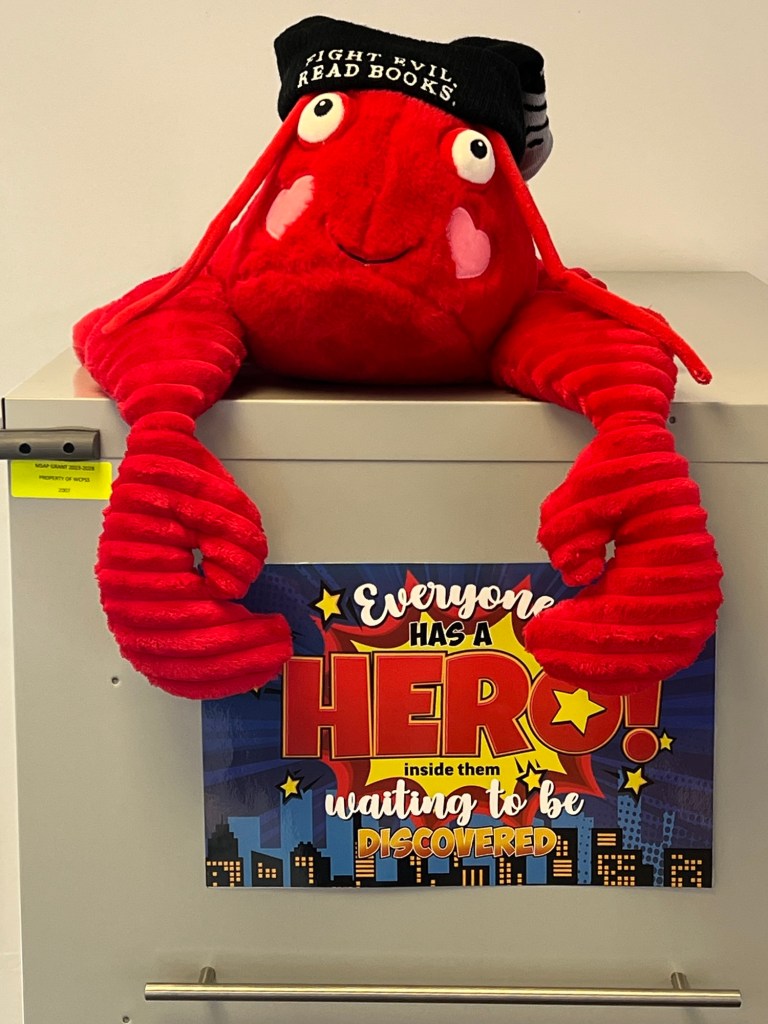
The giant lobster on top of the cabinet in our Heroes’ Hangout reading space.

They are elated:

Look! A lobster! Why is it here? Where did it come from? Look! He has hearts on his cheeks! He’s so cool!

Truth is that a colleague gave the lobster to me when she learned that I sometimes let the smallest, wiggliest students hold onto a stuffie “friend” so they can focus on listening to their volunteer reading a book to them.

But this is what I tell these second graders:

He’s a reading lobster. He wanted to be here in the Heroes’ Hangout.

This sets them off again: What’s a reading lobster?

Well, Friends, you will have to decide that for yourselves… why would a lobster like reading?

More chatter. We may never get to the lesson.

A few days later I remember a hat I have at home. Perfect for the lobster!

I bring it to school and put it on his head.

The kids notice right away: Look! The lobster has a hat! It says ‘Fight Evil, Read Books!’

That’s right, Friends. Maybe he’s a Superhero Reading Lobster.

Maybe we will create a Superhero identity for him and a backstory and possibly write some adventures starring our Superhero Reading Lobster who fights evil by reading books…I mean, anything is possible after Dog Man…

But for now, when my group of second graders finishes their guided self-portrait lesson with me in the Heroes’ Hangout, I say: All right, time to put away your materials and line up at the lobster.

They form a quiet line.

I say, Bye, Friends. Lobster power all the way.

All eleven kids jump up to touch the lobster as they pass by. I watch them walk down the long hallway to their classrooms in a straight line, without a sound.

Not one student has ever asked what I mean by “lobster power all the way.”

That’s how powerful our lobster is.
*******

with thanks to Two Writing Teachers for the March Slice of Life Story Challenge

For more about the Heroes’ Hangout, click here.
For love of reading

with thanks to Anna J. Small Roseboro, today’s Open Write host at Ethical ELA, for inviting teachers to write poems of reflection on the past school year and projections for next…my thoughts came out this way, and so I’m calling it a prose poem.

For Love of Reading

Reading and writing were the great loves
of my childhood…for birthdays and Christmas,
I wanted books. And more books. I never thought
about them as keys to unlock life’s doors. In retrospect
I see that books were my lifeline, keeping me afloat
in a muddy sea of existence. I would read and find myself
in another world, another life. I didn’t think about reading
as amassing riches in my mind. My family didn’t have wealth
but I was rich, rich, rich in books. They were my
greatest treasures.

I never planned to be a reading teacher. I didn’t pursue
the vocation; it pursued me. My professional role changes
every year depending on funding and the current trend
for helping children learn to read. For many the struggle
is great. The battles waged by the Educational-Powers-That-Be
are great. Year to year the sands shift, the tides of research turn,
blame is passed, and verbal artillery is fired.
I have served in ranks wearing armor that didn’t fit me,
using approaches that didn’t dovetail with desired outcomes…
furthermore, we are not talking about war.
We are talking about what children need.

Every so often, the winds of war abate and through the smoke
blows a bit of fresh breeze. Let us name it Opportunity.
It comes offering me a chance to recruit volunteers
from the community to read with students each day. It comes
with a whole new library that I inventoried and archived
in preparation for next fall, a wealth of beautiful books
that are windows and mirrors for our young students
to pick from, with their volunteer readers. It comes
with taking donations of books to give to students
to keep at home. It comes with redecorating
a neglected space in the building, with an astounding gift
of bright new seating from the PTA, to make this space
special for our students. This is a sacred space.
Here people will give of themselves to others,
here relationships and lives will be built, here love will be born…

My reading soul rejoices.

*******

with thanks also to Two Writing Teachers for the Tuesday Slice of Life Story Challenge
—writers need community. ❤

A word on writing

I love writing, teaching writing, and helping others love writing.

There was a time in my career when I designed and co-created workshops for teachers as writers so that they could channel their own positive experiences into the classroom with students, to model for them how an embryo of an idea comes to life, how it grows bones and flesh and begins breathing and crying and rejoicing and blazing trails right there on the page (or screen). I led professional development. I went into classrooms. I worked alongside teachers and kids. I witnessed powerful things…I can still see the tears, the glowing faces, the pride and awe in the eyes of kids (and their teachers) over something they’d created, that came from within.

They wanted more.

That was before changes in my district, moving away from the writing workshop model and Lucy Calkins in general. Now writing is embedded in the Language Arts curriculum, largely in response to reading. The goals are lofty and writing assignments follow a highly prescribed pattern. Neatly formulaic. Uniform.

That is not to say there’s never any creativity… for example, in a nine-week unit series of extensive reading and writing about frogs, the students get to compose poems and write pourquoi tales about frogs. The pacing and process are pretty intensive… which is why a teacher came to me: “Could you meet with some of my students to help them with the pourquoi tales? So many are struggling. Meeting with each one is taking so long.”

It was like old times, almost, these writing conferences…except with the unique challenges of writing a myth about how some true facet of frogdom came to be while describing the setting and the frogs, giving them character traits, having them talk, and ending up with a lesson learned, i.e., moral to the story. —Did I say, by the way, these kids are around eight years old?

And did I say that there’s no way to teach writing without conferring with the writers? This is, in fact, THE teaching…teachers learning about the learners and figuring out what to do for them.

For there is an English learner who understands so much more than he’s able to convey; his struggle is with grammar, as word order is different in his language. His ideas, however, are original; he incorporates what he knows about his own father’s work. There is a child who missed some critical days in the unit and didn’t understand what to write about, and therefore wrote a completely off-topic but interesting narrative. Once he understood, he went on to compose an engaging narrative with a brilliant, metaphorical moral.

One by one, the kids came, and we talked about what they were trying to accomplish with this pourquoi, and then we figured out the big “hows” and “whys” in the tale… usually by my asking “what if…” and the lights in their eyes would come on. The sparkly pink and rainbow-dotted and brown-and-blue striped frogs came to life. They had conversations. They made bad choices like cheating; they made good choices by helping each other anyway. The tales explained why frogs jump so high, why their tongues are so long, why some are so colorful, why some are poisonous. They learned a lot of lessons about being better frogs.

One resistant boy didn’t want to stop working on his draft revisions to go to specials: “This is fun!” he said.

Oh, child. Somewhere the King of Frogs nods his head in understanding. I can almost see his tiny golden crown cocked to the side of his head, by his ancient and all-knowing eye:

Ribbit.

Only I hear it as Pourquoi…

Why.

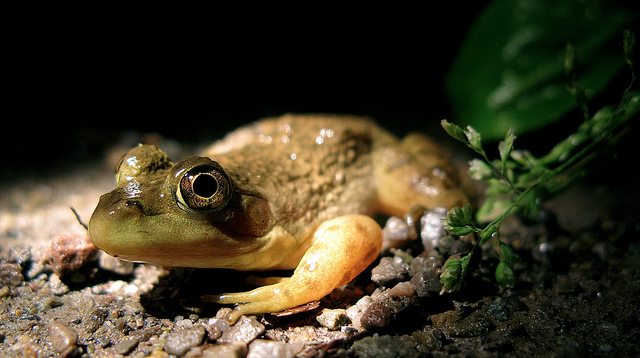
frog

Frog. Dave Huth. CC BY

with special thanks to Two Writing Teachers for all you do on behalf of student writers and their teachers…our stories matter.

Stumbling on a treasure

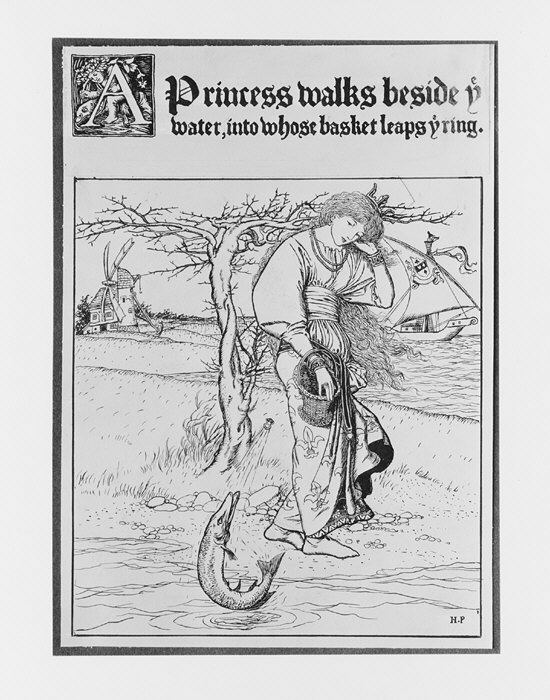
So it was, while I was skimming about for a photo of magical waters (never mind why), I stumbled across this illustration from a book called The Wonder Clock: Or, Four & Twenty Marvellous Tales, Being One for Each Hour of the Day.

Enchanted, I dug a little deeper and learned the tale of a wood-chopper’s son who, in spite of his father’s insistence, didn’t wish to be a wood-chopper himself and went off to school instead where he studied and studied and became the cleverest student in all the world…thumbnail version: with a bit of magic and much transformative wit involving hawks and fish and ruby rings, the Clever Student leaps into the basket of a princess who’s collecting seashells by the seashore. He ends up revealing his true self, marries her with the blessing of the King, and goes home to collect his wood-chopper father to live the rest of his days in comfort by the warmth of the stove in a fine home.

Key line: “And that is what comes of book-learning.”

—Gold.

Illustration from The Wonder Clock, Howard Pyle, 1887. Public domain.

The edge of understanding

It is said that
instruction should begin
at the edge of understanding

I know this edge

where the solid ground ends
and the unknown begins

all certainty suspended
as the mists roll in
obscuring the chasm
before me

I would linger here
until the end of my days
on the foundations that
sustained me thus far

if not for the Guide
speaking one step
at a time
into being

only materializing
when I place my foot
forward
to find a firmness
beneath
before I can
fully see

a little
of the mist clears
while the edge
on which I’m standing
under construction
is expanding

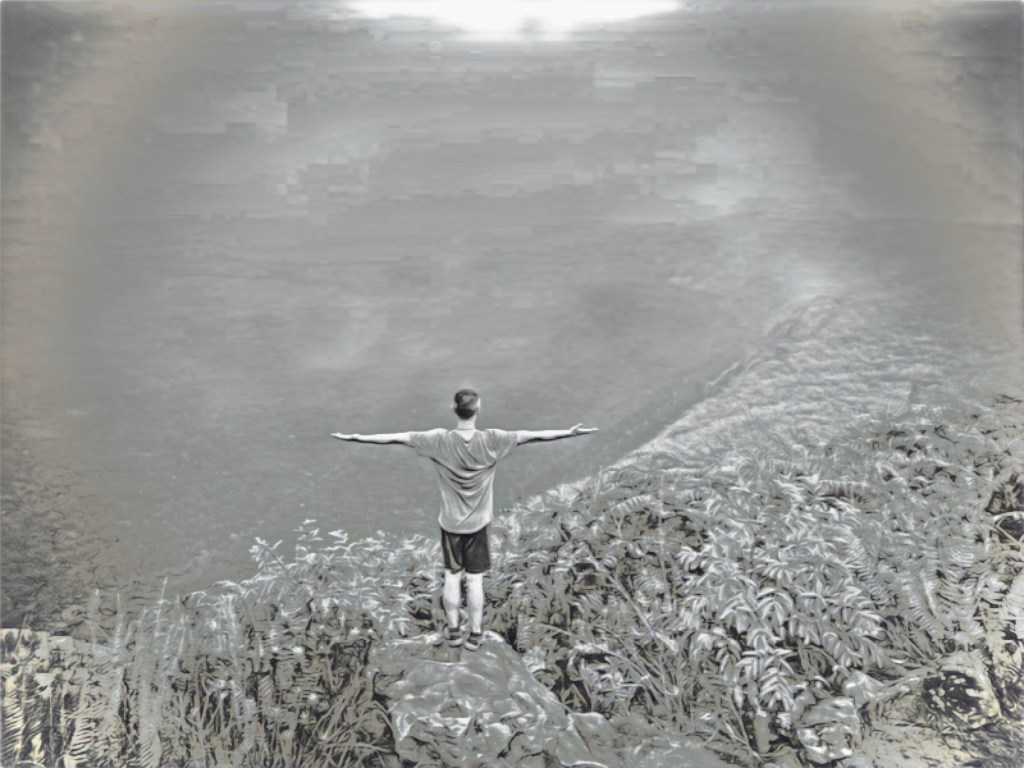
At the Edge of the Caldera… ER’s Eyes – Our planet is beautiful. CC BY-NC-SA 2.0.

Autopsy data

a poem inspired by a professional development facilitator

The educator
in analyzing
student
scores
numbers
and notes
must DO
something
in response
otherwise
all you have is
autopsy data

Rembrandt —The Anatomy Lesson of Dr. Nicolaes Tulp. Public domain.

Expectations

As a literacy coach and intervention team facilitator, I am tasked with communicating expectations of my administration and the district to my colleagues. It’s a tricky position (correction: these are tricky positions. Plural. Sometimes I feel like Bartholomew Cubbins, wearing 500 hats). At present, my fellow educators are, in the wake of COVID, undergoing state-mandated Science of Reading training while adjusting to new curriculum and new leadership. It all comes with new expectations.

Truth be told, however, many of these expectations aren’t new: Problem-solving as a professional community, finding what we need as educators to give the students what they need. Bridging gaps. Collaborative planning. Collective responsibility. None of these are new; they just feel new if they’ve not been done effectively before…the bottom line being the determination of this is what the kids really need; how do we make it happen?

It’s formidable challenge, in a time where there are many needs, and when educational philosophies, beliefs, and mindsets clash. I recently wrote about endurance (from a spiritual point of view). This new school year follows one of extreme exhaustion. We will not endure without leaning on one another. We will not build our strength in isolation. We will not succeed without stamina. Or vision. Where there is no vision, the people perish (Proverbs 29:18). Grappling with expectations is, well, expected. Everything, everything, everything rests on one of two beliefs: it can be done or it can’t.

I believe it can.

Yesterday my granddaughter visited. The hummingbird feeder rings I ordered for us had just arrived. Perfect timing. We took them out of the package, washed them, made a tiny batch of sugar water, and filled them. Off to the yard we trotted to stand with our arms resting on the fence near one of my two feeders where a handful of hummingbirds compete for their nectar throughout the day.

You can see for yourself, in the photo, my granddaughter thinking I don’t know about this…yet there’s a layer of hope and fear in her expression: Will the hummingbirds actually come drink from my ring? Will I be scared?

After a while: How long is this going to take?

The secret, my love, is patience and persistence. If it doesn’t work the first time, we will try again, and again. Hummingbirds have come to drink from the rings of other people in other places; they will eventually do so with us. Keep trying. Believe. I will stand with you until it does.

Oh, right.

I started off talking about teaching, didn’t I.

Expression of uncertain expectation. After she left, I went out again when the hummers were more active. A couple of them hovered nearby, considering me and my outstretched, ringed hand (hummingbirds are highly intelligent and curious). If they come to me…they will come to my granddaughter. I will see if can make it happen for her.

*******

with thanks to Two Writing Teachers for the weekly Slice of Life Story Challenge