Mastering the monster

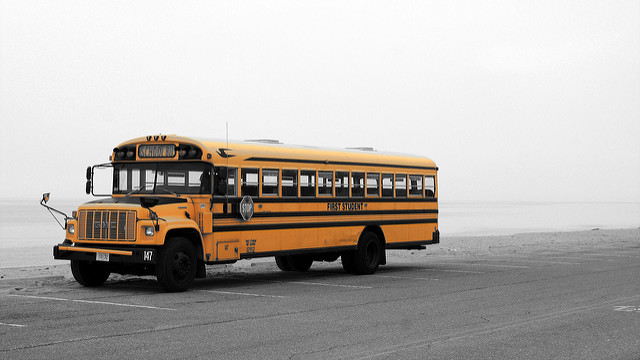
School bus

Bus #147. SebamirumCC BY

Life takes many unexpected twists and turns – a friend of mine says, “Life is one wild ride.” The mysterious is frequently interwoven with the breathtaking, the brightest moments often collide with the darkest, and the greatest desires of our hearts almost always involve epic challenges.

It took me the better part of two decades to finish college, for example.

I married at twenty, quitting college with a year and a half of coursework in general studies and theater arts. My boys were born. My husband completed two degrees needed for his work. I took a variety of jobs, all the while wanting to return to college myself, taking a class or two whenever and wherever I could. Sometimes I dusted off the old textbooks and plays, reread portions, dreamed of going on with my education.

When my younger son started kindergarten, I took a part-time reading remediation position that became full-time, until the program was cut after a couple of years.

“I’d like to keep you on, if you’re willing to take a teaching assistant job in first grade,” my principal told me. “Furthermore, there’s a distance education cohort beginning for paraprofessionals to get teaching degrees. You should pursue this – you’d be an excellent teacher.”

I pondered the prospect. A teacher. At the elementary level? I don’t know. High school English, maybe, but . . .

“It’s a consortium,” the principal went on. “If you’re a full-time teaching assistant, our county qualifies you to attend with financial aid. The books are even covered.”

Here it was, the long-awaited chance to finish school, only it didn’t look exactly like what I imagined.

The principal noted my hesitation. “It’s a perfect opportunity. What are you waiting for?”

Turns out that the program had K-12 reading certification built in.

That was the tipping point.

I love roller coasters. They climb and climb, gaining momentum, then – wooooosh. Hold on tight, as you don’t know what’s coming next – a pretty good metaphor for the wild ride of life. I applied to the program, got in. I loved my classes, my advisor, my instructors, my classmates. Returning to college was exhilarating.

Until.

“Of course, as a full-time teaching assistant in our county,” my principal said, “you’re required to get bus driver licensure.”

WHAT? 

I’m not overly fond of driving in the first place. The idea of maneuvering something as big as a bus, loaded with kids, being the only adult responsible . . .

“I’m not sure I can do it,” I said, going cold and clammy. My stomach lurched like it does after a sudden twist on a coaster, only worse.

The principal smiled. “Yes, you can. Look at it as something that gets you where you want to go.”

That’s what it came down to. If I wanted to finish school, to teach – which I now wanted to do more than anything, the ultimate situational irony – then I would have to face the big yellow monster.

My dad had driven a school bus when he was in high school. So had his sister. Back in their day, students were drivers. Daddy told stories about students tampering with the governor so the buses would go faster – I could envision the buses bumping down the country dirt roads, whipping around the bends in thick clouds of dust, kids bouncing wildly. He told the tales with glee; I listened in horror. While I darkly imagined Daddy’s great amusement on learning that I’d be driving a bus, if he’d lived to see it, this connection to him helped, if only the tiniest bit.

Look at it as something that gets you where you need to go.

I couldn’t let a bus stop me from finishing school or embarking on a whole new career that stretched out before me, glimmering and beckoning like the sea.

I signed up for the training.

The trainer started off with lots of stories, such as a driver once tipping a bus over by trying to avoid a squirrel, which is why we should never swerve if an animal runs in front of the bus.

I put my head down on the desk.

Then there was the first exam: Memorizing all the parts of the bus, how these parts are connected, what these parts do and why, what every light means. This was conducted by walking with the instructor, pointing everything out and giving an oral explanation. A written exam was also given.

I briefly considered failing these exams but my pride wouldn’t let me.

The training culminated in behind-the-wheel practice with the instructor, who asked: “Ever driven a Mercedes before?”

“No sir,” I answered.

He chuckled. “You’re about to now.”

I thought he was joking.

He wasn’t.

The bus I learned to drive on was made by Mercedes-Benz – who knew? It almost drove itself.

I managed to get this monstrous thing, this almost-airplane, through the narrow tree-lined streets of the nearby little old southern town without doing harm to anything until the instructor said: “All right, make a stop. Let these imaginary kids off the bus.”

I made the stop, opened the bus door. The flashing lights came on, the stop sign came out. I even counted imaginary heads.

For the first time, I thought: I’ve got this. It’s not so bad.

Then, as I closed the door to move on, the instructor said, “STOP!”

“What?!” I jumped a little in my seat. I stood on the brake.

“You just ran over a child,” said the instructor.

“I – what? How? I counted all the imaginary heads!”

“You didn’t check your mirrors. Kids can hide close to the bus and you’ll never see them if you don’t check all those mirrors. That’s why they’re there. Kids have been killed that way.”

I returned to work that afternoon in the deepest funk. A teacher assistant colleague greeted me: “Hey, how’d the training go?”

I sighed. “Not great. I ran over an imaginary child.”

My colleague grinned. “How did the imaginary parents take it?”

I laughed in spite of myself.

Still, I put myself on the prayer list at church. Seriously. The youth minister consoled me: “Look, when the time comes, God will give you driving grace.”

He was right.

The first time I had to drive, on my own, with real kids, it wasn’t a magnificent Mercedes bus but an old “cheese box,” as the kids say. I boarded with driving grace in my head and rosary beads in my pocket, given to me by a friend – and I’m not even Catholic.

I – and more importantly, the kids – lived to tell about it.

In fact, my driving the first-graders on their field trip to the movies (a trip of about three miles, consisting of three turns, one of which I took too close with a back wheel going over the curb, causing the bus to sway and the kids to scream), made their writing journals. When the teacher asked them to write about their favorite part of the trip, our entire class wrote various versions of this, with various spellings: “My favorite part of the field trip was when Mrs. Haley drove the bus.” On all the pages I was depicted at the wheel of the big yellow monster, my hair flying in the breeze for some reason, and smiling.

In the eyes of the kids, apparently, I was a great success.

I consider my mastery of the yellow monster my most dubious achievement, closely followed by my passing a college course on golf. No animals ever ran in front of me, all the kids got home, and other than the door handle rolling off one day and causing me to drive back to school with the stop sign out and all the lights flashing so that every car on both sides of the road pulled over, I am happy to report that I only had to drive a handful of times without incident until I finished the teaching degree and moved on, when I no longer had to drive a bus.

It did, indeed, get me where I needed to go.

Those obstacles that stand in the way of what we want, where we want to go – there’s no shortcut, no way over or around them. The only way is through, even when it doesn’t seem feasible, beneficial, or possible.

Whatever it is, whether it looms in front of you, in your past, or inside you, face your monster. Look it in the eye.

Then make up your mind to master it.

Grace be with you.
The brain and story


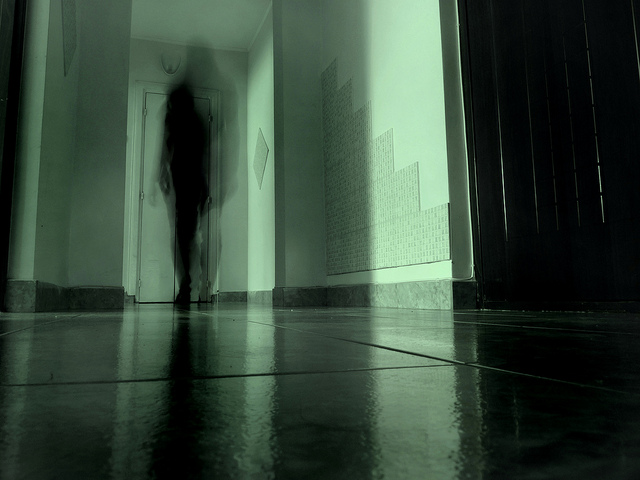
Ghosts in hall

Ghosts in the hall. Rachel TitirigaCC BY

My mother-in-law had a stroke one week ago today.

At ninety-one, she came through emergency surgery astoundingly well. In ICU, she was happy to see her children and grandchildren, called them all by name, told everyone how shocked she was that she’d had a stroke. As I greeted her, she held out her hand to me and said, “Hey, you’ve got a birthday this weekend.”

“Yes, ma’am,” I replied, in wonder.

“I haven’t forgotten,” she said, holding tight to my hand.

In the hospital and rehab, she has remained lucid, talking about books, authors, politics, and traveling she wants to do.

So when she occasionally asks, “Hey, little boy, what are you doing over there?” when no little boy is present, or “Who’s that standing behind you?” when no one is, the family gets anxious.

The physician explained: “It’s her brain at work – partly because of the area affected by the stroke and partly due to her declining vision. When she doesn’t immediately understand what she sees or what’s happening, her brain supplies the story, to make sense of it.”

I hung on every word, thinking: The power of story is profound. It’s more than reading or writing. It’s who we are, how we are wired. 

Both Scientific American and Big Think explain: “The human mind is a story processor, not a logic processor.” Our ability to solve problems, the scientists say, is tied to our understanding of story: “Perhaps story patterns can be considered another higher layer of language.”

Fascinating, isn’t it, that story is where science and the humanities meet.

Story is the essence of being human. It’s how we make sense of the world and our place in it. Story is how we attempt to understand who we are, and how we stretch the boundaries of possibility and our humanity, by imagining more: “What if . . . .”

As an educator, the visit with my mother-in-law could not have been a more striking reminder that story is critical to student learning and growth. It’s not so much the types of texts that students read, but their interpretations, their stories, about the texts that matter – and that for students truly to be critical thinkers and problem-solvers, they must go beyond synthesizing and responding to what others have written. They must look within and generate their own stories. To not do so is to hamper human nature, to not meet an intrinsically human need – and to starve the human brain.

slice-of-life_individual


The value of value

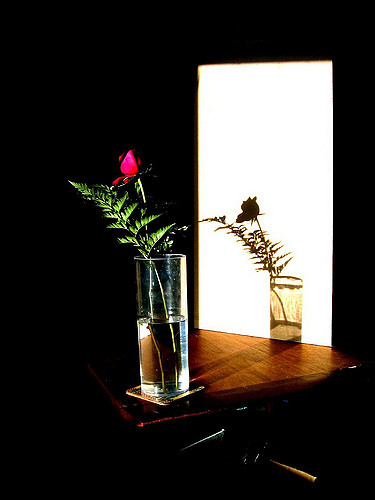
Rose & shadow

Rose and shadow. ankakayCC BY

We have a new principal at our school.

On his office wall is a certificate presented to him by his previous school: “Most likely to make you feel appreciated and valued.”

That word, valued, set my thoughts firing like electrical arcs in a dozen directions.

The first thing that came to mind, strangely, was an image of light and shadow. From an artist’s perspective, in artist terminology, value is the shading that gives depth to a two-dimensional object, almost magically transforming it visually to three dimensions. Values make an image pop, bring it to life.

A fascinating concept for a leader of a school, or any leader, isn’t it – to be an artist of sorts, to harness the light and the shadows of the given entity, to have a vision, to go beyond the surface and bring depth, meaning, and make it work. Artistically speaking, that’s the value of value.

Another image was immediately conjured – the vast machinery of systems. Have you ever had the sensation of being a tiny cog rotating in a mind-boggling conglomeration of structures that do not fit well or operate properly together, with old, vintage pieces welded precariously to shiny new ones, like something out of steampunk? As the cogs we cannot even see the full extent of the machinery looming far beyond us; we can only feel the unwieldy vibrations as it lumbers on. That’s often how education feels today. In truth, it’s not the structures that hold things together and keep everything running – it’s the cogs, the teachers. Teachers are the most crucial pieces – and the end product isn’t the perfectly standardized student. The students aren’t end products at all – don’t we want them to keep growing, learning, discovering, contributing, as long as they live? That’s something no machinery can produce.

Which gets back to value.

To value something means to hold it in high regard, to recognize its worth and usefulness. We value things that are important and beneficial to us.

My thoughts branch out into a hierarchy of what-ifs:

What if systems valued schools more than data? What if they scaled back and simplified rather than adding on?

What if principals communicated their value of teachers through their actions instead of words?

What if teachers made all students feel valued – and valued their differences? And taught students to do the same?

What if everyone realized that these are matters of the human heart and spirit?

I can see the light and shadows separating already, magically transforming things, creating a depth that’s been needed for so long.

slice-of-life_individual

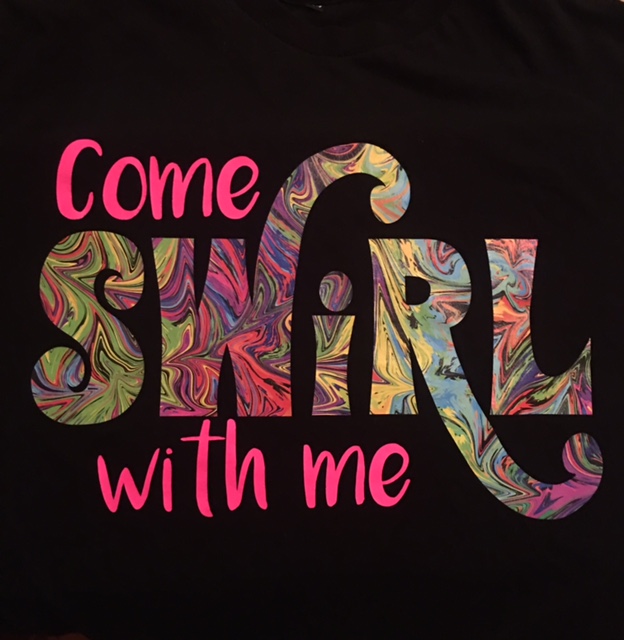
Come SWiRL with me

SWiRL

Our Literacy Lunch team’s T-shirt design

Q: What’s a fun way to engage families in English Language Arts activities with their children?

A: Have a Literacy Lunch!

Every year, families look forward to Literacy Lunch at our school. It’s one of our best-attended events.

Our theme this year, “Come SWiRL with Me,” centered on the facets or domains of language: Speak, Write, Read, Listen (we added the “i” to the SWRL acronym to make a real word), as speaking, writing, reading, and listening comprise the ELA standards and language skills needed across all disciplines.

So, grade levels came up with activities that encompassed all elements of SWRL. Some included poetry, in recognition of National Poetry Month.


Spring poems 1st

First graders wrote spring poems with families, to read aloud. Second graders wrote “I wish” poems.

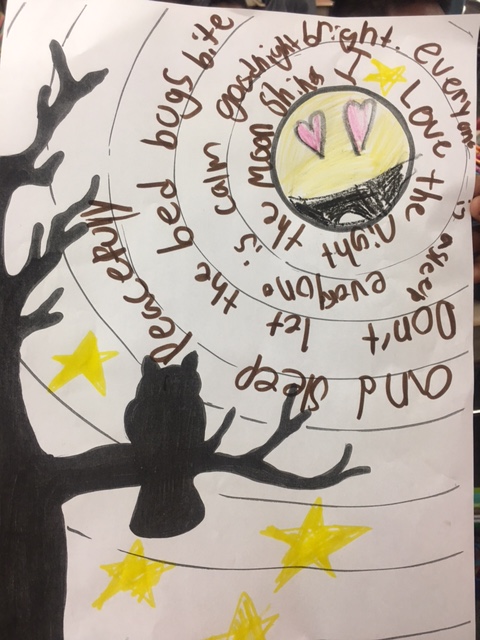
Swirl poem 4th

Fourth graders composed “swirl” poems with families.

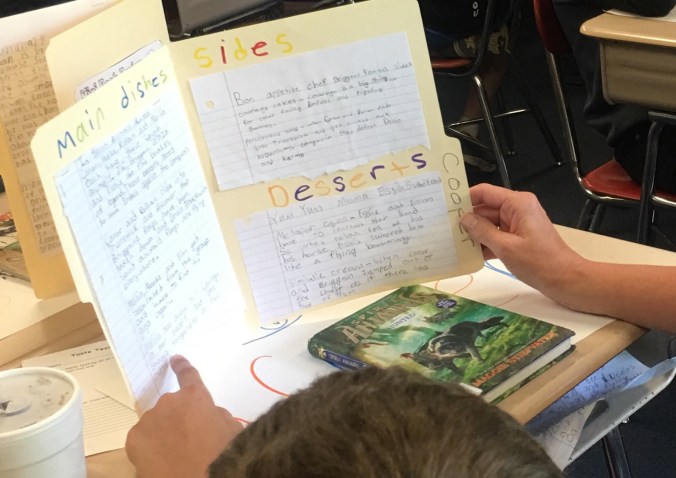
Book tasting 5th

Fifth graders treated parents to a “book tasting.”

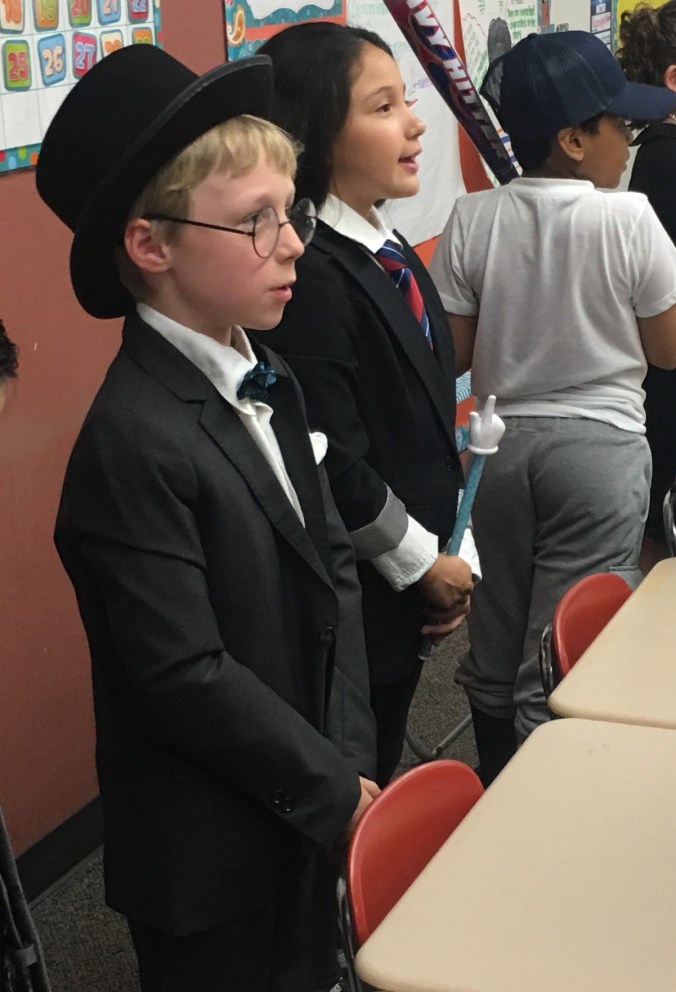
Wax museum 3rd

Third grade’s wax museum: Meet Woodrow Wilson, Frederick Douglass, and Jackie Robinson. Visitors pressed a “button” to hear the historical figures speak. This was the culmination of a biography writing unit.

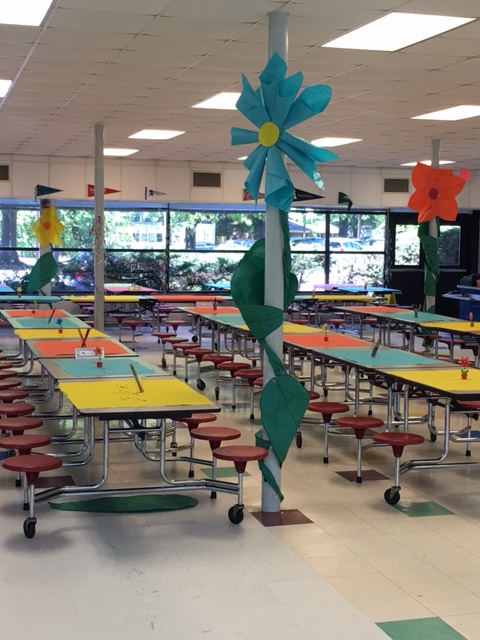
After the in-class activity, families went to the cafeteria:

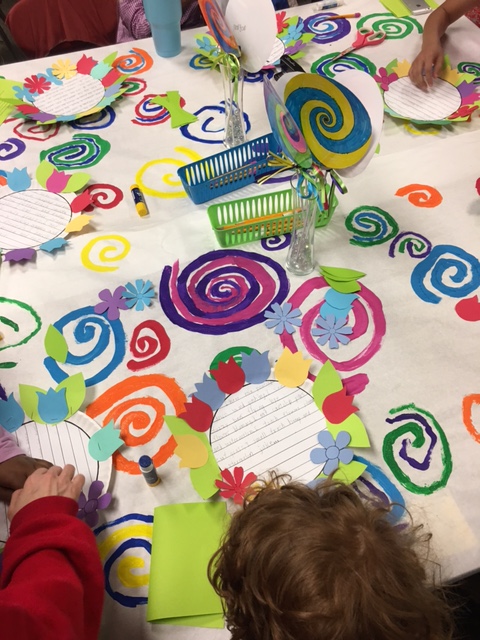
SWiRL - Cafe

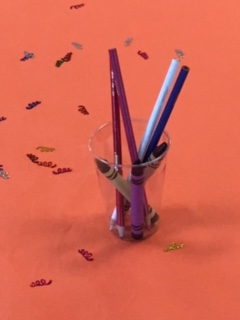
All ready for families to eat together – and to write on the tablecloth.

The children seemed to enjoy writing on the paper tablecloths at lunchtime the most – at the end of each lunch, tablecloths were covered with messages and small sketches. One carefully crayoned note from a first grader: “I love you.” Underneath, the neat printing of a parent: “I love you, too.”

Upon exiting, parents gave feedback: They were in awe of the artwork,  fascinated by the children’s ideas and their creative expression. One parent commented: “Public speaking is VERY IMPORTANT!” Another parent, after attending kindergarten’s renditions of reader’s theater, wrote: “I’ve seen so much improvement in my son’s writing and speaking.”

Perhaps most telling is this comment, one frequently echoed throughout our years of Literacy Lunches: “Thank you for this special time with my child.”

Speak, write, read, and listen well, for words are important.

So is time.

SWiRL table

Reflect: What message do you need to communicate to someone today? Make time.


Committing assumicide

Through the window

Through the window sepia. Jo NaylorCC BY

Your assumptions are your windows on the world. Scrub them off every once in a while, or the light won’t come in.
Isaac Asimov

This quote brings a little girl to mind.

She shows up in my classroom early for her reading intervention group. I am hunkered over my laptop fighting with a SMART Board activity I’ve created on word families.

“Hello,” I say, without looking up, frowning at my screen and the uncooperative technology. “Come have a seat. The others will be here in a few minutes.”

She sits right next to me, a small warmth at my elbow. “What are you doing?”

I sigh. “Trying to fix this activity for your group to play – it will be fun. Something’s not right, though. I’m trying to figure it out.”

She watches while I attempt to cut a word from one side to paste on the other. Unsuccessfully.

Even as I fight the program, I wonder what she is thinking.

She struggles terribly in all academic areas, an ESL student with processing issues beyond the language barrier. She is soon to be tested for disabilities.

“What is that line in the middle?” she asks.

“It’s a dual screen – two screens instead of one.”

“Oh. You are trying to move this word to here?” She points from one side of the screen to the other.

“Yes. I don’t know what I’m doing wrong,” I say in exasperation. I glance at the clock – I should have caught this problem sooner! “I’m going to have to quit now – I’m out of time. Your group will have to do something else instead.”

Without removing her eyes from the laptop, my student reaches over, clicks on the obstinate word, then drags and drops it on the other side.

“There,” she says, matter-of-factly.

I stare at her. “How did you know that? Have you seen a SMART Notebook before?”

She shrugs, laughing at my expression. “No. Just a try.”

The group was able to play the interactive word game. That day my little girl was a much more willing participant, with considerably more confidence.

The outcome could have been quite different. In my frustration, it would have been easy to answer her questions with Oh, never mind. It’s too hard. I could have thought, There’s not much need of my explaining. You won’t understand.

Had I done so, I would never have known that she had this ability, that she could “see” what to do with the new software when I couldn’t.

I would have committed assumicide.

It happens every day.

Teachers assume that students who struggle in academic areas struggle in all things – and thereby limit the students further. Although the thought may never be verbalized, it lurks in the mind: They can’t do that . . . so surely they can’t do this . . . .

A friend of my family was born with cerebral palsy. His father was an avid golfer who decided early on that he would treat his son as if he didn’t have the disability. As soon as the boy was big enough, his father started teaching him the game.

I have often wondered how many eyebrows were raised at the time: What is that man doing? His child can barely walk or dress himself – why in the world would he teach him something requiring as much precision as golf? That boy will never be able to hit the ball! I wondered if some people may have been angry over the injustice.

If so, they eventually learned that they’d committed egregious assumicide.

The boy grew up living and breathing golf. He remains a local expert on the game with a room full of trophies won in multiple tournaments, long after his father had passed away.

Yes, that’s right – a room full of trophies in a precise game like golf, when the two halves of his body don’t work together for him to climb stairs and his hands shake when holding a cup so that it can only be partially filled, lest he spill the contents.

When I needed a fast P.E. credit one summer to complete my teaching degree, the only thing available, to my great chagrin, was golf – and this extraordinary man coached me through it. I have page after page of his painstakingly handwritten notes and drawings on “the fundamentals of golf.”

When I was growing up, my parents had the In the Wind album with Peter, Paul and Mary singing Bob Dylan’s “Blowin’ in the Wind.” As a child, I loved the three-part harmony and haunting lyrics:

How many times can a man turn his head

And pretend that he just doesn’t see? 

Maybe it’s not always a matter of not seeing, but seeing wrongly – seeing the deficits, not the potential.

For the teacher, what isn’t working too often overshadows what might. Sometimes we see but don’t act because we don’t know what to do, or because we believe our efforts won’t matter. We assume we are defeated before we begin. Sometimes our focus just isn’t where it needs to be when worry, exhaustion, fear, discomfort, directives, even the need for self-preservation and validation, occlude our vision. Sometimes it’s hard, in the throes of teaching – and of living – to stop and breathe, to listen, to see, to let go when we’re so focused on whatever it is we are trying to make happen. Accordingly, we close more doors than we open – for ourselves as well as for others.

We assume, and something dies.

I decided at the end of eleventh grade that I wanted to go to college. Higher education wasn’t talked about at my home, wasn’t encouraged. The general expectation is that I would keep taking courses like business typing (which I bombed, miserably) to become a secretary.

I needed to take several college prep courses in twelfth grade even to apply for college, and the college prep English teacher wouldn’t let me in his class.

He had the reputation for being the hardest teacher in the school. He reluctantly met with me, frowning over my transcripts. “You haven’t taken the prerequisites for this class or demonstrated that you can handle this caliber of work,” he commented, handing the transcripts back.

“Y-yes, sir, I know,” I answered, trembling. “I hadn’t planned to go to college until now.”

He eyed me over the rim of his glasses. Piercing blue, absolutely no-nonsense eyes.

“Tell me why I should let you into my class.”

“I’ll work hard. I can do it,” I said.

He sort of snorted. “A lot of students before you thought they could do it, too, and transferred out of my class, even when they had prepared for it.”

“Please.” It was all I knew to say.

He shook his head. “I am doing this against my better judgment,” he grumbled, and signed my special permission form.

That year I encountered the great poets, studied sonnets, wrote so much about the spider in Robert Frost’s “Design” that my teacher noted at the end of my interpretation: Exhaustive analysis! I memorized and recited – in Middle English – the first thirty-four lines of Chaucer’s Prologue to the Canterbury Tales. I hung on my teacher’s every word about London during the time of the Black Death; his descriptions were so vivid that the images remain clear in my mind to this day. For my final paper I wrote about the function of King Claudius in Hamlet – and when our teacher announced that four students tied for the highest score on the paper, I was one of the four.

He returned my paper on the last day with this comment: “For someone who had to have a special conference to get in this class, you have done remarkably well. You have surpassed expectations.”

All of which leads me to believe that the First Commandment of teaching should be Thou shalt not commit assumicide.

Perhaps it may even need to be the First Commandment of humanity.

slice-of-life_individual

Deeper than data

Moonrise

Moonrise. magnoidCC BY-SA

Papers are spread across the conference room table. The projector shines a graph – a student’s reading assessment history – on a screen. Discussions center on interpreting the erratic data points on a trend line in relation to the aim line toward a goal, the rate of improvement, and whether or not this student is a retention candidate.

A colleague turns to me: “What do you think? You’re the literacy person.”

I consider the numbers, the color-coded risk categories, where this child falls in all of it.

“I don’t know,” I reply. “I haven’t heard this child read.”

Silence. Eyes are on me.

“I need to know what exactly this child is doing during reading, how the child approaches it, feels about it, what the actual strengths and weaknesses are. Until I do, I cannot say what I think. Data is information but it doesn’t tell the whole story, only little pieces at specific points in time. I have to listen to the child.”

I leave the meeting to do just that.

The child is eager to read and turns out to be highly accurate, reading slowly and deliberately; the time that it takes this child to finish reading is why a high risk is indicated on some measures. In fact, the child can read and fully comprehend text above grade level expectation. The only enemy is time, and that’s only an issue in assessing. The desire to read, the ability to self-monitor, and an obvious work ethic so early in life will take this child far.

I think of Brené Brown, professor-author, who says: “I am a storyteller. I’m a qualitative researcher. I collect stories; that’s what I do. And maybe stories are just data with a soul.”

Data is the dust jacket; behind it there’s a story, and in the center of the story is a little soul.

It takes another soul to reach it.

I listen to another child reading with great flow and prosody, to discover that this young reader isn’t making meaning beyond the surface of the text – and struggles a bit even to retell what’s explicitly there. This child, whose data looks near-ideal, “in the green,” is of far greater concern. Supports need to be put in place immediately or this child will fall through the cracks.

On paper – on the dust jacket – this child looks just fine.

A few months ago, as I was printing data reports in the computer lab, I saw a young man walking with a class down the hallway. Subs are getting younger and younger, I thought, gathering my papers and returning to my room to begin analyzing them. Two colleagues joined me at my table.

The young man came into my room, smiling. “Mrs. Haley, do you remember me?”

I look at him. A little face, frowning over a book, springs into my mind. “Yes, I do! Goodness, you’ve grown up!” Mentally, I am counting off years – Good grief, how long have I been doing this?

Turns out he’s not a sub, he’s a high school volunteer. I breathe a little easier about the passage of time. He was one of my first intervention students at this school.

“I am planning to go to college to teach,” he says with a grin. I marvel at his poise. He exudes young professionalism.

“Really? What do you want to teach?”

“Reading. In fifth grade. I think I can help the kids love it. I really didn’t love it until I was in high school and suddenly I couldn’t read enough – I read all the time.”

I am awed. “That’s amazing! I am so glad to know. The kids need you. What a great role model you’ll be.”

One of the colleagues at my table asks: “Was there a particular teacher who inspired you?”

His face – once so little and serious, nearly scowling as he sat at this very table – lights up with a beatific smile.

“Yes. Mrs. Haley.”

My colleagues’ eyes tear up. I cannot even blink, cannot quite process this.

“But – you said you really didn’t enjoy reading until high school,” I manage.

“It took a while,” he laughs. “Reading was hard for me when I was little. I didn’t think I’d ever be good at it. You were the one that gave me the confidence, the one who said I could do it. I kept trying.”

Behind the data is a story. Behind the story is a little soul. A precious one.

Sometimes we never know how the story unfolds once the children go on. We only play a part for a little while, but how priceless is that tiny window.

If data were the whole story, I wouldn’t be a teacher, wouldn’t be writing this now. My parents didn’t go to college; one didn’t finish high school. The odds were against me. But my parents bought books and magazines, my grandmother read to me long before I went to school, and teachers challenged me all along to strive for more.

Another meeting, another table strewn with papers. I stand up. “I have to go now. It’s time for me to read with a student.”

This student and I read every day, if we can. He struggles with vocabulary but his primary issue is lack of confidence – he doesn’t want his peers to hear him.

I am running late. When I find him, he tries to hide a smile.

“I thought you forgot,” he says, as we settle at the table.

“I was in a meeting,” I explain. “I had to leave it.”

Pure astonishment is on his face. “You left a meeting? To read with me?”

“Well, yes. Your reading is important. Let’s get going.”

He looks at me, wide-eyed. “I can’t believe someone would do that.”

“You’re more important than the meeting,” I say.

He smiles in spite of himself.

And he reads.

I listen.


Just the right word

Ninja

Happy Go Lucky 393. D-KarissaCC BY

In the midst of writing realistic fiction with third grade, I am stuck on a word.

We are studying how using events from our own lives can bring fiction to life. I once had a yellow parakeet that kept opening the door of its cage to fly around the house. This is the basis for the piece I’m modeling for the students. My story concerns two brothers that the students have named –  it opens like this:

Tweety Bird sat inside his cage on his swing, rocking back and forth. He lifted one yellow wing, preened it, fluffed all of his yellow feathers, and went back to swinging.

As if he didn’t know Jake was watching.

“You don’t fool me, Bird.”

Tweety blinked his purple eyes at Jake and kept on swinging. 

“Jake,” Mom called from the kitchen, “did you get the mail for me like I asked you to?” 

“No, ma’am,” Jake replied. “I’ll go now.”

As Jake left the living room, he turned back toward the birdcage. He shook his finger at Tweety:

“You better stay put. I am going to figure out how you keep escaping from your cage.”

With that, he walked through the front door.

As soon as the door closed behind Jake, Tommy popped up from behind the sofa, wearing his Batman costume, mask, cape, and all.

Tommy looked to the left.

He looked to the right.

Tommy snuck very bat-like over to the cage.

The problem with that last sentence isn’t snuck vs. sneaked, alas. That’s a discussion for another day; snuck is acceptable and I like the sound of it here better than sneaked.

No, the trouble is with another word.

“I am having a problem with the word bat-like, ladies and gentlemen. Tommy can’t sneak bat-like over to the cage because, well, bats don’t sneak. The word doesn’t work here. I’m trying to think of a better word, but I’m stuck.”

Like a wave, expressions of deep thought sweep over the sea of little faces, replacing that of delight over the Batman image. Little brows furrow. These third-graders frequently seem like forty-year-olds; we were discussing once how drivers do not pay enough attention and this is why car accidents occur. One student sighed: “People these days . . . .”

“Maybe you could try cat-like,” suggests a student.

“True – cats sneak a lot. That’s much better, but I am not sure I want to mix cat and bat here. I mean, having Tommy as Batman sneaking like a cat? What do you think?”

Heads tilt. “Yeah, it’s not quite right,” agrees another student.

A hand goes up: “How about with stealth?”

All the heads turn toward this student.

I blink.

“Wow, that’s pretty impressive. What a great word. I could say Tommy snuck with stealth over to the cage. What do you think?”

Faces are contemplative. Another student: “What about Tommy snuck stealthily over to the cage?”

It’s not really grabbing any of us – I can see the doubt on their faces.

Stealthily is an amazing word. Here’s the thing. I want a word that really helps paint the picture in the reader’s mind, that really captures the movement Tommy is making so that the image is clear to the reader. It needs to be connected to a noun, something else that sneaks, something better than a cat.”

A boy’s face lights up: “I know – a Ninja!”

It’s magic, the way all the faces light up. “Yes!”

“That’s perfect!” I cross out bat-like and write Ninja-like:

Tommy snuck Ninja-like over to the cage.

“Can you see the action in your mind, exactly how Tommy is moving toward the cage?”

Heads nod vigorously. A couple of the kids strike Ninja poses.

“I have to thank you all for your help, because I never would have thought of using Ninja. It’s just the right word.”

The students, looking like young sages, get back to work on their own writing. The hum of their brains is nearly audible.

They make another artistic suggestion later on, as my modeled story progresses:

Right before their eyes, Tweety, clinging to the bars on the front of the cage, used his beak to lift the cage door so that it fell open.

Tweety looked to the left.

He looked to the right.

And he flew out of the cage!

“Go, Tweety, go!” screamed Tommy, jumping up and down so that his Batman cape flapped.

A hand: “Mrs. Haley, if Tommy is pretending to be Batman, he could pretend that Tweety is Robin. He should say Fly, Robin, fly!

“Yessssssss!” says the class in unison.

That suggestion changes the shape of the entire story, for it provides the motivation for Tommy, as Batman, to let Tweety out of the cage in the earlier scene.

“You, ladies and gentlemen, are extraordinary writers!” I am as excited as they are with this new layer in the narrative.

With knowing smiles, they bend back over their own pages, pencils in hands.

********

Here’s the Tweety tale in its entirety, should you want to read it: The Escape Artist

slice-of-life_individualEarly Morning Slicer

O. Henry

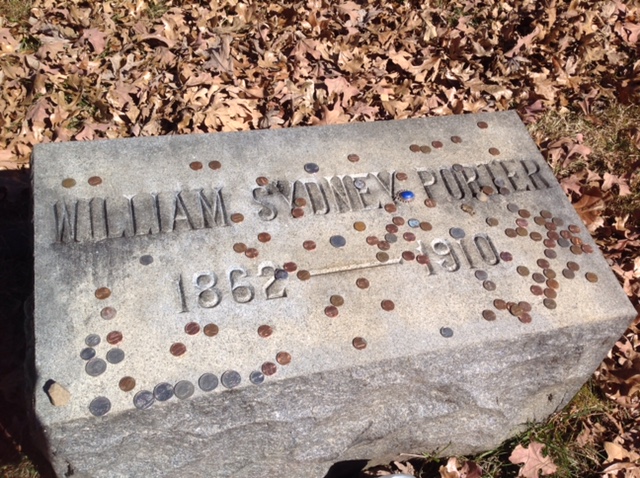
O. Henry grave 

Fall comes early in Asheville, North Carolina. The air is chilly when I get out of the car at the cemetery to visit the grave. I think of winter coming, of Christmas, of this writer’s most famous work. I take a picture, marveling at the coins spread over the gravestone. As I turn to go, a frigid wind gusts, scuttling leaves over the ground and across the driveway.

Leaves . . . I remember that story.

O. Henry’s headstone is covered in coins, mostly pennies, which usually add up to $1.87 –  the amount of money that Jim and Della had at Christmastime in his famous short story, “The Gift of the Magi.” This shortage of money is why Jim sold his gold pocket watch to buy combs for Della’s beautiful hair, and why Della cut and sold her hair to buy a platinum fob chain for Jim’s prized watch. Their sacrificial love for one another has made the story an enduring classic.

There is another story of O. Henry’s that I love almost as well.

I remembered it as I planned to write “Oh, Henry,” yesterday’s post about my son’s dog. I should write about O. Henry next, I smiled to myself. A little word play with the titles. How enticing.

That’s when I thought about the fallen leaves blowing over the writer’s grave.

I scrounged up my old paperback copy of O. Henry’s short stories and reread “The Last Leaf.”

In this tale, two young artists live in a three-story Greenwich Village building. One of them becomes sick with pneumonia. She watches the leaves dropping from an ivy vine against the wall just outside of her window, convinced that she will die when the last leaf falls. To her astonishment, the last leaf hangs on through high wind and rain. To make a short story shorter, the leaf remains because an old artist in the building crawled up a ladder in the dark of a raw November night and painted it on the wall with the vine. The girl begins to recover and the old man, Behrman, dies of the pneumonia he catches from being out in the weather while painting that night.

The old artist had always wanted to paint a masterpiece and never pulled it off – but the last lines of the story have the roommate telling the recovering girl about the leaf: “Didn’t you wonder why it never fluttered when the wind blew? Ah, darling, it’s Berhman’s masterpiece – he painted it there the night the last leaf fell.”

Self-sacrificial love at work again – but there’s more to it.

That leaf symbolized hope, sparking the desire to strive, to overcome. The old artist’s small gesture inspired the young artist to keep living.

This leaves me thinking, in the course of our days as teachers, as writers: Are we not the artists who paint the pictures of possibility, of hope, in the minds of others? Do we spark in others a desire to strive, to reach for what’s beyond their grasp, or to hang on only long enough until this, too, shall pass?

Our masterpieces may never be world-famous; they may be as simple as knowing the right word, the right idea, the right vision, the right story, and sharing it when it is most needed. Inspiration leaps from one heart to another, creating something to hang onto, outlasting high winds and rain. We may never see the full effect of our work, but that’s all right.

We paint the leaves where we can.

I close my old paperback book.

O. Henry, I am so thankful you were here.


slice-of-life_individualEarly Morning Slicer


The coaching tree

Coaching Tree Lg

Early in the school year, my instructional coaching colleagues and I attended district training where participants were tasked with creating an image to explain the coaching process.

My group thought for a moment.

“You know, coaching is an organic thing,” I said. “Or at least it should be. We all know it takes time to develop relationships and trust. It’s about honing practices, sure, but this is a growth process for us as well as for our teachers. We grow together to reach goals.”

A colleague said, “Yes! I’m seeing a tree, branching out . . . .”

In a few minutes we’d sketched the tree. We began to label it, recognizing coaching elements that correlated to parts of the tree. The more we worked, the faster the ideas came.

Relationships are key in coaching, the foundation, but certain things must feed the relationships before the process can begin. These roots are trust, the human connection, listening, collegiality, safety, empathy, and support. Coaches must meet teachers where they are and be willing to plug in with what teachers want to accomplish – it’s not as much about seeing the work as it is seeing a fellow human being. The vision develops from there, and needs to be a shared one.

The trunk of the tree symbolizes this togetherness with inspiration from Shel Silverstein’s The Giving Tree. Near the bottom of our tree, we placed a little heart: Coach + You. The heart of coaching is just that – having a heart for each other.

A solid, thriving coaching relationship branches out into nearly endless possibilities, aspirations, and directions, such as goals, the 4 Cs (communication, creativity, critical thinking, collaboration), encouragement, self-modifying learners, reflection, growth mindset and learner agency.

My coaching colleagues and I stood looking at our work, feeling pretty happy with our Coaching Tree.

“We need to put the sun in,” said a colleague. “The sun is the climate, of course – a warm climate conducive to coaching is necessary for the process to work. That’s where administration comes in.”

We put the sun in.

At this point, something struck me – “Trees bear fruit! What is the ultimate goal of coaching, the payoff? What’s the fruit of our labor?”

We created a basket then, and labeled it The fruit of our combined efforts. It holds apples: Love of learning, data, increased student achievement, teacher fulfillment, students graduating college or career ready. 

As teachers are fulfilled and productive, we desire to branch out into new areas. The growth continues. As students achieve, as they go on with their lives, some will go into the teaching field and the cycle begins anew.

At the close of the training, small groups presented their work to the whole assembly of coaches. The other groups had designed diagrams, cycles, or flow charts, all of which artistically, appropriately encapsulated the continuous reflective coaching cycle of support.

My group was the only one to present the coaching process as a living thing, something organic.

We were startled by the enthusiastic applause from our fellow coaches.

Upon returning to school, my colleagues and I recreated the Coaching Tree in the teachers’ lounge. It stands there to encourage, invite, celebrate, and maybe inspire or spark hope when we all need it, a visual reminder that our work is not in vain, that we’re in this together, to help each other along, and the sky is the limit.

slice-of-life_individualEarly Morning Slicer

The Writing Spa

Welcome to the Writing Spa.

Please put your things down and help yourself to salt scrub – wash your hands and refresh.

Or have some aromatherapy lotion.

Listen to the soft music, the sound of the ocean with the occasional distant gull.

That fragrance in the air? That’s a pillow mist. It’s called Peaceful.

Yes, it does smell very spa-esque, doesn’t it?

Today we will write. It’s so important that teachers of writing write themselves, with and for students.

Today you write for you.

You have a choice of stations: Refresh, Evoke, Escape. Start wherever you like. If there’s time, we will get to all three; if not, certainly two.

Let me explain.

The Refresh sign bears the Isak Dinesen quote: “The cure for anything is salt water: sweat, tears, or the sea.” Which salt water form grabs you first? Close your eyes and envision a scene where this salt water form played a significant role. Where were you? Who was with you? Get back into the moment – show, don’t tell.

Here’s an example, a time when tears played a healing role in my life ….

The sign at the Evoke station reads: “Nature speaks and wafts her perfumes. Capture it.” This is meant to connect us to the natural world with sounds and scents that lift our spirits and make our hearts rise. Write about any sound or any scent that does this for you, and why it has this effect. Who or what is associated with it?

I chose sound. I wrote about cicadas in the summer and what this evokes for me. I will share ….

The last station is Escape. There’s a place you long to return to – why? Who or what is connected to that place? Capture it in detail so the reader goes there with you. Share the reason for its specialness to you.

Here’s one of my special places. I only went there once ….

The teachers write. Some have tears in their eyes; some stop to look into the distance, far beyond the walls of the room, to different places, conjuring different images in each of their minds. The music is soothing. We are breathing in Peaceful. When it’s time to stop, those who wish to share their writing do so with one another; those who’d  rather not share are willing listeners, ready to give positive responses on the strength of the writing. There are more tears. There are also smiles, even a small eruption of laughter at the humor in someone’s writing.

We rotate and repeat.

For reflection, they write a takeaway for themselves and one for their classrooms. They write on white paper. 

Ball up your white paper. This is the Invigoration piece of the spa – we will now have a snowball fight! Have at it!

Much laughter ensures as teachers throw “snowballs” at one another. We stop; they choose a snowball and open it up to read to a partner. No one knows who wrote what and reflections that strike chords are shared with the group. We go another round. 

I hope you enjoyed your Writing Spa, everyone. However you view yourself as a writer, the goal for today is that you found writing a pleasurable experience. Writing must be pleasurable for teachers to be pleasurable for students. We create the atmosphere for writing in our rooms. Think of ways you might adapt what we’ve done here for your kids – pay it forward.

On your way out, by the door, there’s a basket of chocolate – help yourself to Chocolate Therapy. 

Go forth in writing wellness.

*******

I did two variations of the Writing Spa, one with teachers at my school last December and one on Monday with teachers attending the North Carolina Reading Association Conference. Improving writing instruction has been a major focus at my school for a couple of years, the most frequently-requested area of support. The spa was born from a synthesis of ideas: Teachers, however they feel about writing, need to have enjoyable experiences with it; professional development needs to lift teachers’ spirits; writing is about going deep, tapping the power that lies within us.

You are welcome, if you like, to read my sound and place pieces shared for Evoke and Escape.

I’m still working on my salt water piece.

(I finished itBaby’s breath)

slice-of-life_individualEarly Morning Slicer