For Ethical ELA’s Open Write today, fellow teacher-poet Margaret Simon invites participants to write to a photo. “This Photo Wants to Be a Poem” is a regular feature of her blog, Reflections on the Teche.
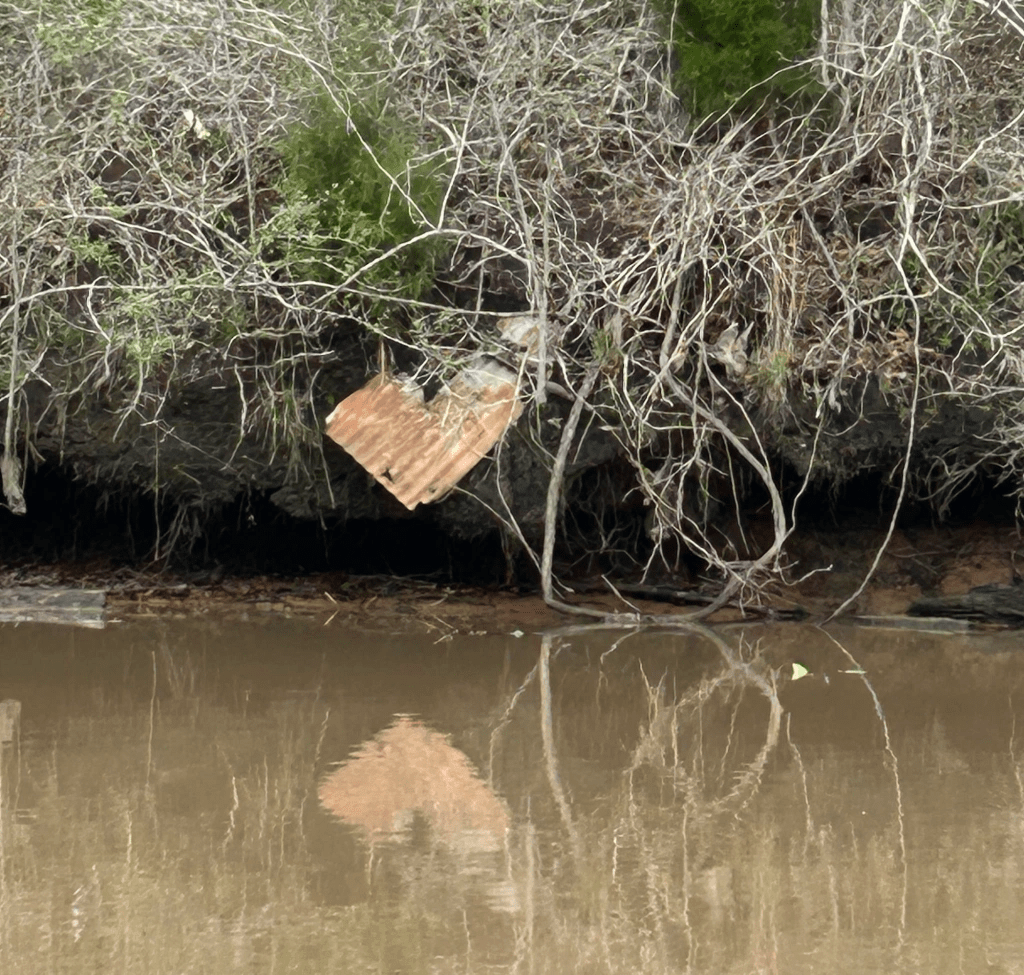
Margaret is also an artist, always viewing the world with artist eyes. She saw this scene on a canoe ride with her husband and knew she needed a photo… found art, shall we say, for a found poem (of sorts):
Provision is the title of the prose poem I share here, originally written to a nature prompt on Ethical ELA’s Open Write. A poet-friend suggested turning it into haibun by adding haiku at the end…Voilà.
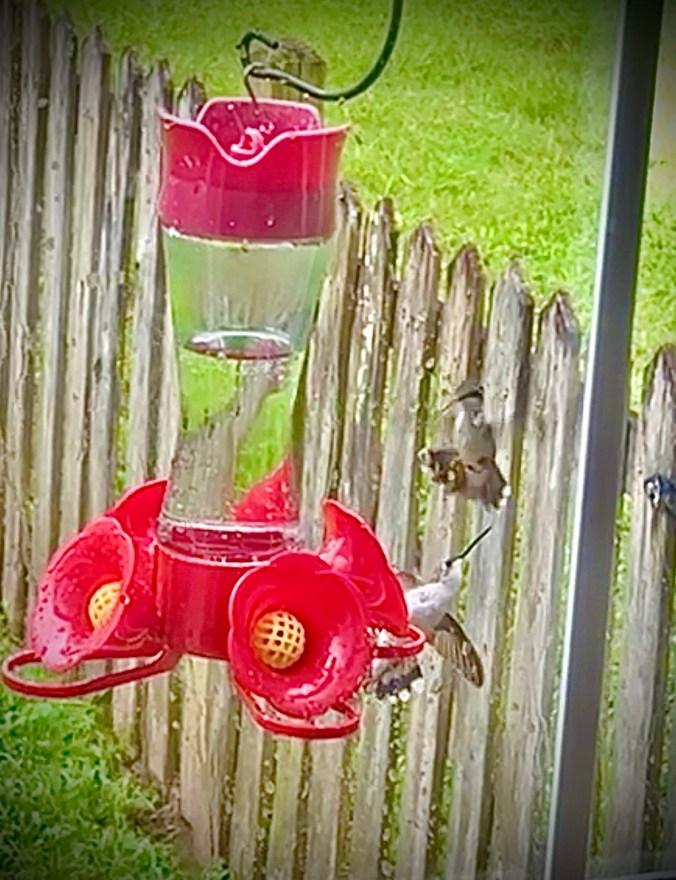
It is July. The hummingbirds are drinking a whole feeder of sugar water a day. My friends say they have no hummingbirds this year and I joke that they are all coming to me. My granddaughters try to help me count, but, in all the frenetic zoomings from window to crape myrtle and every which way, we lose track: Is it seven? Ten? We cannot be sure, even though every bird has different markings. Most are female. One silvery girl has a red dot at her throat. This is somewhat rare, research reveals. I have taken to calling her The Princess. She was here last year. She has come home again to her own realm and it is my great pleasure to serve her. A documentary tells me that every day of life is a combat zone for hummingbirds. I already know this; I am eyewitness to their fierce competition for food. I am occasionally startled by the sound of a tiny body slamming against the window—THUNK! — where the feeder hangs. How is it so loud? How does the body-slammed bird not die? The hummingbird’s awareness and aerial acrobatics are astonishing. Once in a while, a male finds his way to the feeder, his brilliant ruby-throat like nothing else in nature, as long as the light is right. His jewel-fire turns black in shadows. The women soon drive him away. They rule the feeder. I see females sometimes picking near-invisible insects off of its red plastic flowers, likely to carry to their young. I am thinking some of these birds hatched here in our trees last year. We have never had this many before. It is not hummingbird nature to “bring your friends.” They do not have friends. They are individuals. Loners. Warriors. As fierce and resilient as anything in the animal kingdom. They are, in their way, mightier than eagles. And they know me. I step outside to a helicopteresque whirrrr accompanied by loud chips and chitterings…food’s gone! they say, so hurry up, hurry UP. A bird hovers nearby as I rehang the feeder full of fresh, cool sugar-water, condensation already running down the glass, gleaming in the light. They are back at it before I can open the door to go inside. I do not expect their gratitude. Their love. Their allegiance. None of that is possible in this life. Their beauty and perseverance, their very presence, is enough. They perch on the twig-branches of the pines out back whenever I am on the deck, nearly indistinguisable from the pinecones. They are watching me, these tiny winged wonders of sublime iridescence and supreme intelligence. They know me. It is more than enough.
The battle is Yours —I trust Your sweet provision, grace in every drop.
For Ethical ELA’s Open Write today, host Jennifer Guyor Jowett states this purpose: “We are going to tug at your memories, perhaps even look for a way to express that which is hidden.”
Jennifer goes on to share how Emma Parker, a textile and mixed-media artist from the UK, inspired her own poem: Emma Parker’s themes are “often around the broken, the abandoned, and the forgotten.” She explains that thread and cloth hold the metaphors of mending, repairing, and connecting and becomes interested in the stories the materials hold and who has touched them before.
Before I could even finish reading the rest of Jennifer’s intro and prompt, my mind was spiraling in countless directions. First, writing about memories. My favorite kind of writing. Second, themes of “the broken, abandoned, forgotten.” So much to say about that. Then the whole bit about fabric and cloth, mending and repairing… my mother was a seamstress. An image from my earliest days immediately came to mind for a poem, but the ideas do not stop there, no, not at all.
To be honest, I’ve spent much time thinking on the broken parts of life and generations of brokenness. Some people overcome while others are never able. So many stories in my own family and in my husband’s. I keep picking up the pieces in my mind, marveling at the incredible beauty of some, mourning over the ones beyond repair. Someday, someday…I will see what written mosaic I can make of these. Perhaps.
But for now, a poem with the first image that came to mind:
Silky String
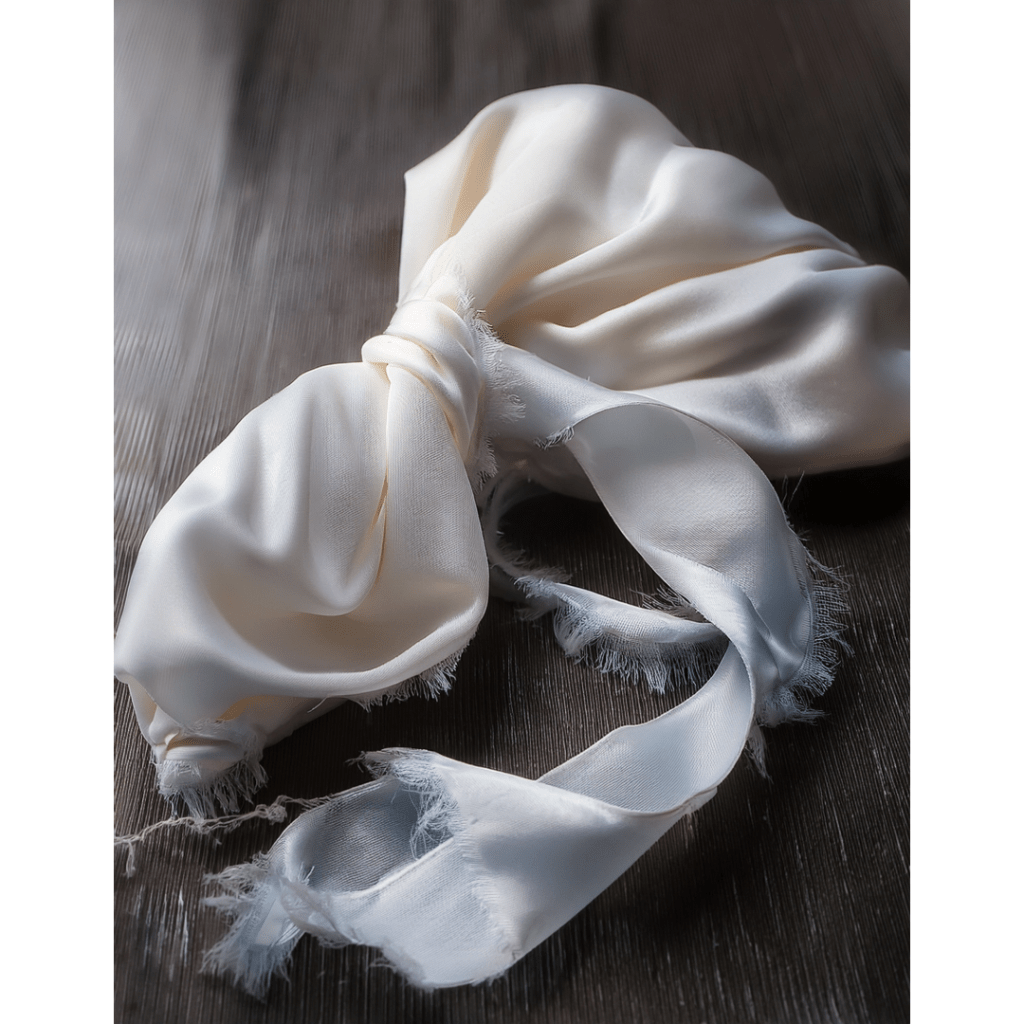
Who gave me the blanket trimmed with satin? Someone receiving a new baby to hold. Did this someone ever know that my sweet blanket, white as snow, would become my babyhood lifeline even as it all disintegrated?
-the blanket, that is, from too much loving. Over time the satin pulled away and someone (who?) tied it in knots to keep it from being lost. Priceless, my silky string, for rubbing across my nose, thumb in mouth…soothing me to sleep.
Note: I didn’t plan to write a double (or reverse) etheree. After the first two lines, the form took charge. Jennifer, the Open Write host, called it “an in and out etheree,” like a blanket unfolding and fading away.
AI-generated image. Took a few tries to get this. Some of the results were haunting. But so is reality, sometimes.
National Poetry Month continues, and while I have been writing a poem each day in April, I have not posted them all here on the blog.
Today I return to post about “safe harbors.”
Yesterday for VerseLove at Ethical ELA, poet Padma Venkatraman offered this prompt along with her own beautiful work as an example: “Think about a place that feels like a safe harbor to you – and bring that space alive in a poem.”
Ah. I knew exactly what to write about…
Haven
I should convert one of the boys’ old bedrooms to a study where I can write with fewer interruptions
but here at the kitchen table is my place
here there are windows all around
I open the blinds while it is yet dark
inviting the light before its return
bringing with it, birds rippling with song praise for the morning and the new day
these colorful feathered visitors peer in my windows from time to time like curious, bright-eyed Muses
—yes, I am here —yes, I see you, too
and sometimes when my husband turns on the TV in the living room I grow weary of the news and sports
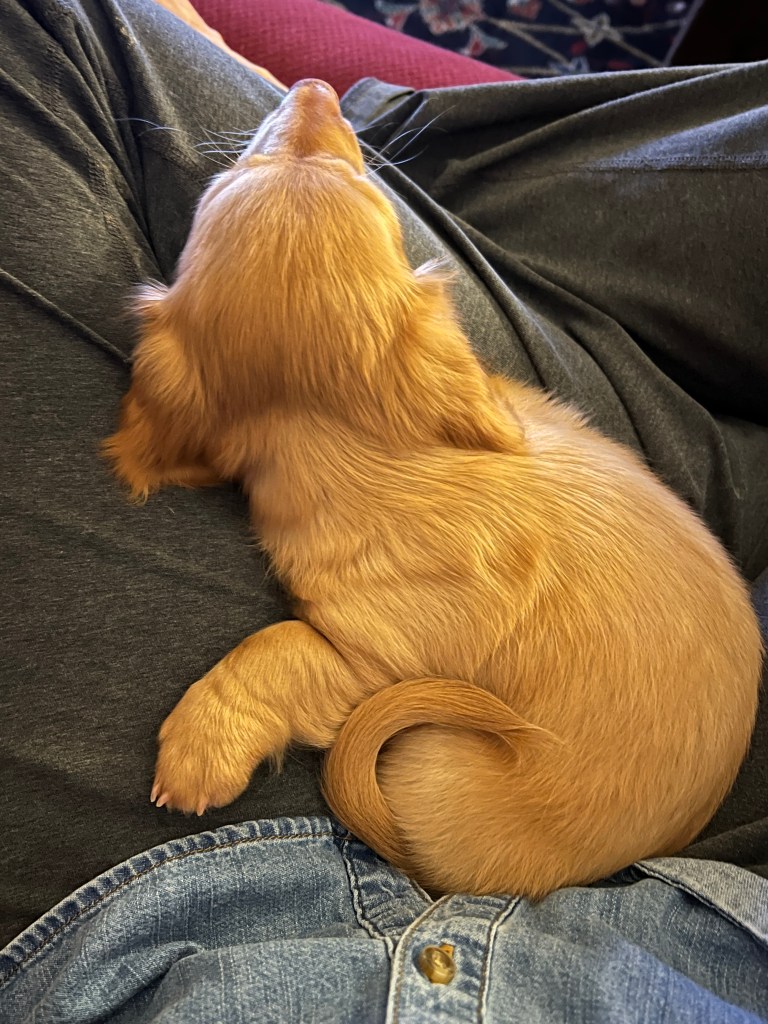
but when he goes away he leaves music playing for the puppy
playing under my chair little ball of golden fluff having dragged every toy he owns to my feet
where he whimpers just now to be held
and so I pick him up
he curls in my lap while I write to the background song a’rippling:
If my words did glow with the gold of sunshine…
yeah, the Grateful Dead…
here in my place my beloved space
I write
ever grateful, alive.
******
Lyrics: “Ripple,” Robert Hunter/Jerome Garcia, 1970.
My Jesse
with thanks also to Two Writing Teachers for the Tuesday Slice of Life Story Challenge
I am honored to be part of a writing community creating a progressive poem throughout the month of April. There are thirty of us, and we each add a line when our day comes.
I am the twelfth. The final line in bold is mine…interesting to watch the poem taking shape! And in which direction will it go next?
*******
Open an April window let sunlight paint the air stippling every dogwood dappling daffodils with flair
Race to the garden where woodpeckers drum as hummingbirds thrum in the blossoming Sweetgum.
Sing as you set up the easels dabble in the paints echo the colors of lilacs and phlox commune without constraints
On the second day of National Poetry Month, Leilya Pitre hosts VerseLove at Ethical ELA. She offers this poetic prompt:
A tricube consists of three stanzas, each with three lines, and each line having three syllables—quick, rhythmic, and focused. It’s easy to remember as 3:3:3.
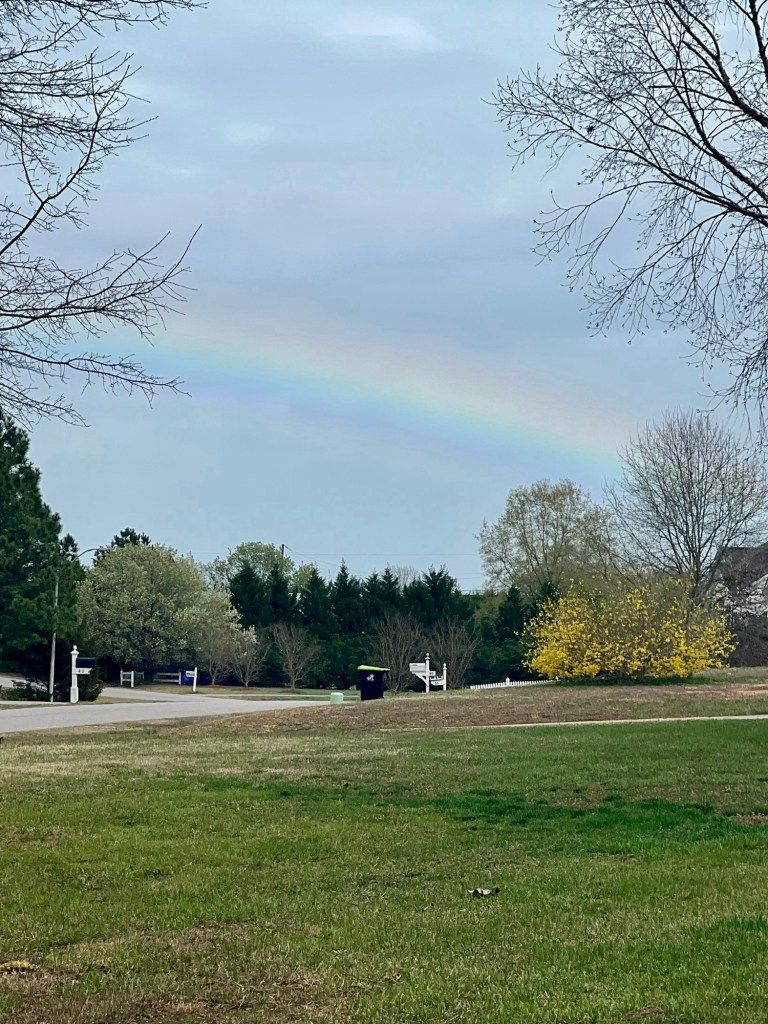
Begin by answering the question: What does spring mean to you?
a thing that causes someone to remember something.
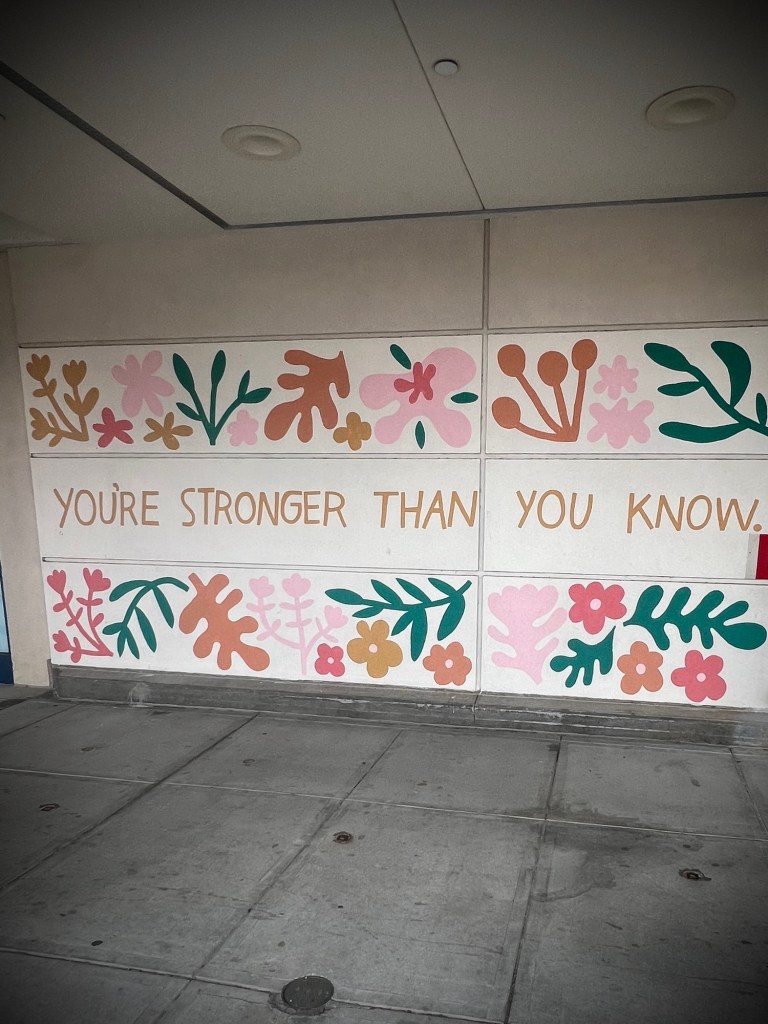
the writing on the wall of a downtown strip mall.
a much-needed message in the midst of challenge.
Message on the wall of a downtown strip mall right in front of my parking space
And, a blitz poem:
Here in Mind
You’re stronger than you know You’re still here Here to to tell your story Here to play Play the day away Play with words Words have power Words build worlds Worlds without Worlds within Within the realm of possiblity Within your reach Reach for the sky Reach and you shall grasp Grasp at straws Grasp the truth Truth slices deep Truth can set you free Free to believe Free to be Be fair Be kind Kind to all Kind of a mess Mess up Mess becomes art Art of living Art of healing Healing the hurt Healing one another Another day Another time Time to sleep Time to rise Rise and walk Rise above Above the clamor Above the earth Earth gives and reclaims Earth keeps turning Turning to mush Turning the key Key to the map Key change Change direction Change your mind Mind over matter Mind your words words matter
******* with thanks to Two Writing Teachers for the March Slice of Life Story Challenge
Note: Here’s my dictionary poem from earlier in the challenge. The blitz is meant to be quick bursts of thought. Here’s a link on how to create a blitz poem. The rules are a little complex, even for the title; but once you get going it almost writes itself.
Katrina Morrison hosted the March Open write at Ethical ELA on Tuesday.
Her invitation: I am calling [this] a“Dictionary Poem.” If anything can define and expound upon the meaning of a word, it is poetry…pick a word to take apart and put back together in a poem. Begin with the dictionary definition of the word. Obviously, some words will offer multiple meanings. Craft your poem however you will. After the definition, expound upon the word’s meaning…the vicissitudes of life may direct you to write a haiku or a villanelle or free verse today.
I will NOT be attempting the villanelle again anytime soon; I wrestled that form to the ground on Saturday and haven’t recouped the stamina yet to give it another go. I went with an acrostic, because the word “shards” stays in my mind, and I keep turning it around and playing with it anyway, to find out all it wants to tell me. I love this word, so…the poem:
Defining
shard
(shärd) also sherd (shûrd)
n.
1. A broken piece or fragment, as of pottery or glass.
2. Zoology A tough scale or covering, such as the elytron of a beetle.
—Dictionary.com
The Poet’s interpretation:
shards
plural
sharp-edged fragments of memory, or
seeking healing among remnants, despite suffering
Somewhere in the shattering Healing awaits, disguised As sharp points Ready to draw yet more blood… Dare to touch the memories. Discover Scattered diamondlight, all around.
On Sunday, Dr. Sarah Donovan, founder of Ethical ELA, hosted the March Open Write. She invited participants to write about a place you go to breathe and know that everything will be okay.
She offered these opening lines as a model, from poet Christine Hartman Derr in “A Place to Breathe”:
Off the path, behind some trees, a clearing sits and waits for me.
Dr. Donovan asked two questions to prompt our thinking:
Where or what are the places that wait for you?
Where are the places and who are the people around which you can simply be?
I write of my “breathing place” all the time: my drive through the countryside, to work and home again.
Here’s my poem.
Breathing Place
Along the road among the trees the wild things live and wait for me
They do not know about things like grace or that they are my breathing place
When they appear as I drive by my spirit soars eagle-high
My heart, it sings oh, glory, glory for their presence in life’s story
Peace descends and folds its wings —I breathe the breath of wild things
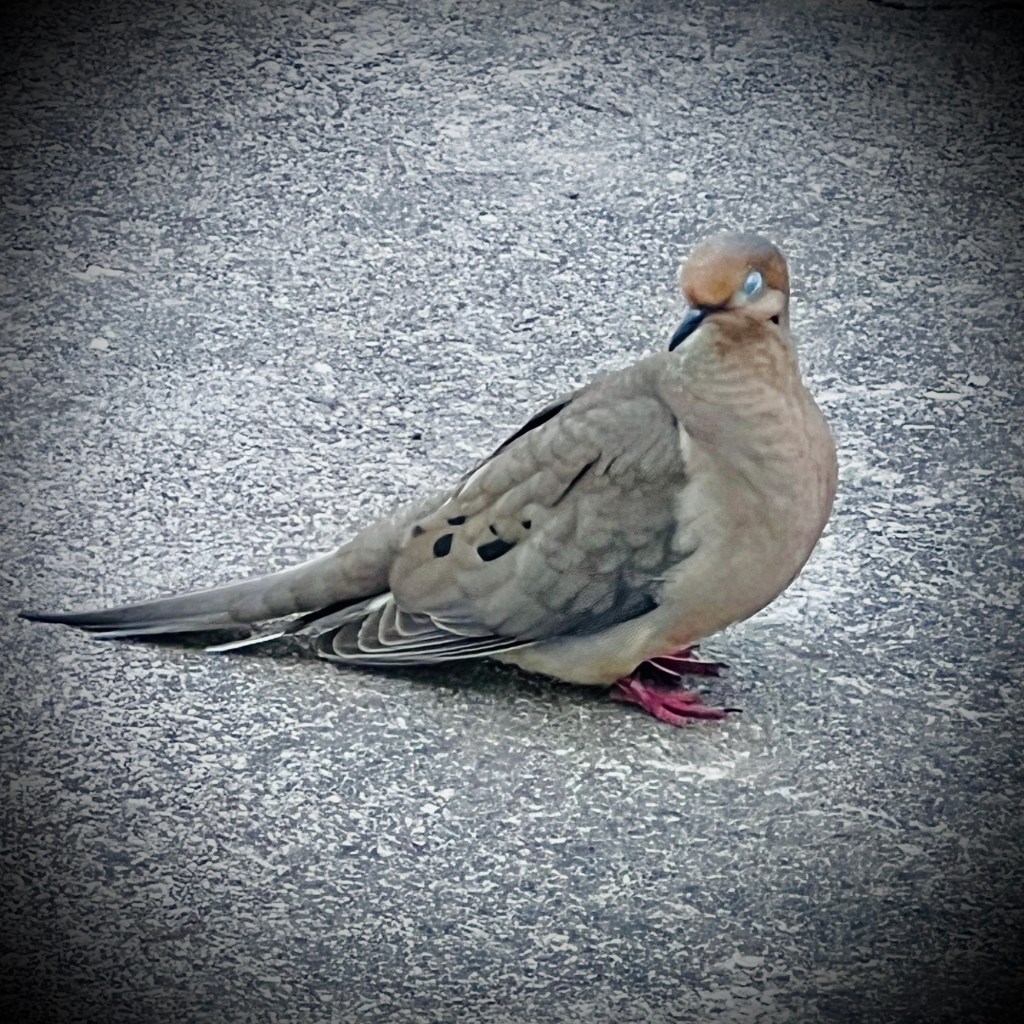
Mourning dove, resting in my driveway
*******
with thanks to Two Writing Teachers for the March Slice of Life Challenge

 lit bits and pieces