On September and scuppernongs

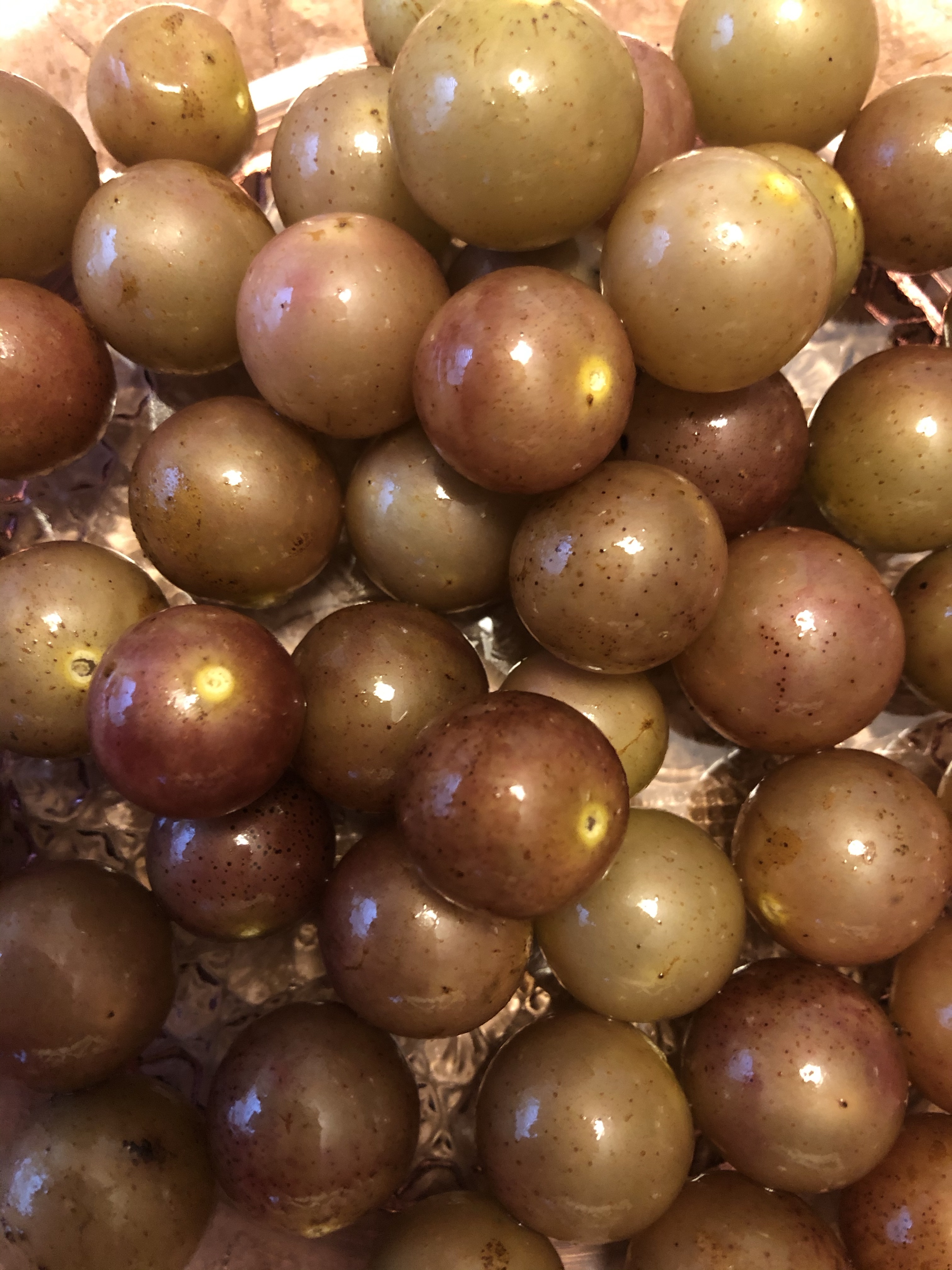
September in North Carolina means the return of the scuppernong grape.

It’s the state fruit. I first tasted scuppernongs as a child, standing with my grandfather under his arbor, thick leaves waving in the breeze, benevolent sun intermingling with cool shadow. The plain appearance of these grapes is misleading; the taste is divine. Richer than anything on Earth. Those thick, humble hulls contain ambrosia. And seeds; Granddaddy said just spit ’em out. It’s worth it.

Today’s his birthday. He’d be 114. As long as I live, he is, the scuppernong is, inextricable from September…

Every year, I await the return.

And savor it.

September, sovereign whose
Crowning glory is not of gilt but of
Unassuming mottled orbs,
Pendulous bronze-green
Pendants strung on knotted vine.
Elysian fields, perhaps, this black earth where my
Roots run deep, where my ancestors sleep.
Noble edict, “Be fruitful and multiply,”
Obeyed here to an extent only by divine design.
North Carolina’s soil stirred, responded, produced—
God alone infused the foretaste of heaven in its grapes.

With deepest thanks to the friends who know and bring me these offerings from their families’ old vines.

Thanks also to the inspirational Poetry Friday gathering at Radio, Rhythm & Rhyme and to Matt for hosting.

Pareidolia poem

From Greek para “beside, alongside” and eidolon, “image, form, shape,” pareidolia is the misperception of a stimulus as something familiar to the observer. The brain is, after all, a pattern-seeking device… surely that is why poetry speaks to us so…

Riding in the car, zipping past
Sunlit dappling shadows cast
Through trees, racing, racing fast
A speeding journey to the last.

Above in the sky I see
That you are following after me
Swiftly sailing your airy sea
Marking my passage, tree to tree.

There in your ethereal shroud
Where silence reigns so blue, so loud
Fleeting as life, warning the proud
Face of mourning in the cloud.

*******

In celebration of Poetry Friday … for more offerings visit Whispers on the Ridge – thanks for hosting, Kiesha.

Lines on a path in the woods

September
whispers
the first hint
of autumn
with a cool breath
caressing our faces
our bare arms
and legs
in the still-warm sun.
Whispers an invitation
to walk
woodsy trails
under trees communicating
in rustling green tongues.
One leaf
already fallen
crispy and brown
cartwheels across the path.
It is longer than we realized.
One of us would push

for a more vigorous pace
but the other of us
is tired.
A restful respite
in the almost-chilly
tree-proffered shade
just short of the bridge
we didn’t know was here.
Cicadas chorus high above
a big black ant hurries past
and somewhere a bird sings
as if it is the very heart
of all things.
We’ve come this far.
We walk a few more steps
one a little ahead
one leaning on a cane

one breath at a time.
Not until
we reach the bridge
can we hear the water
talking to itself below
in a wordless trickling flow
going on and on and on.
And so we do
even though we can’t see
how much path
is left to travel
nor what lies ahead
around the bowery bend.
The bridge cannot whisper

invitation.
It only stands
offering
silent invocation.
It is enough.
We cross over.

We go on.

*******

Thanks to Two Writing Teachers for the Tuesday invitation to write a Slice of Life and to my Spiritual Journey Thursday friends for the writing fellowship along the way. For more spiritual offerings see Karen Eastlund’s collated posts under “Finding Direction” at Karen’s Got a Blog! (Thank you, Karen, for hosting).

Hold on loosely

Grab hold

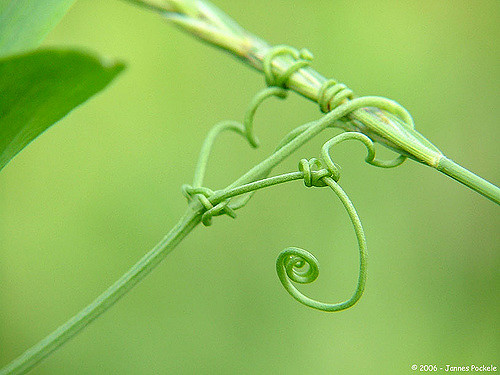
Grab hold! Jannes PockeleCC BY

Just hold on loosely,
but don’t let go
If you cling too tightly
you’re gonna lose control. 

—38 Special/D. Barnes, J. Carlisi, J. Peterik

The draft of this post has been sitting here a long time, gathering cobwebs, while I considered how to write it. The idea began with seeing connections between teaching, instructional coaching, parenting…with those cautionary lyrics, above, coming to mind: “If you cling too tightly, you’re gonna lose control.”

That’s the problem with many relationships, isn’t it. Control. As in, who‘s trying to assert it? By holding too tightly? By force? What are the consequences? Why do I think of Aesop’s fable of the North Wind and the Sun trying to prove who was stronger by making the Traveler remove his cloak? What does this imply about human nature?

And not just human nature…that little green vine in the photo, above…it has goals, doesn’t it? To keep growing, climbing, gaining strength daily…soon the difference between “holding on loosely” and “clinging too tightly” will be evident in the absolute destruction it will wreak. It cannot know the cost to whatever tree, gate, house, other plants, anything it overtakes.

How did I land here, when I began with thinking on connective threads of teaching, coaching, parenting? Where will my metaphorical thinking take me next? What philosophical point am I trying to make?

Is this out of control now? How DO I write this persistent…thing?

When at a loss to say what can hardly be said, there’s always poetry. Maybe that’s what this idea wants to be…

Each poem is a metaphor, a philosophy, a journey of its own. This one, like life, goes fast. The form is designed for that. Sylvia Plath said that once a poem is written, interpretation belongs to the reader. Read it just to read, then maybe reread to decide for yourself if you see threads of teaching, coaching, parenting…and more. With poetry, there’s always more.

So here’s where the poem took me. I landed in a blitz: “Hold On Loosely.”

Have only today
Have and to hold
Hold my hand
Hold it dear
Dear one
Dear children
Children laughing
Children leaving home
Home is wherever YOU are
Home place
Place of remembering
Place in the sun
Sun rising in the east
Sun dappling the grass
Grass rippling in the breeze
Grass withering, fading
Fading light
Fading fast
Fast go the hours
Fast and furious
Furious argument
Furious storms
Storms wreaking havoc
Storms passing
Passing over
Passing by
By the way
By getting to work
Work it out
Work hard
Hard to handle
Hard to reach
Reach anyway
Reach out
Out of time
Out of breath
Breath of fresh air
Breath of life
Life is short
Life is precious
Precious moments
Precious faces
Faces in photographs
Faces tugging at heartstrings
Heartstrings reverberating at final words
Heartstrings tied loosely
Loosely hold on
Loosely, not letting go.
go…
on…

What threads did you see?

Oh, and writer-friends…maybe reread one last time to see how the blitz might describe a relationship with writing.

Having shaken off the cobwebs, I go on…

On community

The recent blog series by Two Writing Teachers, Seen, Valued, Heard: Writing to Establish Community, brought to mind a piece I wrote on community two years ago—long before the current pandemic, the transition to remote learning, and our vastly-intensified struggle for social justice. We are all reminded, many times over, that for a communityever how large, small, or microcosmicto flourish, it is imperative that every member sees, values, and hears one another.

What IS community, really? So much more than we tend to think. Philosopher David Spangler wrote: Some people think they are in community, but they are only in proximity. True community requires commitment and openness. It is a willingness to extend yourself to encounter and know the other.” The words of priest Henri Nouwen: “Community is first of all a quality of the heart the question, therefore, is not ‘How can we make community?’ but, ‘How can we develop and nurture giving hearts?‘” And this line from Dietrich Bonhoeffer, the Lutheran pastor who died in a concentration camp, strikes me deeply: “The first service one owes to others in a community involves listening to them.”

As an educator, as a human being, I continue to reflect on “community.” Here’s my composition from 2018, followed by a double acrostic composed this morning.

When I think of the word community, I first envision a neighborhood where people are bound to one another by a sense of civic responsibility. A grouping of people or houses does not a community make; a true community develops from like-mindedness about the good of the whole. Protecting one another, helping one another in times of need, maybe beautifying the area . . . on a deeper level, think of these variations of community: Commune, communion. These words have a spiritual color to them. They imply an even greater like-mindedness and focus. Definitions of the verb commune include a passionate, intense, or intimate discussion, the exchange of thoughts and feelings; to commune, or for there to be communion, people gather together out of a desire to share, tap into, or celebrate something profoundly meaningful to all. Such a rapport implies that partakers are there not just to get but to give.

So it is for a community of writers. A grouping of people with pencils, papers, and laptops, within the classroom or without, does not a community of writers make. To write is to put pieces of one’s soul on a page; this, in the scheme of human undertakings, is an unparalleled act of courage. A writing community, then, is a gathering of the courageous in a place where it is safe to share the pieces of one’s soul on the collective pages, with the responsibility to hear, value, and honor one another, and even to help each other beautify the arrangement of words for greatest effect. The writing community is vital to the writer, for, ever how old or young, writers sharpen one another, encourage one another, celebrate one another, and grow together in an atmosphere of commitment, accountability, expectancy, sometimes breathless awe, and glorious release.

Above all, let us not fail to see that hidden word in “community”: unity.

Connected by the arc
Of our humanity, we are more than able to
Make one from
Many, to create a vital spectrum
Upholding both me and you.
Numinous, luminous, an
Iridescent inscribing of graffiti
To us, from us, in ink of heart-bent light
You and I define our sky.

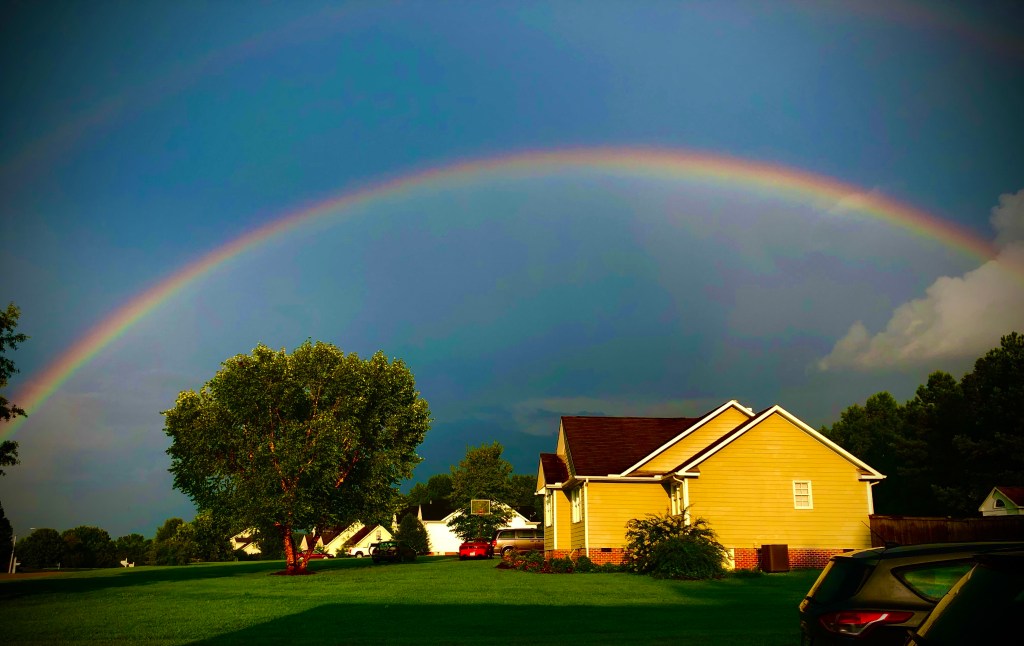
The view of my neighborhood, taken from my driveway last week, between thunderstorms.
The fledgling

Simply walking down the street
found a fledgling at my feet.
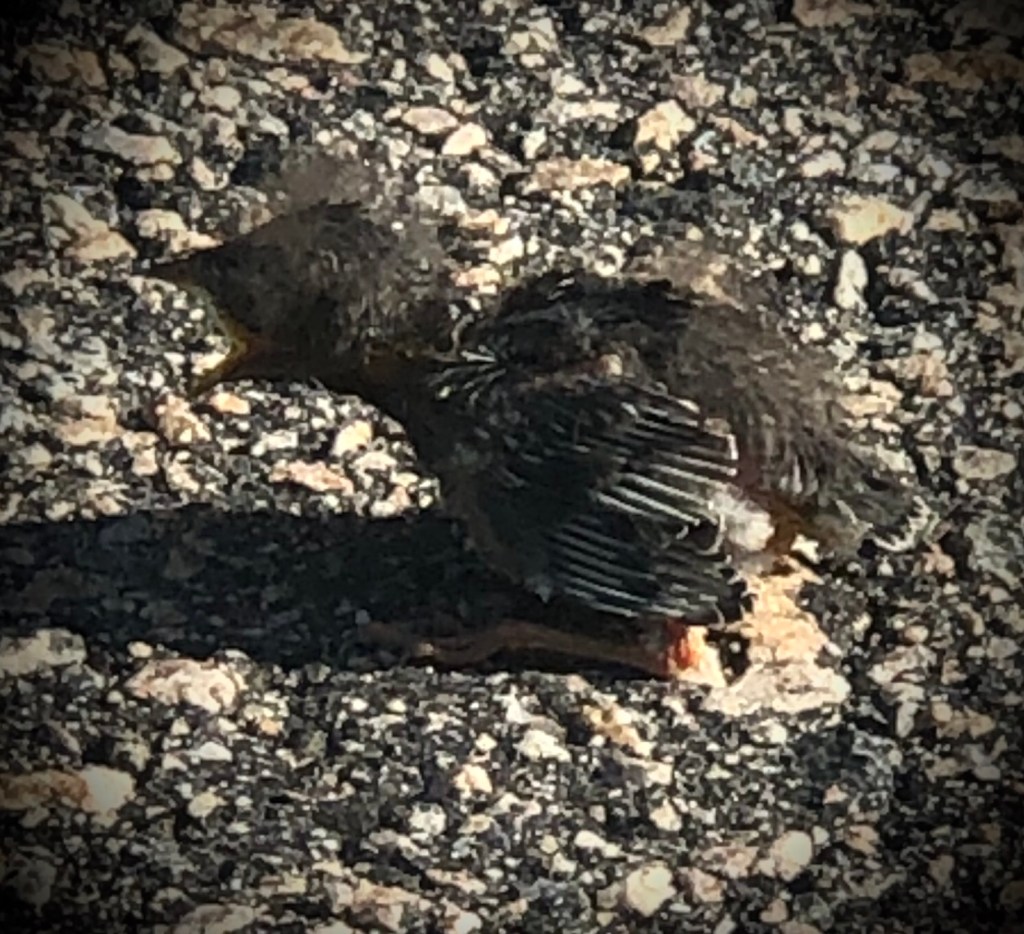
Tiny baby on the hot asphalt
from where’d you fall? By whose fault?
What left you in the middle
of my street
wobbling on your new, new feet?
Yellow beak wide in a silent cry
flailing wings so small to fly.
Should I touch you?
Dare I try?
Baby bird, what can I do
to keep harm from befalling you?
How long could you last
if I just walk past?
Wait—I think I’m hearing
—yes, your mother nearing
and your father, too,
—they’re both here, calling you.
They won’t come very near

as long as I am here.
How wretched it is to back away
my wrenched heart will break—it may
—but from back here I see them land
see you hop-hop toward them, and
—you’re not too steady
—don’t know if you’re ready.
But to think I know more than a bird
about what’s best for birds, is absurd.
So I turn and walk, fighting my fears,
fighting my instincts, fighting my tears
—it’s a hard, hard thing, just walking on
praying, Baby, you’re soon up and gon
e.


*****

I have seldom felt so helpless or torn as I did on encountering this baby bird one late afternoon. Although tall trees line the street (a quiet cul-de-sac), I couldn’t possibly guess which one held the nest, if I could even reach it, for returning the bird. I thought about my Aunt Jack, who found a baby blue jay when I was very little; she took the foundling home and raised it to adulthood (he was never caged, had free rein in her house, and here’s a post if you’d like to read about him: Kilroy). I wondered: Should I take my fledgling (I think it’s a finch) home, too? Could I raise it? Or would I be tempting fate, tampering with nature when nature knows far better than I about taking care of itself? How long had the baby been struggling here on the road when I (heaven help me) nearly stepped on it as it flailed? Should I scoop it up carefully and put it by the side of the road in the grass… where there are cats… and snakes… then, the frantic parents showed: Which side did THEY want their baby on?

I walked back and forth a while, not too close to the scene, until the parents and their baby were gone. Where, I do not know. I didn’t see. Seems I could hear their voices somewhere in the lush pines… all I know is that, after a bit, there was no trace of birds on the street any more.

Yet I remained distressed. I had done nothing to help the baby bird. It was so tiny, so frail. Was it really so helpless? Was I? Had I been wrong? I had to face the truth, even it if it was ugly… so, later on my phone, I searched things like What to do if I find a baby bird and Should I touch a baby bird? National Geographic had an interesting take: “It depends on how cute it is.” Meaning that a mostly featherless pink baby bird not capable of hopping or flitting is a nestling and should be returned to the nest. A fledgling has feathers, can hop, and is “generally adorable and fluffy with a tiny stub of a tail.” National Geographic (bless them) says “It’s not a good idea to put a fledgling back in the nest—it will hop right back out.”

I can rest a little easier. I guess. I do marvel at the parents both coming to rescue their baby, both of them chirping and hopping, looking back to see if the baby was, too. Which it was, in its zig-zaggy way.

—They better be giving that baby some quality flying lessons now.

*******

Special thanks to Catherine Flynn who’s hosting Poetry Friday Roundup at Reading to the Core. Drop by to check out her wonderful post and the many other poetic offerings.

Resurrection fern tanka

Teacher-poet Margaret Simon features a weekly writing invitation on her blog, Reflections on the Teche, in response to a photo. Today’s offering is a resurrection fern photographed by her neighbor and friend, James Edmunds.

Few things are more intriguing to me than a resurrection fern, which seems to die but can manage to live again, maybe even after a century of drought, with a little watering. Somewhere I have an unfinished short story in which this inspiring plant appears…

For today, however, a tanka seemed called for. The form consists of thirty-one syllables, lines of 5/7/5/7/7. It is meant to be song-like.

withering, drying,
fronds curled heavenward, dying,
resurrection fern’s
thermoluminescence burns
until rain regenerates.

Here’s to holding onto the life-spark, Friends, ever how long the drought … storing the inner light for strength until the healing rains finally fall.

Photo: James Edmunds

Life is what you bake it

“‎All the art of living lies in a fine mingling of letting go and holding on.”

-Henry Havelock Ellis

Today I share my golden shovel poem inspired by the Ellis quote, posted this week on Two Writing Teachers‘ Slice of Life Story Challenge along with these questions: What are the moments you’re holding onto? What are you letting go of today?

Here’s to the art of living, to holding on while letting go, to savoring moments spent with children, making every one count.

I hold to all
moments spent with children in the
holy art
of seeing the world with fresh eyes, of
spontaneous embracing, of living
each day in newness. I hold to freedom that lies
in forgiving, that paradoxical self-rising power in
letting go. I hold to a
continuous, necessary cobbling of fine
crystal moments, their pure sanguinity mingling
with, dulcifying, the blood-tart of
a sliced heart. Letting
go of despair, of my shortcomings, letting go
of yesterday, yet believing in tomorrow, letting go and
savoring today in a bluesy canton of confidence, holding
onto the children, always the children, just holding on.

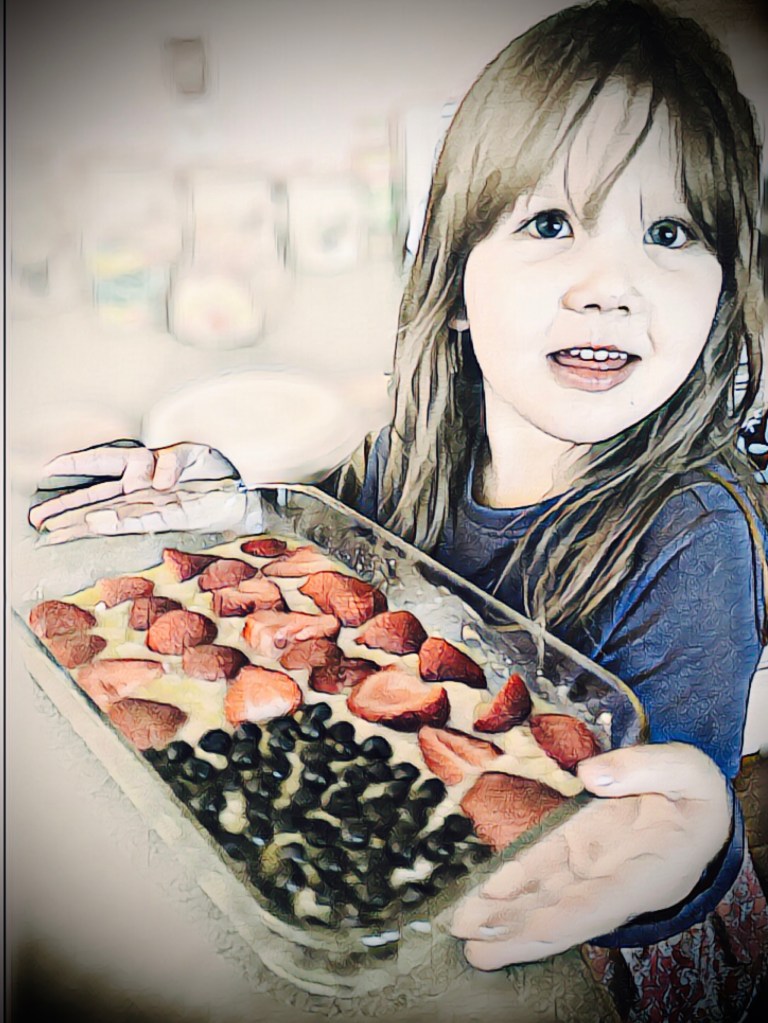
My granddaughter loves to bake. I love symbolism. Here’s our flag cobbler. “Canton” in the poem is the term for the flag’s blue square. Strawberries, heart-shaped, represent love; blueberries, youthfulness and confidence in the future. Bake it well.

The future is calling. I’m listening.

*******

Thanks also to Margaret Simon for hosting Poetry Friday. Visit her blog, Reflections on the Teche, for more poems and magnificent quotes in response to “What is poetry?”

Take heart

Written while waiting for word from the governor about schools re-opening.

Suspended animation

upended education

sense of desolation

facing the fall.

What school should be

we cannot see.

Ill winds still blowing

so much not-knowing.

Separate, there’s a cost.

So much is lost.

But not all

in one fall.

Until the surging tide

should subside

virtuality

may be reality.

Enduring

assuring

we will outlast

passing shadows cast

in empty halls

on empty walls.

By decrees

or degrees

a calling

for not falling

is conversely

full of mercy.

Choosing heartache

over heartbreak

choosing to be stronger

being a little longer

apart.

By whatever decrees

by whatever degrees

however they fall

however we start

dear ones, above all

—take heart.

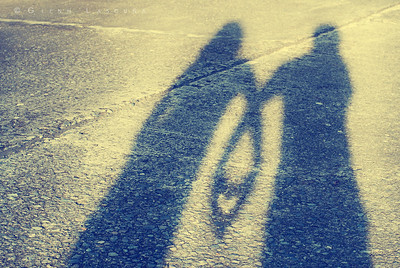
Photo: Heart. Glenn Lascuna. CC BY

I’m the one who leaps

On Ethical ELA today, Margaret Simon shared the work of fellow Louisiana native and Pulitzer Prize-winning poet, Jericho Brown. For the Open Write challenge, Margaret encouraged writers to use an echo line, anaphora, in composing poetry, something Brown does so magnificently. You can read an excerpt of his work and many other moving poems on being “a marcher or a leaper” here.

I lifted a line of Brown’s from The Tradition: “I’m the one who leaps.” My poem is based on a long-ago story told by someone who mattered to me, so much …

I’m the One Who Leaps

I’m the one who leaps
not from here to there
but within.

I’m the one who leaps
not like the farm boy standing rooted
to the old front porch
listening to hounds on the hunt.
Baying, fever pitch, nearing, nearing
when in the clearing
bursts the fawn from the brush.
White spots still visible
here and there
on the body running, running
right toward the farm boy standing rooted
to the old front porch.

No time to think
No turning back
Hounds closing in
-the fawn cries, that final sound
a creature makes when it knows
it’s reached the end.

The boy stands rooted.
No time to think
he just does it
he just opens his arms.

No time to think
The fawn just sees,
sees and leaps …

The farm boy
who caught the fawn
on the old front porch
became a preacher
standing rooted
in the Word of God.

Be the one who leaps,
he told us children,
into the Father’s open arms.
You cannot save yourselves.

I sat rooted to the pew
hearing the hounds on the hunt,
seeing the fawn
and those open arms.

I’m the one who leaps
not from here to there
but within.

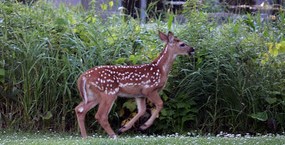
Photo: Running fawn. Cropped. USFWS Midwest Region. CC BY