Once upon a time (last fall), we had a family event at my school featuring Poetry Fox.
Forgive if this disturbs the enchanting image in your brain: He’s a guy in a well-worn fox costume who cranks out poems on the spot, using an old-timey typewriter.
Just give him a word, and clickety-clickety-click, slam! —he types your own personal poem on a piece of paper suitable for framing.
You will want to frame it, because Poetry Fox is amazing.
My new assistant principal stood by, watching in sheer wonderment. “I didn’t know what to expect,” he admitted. “But this…this is magic.”
Indeed. Kid faces and parent faces glowed. In a word…awe.
Afterward, my AP joked: “Hey, if we ever want to do this again and Poetry Fox isn’t available, maybe I could scrounge up a costume…not a fox, of course…some lesser creature…”
The thing was born in my head, right that very instant: “You could be Poetry Possum!”
Today, Ladies and Gentlemen, Girls and Boys, One and All… I am proud to announce the debut of a character who certainly needs to live in stories (and poems) of his own:
I give you… (drumroll)…Poetry Possum and his very first work!
There once was a fuzzy gray creature It is ME! A poetry teacher! With just a little travail I’ll bet my prehensile tail Wordcraft will become your best feature!
*******
Composed for Day 11 of the Slice of Life Story Challenge with Two Writing Teachers
If you want to read more about Poetry Fox, you can do so here.
One recent early morning, I sat down at the kitchen table to write some poetry just as my husband turned on the TV. I caught the word cicadas.
I abandoned my laptop to come watch the segment:
“2024 is going to be a banner year,” announced the newscaster, “a rare co-emergence of two periodical cicadas: a seventeen-year brood and a thirteen-year brood…
A chart appeared on the screen:
Brood XIII
Brood XIX
Emerges every seventeen years
Emerges every thirteen years
“They make the most beautiful sound I’ve ever heard,” said a second newscaster.
“Said no one ever,” joked the first.
The whole news crew burst into laughter.
“But it IS a beautiful sound!” I said to their guffawing faces.
I know the sound is a harsh rattle. Loud. Discordant. Metallic. Strange.
I don’t expect everyone to like it.
I’ve loved it since I was a child.
I wasn’t aware I loved it when I spent brutally hot summers deep in the country with my grandparents, where an old dirt road and a ditch were all that kept their yard from being swallowed up by a towering deciduous forest. From those dense, mysterious depths emanated a deafening buzz, hundreds upon hundreds of cicada-songs swelling and subsiding in synchronized rhythms, the background music of my happiest childhood days.
Time passed. As my grandparents grew older and my visits rarer, I’d realize the meaning of the rhapsody. Cicadas play love songs with all their might. They know their time is short.
At nineteen I was hospitalized with a high fever. My father and mother both accompanied me, clearly concerned about my condition. They sat by my bedside while I lay shivering under layers of blankets, too tired to talk, to move, to care about anything. Afternoon melted into night. It was winter. The heater in the room kicked on with a buzz so like the cicada chorus of my childhood summers that my shivering eased almost instantly.
They’re calling me, I thought. The cicadas. They’re taking me to Granddaddy’s and Grandma’s, and I’ll be safe there.
This flooded with incomparable comfort and indescribable joy.
Then… if I’m dying, it’s okay, as long as there are cicadas.
And I fell asleep.
When I woke in the morning, my fever had broken.
I didn’t know, at nineteen, that cicadas are a symbol of resurrection and immortality. I didn’t know the many legends and lore surrounding the insects, such as the myth of Aurora, goddess of the dawn, doomed to fall in love with a mortal who inevitably grew old. She obtained immortality for him without thinking to secure eternal youth. Soon there was hardly anything left of him but his voice, continually singing his lamentation and love, so she finally turned him into a cicada.
Note: Aurora is the name of my grandparents’ hometown, where I spent those childhood summers steeped in cicada song.
Back to the present…
After that news segment, I had to do a little research.
Scientists say that these perodical broods, XIII and XIX, haven’t coincided since 1803 and won’t do so again until the year 2245.
They’re calling this a “cicadapocalypse” of maybe a trillion bugs…but not all in the same place (in case you’re thinking biblical plague). One’s called the Northern Illinois Brood (XIII) and the other, the Great Southern Brood (XIX). If my calculations are right, this brood appeared the summer that followed my sickness at nineteen (same as the brood numeral). I got married that August, when they would have been in full throttle. The time before that, I’d have been seven and hearing them at my grandparents’.
On the day the segment aired with newscasters poking fun at the sound, I happened to be taking part in an Open Write at Ethical ELA. Host Leilya Pitre introduced the Naani poem form, which orginated in India: four lines consisting of 20-25 syllables total. The poem isn’t restricted by theme, subject, or metric pattern. Leilya challenged participants to scroll through social media or the news to find four phrases to make a Naani.
My lines had just been delivered to me, before I even read the prompt.
Once again, the Magicicada were at work in the background rhythms of my life.
From This Morning’s Newcast
Brace yourself: the cicadas are coming… the most beautiful sound I’ve ever heard.
—I don’t know about you, but I can hardly wait for cicadapocalypse.
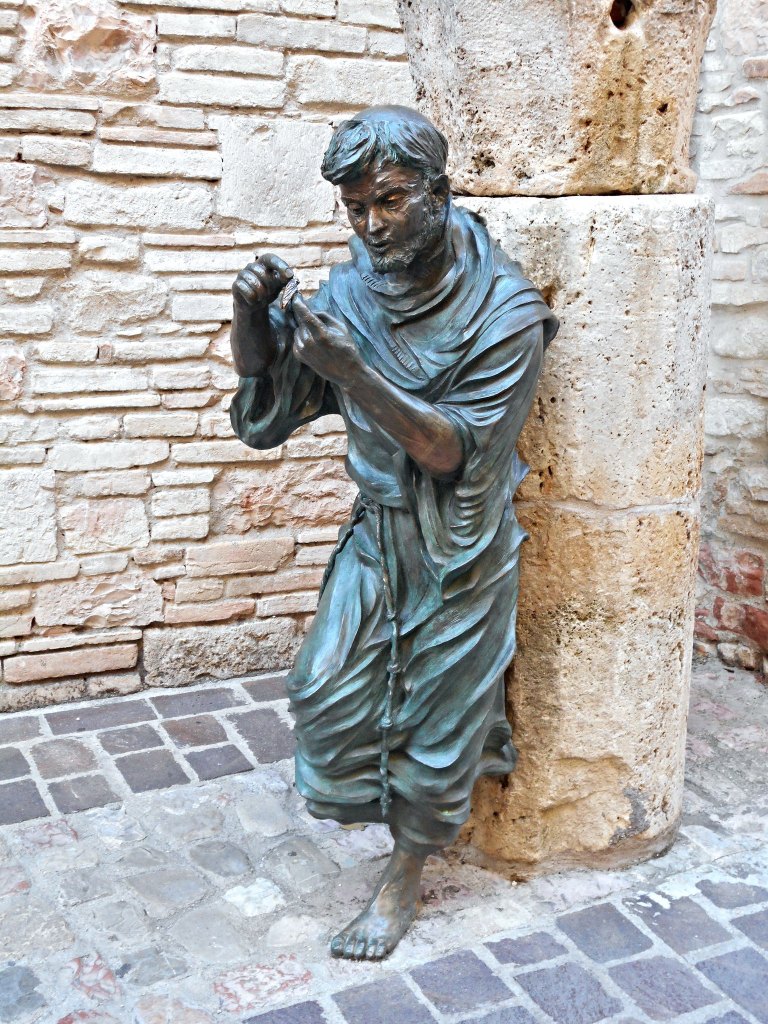
Legend has it that Saint Francis heard a cicada chirping in in a fig tree and called it to him, saying “Sing, my sister cicada, and praise the Lord thy Creator,” and it obeyed, sitting on his hand.
*******
Composed for Day 3 of the annual Slice of Life Story Challenge with Two Writing Teachers. Q: What’s YOUR favorite insect? Why?
Today on Ethical ELA’s Open Write, my friend Margaret Simon invites fellow teacher-poets to compose elfchen, also known as “elevenies,” poems of eleven words. Margaret says that the basic elfchen rules can be found on Wikipedia; she shares these guidelines:
Line 1: One word Line 2: Two words about what the word does. Line 3: Location or place-based description in 3 words. Line 4: Metaphor or deeper meaning in 4 words. Line 5: A new word that somehow summarizes or transforms from the original word.
This is a first for me, never having attempted an elevenie before. Although I love forms with word and syllable counts, the seemingly-simple, enchanting elfchen proved deceptively difficult!
February Elfchen Chain
February gray desolation brightened by bluebirds and sudden pink blossoms overcoming
winter gusting winds squeak naked branches against each other, awakening desire
greenness seeps imperceptibly to the edges Nature revels in pre-season preparation
Halfway between work and home I noticed the field. How could I not, such vibrant green popping against the panorama of brown grass and tired trees giving way to winter.
I needed this shot of unexpected freshness after these first days back to full-time work with my husband at home in the middle of a slow recovery from spinal surgery.
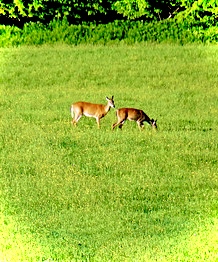
The waning afternoon light slants gold across the green and there, there, clear as day, two deer graze, gilt-edged and peaceful and perfect
as if it isn’t hunting season as if carcasses of their kindred aren’t lying mangled by the roadside within their view as if the long in-betweenness of hours and days and seasons and breaths is no consequence
Usually it’s the sound of cicadas that stirs my soul, their rattling courtship-chorus reaching a feverish crescendo in late August. Summer hits its brutal zenith just before it begins to die. Interesting how August means to increase.
On the last Sunday of August, it’s not the sound of cicadas which captivates me.
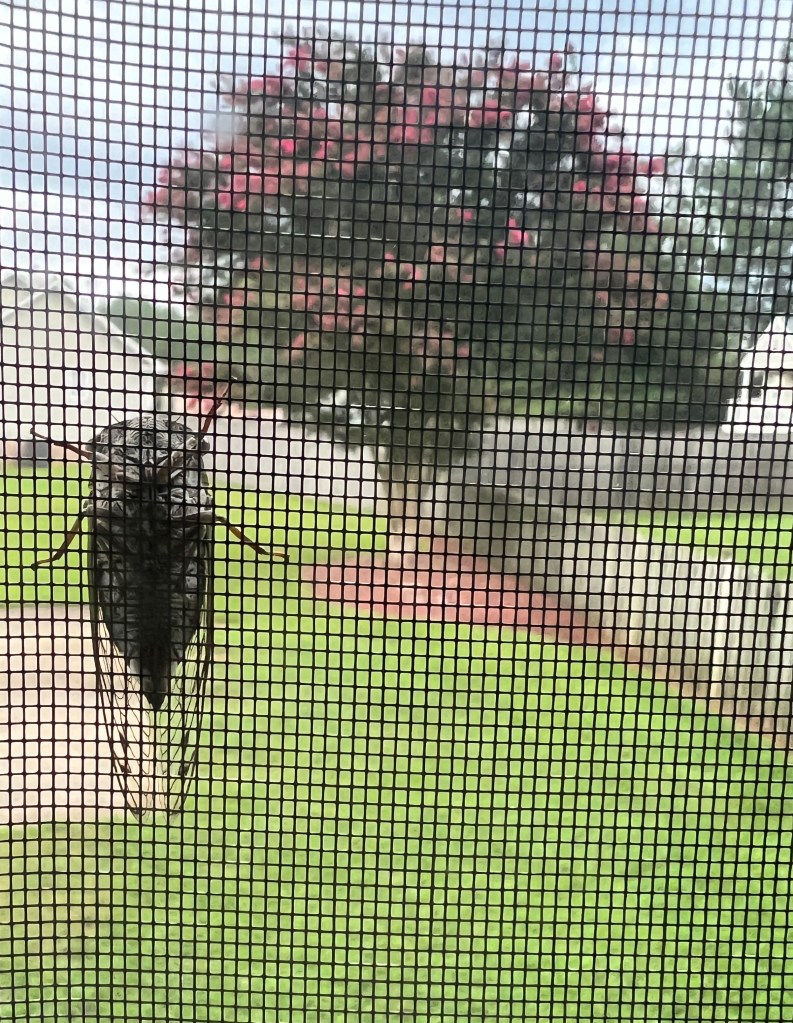
It’s the sight of one clinging to the screen in the kitchen window, early in the morning.
So still that I wonder if it’s dead.
I am tempted to go out and see, but I don’t. Let it be. If it’s dead, it will still be there after church and I’ll save its body to show the granddaughters. Cicadas are big insects that evoke terror in many people; I do not want the girls to fear them. The antidote to fear is understanding. Study. Fear not. Maybe even learn to love.
I take a photo instead.
It is a dark morning, like the one in the sermon text for this day, Mark 1:35: Jesus rises “very early in the morning, while it was still dark” to find a desolate place to pray. He’d spent the previous day healing the sick, including Simon Peter’s mother-in-law, and driving out demons.
When I return home, the cicada is gone.
Not dead.
All I have is this snapshot of it resting alone in a quiet place on the grid, with the crape myrtle by the old dog’s grave blooming in the background.
I could write an entire book, perhaps, on the symbolism and metaphor here.
I settle for a poem.
Clinging to the grid In respite from work Crape myrtle abloom August’s crescendo is the last Defying death in the wings As love drives resurrection
The cicada and crape myrtle are symbols of life, longevity, immortality, and resurrection. Summer is dying, but only for now.
*******
with thanks to Two Writing Teachers for the weekly Slice of Life Story Challenge
For today’s Open Write on Ethical ELA, participants are invited to write poems about “places we call home”.
Nothing pulls on the heart like home… I can almost hear the Beatles’ song “In My Life” playing in the background: “There are places I remember all my life, though some have changed…” The memory of these places, and the spirit of them, really are the theme song of our lives.
Of all the places I remember and could write about…have written about…I choose my home now. I have lived here the longest. I became a grandmother here. I have learned a lot more about savoring here. Usually I try to make my poem title do more work, but today, no other will do.
Home
In the first moments of pale-pink light the big brown rabbit comes from the woods to nibble away at the clover
in the ever-thickening branches of the crape myrtle my husband and planted years ago I can spot hummingbirds hiding among the leaves always alone never together
they dart, one by one to the kitchen-window feeder
silvery-green females perfect, pure ethereal as fairies
a male, ruby fire at his throat (brighter than the cardinal-flame landing over on the fence) impossible greens and turquoise shimmering on his back
unaware of his utter tininess he sometimes perches atop the feeder as if to say I am King of this Water-Mountain
a pair of doves feeds on the ground by the tree line then takes flight on pearly wings vanishing in the pines and sweetgums where their nest is secreted
robins, robins everywhere just last week a speckled fledgling on the back deck both parents in the grass chirping ground-control instructions
the mockingbird in the driveway strutting and stretching his banded wings as if he knows how legendary he is
a trill of finch-song from a nearby tree so plaintive I fear my heart may burst
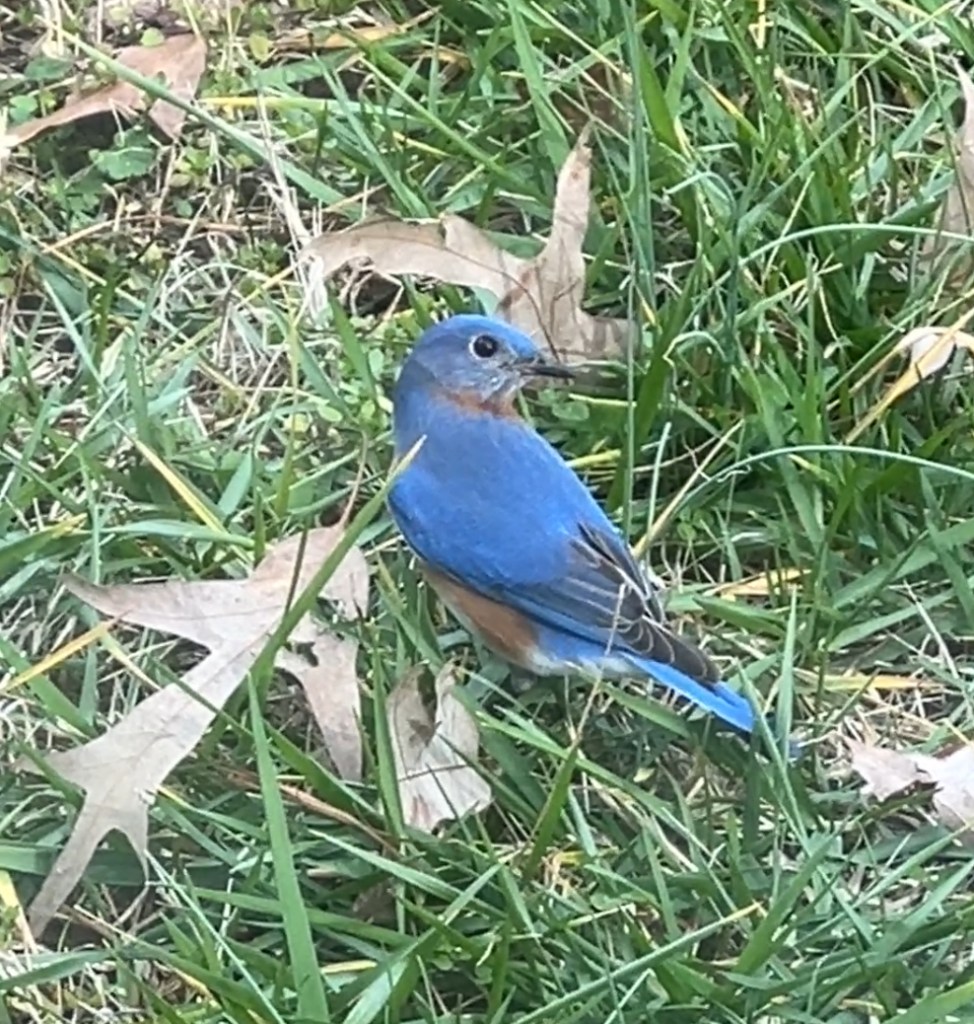
and the bluebirds oh the bluebirds
if only I spoke green language I would explain that I removed their house from the back deck because it is about to be torn down
that I waited until their unexpected second brood flew out into the world
never imagining these parents would return to the empty rail corner a day or two later clearly so puzzled to find their house gone…
if I were the hermit wizard-woman of this semi-enchanted nook (as I sometimes pretend to be) I would have known what to do
but my unmagical self did my best: placing the birdhouse atop the old wooden arbor built by my oldest when he was a boy
well away from the impending deck destruction
and to my astonishment the bluebirds have followed their home
I do not yet know if more eggs have been laid in the house relocated to the arbor
but as evening draws and the pine-shadows fall across the arbor and the crape myrtle and the big brown rabbit back in the clover and the old dog’s grave and the old deck about to be made new
I ponder my length of time on this Earth and the continuous carving-out of home how it goes on and on
a path forever unfolding before me that I must follow
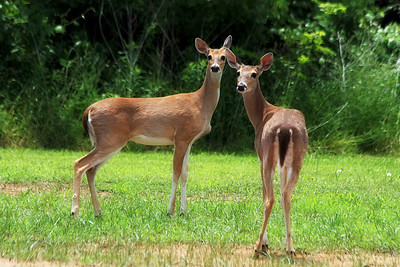
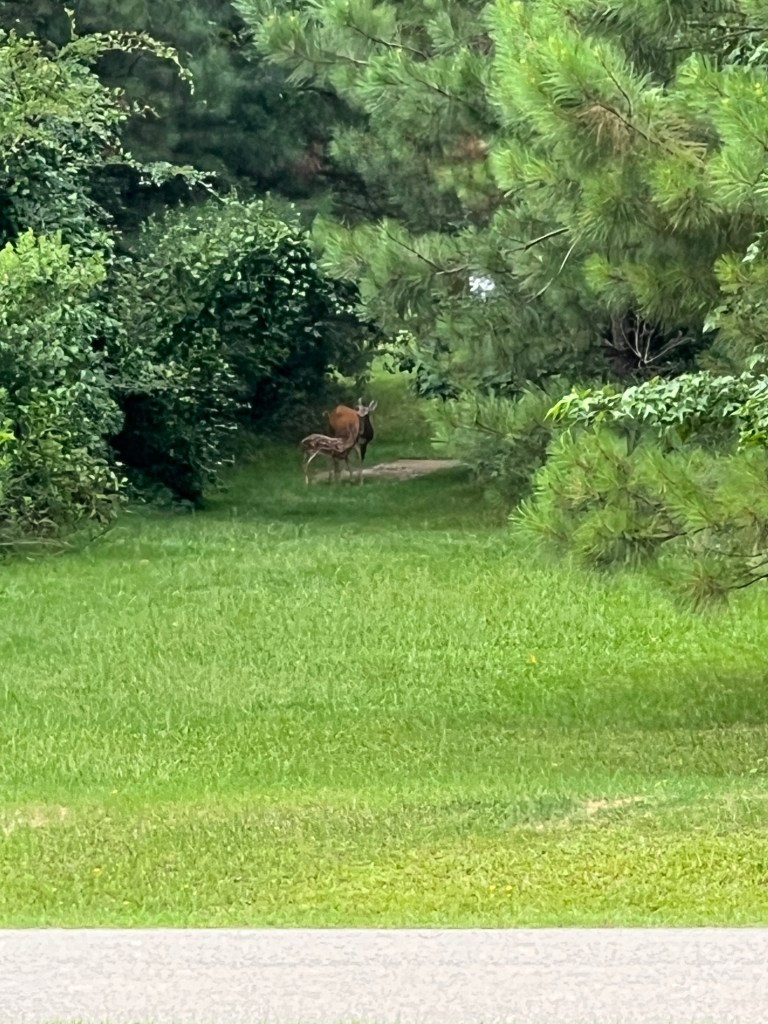
like the doe in the little clearing across the road pausing for one long moment with her two fawns before disappearing in the leafy green
One fawn has already been ushered across
*******
with thanks to Ethical ELA and Two Writing Teachers for the inviolable, invaluable writing spaces and the inspiration
On Day Two of July’s Open Write at Ethical ELA, host Mo Daly invites us to write a poem in Fibonacci sequence: six lines with syllables of 1, 1, 2, 3, 5, 8.
The Fibonacci sequence appears over and over in nature, from shells to flowers to trees to our own DNA.
Maybe that’s what led to thisdouble-reverse attempt…
Hey, Ancestors
composed after a trip to the home place
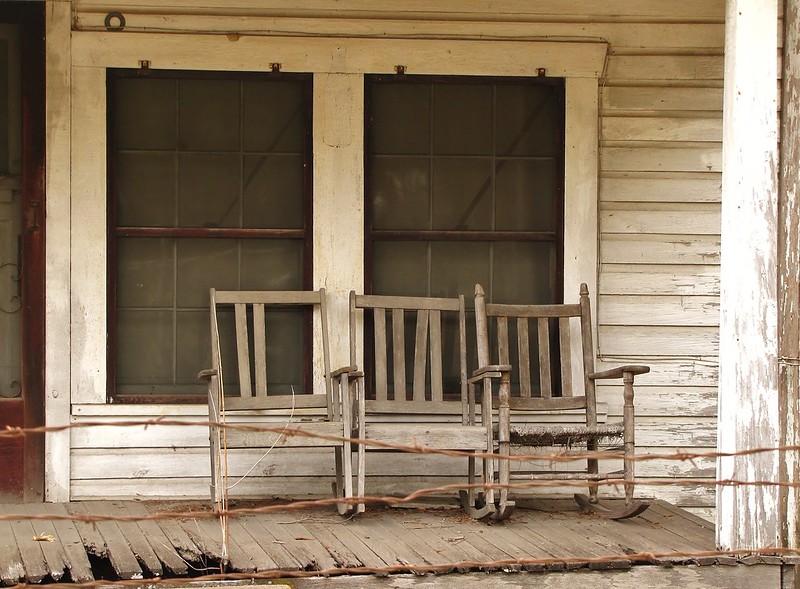
Come sit a spell on the porch. I want to know you. Tell me the stories of your life. I don’t mind your being a ghost. Just (if you please) try not to rock your chair too much.
The July Open Write on Ethical ELA begins today with host Mo Daley, who invites poets to “Consider the masks you or those around you might wear. Using a format of your choosing, write a poem about a mask or masks.”
My first thought in response, with masks being linked to ancient theatrical performances, was writing around Shakespeare’s “All the world’s a stage, and all the men and women merely players…”
But then a little creature appeared in my head and ran the rest of it away.
Which may be for the best…
Mask Obscura
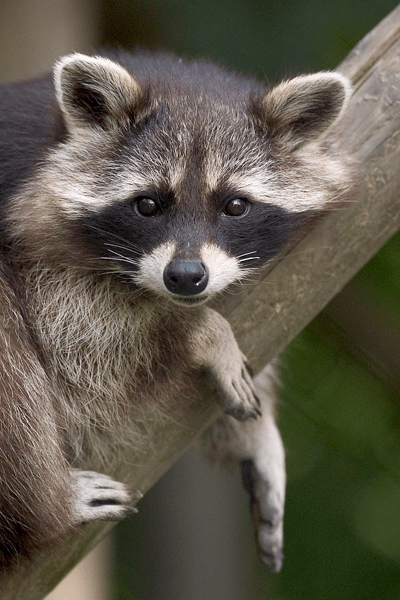
Raccoon was named for the way it uses its “hands”
rubbing and rinsing its food in water
not for the mask forever typecasting Raccoon as bandit-trickster in human lore.
Unlike humans these creatures know one another by their individual masks
not donned as shields or ritual or protocol or festivity or theatrics or deeds of darkness
but serving to absorb light in the night
to see
to survive.
Yet like humans Raccoon covets shiny things
and can be trapped by them.
Hunters of yore eventually learned to cut holes in logs to place a bit of tin inside to hammer in nails around the small circumference
knowing Raccoon would be beguiled would reach its hand inside for the bright thing.
Once the fist is clenched the creature will never let go to set itself free…
in paradoxical symmetry so does the creature that named itself for its supreme intelligence.
Might it have been better named for its own myriad masks and motives, ever disguised? Or for the hubris and folly accounting for so much of its own demise?
If only Raccoon had the ability to write, there might be annals of Ring-Tales read aloud in the night at a gathering deep in the forest by crackling firelight:
To see or not to see*… Lord, what ultimate Tricksters these Homo sapiens be! There in that circle, perhaps with shivery spines and whiskers a-tremble they name us not for our deeds or dominion but for the way we wash our hands.
— *Note: The collective noun for raccoons is a gaze.