Finding a safe harbor poem

National Poetry Month continues, and while I have been writing a poem each day in April, I have not posted them all here on the blog.

Today I return to post about “safe harbors.”

Yesterday for VerseLove at Ethical ELA, poet Padma Venkatraman offered this prompt along with her own beautiful work as an example: “Think about a place that feels like a safe harbor to you – and bring that space alive in a poem.”

Ah. I knew exactly what to write about…

Haven

I should convert
one of the boys’
old bedrooms
to a study
where I can write
with fewer
interruptions

but here
at the kitchen table
is my place

here
there are windows
all around

I open the blinds
while it is yet dark

inviting the light
before its return

bringing with it, birds
rippling with song
praise for the morning
and the new day

these colorful
feathered visitors
peer in my windows
from time to time
like curious, bright-eyed
Muses

—yes, I am here
—yes, I see you, too

and sometimes
when my husband
turns on the TV
in the living room
I grow weary
of the news
and sports

but when
he goes away
he leaves music playing
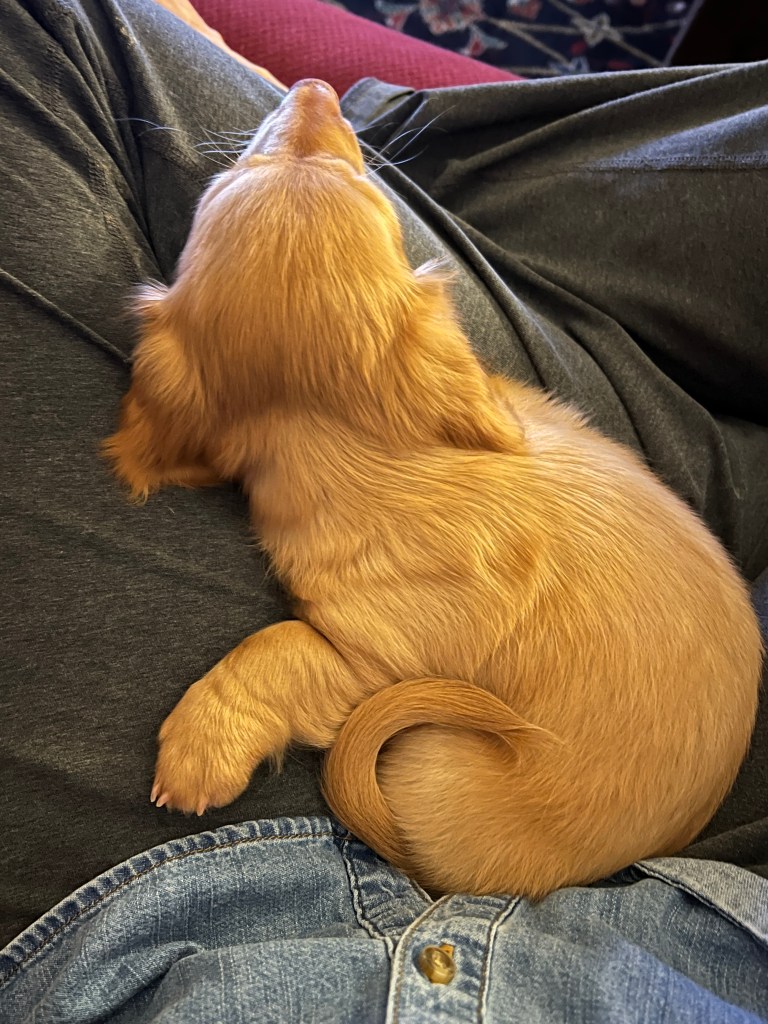
for the puppy

playing under my chair
little ball of golden fluff
having dragged every toy
he owns
to my feet

where he whimpers
just now
to be held

and so I pick him up

he curls in my lap
while I write
to the background song
a’rippling:

If my words did glow
with the gold of sunshine…

yeah, the Grateful Dead…

here in my place
my beloved space

I write

ever grateful, alive.

******

Lyrics: “Ripple,” Robert Hunter/Jerome Garcia, 1970.

My Jesse

with thanks also to Two Writing Teachers for the Tuesday Slice of Life Story Challenge

Thank you, Writing Community

Dear TWT Writing Community,

On this next-to-last day in the March Slice of Life Story Challenge, I want to tell you what a profound gift you are.

Thank you…

For sharing your heart and your stories…some of which were difficult to share.
For standing by one another, offering solace, healing, and love, which helped to fill a crack or two in life’s broken places.
For sticking with challenge, knowing it fosters growth.
For stretching your writing wings as far as they’ll go, and discovering that, yes, you can fly.
For being a warrior angel on occasion, ready to defend a fellow writer wounded by the world.
For taking us places we’ve never been, and may not ever see, otherwise.
For sparking new insights, new tastes, new things to try, new goals…for keeping life fresh.
For celebrating the joys in each others’ lives.
For your humor.
For your sorrow.
For your courage.
For your encouragement.
For believing in yourself.
For believing in me.
For pulling each other onward and through.

I’ll say it again: I did not believe I had the stamina for the daily writing challenge this year. I decided not to do it.

Until the morning of Day One, when I woke up ridiculously early with my starved inner writer tapping on my heart…Hello! Hello! You cannot wait for sustenance. Seek it, and it will come. Open up! You will reget it if you don’t…

How right is my inner writer. Always.

Sigh.

I didn’t feel like writing, but I wrote. And kept on writing. Every single day.

YOU are the reason.

I drew energy and strength from you. From your comments, from your stories, from your experiences…from the sense of belonging, from the mutual desire to build each other up, from valuing and being valued by each other.

Writing is one thing; writing in community is everything.

Don’t we know it.

How much richer is my life, because of these last thirty days.

We are a shared story.

Thank you for every minute, every word.

I am so grateful.

Here’s to one day more ❤

Fran

*******
in honor of my fellow “Slicers” in the Two Writing Teachers March Slice of Life Story Challenge

Laugh for the day

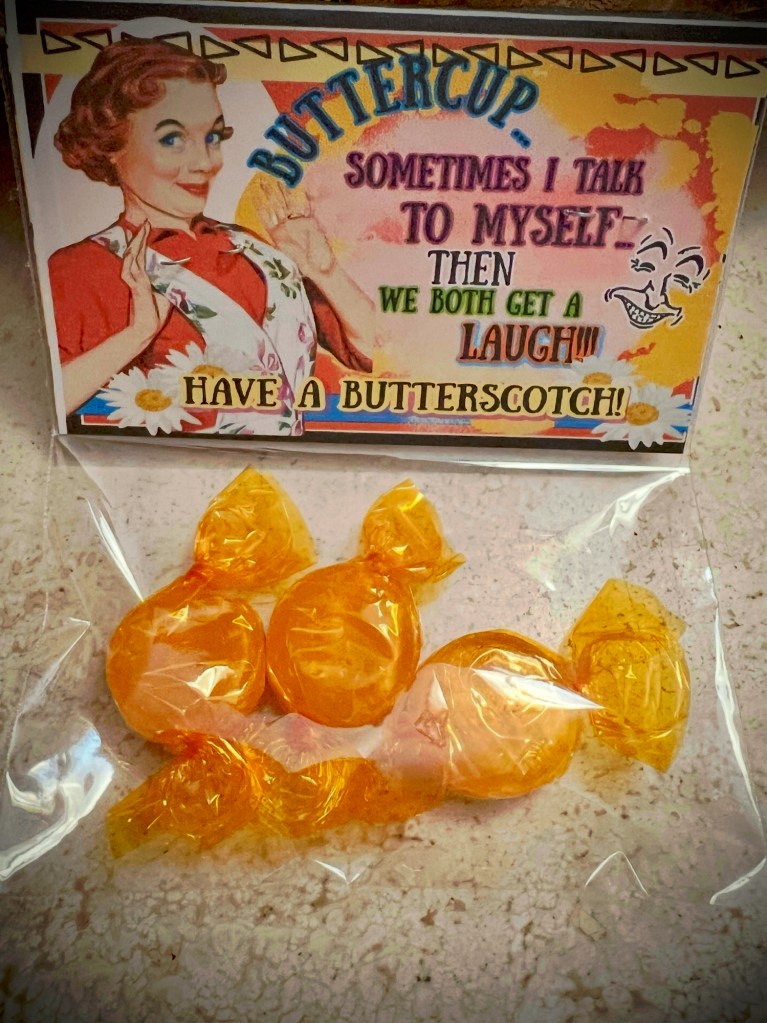
I ordered a vintage bird ornament earlier this month. When I opened the package, I found this delightful little treat from the seller:

I offer some accompanying haiku:

I said to myself:
Self, what shall we write today?
Myself thought a bit.

Let’s not overthink…
we know we got this. Just write
something short and sweet.

That’s all for now, folks…you and yourselves have a sweet day.

*******
with thanks to Two Writing Teachers for the March Slice of Life Story Challenge

A poem of pride

On Wednesday, a team of students from the Aquinas College School of Education hosted the final March Open Write at Ethical ELA. Jacob Rottier, Bonfils Matenga, Zee Simpson and Brynn Reams offered this process for composing a “nonet of pride”:

  • A traditional nonet is written in nine lines – from nine syllables to one syllable. 
  • Today we will be writing in words instead of syllables.
  • You can either do 9 to 1 or 1 to 9 words.
  • Your nonet poem should reflect something you’re proud of. So you might have your first two lines be:

I
Am Proud

These young people wrote of their accomplishments, the attaining of their dreams, overcoming odds…beautiful inspiration, all the way.

I thought for a bit. What am I proud of? My sons. My granddaughters. My grandparents. My husband. I am fiercely proud of them all… how to choose just one? What about my work? A professional or personal achievement? Having lived this long? My banana pudding cake? It was kind of amazing…

I grew restless. Maybe I needed to write something unexpected, something different. Inspiration to write is sometimes just so elusive…

And then I knew.

My nonet of pride:

I’ll Say It Just This Once

I
am proud
of my writing
although it isn’t perfect
and doesn’t have to be…
it is always stirring inside me
waiting to be born, and I’m reborn
with the crystallization of every word from ideas
—this is me, living life exponentially, when I write.

My blog header. This theme happens to be called “Hemingway Rewritten.”

*******

with thanks to two Writing Teachers for the March Slice of Life Story Challenge

Grace upon grace

Yesterday Leilya Pitre opened the March Open Write over at Ethical ELA with an invitation to compose poetry inspired by the Ides of March.

The Roman calendar confuses me, with all the backward counting. An “ide” is one day before the middle day of the month. For March, that’s the 15th – yesterday’s date. Leilya gave several poetic form suggestions: villanelle, free verse, limerick. She prompted participants with a choice: 1) Write with “an air of inevitability and doom…mirroring the idea of a foretold fate,” or 2) “Write a poem that celebrates a moment of change or transformation, akin to the original meaning of the Ides of March as a day of transition in Roman history.”

A day of transition…hmmm.

Change.

What needs to change more than the human heart?

I confess to wanting to run for my life at the idea of writing a villanelle (see how much the very word looks like “villain”?). The form is deadly! And there’s only one Dylan Thomas. Nobody else can rage, rage at the dying of the light quite like him. And so I opted for free verse, my default form.

Crickets. Nothing. No ideas on ides.

And so I returned to the villanelle – drat it all! – with “an air of inevitablity and doom,” for sure.

But then: Two repeating lines came to me. I started a rhyme search. A villanelle takes a pile o’ rhyming words. Not all of them will work. One of my favorite images re-materialized in my head: the “golden rim.” Yes. Let us drink from the golden rim of the goblet…no, chalice. Yes. What are we drinking, and why? What’s the point? What does it mean?

Have you ever heard that what you need is there, right within your reach, if you just look?

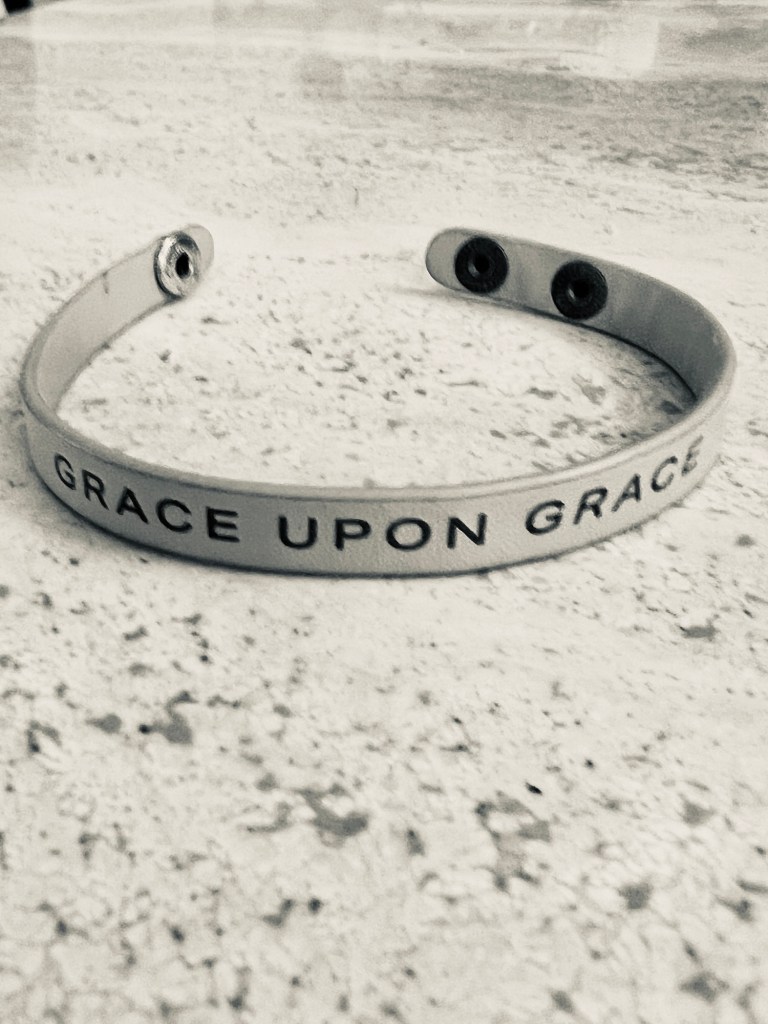
In this case, what I needed was literally right there within reach: the bracelet on my wrist. You’ll see.

Here’s the poem. Still tinkering with it.

Gratiam pro gratia

As evening descends in shadows dim
Let’s toast to ceasefire of life’s fight:
Drink, my love, from the golden rim.

The face of the morrow will be less grim
—See, our ashen embers retain the light
As evening descends in shadows dim.

Toss off your cloak with fraying trim.
Kneel by me, pray, well we might—
Drink, my love, from the golden rim.

There sparkles yet a priceless gem
Within the pocket, glittering bright
As evening descends in shadows dim.

Hold my hand — let’s sing a hymn
Before we take our earthly flight.
Drink, my, love, from the golden rim.

Sweet chalice of life, abrim,
Despite this darkest night…
As evening descends in shadows dim,
Drink, my love, from the golden rim.

My poem’s title is Latin for the words on my bracelet. An excerpt of John 1:16: from the fullness of Christ, we have received “grace upon grace.” I wear it as a reminder to give grace, having received it in such abundance. I purchased the bracelet at a coffee shop called Charis (“Grace”) which has a wall plastered with customers’ prayers written on tiny slips. The owners donate a portion of proceeds to organizations that are working to make the world a better place. Our time here is short. Let us be about this work, in communion with one another, giving each other grace.

*******

with thanks to Two Writing Teachers for the March Slice of Life Story Challenge

Squirrel

Today’s WordPress prompt: Which animal would you compare yourself to and why?

Yikes. This could take awhile.

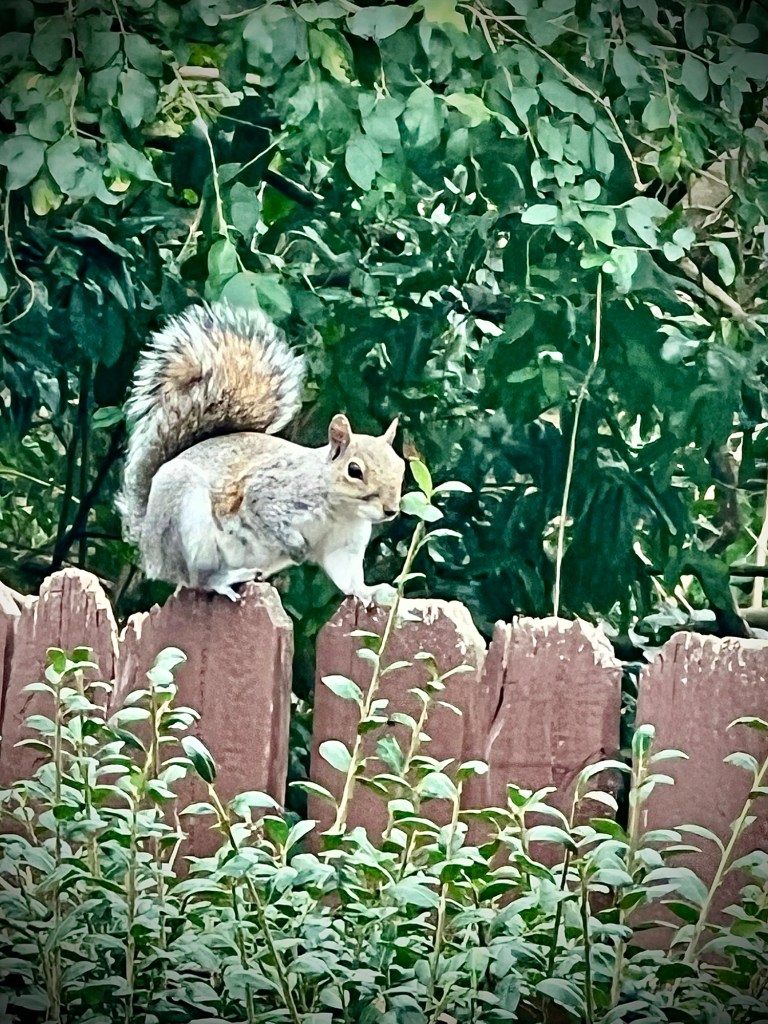
However…yesterday afternoon I had a dentist appointment, and this creature was sitting on the fence as as I pulled into the parking space:

“Well hello, Squirrel,” I say from the driver’s seat.

The squirrel does not move.

I take a picture of it with my phone.

The squirrel does not move.

The wind is kicking up, rain starts spattering…

The squirrel does not move.

It watches me as intently as I’m watching it.

I note the right paw raised, perhaps in readiness to flee…

Which is what the squirrel does, as soon as I look away to reach for my purse, for in that fraction of a second – poof! – it is gone.

So, back to the WordPress prompt: Which animal would you compare yourself to and why?

I wouldn’t have thought to compare myself to a squirrel, but since one came to me, and since I have no idea of what else to write about today in the March Slice of Life Challenge, I will consider how the squirrel and I are alike. Isn’t this a hallmark of the writerly life, using everything that comes your way?

Here’s what I found with a bit of research:

Squirrels are preparers.

Squirrels are resourceful.

Squirrels can symbolize that it’s okay to forget and move forward.

Squirrels can symbolize that life’s blessings can take root in unexpected ways.

I never expected to discover such a kinship with the squirrel.

I am also captivated by the etymology of “squirrel.” Derived from Ancient Greek, it means shadow-tailed.

Squirrels use their beautiful “shadow” tails for balance, a warm cover against the cold, a means of communication, and even in expression of emotions. They flick their tails when alarmed, happy, and frustrated.

Symbolically speaking, the squirrel’s tail can represent the past (as a “shadow” behind the squirrel, which is attached to it, and follows it).

Think on that awhile. The shadows of the past…ever with us.

Haunting? Not necessarily. As someone who likes dabbling with memoir, I find unexpected riches in writing about the past. A cache of courage. A hallowed hoard, even in the darkest places.

In those shadows, I find the first book I can remember being read to me… here I am, a toddler, sitting on my grandmother’s lap, listening to the playful rhyming lines in a book about…squirrels.

Thank you, Squirrel, for being here.

*******
with thanks to Two Writing Teachers for the March Slice of Life Story Challenge

The Heroes’ Hangout

Do you believe in fate/destiny?

That’s today’s WordPress prompt.

It’s beguiling, like the sword in the stone: Dare I grasp that jewel-encrusted hilt? Even if the sword should slide free of the rock (wonder of wonders!) will I have the strength to heft its ponderous weight, to actually use it? And to what purpose?

Here is what I believe: With every challenge comes opportunity; you cannot know the outcome until you seize it (ever how cold, heavy, terrifying the opportunity may be).

And so I put my hand to the hilt here with bits of a destiny story:

When I was a child, reading and writing were practically my life’s blood. Invaluable gifts for life’s journey. When the path took terrible turns through the darkest regions, strewn with loss…I could always read and write and pray my way through. Some encouraging soul, some sage, would also appear at every critical juncture to help guide me along, before I lost my way entirely.

Never in my wildest dreams did I expect to be a pastor’s wife (nor, most certainly, did many of my young acquaintances and their parents). But here we are, my husband and I, thirty-eight years in the ministry, standing on the the cusp of our fortieth wedding anniversary, with two grown sons and two granddaughters who are the joy of our days.

I never expected to be a teacher. I quit college at twenty and didn’t go back to finish until after my youngest started school. The way was circuitous, full of obstacles…impossibilities…even loneliness and more than a little despair…until the sword called Opportunity appeared, glittering there in the gray stone of Challenge. I put my hand to it, finally graduating from college with a teaching degree when my oldest was taking his first semester college exams. Today I work with students in the very things I loved best as a child: reading and writing.

Do you believe in fate/destiny?

I see the hand of God at work in all of it…that doesn’t discount destiny, now does it?

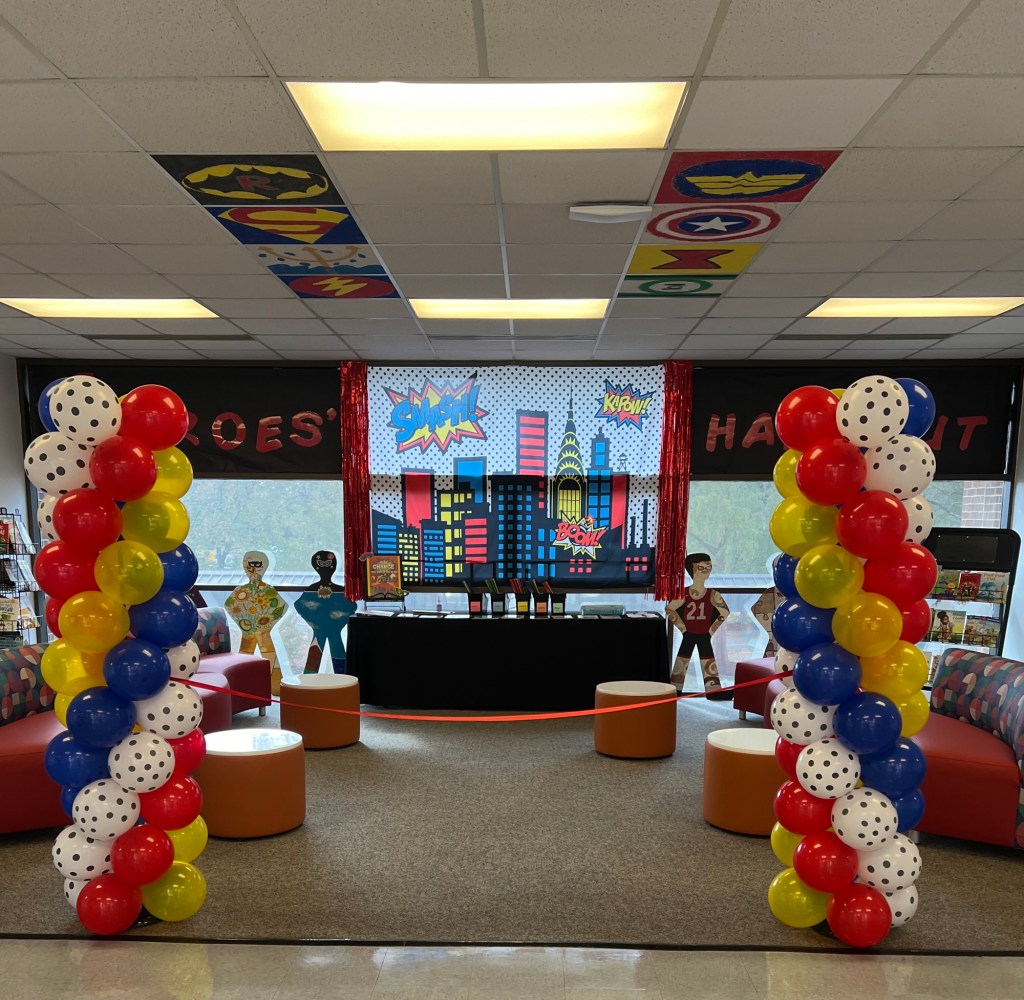
In this, my seventeenth year of teaching (a latecomer, oh yes, but it doesn’t matter, the story begins anew every day), another opportunity presented itself: Setting up a program and a space for volunteers to come and read books to students. The challenge: Where? Every space in the building was in use, except for a recessed area at the top of the stairs, where black-draped tables once housed student “artifacts”… with a little time, imagination, and the generosity of our PTA, this has become our Heroes’ Hangout:

In this space, children fall in love with books and stories. They laugh. They learn. They experience. They ask questions. They observe. They imagine. They are at the beginning of their own hero-stories.

For, after all, are not the ideas of fate, destiny, and hero inextricably intertwined?

I have had the opportunity to guide students with writing in this space. Here’s a cento poem (cento meaning “patchwork”) composed of completely borrowed lines, my favorites from poems my second-grade heroes have written:

I worry about me and heights
I cry over the iPad because Mom said no
I understand my dreams tease me
I see a fairy in the forest
I say mermaids are real
I wonder why people think Ohio is strange
I dream of going to Ohio
I try to be kind
I worry about animals dying
I hope all the endangered animals survive
I wonder if Dodo birds are still alive
I see a baby goat getting milk from its mother
I hope people never litter again
I understand that palm trees are not trees
I want ice cream for life
I try to be a better sister
I pretend I am brave and smart
I think Heroes’ Hangout is the best
I pretend I am the fastest thing alive
I worry I am going to lose my gravity
I touch Dog Man’s hat and it feels like victory
I hear my future.

Do you believe in fate/destiny?

You tell me.

I can just tell you that if you are looking for heroes…you will find children.

*******

with thanks to Two Writing Teachers for the annual March Slice of Life Story Challenge. This is my ninth year participating alongside fellow teacher-writers, as a means of continually honing the craft.

Confession: For the first time in nine years, I’d decided to not take up the Challenge.
Writing every day doesn’t seem sustainable right now. And maybe it isn’t.

But this morning, without any kind of plan, I got up and did it anyway.
Opporunity is here. WordPress provided a prompt. I reached. I pulled.

Your hand is on the hilt, my friends. You can do this!

Dig the past

Way back on Day 10 of this current Slice of Life Story Challenge, I had a lot of fun playing around with a prompt asking what the first line of my autobiography would be. I really prefer the idea of memoir…my definition: Mining one’s memories for the stories that matter most, digging in the storied strata of one’s past.

I came up with this “opening line” for it:

My father named me for his mother, and that was the beginning of everything.

Truth.

From the moment I entered this world, my grandmother and I were bound together by blood, love, and namesakery. Long after she’s left it, our bond remains unbreakable.

Were I ever to write an extended memoir, her stories would be layered throughout. I am part of them; they are part of me.

She would say, You were named for me like I was named for my Papa. I loved him so. He was very religious, sang in the choir every Sunday. He had a beautiful bass voice…he used to keep bees when I was young and I’d help him get the honey.

She was sixteen in March of 1932 when her Papa, Francis, died by suicide. On his sixtieth birthday. I don’t know the whole story but what little I do know, I shall keep for now. Grandma told me they brought him home in a wooden casket lined with black oilcloth and that she sat up with him all night before the burial.

The point is that my grandmother’s stories made me hungry to know as much as I could about her childhood, daily life long ago, how people endured such hard times. Many didn’t. The old cemeteries tell stories of their own.

I asked her about the 1919 influenza epidemic: I don’t remember it. I was little. I do remember people talking about “hemorrhagic fever” and Mama saying she made big pots of soup for the neighbors who were sick. Papa carried it to them and left it on their porches. He wouldn’t go in because he didn’t want to bring the sickness home.

I asked her about meeting my grandfather: Oh, we always knew each other. He’s nine years older than I am and he and Mama used to pick cotton together…

Granddaddy would say: We’d all see who could pick the most cotton and it was always Lula [Grandma’s mother] or me. That was before the boll weevil came along and people started planting tobacco.

Grandma said: When tobacco came along, I was a looper…you had to be careful. That juice was sticky and would stain your clothes; it was hard to get out…using a wringer washing machine or washboard, I might add.

The setting of all this is a tiny community called Campbell’s Creek, established around 1700, way down east in the far reaches of Beaufort County, North Carolina. It’s part of Aurora although the actual town is five miles away. Most of the town is now in serious disrepair and the place is so remote that when I happen to encounter people who’ve been there, they typically say something like “I thought I was going to the end of the world.”

It is one of the places I love best on this Earth. The beginning of everything…Aurora is Latin for “dawn,” you know.

My grandparents, Columbus St. Patrick and Ruby Frances, were born here in 1906 and 1915, respectively. They married during the Great Depression. Their first home was a tenant house; their first child, my father, was born there. Granddaddy was a sharecropper. He plowed fields with mules. He was skilled with farm tools that people seldom use now, like an adze. This would give him a unique advantage when he “couldn’t make a go” of farming and went to Virginia to find a job as a shipwright, just as war broke out and ship production went into overdrive. When the war was over, he tried his hand at a number of things, but he had two more children to provide for; he went back to the shipyard until he retired.

All of his life, Granddaddy was a farmer at heart: I can remember when we ordered chickens by mail and they’d be delivered in cages by horse and buggy. I was three or four when I saw my first automobile…

That would have been around 1910. A Model T.

Time was, he’d say, in his country dialect bearing faint traces of Elizabethan English, that the whole family could go off for a week to visit somebody and you didn’t have to lock your house or barns because nobody would bother them. People looked out for each other. There won’t no nursing homes. When somebody was sick we all took turns helping out.

Grandma said: I was sitting with a friend’s mother. She’d been sick awhile and we all knew her time was near. She hadn’t spoken a word in days, hadn’t moved or responded to anyone. She was just lying there in the bed when all of a sudden she sat up and opened her eyes. She started laughing: “Can you hear them? Can you hear them?” Her face just glowed...it had to be angels. A little while after, she was gone.

I grew up on these stories and so many more.

My summers were spent learning things that I wasn’t even aware I was learning, things that will drive my interests for the remainder of my days: story, history, culture, nature.

Faith.

And science.

I’ve written much about the little dirt road that ran past Granddaddy and Grandma’s house. It’s one of my life’s greatest metaphors. I can recall, in the 1970s, when it was covered with gravelly “rejects” from phosphate mining, Aurora’s biggest industry since 1964. Granddaddy and Grandma were so excited for their grandchildren to come digging in the road to find sharks’ teeth—some were quite large — coral skeleton, and various fossilized bones of sea creatures. Someone of official status must have soon realized the value of these rejects and they weren’t scattered on the old dirt road anymore. Instead, they were taken to a newly-created fossil museum in town. Today, children from all over come to dig for fossils they can keep, and they can learn about the history in the little museum. There’s even an annual fossil festival at the end of May; last year I went for the first time with my seven-year-old granddaughter.

This excerpt is from an article in the April 2023 edition of the magazine Our State: Celebrating North Carolina:

Beneath our state’s soil and waves is a lost world waiting to be discovered—a geologic trove we claim as our own…about 50 years ago, coral specimens were found in drilling samples near present-day Aurora. They were sent to the Smithsonian Institution, whose scientists soon visited—and identified the area as one that proclaims the most prolific fossil record of the Miocene (2.3 million to 5.3 million years ago) and Pliocene (5.3 to 2.6 million years ago) marine life on the Atlantic coast.

About fifty years ago… I’d have been a child playing in the gravel on the old dirt road, collecting shark’s teeth, unware of the true treasures of my life.

The Aurora Fossil Museum, writes the author, “continues to keep the past alive.”

It’s analogous to to me: Scientists finding bits of ancient creatures, trying to piece them together to understand stories of this “lost world,” and how I hold to bits of story from this same place, the lost world of my grandparents.

Generations rise and fall…layer upon layer of story strata settling in their wake.

I am a remnant of their world. From early childhood Grandma infused me with story, unknowingly turning me into amateur oral history exacavator, archivist, curator…the stories still live in me.

My father named me for his mother, and that was the beginning of everything.

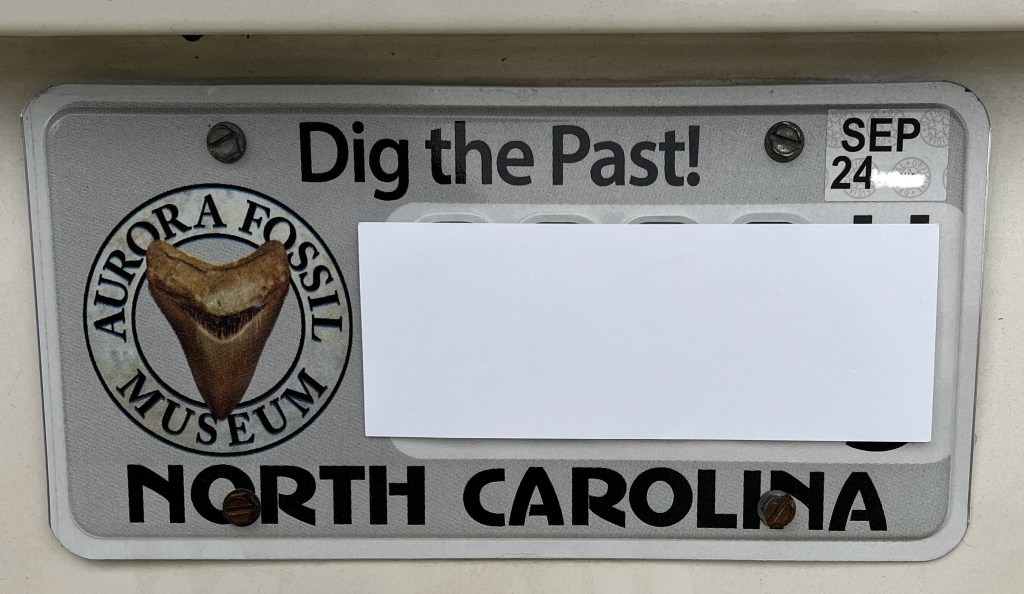
Imagine my delight when I learned last year that the Aurora Fossil Museum had been approved for an official historical site license plate with the NCDMV. I applied for one right away….it finally came, a couple of months ago. I’m among the first to have it:

I imagine Granddaddy’s beaming face. I hear Grandma’s typical expression of surprise: My land!

Dig the Past! the license plate reads.

I do it every day that I live. I go on mining my memories for stories, working their meanings out bit by bit, trying to preserve them for the priceless treasures they are.

Keeping the past alive. For the future. For right now.

That’s what memoir is for.

*******

Composed for Day 30 of the Slice of Life Story Challenge with Two Writing Teachers
Backward glance

Today I muse about the serendipitous nature of writing.

For example: In a writing community, the same idea or topic will mysteriously come to several people at one time, without their ever having discussed it. Like a blanket settling over people’s minds. Then there’s the peculiar corollary that, the more you write, the more you can think of to write…an exponential growth kind of thing. As long as you’re not completely exhausted, that is. Then there’s a shared writing encounter, an exchange, that suddenly awakens an experience or memory that’s long lain latent.

Case in point: On Day Two of the current daily challenge with the Two Writing Teachers community, I had a lot of fun sharing a story about spelling names backward. I never expected it to resonate like it did with others…this bit of wordplay is obviously a common rite of childhood (after all, my no-nonsense dad even admitted to using his name backwards as a child, to my extreme amusement). In the midst of it all, I remembered a book I loved as a child, in which the plot hinged on a backward name. The titular character was a Siamese cat, “The Piebald Princess,” formally styled as Princess Renekrad Riah Sretsevlys. I haven’t seen it in years, but I recalled being thoroughly enchanted by the story and stunned by the revelation at the end: Princess Renekrad Riah Sretsevlys was not, in fact, a real princess OR Siamese. She was a plain cat who wanted adventure… so she disguised herself with a little help from a bottle of Sylvester’s Hair Darkener, spelled the name backward, and took it for her new royal persona.

I hadn’t even thought to read her exotic name backwards. Magic!

Upon remembering this book, I so wanted to read it again. I wanted my granddaughters to have it. An online search revealed that it’s out of print now. I was able to find a copy on Etsy, however (“vintage,” alas—how am I this old??), so I ordered it.

The story is even better than I recall. Pure delight. And I’ve learned that the author based it on stories she made up about her dolls when she was a child.

The fragile, faded dust jacket of The Piebald Princess inspired today’s post; the illustration shows Princess Renekrad Riah Sretsevlys casting a backward glance at herself in the mirror.

A perfectly serendipitous segue, if you will, because…

The time has come, the Walrus said… for a confession.

I’ve been working backward.

With my post titles.

Alphabetically.

Here’s the thing… I got the idea, two years ago, that if I thought of a title word starting with each letter of the alphabet, well, that would cover 26 posts out of 31 for the Slice of Life Story Challenge. It worked so well for the first year that I did it again for a second.

This year I almost didn’t sign up for the Challenge at all because…in a word, life. Was I actually up for Slicing it? I hadn’t been writing much of late. At the last minute, I took the plunge. First thought: I need some kind of plan if I’m going to sustain this. Second thought: I don’t feel like going in ABC title order again. Done that, twice.

But… what if I worked backward? As soon as I thought of it, the first story idea crystallized.

Seemed a sign to me.

From that point on, most days I had an idea of a story to write. What word might work for the title, with the given letter of the day? Some days, I had no idea what to write; was there a word for a title to help me frame an idea? A synonym, maybe? As ideas or titles came to mind for the next posts, I jotted them down. I worked them into order. There was always a way.

Here’s how this year’s posts played out:

Zen
You, reversed (backwards names)
XIII and XIX (cicada broods)
Wedding music
Verily
Universe of possibility
To build or not to build
Serene senryu
Rosary beads
Q: What to write now?
Poetry possum
Otters
Nature’s divine voice
Moments
Life’s a cupcake
King no more
Jewels
Interpretation of Grandmothering by AI
Huh?
Grim tale
Franna’s house
Eagles
Dream-double
Chanticleer
‘Bad things are going to happen’ poem
Angels

This, of course, leaves me with five Slices of Life to go, so, I started going “backward” again, which is actually forward, in this case: Yesterday was Awakenings; today, Backward glance. Tomorrow will be a title with C, the next day a title with D, and on the last day, E.

The last day happens to be Sunday.

Easter.

Serendipity every which way.

Princess Renekrad Riah Sretsevlys, casting a backward glance in the mirror

*******

Composed for Day 28 of the Slice of Life Story Challenge with Two Writing Teachers
Jewels

On March 17th I typically write a post contemplating my obscure Irish roots while celebrating the novelty of my grandfather’s middle name: St. Patrick. Yes. For real. No one knows why, my down-east North Carolina Methodist Granddaddy hated it, and by my lifetime he’d legally changed it to the initial S.

I love the uniqueness of it. I cannot let the day pass without saying that Columbus St. Patrick Brantley’s name remains a treasure to me, a jewel in my family’s living memory, a perpetual mystery in our supposed non-Catholic history.

Here is where I diverge from my norm to chase, not a name, but a word: jewels. In keeping with the day, of course. The first jewel I’m after is brilliant language, and the Irish are rich in that. It glimmers in every bit of their wit, storytelling, poetry, and song.

In 1996, Frank McCourt’s memoir Angela’s Ashes burst upon the world and won the Pulitzer Prize. As soon as I learned of the book, I had to have it. Reviewers raved about McCourt’s narrative voice: Stunning. Lyrical. Dazzling.

So I got my own copy. From page one…spellbinding. My concepts of writing and memoir were forever changed; McCourt’s Irish voice has never left my head.

Of his many glorious phrases, one that returns to me most often comes from the scene where young Frank is in the hospital recovering from typhoid fever. In the room next door is a girl recovering from diphtheria. They can’t see each other, but she calls out to him. She says she has a book about the history of England with her, if he’d like to read it. He does. Books are treasures to him; his impoverished family doesn’t own any. The girl sends the book to him via the nurse, Seamus, who delivers it most reluctantly, complaining because it’s about England “after all they did to us” and that there “isn’t a history of Ireland to be had in this hospital.”

McCourt writes:

The book has the first bit of Shakespeare I ever read:

I do believe, induced by potent circumstances
That thou art mine enemy
.

...I don’t know what it means and I don’t care because it’s Shakespeare and it’s like jewels in my mouth when I say the words.

Jewels in my mouth…

I knew exactly what he means. I loved Shakespeare from my own first encounter. The last line of Sonnet 73 is the heartbeat of most everything I do in life, certainly of the things I write: To love that well, which thou must leave ere long. Jewels in my mouth, in my heart…the bequest of beautiful language.

McCourt eventually left Ireland for America where he became a high school English teacher. He’d regale his classes with stories of his childhood, and they’d say Hey Mr. McCourt, you should write a book.

So he did.

Angela’s Ashes.

And so the world is changed.

That is the power of story.

That is the second jewel from McCourt: Story. Specifically, writing of your own life.

In his final memoir, Teacher Man, he’s become a creative writing teacher. He’s trying to inspire students to write about their lives when they think there’s nothing interesting to say. He tells them: Every moment of your life, you are writing. Even in your dreams, you’re writing…Dreaming, wishing, planning: it’s all writing, but the difference between you and the man on the street is that you are looking for it…realizing the significance of the insignificant, getting it on paper. You might be in the throes of love or grief but you are ruthless in observation. You are your material. You are writers and one thing is certain: no matter what happens, you’ll never be bored again. Never…nothing human is alien to you.

Jewels. Your words, your story, your every moment. All priceless.

I met Frank McCourt in the winter of 2000 when he visited North Carolina State University. I went despite a falling snow. I took my oldest son with me and we listened to McCourt speak of his books and devastating childhood in Ireland. We listened, and marveled. We listened, and wondered about the story of our own origins on The Emerald Isle.

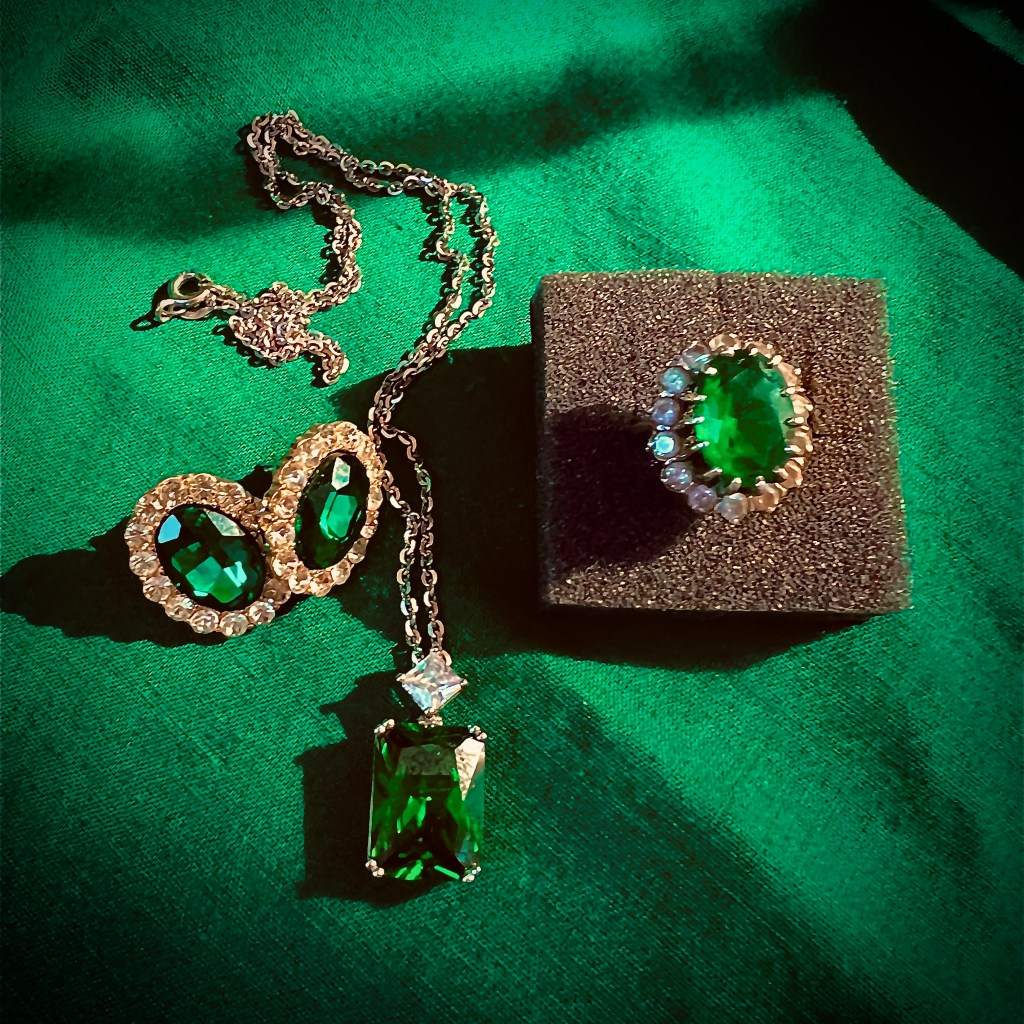
Which brings me to my final set of jewels for today: Christmas before last, my husband gave me a necklace and ring. His sister, without knowing or discussing it with him, gave me earrings. The jewelry, all bearing my birthstone, emerald, are a startling match. My sister-in-law chose the jewelry for me because she loves the color. My husband said, These are to remind you that one day, I’ll take you Ireland.

Where, I imagine, the voices of my distant ancestors still whisper in the wind…perhaps when I go, if I am very still, I might hear them…learn from them…

Until then, and always, I shall be about the excavation of my own story-jewels, with McCourt’s words echoing in my brain and my curious link to St. Patrick forever pulling at my heart.

As for today… here’s to proudly wearin’ o’ the green.

*******

Composed for Day 17 of the Slice of Life Story Challenge with Two Writing Teachers
*******

Works cited:

McCourt, Frank. Angela’s Ashes: A Memoir. New York, Scribner, 1996. (Pages 195-196)

McCourt, Frank. Teacher Man: A Memoir. New, York, Scribner, 2005. (Pages 244-246)