Where the meaning is

My colleague is weeping.

She’s just read aloud a passage from The Unstoppable Writing Teacher: Real Strategies for the Real Classroom by Colleen Cruz, specifically from Chapter Five, entitled “I’m finding some student writing repetitive and boring.”

In this passage Cruz  relates the story of being observed by teachers who said that some students in the class had chosen “boring … almost shallow” personal essay topics. Cruz confers with one of these students. He’s writing about why Christmas is his favorite holiday – his reasons are the food, the presents, watching videos. As Cruz continues to converse with the boy, she feels pressure building under the skeptical eyes of the observers; the conferring is going nowhere. But Cruz presses on. She keeps talking, feigning enthusiasm: “There’s just so much to say about videos on Christmas. I would love to hear what you have to say about them.”

And then the boy explains that every year on Christmas, after the presents are opened, his mom lets him watch all their previous Christmas videos, when his dad was alive. She can’t endure the videos during the rest of the year, but at Christmas she watches them with her son.

“It’s like we’re all together again,” said the boy.

Like Cruz and the observing teachers in the story, my book study colleagues and I all have tears in our eyes.

I write in the margin of that page: Go deeper and deeper to the meaning. 

I think about a second grader writing realistic fiction. Her first attempt at dialogue was rambling, pointless; the characters were talking but not saying anything. When I mentioned that we can add things from our own lives to make characters think and feel things that we do, to “make it real,” she revised the dialogue to a conversation about a girl who was worried about her new stepfather liking her. When she read it to me, I said, “Wow, your story really came to life there! What made you write about the girl’s worries over her stepfather?”

The child answered, solemnly, “My mom is getting married next weekend.”

I think about a girl describing how she and her grandmother waded through the regular flooding of their impoverished hometown in Viet Nam.

I think about a fifth-grade boy who never liked writing, how he developed an enthusiasm for it with his memoir on making the hard choice to tell the truth after having lied. A girl new to the school wrote about a girl having to move often. The piece opened with the narrator shouting at her mom; the anger was palpable.

A dim recollection of the movie Where the Heart Is flits through my mind – the young pregnant girl pressing a hand against her abdomen, saying, “That’s where the heart is.”

Cruz says students “have a subconscious need to write about particular topics, but they don’t consciously know why.”

Our job, then, as writing teachers, is to help students go deeper to the why, to where the heart, the meaning, is.

slice-of-life_individualEarly Morning Slicer


A rising tide lifts all boats

Boats

Fishing boats. karol m. CC BY

At a recent team meeting of K-12 cross-curricular educators dedicated to improving writing instruction, we discussed the Calkins and Ehrenworth article entitled “Growing Extraordinary Writers: Leadership Decisions to Raise the Level of Writing Across a School and a District” (The Reading Teacher, Vol. 70, No. 1, July/August 2016). While takeaways included the need for a shared vision of good writing and good writing instruction, as well as a need for shared expectations and ways to track growth – the reason for the formation of this team – what struck me most was this line on the transformative power of professional development: “It should be focused on strengthening teachers’ methods and spirits.”

Yes. Spirits must rise, I thought. Before we can raise the level of writing, before we can raise the students at all,  we must first raise each others’ spirits. 

The truth is that professional development is so seldom inspirational. For the last year, when I planned professional development in writing for teachers, my driving question was, How can I inspire them? How can they tap into the wellspring of their own power, their own voices, all that matters to them?

When I spoke on this at the meeting, a colleague chimed in: “We have to be the rising tide. If we rise, we’ll raise others with us.”

“Yes – a rising tide lifts all boats,” I responded, recalling those words associated with John F. Kennedy.

I grew up in the Tidewater region of Virginia. I have been on the Chesapeake Bay-Bridge Tunnel when the tide was high, in a storm; as I descended into the tunnel, waves crashed above the entrance and spilled over the car. A layer of salt remained on the windshield when it dried. I’ve seen boats grounded when the tide was low, making the would-be sailors push and pull that much harder to get them afloat. I’ve walked floating docks of marinas on sunny days, feeling the sway of the boards under my feet as boats rocked with the incoming tide, the metal of their moorings and buoys clanking softly, rhythmically, as if coming to life with with the rising flow.

When the tide rises, it lifts everything with it – everything rises.

When our spirits rise, we lift others around us – everyone rises.

That’s so needed in education today.

It’s so needed everywhere.

The power lies within you. Tap into that inner wellspring; let it flow.

And rise.

Note: The one word I chose for for myself at the beginning of this year is Rise. If you’re interested, here’s my little poem: Rise.

slice-of-life_individual

Morning snow

Snow

There was crisp, dry snow under his feet and more snow lying on the branches of the trees. Overhead there was a pale blue sky, the sort of sky one sees on a fine winter day in the morning. Straight ahead of him he saw between the tree trunks the sun, just rising, very red and clear. Everything was perfectly still, as if he were the only living creature in that country.

-C.S. Lewis, The Lion, the Witch and the Wardrobe

Snow swirled down in the gray dawn yesterday, winter whispering farewell in its dying breath: I’m still here, but not for long. Just one more time . . . .

There’s a silence, a stillness, to Sunday mornings anyway, a sense of expectancy, an invitation to step away from the world.

Of course I think of Narnia. I always do when it snows.

I was ten years old, scouring the school library shelves for a book I hadn’t read yet, when I encountered a compelling title: The Lion, the Witch, and the Wardrobe. 

“Sounds interesting,” I thought, opening the cover, not realizing that it was a portal to another world that I’d never fully leave  – or want to leave. I fell in and never climbed all the way out again. Part of that pull is the longing C.S. Lewis infused into the Narnia Chronicles, the sense of “realness” that pervades the magic. Lewis poured what he loved into the stories, and they live because of it.

Having facilitated a writing workshop for teachers just the day before on “creating the magic” – writing about what matters to you, tapping into your heart, your dreams, your struggles, your memories, making your writing authentic so you can help students do the the same – I watched the snow, remembering Narnia.

Writing is the closest thing to magic that there is. As teachers we create the atmosphere for our writers. It’s one of excited expectancy, of energy, when young writers discover the power within them, learning how to harness words to impact readers. Writing, after all, is meant to be shared – it’s the connecting of human minds and hearts.

Which is why, for me, Narnia is never very far away.

Especially when it snows.

slice-of-life_individualEarly Morning Slicer


All that you hold dear

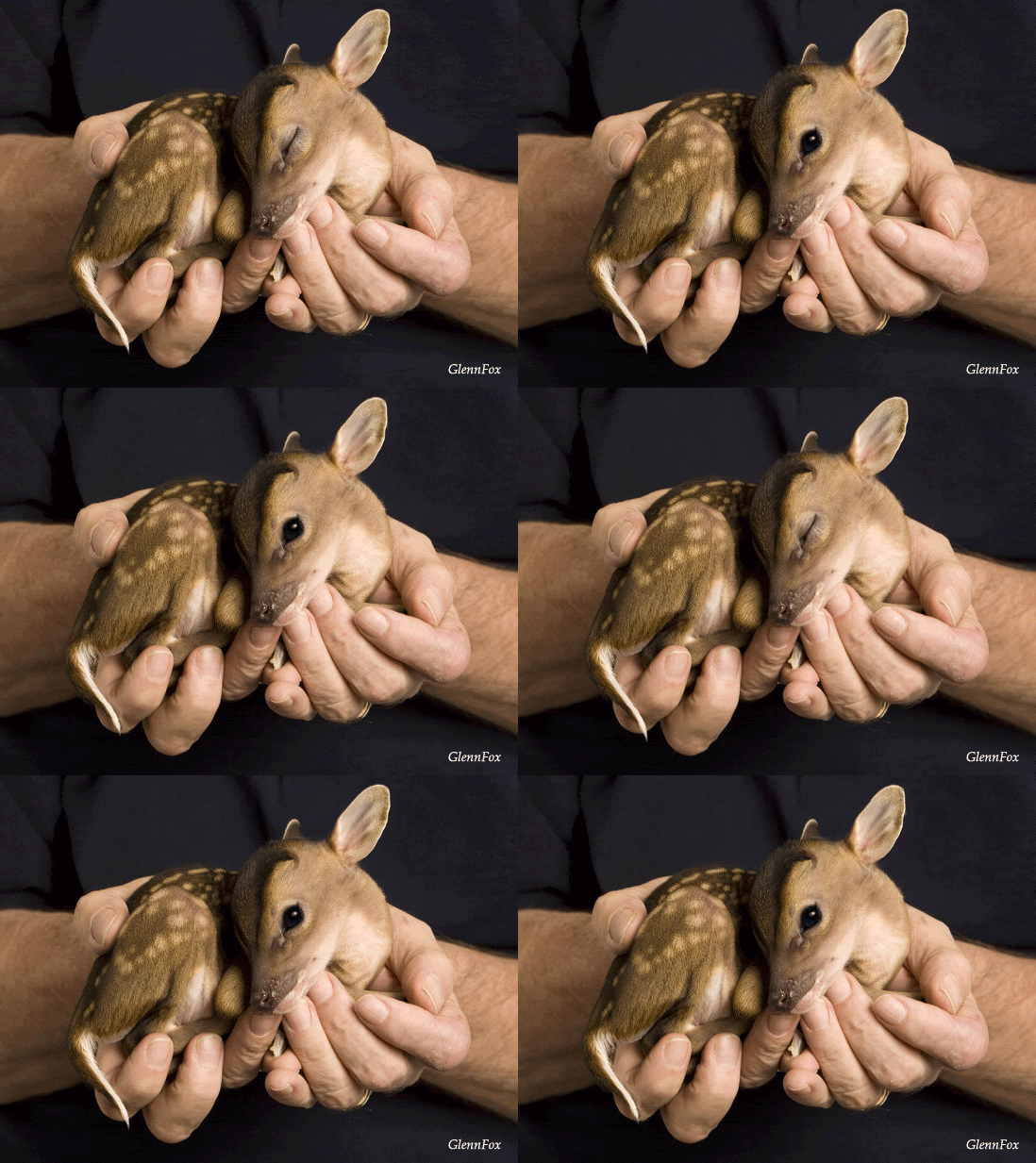
Fawn in hands

A new idea is fragile, fleeting

capture it as soon as you can.

Find the meaning

what it makes you think

how it makes you feel.

Nurture it

as you nurture the artist within you

so the idea and the artist will grow.

Play with the words

the images will come.

Play with the images

the words will come.

Trust your inner writer

to find a way

of conveying that idea, that image

so that others think and see

and feel.

There’s power in that fledgling thought

in every feeling connected to

 all that you hold dear.

More power in sharing it

than in holding it tight, unspoken.

Let it breathe

let it live.

It wants to.

It is precious.

Even

priceless.

Inspired by my writing workshop with teachers yesterday on “creating the magic”  – first as a writer, then for your writers.

slice-of-life_individualEarly Morning Slicer

Six-word memoir

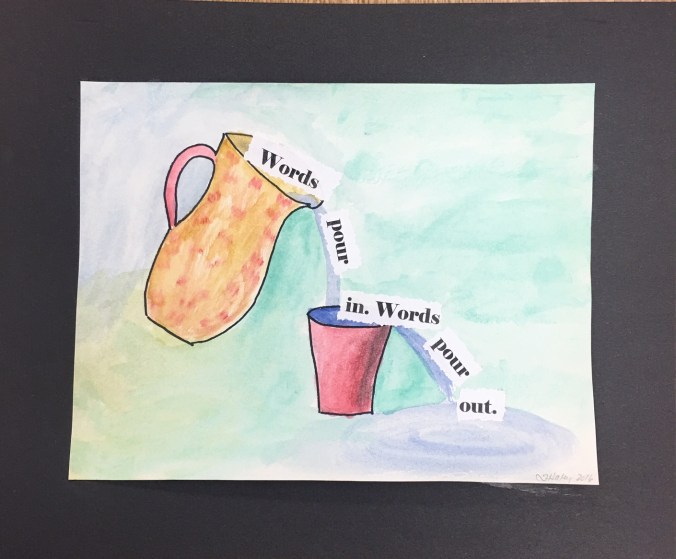
Words pour in

“What do you love best? How can you use the things you love to represent you, to describe who you are, in just six words?”

I pause to let the fifth graders think.

“One thing that I love,” I continue, “is the sound of cicadas. Have you heard that sound?”

Hands shoot up. I nod to a girl who replies: “Those bugs that buzz really loud.”

“Yes. Every spring I look forward to hearing the cicadas again – they will buzz all summer long. They remind me of summers spent with my grandparents. The sound was deafening in the thick woods around their home. Hearing cicadas now makes me feel happy and safe, no matter what else is going on. It’s one of the things I love best. So I might try to write my six-word memoir about the sound of cicadas.”

With pencil on paper, using the document camera, I write:

Nature sings to me. I listen.

I see heads nodding.

“I might keep working these six words to see if I can make them represent me better. I might decide to work on another idea. Today you will make a list of things that you love – maybe things you love to do, or favorite objects, or even dreams you have of things you want to do or be – and think about how each thing represents you. Then we will work on capturing and hammering out those descriptions in just six words.”

Off they go around the room, to brainstorm.

I brainstorm, too. What else can I write? What’s another example I can give them?

Well, as far back as I can remember, I loved reading and writing – it’s who I am. It’s what I do. It’s why I’m in this very room this very minute, teaching it.

I think about it all night, and am ready for the next lesson.

“So, ladies and gentlemen, yesterday we brainstormed ideas for writing our six-word memoirs. We thought of things we love and how they might represent us. I thought of something else to represent me. Let me ask you: What do you think represents me? Think about what I do and what you know about me.”

A boy waves his hand: “I know! Harry Potter!”

The class giggles and a few say, “Yessss!”

I laugh. “Excellent. But think bigger than Harry Potter, if possible! Think about who I am and what I do.”

A quiet girl’s hand sneaks up. “You teach reading and writing.”

“There you go. I’ve loved reading and writing all my life. I think this idea might be a great choice for a six-word memoir. It really describes who I am. I have to think now about how to capture this idea in six words.”

With pencil, paper, and the document camera, I write:

I read, I write, I am.

Heads nod – and an image materializes in my mind just then.

A pitcher, a glass, water pouring . . . .

“I just got an idea of how to make this better!”

I write:

Words pour in. Words pour out.

The children study these words.

“What do you think this means, ladies and gentlemen?”

A boy says, “First you wrote I read, I write, I am and you said you could make it better so I think you mean that if words pour in, you’re reading, and if words pour out, you’re writing.”

Across the room, faces light up.

I smile. “Well done. For a few minutes, share your ideas with your partner and talk about possible ways to begin writing your six-word memoir. Then we’ll all write.”

I listen as the ideas flow in and out, with a hum as vibrant as that of cicadas.

(If you’re interested in reading an earlier Slice on the sound of cicadas: Cicada rhythm)

slice-of-life_individualEarly Morning Slicer

Lighting the way

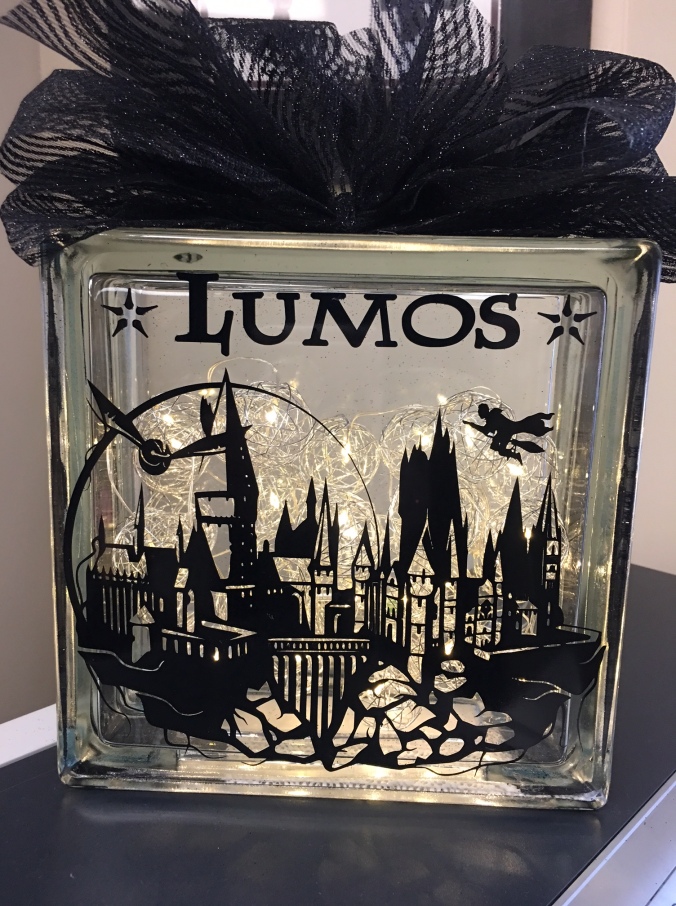
Lumos

Yesterday a fifth-grader caught me in the hallway:

“Mrs. Haley, do you have a copy of Harry Potter and the Chamber of Secrets in your room?”

 “I have two copies. Ask your teacher if you can walk with me to get one.”

He did. As we walked, I said, “The Chamber of Secrets is a great book. I enjoyed it more than The Sorcerer’s Stone.”

“Yeah, I haven’t read Chamber of Secrets. I saw the movie and my favorite part is when Harry gets the cloak of invisibility and finds that mirror where he sees his family.”

“Ah, the Mirror of Erised … I just read that aloud to two classes at another school last week while they were studying fantasy.”

In that chapter, Harry receives the cloak of invisibility at Christmas with an anonymous note explaining that it had belonged to his father; he is admonished to “use it well.” He sneaks around Hogwarts, hidden by the cloak, and ends up in a remote, off-limits part of the building in what appears to be a storage room. He finds a large, ornate mirror. Erised backwards is desire – looking in the Mirror of Erised shows a person the deepest desires of his or her heart. Harry’s family is dead; he desperately wishes he could have known them. He is transfixed by their images in the mirror – they wave at him, and his mother wipes away her tears as she smiles at Harry.

I think, as I rummage through my basket of Potter books, Fascinating how it’s the humanity that draws us, more than the magic. 

“Here you, go,” I say to the student. “The Chamber of Secrets.”

His face lights up when I place it in his hands. “Thanks, Mrs. Haley!”

“Read it well,” I call after him, as he walks away, flipping pages.

I look around my room, my own chamber decorated with Potter memorabilia that draws children from across grade levels. They love to drop by to show me their owl collections, to ask if I’ve read The Cursed Child, to share anything Harry Potter that they’ve recently acquired. The Harry Potter club meets here twice a month, students from third through fifth grades, and we talk so much more about what motivates the characters than the magic they employ.

My Lumos glass box gleams in the corner by the doorway. I think of all the times that teachers might wish we had magic wands to show us everything the kids need, to fix all that needs fixing. I recall J.K. Rowling’s quote from her 2008 Harvard speech, now connected to her Lumos charity on behalf of children:

“We do not need magic to transform the world. We carry all the power we need inside ourselves already.”

It’s apparent whenever I read with the kids, whenever the Potter club meets and someone has an epiphany about a character, whenever I walk into a classroom to write with students and teachers. The essence of teaching, of reading, of writing more than anything else, is the connection of human minds and hearts. It’s all part of same story, the triumph of the human spirit. Teach it, read it, write it well – tap into all you’ve known, all you’ve loved, all you’re wrestling with, and watch their faces.

It’s all inside you. Light the way.

slice-of-life_individualEarly Morning Slicer


Writing the truth

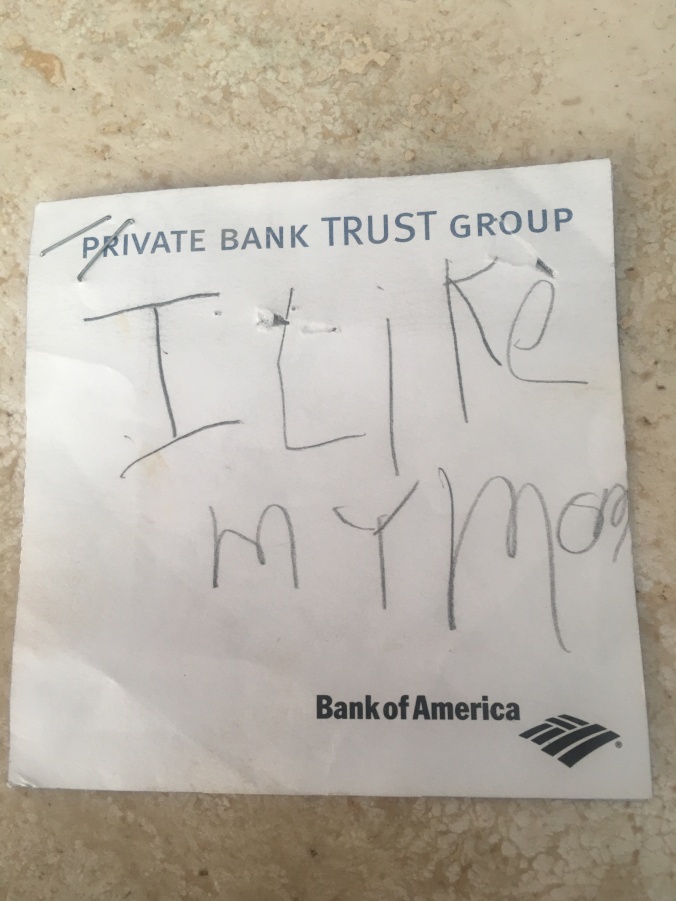
i-like-my-mom

Ernest Hemingway once said that it is the writer’s job to tell the truth. In A Moveable Feast, he describes his process:

“All you have to do is write one true sentence. Write the truest sentence that you know.”

I am sharing here one of the truest pieces of writing I have ever seen.

The background: When he was small, our younger son often went with my husband to church early on Sunday mornings. The little fellow sat in the church office and busied himself with writing sticky notes that he delivered to me on my arrival.

I saved them – they’re all in the bottom of my jewelry box.

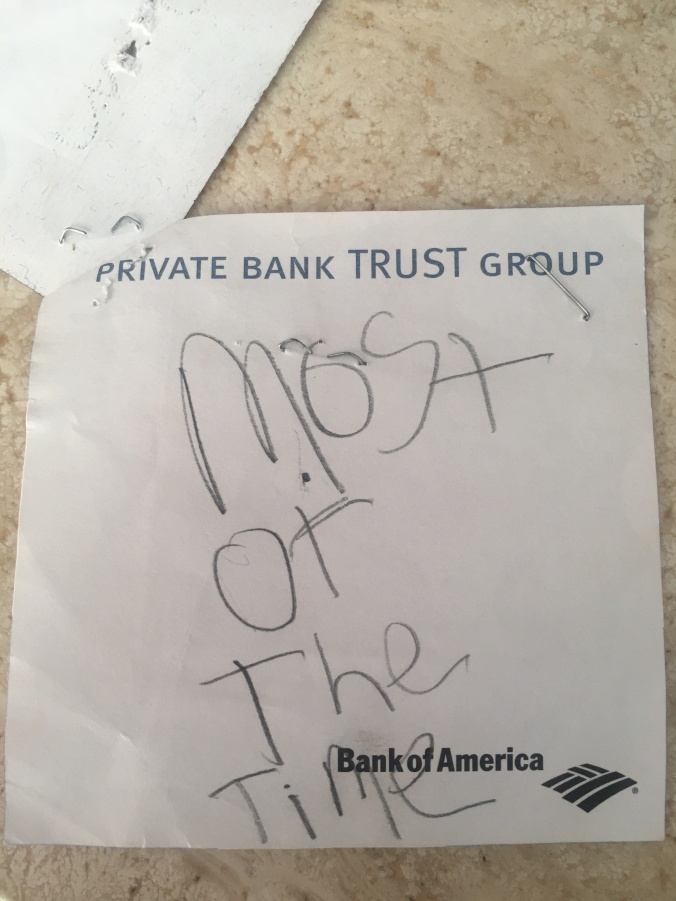
This one is my favorite. As you can see, the note says “I like my mom.”

Not love, mind you . . . .

But this is a two-pager (see the staples?). The sentence continues on Page Two:

most-of-the-time

“I like my mom – most of the time.”

I ask: Has a truer sentence ever been written?

slice-of-life_individual

My Patronus

As a headmistress and co-founder of my school’s Harry Potter Club, I was recently admonished to take the Pottermore Patronus quiz, as all other Patronus quizzes are essentially heresy. I approached the task with a bit of trepidation, having heard of people attaining aardvarks and the like.

For the non-Potterite: The Patronus charm produces a silvery animal guardian, usually representative of the individual casting it.

Being a fantasy fan since childhood, and considering my headmistress role, it was necessary: I plunged into the virtual dark forest to seek my symbolic protector. On the site, ghostly words appear in groups of three amongst the trees; the seeker chooses one and is moved onto the next set. At one point in this quest, when I paused too long, the words evaporated with a reprimand: “You are too slow. This game requires quick reflexes.” Silently chiding myself for overthinking simple word choices, certain that this blunder would land me with an armadillo or caterpillar, I picked up my pace. At last, in the ominous forest, a silvery shape materialized.

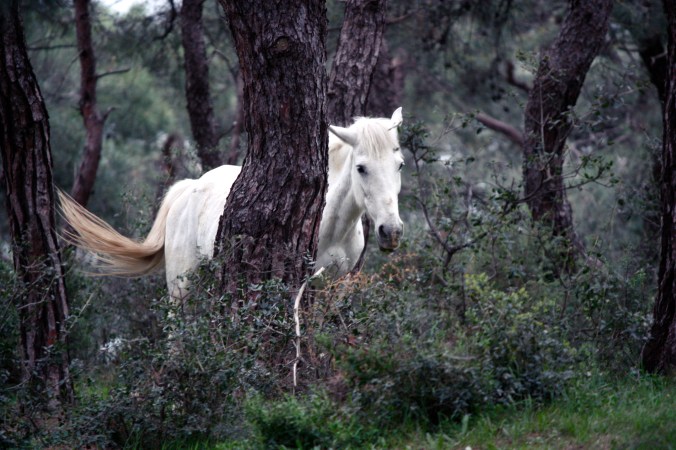
A white mare.

Beautiful and powerful, my white mare galloped through the forest, luminous against the darkness. Enchanting.

My next quest, naturally, was looking up the symbolism.

From various sites, the synthesis is that a white horse represents wisdom, power, loyalty, heroism, nobility, victory – encouraging, yes, but also inversely raising an intrinsic, lofty bar: am I worthy of the white mare? Do I deserve her? Never mind the fact that I gained her by playing a game with an end product based solely on word choices, not short answers or soul-searching responses. The writer in me delves deep into the metaphorical.

I already knew that white horses can symbolize death or the end of the world. They are considered psychopomps, creatures that guide human spirits on their journey from Earth to the afterlife.

As I pondered these connections, my Patronus suddenly conjured up road trips with my father and sister. Three hours is an eternity to young children cooped in a car, so to pass the time, Daddy taught us a game he played as a child:

“When we go by any horses, if they’re on your side of the street, you get a point for each horse. If you have a white horse on your side, it’s worth ten points, because you don’t see many of those.”

My sister and I instantly glued our faces to our respective windows, for we’d been by these random pastures before. We’d often seen horses grazing, strolling, sometimes galloping. I was sure – I just knew – I’d get a white horse. Maybe more than one!

“The thing is,” Daddy continued, “if we pass a graveyard, and it’s on your side of the street, you lose all your horses.”

So we played the game. My sister and I gained horses with glee, then lost them with loud groans, without realizing that one of us would win on the journey to the destination and the other would win on the return trip.

Daddy drove on in peace, smiling to himself.

How many horses I won and lost, I’m not sure, nor do I recall how many were white, only that they were there by the wayside on a long, tiresome journey. Those white horses are obscured by time now, very dim, but still real, ever more priceless, in my misty memory.

Enchanting, indeed, that one should reappear as my guardian after so many years, and that I should have gained it in a game venue that didn’t exist when I was a child.

Daddy, I think, would be pleased. Perhaps he is, from his place on the other side.

Reflect: What creature might symbolize you, and why? I’ve often played a game with students, challenging them to think of an animal that begins with the first letter of their first names (I’ve always chosen fawn in these scenarios – perhaps I should change it to foal?). No two can be the same, so each student ends up with a unique animal and has to think of ways the animal might represent them or their lives. Think – and write. 


Shine

born-to-shine


This is the cover of my mentor text notebook, housing the writing I’ve done with and for children across grade levels.

I believe that every child is a writer, because every child has a story. Every child has feelings and ideas. The writing teacher simply shows how to tap into these feelings and ideas, to give voice to them, to organize them, so that the mind and heart of the writer impacts readers.

Writing is about the human experience: We are all born to shine.

We shine through our fears, our losses.

We shine beyond the choices we make and the choices of others, beyond the things done to us and the things we have done.

We shine no less in our failures than in our successes; in fact, in learning and pressing on, we shine the brighter.

We shine in knowing what to hold onto and what to let go.

We shine when we harness anger before it burns away all that’s of value within us.

We shine by leaving footprints of hope for others to follow, for the human heart runs empty on despair.

We are ALL born to shine. Whether or not we do is up to us.

Reflect:  In the book The Forgotten Beasts of Eld by Patricia A. McKillip, 1974, a mysterious creature had the power to turn people’s eyes around to see inside their minds; they died from what they saw there. Writer, know thyself. Look deep within. You will be surprised by what you discover – the beautiful and the not. Write – and shine.


Why I write 2016

writing

I write because it’s the closest thing there is to magic.

From words spring worlds.

Worlds of understanding, perception, knowledge – of humanity and of myself. I write to explore the world without and within, the real and the fantastic, the important and the insignificant, the extraordinary and most certainly the ordinary. Where there are ideas and images, there are words – lanterns for encircling thoughts, illuminating objects and scenes, mystically shining from one mind to another.

I write because the narrative voice in my head is continuously composing, often drowning out other important things.

The power of story compelled me to write when I was six years old, sitting at the living room coffee table with a pack of wide ruled paper and a fat pencil. A few years later, a teacher said, “What vivid descriptions! Keep writing.” Every year thereafter, a teacher strategically appeared to give a refining bit of feedback: “Wonderful writing. Here’s a way you can make it even better … and keep writing!”

I kept writing, even when my dad grumbled, “Why are you wasting so much notebook paper?”

Today, I write with children. I witness their discovery of their own voices, their courage in putting pieces of their souls on a page. I share in the excitement of their creations, in every little triumph over challenge. I work to empower teachers as writers, for the empowerment of student writers, that all might tap into the magic.

And I keep writing.

I write to wrap a cloak of immortality around everything I have loved – what was, what is, what will be.

I write to scatter the ashes of all my yesterdays, to walk in the light of all my tomorrows.

I write to celebrate having lived.

In honor of National Day on Writing, October 20.

Reflect: Why do you write? What have you wanted to write, but haven’t yet? Carve out a pocket of time today and begin. Tomorrow, repeat.