If ever I were to write a spiritual journey memoir, I might begin with this, one of my earliest memories…
She tells me to sit here on the braided rug. She places a wheel of colors on the floor in front of the silver tree, decorated with red and blue glass ornaments.
Watch, she says. Watch. She plugs in the color wheel’s cord and switches off the overhead light.
We are plunged into darkness. I shiver. There’s a small click and suddenly the room is ablaze with amber light. The tree before me is no longer silver but gold, glittering as if lit with thousands of tiny candles. The color wheel hums. Gold gives way to green, red, blue. The tree deepens to shimmering emerald, glows like redhot fireplace embers, descends into sapphire glimmers bluer than flames of the gas stove burners.
Everything is transformed by the light. The ornaments on the tree go dark, throwing sparks in the colors that touch them. Over by Granddaddy’s black recliner, the ashtray on its thin pole makes a long, flickering shadow. Its curved brass handle, a little leaping ram, gleams like pure gold. The moving colors make the ram seem a living thing. The knotty pine walls watch it all with a hundred unblinking eyes. The polished wood organ, with legs curved like a deer’s, reflects the whole scene…and nothing is as radiant as my grandmother’s smiling face, bending down to mine…
I can’t remember what she said, exactly, but her expression was one of joy. I would see it many times over in my life, most often connected with stories of my birth or upon seeing spotted fawns by the roadside or when receiving a gift from someone in the family. And always with snow and Christmas. She came into the world the day after Christmas of 1915 and left it the day before Christmas Eve, 2006. She never lost her childlike joy of the season.
This memory of her aluminum Christmas tree and color wheel is from the late 1960s, when my grandparents lived in an apartment near mine. Probably the Christmas I was three.
I did not know about separations then. Or loss. I did not know all that my grandmother had already suffered in her life, from deprivation to death. Neither of us could know the shatterings that lay ahead of us.
But in these shards of memory I see great love reflected. Something pure and bright despite the brokenness. My grandmother believed in Jesus and heaven. She tried to live it. She prayed, and even when her prayers seemed unanswered, even when she grappled with not understanding, her faith held fast. Try as it might, darkness could not overcome her bright spirit. It could not extinguish the flame of her inner joy. She sang hymns. She spoke of angels. She never would have thought of herself as a warrior angel, but she served as mine as long as she lived. She loved me fiercely.
God loves us fiercely. That is the story of Christmas. That is the song of the stars. That is the light I find reflecting in the sharpest shards of life. It is the holiness that remains in the unholy fragments. We catch glimmers of it. We desire this light, but then we want to bend it. We would color it our own way and to our own purposes. That’s the story of humankind. We want to be our own authority, not to submit, and then to play victim. Our vision of truth and justice is skewed. We want to judge without being judged. We don’t want to love everybody; we nurture our hatred of one another. We fail to see our self-worship and idolatry (except for when we deliberately choose it). We fall farther and farther away. We have lost direction and think we can find it on our own, despite the darkness of our hearts.
Yet…
I loved you at your darkest is my favorite paraphrase of Romans 5:8.
Thoughout life, iridescent sparks are sent to guide us beyond the brokenness. Like my grandmother and countless others who are imperfect but real conduits of God’s love, ever drawing us back to the awe and worship we were meant for.
Therein lies the real spiritual journey.
******
with thanks to my fellow Spiritual Journey Thursday witers and Jone Rush MacCulloch for hosting us in December.
My friend Kim Johnson chose the Spiritual Journey Thursday theme for October.
Kim is in the process of grieving her father. As she puts it: “I’m in the anger stage of grief, and along with everything else going on the world, I’m feeling the word COMPASSION calling to me as this month’s topic. I need to have more of it as I work my way toward acceptance.”
Compassion literally means to suffer together. The distress of another person sparks within us an intense desire to alleviate it. It is one of the purest facets of our humanity. Not mere emotion. Compassion is complex: I see your suffering. I am wiling to enter it, to help you.
There’s also a thing called compassion fatigue. It comes from prolonged exposure to traumatic events or being overwhelmed by the suffering of others, ultimately leading to physical, mental, and spiritual depletion. Our wellspring of compassion dries up. We find ourselves numb, in a desert devoid of hope, crushed beneath a boulder of distrust, breathing an atmosphere deprived of positivity. What is the point of it all, anymore?
The point is that we all need help. We want to get rid of the pain and anxiety eating us alive. We would heal ourselves, were it in our own power—even as our souls rage and wage war. Our fiery reaction, our fierce retaliation, is a temporary outlet that cannot bring true satisfaction, because it can never bring the peace we crave. How can we find peace when we are so unable to live peaceably? The fight is a wounded animal’s, a defense mechanism when existence is threatened. For…being alive… the innermost part of us is crying out against the knowledge that we will die.
I will speak now of the snake.
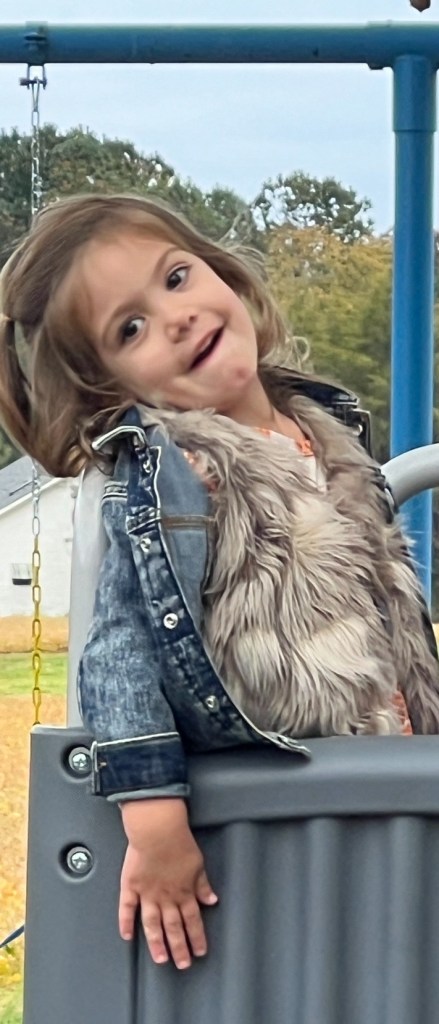
A week ago my granddaughter, almost four years old, asked: “Franna, do you like snakes?” She is asking all sorts of intriguing questions: Why is this your house? Why are you my Dad’s mother? She is forming her understanding of the world and affirming her place in it.
I answered as honestly I could. I do not want her to be afraid, like I was, for most of my life: “Do I like snakes? Not especially. But they can be helpful.”
Someday I will tell her how my Granddaddy taught me never to kill black snakes because they eat rats and mice. I may never tell her how he hacked copperheads to death with his hoe, or that when he became too elderly to manage the hoe, he shot them with his shotgun. It wasn’t that he didn’t like snakes. He was protecting his grandchildren and great-grandchildren from potential harm. Out of his love for us.
Note here how the spiritual journey employs foreshadowing. A thing is encountered; give it time. It is soon to reappear with greater significance. A portent.
The week after the snake question, I was at school, walking students down the sidewalk at dismissal, when I saw it, there on the cement by the edge of the grass: A little gray snake. Dead. Its body twisted, white belly frozen in an upward arch.
My first thought: It died painfully, in the act of writhing.
Second thought: Why aren’t the kids flipping out?
Not a one of them noticed the snake lying there.
Not that day, nor the next, or the next.
But I saw it, and it flooded me with…compassion.
For a snake, a creature I recently confessed to not especially liking.
It was alone. Abandoned. Not seen.
It was little. Not venomous (an earth snake). Not harmful.
And it was dead, with no one to acknowledge its existence or to mourn its passing.
I actually mourned it. I am sorry that it suffered, spiraling on itself in great pain as it died.
I am sorry we all have to suffer and die.
Every time I passed the snake the words mortal coil came to mind. Hamlet: When we have shuffled off this mortal coil…
I suppose that is the whole of the spiritual journey, is it not? Shuffling off this mortal coil. Someday shedding this battered body, being freed of the suffering.
Freedom from suffering is the very meaning behind the caduceus, symbol of the medical field. Snakes coiled around a staff. Odd. It just so happens if you research “symbols of compassion,” the caduecus appears. We do not think of it as representing compassion, but healing.
It is also linked to peace.
Many myths are behind the symbol, notably one in which the Greek messenger god, Hermes (Mercury in Roman mythology) saw two snakes fighting and cast his wand between them. The snakes gave up the battle and entertwined themselves peacefully around the wand.
In the Bible, God tells Moses to cast a bronze serpent and place it on a wooden pole as a cure for poisonous snakebite, a direct consequence of the people’s continued rebellion. God, out of his great compassion, provided a cure: Anyone bitten by a snake was healed of its venom by looking at the serpent on the staff, “high and lifted up.”
Herein lies THE point. Is there an antidote to the suffering we experience from the beginning of our existence, all the physical pain, mental anguish, and the thing we fear most—loss? Is it fighting venom with venom, or is it the active decision to stop battling each another, to cease provoking, retaliating, mocking, belittling, degrading, and causing more harm, until we seal our own destruction in utter carnage? Or is it a matter of realizing we’re all snakebit, and in the act of trying to alleviate another’s suffering, we ease our own? Can desperately-needed relief come in the very midst of our pain by desiring to help another….in compassion, “suffering together?” Not pulling others into our pain, but pulling ourselves into theirs?
Is this not THE point of Christ’s ministry and mission? He saw the suffering of people around him, out of compassion. He healed out of compassion. He wept at death for the ugly, unnatural thing it is, out of compassion. He was tortured and gave up his own life for broken humanity, out of compassion.
Compassion is born of love. Selfless love. Sacrifical love. As long as we have such love…we have hope.
Lest I sound too idealistic…today is my father’s birthday. A week ago today marked the twenty-third anniversary of his sudden death and the implosion of our family. It might as well have been dismemberment. Pain sliced us apart like a mighty warrior’s well-honed sword.
It isn’t supposed to be this way.
Someday, someday, we will shuffle off our heavy mortal coil and discover how great God’s compassion truly is…as well as his power to reverse and restore.
Until then, let us keep trusting. Let us wrap our wounds and our arms around each other. The pain will not disappear, not yet; but we can help each other through it.
That’s what the journey is for.
with special thanks to Kim — I hold you in my heart and prayers each day — and to the SJT band of writers, for so often inspiring me to rise above.
It’s been a while since I wrote a post, dear Reader and Writer Friends. Life keeps happening. The spiritual journey presses on, across craggy, unforgiving mountains with paths cut too near the edge; down through the valleys steeped in shadows and heavy rainfall; alongside the sea, where sun and salt pull at the wings of the soul longing to be free; and by the shady garden path where one can sometimes find an unoccupied bench to sit awhile, inhaling dewy flower-fragrances. —What is the spiritual journey, if not metaphor?
The beach is always the first summer getaway for my husband and me. Now that the children are grown and married, it’s just us…except for the new puppy, Jesse, now five months old (could this be a reason I haven’t written much of late? Indeed.). And so we headed east with our Jesse in tow.
We needed the break. There are a thousand reasons why. You have the same, yourselves. It so happens that this particular destination is in the quietest community we have ever experienced. New, colorful beach homes with impeccably manicured lawns, rustling palms, rippling birdsong on the ever-present stiff breeze —the ocean, making its nearby presence known. Human voices are almost entirely absent here. We marvel at it. Almost eerie but for the incredible sense of peace and intense sunlight that lasts longer than a summer day ought. Outside with Jesse, soaking up the radiant light, the silence, the rejuventating breeze, the word paradise comes to mind over and over. As does a longing for it to never end.
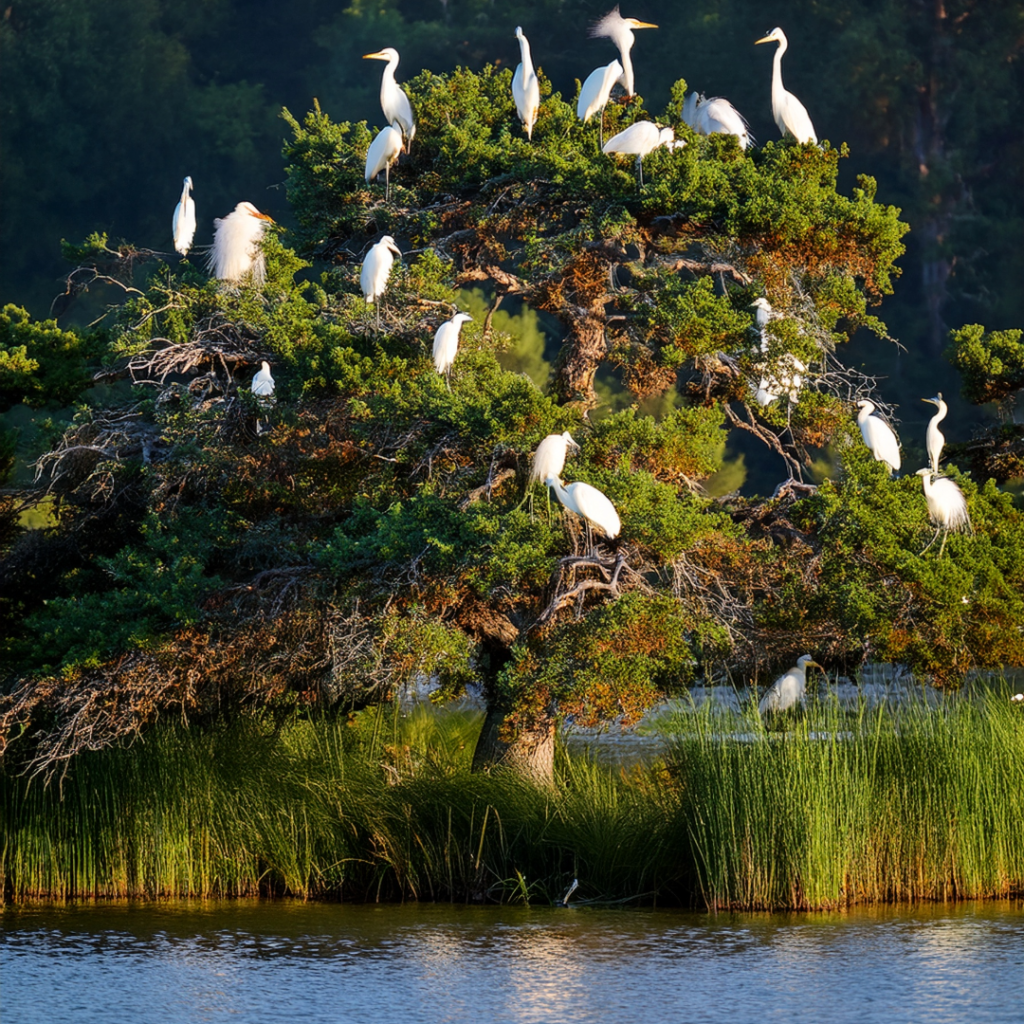
After dinner one evening my husband and I take a drive. I am the driver now; the loss of his eye and his heart condition make him nervous about driving the new car. This is how it is, now. This is how it will be, as long as our journey continues. On this particular evening, we travel to a beach our children enjoyed when they were small. The road meanders through marsh and lakes. As I am the driver, I can’t look at everything. I catch glimpses of big white birds sailing over the water. Egrets. Elegant. White as snow, poetry come to life. We round a bend and I see a whole colony of them, roosting in a tree by at the waterside.
I could not get a picture…even if I had, it would not do justice to the reality, the breathtaking beauty of that colony of big white birds in the deep, dark green tree by the still waters. Again, the word paradise returns to mind, with a fleeting recollection of being a little child in a bathtub singing a song I made up for myself: Bird of paradise, bird of paradise, you’re so pretty and nice…I don’t know what inspired me. Maybe I’d just learned the term “bird of paradise” and loved it for its lyrical feel.
How quickly time passes. One day a child splashing in a tub singing made-up songs, to—poof!—forty years married, splashing in the sunset chapters of life…still savoring the beautiful, all along the journey.
For it is there, it is there, if we but take time to see.
Thank God for the moments of awe and rest that only He can provide.
AI-generated image of egrets roosting in a tree by the water…does not do justice to the real sight.
*******
With thanks to Karen Eastlund for July’s Spiritual Journey “still waters” theme, and to my fellow SJT writers, who are such good company.
On the first day of May, Carol Varsalona offered the theme of “blossoming” to our group of Spiritual Journey Thursday writers. Carol’s husband passed away at the beginning of April. She writes in her post: “When I signed up to host the Spiritual Journey, I felt blossoming would be an appropriate theme for May since it connotes a renewal, a new beginning, and personal growth. I did not think that I would face the sudden death of my husband and go through a period of grief.” She dedicates this month’s post to his memory, along with a beautiful poem about him; you can read about her spiritual journey here.
Carol is one of the people who aways inspires me to see and savor the beauty of nature. Whenever I read her blog, it’s like taking a rest stop in a flower-filled garden, where one can breathe the fragrance deep and be strengthened for the journey. In her present loss, she writes of May flowers coming along to remind us of renewal and resilience.
To me the blossoming flowers are a metaphor for faith itself. The beauty of the earth pointing us back to the Creator, in a world that buffets us with fear, uncertainty, sadness, brokenness, rage, and loss. The peace and healing our human hearts desperately long for will never be found on this path. “All the world’s a rage,” to put a twist on a Shakespearean line. An ever-maturing faith is able to cut a path through anxiety, blame, and fear with which the world deliberately keeps distracting and demeaning us, where some of the worst pain is inflicted by those we care about most. As the saying goes: Hurt people hurt people. Faith does not retaliate. It withstands. It endures. It continues to bloom, and its fragrance beckons others to carve a better path through the the world’s dense, thorn-filled forest, to the inner garden. It is there, in our hearts. It has always been there…if we choose to see it.
In her poem, Carol wrote of her husband collecting a bouquet for her. I am reminded that one day, our faith will be made sight. We will BE the bouquet, the Lord’s very own, gathered unto him not as cut flowers but ones that shall bloom eternally in his presence, in that promised place where there will be no more tears, no more death, or sorrow, or crying, or pain (Revelation 21:4).
When I am still, I can feel the warmth of the sun on those flowers of peace; they open up, releasing their perfume in the soft breeze that infuses my soul.
Beyond this world’s brambles Lies a garden of faith-flowers— Opening, ever-opening to Sunlight—yes, the Son’s light. Our hearts are filled there Mind-rambles stilled there In the hush of His garden Nurtured by the Gardener’s Grace.
For Spiritual Journey Thursday (the first Thursday of each month), a fellow writer offers a topic for our group to reflect on individually. Then we write and share.
Today Ruth Hersey offers this: The topic I chose today, given that we’re in the second half of Lent, is Lament. The world has plenty to lament right now, and I suggest writing a Psalm of Lament…Aaron Niequist say[s] that a third of the Psalms in the Bible are about lament, whereas zero percent of modern worship songs are.
I’m not sure I’ve ever written a lament.
Biblically speaking, they follow a general pattern:
An address to God
A complaint
A request for help
Expressing trust in God
And so I started with the following. I almost deleted it, but am choosing to leave it as a record of my thinking and my heart:
Oh Lord, my God Creator of all you have always been there
before the beginning and never-ending
you have aways been there
in my joy in my pain in my sorrow in my rage
you were there
before I knew You when I forgot You when I ran from you
and when I ran to you
you were there…
I know these things to be true; however, I am losing the point of a lament, which is to be an expression of deep sorrow or grief, yet not without hope, and not without seeking the Lord and ultimately trusting. I think I struggle with laments because their anguished cries to God can sound somewhat accusatory. That is not the tone I want. It feels like misplaced blame.
And so I turned to Psalm 13. It is the model for my second lament attempt, here…
How long, Lord, will I forget that You are here in the midst? How long will I try to carry my burdens alone? How long will I grieve the ways of the world with human judgment clouding my heart? How long will my own flawed perspective blind me?
Look on me with mercy, oh Lord my God. Give me Your light, that I might see Your ways, Your workings, unaffected by humanity which makes of itself an enemy.
Only in You do I wholly trust for only holy You never fail. Grant me wisdom, strength, and grace all my days to live each one remembering and honoring You.
…it is still a work in progress, as are we all, thanks be to God, whose mercies endure forever.
Psalm 139 is my favorite of the psalms; I close here with its final verses as part of my daily prayer.
Search me, O God, and know my heart: try me, and know my thoughts: And see if there be any wicked way in me, and lead me in the way everlasting.
On the first Thursday of each month, a group of us gather online to write to a theme. We call this Spiritual Journey Thursday.
I’ve been out of the loop awhile. Today I take up the invitation again. Denise Krebs is hosting, and she has offered us the topic of wholeness:
What does it mean to be whole, on our spiritual journey?
I feel like my reponse could take a whole book.
Maybe that’s because I understand brokenness.
Last Sunday I wrote a letter to my mother after learning of her death (the post Strewn with loss). We were estranged for almost twenty-three years. It’s a story of mental illness, compulsions, a family paying a price, and no reconcilation. The truth is that after such a shattering we can’t wish wholeness into being; we can only find something of beauty in the pieces. We must learn to treasure that. To be grateful for it. The letter to my mother is to thank her for the beautiful shards amidst the brokenness. There are many. She loved me, once. I loved her. I forgave her. She never knew. She is gone. I could not fix her or the relationship. I had to learn to be whole without her.
The truth is that we are all broken in some way, and sometimes, wholeness doesn’t look or feel like being whole. It’s not perfection. It’s not even peace. It’s more like a path.
If we choose to take it.
To me wholeness being productive, fulfilled, and able to love. Three things I rely on to get me there: Faith, nature, writing.
I’ll take them one at a time:
Faith. I believe God is sovereign. God is at work even when we cannot see it or feel it, and when we can’t seem to make any sense at all of what we are living through. He often does his best work through the least likely people and in impossible situations (for nothing is impossible with God, Luke 1:37). In my current rereading of the Bible, what stands out to me, over and over again, is God’s provision to those who love and obey him. If I am to be honest about my own spiritual journey…I fail at this miserably. But that is the point. I am broken like everything else in this world. The desire for relief from pain or a racing pulse or an anguished heart or a reeling mind is the very desire that pulls me toward God. I do not have to understand ungodly things. I have only to seek God’s help in rising above them all. He will make a way. He will provide. This requires that I know more about him and so I study. Again…wholeness is a path.
Nature. I won’t go into my many bird stories here. I will just say that having a sense of awe, as in understanding that you are part of something greater than yourself, brings purpose and wholeness. It also brings wisdom; King Solomon “spoke of beasts and of birds, and of reptiles and of fish” (1 Kings 4:33). Says my study Bible: “Careful observation of the natural world and how it works it one of the ‘normal’ ways in which people gain wisdom… Solomon was concerned with the natural world.” Nature opens your mind and your heart. It imparts awe in abundance. Trees can communicate with each other. They try to help each other. When grass is cut, it immediately begins to heal itself; that’s the fragrance you smell. That very same chemical is also warning other grass that danger is near. The networkings of mushrooms is mind-blowing. It’s called “The Wood Wide Web.” Not long ago, a first grader told me earthworms are so important that none of us would be here without them (!). Nature offers healing. If you haven’t read Something in the Woods Loves You by Jarod K. Anderson…give it a try. He is frank about his battles with depression and how nature helped pull him out of the abyss and into a better place.
He writes:
Kindness won’t make you rich, but it will make you whole. I know there is hurt in your life…These pains stick to us like burrs. They tell us to lash out, to stop feeling, to turn away and turn inward… But these impulses do not control us. They don’t write our stories, and each time you hear them and answer, “No, not today,” you have given a gift to the world…The world will give back to you in kind, but receiving those gifts can take a little practice… Nature is out there and she is in you. Meet her halfway.
I do this, every day. I meet nature. I look for birds. And more. Here’s the thing: Start looking, and they will come.
So might the feathers of wholeness that grow into wings.
Writing. I haven’t done as much writing this past year as in previous ones. I could say life gets in the way. That I don’t have a lot left to give at the end of the workday. That I am busy with my family, from my husband’s health issues to savoring any time I can get with my granddaughters…these things are true, but they’re not all. The “whole” truth is that I am tired. So, when the March Slice of Life Challenge rolled around again, I decided I would not take it on. Despite having loved it in the past, the idea of writing for thirty-one straight days and responding to others tired me even more. And then I woke up in the wee hours of March 1st and thought, why not write, you will feel deprived if you don’t. And so I got up and wrote. The following day, I wrote that letter to my mother…something I realized I really needed to do even though she will never know about it. That doesn’t matter; she’s free of her suffering in this world. And once again I realized the power of writing. Since I took on the daily challenge, I haven’t been as tired, strangely. I’ve felt stronger. More able. More clear-minded.
More whole.
Most of that is due to you, my friends. Coming back to my writing communities is like coming home to a place of profound belonging.
What is wholeness? Being productive, fulfilled, and able to love. How to attain it? Through faith, nature, writing…
Thank you, my fellow travelers, for being such a vital part of my journey.
And my wholeness.
*******
with thanks to Two Writing Teachers for the March Slice of Life Story Challenge and to the SJT writers and to my friend Denise, for her invitation to “wholeness”
When I tell you your story in all the years to come you will remember bits and pieces on your own
because Three records memory
I will tell you of these days my own autumn in which you paint infinite points of opal-fire against charcoal-ash sky
because Three is alchemy
I will tell you how my heart sings at sight of you running as hard as you can your little arms held out to me, to me
because Three is utter glee
And I will tell you how I listen as still as I can be when you sing snippets of hymns… oh, always, always abide with me
beautiful Three ever holy
love you forever, Micahroni – Franna
*******
with thanks to Linda Mitchell for hosting Spiritual Journey Thursday writers with this invitation: “As we enter Native American Heritage Month I ask that you respond to Joy Harjo’s Fall Song in any way that makes your heart happy.”
Our two granddaughters make my heart and Grandpa’s as happy, and as awed, as they have ever been.We pray thanksgiving every day.
This week, my friends from across the country have reached out to see if my family and I are okay in the wake of Hurricane Helene.
We are. Here in central North Carolina we did not suffer damage like the western part of the state, where many people are dead and many more are still missing. East of us, a tornado flattened buildings in a city where my youngest son once served as a church worship leader.
Speaking of my son: He was in the North Carolina mountains when the storm struck. He and his bride spent the last day of their honeymoon without power, food, and water, trapped by downed trees on the only path to the main road. After someone eventually arrived with a chainsaw, my new daughter-in-law navigated their journey out by using her phone to pull up road closings.
They were fortunate to even have cell service. Thoughout the region, service failed just when it was needed most. It has yet to be restored in many places, meaning that families and friends still cannot communicate with loved ones.
Travel remains precarious. 300 roads are still closed, many of which are shattered with portions and bridges washed away. Mudslides added to the havoc of catastrophic flooding. The picturesque little village of Chimney Rock has been wiped out; “there’s nothing there,” says one eyewitness, except muddy brown water and debris choking swollen Lake Lure. A clogged sea of splintered wood and trash. A friend of mine was in Boone like my son during the deluge and saw a house carried off by the river; it floated away before her eyes. Asheville, a favorite destination and home to the famous Biltmore, is devastated. My husband and I watched the news unfolding and saw this beautiful city submerged. It looks wartorn. We no longer recognize the familiar streets where we love to walk. Recovery will extend well into next year, meaning that the major tourist season and local income is also destroyed.
We North Carolinians know that bodies are still being recovered (some from trees) and that the extent of the damage is not fully depicted in the news.
Words that keep recurring in the reports are transformed and changed. The mountain communities have been “utterly transformed and cut off from the outside world.” An artist with the River Arts District of Asheville, a hub of warehouses converted to thriving studios, galleries, music venues, and businesses, spoke to its ruination: “This changes everything.”
Loss does change everything. Life is forever categorized into before and after. Overcoming is a long, arduous journey, moment by moment, like breathing. Even though restoration may eventually diminish the pain of loss, soul-scars remain with us as long as we live. We are changed.
For those of you who pray, please do so for the victims of Helene. For those of you with means, please offer any help you can to organizations taking donations for those who have lost all. My school, my church, my community are doing so.
I think of the process of refining gold. I will not apply it to suffering and loss but to the effort of alleviating them. In this act, I believe, we are most transformed… in responding to the alchemy of the Spirit working in us to love our neighbors as ourselves.
It changes everything.
with thanks to all of you reached out to check on my family this week and to my fellow Spiritual Journey writers
My fellow Spiritual Journey writers post on the first Thursday of each month. Our host for September, Patricia Franz, offered these bursts of thought for reflection: Life at the speed of grace. Grace is my shorthand for God. How will Grace find you?
To me, grace, like love, is a many-splendored thing. It has many facets, casting fiery rainbow-sparks like a diamond ring.
When Patricia says It’s my shorthand for God, I remember discovering my aunt’s spiral-topped notebook when I was a child. The pages were covered in curious swirls and curls, an otherworldly language, impossible code. I was awed by the way my aunt, a civil-service secretary, could interpret these runes into words which would become an official letter typed on behalf of the U.S. military. To this day I cannot read or write shorthand. In this way, grace is code written in the offices of Heaven, authored by God, signed and sealed with His unfathomable, unconditional love. It is the language of love. To be a true recipient of grace is to be an authorized and expected giver of it, in turn.
But what IS grace, aside from aesthetics: clean lines, beauty of movement, a blessing over food before we partake? One dictionary definition says it’s the unmerited favor of God, something echoed over and over in the New Testament. My favorite grace-verse is probably Romans 5:8: God shows his love for us in that while we were still sinners, Christ died for us (ESV).
I have a bracelet that bears this paraphrase: I loved you at your darkest.
Grace.
In preparation for a lesson I recently taught at church, I arrived at another understanding of grace. In the same epistle to the Romans, the Apostle Paul writes: For by the grace given to me I say to everyone among you not to think of himself more highly than he ought to think, but to think with sober judgment, each according to the measure of faith that God has assigned (12:3). In this message to the Roman community of believers, Paul expounds on the characteristics that (should) set them apart from the rest of the world. That opening phrase is what catches my attention: For by the grace given to me…suddenly a portion of the code becomes clear. Grace is more than unmerited favor writ in the blood of unconditional love. Grace is a force for living. A sustainable fuel for powering us throughout all of our days.
I can never write about grace anymore without thinking of Eugene Peterson and his paraphrased reflection of Christ’s words in Matthew 11:29: Learn the unforced rhythms of grace.
Which of these word holds the most transformational power?
unforced
rhythms grace
Learn.
For me, it’s learn. That is where I must begin. Grace begins with God. The unforced rhythms of grace are currents that have existed long before me and will continue long after me. Learn, as in learn to swim. Therein lies a unique freedom, being carried by that current and never being swept away by it. Grace seeps into one’s heart, becomes a beat in one’s blood, in one’s soul. A rhythm, a song, a dance. A unforced force for living.
Learn.
Of this, I will be forever a student. But all around me, every day there are reminders, endless grace-analogies making themselves known. During Hurricane Idalia last week, the hummingbirds never stopped coming to my window-feeders. The gusting wind and rain appeared to have no effect on these tiny creatures. Completely undeterred, the feisty hummers came for their nectar amid the storm, steady, straight, and sure, same as they do every day.
I have an entire bluebird family that appears, morning and evening, like clockwork, around their little log cabin birdhouse on the old grape arbor. When the birdhouse was on my dilapidated back deck the parents raised several broods in it. When I removed it for the deck to be torn down and rebuilt, the puzzled parents came searching for their home. It shattered my heart. I put the birdhouse on the arbor, not knowing what to expect. They found it immediately. The bluebird family followed it. They still lay claim to it, still operate from it. They are devout about it. I might add that there’s a little cross on the top of the birdhouse; my granddaughters call it the bird church. I might also add that it held during the hurricane…during several hurricanes, actually, including a few before it was moved.
I consider the makeshift birdbath my granddaughters and I built with an upturned trashcan lid and rocks. The solar-powered fountain kept spraying in the storm, even though there was no sun that I could see in the grayness…
For me, all of these echo unforced rhythms of grace.
Most every morning and afternoon since school has started again, on my drive to work, I’ve seen the great blue heron I love at its pond in the corner of picturesque little farm. I’d much rather be birdwatching and soaking up nature than playing around online, but I couldn’t resist a “what bird are you” quiz I came across online. I gave it a try. The results: You are a snowy egret.
That same morning, when passing the pond, I didn’t see the blue heron. Instead I saw a white egret in flight, reflected in the pond.
The very image of grace.
I am more amused than awed: If that egret represents me, I’d be the reflection of it. I cannot be the breathtaking, winged creature itself, skimming with perfect ease above the water. But somewhere in my being is an image of it.
And so it is with God, in whom all things connect, from whom all blessings flow.
Unforced rhythms of grace on the wing, in every breath, in the often-turbulent currents of life, a never-ending song, a ceaseless rising.
Funny how I’ve just now remembered a thing, during this writing: When my husband became a pastor many, many years ago, I was asked to sing my first solo at church. I was twenty-two. Scared and unsure, I tried my best. I fell dismally short of what I hoped for. But an elderly man, a woodcarver, made a gift for me to commemorate the occasion: a white egret on a little base. Underneath, he etched the title of the song: Amazing Grace.
Let me throw my wings wide to rest in and ride the currents, O Lord. Let me abide in the depths of your grace as a wanting but willing conduit.
And so it comes to pass, at long last, that I return to the site of my sun-kissed childhood summers.
My ancestral homeplace in eastern North Carolina. Literally the land of my fathers: My dad, my grandparents, my great-parents, my great-greats were all born within a small radius of a tiny town and crossroads that were old long before my appearance on this Earth.
Thus began my fascination with Time.
In the bend of a dirt road stood my grandparents’ home, where my father grew up. My youngest aunt was born here in the same room where her father, my Granddaddy, would die fifty-three years later at 92. He wanted to die at home. He did, peacefully and “full of days,” as the Scriptures say of Abraham, Isaac, and Job: After this lived Job an hundred and forty years, and saw his sons, and his sons’ sons, even four generations. So Job died, being old and full of days (Job 42:16-17).
Likewise, my grandparents saw four generations. They lived to see my children. Incidentally, Granddaddy had a brother named Job who died in the 1920s (he drowned, if I recall correctly; this is a coastal area).
So it was that I grew up on stories of the old days and ways, a little city girl mesmerized by my deep country roots. In my time the once-thriving community was already history; nature was reclaiming the unpainted houses, one by one. Some were still visible through the woods (an early memory: a cypress shingle roof in the treetops, if you looked just right) and others were in various stages of falling down with yards still mowed by descendants.
On this return journey a few weeks ago, I discovered that my grandmother’s homeplace from the early 1900s is being swallowed by the forest:
A terrible jolt, as I can remember it having a hedge, a lawn, a porch swing, a screen door. I remember the layout inside and my great-uncle living there, tending to a patch of sunflowers.
And I knew, prior to this journey, that my grandparents’ house, which stood on the corner a little farther on, is gone.
This story is a little different, however. Instead of the forest reaching its veiny green fingers to reclaim its own, a young couple has built a home right in the middle of what was once my grandfather’s garden. I can’t help thinking how Grandma would marvel at the beauty of this new house and its lovely landscaping.
All that remains here from the enchanted summers of my childhood half a century ago (and from time before me) is the pumphouse, one of Grandma’s crepe myrtles (now wistfully draped in Spanish moss, which never used to be in these parts), and the sidewalk that once led to the front porch of Granddaddy and Grandma’s home:
As a teenager I wrote a song about a sidewalk. Haven’t thought about it in ages:
Where does this lonely sidewalk lead? You think by now I’d know Footsteps into yesterday That’s where I want to go…
I had no idea, then, that only the sidewalk would remain in this place I loved so well, where I used to play outside in the sweltering bug-infested heat, where Grandma would sit at her piano in the evenings to have me sing old hymns with her as Granddaddy listened from his recliner, where I felt loved and wanted and sheltered and that I belonged…
The old dirt road remains, too, of course.
There was another dirt road branching off of it here in the shadows to the left; it once led, Grandma said, to a two-story antebellum house with a double balcony. I could hear admiration for that house in her voice. In my childhood the road was just two tracks through grass and thickets. The path faded more and more with every passing summer. Now you would never know it had ever been anything but woods.
From this vantage point, my grandparents’ yard is on the right, and to the immediate left is an old family cemetery. Not my family’s, although I walked it often with Grandma over the years. When I was a child, I was afraid ghosts would come out here at night. Grandma assured me they would not. She offered this dubious comfort: No need to fear the dead. Fear the living.
When I wondered at the graves of so many babies, she said people just didn’t know what to do for them when they were sick.
It’s clear how much the children were loved and mourned. This tiny cemetery remains painstakingly tended and strangely outside of time:
Hello again, baby Leafy Jean and big brother Leon Russell.
These siblings died a month apart in 1917. Grandma was born three months after Leon, almost a year to the day before Leafy, in the soon-to-be obscured homeplace just around the bend of the road.
Four-month-old twins Audrie and Aubrie died a week apart during that same summer.
The greater wonder, in its way, are the children who survived disease and mothers who died giving birth to them, which almost happened to Grandma: her mother delivered a stillborn baby three months before she was born. My grandmother was a twin. Grandma journaled this because I asked her to; in her writings, she says several women in the community who recently had babies helped nurse her while my great-grandmother was so ill that she “almost didn’t make it.”
—Why am I just now realizing that Grandma’s lost twin would have come around the same time as Leon Russell? Could his mother have been one of the women who preserved my newborn grandmother’s hungry life? if so …imagine saving someone else’s child and losing your own…
So many mysteries in this place. I’ve always felt the pull.
Over fifty years after I first walked this cemetery with my grandmother, I’m awed by the good condition of the headstones. I halfway expected them to be eroding into illegibility — after all, these people’s earthly homes have long since crumbled. No greater mystery than Time…
I cannot linger here, ruminating, for there’s another place to visit. Really just a good walk “around the horn” to the church, a journey I’ve made many times.
This was once the heart of the bustling farm community. The church was built on land given by my grandmother’s predecessors. Her father, mother, brothers, and other family are buried to the right of this crossroads.
Granddaddy and Grandma are buried in the churchyard, to the left.
Such a beautiful little resting place, presently bordered by a lush cornfield. An old live oak felled by a hurricane in recent years has been replaced by a new one nearby.
Grandma would be so pleased to see how well-tended everything is.
There’s even a new footbridge over the ditch at the churchyard, for easy access to the little community center across the road. This building stands where Grandma’s three-room grade school used to, she said in her journal.
Here’s where old and new converge most for me, where Time is most relevant and paradoxically elusive. The spirit of this place is old; my own memories are growing old.
My father as a teenager, in the churchyard
I am the keeper of memories older than mine.
But I came for the new.
I brought my granddaughter, you see.
All along the journey, I told her stories. Of the old days, the old ways.
I brought her to dig for fossils at the Museum in town (which is where the phosphate mining company sends its rejects now, instead of scattering treasures on the old dirt roads).
We found a bit of coral skeleton, shark’s teeth, and some bony things I’ve yet to identify:
Making new memories from the old… even from the ancient, from time before recorded time.
As we were leaving, I discovered that the old library in this old, old town looks the same as it did five decades ago when Grandma drove me to pick out books to read at her house in the summer. I halfway expected to see her coming out with the armful she had to help me carry…
And I think this is used to be, or is at least near, the butcher shop where Daddy worked as a teenager.
There’s so much more to be said about memory, legacy, endurance, overcoming, and family… about the whole spiritual journey of life. The greatest gift my grandparents gave me, beyond their unconditional love and their stories, is that of faith lived out. I learned long ago that eventually there comes a homecoming so bright, so glorious, that all the former shadows are forgotten.
I expect I’ll recognize my little corner of Heaven, having had such a foretaste here.
Until that time, I carry on in the footsteps before me, praying I walk even half as well.
My now, my tomorrows ❤
From Everlasting to Everlasting: A Prayer of Moses
Lord, you have been our dwelling place in all generations. Before the mountains were brought forth, or ever you had formed the earth and the world, from everlasting to everlasting you are God.
You return man to dust and say, “Return, O children of man!” For a thousand years in your sight are but as yesterday when it is past, or as a watch in the night…
Let your work be shown to your servants, and your glorious power to their children. Let the favor of the Lord our God be upon us, and establish the work of our hands upon us; yes, establish the work of our hands! Psalm 90: 1-4;16-17
*******
with thanks to my Spiritual Journey friends who write on the first Thursday of each month and to host Carol Varsalona who posted this reflection and question for July:
Pause and praise God for His wondrous gifts! What are you rejoicing over this summer?