I bind unto myself

A Spiritual Journey Thursday offering for April.

Karen Eastlund beckons fellow SJT writers with the phrase “I bind unto myself today…”

It’s the beginning of many prayers compiled by the Northumbria Community in Celtic Daily Prayers. The phrase is also attributed to the Hymn of St. Patrick (see Cantica Sacra). Thank you, Karen, for the inspiration and blessing.

What prayer might I make, what claim might I stake, on these five words? What do I need to bind unto myself today, any day, every day? What do I hold most dear? What holds me?

It comes to me via pieces of Scripture—John 1:1-4, 6:63; Hebrews 12:2.

A pantoum:

I bind unto myself today
love of words
the Word, in the beginning
the Creator of all things    

Love of words
I bind unto myself today
the Creator of all things
speaking life

I bind unto myself today
the Word made flesh, who dwelt among us
speaking life
the Author and Finisher of my faith

The Word made flesh, who dwelt among us
the Word, in the beginning
the Author and Finisher of my faith
I bind unto myself today

Ashes

a combination Slice of Life & Spiritual Journey offering

I grew up hating ashes.

They were a part of my everyday life.

My parents were smokers. Salem menthols. When their friends came over or when some of my mother’s family gathered at our house, smoke hung in the air, thicker than fog, like some conjured ghost constantly materializing, encompassing, lingering…

Sometimes I was given the chore of cleaning out the ashtrays. A debasing job. Dirty. Ashes are pervasive. Everywhere and never really gone, no matter how hard you try. Even now, remembering, the stench is my nose, the metallic taste on my tongue…

It would be a long time before I’d learn the seeming incongruity of ashes as the main ingredient of an age-old cleansing agent. Lye. Which was also used to make hominy and that Southern staple, grits. In spite of my heritage, I never learned to like them.

It took me longer still to understand ashes as symbolizing something holy. Ash Wednesday and Lent weren’t part of my Protestant church or family tradition.

I got the humility part early on, however. From stories. First there was Cinderella, named for the soot that clung to her skin and her clothes from ashes that she (too!) was relegated to cleaning. Ashes are pervasive… then the Bible. Job, stricken with boils, scraping himself with broken pottery, sitting in the ashes. The repentant king of Nineveh mandating sackcloth and ashes after revival preached by the pouting prophet Jonah. Eventually, the vivid image of Tamar placing ashes on her head, sobbing, in utter humiliation and grief after the assault by her half-brother. Priests were commanded to change out of their sacred garments before disposing of burnt offering ashes.

Ashes are pervasive…

At fifteen I stood outside watching flakes falling from the sky in late May. Not snow at that time of year, in the southeastern United States. Ash. From the eruption of Mount St. Helen’s on the other side of the country. The volcano’s side exploded with such force that plumes of ash rocketed skyward for miles. The snowlike flakes settled across the nation and parts of Canada. I caught these curiosities in my hands. They didn’t melt. They looked to me like flakes of human skin.

I thought of war.

I think of war now. As I write, scenes are all over the TV. Bombs. Destruction. Death. What once was, now in ashes.

I think of the gorgeous churches of Kyiv.

I think of the dead.

My second son is a recently-certified crematory operator. Traditional burials are steadily giving way to cremations now. One day I went with him and watched while he placed someone’s ashes in an engraved box urn. These ashes are different from other kinds. Pale powder, fine as talcum. One of the most reverent acts I’ve ever witnessed, my boy tenderly packing that human dust.

The ancient Romans had a saying, Memento mori. Remember that you die. It is the same idea behind Ash Wednesday rites: Remember that you are dust, and to dust you shall return, echoing God’s words to Adam in Genesis 3:19, after the Fall.

I’ve never had a cross of ashes placed on my head by a priest, but I understand the call to repentance. It echoes deep in my bones. I know the desperate desire for holiness in the face of raging unholiness. The need for wholeness. I believe in repent and believe. I do. I repent. I believe.

I believe there’s an eventual reckoning.

Ashes are pervasive.

Volcano ash man. @Doug88888.CC BY-NC-SA 2.0.

*******

with thanks to Two Writing Teachers for the Slice of Life Story Challenge every day in the month of March. This is my sixth year participating.

Thanks also to my Spiritual Journey writing friends and to Ruth Hersey in Paraguay for hosting on the first Thursday in March. Ruth chose the theme “ashes” in connection with Ash Wednesday (which is why my post is going up a day early this month).

Heart healing

“Heart” is the Spiritual Journey prompt for this first Thursday in February.
Thanks to Linda Mitchell for hosting our group of writers.

On a Sunday afternoon at the end of July, 2019, my husband had a massive heart attack and cardiac arrest. He was resuscitated by EMTs and went straight into surgery after arriving at the hospital. He got four stents and spent several days in induced hypothermia to reduce trauma to his brain, which can happen when blood flow has ceased and is suddenly restored. He recuperated slowly, painfully; his sternum had been broken by the CPR which saved his life. He came home. One morning in September he woke to jolts in his chest and tingling down his arm. I took him back to the hospital. More heart attacks. This time he had four bypasses. The surgeon mended his sternum with a little metal plate.

He is doing well now. In fact, up until winter settled in, he was doing eight-mile hikes in the park a couple of times a week and feeling as good as he ever has.

As this first Thursday in February drew near with Valentine’s Day and “heart” as the Spiritual Journey prompt for the month, I thought of a couple of things I might like to explore. I had chosen one, in fact, when I saw the heart-shaped hospital pillow that remains in our bedroom. This pillow was given to my husband after the bypass surgery. His attending nurse wrote on it with a Sharpie: “Keep hugging your heart!”

I thought, this is it. This is what I need to write about.

These pillows are given to all patients recuperating from open-heart surgery. The patients hug them when they have to cough or sneeze, lessening the severity of the jolt. The pillow protects the incision site whenever the patients move and when they practice the necessary deep-breathing exercises for their lungs.

It just so happens that the hospital where my husband’s surgery and recuperation has the lowest mortality rate in the country for heart bypass patients (according to reports from 2017-2019). It also just so happens that the county’s resuscitation rate is the highest in the nation. So, if you’re going to have cardiac arrest and need cardiac surgery, it’s the best place to be.

My husband is evidence of this.

I think about the surgeon who held my husband’s heart in his hands, who grafted those bypasses. He told us that as soon as the first graft was done, my husband’s heart immediately began beating stronger; it was hungry for the blood. It wanted to live.

Now. Where’s the spiritual element in all this, you ask?

Beyond the miracle that one human can cut open another and repair his heart, and that this repaired person can heal and live life awhile longer, is the Great Physician who is able to transform hearts and lives. When I was young, I attended a Bible study group in which a couple of guys could play guitars and we’d often sing this version of Psalm 51:10-12:

Create in me a clean heart, O God
and renew a right spirit in me

Create in me a clean heart, O God
and renew a right spirit in me

And cast me not away from thy presence, O Lord,
take not thy Holy Spirit from me.
Restore unto me the joy of thy salvation
and renew a right spirit in me.

Godly heart-grafting, I would say. Cleansing, taking away the bad parts, restoring. The heart must be transformed before the spirit can be renewed. Sometimes a great deal of work must be done…but the Lord is able. If we let Him work. If we are hungry for it. We often think of letting Him into our hearts but it’s really more a matter of offering our hearts—battered, damaged, tangled, sick as they may be—to Him. He knows exactly what is needed. Psalm 51 is the cry of David’s heart after Nathan the prophet confronted him with his adultery and murder. It can be the cry of any of our hearts as we place them in the healing hands of Almighty God, craving His mercy.

I rejoice that my husband lives, that he was made well, that the hospital and the EMTs are the best around.

I rejoice more that the Lord forgives and heals hearts and spirits. He works on my own, daily. He is the physician and the pillow, the healer and the comforter. The ultimate heart-hugger. He is the best place to be.

Not to mention that His own mortality record is unsurpassable.

Spiritual journey: Awe

On the first Thursday of each month I write with fellow sojourners about our spiritual journeys. Margaret Simon leads the way on this first Thursday of 2022 with reflections on “one little word,” the writer-tradition of choosing a focus word for the year (thank you for hosting, Margaret).

This is the first time I have carried a word over from one year to the next.

Last year awe chose me by appearing in a quote on my planner when I had pretty much decided I wouldn’t choose a word. Perhaps the pandemic had left me jaded. Or simply too bone-tired to care. Nevertheless, there it was, an invitation to seek awe.

I accepted.

I never imagined all the awe that awaited in 2021.

The first grandchild was born into our family. Her big sister came to us by marriage at age three. She had been wishing for a little sister.

God is especially near to children.

Awe.

Baby Micah looks at me with the very eyes, from the very face, of my firstborn son. My husband and I wept at first sight of her.

Awe.

We lost one of our dearest friends in 2021. His last words to me were in response to one of my posts on awe: You are awesome in every way. Years ago he played Santa Claus at church for the children, when my oldest (the current new dad) was three. Nobody loved Christmas better; we spent every Christmas Eve together when my children were growing up.

He’s attained Heaven now. My youngest son, who’s become a funeral director apprentice, helped prepare his body for burial.

A symmetry, a grace.

Awe.

As the year ended last week, my family rescued a robin caught in the grille of a car after a trip down the interstate (read about it here if you like: The Robin). I couldn’t believe it was alive, that we were able to extricate it, or that it was soon hopping around my backyard eating worms in the unseasonably warm December.

Awe.

It chose me in 2021.

I am choosing it for 2022.

If you search the Internet for the benefits of awe, you will find lots of information: Awe reminds us that we are small parts of something vast and that’s good for us. It makes us care more for one another. It makes us healthier, calmer, more focused, more humble, less concerned for material things.

Spend time in nature and you’ll experience awe. Everything is connected, everything. I have seen a shy beige earth snake in the flowerbed glowing with bioluminescence. I have seen a deer running alongside dogs in a field, playing.

Spend time with children and you’ll experience awe. In the way that they see the world. In the way that they trust. And laugh. And dance. And sing. And love. Jesus said: I thank you, Father, Lord of heaven and earth, that you have hidden these things from the wise and understanding and revealed them to little children (Matthew 11:25, ESV).

Write, and you will experience awe. Yesterday I wrote on an unusual paraphrase of Jesus’ words in Matthew 11:28-30: “Learn the unforced rhythms of grace.” That line may stay with me forever. There is a flow, a pattern, a choreography to grace. As there is to the stars. Something too beautiful for words.

To realize that one is the recipient of God’s grace is awe. That He means for us to be free and not burdened is awe. That we exist at all, on this blue planet in the vast universe, is awe. That he wants us to learn of him is awe. That we play our short part in an ongoing story of humanity, forgiveness, redemption, and incomparable love, is awe. To know that unseen angels surround us is awe.

I know many stories like the one my grandmother told me, how people in farm communities nearly a century ago used to take turns sitting with someone who was sick and dying. It was Grandma’s turn to sit with the mother of her friend, Amanda. The old woman had been unresponsive for days, when all of a sudden, she sat up. Her face shone; she looked young again. She began to laugh: “Can you see them? Can you see them?”

She died that day. My grandmother never forgot the awe.

When it comes to spiritual journeys, be sure to invite it.

It is the fuel of eternity.

*******

also shared on SOS-Sharing Our Stories: Magic in a Blog, with special thanks to Ruth for the “unforced rhythms of grace” inspiration.

x

On waiting: Spiritual journey

All dressed for church
waiting for our ride
because Mama doesn’t drive
never got her license:
I get too nervous, she says—

so we wait while she watches
through the picture window
where I see our reflection: 
Mama, little sister, and me
against the empty street beyond

after a while she says
you might as well change
we have been forgotten

her voice is strange 
and when I look up
there are tears

sliding down her cheeks.

excerpt, “Picture Window.” Draft poem, F. Haley

On the first Thursday of each month, a group of us teacher-writer-blogger-believers post spiritual journey reflections. Today Chris Margocs hosts our gathering on her blog, Horizon 51. We are writing around the theme of “waiting, with a side of hope.”

Earlier this year I wrote those lines above, remembering the scene from long ago. My mother had asked another church member to please stop by and pick us up. We waited, and waited…until my mother understood the ride wasn’t coming. And cried.

I might have been six or seven. I wasn’t too upset about changing my clothes (likely a dress made by my mother) and not going to church. But I was sorry for my mother’s sadness. I couldn’t understand being forgotten.

My childhood pastor once preached on Isaiah 49:15: Can a woman forget her sucking child, that she should have no compassion on the son of her womb? Even these may forget, yet I will not forget you.

I couldn’t understand that either, at the time: How can a mother forget her child? It seemed impossible, inconceivable…

Decades later, as a mother and grandmother myself, I decorate for Christmas with exceeding great joy because of the new baby in our family. As I plan and wrap and make preparations, humming along to holiday music, I can’t imagine ever forgetting my sons, my little granddaughters. I would cease to be me if I did. They’re such joys. Layer upon layer of richness and fullness on all of my days. But mothers can forget. They do forget. There are mental health issues. Addictions. Illnesses. Diseases. Destroyed relationships. A number of things can separate a child from a mother’s love and from her memory.

The Apostle Paul wrote: For I am sure that neither death nor life, nor angels nor rulers, nor things present nor things to come, nor powers, nor height nor depth, nor anything else in all creation, will be able to separate us from the love of God in Christ Jesus our Lord (Romans 8:38-39).

How this links to God’s promise in Isaiah: I will not forget you.

Christmas is a reminder of exactly that.

We are not forgotten; we are not alone. The prophet Isaiah, again: Therefore the Lord himself will give you a sign. Behold, the virgin shall conceive and bear a son, and shall call his name Immanuel (7:14).The Gospel of Matthew repeats this prophecy as fulfillment in the first chapter detailing the genealogy and birth of Christ: Behold, a virgin shall be with child, and shall bring forth a son, and they shall call his name Emmanuel, which being interpreted is, God with us (1:23).

Words that resonate. God with us. Every day, all the time. How long a wait it was—around eight centuries—from Isaiah’s prophecy to the coming of Christ.

A long, long wait…but we were not forgotten.

That church member from long ago apologized profusely to my mother for failing to pick us up that day. My mother, I presume, graciously forgave. Whenever the weather was nice, we walked to church, my mother, my little sister, and me. I couldn’t know then that my childhood pastor would ordain my future husband to the pastorate one day. I just walked along, hoping Mama would take us to Hardee’s for lunch afterward. The Looney Tunes glasses we collected from those after-church excursions remain in my cabinet to this day, much as memories rest on the shelves of my mind. They are a treasure. I do not want to forget.

My childhood pastor would eventually tell me that when the church’s bus ministry began, my mother was the first person to sign up. No more waiting for rides that might not show. God provided the vehicle to get us where we needed to go.

He always does. In the fullness of time.

Even now, I hear the distant chiming of those church bells of years long gone:

Savior, Savior
hear my humble cry
while on others Thou are calling
do not pass me by.

He hears. He is here. He remembers.

So do I, Mama.

one of my favorite Christmas cards

*******

with thanks to Chris and all my dear Spiritual Journey friends

a blessed Advent to all
the first candle lit on the Advent wreath this week symbolizes hope


Reflections of gratitude: Spiritual journey

For my newborn granddaughter, Micah

What shall I tell you about the day you were born?

Your Grandpa and I were waiting in the carpool line to pick your big sister up from kindergarten when your dad texted: Micah is here! 9 lbs!

Gratitude flooded our hearts as photos flooded our phones.

We wept at sight of you. Your sister would say “happy cried.”

Looking at your beautiful rosy face, a thousand thoughts fluttered in my mind, like birds descending from the azure sky, landing one by one on soft, moss-covered branches…

I remembered it was supposed to storm that day, and it didn’t; the late October sun shone for all it was worth, illuminating the countryside with brilliant gold, orange, yellow, and scarlet.

I forgot the shadows, worries, and grind of daily life.

I remembered the story of my own birth, told over and over to me by my grandmother: She, Daddy, Granddaddy, and Grannie stood looking at me through the nursery window, Grandma “happy cried,” Daddy said I looked just like Granddaddy.

I forgot to be sad about not going to the hospital to see you on the day you were born due to limited visitors in COVID protocols.

I remembered that I’d be able to come the next day, and that it would suffice.

I forgot there was even a pandemic.

I remembered the joy of your father’s birth, the fierce motherlove which surged in my veins, which surges still, and exponentially now, for you.

I forgot about fearing my own inadequacies.

I remembered to wear Grandma’s locket.

I forgot, until your curious big sister opened it, that your father’s newborn picture was nestled inside.

I remembered the promises of God, that blessings fall on the generations of those who love Him, my precious, precious baby Micah, daughter and granddaughter of pastors: Know therefore that the Lord your God is God; he is the faithful God, keeping his covenant of love to a thousand generations of those who love him and keep his commandments (Deuteronomy 7:9, ESV).

I have never forgotten that.

Thankful for the infinite grace of God. Love you always, Micah. – Franna

********

with thanks to Denise Krebs for hosting November’s Spiritual Journey Thursday group, with a focus on gratitude.

and also to Two Writing Teachers for the weekly Tuesday Slice of Life Story Challenge.

I am deeply grateful for you all.

Here

a Spiritual Journey offering

in memory of my father

and in honor of Micah, my granddaughter
who will be born later this month

*******

Meanwhile the wild geese, high in the clean blue air,
are heading home again…
the world offers itself to your imagination,
calls to you like the wild geese, harsh and exciting — 

over and over announcing your place
in the family of things.

Mary Oliver, “Wild Geese”

October is here
and with it, memory:
it is the month

of my father’s birth.
I am here
because he was here
once upon a time.

October is here
and with it, wild geese

coming home.
My father loved them
like he loved planes
in the wild blue yonder
of his service years

when he was young.
At his funeral procession
a flock of wild geese
stood by in solemn ranks.

He chose to be buried here
so Air Force jets
would fly over his grave

every day.

October is here
with its fiery oranges, reds, golds
and heartrending blue.
Blazing colors that are here
for just a little while,
coming and going
before the long sleep
and eventual rewakening
.

October is here
with its bright story
of permanence
cloaked in

the temporary darkness
of impermanence.

October is here
with its beckoning to
see, smell, taste, feel, know
life in all of its spice

and fullness,
never bound by a calendar,
a schedule, a checklist…

October is here
with its own organic order,
a natural reminder

of all our comings and goings
and of the taking of one’s place
in the family of things
.

October is here.
You will soon be here
,
firstborn child
of my firstborn child
.
I, too, am
the firstborn child
of a firstborn child
.
My father named me
for his mother.
Your father named you
for God

by whose infinite grace
I am here
to see your coming.

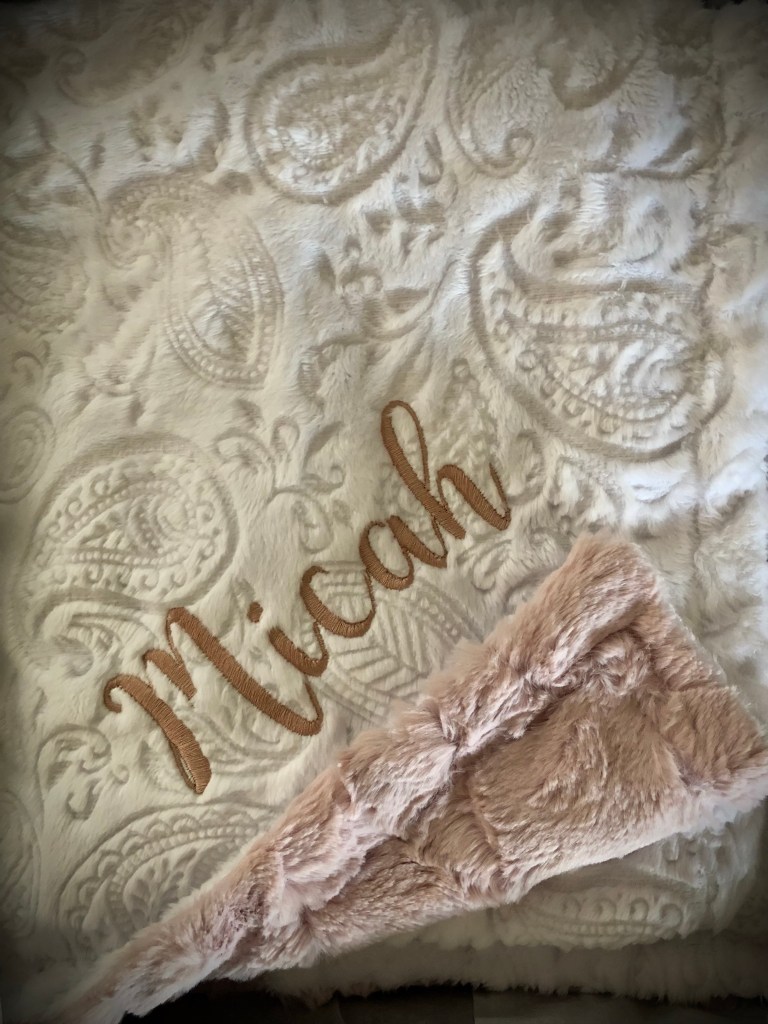
A downy-soft blanket and a whole lot of love are here awaiting you, little precious one.
Your name is one of ancient faith and praise: “Who is like God?”

*******

with much gratitude to Ramona Behnke, who inspired our monthly Spiritual Journey Thursday group to write around the word “here” with this quote from Emily P. Freeman’s podcast, Episode 188: You Are Here (And It Matters):


“What if you being all the way here actually mattered, with your cold feet and your stomachache and the light shining through the window. You with your stack of books, by the bedside table and hopeful feeling inside your heart. You with your deep grief, over a loss you thought you’d be over by now, standing in the kitchen while you microwave your coffee. For now, this is true. So what is true of you? And do you really believe God is with you no matter what? That you are not alone, that you don’t have to be you all by yourself? Here’s to being where you already are. Fully present with all that is true. And then here’s to doing your next right thing in love.”

*******


Shield of virtue

A Spiritual Journey Thursday offering

with thanks to my Spiritual Journey writing friends and to Karen Eastlund for hosting on this first Thursday in September. Our theme is “virtue.” I began writing on this topic last month: What is virtue?

Allow me to start my circuitous spiritual journey route today with a question, Dear Readers: Do any of you remember a vintage device called Viewmaster? From back in the olden days before cable, videos, DVDs, movie channels, and Virtual Reality headsets?

My grandmother bought one for me in the early ’70s. It looked exactly like this:

My Batman & Robin Viewmaster 3D Viewer and Reels. 1966. Jimmy Big Potatoes. CC BY-NC-SA 2.0

You’d remove the reels, ever so carefully holding them by the rim, not getting your fingerprints on the little squares of film. Notches on the rim indicated proper insertion; these would be centered at the top. Then you’d hold the Viewmaster up to your eyes, aim for a light source—lamp, overhead fixture, or window—and voilà! The magical 3D scene would draw you in. When you were ready for the next scene, you’d push down the little lever on the right.

I didn’t have Batman reels as pictured in the photo above. I had Lassie, Casper the Friendly Ghost, Bambi, some others I can’t recall at the moment, and the first set Grandma ever purchased for me: Sleeping Beauty.

I recall my childhood horror of Disney’s Maleficent and her curse on Princess Aurora, who was subsequently disguised as Briar Rose, relegated to living in the woods. My child’s blood ran cold at the spindle scene in which the young girl pricked her finger (creepy multiple hands appeared there), which ushered in her enchanted sleep instead of death…

Enter Prince Philip, her rescuer.

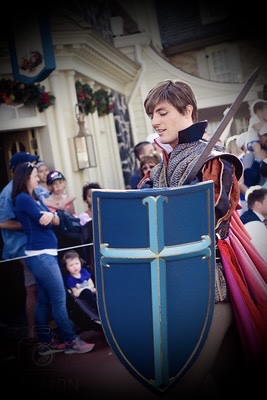
The good fairies Flora, Fauna, and Merryweather, always working on Aurora’s behalf, gave two objects to the Prince: The Sword of Truth and the Shield of Virtue.

That Shield of Virtue has lain dormant in my memory for decades.

Today I retrieve it, blow off the layers of dust, and consider its gleaming significance.

The Shield of Virtue (vignette). C-Lemon. CC BY-NC-ND.

The shield, emblazoned with a cross, protected Philip from Maleficent’s fiery breath when she transformed into a dragon; in the movie, she cries: “Now you shall deal with me, O Prince, and all the powers of hell!” (yes, this is an animated Disney movie made for children. Fairy tales, as you know, can be quite Grimm).

As I contemplated writing on the topic of virtue again, this shield kept rising to the viscous surface of my thoughts. It is more than a magical token.

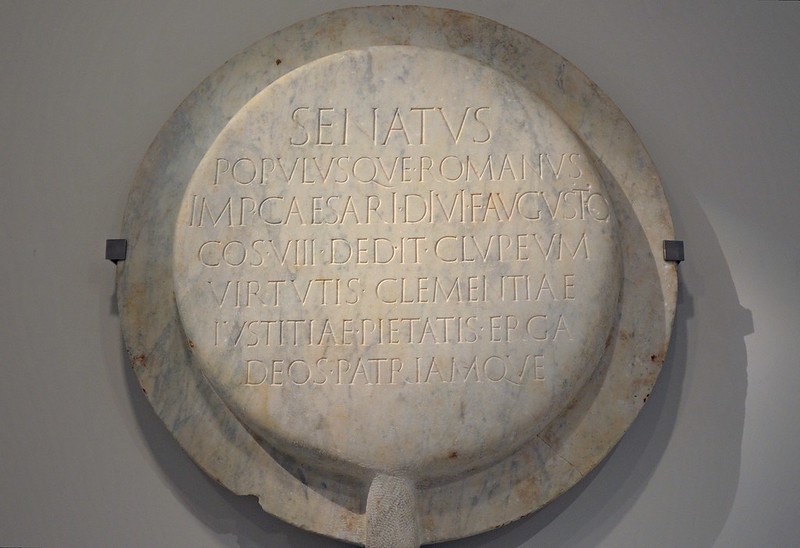
There’s a real Shield of Virtue. A gold one, awarded to the first Roman emperor, Caesar Augustus (Octavian), so inscribed: The senate and the Roman people give to Augustus, son of the divine Caesar, in his 8th consulate, the shield for virtue, clemency, justice, and piety towards the gods and his native land.

Marble copy of the Shield of Virtue (Clipeus Virtutis) of Augustus. Carol Raddato. CC BY-SA

The Shield of Virtue is a thing that was given. It denotes battle. Above all, valor. It is a defense. By very nature of its name, the Shield of Virtue represents high standards, mercy, fairness, loyalty, acting on behalf of others.

I return now to the spiritual journey. A path of treacherous turns, often littered with brokenness. Dark forests of encroaching thorns and dragonfire as ever the fictitious Prince Philip faced. Ongoing warfare, threat of destruction…

Armor is desperately needed. As Paul wrote to the Ephesian believers:

For we do not wrestle against flesh and blood, but against the rulers, against the authorities, against the cosmic powers over this present darkness, against the spiritual forces of evil in the heavenly places. Therefore take up the whole armor of God, that you may be able to stand in the evil day, and having done all, to stand firm…in all circumstances, take up the shield of faith, with which can extinguish all the flaming darts of the evil one…(Ephesians 6:11-16).

The spiritual battle is real. A shield is given; one of faith. It occurs to me that virtue and faith are inextricably intertwined. Courage is born of believing in something greater than oneself (my favorite definition of awe). Tapping into this disperses unique fuel in one’s veins, enabling one to grasp the shield and to power through, trusting. Scriptures repeat that the battle isn’t even ours, but the Lord’s. His faithfulness will be your shield and rampart… (Psalm 91:4).

Somehow, an acrostic seems called for.

Valor. Let it not be born of vainglory but of an
Infusion of love, of mercy, of divine strength.
Righteousness not fashioned by humanity,
Tempered and refined in heat of battle.
Upward, toward the light, let me always cast my
Eyes.

Strength to all.

*******

Another lens through which to view virtue, from my previous post on this theme:

Within the angelic hierarchy of Judeo-Christian tradition is a class of angels known as Virtues. They are connected to motion and order of the cosmos, dispensers of grace, exceptional courage, unshakeable faith, and miracles. They are balance-bringers; in a world so unbalanced of late, the angelic Virtues must have their hands full. As I write, I imagine them roaming the streets, unseen, fervently seeking ways they can impart divine strength.

What is virtue?

A Spiritual Journey Thursday offering


While walking with my son this week, out of nowhere a shape descends upon us…

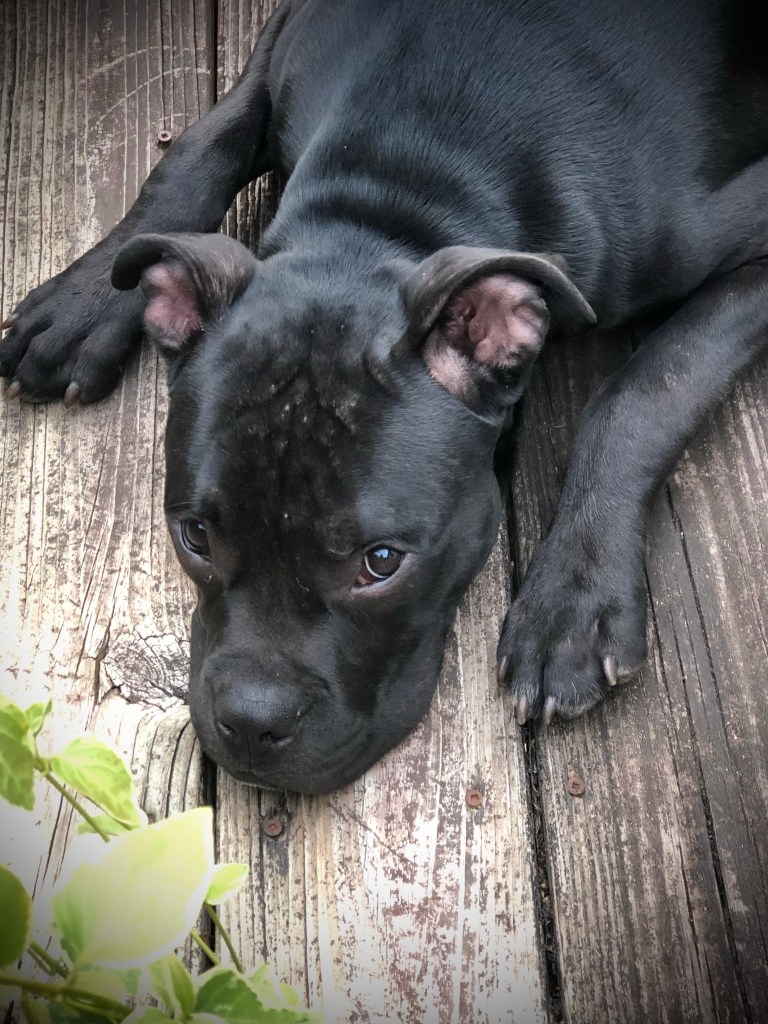
A dog. Not just any dog…

A pit bull.

Wriggling all over for joy, jumping up as if he knows us.

Begging to be petted and to play.

Glossy back coat, merry eyes, laughing face (yes really). Still a puppy, soft-mouthing our hands in greeting. Same as my older son’s pit, Henry, does.

“He is beautiful,” I say to my son. “He must belong to somebody.”

“I wish he was mine,” says my boy. Never mind that he already owns one of the mightiest breeds of all time: a dachshund.

The dog follows us home. We put him in our backyard until we can locate his owner. He doesn’t like being left alone. He cries when we are out of sight. He rejoices on our return. When we sit on on the deck chairs, he lies at our feet; when we rise, he rises to stand by, ready and willing to do whatever it is we are getting ready to do.

We learn from asking around the neighborhood that he’s roamed the streets before and that people shoo him away. Uninvited dogs, especially pits, are not especially welcome. I begin to think about harm that could befall him, aside from the danger of being in the street: What might a startled, frightened, or angry person do to him?

He raises his head as if he hears my thoughts. He looks at me with a wistful expression.

We find his owners. We send him home.

The next morning, he’s back. Curled up on our front porch mat.

Poor sweet boy. He shouldn’t be allowed to roam…or maybe he’s just an escape artist.

And I realize how powerless I am to do anything except hope for his safety and enjoy him whenever he should visit. He’s not mine and he’s disappeared again. I find myself missing him, looking for him.

He’s on my mind as Spiritual Journey Thursday rolls around; he seems, somehow, to be connected to the question, “What is virtue?” The four cardinal virtues of classical philosophy and Christian theology are Prudence (wisdom), Justice (righteousness) Fortitude (strength; overcoming fear), and Temperance (restraint; self-control). We usually think of virtue as people demonstrating goodness or excellence of character (the virtuous woman of Proverbs 31), or as the beneficial quality of a thing: patience is a virtue.

I cannot help thinking that this pit embodies virtue, too. He’s a good dog. He is loving. He is eager to share his affection and exuberant joy with whomever he encounters…he’s perceptive, willing to to serve, and, I suspect, highly trainable even if somewhat uncontainable at present. Above all, he’s one of God’s creatures.

Which reminds me that within the angelic hierarchy of Judeo-Christian tradition is a class of angels known as Virtues. They are connected to motion and order of the cosmos, dispensers of grace, exceptional courage, unshakeable faith, and miracles. They are balance-bringers; in a world so unbalanced of late, the angelic Virtues must have their hands full. As I write, I imagine them roaming the streets, unseen, fervently seeking ways they can impart divine strength.

I am not sure of connections between the Virtues and the mass adoption of dogs during the COVID pandemic…just musing over shapes that heavenly comfort, courage, and sustained strength might take.

Most of all I think about the desire to serve, to do good versus harm in a spirit of fear and distrust.

Perhaps…perhaps virtue arises where it is welcomed, and when it does, it opens our eyes to the virtue of others.

*******

with thanks to my Spiritual Journey writing friends and to Linda Mitchell for hosting on this first Thursday in August. As it turns out, “virtue” is supposed to be theme for September. Today the group is focusing on “respect.” I caught this after I wrote the post, alas, which leaves me with a choice: write another one and save this for September or let this one fly, regardless. I’m choosing to post now. It is, after all, written from a place of respect for the cosmically happy adventurer we’ve taken to calling “Harold.”

Apothecary of the soul

Today, the first Thursday of the month, my Spiritual Journey gathering writes around the theme of “Nurturing Our Summer Souls.” Deepest thanks to my friend, teacher-poet-artist Carol Varsalona, for hosting.

Summer itself is about journeys, is it not

In my previous post, A walk back in time, I told of a long-awaited trip to the Country Doctor Museum in the small town of Bailey, NC. I expected to learn about rural physicians and their practices in the 19th to early 20th centuries. I didn’t expect to be mesmerized by the first exhibit, a reproduction apothecary shop replete with show globes (which became the official symbol for pharmacies), exquisite leech jars, real live leeches, rows of dried herbs and powders displayed in large glass jars bearing labels of names so poetic and compelling I itched to look them all up right there on the spot, and black pills made in the shape of tiny coffins because they contain a measure of poisons like mercury, so an illiterate population would be mindful not to overdose.

I certainly wasn’t expecting the large painting on the wall behind the counter…

Apothecary of the soul painting, circa 1700-1750. Artist unknown.
Image: Joyner Library, East Carolina University.

It dominated the wall—the whole room.

“These ‘apothecary of the soul’ paintings are rare,” the docent told our tiny tour group of four, one other couple plus my husband and I. “Most come from Germany. You can see here that Christ is the apothecary. He’s holding the scales, weighing his Crucifixion against the weight of a man’s soul… behind them, jars are labeled with the virtues…we’ve had visitors who are fluent in German and they tell us that this is an old form of the language, much of it is complicated to translate…”

I can make out two Bible references, though. Here’s the King James translation:

Matthew 11:28:

Come unto me, all ye that labour and are heavy laden, and I will give you rest.

Isaiah 55:1:

Ho, every one that thirsteth, come ye to the waters, and he that hath no money; come ye, buy, and eat; yea, come, buy wine and milk without money and without price.

My tour group moved on too soon. I couldn’t linger to study the work at length, to grasp more of its symbolism, so I’ve since visited the Museum’s website for more information. There I learned that an apothecary may have commissioned the painting. Apothecaries wanted to draw people to their shops; they sought to be alluring, to the point of extravagance (hence the elaborate show globe towers and gilded leech jars). But imagine the effect on the ordinary townsperson, in need of help, relief, comfort, entering the shop to find Christ adorning the wall. If customers weren’t able to read the verses (from Luther’s 1545 translation of the Bible, I wonder?), they could see that Christ’s right hand holds the scales and that his sacrifice outweighs the man’s sins, represented by a horned beast. The man holds a banner reading My sins are heavy and overwhelming and grieve me from the heart.* Christ’s left hand rests on what appears to be crosswort, a plant often used to treat wounds, headaches, and other ailments, possibly representing a cure-all from the hands of the Great Physician (or Apothecary) himself: the dispensation of spiritual healing as well as physical, “without money and without price.”

I left the shop thinking about the level of trust one must have in the apothecary, and feeling as if I’d been on a pilgrimage versus a museum tour. This happened to be my first journey of summer, which has come at last, bright and beckoning, as the world strives to heal from the COVID-19 pandemic…

Here is to rest, ongoing spiritual journeys, and nurturing the soul.

*******

*Source: Apothecary of the Soul video, ECU Digital Collections, via the Country Doctor Museum website (see Learning). The Museum belongs to the Medical Foundation of East Carolina University, under the management of the Laupus Health Sciences Library.

Other Apothecary of the Soul paintings can be found online; they contain much of the same symbolism.