Henry writes again

Dear Readers:

Greetings!

As I’ve a few moments while My People are busy, it pleases Me to skim the goings on of this site.  I’ve been clicking through comments (literally clicking, the sound of My nail striking the keyboard) and have discovered, to My utmost delight, that many of you have expressed the wish that I write again.

It gives Me great pleasure to grant this wish.

I shall share My important work with you today.

I wake of a morning at approximately 4:00 a.m. Usually She is up by then and ready to attend Me. I exit my bedchamber and make My way into the Room of Dining, where I receive, in no especial order, a massage (if insufficiently performed, I simply nudge Her repeatedly until she does it again, to My satisfaction), a hearty breakfast of salmon nuggets for Sensitive Systems, and a brisk jog around the posterior courtyard. I re-enter the dwelling and wait for the fine tidbit that is given Me simply because I am Me.

Then I rest a while before awakening My other Servants. I give them ample time, but, as I am no sloth, and have little patience for slothery, eventually it becomes time for me to sit— with all due respect— outside of closed bedchamber doors, politely clearing my throat so that less-early risers will get the message: It’s time to get up.

Once I’ve roused the entire Staff, and everyone has greeted me properly, they go about grooming themselves. My important work is nearly done. By approximately 6:00 a.m.

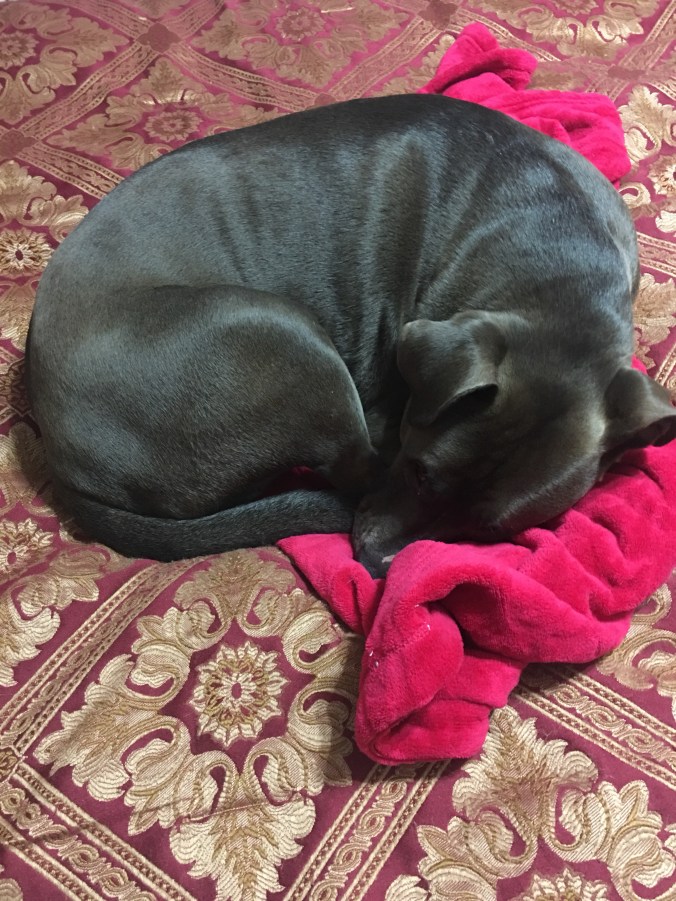
With the household up and running, I am ready for My morning nap. I retire to the master bedchamber, where the gilded quilt atop the bed is freshly prepared for Me. I perform My ceremonial turning, turning, turning, before situating Myself ever-so-comfortably in My luxurious robe of red.

Which smells most wonderfully of Her.

<sigh>

I wish for you an equally charmed day. And existence.

-My robe awaits. I shall meet you here again soon, perhaps.

Fondly,

Henry Rollins Haley (HRH)

P.S. Noting the lack of My own category on this site, I have chosen to take the high road. Rather than pointing out this glaring oversight to Her, in particular, I have simply created a category for Myself: “Henry Writes.” When not consumed by My important work as described above, I may write a few words. And, if you can figure out a way to send Me some of those magnificent tidbits through this screen, I would be most appreciative.

Thirty-four words

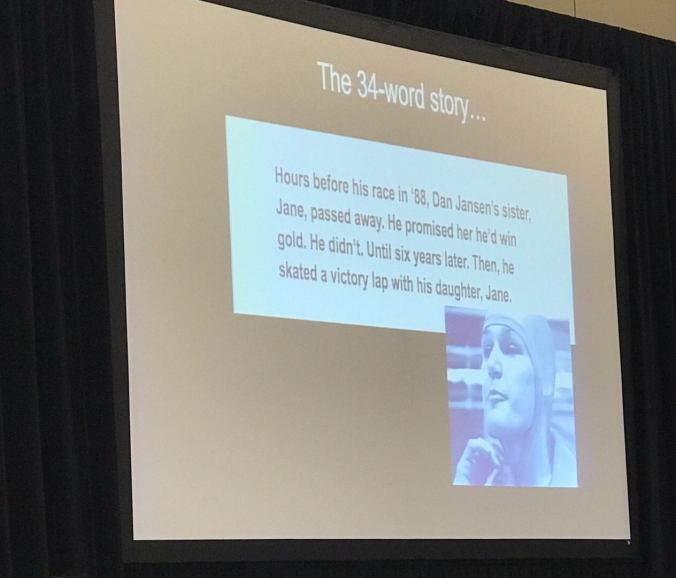
img_2687

“Teaching Practices That Position Students Closer to Reading and Writing Excellence” presentation, Kelly Gallagher, NCRA, 03/19/2018.

When Kelly Gallagher gave the keynote address at the North Carolina Reading Association last week, he cautioned educators about overwhelming student writers. He said: “Start off small when modeling. Use high-interest models.”

Before students write an essay, for example, they might write a 100-word memoir after the teacher models it.

Gallagher doesn’t begin there. He starts even smaller.

He shared the example of the “34-word story” he uses to inspire his students—that of Olympic speed skater, Dan Jansen, as seen in the photo above. Gallagher plays this Visa commercial at the outset of the lesson, to illustrate the impact of these few words:

He knows what he’s doing, Kelly Gallagher.

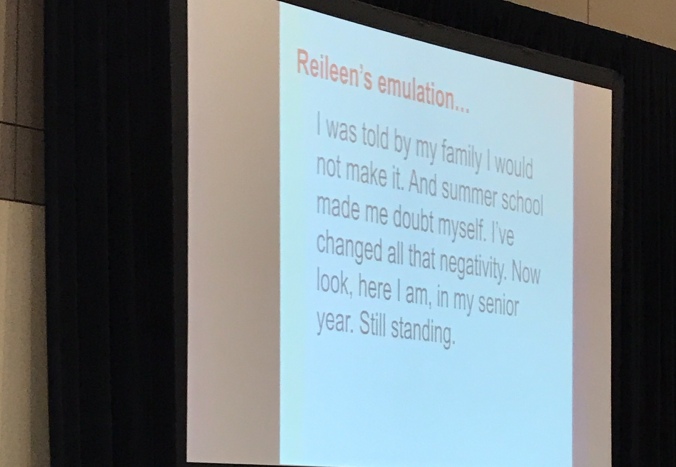
As if the hearts of the audience members weren’t pierced enough, he then shares this “34-word story” written by one of his students:

img_2688

“Teaching Practices That Position Students Closer to Reading and Writing Excellence” presentation, Kelly Gallagher, NCRA, 03/19/2018.

The absolute power of words.

Just thirty-four of them.

*******

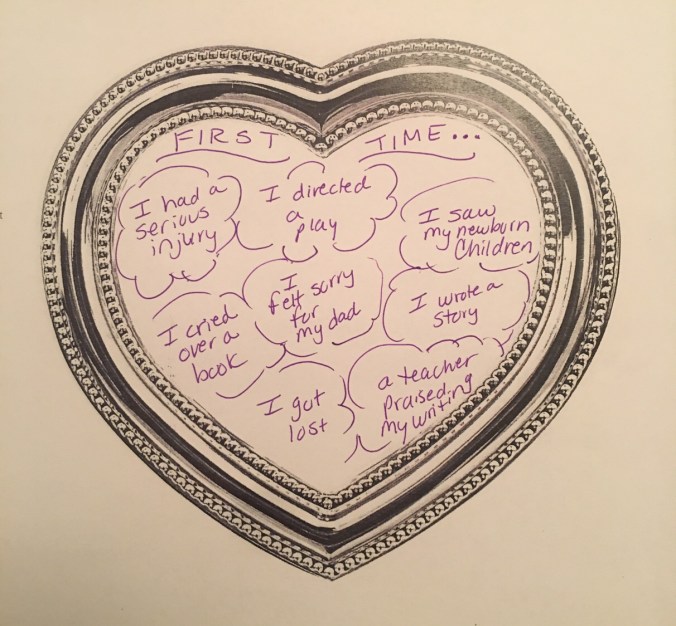
Challenge: What would your “34-word story” be? I experiment with my own. . . .

A teacher once told me, after seeing my performance in a play: “I didn’t think you had it in you.” Guess what, teacher? There’s a lot more in me, too. Including the last word. 

I asked a friend to read my first blog post for feedback. She said, “What’s your niche? You need to target an audience.” I said, “I write for humans. My niche is the world.”

When all’s said and done, and my time here is over, I will go celebrating these things: I lived. I loved. I was loved. I got to write about it all. Thank you, God.

Secret rendezvous

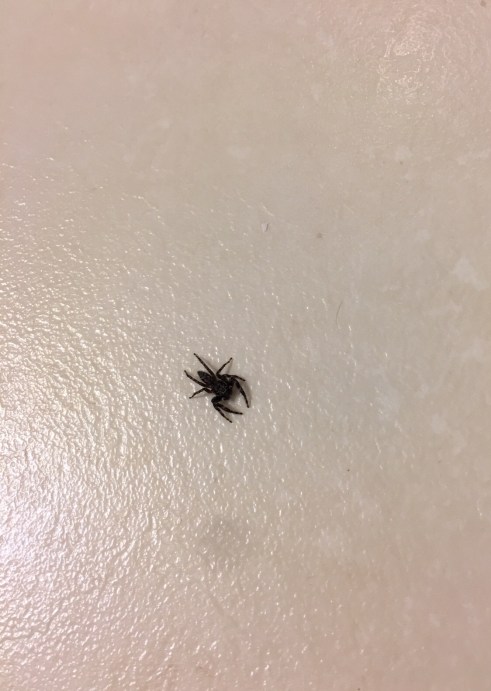
One morning, as I brush my teeth, out from behind the mirror comes a little spider.

It sits there on the wall as if watching me.

I am not a spider fan, generally.  But I don’t kill these little wanderers (sudden inspired quote: Not all those who wander are lost. Hmmm. Interesting point, Tolkien).

No, usually I capture the creatures and put them outside. If they’re small. I am getting someone else to deal with them if they’re large.

This spider is tiny.

And  . . . I don’t know . . . friendly. I  know exactly what my husband would say: What, you think it’s Charlotte, right? 

I just don’t have the heart to bother it. It’s not bothering me, so I let it be. Right there on the wall by the mirror. I finish getting ready for work, turn the bathroom light off, and call, “Bye, Spider. Have a good day.”

I think no more of it until the next morning when I am brushing my teeth, and out from behind the mirror comes my new friend.

We begin meeting this way every morning.

“There you are!” I say as my spider emerges later than normal one day. “Sleeping in? Have a late night?”

I swear if I can find a cup tiny enough, my spider would have coffee with me. I imagine it holding a miniscule newspaper. What our conversations would be:

What are you going to do today?

Oh, just stalk some prey. The usual.

Great. Get the gnats, will you? They’re on my last nerve. I don’t know where those things come from.

Sure thing.

Then comes the day the spider doesn’t show.

And the next.

And the one after that.

I begin to be sad. Seriously. Surely no one in my family has . . . no. I won’t think like that. I haven’t told any of them about my daily morning rendezvous. They can’t know, then, that I have a relationship with this spider, so. . . .

But no one has mentioned seeing a spider, so I don’t, either.

After another week, as I am dressing in the morning—lo and behold!—what should I see but my tiny friend there on the floor by the garden tub!

“Where have you BEEN?” I cry.

“What?” calls my husband from down the hall.

“Uh . . . never mind!” I call back.

I grab my phone and take a picture, because, well, that’s what you do with friends. You take pictures to remember them by.

I bend close. My spider comes nearer to me.

“Listen,” I say. “I missed you. I’m happy to see you’re well and all, but when I’m not here you really need to stay out of sight, okay? Other people just won’t understand.”

My spider takes this in. I can tell. I’ve looked him up and I know he’s a jumping spider and that they are very intelligent. They have cognitive abilities. They can be trained . . . after all, doesn’t he know where to find me each morning?

In other parts of the house, I hear my family bustling about, getting ready for school, for work.

“It’s not safe at the moment,” I tell my spider. “When everyone’s gone, you can come back out and do whatever it is you do during the day, but for now. . . .”

I slide a bit of paper towel under my spider.

He hangs on. Doesn’t protest.

I tuck him gently behind my fuzzy gray bedroom shoes.

“There,” I whisper. “That’ll do. Until later.”

I turn out the light.

“Bye, Spider. See you in the morning.”

I feel certain, from his sanctuary behind my bedroom shoe, that he’s waving a tiny leg.


The locket

She stands at the counter, admiring the jewelry. If  Papa were here, he’d get a necklace for me, she tells herself. I know he would . . . I’d keep it in the jewelry box he gave me for Christmas. 

But Papa was gone. Back to the hospital, again. She knew he feared going and she feared it for him, not knowing exactly what treatments he was being given, only that his face was whiter, more hollow, on every return, his blue eyes sadder. 

Her own eyes blur. Wiping away the tears, she finds her uncle, the store owner, leaning over the back of the wooden counter.

“Hello, dear. You like the jewelry, don’t you?”

She nods, tries to smile.

“Tell you what—I’ll give you a piece. Choose the one you like best.”

Her tears flow in earnest then. 

She chooses the locket.

*******

She was fifteen. The year was 1931. A year later, her beloved Papa would commit suicide on his sixtieth birthday, just weeks before she graduated from high school.

I wonder if she wore the locket as she sat by his casket in the living room overnight, or to his funeral.

When I was fifteen, she gave the locket to me:

I open the locket to find a black substance on the left side.

“I thought you said there was a picture of you in here!”

“It’s so old. That picture has turned darker and darker over the years,” she explains.

The image is completely obscured. 

“What did the picture look like, Grandma?” I ask, mourning the loss of it.

“It was a school picture. I had wavy blonde hair. It was pretty.” She smiles slightly as she picks the decayed photographic material out of the locket with Granddaddy’s pocket knife. She rubs the locket with a cloth until it gleams, and then she places it in my hands. 

“I know you’ll take care of it, my dear,” she says. 

As I clasp it, she draws me into her arms. I lean against her like I did when I was smaller, breathing in the light fragrance of her Avon cream sachet. 

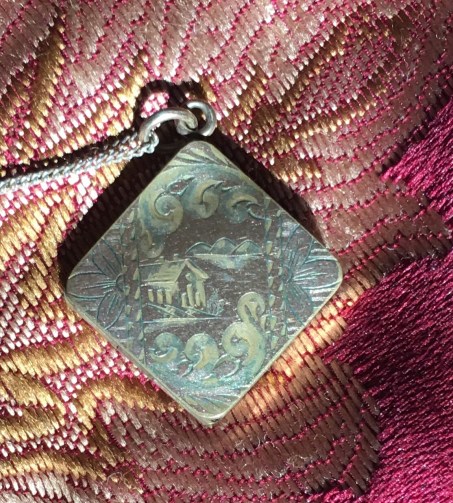
The locket is around 87 years old now. It’s made of brass, remarkably shiny, unmarred, despite its age. The front surface is finely etched with antiquated swirls and flowers, and if you look very closely, in the center there’s a house with a little fence and mountains in the background along the horizon.

Grandma, what a prophetic symbol for you, in so many ways.

The Great Depression was a year underway when her uncle gave her the locket. In 1936, my grandmother married my grandfather. My father was born ten months later. To me, the house on the locket represents their rural North Carolina homeplace;  it’s where Grandma’s heart was when Granddaddy, unable to “make a go of it” with tenant farming, sharecropping, and odd jobs, found employment almost two hundred miles away at the Newport News shipyard and moved his family. He was working there when Pearl Harbor was attacked.

Grandma was expecting her second child that year:

We stayed in an upstairs apartment and it was so hot. I could look through the window to see the ice truck making deliveries. People couldn’t get refrigerators because of the war; if you had one, it didn’t have a motor. We used them like iceboxes. I’d stand at that window thinking,  I’d give anything for a piece of that ice right now . . . . 

And she longed to go home.

Those mountains on the locket’s background symbolize numerous obstacles, hardships, trials, everything from the loss of her father to the Depression and the war (her brothers served in the Army and the Marines) to the ten years she did live back home, raising the children while my grandfather commuted from the shipyard on weekends. It was hard, all of it. She endured. The brass locket shines almost like gold—beyond the things of home, beyond every mountain to be scaled, hope always shines bright, not dimming over time. My grandmother’s faith would be challenged; she’d outlive two of her three children, but her faith would hold.

Home, endurance, overcoming, hope, faith, love. All of these are her legacy to me.

And the stories.

All old things have a story. Grandma’s locket is a tangible reminder of the stories she lived and told to me. It even opens like a book for pictures or tiny mementos to be placed inside; pictures of my two boys when they were babies are in it now.  The locket is the story of who I am, where I have come from, where I am going. I like to think that as the generations rise and fall, the locket will be passed down again and again, and that our stories will go on, and on, and on.


Blanket

I am more tired than I realized.

I wake up early every day, around 3:30. Not intentionally; I just do. Instead of lying awake or drowsing for another couple of hours, I get up and write. It’s the perfect time, before my menfolk and canines begin to stir.

My early mornings are a logical reason to be tired.

And spring break is still a week away. The last mile is always the hardest . . . .

And I am twenty-five days into a thirty-one day writing streak, the Slice of Life Story Challenge, which requires an extreme level of thought-immersion and attention to the minutiae around me (everything is a writable moment). My receptors must be wide-open all the time. This, however, is a good kind of tired. Even though I am mentally composing while I’m sleeping.

And I am fighting an allergy or a cold; I feel it lurking around my edges. My boys, when they were small, used to say, “I am catching up to a cold.”

And it’s been a long winter. There may be a few snowflakes tonight. Spring hasn’t fully sprung. There’s still a lot of darkness.

And my family marks a year of losing loved ones, young and old, sudden and by inches with dementia. My husband, his sister, and I need to finish cleaning out their mother’s house.

The dogs, knowing I’m the mom of everything, trail my every step. Henry wriggles like a worm, with an insatiable need for pats, for attention, and even poor old Nikolaus, his eyes like clear marbles full of misty clouds, is still able to scamper behind me in hopes of a treat.

And so, I’m tired.

Yesterday, being Saturday, I did something I almost never do:

I finished my post and went back to bed.

My husband, who’s now been up for a short while, reading in the study, comes looking. “Oh, you’re back in bed?”

“Just for a little while,” I say.

“Okay.” He closes the door.

I pull the blankets up to my chin. So cozy. I drowse. I hear bits of blog posts echoing in my brain.

The door opens. Older son. Henry’s so-called “dad.”

“Are you sick, Mom?”

“No. Just resting.”

“Oh, okay.” He goes to fix his breakfast. He loves a big breakfast. His brother won’t eat until lunchtime.

Snuffling outside the door. Henry. He usually begins to grumble-half-whine to come in and snuggle to me, or to sleep on my bed if I am getting ready for work. Today he must sense something. He goes away. Unusual.

Distant clanking in the kitchen. Muffled voices. Footsteps in the hallway.

The door opens. Younger son, Cadillac Man.

“Mom?”

“Yes?”

“Are you okay?”

“Yes. Just resting.”

“Okay. Lowees.” This is how he first said ‘I love you’ when he was a baby. Lowees. It immediately became part of the family lexicon. We all say it to each other. His father reminds me again and again that Cadillac Baby said it to him first.

“Lowees,” I say.

I can’t stay here long. None of them will be able to take it. There’s too much to do, anyway. There are places to be.

But I pull the covers partway over my head, sinking into the warmth, the softness, savoring the moment, grateful for the web of words knitting itself from random scraps in my mind, for the abiding blanket of love wrapped over and around my life.

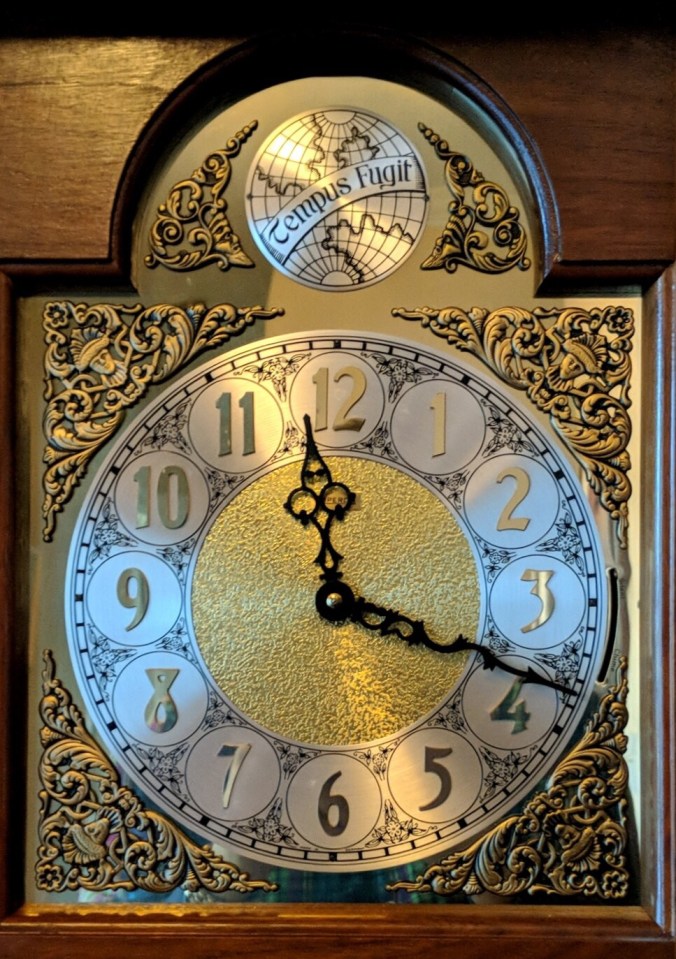
Tempus fugit

Tempus Fugit

(Time Flies)

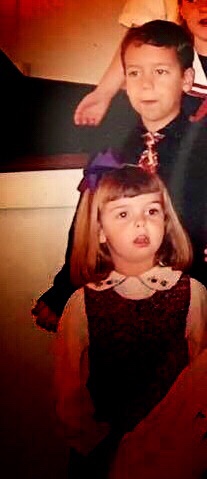
They should still be preschoolers

singing in the children’s choir

round-faced cherubs, both

ever so serious.

Time flies.

Or

children on vacation

tasting salt on their tongues, brine in the wind

with sand on their toes, in their hair

eating pickles from a jar.

Time flies.

Or

teenagers at Bojangles’

laughing, cutting up

marching in the band, going to the prom

still singing the old hymns together.

Time flies.

Or

college kids, going their separate ways

friends temporarily parted

by finding their own paths, until

one ended on a fresh spring night.

Time flies. 

She wrote that he was part

of her favorite childhood memory.

On the eve of her funeral, he dreamed

he heard her singing

of the ocean.

Time flies

Time flies

Time flies.

*******

One year ago today, my younger son (the Cadillac man) lost his childhood friend in an accident. 

She was eighteen. 

Only a minute

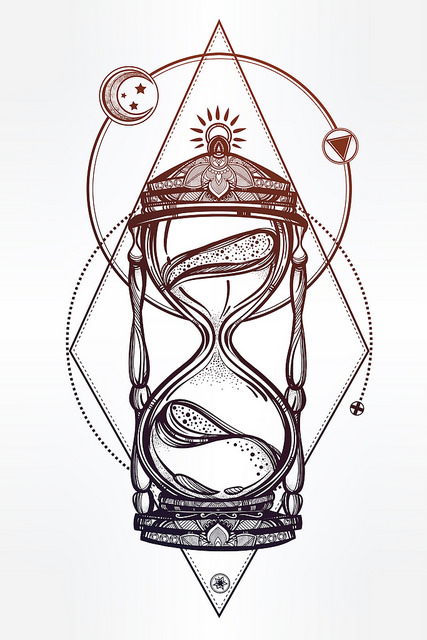
Hourglass

Hand drawn romantic design hourglass. jl71077CC BY

Every so often, this poem comes to mind.

I first heard it years ago, when a young co-worker recited it from memory. Listening to her mellifluous voice, rising and falling in all the right places, I thought, How profound.

I’ve used it with students for interpretation, for inferring, for fluency practice, for the pleasing rhythm.

Mostly I just mull the truth of it, in its utter simplicity.

Especially the last two lines.

I’ve only just a minute,

Only sixty seconds in it.

Forced upon me, can’t refuse it,

Didn’t seek it, didn’t choose it,

But it’s up to me to use it.

I must suffer if I lose it,

Give an account if I abuse it,

Just a tiny little minute,

But eternity is in it.

Attributed to Dr. Benjamin E. Mays

You’ll bring your own interpretations, images, minutes to this.

I think of all the stories that hang in the balance of a minute. In the wavering. In the choosing. There’s always that minute before the accident, before the attack, before the kiss of human or substance, before the choice that cannot be unmade is made. In a minute, lives are created, lives are destroyed. Fortunes gained, fortunes lost. The young, often consumed with this minute, blinded by now, cannot see forward; the old, bearing the weight of all their minutes, look back, see them all too clearly, and sigh.

We do not choose our minutes. We cannot save them or store them. We can only seize them, endure them, waste them, invest them, or pay for them. A choice lies inside each minute, always, even when there seems no choice.

I think of the ripple effect of one minute’s choice, how it never affects just one person but countless others, spanning families, communities, cities, nations, maybe generation after generation. For better, for worse.

I see the news. I read. I hear people’s stories, every day. We live our stories, we make them, every single minute, by our choices, actions, reactions. In some minutes I pause, recalibrate, celebrate, breathe a prayer of gratitude. In other minutes I sink under the anesthesia of why.

Only a minute, come and gone, and we are changed, whether imperceptibly or instantly, forever.

And that line whispers to me, once more. It’s never far away, really.

Just a tiny little minute, but eternity is in it.

Magical literacy and learning, part 2

As my colleague and I present at a reading conference for educators this week, I watch the participants’ faces. Eager. Expectant. Reflective. Smiling and visibly misting over in turn, as my colleague and I talk about the diversity of the third, fourth, and fifth grade students who sign up, some of them multiple times, to be in our Harry Potter club. How they develop a sense of identity, of belonging, how the club became a “thing” at our school . . . 

On the first day of our club each semester, we “co-headmistresses” give the kids a quiz adapted from one we found online. We plug answers into the website so that every child is sorted into his or her own Hogwarts house. Students familiar with the books or movies are triumphant to know they’ve landed in their favorite house (usually Slytherin; we seem to have an abundance of those), and even students who are just encountering the world of Harry Potter for the first time have an unmistakable look of pride on their faces. They all write their names on the Hogwarts crest in the areas designating their houses. I read Harry’s sorting experience to them, and then we talk about how members of each of the four houses have specific traits or characteristics, and how we’re sorted according to these attributes:

We read each column of traits. It’s a lofty word bank. I ask, “Who knows what these words mean?” The students who know, share; the words that no one knows, I define.

Then I ask: “So, do you see yourself in these words? Do any of these words describe you?”

A vigorous nodding of heads. One sweet-faced little girl says, emphatically: “Yes! I’m ruthless!”

It’s all I can do to not collapse with laughter.

For part of developing a sense of belonging is first developing a sense of self-awareness. Why I think and feel the way I do—because these drive my actions. If I understand myself, then maybe I can begin to understand others. In books, in real life.

Not to mention that character traits and character motivation are woven throughout the reading and writing standards.

The newly-sorted club members move onto talking about Harry, Ron, Hermione, Draco, and their stories. Why they make the choices they make.

For everyone has a story, and as the club rolls on, the students begin sharing bits and pieces of their own lives in conjunction with the characters’ experiences:

One time I . . .

I had something like that happen . . .

In my family . . .  

And somehow this “thing” spreads from the confines of our club into the school at large.

In my daily work as a coach, I am in and out of classrooms across grade levels. In third, fourth, and fifth grades, the club members greet me excitedly, with an air of ownership. Their non-club classmates say: Mrs. Haley, I am reading the books for the first time! I just saw one of the movies again! Hey, Mrs. Haley, they have new Harry Potter shirts at Walmart—my mom’s gonna get me one. Come check out my Harry Potter socks! 

When I walk through lower grade hallways, a second-grader will occasionally pop out of line just long enough to say, “Next year I’ll be in third grade and I can be in the Harry Potter club!”

Once a teacher brought a kindergartner to see me—a boy, the spitting image of Harry himself in miniature, black hair, glasses and all. He was even wearing a gray shirt adorned with tiny lightning bolts.

He looked me dead in the eye and said: “I love Harry Potter more than you do.”

I dared not argue.

I’ve dubbed this “thing” permeating the ranks of children across the school “the Hogwarts phenomenon.” Again, Harry breaks barriers, open doors that might not have opened otherwise. Children seek me out to borrow my books, to see my ever-growing collection of Potter memorabilia, just to have conversations.

I think of one of our rare Ravenclaws, a shy girl who came out of her shell in the club, who later realized how much creativity was bottled inside of her, and that it could, and did, pour forth in writing (she’ll be published one day. Trust me).

My colleague recalls four siblings, three brothers and a sister, who were all members at various times, how the club became their family legacy.

I remember how, when we first created a page of spells that Rowling made up for the books and put them into visual representations to see if the kids knew or could figure out their meaning, that one boy said: “Hey—Aguamenti—that sounds like my word for water. Agua.” Indeed, that’s what it meant. This sparked a deep discussion of word origins and vocabulary, such as incendiary meaning “to cause a fire” and luminous meaning “giving off light or glowing.”

My favorite story of all (I’ve told it many times) is about the boy who stayed with us for four semesters, because he despised school and was frequently absent, but never on club days. His mother said: “The only thing he ever talks about is the Harry Potter club.” In his final semester, we made him Head Boy; he co-facilitated with us, reading to the new members and helping them make their crafts. We gave him a Hogwarts shirt on the day of fifth-grade graduation. He ran immediately to the bathroom to put it on.

He walked across the stage at the ceremony wearing that shirt.

We had no idea, really, where we were going with this club in the beginning; when our school started clubs as part of our magnet theme, my colleague and I just thought it would be great fun to read bits of Harry Potter books to kids, make some crafts, and simply enjoy the experience.

Then all the magic just . . . happened.

Teachers, remember:

What inspires you will inspire the kids. Passion is contagious. Tap into it.

Find a way to make it happen for them.

As we end the presentation, we give our participants—educators from across the state of North Carolina—the choice of going to the official Pottermore site to find their own Hogwarts house or Patronus, or making some of the crafts we make with our students. The glee in the room is palpable; how many presentations have you been to where you can make a pencil broom, a golden Snitch, a feather pen, a wand, a winged key, an ornament with your house colors, or eat a homemade chocolate frog? 

The teachers bubble over with ideas to take back to their schools. A couple of them are actually from a women’s prison; they think now they will start a Harry Potter club for inmates.

Again I think of major themes in the books.

Hope. Redemption. Overcoming. 

Love.

“Thank you,” the participants say, over and over, on their way out, carrying their new Potter loot. 

One teacher says, “This was just so inspiring.”

I say, “That is THE word that matters most to me . . . so thank you.”

“It is our choices, Harry, that show who we are, far more than our abilities.”

Dumbledore, Harry Potter and the Chamber of Secrets, J.K. Rowling

Magical literacy and learning, part 1

img_4455-e1521584141615.jpg

Yesterday my colleague and I presented “Magical Literacy and Learning: The Harry Potter Club” at the North Carolina Reading Association. While we waited for the preceding session to end, I watched other educators gathering in the hallway outside the closed door where our session would be held. I could hear whispers: “Harry Potter . . . Harry Potter . . . .” For a second, it was almost like being in one of the books or movies. Here’s a portion of what we presented, in narrative form. There’s more to come . . . .

For seven semesters now, a colleague and I have hosted the Harry Potter Club for third, fourth, and fifth graders at our school as part of our creative arts and science magnet theme.

When clubs began in 2015, teachers who volunteered to do clubs were told, “Pick something that interests you. Something that you enjoy.”  Here’s a small sampling of club offerings over the years: cooking, gardening, etiquette, beading, creative writing, acts of kindness, paper airplanes, tie-dye, iPad movie-making, weightlifting, astronomy.

My colleague and I wanted to integrate arts and crafts with reading enjoyment, so that’s how our Harry Potter club was born. We figured we’d read some passages from the books and have the kids make something. That’s all the vision we had, in the beginning.

The club became so much more.

Last winter, a former student of ours, in his first year of middle school, was killed in an accident. My colleague and I, mourning, recalled that he’d been in our club more than once. We remembered how much he enjoyed it, how much he smiled, how he asked questions. We went back over our club rosters to see when he’d attended, and that’s when we discovered something that we hadn’t exactly realized before.

Maybe it’s due to our school improvement-trained brains, but, as we looked back at lists of club kids, I said, “Hey . . . there’s something significant going on with subgroups here.”

That, of course, led to further analysis.

Here’s what we learned about our club:

70% of attendees are male.

54% are non-white or minority.

Over half have identified learning or behavioral needs.

Siblings of nine families have attended.

Boys chose Harry Potter over sports camp, Lego mania, football, and tech. Several of them made this choice more than once; they asked to be in our club again and again, even when we said, “But you’ll just be making the same crafts as you did before!” They said: “I know! I just want to be in the club.” Children of diverse backgrounds, cultures, and races identify with the predominately white Potter characters and their struggles, because the underlying themes speak to all children, all people: Friendship, teamwork, love, hope, redemption.

During club sessions, after I’d read a portion of a book and the kids were busy with their craft—painting a wand, tracing wings and attaching them to keys, making pencil brooms or gold-foil Snitches—discussions developed. Unscripted, organic discussions. Many of the children had seen the movies, some had read the books, some had done neither, but everyone talked. Everyone had questions, observations.

Professor Snape in particular fascinates the children (I often have to say, “Snape. His name is Snape. Not Snake”):

“He was so mean to Harry and Harry thought he hated him, but really he was protecting Harry the whole time.”

“Yeah, because he was in love with Harry’s mother.”

“What do we learn from Professor Snape, then?” I interject.

Pause.

“Even when somebody seems bad, they really might be good. You don’t always know what’s in their heart,” pipes a voice.

I see their heads, bent intently over their craft, nodding.

The children speak of how much Harry’s mother loved him, how she died to save him. The mothers in the series are some of the strongest characters: Molly Weasley, Narcissa Malfoy. In the end, Narcissa saves Harry in order to save her own son.

It’s a safe place, the club. A place of belonging. It doesn’t matter if you’re academically gifted or have an IEP, if you’re an extraordinary reader, or if you struggle with reading. Here, with the read-aloud, the crafts, the discussions, the playing field is level. Here, everyone excels at something.

I think of how the magic was probably the pull for many of the kids, at first.

Or maybe the crafts.

But something deeper keeps them coming back for more.

The angel’s pedicure

img_4489

My son, the Cadillac man, and I stand looking at the angel statue.

Specifically at her pink toenail polish.

“Really?” he says in disgust. “Painted toenails?”

I giggle. “I know! How many depictions of angels have you seen with painted toenails?”

He shakes his head. “I’ve never seen an angel with feet.”

I start to laugh, but . . . the way he says that . . .

He turns, walks off in his unassuming, old-soul way. I watch him go, wondering.

I said depictions.

He said he’d never seen an angel with feet.

Not that he’d never seen an angel.