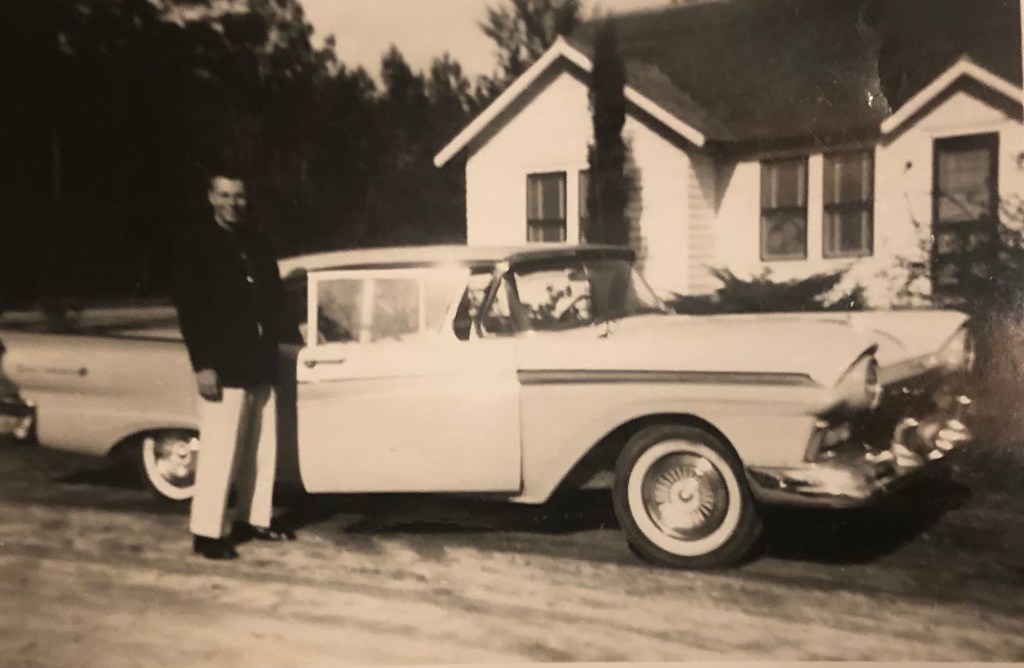
My own St. Patrick

In 1906, Theodore Roosevelt was president, Upton Sinclair published The Jungle, and the San Franciso earthquake killed around three thousand people. The Panama Canal was under construction and Cuba had its first president. Susan B. Anthony died that year. Lou Costello, Estée Lauder, and Anne Morrow Lindbergh were born.

In the far reaches of eastern North Carolina, a farm woman named Claudia Amanda Victoria delivered another of her ten children. A boy. She would have only two girls; one would die of diphtheria at age four.

But this baby boy would be hardy. He would outlive them all.

She named him Columbus St. Patrick.

Some folks called him Columbus. Those who knew him best called him Lump.

I called him Granddaddy.

As I grew up listening to the old stories, I tried to imagine living in his era. Seeing an early Ford Model T. Mail-ordering live chickens, delivered in wire cages by horse and buggy. Raising ducks that wandered off to the swamp on a regular basis, only to be herded back home again to eat bugs in the garden and to provide eggs for breakfast. Learning to plant and to harvest, to be in tune with the rhythms of the earth, following the steps of that ancient choreography, the seasons.

He was five when the Titanic sank, seven when World War I began. His older brother, Jimmy, served in the Great War and returned; I would know him and his wife Janie in their old age. They lived in a little tin-roofed house along one of the many dirt roads of my childhood summers. Jimmy and Columbus had a brother who drowned long before my time. Job Enoch. One brother accidentally shot and killed another on the porch of the family home. I knew their sister Amanda, who had a high-back pump organ adorned with brown-speckled mirrors in her house. The organ sounded and smelled of ages and ages past…but she could play it, and she could sing.

Columbus didn’t sing, but he loved country gospel songs and bluegrass to the end of his days.

And Columbus St. Patrick loved Sunday School. He had perfect attendance for years, garnering long strings of pins awarded to him. He did not enjoy regular school. He quit in the fourth grade to work on the farm. Later in life he had some regrets about this. But his father walked out on the family and Columbus rose to the role of provider.

He participated in community hog-killings, with the farm wives taking the backbone to flavor collard greens. The pork was preserved in barrels with salt brine. Some of the folks enjoyed scrambling hog brains into their breakfast eggs.

Columbus St. Patrick worked hard. He plowed fields with mules. He took part in the making of molasses, which required several people. Mules walked in a circle, harnessed to poles attached to large grinder where sugarcane was fed to extract the juice. The juice would be collected and heated in trays over a fire, skimmed numerous times until it became rich, blackstrap molasses. At the end of a meal, he sopped his biscuits in molasses, and poured his hot coffee in the saucer to cool it.

He competed with a scrappy little woman named Lula for the honor of being the community’s top cotton-picker. She often beat him.

Lula would be widowed when her husband Francis hung himself in the woods. One of their daughters would find his body.

Columbus St. Patrick’s youngest brother married another of those daughters.

Columbus made some time to hang out with the young people, attending taffy-making parties in their homes and driving groups of friends to the movies in town…all the while noticing Lula’s daughter with the wavy blonde hair and straight posture. There was a certain spark about her.

She considered him her mother’s friend. The “older” set. She was nine years younger and she had her eye on the preacher’s son, who would surely follow in his father’s footsteps: How wonderful, to be a preacher’s wife!

It didn’t happen. Desires of the heart sometimes come to unexpected fruition: I would be a preacher’s wife, a half-century later.

This daughter of Lula’s ended up marrying a farmer: Columbus St. Patrick. They planned to wed in September but he had the mumps. And so it came to pass in mid-December instead.

My grandparents.

Here’s a photo taken sometime early in their marriage:
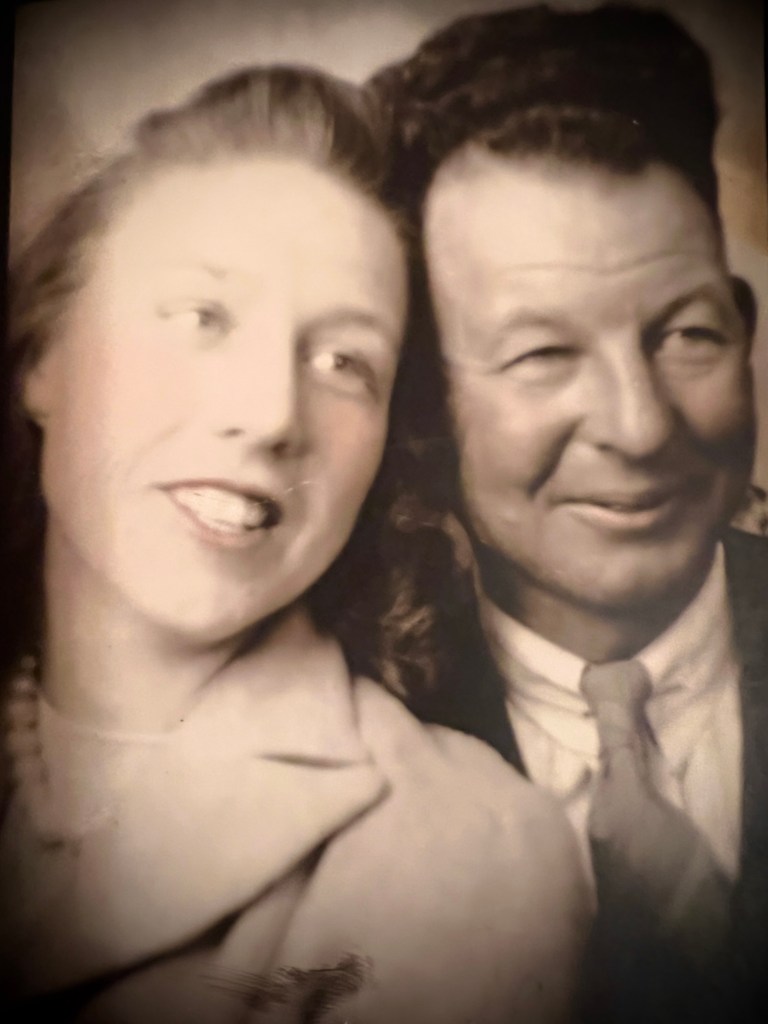
Ruby Frances and Columbus St. Patrick, circa 19371938.
She would have been around 23. He would have been 31 or 32.
If this photo was taken prior to October 1937, my father was not yet born.

They would endure the Great Depression and the second World War with a small child. My father. When Columbus St. Patrick couldn’t make a go of tenant farming and sharecropping, he traveled to the shipyard nearly 200 miles away with a group of men from down home. He was working there, building cradles for ships, when Pearl Harbor was attacked. Suddenly U.S. ship production went into overdrive; the Yard turned out ships in three months versus the usual year.

He would try, after the war, to make a living farming, painting, and doing other handyman jobs. By that time there were three children to care for. Columbus opted to go back to the shipyard, staying in a boarding house during the workweek and coming home to see his wife and children on the weekends.

For ten years.

His son (my dad) became senior class president and entered the United States Air Force after graduation. The oldest daughter was a high school basketball star; Columbus St. Patrick nailed peach crates to posts out in the yard for her to practice. By the time his youngest daughter was ready for high school, he’d had enough of separations. He moved the family to an apartment near the shipyard.

Hilton Village, built between 1918 and 1921, is the first federal wartime housing project in the U.S. It was created for shipyard workers. These quaint, English-style rowhouses would be the setting of my first memories. I would awaken in the dim gray morning at my grandparents’ upstairs apartment and my grandmother soothed me back to sleep while my grandfather, having risen at four, made his own breakfast before going to work. On Sundays, his day off, he took me to the playgound behind the Methodist church.

I felt as safe as I ever have in life, walking hand-in-hand with him.

He retired after I started school and lived another twenty-nine years. He saw my children. He survived the removal of his bladder after a cancer diagnosis. My grandmother would empty the urostomy bag and dress his stoma (surgical opening) every day until his death.

They would lose their middle child, their basketball star, to multiple sclerosis in her fifties. She died on Good Friday; they buried her on Easter Sunday. Their son (my dad) was just recovering from bypass surgery after his first heart attack. He would not survive the second, but Columbus would not be here to suffer the loss of his son.

Granddaddy died of lung cancer under hospice care, at home his own bed, as he wanted, on a fine spring day. He refused morphine in favor of keeping his mind clear. And it was, to the very end.

St. Patrick’s Day rolls ’round again and stirs all the memories. They spring to life, as rich and sweet as molasses that Granddaddy and I sopped with our biscuits. He was always embarrassed by the oddity of his middle name. I am proud of it. I have loved it all my life, just as I’ve loved him. Fiercely. I have learned many a valuable lesson from Columbus St. Patrick: Treat people well. Help those in need. Money doesn’t buy happiness (back in the old days, he said, nobody had any money but everybody was happier). Love your family. Love your neighbor. Get a dog to love. Work hard. Persevere. There’s always a way. Tend the earth. Do your duty. Spend time with children, for they are precious. Go to church. Trust in the Lord. Return thanks.

One day, he said, we will meet again in a better place. I am looking forward to it.

Me, too, Columbus St. Patrick.

Me, too.
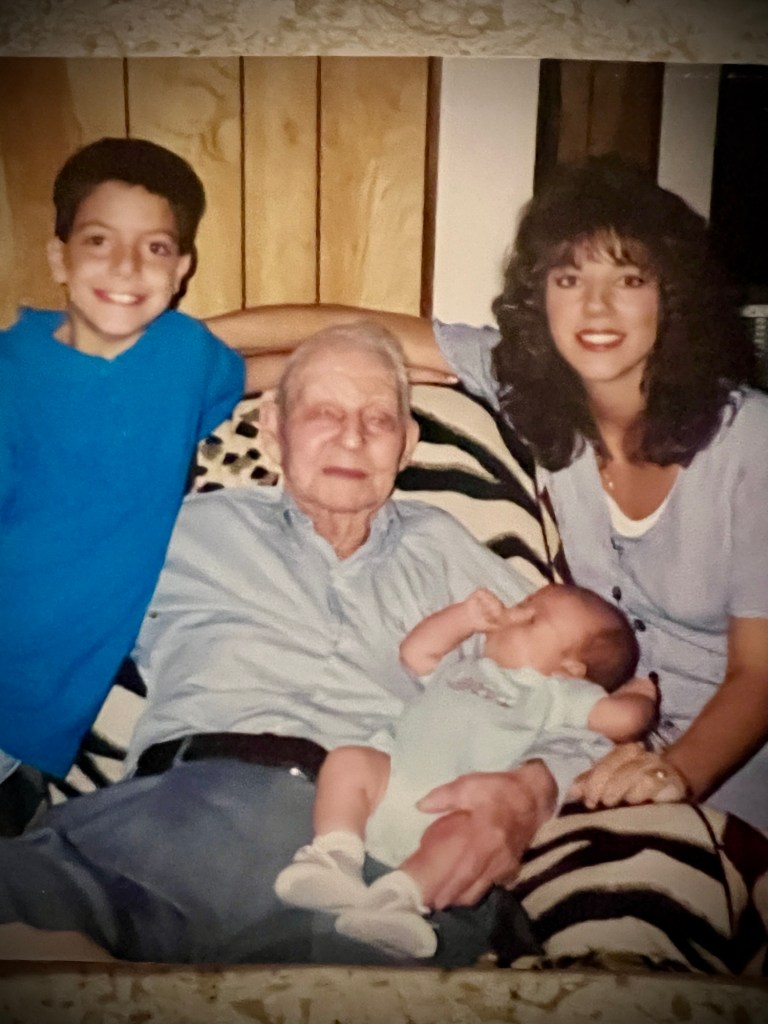
My boys and I visiting Granddaddy for his 91st birthday, 1997.
My youngest was six weeks old.

*******

with thanks to Two Writing Teachers for the March Slice of Life Story Challenge
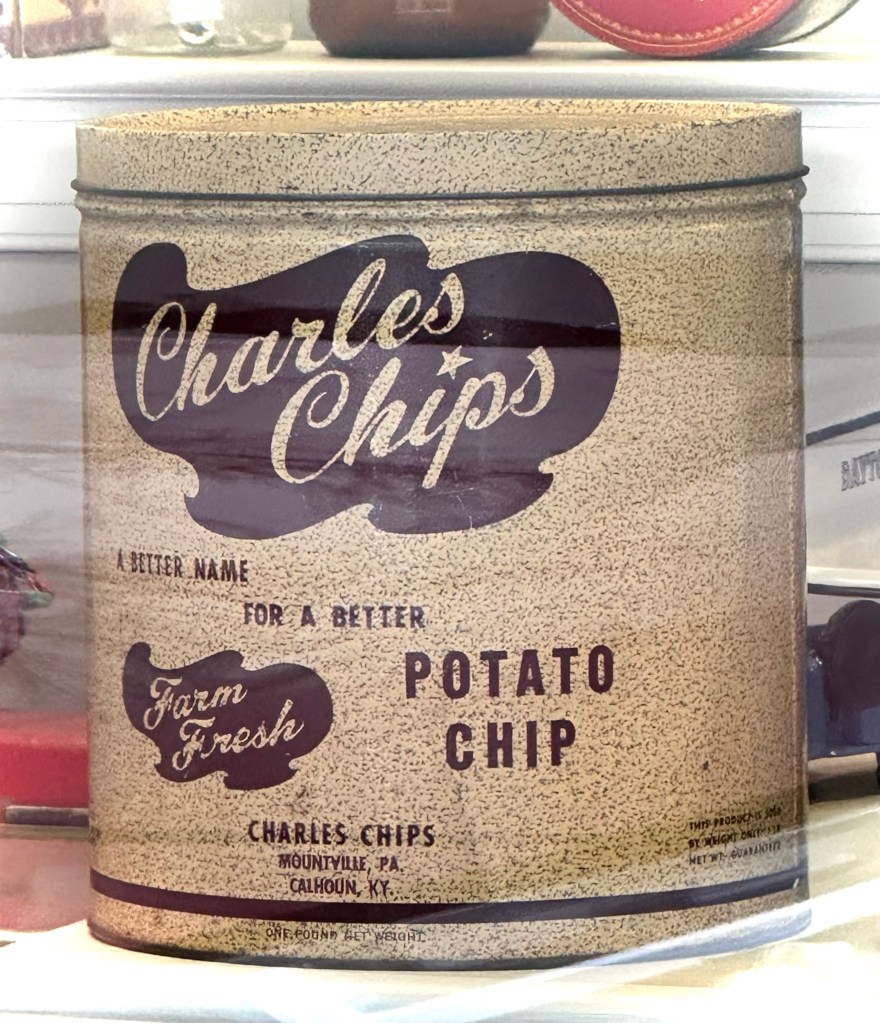
I remember these

I just so happened to see it there in the store window next to the Chinese fast-food restaurant where my colleague and I were picking up lunch:

A big, round, tan-and-brown can of Charles Chips.

“Look at that! I haven’t seen those in years!” I shouted, to my colleague’s amusement.

These tins were delivered by truck to our house when I was a kid, if I recall correctly. Like Dy-Dee Diaper service…only not taking something horrifically pungent away (I remember that, too, up until I was about four; I had a sister two years younger).

Instantly I was thrown back to the 1970s, beginning with this scene:

The sewing room that is supposed to be a dining room. Mama’s Singer sewing machine, threads, pins, patterns galore. The ironing board. Daddy’s shoeshine box and bench in the corner. The distinct scent of Kiwi shoe polish in hanging in this space…the Charles Chip can, long missing its lid, heaped to the brim with socks that had lost their mates. Mama calls it the sock box. How are there so many? The washer (that lasted over twenty-five years) ate them, maybe? Mama tries to keep socks matched by sewing a knot of thread in the toe tips, a different color for each pair… me, age seven, on the day of my baptism, walking down the baptistry steps into the surprisingly warm water, looking down at my white-socked feet, seeing the coordinating navy-blue knots…

All this, triggered by mere sight of a Charles Chip can after so many years.

I was there.

The Statler Brothers had a nostalgic song about things they remembered from their youth, entitled “Do You Remember These?”

Here’s what the Charles Chips started dredging up for me…see if any of you remember these, from the late 1960s to early ’70s:

The Archies cartoon (and the song “Sugar Sugar”)
Penelope Pitstop cartoon
Josie and the Pussycats cartoon
Rocky and Bullwinkle
The Flintstones
The Jetsons
H. R. Pufnstuf show
The Banana Splits show
The Munsters
The Addams Family (our family friends had a black lab named Thing)
The Wonderful World of Disney, Sunday nights
Wild Kingdom
Family Affair and Mrs. Beasley dolls
Easy-Bake ovens
The Wizard of Oz on TV once a year
Paper dolls, such as “Mod Maude”
Squirmles, the Magical Pet (a furry worm that “moved”)
Silly Putty for placing & peeling on the Sunday comics – so fun
The Pink Panther Show
The Partridge Family (how is it I can still sing every song?)
Donny and Marie
The Monkees
sea monkeys
bellbottoms
pet rocks
mood rings
tetherball
jacks
macrame
decoupage
Tupperware parties
Beeline parties
Avon ladies calling
Choco’Lite candy bars
Count Chocula cereal (back in stores now at Halloween!)
upper elementary girls wearing wigs to school
shag haircuts
The Brady Bunch
Gilligan’s Island
Viewmasters and reels
Spirograph art
Romper Stompers
Hippity Hop (ball with handle, for sitting on and bouncing wherever you wanted to go)
Super Elastic Bubble Plastic
rabbits’ feet (I am so, so sorry now, dear Rabbits)
Popeye
Looney Tunes
Star Trek
Lassie

and last but not least
Sonny and Cher

…these are just the first ripples in my memory. There’s a story surrounding each. There are more memories just below the surface, waiting to be stirred… so many, many more.

Funny, crazy, wondrous, strange, sweet slices of life. So long ago.

Seems fitting to end with this song (imagine me singing it with gusto around age five).

*******

with thanks to Two Writing Teachers for the monthlong Slice of Life Writing challenge

Car poem: Galaxie Ride

with thanks to Susie Morice for the car poem inspiration on the Ethical ELA Open Write today

Galaxie Ride

One thing I knew
from the beginning:

We were a Ford family.

Granddaddy could recall
his first glimpse 
of a Model T.

Daddy always spoke
with a trace
of yearning for 
the white Thunderbird
he gave up
after I was born.

I came along in the era
when cruising the Earth
was not enough;
governments sought
to be the best
at hurling humanity
into space.

In the hazy gray memories
of my early days, 
one bright pop of color
stands out:

Grandma’s car.

Ford Galaxie 500
fire-engine red
rocket-sleek
aerodynamic
meant for racing

curious choice
for a grandmother.

She loved it.

Granddaddy bought it used
never imagining, I suspect,
that it would carry us
through three decades.

No power steering
—that silver steering wheel, 
a full cardio workout—

no AC

—sweltering in southern summers:
when I was twelve 

I left a stack of 45 rpm records
on the rear window dash
and they melted, 
rippling up
just like ribbon candy.
Grandma would tuck a Kleenex
into her cleavage
to absorb the sweat—

seats trimmed in red leather
upholstered in scratchy red fabric
studded with silver dots
—I like to think they were stars—

I cannot remember seatbelts.

Over the years
the red fabric
faded to pink
and began to split.

By that time I’d learned to drive
having practiced
with the old red Ford
on the old dirt road
of my father’s childhood home.

Grandma said:
“Honey, if you can drive this,
you can drive anything”

—and she was right.

The Galaxie and me. Grandma took this photo. Can you guess her favorite color-?

Daddy with his pride and joy. I believe the T-Bird had a red interior.

Old red barn

Old red barn
testament to ingenuity
the rust in your coat
counterintuitively
preserving against decay

Still standing today
on your windswept plain
amid long amber grasses
continually bowing
their homage

Like sun-cast gold at your feet
despite encroaching shadows
ever-shifting with clouds
under the benevolent blue
striated sky

A skeleton tree
veils your face
attempting to conceal
the emptiness behind
your window-eyes

You’ve no weathervane
pointing heavenward
with its rooster of betrayal
—can you hear geese calling
fly on fly on fly on

Old red barn
vignette of yesterday
rustic testimony never reduced
—I will not think of you
as desolate

*******

With special thanks to Margaret Simon for the prompt in “This Photo Wants to be a Poem,” her journalist friend Jan Risher for sharing the photo of the old barn, and to Tabatha Yeatts at The Opposite of Indifference for hosting today’s Poetry Friday Round-Up.

Twilight’s gleaming

Twilight Zone

Rod Serling – Twilight Zone Button. Tony AlterCC BY

“It is a dimension as vast as space and as timeless as infinity. It is the middle ground between light and shadow, between science and superstition, and it lies between the pit of man’s fears and the summit of his knowledge. This is the dimension of imagination. It is an area which we call the Twilight Zone.” 

– Season One opening narration, The Twilight Zone television series (1959-1964)

What’s your Fourth of July tradition, fellow Americans?

For my family, it’s watching The Twilight Zone marathon on Syfy.

I have to ask myself: Why do I love this series? Why is it so addictive? After all, special effects have advanced light-years since these shows were filmed; some of the outer space/alien/futuristic costumes and settings are primitive, even laughable. Rod Serling, garbed in dress jacket and skinny tie, strolls out of inconspicuous places – other rooms in houses, offices, or even the woods – to comment on the rising action and the characters,  occasionally smoking a cigarette in true ’60s vogue.

Part of the fun is seeing famous people when they were heartrendingly young, when their stars were still on the rise: Carol Burnett, Telly Savalas, Elizabeth Montgomery, William Shatner (THE Captain Kirk, before the inception of Star Trek). There’s Burgess Meredith, the best of the best character actors, Mickey Rooney beautifully playing an angry drunk. The furniture and props in many episodes, some fashionably chic, some commonplace, are now vintage, nostalgic slices of a bygone era. Something must also be said for the show’s camera work, the strategic zooms, the compelling close-ups. In truth, between some captivating characterizations and the cinematography, there’s a great bit of artistry in The Twlight Zone.

But all that’s just part of it. What really draws the viewer, ultimately, is the story.

The Twilight Zone breaks the dimensions of time and space, to be sure – it takes us away from Earth, brings us to an Earth we don’t recognize, allows us to step into the past and sometimes into a future that isn’t future anymore (I just saw a calendar on the wall of a restaurant in  one futuristic episode: 1974. Geez.). Statues come to life;  a warm, vibrant grandmother is really a custom robot; dolls talk, wreaking havoc and destruction. People down on their luck find good fortune; people lose fortunes; people are at the mercy of forces greater than themselves; people possess supernatural powers that are often abused or taken advantage of by others.

The most haunting thing about The Twilight Zone isn’t the supernatural, however. It’s the journey within, the recognition of the worst parts of ourselves. Selfishness and greed are common themes, with catastrophic consequences – not that the Zone is didactic. In the spirit of the best short stories, with O. Henry-esque twists at the end, The Twilight Zone follows the dark convolutions of the human psyche. Endings are intriguing, but not always happy.

My favorite episode is “A Stop at Willoughby.” A man is locked into a job he hates by a demanding, socialite wife; a hardcore boss berates him for his ineptitude and lack of drive. He’s miserable; he can’t please anyone, least of all himself. On the train commute between home and work, he falls asleep and dreams of a stop that isn’t on the line – a back-in-time place, where women carry parasols and children go fishing and men ride penny-farthing bicycles (the ones with the huge front wheel). The vision of this place, Willoughby, is so real and inviting that the man thinks about getting off there in his dream.  He wakes to the ongoing pressures of his life, but yearns more and more for the slower, contented pace of Willoughby. His wife mocks him for wanting to be Huckleberry Finn, then turns her back on him just as he caves from the pressures at work. On the train, he dreams of Willoughby once more, and this time he gets off, where the townspeople greet him cheerfully by name, as if they’ve always known him, as if he belongs there.

The story doesn’t quite end here; there’s a final scene with a big final twist, but I would be the ultimate spoiler if I told it here. The episode – all the episodes – are meant to be experiences for the viewer. Here’s part of the closing narration: “Willoughby? Whatever it is, it comes with sunlight and serenity and is part of The Twilight Zone.”

Perhaps that’s the pull of the Zone – that beyond the darkness, horror, oppression, bad choices, fears, the worst of humanity, there lies something better, that’s worth the pain of overcoming. Where morbid fascinations, bystander mentalities, selfish desires and regrets melt away. A place of healing, of peace, of freedom – where the best of humanity thrives, has a voice that’s heard. It’s not a place to be merely maintained, but is always being actively created.

What does that sound like to you? What would a Magic 8-Ball say?

Utopia? Very doubtful.

America? Most likely.

The Twilight Zone? Yes definitely.

So celebrate.

Cherish. Savor. Digest. Mull.

Not just food, but your tradition, your story. Yours as well as others’.

And see beyond.