Asheville, North Carolina.
First vacation in two years, owing to my husband’s cardiac surgeries and the pandemic. He wants to see the mountains. They remind him of his childhood. They’re in his blood, like rivers and bays are in mine.
We’re not campers, though. We stay in town.
Late arrival, chilly summer rain, deserted city streets. Apparently everything closes early on a Sunday night. Downtown is eerily vacant, as if we’ve landed in a time warp or the Twilight Zone. Where have all the people gone? We walk in the desolation, huddled under our umbrellas.
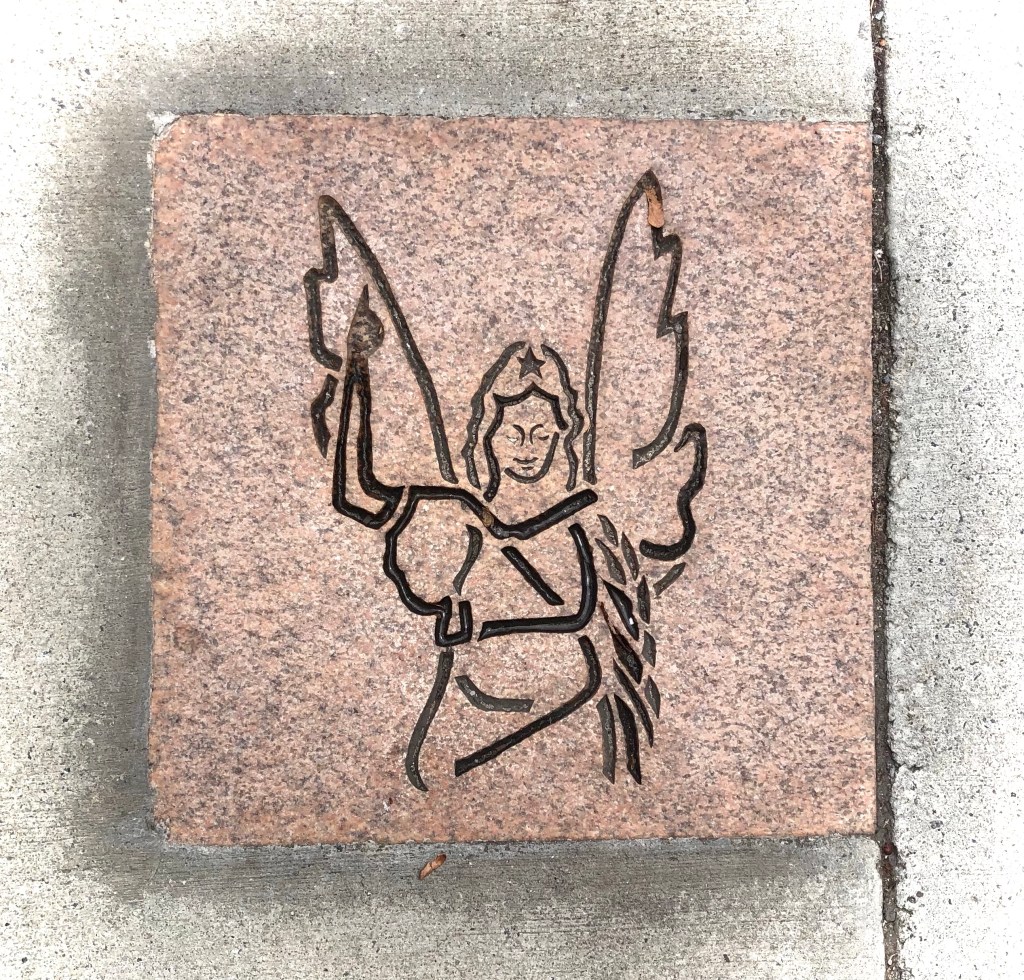
On the sidewalks, random pink granite squares bear strange designs of some secret code: a feather, a horseshoe…
“Did you see that angel?” I ask my husband. I think I recall seeing this here before, on a previous visit.
“No. Where?”
“Back there, on the sidewalk. An angel pointing up, with a star on its head. We just passed it. I’m sure it has something to do with Thomas Wolfe. You know, ‘Look Homeward, Angel’…”
“Oh yeah, I bet it does.”
The rain slacks off. We round a corner to discover people dining under a café awning. A stocky, stubble-faced man lurches along the sidewalk from the opposite direction; his countenance lights up when he sees my husband: “Kris Kristofferson! Jerry Garcia! Can I get your autograph?” He fairly ripples with his own merriment.
Aside from the mountain panorama, this may well be the highlight of the trip for my hoary-curled, gray-bearded husband. Never mind that he’s a Baptist preacher. He’s a lifelong fan of these artists. He laughs: “My autograph won’t get you very far, brother.”
As we press on, trying to determine if any other restaurants are open, I glimpse blanketed bodies nestled in recessed shop doorways. The homeless, sheltered from the weather, settling in for the night ahead. Disparity, like cold mountain rain in midsummer, seeps all the way to my bones. I shiver.
They are still cocooned there the next morning when my husband and I hunt for coffee and bookstores, navigating around other vacationers who are now out and about, pushing their dogs in strollers. One lady on the sidewalk has risen and is sitting by her rolled blankets with a small basket by her side and a little black dog in her lap. Over the course of the next two days, as we try to decipher the odd hours of stores and restaurants (we discover that some are closed on Mondays, others on Tuesdays and Wednesdays, and that some don’t open even when their signs said they will; how apropos is the ‘Stay weird, Asheville’ slogan?) —we see this petite lady several times. She remains there on the sidewalk by the same shop while other people of the street come and go, apparently checking in with one another. She is of indeterminate age. Slight wrinkles, blondish hair pinned up. Blue eyes. The little black dog stays right with her, cuddled close, never making a peep, watching the world walk by. I note that they get visitors. Some bring food. As my husband and I wait for the walk signal to cross the street, a young man from the Ben & Jerry’s shop comes out with a tiny cup of ice cream for the dog. I wonder how often he does this, how many other shopkeepers share in this caring…
I wonder how long this lady has been here, what her story is, if she has any family, if she’s ever stayed at a shelter. Not all shelters are safer than being on the street, especially with COVID. I find myself trying to imagine her daily life, her subsistence, the haunting freedom of living on the street; in the lyrics of Kristofferson: “Freedom is just another word for nothing left to lose.” She doesn’t appear to ask anyone for anything although she has a red plastic container sitting out for donations. I begin to worry about someone taking it from her…
On our last day, as my husband and I approach, she greets us: “Good morning.” She smiles. I know she’s recognized us as having passed this way before. It’s a familiar, familial tone. Full of warmth, the way a mother speaks to her waking children.
We respond in unison: “Good morning!”
“Your little dog is precious,” I say. “And so good.”
“Thank you.” Her voice is raspy but pleasant. “She’s a girl.”
“Such a sweet girl! What’s her name?”
“Raspberry.”
My husband and I learn the woman’s name, too. We chat with her for a moment. My husband takes some cash from his wallet and puts it in the red tub where the woman has an inconspicuous cardboard sign with the words ‘Thank you and God bless you — G. and Raspberry’ written in red marker, accompanied by a small drawing of a cross.
We say our goodbyes. The image of Raspberry’s moist dark eyes stays with me as my husband and I walk our last through this beautiful city of Look Homeward, Angel: The Story of a Buried Life. Wolfe set the novel in a fictionalized version of Asheville, his hometown, to explore the “strange and bitter magic of life.“
G. and Raspberry remain on my mind as we head homeward through the majestic blue-shadowed mountains. What is homeward if you have no home? Which way do you look then?
I have infinite questions, but this I know: there’s more than one sidewalk angel in Asheville.
*******
It is estimated that over half a million people in the United States experience homelessness. This includes those in shelters, transitional housing, and hotels and motels paid for by charities or government programs as well as those who sleep in cars, parks, camps, and places not meant for human habitation. While many misconceptions persist, among the the primary causes are lack of affordable housing, poverty, disabilities, and domestic violence.
The pink granite squares with designs in Asheville’s sidewalks are part of the Urban Trail, comprised of thirty different stations with sculptures representing historical periods. The Trail tells the story of the city’s past. The angel represents The Times of Thomas Wolfe, 1900-1938.
Right now, as the sun rises in my part of North Carolina, it’s raining again; I wonder how G. and Raspberry are faring this morning.
with special thanks to Two Writing Teachers for providing a venue for sharing Slices of Life.

 lit bits and pieces