Ominous?

One Sunday morning
atop the fellowship hall
sat two black buzzards

holding up their wings
like unholy cherubim
like some ancient sign

of impending doom
(Woe to all who enter here!)
except that I know

a couple of things:
see, buzzards hold out their wings
for the sun’s cleansing

not as harbingers
of death (unless one counts the
zapped bacteria)

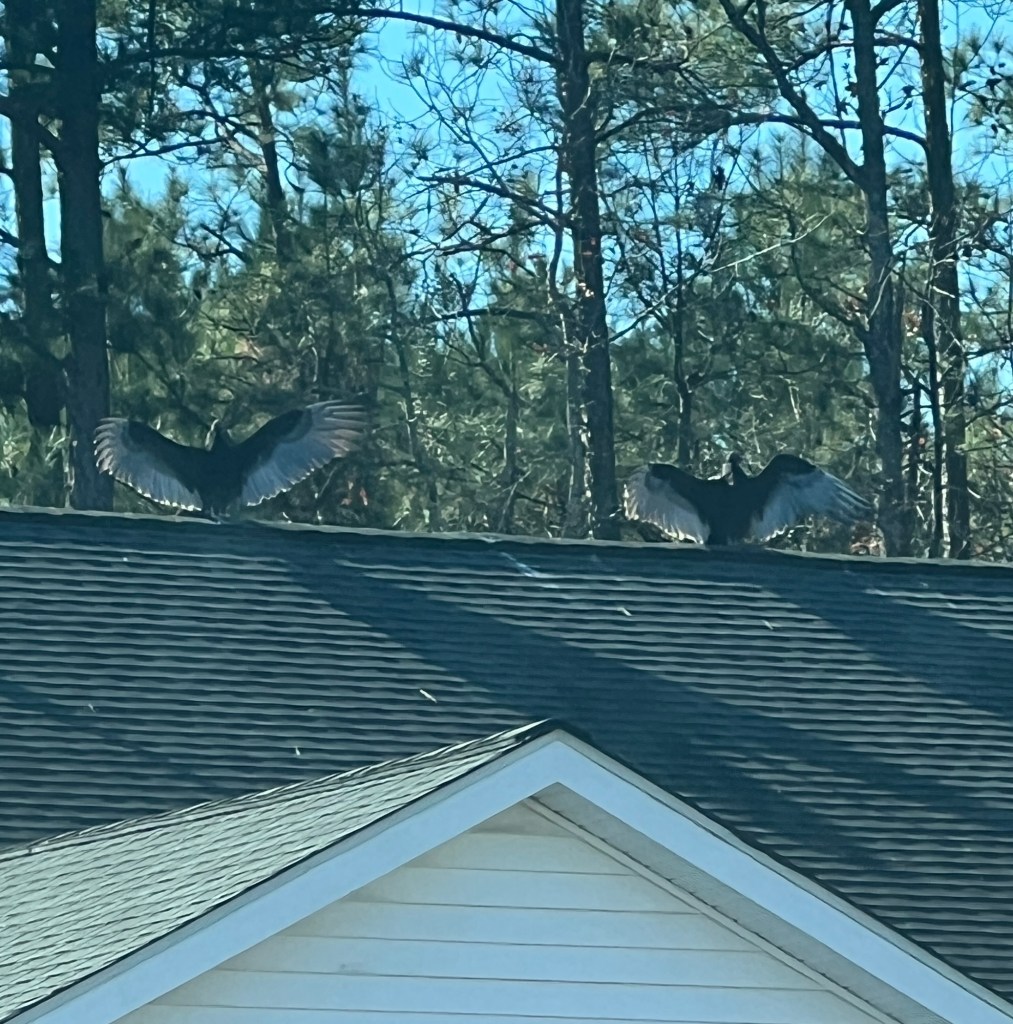
Sunday, December 8, 2024: The sight when I pulled into the church parking lot. The buzzards (black vultures) remained motionless atop the fellowship hall, disinfecting their wings in the bright sunlight, until the parking lot got too people-y for them and they flew off. Gotta admit this looks ominous, like something out of Poe or painted on the wall of an ancient tomb. Black buzzards are, however, “highly social birds with fierce family loyalty,” says the Cornell Lab of Ornithology. No wonder the church fellowship hall was so appealing to them for their own sun-day.

*******

with thanks to Two Writing Teachers for the March Slice of Life Story Challenge

Chanticleer

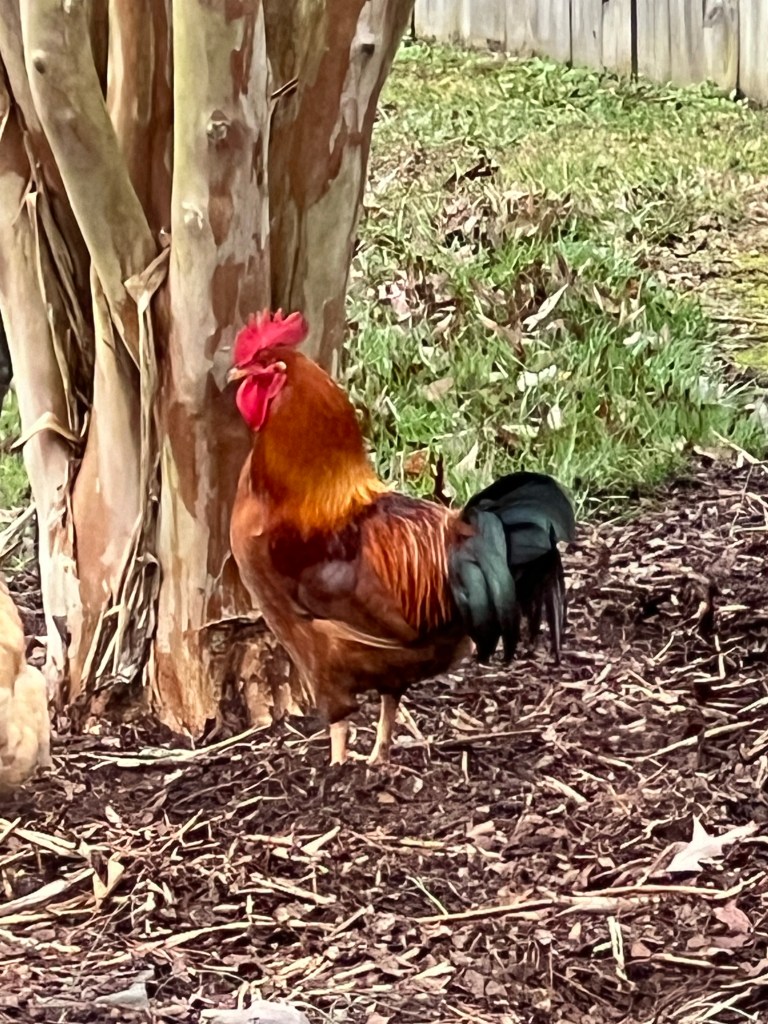
He comes a-strolling with dignity and purpose, bobbing majestically, robed in royal red, as fiery as embers in the grate on a winter’s night. He’s huge, he’s beautiful, and he knows it, the neighborhood rooster leading his ladies on a foraging expedition though all the front yards.

Sometimes he brings three ladies. Today, it’s four.

He doesn’t partake of the ground-feast himself. He leads the way, strutting to and fro, keeping watch while the hens scratch and peck.

Naturalist Sy Montgomery writes in Birdology:

Most roosters are very solicitous of their hens. When he’s not patrolling for predators, he’s often searching for food his flock might enjoy. When he finds it, uttering his food call…he stands aside while his women enjoy the treat, and only after they’ve had their fill will he sample the snack. The Talmud praises the rooster, and its writers advise the Jews to learn from him courtesy toward their mates.

I watch from the kitchen window as the chickens work their way over to my yard. The rooster crows. Montgomery calls it “the soundtrack of rural life.” In my mind, it’s the quintessence of rustic. And something more. The rooster’s crow calls to something deep in the human spirit (long before and long after the Apostle Peter wept in contrition).

Montgomery, again:

In the sacred book, the Hadith, the prophet Muhammad tells us why roosters crow: they do so because they have seen an angel. The moment a cock crows, the holy man advises, is a good time to ask for God’s blessing.

I remember the story-name given to roosters in fables: Chanticleer. From Old French, meaning “clear song.”

I slip outside through the garage to see if I can record it.

The chickens are under the crape myrtle at the old dog’s grave, scritching about in the mulch, flinging it every which way. The rooster is immediately aware of my presence. He turns to face homeward, in case.

Here’s my recording…wait for it…

At the end of a required re-interview for a job I’ve had for years (another story in itself, involving all staff) I was asked if I had anything else to add. I said yes. “I’ve learned a lot by watching birds. There’s nothing random in their actions.”

I likely left the interviewers scratching their heads, but I held my position.

Chanticleer crows. God, please bless me, my family, the work of my hands, my heart. Give me strength.

In the words of Montgomery: At the end of my prayers…birds teach me how to listen.

*******

Composed for Day 24 of the Slice of Life Story Challenge with Two Writing Teachers

To build or not to build

Those of you who’ve followed my blog for a while will know that I chronicle the return of house finches to my front door wreath every March. These little songbirds typically build a nest before I know it; they’re incredibly surreptitious. This has been happening for several years. A little pair actually slept in the wreath at night all winter before last, as if staking their homestead claim.

Last April, a tragedy struck and the finches have been scarce ever since. One day, five tiny, beautiful fledglings were thriving in the nest; a week later, all five died without warning. I found them with their yellow beaks opened wide to the sky, quivering; took me a minute to realize they were dead and full of maggots. This was the second seasonal brood for these parents. They’d built the nest and laid the first set of eggs before the end of February (“seems awfully early,” I wrote in my notes). Two of those fledglings died. The very day I removed the nest with the two dead fledglings in it, the parents rebuilt. They worked feverishly, laid five new blue eggs, hatched them, and lost every baby within a couple of weeks.

Seven dead babies in a season…too much for me, maybe for the parents. They vanished. There was no rescuing the wreath; it had to go, nest, dead babies, and all.

For the remainder of the summer my front porch was silent. No melodious trills of finch song. My granddaughters and I watched the bluebirds out back raise two broods (bluebirds are amazingly tenacious, territorial, and extremely loyal to their breeding grounds; they watch us as much as we watch them, almost as if to say Hello, what are you people doing in our yard?).

But the finches are shy. Nervous, even. They nest near people as a defense against predators, but they don’t want to be near people.

Ever since I took down my Christmas wreath and hung an old grapevine wreath with silk magnolias, I’ve been watching and wondering: Will the finches return this year? If they do, will the eggs hatch and will the babies be okay? If not…I don’t think I can handle the grief. I always protect the porch and door for them and yet this thing happened. As much as I love these birds, as precious as they are, I’d rather they nested elsewhere than endure it again.

I realize this is my own defense mechanism. An attempt to protect my heart.

Then, at the very end of January, I thought I heard a familiar Cheep! at my door.

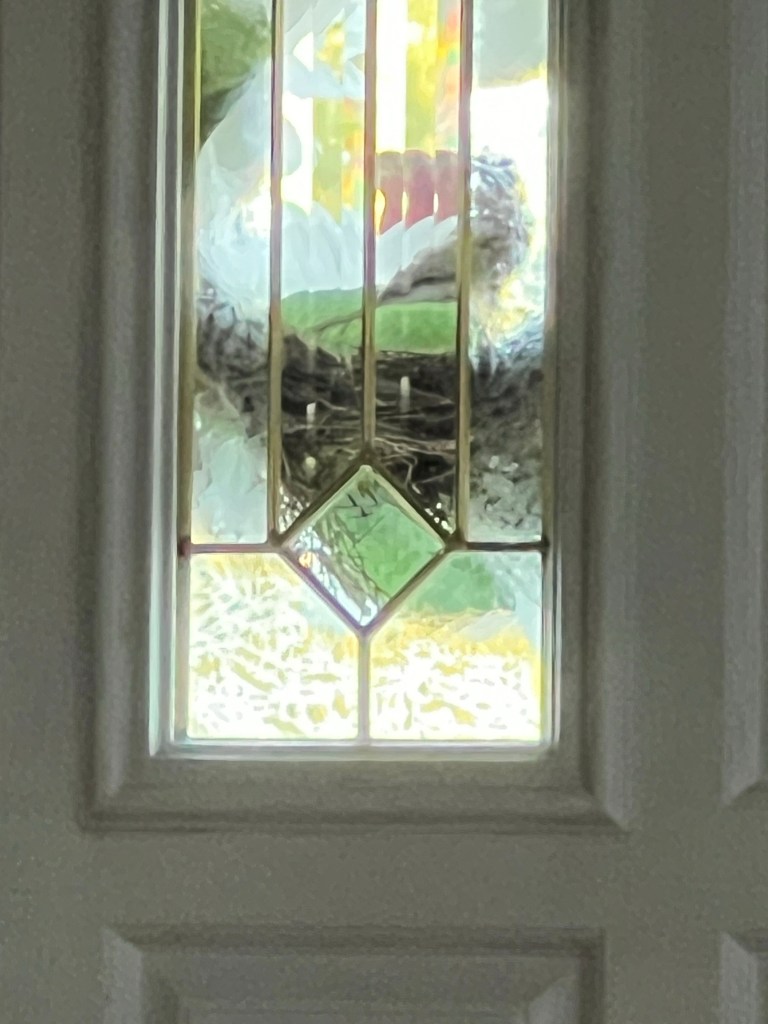
Through the beveled window, I saw a shadow moving in the wreath…

Could it be?

It was.

A male house finch.

He was there and gone.

I know he was scouting the nest site.

I’ve seen him a time or two since. He comes punctually between 4:44 and 4:54 in the evening.

Three weeks later, on February 20th, he brought his mate:

The female is in silhouette; the male’s head is facing the camera—his chest is extraordinarily red (looks like there’s three of him, but that’s just the beveled glass).

I suspect they’re having ongoing discussion about nesting in this wreath:

What do you think, honey? Prime location…

Hmmm. I don’t know. I definitely don’t like this glass. Too cool to the touch with way too much movement on the other side. I must have absolute privacy for incubating my eggs.

Right, right, right. Well, you know we don’t usually build here in the curve anyway. We build on top! Lots of privacy up there!

Weellll… it just feels a little too narrow. A little more space, a little more cover, that’d be nice...

This past Tuesday, March 5th, I saw a little bird tail busily moving at the upper right side of the wreath… same spot where last year’s ill-fated nest was built.

Yet no nesting material has been laid.

And so I wonder. Will they actually build here? They clearly want to. If so…when will it start in earnest? Will they decide this wreath just won’t do, after all? Is it not quite time yet? There’s nothing random about birds, their actions, or their inner clocks; their precision is astonishing.

Dare I, dare I even hope, that they are still in the planning phase? Maybe with a week or so to go, and that there will be eggs, possibly hatching at Easter?

Time will tell. I daren’t make predictions…I’ll just keep watching and waiting…

I should just take the wreath down and let them go. It would be easier.

Oh, but love isn’t easy, is it, little finches.

*******
Composed for Day 7 of the Slice of Life Story Challenge with Two Writing Teachers

Hummingbird observations

It all started last month when I saw one hummingbird in the backyard, out by the pines.

She appeared from nowhere, hovering stock-still in the air across the yard, directly facing my son and me as if to consider what manner of beings we are before she darted away—poof. Perhaps it’s just my overactive imagination, but I felt like some sort of message was in this magical appearing. Something the bird wanted…

I bought a feeder.

In a day or so, I had a bird. Or two.

Then there seemed to be three. All females.

Eventually a male showed up with his gorgeous fiery throat. From a distance he looked like a flying ember. He preferred coming early in the morning or around suppertime. It’s almost like His Tiny Royal Highness was letting his Royal Nectar-Tasters go before him to be sure the stuff wasn’t tainted. I cannot say, however, that he was any match for the females in regard to which was most vicious in the dive-bomber approach of driving all others away from the sugar water.

Hummingbirds are contentious creatures. Terribly territorial.

I’ve learned there’s a scientific reason for this: Their metabolism requires them to feed almost constantly. Hummingbird hearts have been recorded, I read, at 1200 beats per minute.

I bought another feeder.

As of mid-August, there’s a squadron of hummers at my feeders, so much so that the original feeder hanging on the kitchen window has to be refilled daily; I had to buy more sugar. I know that ruby-throats (the only kind of hummingbird that breeds in the eastern U.S.) are supposed to start migrating to central Mexico. The males go first, in early August, which explains their current scarcity, I think. Females wait a while longer. I’ve also read that some hummingbirds stay in residence all year. We shall see… I have learned to recognize some individual females by their different markings: one with black speckles all down her pale breast and belly, one with a pure ivory belly and a brighter, iridescent green back, one with a darker head, one with a lighter head and pale stripe on top, and one with a precious, tiny dot of red at her throat, like a lady bedecked in a ruby pendant. When I opened the blinds one morning last week, there was Little Ruby, hovering in the gray dawn; we were so startled by each other that we both froze for a split second in mutual awe (wonder on my part, likely fear on hers) before she zipped away.

At this point I must mention my grandmother. Hummingbirds and cardinals were her favorite birds, perfect symbolism for a woman named Ruby. I saw my first hummingbird by the spirea bushes in her yard one summer. The loud buzz of the beating wings alarmed me—was this a big bug coming after me?—but Grandma Ruby’s childlike delight quickly allayed my fear. And then there was nothing but enchantment for this tiny, dazzling fairy of a creature, glittering like an emerald, my own birthstone, in the sun.

Perhaps that is why I took my six-year-old granddaughter out with refilled feeders yesterday:

The hummingbirds hide in the crape myrtle and cheep at me whenever I take their feeders down.

They do? Why, Franna?

They just want their nectar. They are saying ‘What are you doing with my food!

I haven’t ever heard them cheeping.

Today you will.

And so, for just a moment, I held the favored window feeder out at arm’s length as my granddaughter stood by, very still. Two hummers appeared instantaneously, cheeping competitively before hovering, suspended in the air, eyeing me, uncertain, their whirring wings as loud as electric propeller fans. Each took a tentative drink before whizzing off to the pines out back.

I hung the feeder and my granddaughter said, Quick, let’s go in before all those wings come back!

I chuckled, remembering my first experience with the intimidating sound when I was about her age. We darted for the door. As we entered the house, she said: I heard them cheeping!

And then, before I could reply: Franna, look!

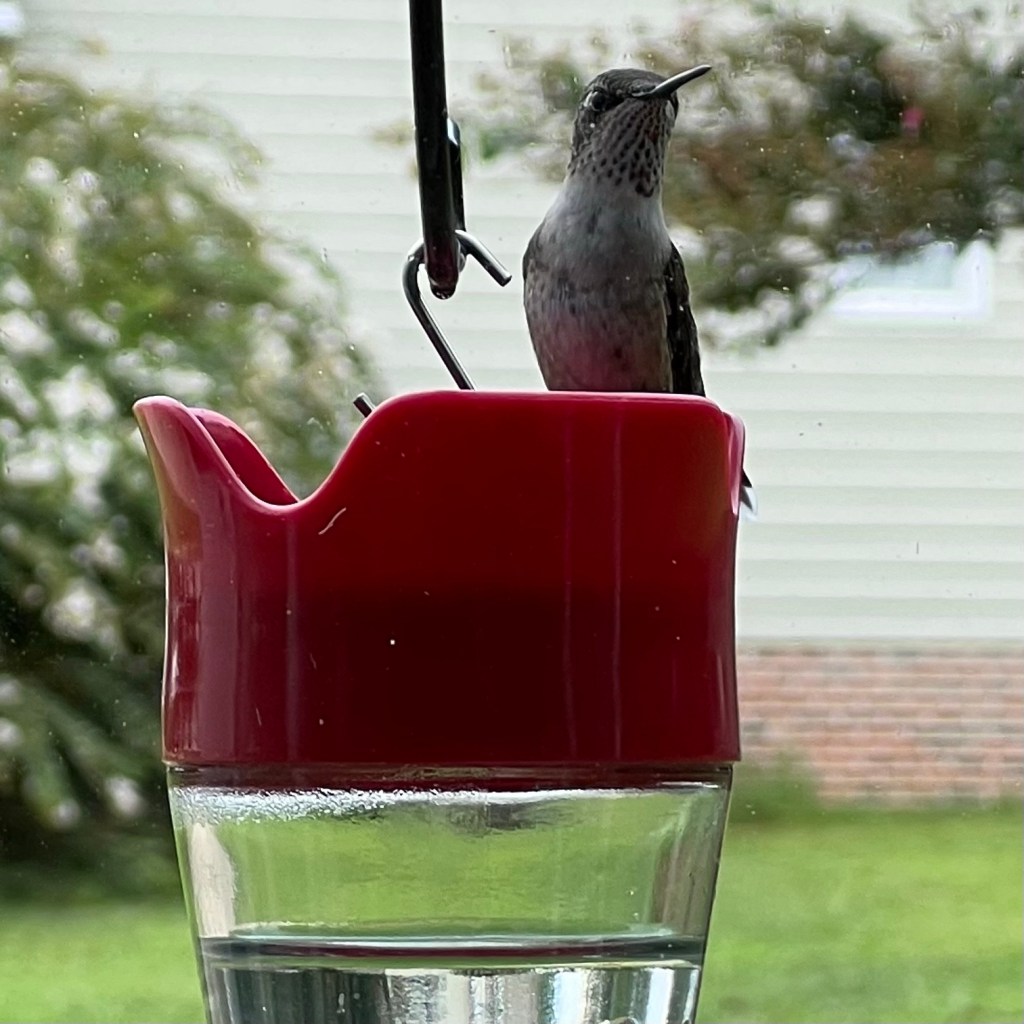
She pointed to the window, where a hummer was perched on the very top of the feeder.

Well, that is something new, I said. I haven’t seen any of them sitting up there before.

My husband, sitting at the kitchen table preparing a sermon, said: That bird was perched on the feeder hanger the whole time you were fixing the sugar water.

I am sure she was one of the two who dared to take a drink when I was holding the feeder.

For the rest of the day, this little bird perched, fed, flew off in skirmishes with other tiny feathered Amazons, and returned. Whenever I looked at the window, she was there, looking in, occasionally fluffing her feathers. I am not sure if she’s nominated herself Queen of This Feeder or if she’s simply curious—hummingbirds are known to be extremely so—and is watching me as I play with my granddaughters and cook supper.

I suppose the ultimate question is who’s observing whom.

And what we are learning about each other in the process.

Didn’t realize, until I reviewed the day’s photos, that I happened to catch her with her tongue extruded. Every minute with hummingbirds filled with absolute wonder. I have christened her Lilibet, the nickname of Queen Elizabeth (since she seems to be reigning over the feeder) and also in honor of my great-aunt Elizabeth, Grandma Ruby’s sister. I wrote about Aunt Elizabeth’s hummingbirds a couple of weeks ago: Solitary existence.

Next goals: 1) Get a good photo of Little Ruby and 2) Invest in hummingbird feeder rings for my granddaughter and me to wear…can we stand still enough for them to come drink from our hands? Will they actually do it?

*******

with thanks to Two Writing Teachers for the weekly Slice of Life Story Challenge
An incongruity

These are
the collective nouns
for hummingbirds:
a charm
a glittering
a shimmer
a tune
a bouquet
a hover

Call them what you may
they are not at all charmed
by each other

They are
tenacious
pugnacious
audacious

This I have learned
by observing
a half-dozen tiny Amazons
battling over the feeder
sometimes striking each other
so hard
that one smacks, thunk,
against the window

I am also learning
their colorful language:
warning cheeps
and indignant squeaks
over who gets the sugar-water
even questioning chirps
from the safety of the
pink crape myrtle branches
whenever I remove the feeder
for cleaning and a refill
(I am bringing it right back,
I say aloud
to a subsequent
skeptical silence)

Right back to the nectar
they come
with renewed vigor
peeping
chirping
quarreling
never singing
only once in a while
by some temporary truce
feeding side by side

I might call them
an incongruity

Although, in a way,
they are a bouquet
of diva style:
I can now recognize
the one with black spots
from her neckline
all the way down her pale belly
and the bigger one
with a pristine ivory belly
whose back shimmers
brighter green
and my favorite of all
the smallest one
with just a touch of red
glittering at her throat
—a tiny lady wearing
a precious ruby pendant

When I opened the blinds
this morning
there she was,
Little Ruby, hovering,
looking in at me for a split second
of mutual awe
before she darted away

which, hummers being
what they may,
makes for me a
charmed
glittering
shimmering
day

Forest Music.~Brenda-Starr~.CC BY-NC-ND 2.0.