My book bag

Bookbag

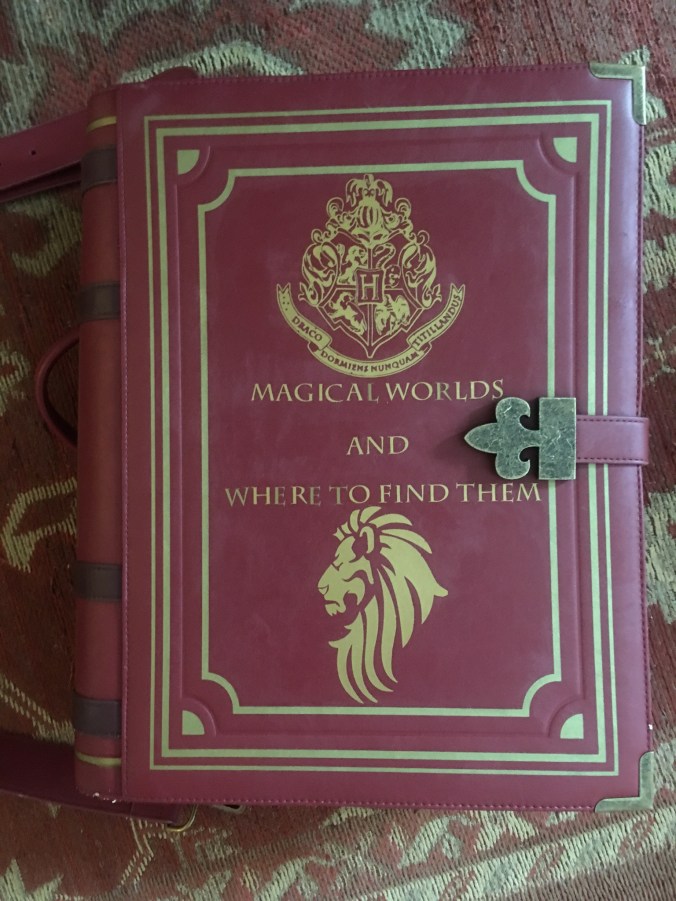
Everywhere I go, my customized book bag is a topic of conversation.

First of all, it’s literally a BOOK bag, sending the message “I’m a reader.”

Then people realize what the “book” is about. A play on Fantastic Beasts and Where to Find Them, my book bag bears the title “Magical Worlds and Where to Find Them.”

Opening a book, for me, is akin to Newt Scamander opening his suitcase – we step in and walk through magically expanded worlds. Whatever the book, it’s a passport to the minds and souls of other people, where I find myself reflected not always as a writer or thinker but as a fellow human being on the common, complex journey of life.

That’s the message I want to send to my young students, who are frequently in raptures over my book bag: Read. Expand your world, your mind.

My book bag actually sends more than one message:
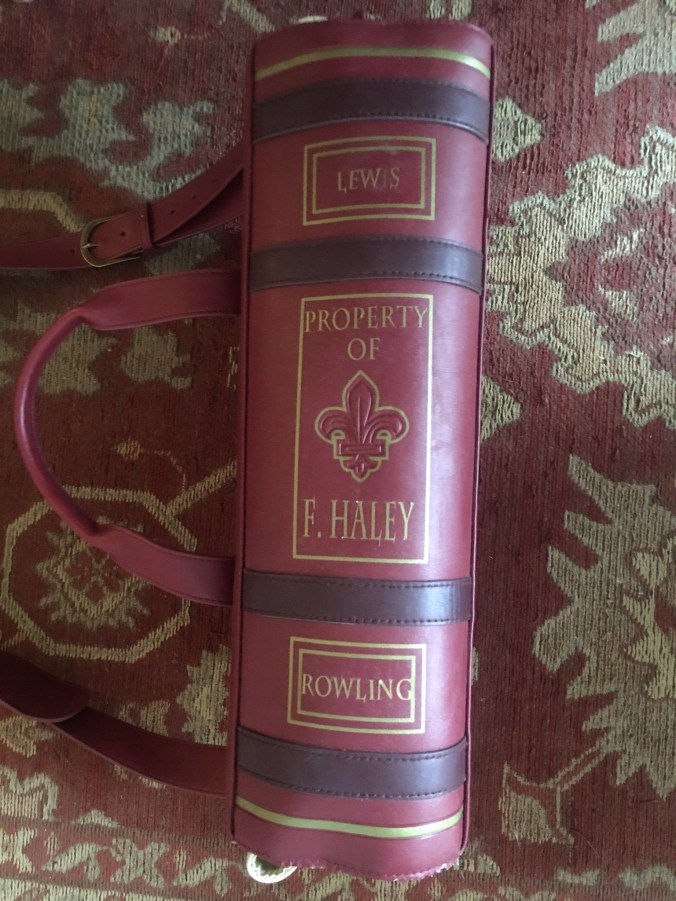
Bookbag spine

It’s an homage to my favorite fantasy writers and the worlds they created, old and new.

Much is written and debated, perhaps, on the importance of reading fantasy. Here’s a favorite quote on the subject:

The problem with people who are afraid of imagination, of fantasy, is that their world becomes so narrow that I don’t see how they can imagine beyond what their senses can verify. We know from science that there are entire worlds that our senses can’t verify. 
-Katherine Paterson

The magic is a draw, certainly – in regard to Lewis’ Chronicles of Narnia, who wouldn’t want to experience singing stars and merfolk, a centaur, talking animals? Who wouldn’t want a chance to feel the tingle of the box of dust from the lost island of Atlantis and ride on the back of a huge owl? Truth is, the bigger, deeper exploration is not the mysteries of the magical world but the real workings of the human heart – we read fantasy to escape our world, to live in another for a time, and all the while we’re looking into a mirror. This is where our thinking truly broadens – in understanding self, then in pushing the parameters of possibility.

Dr. Seuss said:

Fantasy is a necessary ingredient in living, it’s a way of looking at life through the wrong end of a telescope, and that enables you to laugh at life’s realities.  

The lines between the fantasy stories we love best and the world we live in are much blurrier than we realize. It’s where the impossible and possible merge – who’s to say where all the boundaries really are?

Which is fun, sometimes even comforting, to think about.

So everywhere I go, I carry a little fantasy, a little magic, with me.

Via my book bag – a messenger bag, indeed.
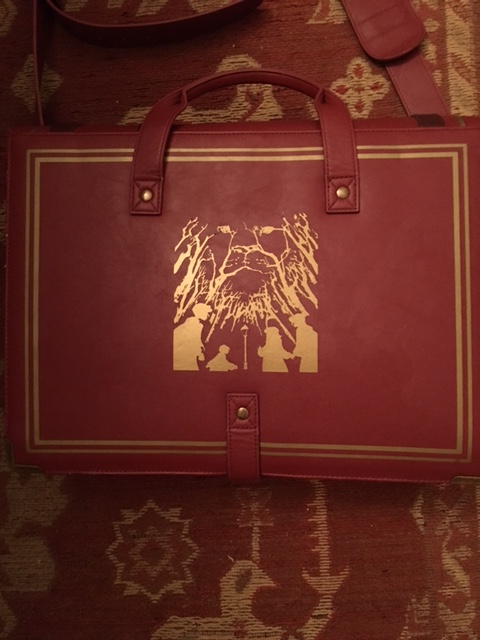
Bookbag back

slice-of-life_individual

Morning snow

Snow

There was crisp, dry snow under his feet and more snow lying on the branches of the trees. Overhead there was a pale blue sky, the sort of sky one sees on a fine winter day in the morning. Straight ahead of him he saw between the tree trunks the sun, just rising, very red and clear. Everything was perfectly still, as if he were the only living creature in that country.

-C.S. Lewis, The Lion, the Witch and the Wardrobe

Snow swirled down in the gray dawn yesterday, winter whispering farewell in its dying breath: I’m still here, but not for long. Just one more time . . . .

There’s a silence, a stillness, to Sunday mornings anyway, a sense of expectancy, an invitation to step away from the world.

Of course I think of Narnia. I always do when it snows.

I was ten years old, scouring the school library shelves for a book I hadn’t read yet, when I encountered a compelling title: The Lion, the Witch, and the Wardrobe. 

“Sounds interesting,” I thought, opening the cover, not realizing that it was a portal to another world that I’d never fully leave  – or want to leave. I fell in and never climbed all the way out again. Part of that pull is the longing C.S. Lewis infused into the Narnia Chronicles, the sense of “realness” that pervades the magic. Lewis poured what he loved into the stories, and they live because of it.

Having facilitated a writing workshop for teachers just the day before on “creating the magic” – writing about what matters to you, tapping into your heart, your dreams, your struggles, your memories, making your writing authentic so you can help students do the the same – I watched the snow, remembering Narnia.

Writing is the closest thing to magic that there is. As teachers we create the atmosphere for our writers. It’s one of excited expectancy, of energy, when young writers discover the power within them, learning how to harness words to impact readers. Writing, after all, is meant to be shared – it’s the connecting of human minds and hearts.

Which is why, for me, Narnia is never very far away.

Especially when it snows.

slice-of-life_individualEarly Morning Slicer


Titanic relic

pier-54-april-2012

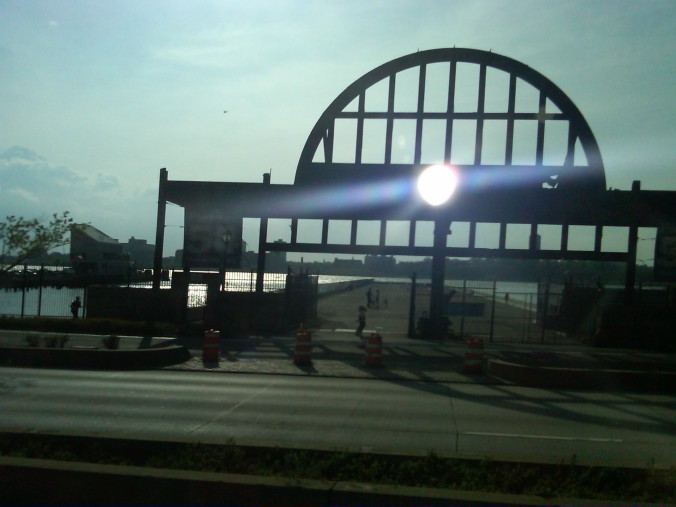
Pier 54,  April 21, 2012 – exactly one hundred years after the sinking of the Titanic.

Arriving by bus in New York City, the tour guide said, “This is Hudson River Park.”

Looking through the window, I saw a sign: Chelsea Piers.

Chelsea Piers – why does that sound so familiar?

The words buffered around my brain for a second or two, retrieving the information: Chelsea Piers is where the old old ocean liners docked. 

Pier 54 is where the Titanic survivors were delivered by the Carpathia – hey, that’s exactly a hundred years ago this week!

I scrambled for my phone and opened the camera.

I took the shot just as we passed.

There is no magnificent dock anymore, only a corroding steel arch standing like a neglected, tired sentinel as people go about their daily lives. It’s hard to imagine this unremarkable structure as a portal to luxury, to adventure, to the stuff dreams were made of over a century ago.

C.S. Lewis wrote in The Voyage of the Dawn Treader, in the chapter entitled “The Dark Island”:

“Do you hear what I say? This is where dreams  – dreams, do you understand – come to life, come real. Not daydreams: dreams.”

In other words, nightmares.

I tried to envision the crowd, the men in overcoats, the women in long dresses, everyone wearing hats, as the Titanic survivors disembarked on April 18, 1912. It was night. For a fleeting second, I could sense the darkness, the shattered dreams, the unspeakable horror of watching that massive, beautiful ship break apart in the icy sea, taking so many passengers with her to a deep, watery grave. The nightmare was real; it would never leave the survivors.

In an instant, the darkness vanished, my glimpse of long ago ended. I blinked in the broad daylight. As my bus sailed on, I studied the photo. A bright light shines in the very center of the arch, which once bore the words White Star. I cannot tell if my camera was poised just right to reflect a flash in the window, to be captured perfectly in the middle of that haunting remnant, or if it is a phenomenon of light from some other source; nevertheless it shines like the sun over this relic of ruin, like day following night, driving the nightmares, the ghosts, away, hallowing this entrance to another time.

slice-of-life_individual