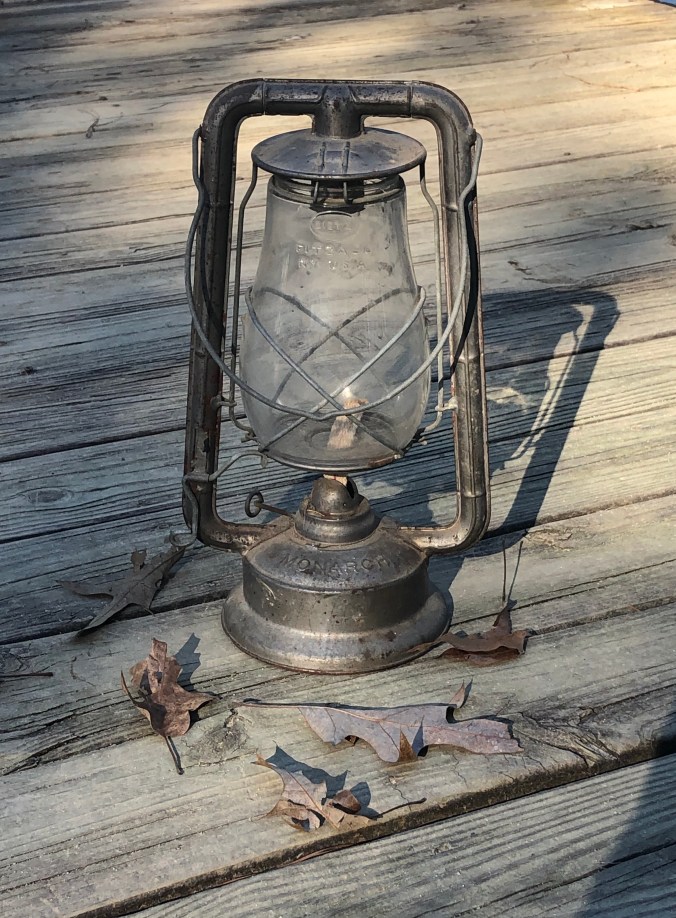
Pa-Pa’s lantern
In the lamplight, the withered leaves collect at my feet
and the wind begins to moan.
—”Memory,” Andrew Lloyd Webber & Trevor Nunn
It is all I have of him.
I don’t recall ever seeing it until I returned home after my Grannie’s death, years ago. My father picked the dusty old lantern up from a box of her belongings: “This was Pa-Pa’s,” he said. “You don’t remember him.”
I bristled a little. “Yes I do, Daddy.”
He smiled, shook his head dismissively. He placed the lantern on the bookshelf by the front door.
“He had white hair,” I said. “And glasses.”
Daddy’s brow furrowed just a bit.
“And he wore a gray . . . jumpsuit or something,” I continued. “And he was tall . . .”
Daddy chuckled. “No, he wasn’t! He was a short man, although he did wear a gray work suit. He was a mechanic.”
“Well, I was little. He looked tall to me.”
He looked at me strangely, then.
And told me I could have the lantern.
Pa-Pa was my step-grandfather. There are very few images of him in my mind. He and Grannie, my maternal grandmother, lived in the big house with the long stairs outside. My mother and father and I lived in the small white house right next door. One day Pa-Pa came over, sat in the floor with me, and taught me how to spin a rubber ball. Round and round it went, white and pink, blurring, round and round; I didn’t want it to stop. I must have amused him because he laughed a lot . . . when I recalled this to my mother, she said Yes, he thought a lot of you. He didn’t get along with his own family.
When I first saw a model of the Earth rotating, it brought to mind Pa-Pa and that ball on the floor.
My memories of those days are fragmented, strange. In Grannie and Pa-Pa’s living room I saw a pair of bedroom slippers that still had feet in them. I screamed in terror and couldn’t make anyone understand me. Another time I was standing between the kitchen and the living room when something behind me exploded. I saw the flash, the fire, reflected in the picture window behind the sofa where the grown-ups were sitting. They came running —it turned out to be a pan of grease left on the stove, igniting. No one was hurt but, again, I was terrified.
Pa-Pa let me ride in his wheelbarrow, out past the blue snowball bushes (hydrangeas) in his yard.
—That’s about all.
I have no recollection of his vanishing.
I know now that his grown sons told my parents we couldn’t stay in the little house anymore; we had to find another place to live.
Much later I learned that Pa-Pa bought the little house after World War II, when a nearby Army camp was decommissioned and its buildings were sold for a song. He had it moved to its place beside his big house. When I was born and my parents weren’t happy with their apartment, Pa-Pa offered it to them.
That little house, the first home I remember, had been the Army hospital morgue.
Ghosts, ghosts, everywhere . . .
I wonder why he comes to mind this night, why I suddenly think about his lantern.
Perhaps because he died in March.
I didn’t know this, either, until I found his grave a few years ago.
I stood reading his headstone, shivering in the dusk, brown leaves swirling, rattling softly at my feet. The month, the year—I could hardly believe it, myself.
He died in March.
I would turn three in May.
But I remember you, Pa-Pa. I remember.
—Your old lantern still lights.
 lit bits and pieces