Skitterings

Winter morning, below freezing, ground covered with thick layer of frost like unto snow. Oyster-gray sky streaked with clouds aflame with sunrise. Breathtaking colors. I drive to work, looking for magisterial hawks perched on power lines. None to be seen. At the corner where the patch of woods has been cleared, old tobacco barns are melting into the stubble, overlaid with a thin veneer of crystal. So beautiful, I say aloud. Something pure remains in the devastation. I cannot think of what. I drive on, pondering destruction and human hunger for it.

In the new rose-light little birds skitter up from the wood-edged fields. What type of birds they are, I cannot determine, just upward movement and wings. A strange line plays in my head: This day your life will be required of you. I suppose it’s born of constant murder in the news and too much reading, this very morning the strange coincidence of Diana, Princess of Wales, attending the funeral of Princess Grace of Monaco, who died from injuries sustained in a car crash. Did the struggling Diana sense any foreshadowing?

Why am I even thinking of these things during such a glorious dawn?

A shape swoops from the right, directly in the path of my car…surely a bird. I hear no thunk. I see no skittering escape in my rearview mirror.

The bird—if in fact it was—must be caught in the grille of my car. This happened once, long ago, when I was driving a different vehicle: I discovered a dead cardinal hanging partway under the car. Why, why do they fly so low?

I will have to stop and check. There’s nowhere to pull over on these winding backroads frequented by too-fast drivers and farm equipment.

There’s a tiny church tucked in the woods up ahead, past the intersection. Steep driveway, deserted area, but I have to get out and look.

Nothing ensnared on the wide chrome grille of my old car. Beneath the grille, however, are unscreened compartments and there, on the dark, recessed shelf, is a bird.

Alive and moving around. Gray, orange, and cloud-white, like the morning.

Oh, bird.

I take off my heavy black cardigan, wrap it around my hands, and reach in.

Gently, gently… then a soft, warm weight is in my sweatered hands. I make sure to cover its wings to avoid panicked and possibly injurious flapping. Its head is gray. Small gray beak opens and closes without a sound. Its eye, turned toward me, has a faint purplish hue, slightly reminiscent of my pet parakeet when I was six. The gray back and pale-orange coloring on the breast had me thinking robin, but now I can see it’s not. I don’t know what kind of bird this is.

Oh, little bird. I am sorry. As if my speaking will help, somehow.

I cannot stand here gawking at it. The creature has survived the trauma of my car; I don’t want it to die from terror of me.

I think of being in the hands of God.

Please don’t let it die, I pray. Is this a selfish prayer? I don’t know how badly the bird is damaged.

And what am I going to do with it now.

The woods…I skim for a sheltered spot. I step in the leaves and a sudden sound startles me: a rabbit goes skittering away, its big white cottontail bobbing against the sepia scenery. I had no idea it was there. What else is here that I cannot see—? I am shivering. I find a small ridge of leaves and pine straw by a bit of barren brush and there I lay the bird.

The bird turns itself from side to breast, facedown. There’s a bit of white edging on its tail feathers. I wish for to something cover it. The morning is so cold. My sweater might entangle its legs; scraping pine straw over it might alarm it.

I will go. I will not stay to see the outcome. It will recover, or it won’t. I recall the woodpecker that flew smack into the glass wall of the school where I work; it landed on its back in the flowerbed mulch and lay so still I was sure its neck was broken. Within a moment, it managed to flip itself right side up, ruffled its feathers, and flew off—zip!—as if nothing had happened. The robin I extricated from the grille of my sister-in-law’s car, having traveled miles down the interstate at 70+ mph, hopped around my backyard for a day before it flew away. Birds are hardier than they look…at least robins and woodpeckers are.

Still.

Should this pretty little bird die or recoup…it will be in its own natural setting.

In the hands of God. Not a sparrow will fall to the ground apart from the Father...

It is hard, yes, to leave it there and walk away. But I have done so before. With people whom I loved very much.

It is Yours.

Back in the car, I circle the tiny church named for St. John, heading on toward crystal-coated fields and misty-mirror ponds and the work that lies ahead. The little bird will never know that I will remember it, that it’s now part of me, stuck to my soul as long as I live. I know it and that is enough on this cold, fiery-sky morning, orange and gray, breathtaking glory tinged with, but not diminished by, loss.
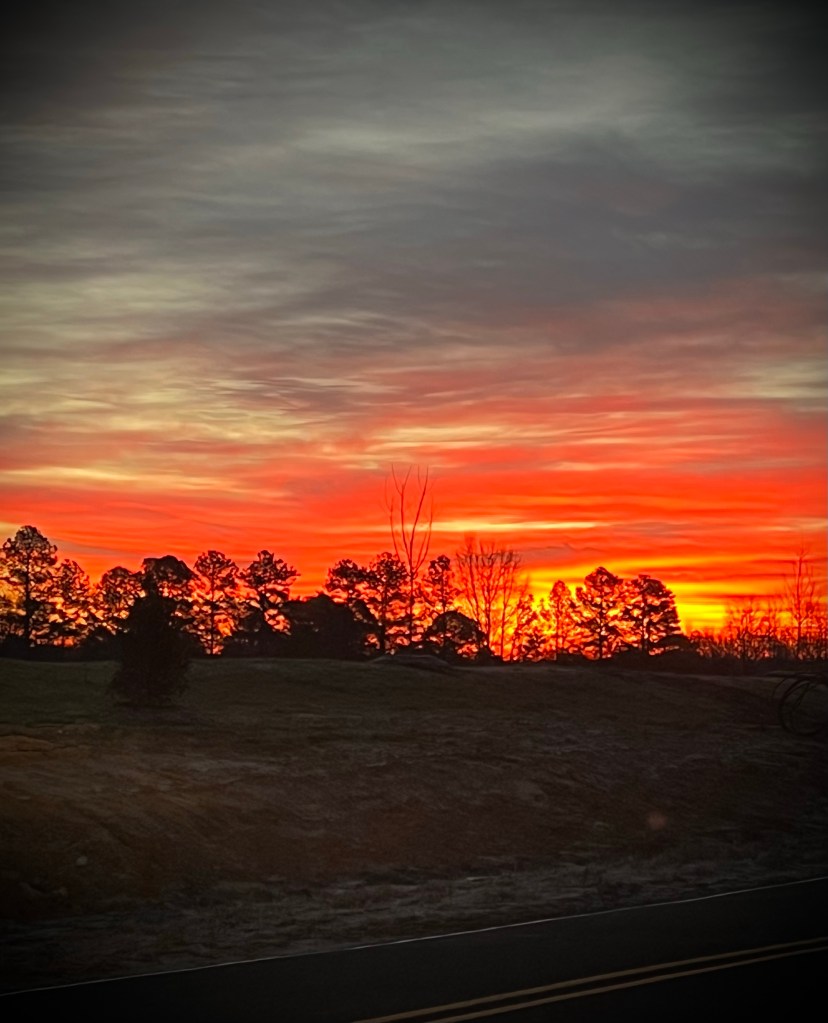
“If I take the wings of the morning and dwell in the uttermost part of the sea, even there your hand shall lead me, and your right hand shall hold me.”Psalm 139:9-10 (my favorite of the Psalms). This is the view leaving my neighborhood.
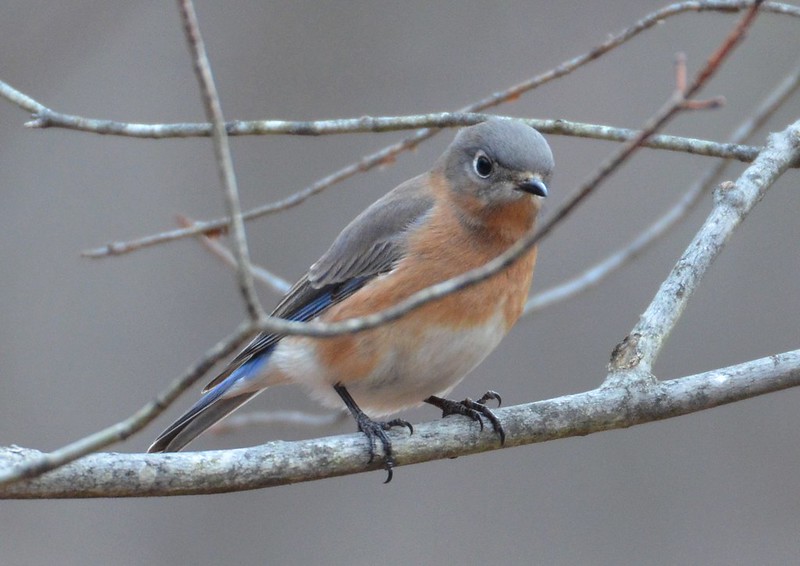
As best I can determine: My unexpected passenger was a female eastern bluebird.

DSC_3019e eastern bluebird–female. jjjj56cpCC BY-NC-SA 2.0.

*UPDATE, May 2023:

I’ve used the Picture Bird ID app to identify my mystery bird as a female Eastern Towhee.
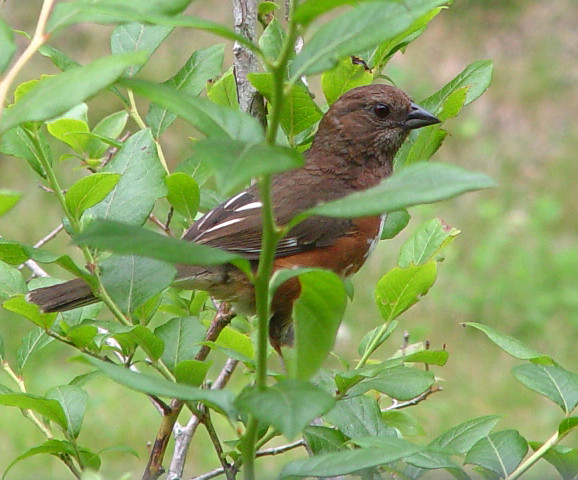
Eastern Towhee.
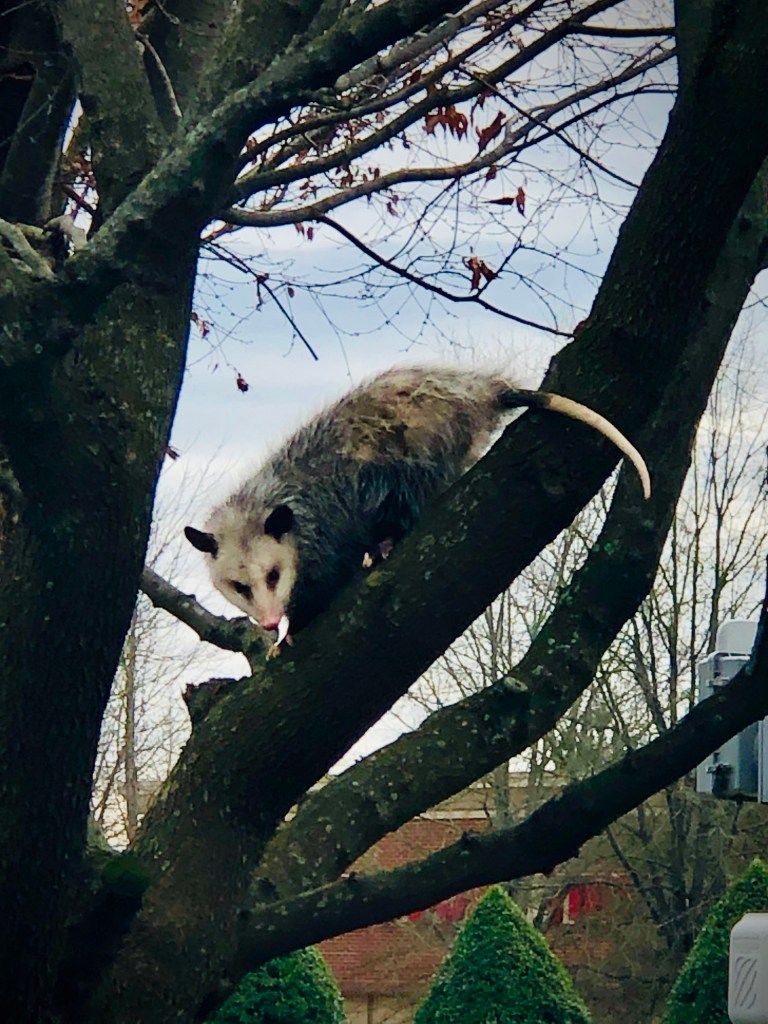
Possumbilities

It was not a thing I expected to see while on a Chick-Fil-A lunch run.

But there it was, directly opposite the drive-through menu board for ordering: A possum in a tree.

First thoughts: What’s wrong with it? Why would a possum be out and about during the day?

Next thoughts: Where did it come from? Why is it here? Has the smell of food lured it? Did it somehow manage to cross the busy street? Or (I shuddered): Will it TRY to cross the busy street? What will become of it?

Then: I need a picture. I’ll have to write about this.

And so I left the drive-through with the possum’s image preserved in my phone. Before I pulled into traffic, I looked back at the tree one last time. The animal wasn’t there any more.

It’s hard, for a storyteller, to not know fate or destiny.

I wondered many things as I drove away: Will restaurant workers or patrons call Animal Control? What does Animal Control do in a case like this? Will some random person decide to shoot it, deciding it poses a safety hazard, or just for the sake of shooting it? I am not a big fan of opossums but I didn’t want harm to come to it. Maybe it was old, weak, confused, like a person wandering in a nursing home. Maybe it was a female with babies hidden in her pouch. One Sunday morning when I was coming home from church a possum darted in front of my car. “Dart” isn’t really accurate; it hobbled as fast as it could. A mother laden with knobbly pink and gray babies on her back. Four little faces with eyes looking right at me. I slowed; they skittered across the road to safety.

That time, anyway.

And so I remembered them as I drove farther from my drive-through possum, contemplating the whole gamut of what might happen to it. Then, thankfully, my fanciful side kicked in: It knew where the speaker was. Maybe the possum comes on a daily basis to place an order: “Twenty-piece nuggets, please. Don’t forget my ketchup.” With those little pink hands, it could probably peel the ketchup foil back for dipping. Maybe the famous renegade cows are initiating this possum for the next round of their advertising campaign to ‘Eat Mor Chikin‘. . .

Oh, I thought, children would really like that story! I wonder what THEY would write . . . ?

There was a time when I’d take the photo and my story right into classrooms, across grade levels, as a model for any kind of writing. Small moment narratives, opinion, informational (for I ended up researching why an opossum would be so visible during the day and guess what? It’s not out of the ordinary at all. I further learned that opossums have a natural resistance to rabies and snake venom. Imagine people shooting it out of the tree because they don’t know). As an intro I might ask students if they know that the opossum is the only marsupial native to the Americas and link it to the koalas and kangaroos in Australia; we might consider relief efforts and life preservation, for all life is connected.

I’d even use my possum for teaching poetry writing. My mind is playing, this very minute, with opposite and opossum and tree and see, with an atmosphere of fear, wishing for a safe place. . . and of course there’s the fabulous fun of writing fantasy. Perhaps this possum took Chik-Fil-A home to its family where the bigger possum kids are playing video games (it always appears in some students’ writing). Maybe the possum babies got their nuggets “to go,” eating them in their mother’s pouch, with the littlest one crying that it didn’t get a toy . . .

The possibilities—or, in this case, “possumbilities”—are endless.

Or were endless, in the days when we did those kinds of writing, in that way, before the advent of programs that “incorporate” writing via a series of formulaic steps with whole classes writing on the same thing for the same amount of prescribed time. When authentic process was valued above uniform product and the end results were all different, because students—humans—are all different. In the days when students asked questions they generated themselves, because they really wanted to know the answers, because the answers mattered to them. When mining their own experiences for meaning lit up their faces and exploring their own ideas illuminated their minds. When the most priceless gift of childhood, imagination, wasn’t constrained and when teachers were not conscripted to teaching writing this way (with some believing that it’s better because it’s “easier”).

—Not me.

I saw a possum in a tree.

And I wondered, knowing I’d write about it, to find out why I needed to write about it.

It’s not about knowing fate or destiny.

It’s all about seeing possibilities, great and small, without and within, following a thread of thinking, of feeling, of life, to see where it takes you.

In other words, not blindly driving through and missing possumbilities.

Life imitates art

img_0527

“Life imitates Art far more than Art imitates Life.” -Oscar Wilde

When I saw my colleague’s handmade “Principles of Art” on the wall of the art classroom, I thought: Wait – couldn’t these be principles of life, too?

Inspiration struck; in fact, it dared me to try . . . so, here goes . . . .

How to Use Tools in Life

Pattern

Let us step away from repetition; save it for rhythm. Think instead of a template laid before us, with diagrams and guidelines, a model to be examined before cutting to fit who we are and are becoming, always making the necessary alterations as we go. 

Contrast

—isn’t easy, might be painful, but is necessary, for it makes elements that need to be seen stand out: the good, the bad, the ugly. It also makes better and best possible, for it is in differences that we find beauty, that we reach beyond realms that we know into those we don’t; this is how we grow. 

Emphasis

Find your focus. What’s WORTH emphasizing? Everything cannot have the same intensity or there’s no big picture, no real vision, and meaning is lost. 

Balance

—means stability. Not attempting too much or too little. Too much and we become oppressed, paralyzed, ineffective. Too little, and we become bored, listless, unproductive. Balance is achieved by planning for it, knowing that the work and the break from the work are essential, equivalent, and correlated gifts. 

Scale

—is about relationships. And perspective. It takes courage to see these as they are. Healthy relationships are in proportion. Unhealthy ones are not. A whole must relate to another whole, not to parts. The only person you can adjust is you. Use your power wisely.

Harmony

Finding common ground, honoring inherent sameness, coming to a pleasing agreement or resolution, is finding our place of belonging, one to another.

Rhythm (movement)

—begins with the beating of our hearts. Humanity is meant to to make music, sing, to dance, to run; rhythm is exciting, reminds us we are alive. It is not random. It is structured. It is anticipated. It is a recognizable, repeated pattern necessary for order and flow. It’s all about the right timing.  

Unity

—is about overall clarity and completeness. It occurs only when all individuals, all pieces, are in harmony with one another. Clutter and confusion are gone.

Variety

Ah, the spice of life . . . intricacies, complexities, diversity, the delight of the unexpected . . . all that transforms existence from an interesting experience to one breathtaking adventure. 

Double challenge: Re-read as 1) Tools for writing and again as 2) Tools for teaching.


To dream, to write, perchance to connect

Connection

“Connection” by Dylan O’Donnell

Henry is sound asleep on the sofa, his head on two throw pillows, snoring like a middle-aged man.

He is my family’s  endearing, shamelessly-babied Lab-Pit mix. Three years old and in his mind, he owns this sofa. It exists solely for him.

We don’t tell him otherwise.

Within moments, Henry’s breathing changes. His smoky gray body shakes; his white paws twitch. He whimpers at a higher pitch than he ever does when he’s awake.

“He’s dreaming,” we humans say to each other.

That whimper. It sounds puppy-like. Afraid. Vulnerable. Nothing like the rumbling from deep within his chest when Henry “talks” to us (translating to “Hello, I want something, so drop what you’re doing, pronto, to do my bidding”).

Which leads me to wonder: What is he dreaming about?

He is a rescue dog, found wandering the streets. He was timid for a long time before attaining his current level of confidence (and world domination).

Is he reliving a scene from his early life? Was he mistreated? Abandoned? Did something frighten him badly when he was a puppy?

Do dogs really dream like humans do?

The answer, according to Live Science, is yes: “Dogs likely dream about waking activities much like humans do.”

I am the one chasing a rabbit here: Captivated by the article,  I keep on reading beyond dogs to rats to flies—yes, says a cognitive scientist, even flies may dream in some form.

Sounds like something straight out of fantasy . . .

You may visit the site to read about the rats and flies yourself, if you like, but here are the article’s big clinchers for me: That sleep “adds something” to the process of learning and remembering, that sleep is “a sort of categorizing of the day’s activities” and a chance for the brain “to explore in a consequence-free environment”:

The idea is that, in sleep, the brain is trying to find shortcuts or connections between  things that you may have experienced but you just hadn’t put them together.

Cognitive scientist Matthew Wilson, “What Do Dogs Dream About?” Live Science

Categorizing of the day’s activities . . . yes, this often happens to me as I fall asleep. Reliving moments, subconsciously archiving them in specific mental folders for future retrieval as needed. A subliminal attempt at order and organization—how I appreciate that. The brain is an indescribable marvel, the ultimate computer. I envision lines arcing this way and that along a grid, an image of our brains actively searching, reaching, connecting and grouping things, while we rest.

My uncle once told me he could sleep on a problem and before he woke, the solution would materialize in his mind. Some mornings, in the transition between sleeping and waking, I can “see” the day’s events before me, and a detail or an approach will offer itself in a way I hadn’t thought of before. This has a name: liminal dreaming. 

But as I am awake, here is where I very consciously, intentionally, connect some psychological dots.

As Henry lay dreaming, prompting me to wonder about his background and the stuff of his dreams, I happened to be reading Ruth Ayres’ new book, Enticing Hard-To-Reach Writers. It is a must-read for educators, whether one teaches writing or not. Ayres has a lot to say, from firsthand experience, about the brains of children who’ve suffered extreme trauma and neglect. She also has a lot to say about the power of writing, of story, to heal and to save . . . I cannot help thinking now of the thirteen Turpin children in the news and the discovery of  their “hundreds of journals” which officials speculate may have helped them survive the unimaginable at the hands of their parents. If this is true, we’ll soon know.

But as for my dog, his dream, a website, the book in my hands . . . they all converge on the work of the brain:

When I write, I realize new ideas. I make connections. I figure out what I need to do next. When I write about what’s happening . . . something significant happens: I begin to see things from a new perspective. This is how learning happens. This is how growth happens. 

-Ruth Ayres, “Writing Always Gives More Than It Takes,” Enticing Hard-To-Reach Writers

To sleep, to dream, to subconsciously categorize, make connections, problem-solve . . .

To wake, to write, to consciously realize ideas, make connections, problem-solve . . .

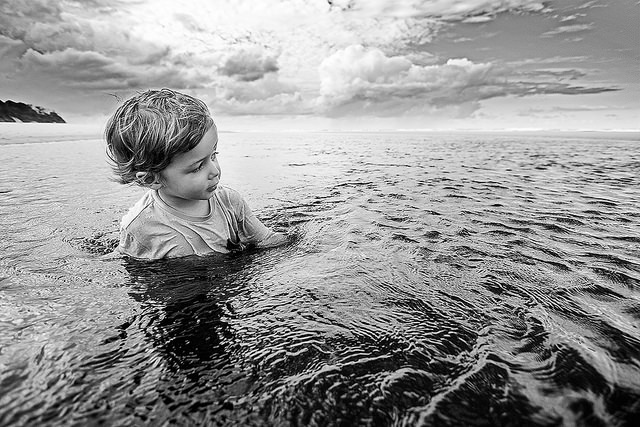
Revisit the child in the photo at the top of this post. He’s immersed in water, a symbol of life, an expression of contemplation on his little face. He’s absorbing the experience. The world is big. Sometimes alarming. Not always fair. When he lies down to sleep, what dreams may come? Will they haunt or heal? Hold him back, or help him overcome? He is at the mercy of his dreams. As are we all.

But to wake, to write, is to immerse in thought, to gain unexpected perspective, to remain open to questions, to answers, to possibility, to wonder, to hope.  Dreams, in all their mystery, come and go at random; their meanings and value often elude us. When we write—an equally mysterious process—we actually take hold of meaning. We continually unfold it, one layer of thought leading to another, branching off in directions previously unseen. To write is to go both deep and wide, to actively broaden the scope of one’s own world, to expand one’s sphere of interest, to explore what’s within to better relate to what’s without  . . . to connect.

I mark the page in my book and reach over to rub my quivering dog.

“Shh, shh, Henry. It’s okay. I’m here.”

At the touch of my hand he eases. He lifts his head, regards me with bleary eyes. His tail thumps. He readjusts, curling himself into a tighter ball there on his sofa.

He sighs.

The sound of satisfaction, of being connected, of being safe.