Help

Help

“Help.” James JohnstoneCC BY

As I entered the darkened cinema auditorium, an attendant handed me a pack of tissues.

Foreshadowing at its best.

The tears come at various points throughout the viewing of Won’t You Be My Neighbor?—the lovingly documented life and work of Fred Rogers.

Mr. Rogers operated from a profound wellspring of love and empathy for children. At the outset of the movie, he’s young, seated at a piano. The film is black-and-white. With his hands on the keys, Mr. Rogers speaks of modulations: “It’s fairly easy to go from, say, a C to an F,” he says, playing each chord. “But to go from an F to an F-sharp,” he models, “you must navigate all sorts of things.” He saw the new medium of communication, television, as a means of helping children navigate the modulations of life. Fears. Changes. Questions. Emotions. A country at war. Hatred. Not understanding. Divorce. Illness. Death.

I watched and listened with the ears of an educator and the heart of a writer. This is my work, too, I thought, only my medium is paper and pencil. 

Then, after having helped generations of children through the modulations of life, came 9/11.

Mr. Rogers, then retired, was asked to help, his voice, his presence, once again a ray of light, this time cutting through incomprehensible darkness. In the documentary, the sorrow is etched on his face. He spoke of being tikkun olam, “repairers of creation.”

With his words I saw the world in all its brokenness, violence, despair . . . and thought, It begins with the world inside us. Repair begins there, within each of us, before we can work on the world without.

I thought of children I’ve known through the years, finding their voices through writing, facing their fears, overcoming them, gaining strength and courage. Children who have suffered loss and grappled with it in their own words. I’ve read the haunting account of a child being tortured in another country and celebrating his new life in the United States. I thought it was fiction until the third-person changed to first near the narrative’s end; the teenager was writing about himself. A second-grader whose mother was remarrying and her fear: “Will my stepfather like me?” A fifth-grader lashing out at her mother in the very first line of her memoir over how many times they’d had to move, and how it hard it was to have any friends.

And with the words that came from within, anger eventually melted to forgiveness, fears pointed toward hope, insecurities gave way to confidence and validation. With the writing, the stories became those of enduring, of overcoming, of celebration.

Repairing within.

I thought about how some educators look at writing only as a means of retelling what you know from what you’ve read, or a standard to be delivered, assessed, and crossed off a list. No time for this “touchy-feely” kind of  thing . . . yet the one thing that best helps children understand themselves, the world around them, and their place in it, is writing. Freedom versus constriction. Discovering potential, seeing possibilities, problem-solving. I’ve said it before, I’ll say it again: Why is the goal “college and career ready?” How about life ready?

For the modulations don’t end in childhood, do they, Grown-Up.

Mr. Rogers spoke of his own childhood and what his mother told him whenever there was a catastrophe, or news of tragedy, on the air; she said “Look for the helpers. There will always be helpers, even if on the sidelines . . . because if you look for the helpers, you’ll know that there’s hope.”

Look for the helpers. Repairers of the world.

Then be the hope.

And . . . write.

Blanket

I am more tired than I realized.

I wake up early every day, around 3:30. Not intentionally; I just do. Instead of lying awake or drowsing for another couple of hours, I get up and write. It’s the perfect time, before my menfolk and canines begin to stir.

My early mornings are a logical reason to be tired.

And spring break is still a week away. The last mile is always the hardest . . . .

And I am twenty-five days into a thirty-one day writing streak, the Slice of Life Story Challenge, which requires an extreme level of thought-immersion and attention to the minutiae around me (everything is a writable moment). My receptors must be wide-open all the time. This, however, is a good kind of tired. Even though I am mentally composing while I’m sleeping.

And I am fighting an allergy or a cold; I feel it lurking around my edges. My boys, when they were small, used to say, “I am catching up to a cold.”

And it’s been a long winter. There may be a few snowflakes tonight. Spring hasn’t fully sprung. There’s still a lot of darkness.

And my family marks a year of losing loved ones, young and old, sudden and by inches with dementia. My husband, his sister, and I need to finish cleaning out their mother’s house.

The dogs, knowing I’m the mom of everything, trail my every step. Henry wriggles like a worm, with an insatiable need for pats, for attention, and even poor old Nikolaus, his eyes like clear marbles full of misty clouds, is still able to scamper behind me in hopes of a treat.

And so, I’m tired.

Yesterday, being Saturday, I did something I almost never do:

I finished my post and went back to bed.

My husband, who’s now been up for a short while, reading in the study, comes looking. “Oh, you’re back in bed?”

“Just for a little while,” I say.

“Okay.” He closes the door.

I pull the blankets up to my chin. So cozy. I drowse. I hear bits of blog posts echoing in my brain.

The door opens. Older son. Henry’s so-called “dad.”

“Are you sick, Mom?”

“No. Just resting.”

“Oh, okay.” He goes to fix his breakfast. He loves a big breakfast. His brother won’t eat until lunchtime.

Snuffling outside the door. Henry. He usually begins to grumble-half-whine to come in and snuggle to me, or to sleep on my bed if I am getting ready for work. Today he must sense something. He goes away. Unusual.

Distant clanking in the kitchen. Muffled voices. Footsteps in the hallway.

The door opens. Younger son, Cadillac Man.

“Mom?”

“Yes?”

“Are you okay?”

“Yes. Just resting.”

“Okay. Lowees.” This is how he first said ‘I love you’ when he was a baby. Lowees. It immediately became part of the family lexicon. We all say it to each other. His father reminds me again and again that Cadillac Baby said it to him first.

“Lowees,” I say.

I can’t stay here long. None of them will be able to take it. There’s too much to do, anyway. There are places to be.

But I pull the covers partway over my head, sinking into the warmth, the softness, savoring the moment, grateful for the web of words knitting itself from random scraps in my mind, for the abiding blanket of love wrapped over and around my life.

The writing shows up

While I—er, I mean Henry, our dog—composes his own blog post, my younger son (the Cadillac man) drifts through the kitchen.

I pull up a previous post on my phone and hand it to him:

“Here, read the comments about you and Pa-Pa’s Cadillac.”

He reads, smiles. He’s pleased but says little. He’s a man of few words.

He won’t ask, so I tell him what I—um, Henry—is working on: “This is the next post. Henry is writing it in response to one I wrote about him interrupting my writing.”

“Hmmm,” replies the Cadillac man.

“Want to read it?”

“Sure.”

So the Cadillac man sits down at the table and takes my laptop. He reads Henry’s post-in-progress.

“I like it,” he says.

He sits for a minute.

Then: “I wonder if I could write from Nik’s perspective.”

Nikolaus is our sixteen-year-old dachshund. We got him as a puppy when my son was four.

As I take my laptop back, I say, rather airily, “You should try it.”

I don’t expect him to.

He hates writing.

This is a big, jagged stake in my heart.

His older brother loves writing and even maintained a blog for a while, long before I started this one. But the Cadillac man has gone all the way through his academic career cracking books only when he had to, writing only when forced for assignments, and utterly exasperating me with his lack of interest. He didn’t struggle with reading or writing. He just didn’t care about any of it.

At all. Ever.

He’s a brilliant musician, however, and a powerful vocalist. He’s loved music all of his life. At age seventeen, two weeks after graduating from high school, he was hired as a church music director. He’s working on a degree in that field. He’s adapted songs, composed a little—”just the music, not the words. I don’t do words”—and coaches others as they try playing instruments new to them. He speaks beautifully before a crowd, did so at Ma-Ma’s funeral despite not having any notes, because . . . he hates to write.

So, when he mentions writing about Nik, I think he’s just wondering out loud, nothing more.

He leaves the room. He comes back to the kitchen table with his new Chromebook.

“Do you have homework?” I ask.

“No, Mom, it’s spring break, remember? I’m going to write a story from Nik’s perspective. To see if I can actually do it.”

What?

The first time in his twenty years that he’s chosen to write a story.

I feel like the floor under my feet is shifting, that the Earth itself hangs in the balance. I have to leave the room.

I can’t stand it. I have to know.

I creep back into the kitchen.

He’s typing away.

“How’s it going?” I dare to ask.

“Pretty good.”

“Is it . . . fun?” I hear my voice quaver.

“It’s sad, really,” he says.

He finishes, lets me read it.

We know Nik won’t be with us much longer. He’s old. Frail. He’s going blind; his eyes are turning milky. My son’s words show Nik making his peace with all of this, that he’s satisfied he’s served his family well, and how he knows our other two dogs will “carry my torch of comfort and protection long after I’m gone.”

The attribution reads Nikolaus Haley, expert red dachshund.

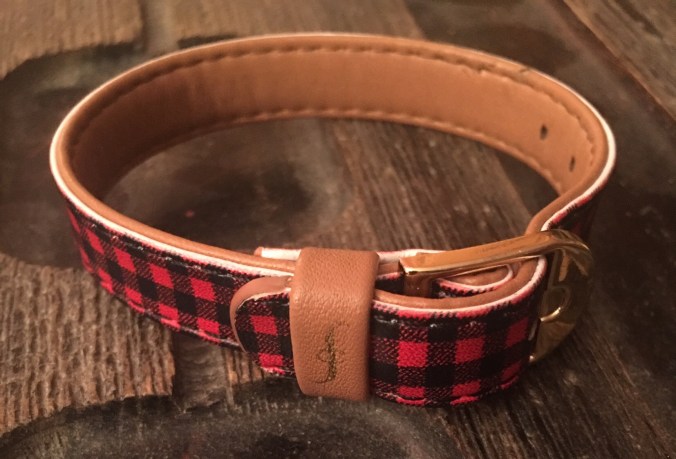
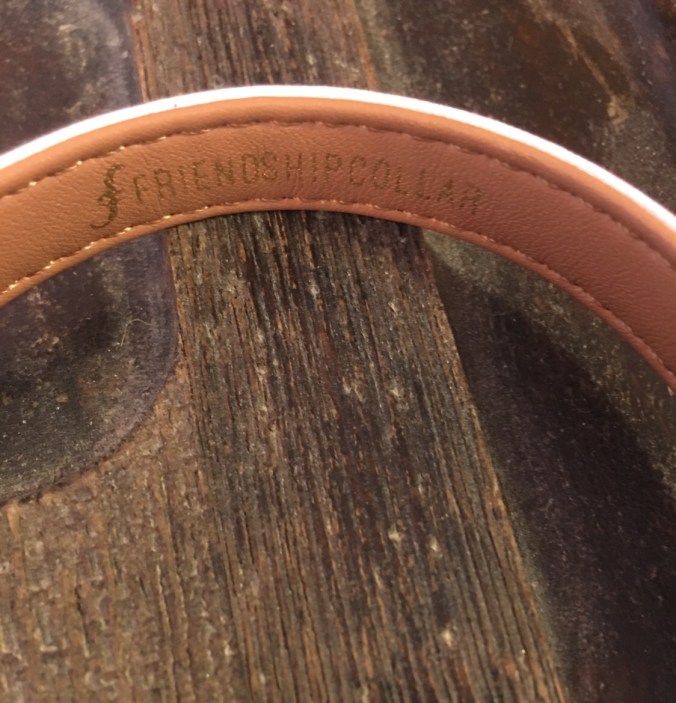
My throat is tight. Nik and the Cadillac man have been together almost their entire lives. Every single day. They wear a matching red-and-black checkered friendship bracelet and collar.

“It’s a powerful story,” I manage.

“Thanks,” says my son, softly. He gets up from the table, gathers Nik, who’s been wandering aimlessly around the kitchen this whole time, and takes him upstairs to “the lair,” as we call it.

I read the story again and again.

Thinking how he said to see if I can actually do it.

I think he meant getting in Nik’s head to write from his beloved dog’s viewpoint, rising to meet a challenge he set for himself.

And then I think how, when you finally show up for the writing, the writing shows up for you, and pulls you through.

Released

There were two North Carolina sons who died on the same day.

One lived to be ninety-nine. 

The other lived nineteen days.

One is known the world over; his body will lie in the Capitol of the United States. 

The other is known only by a small community; his body weighed less than three pounds.

One accomplished great and mighty things; he is remembered, will be remembered, by generation after generation.

The other fought a great and mighty fight to stay alive, to grow; he was the start of a new generation. The first child, the first grandchild. 

There will be several commemorations for the one.

There was a small gathering of family and friends, clutching balloons, for the other.

A man old and full of days, as the Bible says, ravaged by time, and a new baby ravaged by arriving too early, they breathed their last around the same hour and left the world behind. 

Released. 

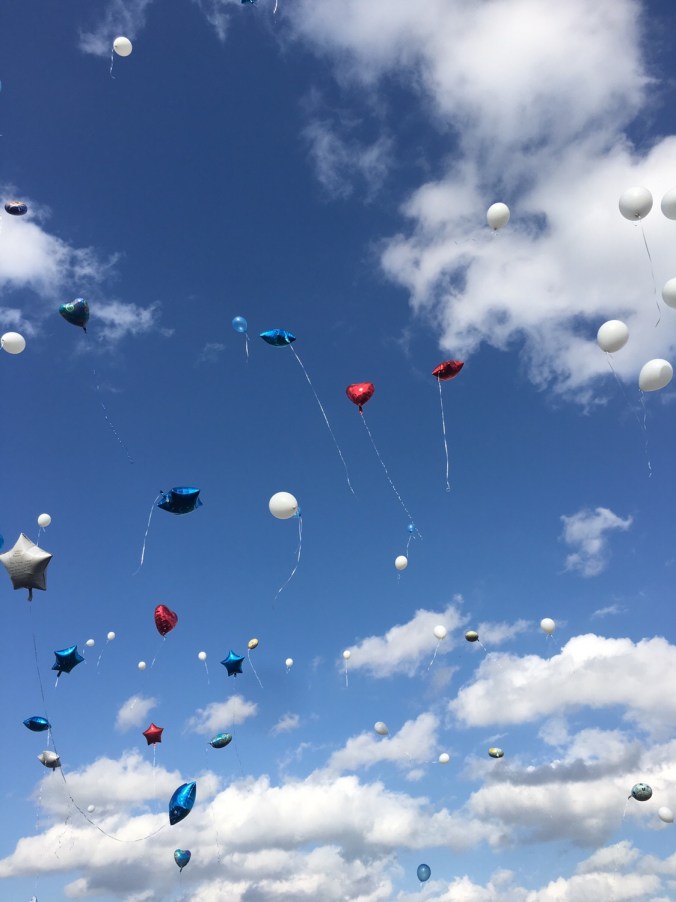
 I stood at the little gathering for the baby, holding onto the ribbon of a light blue balloon someone handed me.  

The North Carolina sun shone bright and uncharacteristically warm for February. It felt like spring. A breeze rattled the balloons; the sound of their bumping each other reminded me of boats bumping against their moorings at a dock. 

A lonely sound.

In one motion, together, our gathering released the balloons. Swept quickly upward, they made an array of shimmering colors against the azure sky. Breathtakingly beautiful. Within seconds they attained stunning heights. The brilliant colors changed, before our eyes, into distant glittering dots, bright, silvery stars twinkling in the daytime. 

I thought then of all who are loved and lost. The young and the old. By sickness, tragedy, time . . . it matters only that they lived. They were here and we loved them. We do not stop loving them. We rail against our constraints, but they are not tied anymore. Their moorings are loosed. Their spirits are free, glittering, ever-bright in the distance, going on and on.

Released.