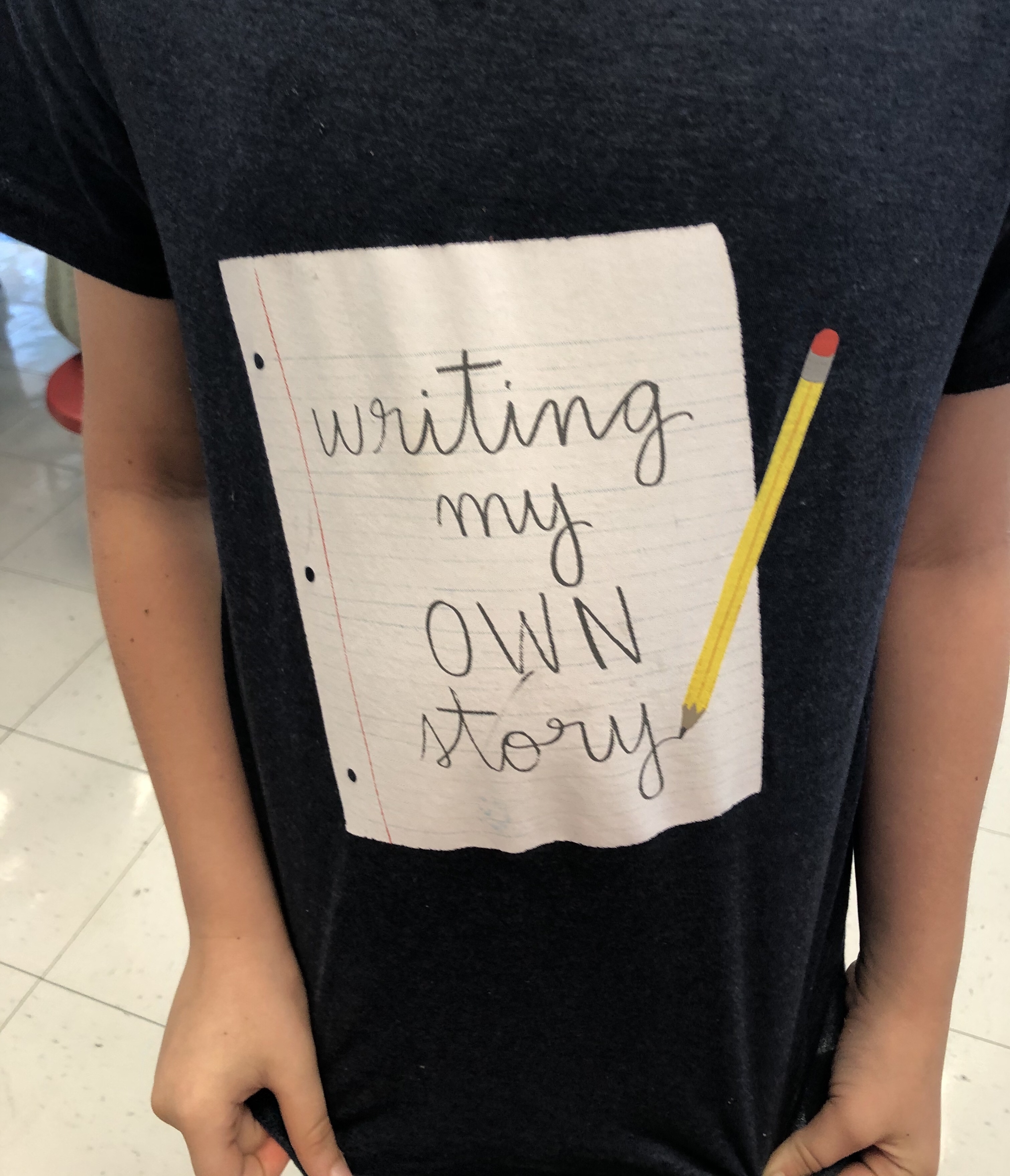
I saw his shirt from across the crowded cafeteria:
Writing my OWN story.
I hadn’t seen him before, didn’t know him, but I had to go over and say: “That’s the most awesome shirt! Do you like to write?”
He smiled and nodded, eyes bright and cheerful: “Yes!”
We had a short conversation about reading and writing. He was new to our school. After this initial encounter he was quick to come ask questions if he wasn’t sure about how we do things here, always greeting me with an earnest face and slightly self-conscious smile.
He wasn’t with us long. On his last days, he asked if he could stay after lunch and clean all of the tables as his grade level headed to recess. He wiped every table meticulously, then straightened all of the cardboard trays in the serving line for the classes to follow.
I understood.
It was something he could control. A positive and productive outlet.
I never got to write with him.
I thought about students over the years and what I learned about their lives from their writing. A girl whose family slept in their car on the journey north to visit relatives for the holidays; how she woke in the morning, shivering, to find frost coating the windows. A teenager whose vivid third-person narrative about a child born in another country, who survives abuse to find a new life and family in America . . . it switches to first person at the end as he rejoices and reveals he was that child. A first-grader who wanted to write about her dog, how the police shot and killed it. Unnerved, I told her teacher, in hopes that this was just a disturbing fabrication. It wasn’t. The child saw it happen.
For all the story-loving writer that I am, I know writing is not a magic cure for the pain and scars of life. It is, however, a real coping mechanism, a positive and productive outlet, a way of seeing and dealing with and finding hope to overcome. Even in the youngest of us, many of whom already know that life doesn’t follow a neat formula, that it seldom follows a clear and sensible series of steps. I often think about what passes for “writing” in schools; it can’t always be a neat response to a text or a prompt. If we are truly to equip children with tools for life, it begins with a real response to their lives in this world. We owe them, for as long as we have them, a place to feel safe, to be loved, a way of having some control in the face of change, to find their own power despite their powerlessness.To write their own lives, even as life is unfolding.
To have hope on the journey as it takes so many twists and turns.
Time is of the essence; we don’t know for how long or short a time they’ll be in our sphere of influence. Good-byes can come without warning.
And so I quickly gathered the best tools I had at my disposal: pencils, notebooks, a couple of favorite books from my shelf. It was my way of saying Godspeed, child. Write your OWN story. Believe. Attend to your heart. Here’s a piece of mine to carry with you.
Edward knew what it was like to say over and over again the names of those you had left behind. He knew what it was like to miss someone. And so he listened. And in his listening, his heart opened wide and then wider still.
You must be filled with expectancy. You must be awash in hope. You must wonder who will love you, whom you will love next.
—excerpts, Kate DiCamillo, The Miraculous Journey of Edward Tulane
 lit bits and pieces