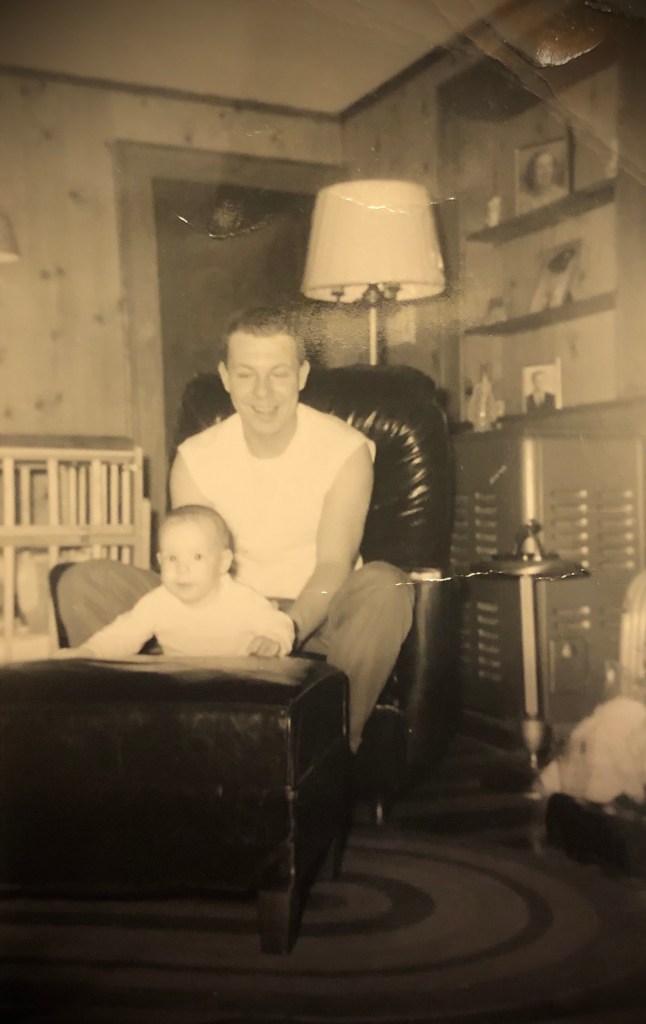
My own St. Patrick

In 1906, Theodore Roosevelt was president, Upton Sinclair published The Jungle, and the San Franciso earthquake killed around three thousand people. The Panama Canal was under construction and Cuba had its first president. Susan B. Anthony died that year. Lou Costello, Estée Lauder, and Anne Morrow Lindbergh were born.

In the far reaches of eastern North Carolina, a farm woman named Claudia Amanda Victoria delivered another of her ten children. A boy. She would have only two girls; one would die of diphtheria at age four.

But this baby boy would be hardy. He would outlive them all.

She named him Columbus St. Patrick.

Some folks called him Columbus. Those who knew him best called him Lump.

I called him Granddaddy.

As I grew up listening to the old stories, I tried to imagine living in his era. Seeing an early Ford Model T. Mail-ordering live chickens, delivered in wire cages by horse and buggy. Raising ducks that wandered off to the swamp on a regular basis, only to be herded back home again to eat bugs in the garden and to provide eggs for breakfast. Learning to plant and to harvest, to be in tune with the rhythms of the earth, following the steps of that ancient choreography, the seasons.

He was five when the Titanic sank, seven when World War I began. His older brother, Jimmy, served in the Great War and returned; I would know him and his wife Janie in their old age. They lived in a little tin-roofed house along one of the many dirt roads of my childhood summers. Jimmy and Columbus had a brother who drowned long before my time. Job Enoch. One brother accidentally shot and killed another on the porch of the family home. I knew their sister Amanda, who had a high-back pump organ adorned with brown-speckled mirrors in her house. The organ sounded and smelled of ages and ages past…but she could play it, and she could sing.

Columbus didn’t sing, but he loved country gospel songs and bluegrass to the end of his days.

And Columbus St. Patrick loved Sunday School. He had perfect attendance for years, garnering long strings of pins awarded to him. He did not enjoy regular school. He quit in the fourth grade to work on the farm. Later in life he had some regrets about this. But his father walked out on the family and Columbus rose to the role of provider.

He participated in community hog-killings, with the farm wives taking the backbone to flavor collard greens. The pork was preserved in barrels with salt brine. Some of the folks enjoyed scrambling hog brains into their breakfast eggs.

Columbus St. Patrick worked hard. He plowed fields with mules. He took part in the making of molasses, which required several people. Mules walked in a circle, harnessed to poles attached to large grinder where sugarcane was fed to extract the juice. The juice would be collected and heated in trays over a fire, skimmed numerous times until it became rich, blackstrap molasses. At the end of a meal, he sopped his biscuits in molasses, and poured his hot coffee in the saucer to cool it.

He competed with a scrappy little woman named Lula for the honor of being the community’s top cotton-picker. She often beat him.

Lula would be widowed when her husband Francis hung himself in the woods. One of their daughters would find his body.

Columbus St. Patrick’s youngest brother married another of those daughters.

Columbus made some time to hang out with the young people, attending taffy-making parties in their homes and driving groups of friends to the movies in town…all the while noticing Lula’s daughter with the wavy blonde hair and straight posture. There was a certain spark about her.

She considered him her mother’s friend. The “older” set. She was nine years younger and she had her eye on the preacher’s son, who would surely follow in his father’s footsteps: How wonderful, to be a preacher’s wife!

It didn’t happen. Desires of the heart sometimes come to unexpected fruition: I would be a preacher’s wife, a half-century later.

This daughter of Lula’s ended up marrying a farmer: Columbus St. Patrick. They planned to wed in September but he had the mumps. And so it came to pass in mid-December instead.

My grandparents.

Here’s a photo taken sometime early in their marriage:
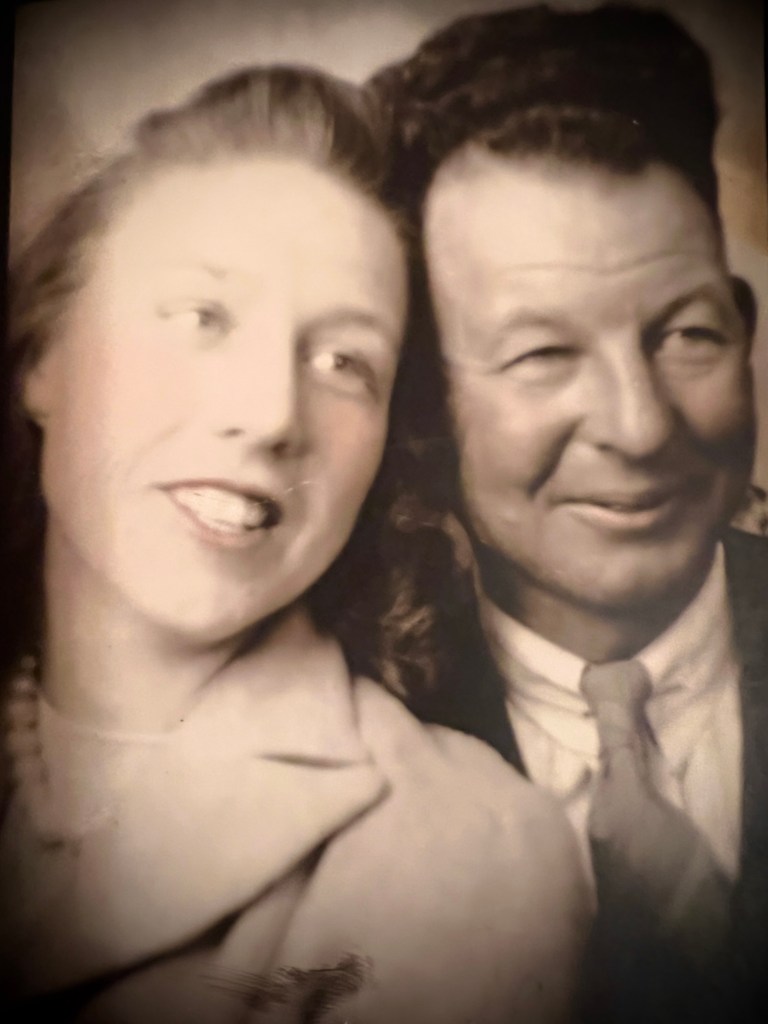
Ruby Frances and Columbus St. Patrick, circa 19371938.
She would have been around 23. He would have been 31 or 32.
If this photo was taken prior to October 1937, my father was not yet born.

They would endure the Great Depression and the second World War with a small child. My father. When Columbus St. Patrick couldn’t make a go of tenant farming and sharecropping, he traveled to the shipyard nearly 200 miles away with a group of men from down home. He was working there, building cradles for ships, when Pearl Harbor was attacked. Suddenly U.S. ship production went into overdrive; the Yard turned out ships in three months versus the usual year.

He would try, after the war, to make a living farming, painting, and doing other handyman jobs. By that time there were three children to care for. Columbus opted to go back to the shipyard, staying in a boarding house during the workweek and coming home to see his wife and children on the weekends.

For ten years.

His son (my dad) became senior class president and entered the United States Air Force after graduation. The oldest daughter was a high school basketball star; Columbus St. Patrick nailed peach crates to posts out in the yard for her to practice. By the time his youngest daughter was ready for high school, he’d had enough of separations. He moved the family to an apartment near the shipyard.

Hilton Village, built between 1918 and 1921, is the first federal wartime housing project in the U.S. It was created for shipyard workers. These quaint, English-style rowhouses would be the setting of my first memories. I would awaken in the dim gray morning at my grandparents’ upstairs apartment and my grandmother soothed me back to sleep while my grandfather, having risen at four, made his own breakfast before going to work. On Sundays, his day off, he took me to the playgound behind the Methodist church.

I felt as safe as I ever have in life, walking hand-in-hand with him.

He retired after I started school and lived another twenty-nine years. He saw my children. He survived the removal of his bladder after a cancer diagnosis. My grandmother would empty the urostomy bag and dress his stoma (surgical opening) every day until his death.

They would lose their middle child, their basketball star, to multiple sclerosis in her fifties. She died on Good Friday; they buried her on Easter Sunday. Their son (my dad) was just recovering from bypass surgery after his first heart attack. He would not survive the second, but Columbus would not be here to suffer the loss of his son.

Granddaddy died of lung cancer under hospice care, at home his own bed, as he wanted, on a fine spring day. He refused morphine in favor of keeping his mind clear. And it was, to the very end.

St. Patrick’s Day rolls ’round again and stirs all the memories. They spring to life, as rich and sweet as molasses that Granddaddy and I sopped with our biscuits. He was always embarrassed by the oddity of his middle name. I am proud of it. I have loved it all my life, just as I’ve loved him. Fiercely. I have learned many a valuable lesson from Columbus St. Patrick: Treat people well. Help those in need. Money doesn’t buy happiness (back in the old days, he said, nobody had any money but everybody was happier). Love your family. Love your neighbor. Get a dog to love. Work hard. Persevere. There’s always a way. Tend the earth. Do your duty. Spend time with children, for they are precious. Go to church. Trust in the Lord. Return thanks.

One day, he said, we will meet again in a better place. I am looking forward to it.

Me, too, Columbus St. Patrick.

Me, too.
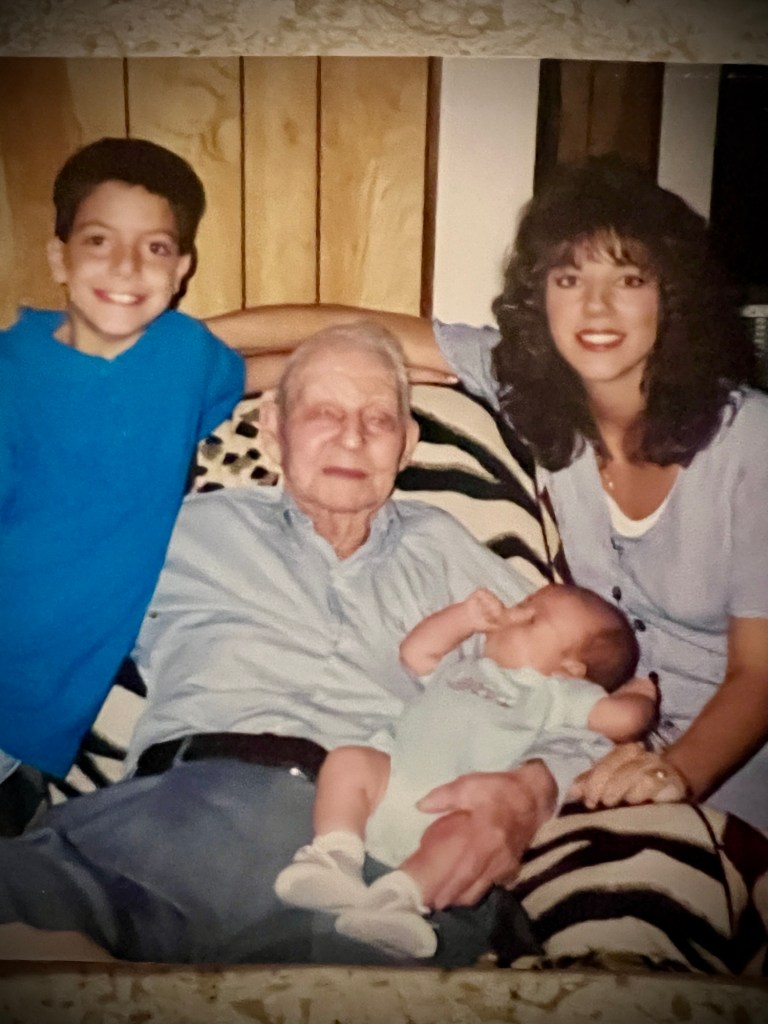
My boys and I visiting Granddaddy for his 91st birthday, 1997.
My youngest was six weeks old.

*******

with thanks to Two Writing Teachers for the March Slice of Life Story Challenge
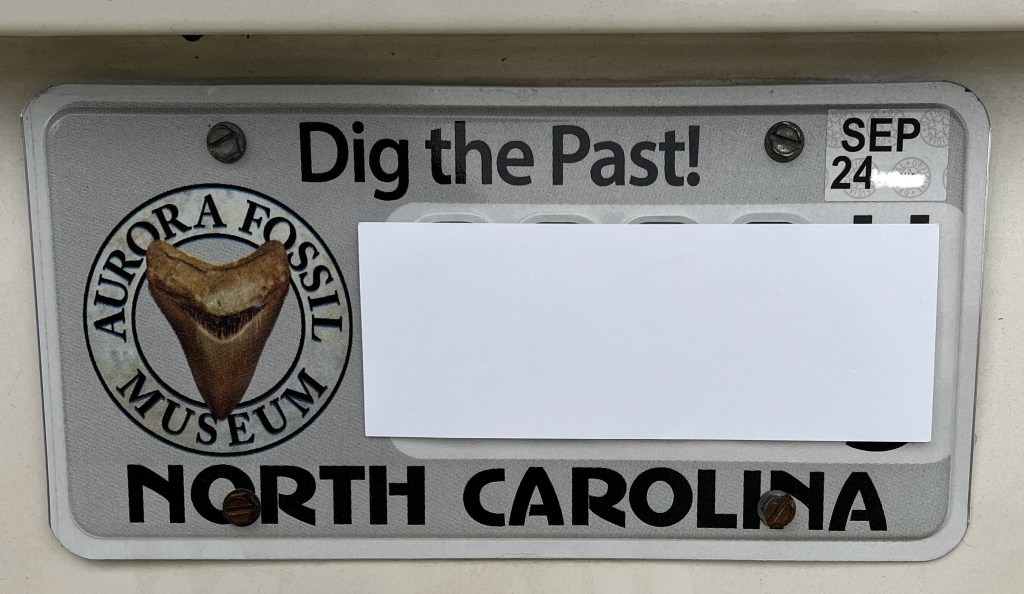
Dig the past

Way back on Day 10 of this current Slice of Life Story Challenge, I had a lot of fun playing around with a prompt asking what the first line of my autobiography would be. I really prefer the idea of memoir…my definition: Mining one’s memories for the stories that matter most, digging in the storied strata of one’s past.

I came up with this “opening line” for it:

My father named me for his mother, and that was the beginning of everything.

Truth.

From the moment I entered this world, my grandmother and I were bound together by blood, love, and namesakery. Long after she’s left it, our bond remains unbreakable.

Were I ever to write an extended memoir, her stories would be layered throughout. I am part of them; they are part of me.

She would say, You were named for me like I was named for my Papa. I loved him so. He was very religious, sang in the choir every Sunday. He had a beautiful bass voice…he used to keep bees when I was young and I’d help him get the honey.

She was sixteen in March of 1932 when her Papa, Francis, died by suicide. On his sixtieth birthday. I don’t know the whole story but what little I do know, I shall keep for now. Grandma told me they brought him home in a wooden casket lined with black oilcloth and that she sat up with him all night before the burial.

The point is that my grandmother’s stories made me hungry to know as much as I could about her childhood, daily life long ago, how people endured such hard times. Many didn’t. The old cemeteries tell stories of their own.

I asked her about the 1919 influenza epidemic: I don’t remember it. I was little. I do remember people talking about “hemorrhagic fever” and Mama saying she made big pots of soup for the neighbors who were sick. Papa carried it to them and left it on their porches. He wouldn’t go in because he didn’t want to bring the sickness home.

I asked her about meeting my grandfather: Oh, we always knew each other. He’s nine years older than I am and he and Mama used to pick cotton together…

Granddaddy would say: We’d all see who could pick the most cotton and it was always Lula [Grandma’s mother] or me. That was before the boll weevil came along and people started planting tobacco.

Grandma said: When tobacco came along, I was a looper…you had to be careful. That juice was sticky and would stain your clothes; it was hard to get out…using a wringer washing machine or washboard, I might add.

The setting of all this is a tiny community called Campbell’s Creek, established around 1700, way down east in the far reaches of Beaufort County, North Carolina. It’s part of Aurora although the actual town is five miles away. Most of the town is now in serious disrepair and the place is so remote that when I happen to encounter people who’ve been there, they typically say something like “I thought I was going to the end of the world.”

It is one of the places I love best on this Earth. The beginning of everything…Aurora is Latin for “dawn,” you know.

My grandparents, Columbus St. Patrick and Ruby Frances, were born here in 1906 and 1915, respectively. They married during the Great Depression. Their first home was a tenant house; their first child, my father, was born there. Granddaddy was a sharecropper. He plowed fields with mules. He was skilled with farm tools that people seldom use now, like an adze. This would give him a unique advantage when he “couldn’t make a go” of farming and went to Virginia to find a job as a shipwright, just as war broke out and ship production went into overdrive. When the war was over, he tried his hand at a number of things, but he had two more children to provide for; he went back to the shipyard until he retired.

All of his life, Granddaddy was a farmer at heart: I can remember when we ordered chickens by mail and they’d be delivered in cages by horse and buggy. I was three or four when I saw my first automobile…

That would have been around 1910. A Model T.

Time was, he’d say, in his country dialect bearing faint traces of Elizabethan English, that the whole family could go off for a week to visit somebody and you didn’t have to lock your house or barns because nobody would bother them. People looked out for each other. There won’t no nursing homes. When somebody was sick we all took turns helping out.

Grandma said: I was sitting with a friend’s mother. She’d been sick awhile and we all knew her time was near. She hadn’t spoken a word in days, hadn’t moved or responded to anyone. She was just lying there in the bed when all of a sudden she sat up and opened her eyes. She started laughing: “Can you hear them? Can you hear them?” Her face just glowed...it had to be angels. A little while after, she was gone.

I grew up on these stories and so many more.

My summers were spent learning things that I wasn’t even aware I was learning, things that will drive my interests for the remainder of my days: story, history, culture, nature.

Faith.

And science.

I’ve written much about the little dirt road that ran past Granddaddy and Grandma’s house. It’s one of my life’s greatest metaphors. I can recall, in the 1970s, when it was covered with gravelly “rejects” from phosphate mining, Aurora’s biggest industry since 1964. Granddaddy and Grandma were so excited for their grandchildren to come digging in the road to find sharks’ teeth—some were quite large — coral skeleton, and various fossilized bones of sea creatures. Someone of official status must have soon realized the value of these rejects and they weren’t scattered on the old dirt road anymore. Instead, they were taken to a newly-created fossil museum in town. Today, children from all over come to dig for fossils they can keep, and they can learn about the history in the little museum. There’s even an annual fossil festival at the end of May; last year I went for the first time with my seven-year-old granddaughter.

This excerpt is from an article in the April 2023 edition of the magazine Our State: Celebrating North Carolina:

Beneath our state’s soil and waves is a lost world waiting to be discovered—a geologic trove we claim as our own…about 50 years ago, coral specimens were found in drilling samples near present-day Aurora. They were sent to the Smithsonian Institution, whose scientists soon visited—and identified the area as one that proclaims the most prolific fossil record of the Miocene (2.3 million to 5.3 million years ago) and Pliocene (5.3 to 2.6 million years ago) marine life on the Atlantic coast.

About fifty years ago… I’d have been a child playing in the gravel on the old dirt road, collecting shark’s teeth, unware of the true treasures of my life.

The Aurora Fossil Museum, writes the author, “continues to keep the past alive.”

It’s analogous to to me: Scientists finding bits of ancient creatures, trying to piece them together to understand stories of this “lost world,” and how I hold to bits of story from this same place, the lost world of my grandparents.

Generations rise and fall…layer upon layer of story strata settling in their wake.

I am a remnant of their world. From early childhood Grandma infused me with story, unknowingly turning me into amateur oral history exacavator, archivist, curator…the stories still live in me.

My father named me for his mother, and that was the beginning of everything.

Imagine my delight when I learned last year that the Aurora Fossil Museum had been approved for an official historical site license plate with the NCDMV. I applied for one right away….it finally came, a couple of months ago. I’m among the first to have it:

I imagine Granddaddy’s beaming face. I hear Grandma’s typical expression of surprise: My land!

Dig the Past! the license plate reads.

I do it every day that I live. I go on mining my memories for stories, working their meanings out bit by bit, trying to preserve them for the priceless treasures they are.

Keeping the past alive. For the future. For right now.

That’s what memoir is for.

*******

Composed for Day 30 of the Slice of Life Story Challenge with Two Writing Teachers
Eternal summer: memoir poem

with thanks to Jennifer Guyor Jowett for the Open Write invitation on Ethical ELA today: “Share your summertimes with us, whether it’s within the memories of your childhood or the place you are in right now. Take us there. Include sensory details to evoke the spirit of your summer.”

I have written lot about my childhood summers. Today I try a bit of reframing and recapturing the magic…

*******

Eternal Summer Reigns

Daughter of Eve from the far land of Spare Oom where eternal summer reigns around the bright city of War Drobe, how would it be if you came and had tea with me?

—Mr. Tumnus to Lucy, The Lion, the Witch and the Wardrobe

I live it every day of my life, summer.

By some great magic I am still a child
returning to my grandparents’ house
so deep in the country some people say
it’s at the end of the Earth

for me, ever the beginning

a place of woods, holding their secrets close
a place of enchantment, outside of Time
a place of belonging, of sacrifice

where ghosts of the past live again
in Grandma’s stories

there’s her Papa, tending bees
never getting stung
her Mama, picking cotton
and dipping snuff

her brothers and sisters
(eight in all)
playing softball
or piling in the goat-cart
to be pulled by a white mule
named Jenny

there’s my grandfather and his brother
courting my grandmother and her sister
gathering at friends’ houses
singing and make taffy

my father, being born
in a tenant farmer’s house
—Cotton-Top, they call him,
for the color of his hair
when he is a toddler

babies born into the family
some stillborn
(Daddy’s voice…Would have been
so interesting to see
what my double first cousins
would have looked like
if they’d lived)

—I live them every day,
the stories.

I am the stories.

Every day I am a child
unpacking my suitcase
for the summer
welcoming the ghosts
walking the old dirt road
eventually covered with gravel
from phosphate mining rejects

bits of ancient history
crunch beneath my feet:
shark’s teeth, some tiny and sharp,
some as big as my small palm;
coral skeleton, white chunks
embossed with lacy flower designs;
whale eardrums, curiously curved fossils
—with these, whales heard
their own stories, too
now, they are 
part of mine

and above all, above all
from the surrounding woods, bending near
keeping their secrets close
the crescendo and decrescendo
of cicadas

the true song of summer
and the sun
and living
and dying

and returning.

By some great magic I am still a child
still listening, still living summer every day
and forever
in that sound.

My grandmother in the summer of 1959, years before my birth. This is the setting of my idyllic childhood summers to come, beginning a decade and a half later. I would stay for a couple of weeks each year and never wanted to leave. Grandma fostered my love of reading, writing, and story. She drove me to the tiny county library at the beginning of my summer visits and helped me haul out the armloads of books I selected. She saved magazines, Mini Pages, and National Enquirers all year long for me.

We walked the old cemetery in the clearing diagonally across from where she sits in this photo and the graveyard of the church around the bend, where her parents are buried. As we read the stones, the blazing sun casting our shadows across them, Grandma told me the stories.

The fossils in the gravel of the poem were real. I found handfuls of them in the road here when I was a child.

Cicadas are an ancient symbol of immortality and resurrection. I write of them often because of their connection to this place. Their loud, rattling chorus was ever-present in the background of my childhood summers; the sound remains one of the most comforting on Earth to me. It’s a call of the sun, love, belonging, and home. There’s a myth about the goddess of the dawn, Aurora, asking Jupiter to grant immortality to her lover, which he did, only the goddess forgot to ask Jupiter to also grant her man eternal youth. Her beloved continued aging until Aurora finally turned him into a cicada. If you look closely at depictions of Aurora, you will see the cicada. Why tell this story here? This morning, before the dawn, before the cicadas woke to sing, I saw Jupiter shining high beside the moon. Then I sat down to write to this prompt of summer celebration, reliving halcyon childhood moments with my grandparents at their home, a place where my generational roots run deep in the earth, where my father grew up…an old, far place in the east, named Aurora.

For me, ever the beginning. Eternal summer reigns.

*******

thanks also to Two Writing Teachers for providing a place to share our stories – for we ARE our stories

The morgue

a slice of memoir

By 1949, the Army base where a million and half people were processed for service in WWII stood deserted. This had been the last stop before boarding ships for western Europe. All branches of military personnel, not just Army, passed through here — even some civilians on secret missions. Surely these young people made time for the cantina, laughing and maybe dancing to big band music, or for a show in the base’s theater before they left American soil, maybe for good… how many wouldn’t return to see the wooden arch bearing the message WELCOME HOME at the camp’s entrance, erected over the wide road cut through the forest? And how did the Axis POWs feel, seeing this sign on their arrival? Did they wonder what welcome awaited them here in an Allied prison? They would be put to work; they would also be given their own canteen.

All that remained four years after war’s end were empty buildings, ephemeral fliers, yellow canteen coupons occasionally spiraling in the wind, and weeds growing tall in their eagerness to swallow it all, to satisfy the hungry forest.

A local man overheard talk that the decommissioned land was being sold and if you had a way to move a building, you could buy one cheap.

He had a way of moving a building. He had a place for it, on his own land right beside his own house. He signed the papers and took his building.

It made for a nice little home, he thought. It had a concrete floor with pipes running through for radiant heat. Solid. It would need a little paint, a little work here and there. He could do it. He was pleased with himself. He would rent it it out, make a little money…

Quite some years later, a young man came to ask about the house: We can’t stay in the apartment where we are anymore. It’s not working out… he and his wife had a baby. They wanted to be in a safer place.

The older man, now gray-haired, pursed his lips for just a moment before agreeing.

And that is how I came to live in the house which was once part of a bustling World War II Army base at a port of embarkation.

That was my dad and mom who needed a place to live.

That was my step-grandfather, Pa-Pa, the sometime opportunist who’d moved the building. He’d married my mother’s mother.

I, of course, was the new baby.

This house is the first home I remember. In this place, my memories would first come into being while I watched the interplay of light and shadow on the walls. Here I would dream my first dreams and cry out in the darkness until my father came to settle me back to sleep, sometimes holding me in his arms all night when I suffered asthma attacks. Here I would begin to recognize the distant rattle and whistle of trains, long before I first crawled on the warm, warm floors in wintertime or knew the cold and silvery moon.

I wonder if this is where I first came to understand the word ghost.

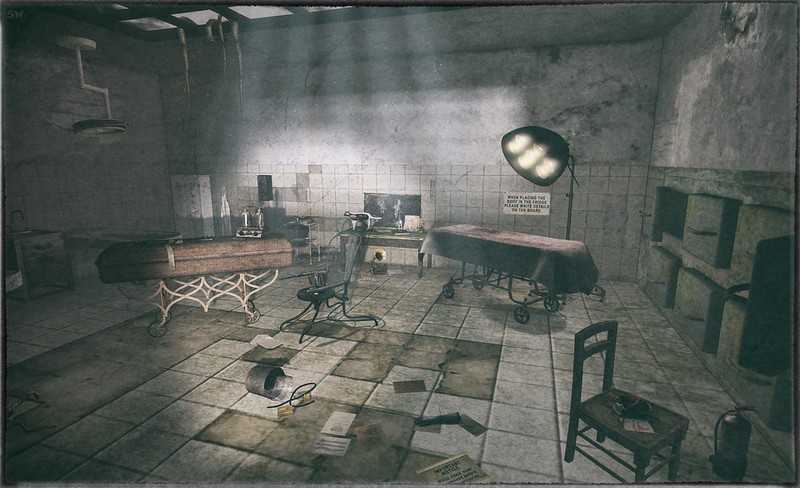
The little white house with the heated floors was, after all, the Army hospital morgue.

Photo: Shocking Wonder. CC BY

*******

with thanks to Two Writing Teachers for the Slice of Life Story Challenge every day in the month of March.
Until we meet again

Today I write in memory of my grandfather.

His name was Columbus St. Patrick Brantley.

He was born in 1906 “up the swamp” in coastal North Carolina. Farming was in his blood. He married my grandmother during the Depression and worked as a sharecropper. My father was born in a tenant house. Just before WWII, Granddaddy went to Virginia to work as shipwright. He tried farming and house painting after the war but “couldn’t make a go of it,” so he went back to the shipyard, where he was still working when I came along. For the record: the whole family said I looked exactly like him when I was born.

He didn’t work on Sundays; that became our day together when I was small.

He retired when I was six. He and my grandmother moved back home and thus began my many journeys to the little white house nestled in the bend of an old dirt road, where the woods had grown up all around, taking back house after house where people lived no more.

In his later years Granddaddy recorded stories of his life on audiocassette to give to his family. He could remember seeing his first Model T at age three or four. He said that mail was delivered by horse and buggy; farmers ordered chickens that were delivered in cages. He had a whole string of pins awarded him for perfect Sunday School attendance at the little Methodist church. He loved listening to the Grand Ole Opry on the radio. He spoke of his nine siblings, including a sister, Peaney (Penelope), who died of diphtheria at age four. He outlived them all. He lived to see both of my children. He could remember an ancestor speaking of Dublin.

Near the end of his life, I gave him a framed print of an Irish blessing. It hangs by my front door now:

The last time I saw him, he was dying of lung cancer at ninety-two. It was springtime. He’d grown weak but was fully dressed, sitting in his recliner by the door; he tried to coax my two-year-old to sit in his lap, like I did when I was little. I sat by his chair on a stool and held his old, wrinkled, work-worn hand.

Do you remember how we used to go to the park on Sundays?

I do, Granddaddy. We took bread to feed the ducks.

And the old locomotive?

I can just remember climbing in it together…

He was tired, always a man of few words. We sat for a long time together, not speaking at all.

When it was time to go, I kissed him on his forehead.

I love you, Granddaddy. God’s got you safe in His hands.

That’s the best place to be. And I love you.

He held tight to my hand.

It’s been twenty-three years. You can’t imagine all I have to tell you, Granddaddy. There’s been another pandemic. Wars and rumors of wars. Your great-grandsons are grown. The little two-year-old you tried to coax into sitting with you at that last visit plays piano and guitar; he loves singing the old-time songs that you loved. His brother’s a pastor with a baby girl; he tells me almost daily that something about your great-great-granddaughter reminds him of you. God remains faithful from one generation to the next. It’s almost springtime again, the fields are so green…

Until we meet again, Columbus St. Patrick.

I love you.

*******

with thanks to Two Writing Teachers for the Slice of Life Story Challenge every day in the month of March.


Anniversary of twelves

On the twelfth day of December, back in the Great Depression, my grandparents were married. My father was born the following October in a tenant farmhouse.

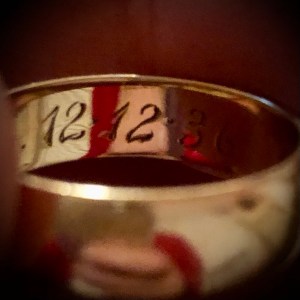
That’s my grandmother’s wedding band in the photo. It’s not the one she received on her wedding day. That ring was thin; it wore “clean through,” Grandma said. Broke in half due to overuse, in the days when washing machines had wringers, in an era of canning and preserving, in the time of sharecropping cotton and looping tobacco.

This is Grandma’s replacement ring. She had her initials and Granddaddy’s engraved inside, along with their wedding date. A wide gold band, made to last.

It is my ring now. I wear it every day.

Often thinking of December 12th.

For it’s not the only anniversary.

Almost thirty years after my grandparents married, their youngest daughter got married. On the same day.

She was eighteen. A senior in high school.

Her husband, my uncle, was going to Vietnam.

I went to that wedding. In utero. I wasn’t born for another five months. My presence was obvious; my mother couldn’t fit into the dress she planned to wear. She had to rush out and buy a new one that day.

My young aunt mailed black-and-white baby pictures of me to my uncle on his tours of duty.

He brought these pictures back home with him.

Fast forward three decades…

On December 12th, exactly sixty years to the day of my grandparents’ wedding, my husband and I learn that we will have another child.

A second son. Our last child.

My grandparents lived to see him and know him. To tell him they loved him, like they always told me.

It is a day of remembrance for me, December 12th. A deep and quiet knowing, a dark-blue glittering gem that I carry in myself in the middle of the holiday season. Meaningful. Valuable. Priceless.

I think of the long-ago Decembers. Family gatherings, celebrations. Layers of blessing. A blanket unfolding again and again to encompass the next generation.

I am a grandparent now; the mantle is passed.

It is one comprised of faith. Of courage and commitment. In it lies the story of persevering against unknowable odds. The Depression. Vietnam. In it I find strength for living now. I know that what keeps us pressing on is having someone to press on for.

Numerologists might wax eloquent on the significance of the number twelve, in all its powerful associations. We mark our time by twelves on the clock, by months in the year…there are ancient connotations such as twelve Olympians, twelve disciples, twelve tribes of Israel, twelve of days of Christmas… twelves go on and on. Twelve is considered the number of perfection, cosmic order, completion. Just now I recall that our second son was born in our twelfth year of marriage. I am not a numerologist, only a poet contemplating patterns. Not a mathematician, just a wonderer. A believer. Pythagoras is said to have said: “There is geometry in the humming of the strings, there is music in the spacing of the spheres.”

I sense a geometry in dates and a musicality to years…a song of life and the living of it. For me, this is the lesson of 12/12. There’s something of eternity in it.

Which makes perfect sense, if twelve is God’s number.

The song is love.

*******

Many thanks to Two Writing Teachers and the Slice of Life Story Challenge community.
And to readers…you’re all part of the story and the song.

I am from poem

How have I lived to be this old without attempting an “I Am From” poem?

A rectification …

I am from sharp pencils
from Ivory soap and Duke’s mayonnaise
I am from the secret vault under the concrete back steps
(cool, cobwebby, smelling of ghosts)
I am from gardenias
from towering Eastern pines
heavy boughs whispering
waving to me like a vertical green sea
I’m from storytelling and dogs
from Columbus and Ruby
I’m from Reader’s Digest and gospel music
From “You’re the oldest, set the example”
and “take care of your precious self”
I’m from Jesus Loves Me, red-letter Bibles, put your offering in the plate
I’m from the riverside and the shipyard
from collards with hot pepper vinegar and carrot cake from scratch
From my father’s crew-cut ever since his head was pierced
by a friend’s cleats in a childhood game of deer and dog,
from three translucent pink moles on Grandma’s chin.
In trunks and in closeted boxes my grandmother’s painstaking albums
rest atop layers of loose photos, paper strata of many eras.
I am etched deep in this phosphorite, the living reliquary
of all the stories.

The bottle

Today I have a literal “found poem.” Meaning not one derived from another’s work but as in finding it while going through folders from previous school years and unearthing poetry I’d modeled for students on writing around an object. I remember taking three objects with special meaning to me so the kids could choose which I’d write about.

They chose the bottle.

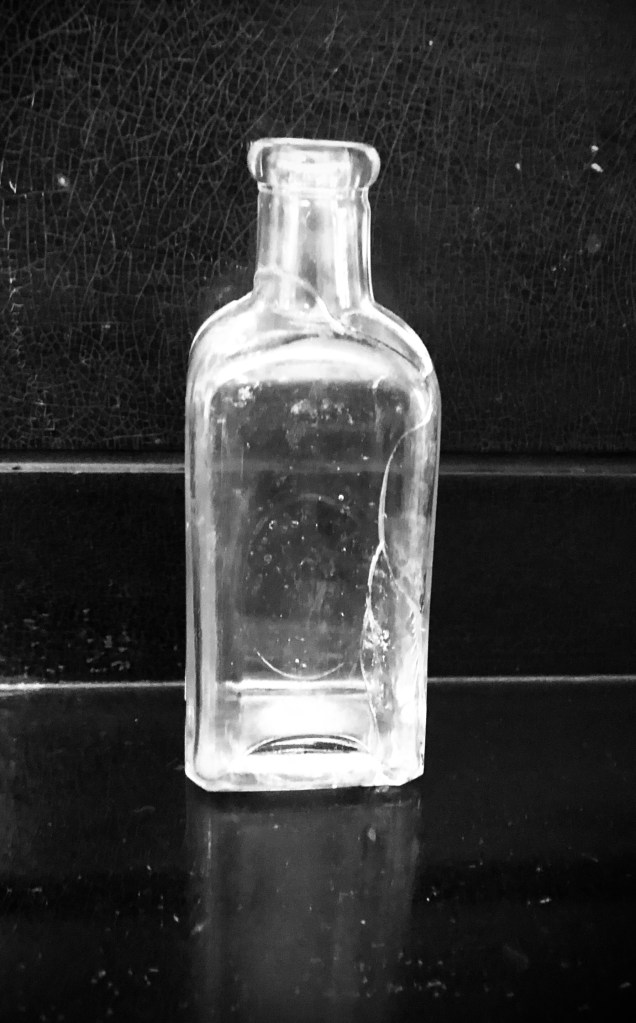
Which I found after my grandfather’s death, visiting the farm where he was born. It was the second and last time I walked this piece of land. The first time, my grandfather, grown old and frail, walked with me. Ten acres of fields bordered by trees is all that remains, but he showed me where the house once stood, and the barns, and the henhouse … all gone without a trace now.

Except for some long-buried treasures.

In the old days, farm families had a trash pile. What wasn’t burned away with fire, or washed away by ages of wind and weather, or destroyed by perpetual tractors and harrows, might be swallowed by the earth until the earth is ready to give it back.

I wasn’t expecting such a gift the day I walked alone, mourning my grandfather.

So, I told the students, as I prepared to draft, when you write about an object you might also consider the feeling the object triggers in you. For me, with this bottle, it’s wonder. I want to incorporate a sense of wonder in this poem.

And so I wrote for them, and they enjoyed making artistic suggestions (they wanted it to rhyme):

Granddaddy is gone
And I walk his old farm
How he loved this place
This wide-open space
Nothing now to see
Where barns and house used to be
Just an empty field
After harvest’s yield
Cold breeze blows
Through my heart, it goes
When I spot in a bit of grass
Sunlight glistening on—glass?
I momentarily forget my hurt
As I dig it from the dirt
—a bottle, imagine that
No telling how long it sat
Buried deep in this ground
As the as the years circled round
Whose hand touched it last
In that long ago past?
Clear glass, heavy, yet small
Cracked but unbroken, all in all
What unseen secrets must it hold
This bottle of stories untold

It holds untold stories, all right. I’ve not determined exactly what tincture this old bottle actually held. The faintest embossed image of a root, almost worn away, remains on the front. A health tonic, likely. I know my grandfather had a sister who died of diphtheria at age three, in 1907. I doubt the bottle is that old but I have visions of my great-grandmother nursing her ailing children and tossing that empty bottle onto the trash heap…

Sparking me to attempt a didactic cinquain:

Bottle
Antiquated, weather-worn
Eroding, cracking, enduring
Poured out for healing
Elixir

Or maybe a double reversed etheree:

Empty of that for which you were fashioned
vessel of life-blood for veins long ceased
drawn from roots to nourish my own
cold glass clasped in hands now still

spooned in mouths now silent
elixir fully
poured out, consumed
every drop

gone
cast off
forgotten
swallowed by earth
kept year after year
without ceremony
lying silent, eroding
enduring seasons, weathering
cracking but enduring, determined
to remain clear with your story obscured.

—oh, little bottle.

How I wish you could speak.

Signs of the times

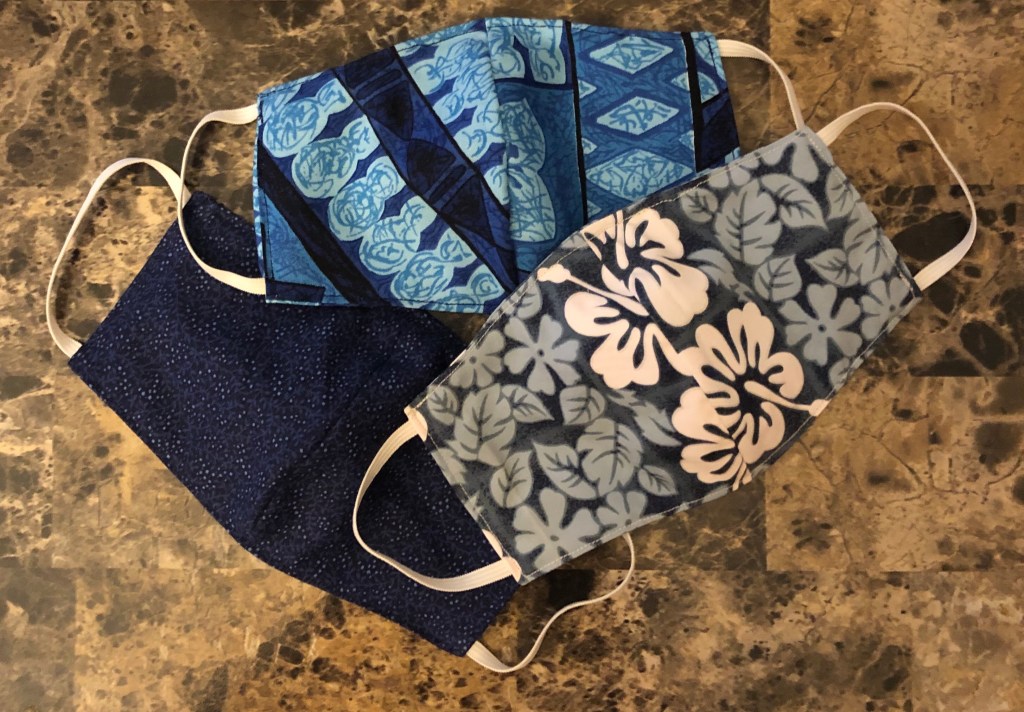
A friend wanted to know if my family would like some face masks.

She is making them.

She sent us pictures of the fabric—she has bolts of it—for us to choose the prints.

Yesterday she and her husband pulled up in our driveway to drop off the masks. My husband and I went out to meet our friends, offering our thanks only in words, no hand-grasps or hugs … a time to embrace, and a time to refrain from embracing … a few weeks back, we were all sitting around the dining room table here in the house, laughing and telling stories after a lasagna dinner. It seems long ago.

When will we be able to do so comfortably, again?

When I look at these masks, I see all that they represent. Shields in time of trouble. A friend channeling inertia into something productive, a practical means of battling an unseen enemy. Self-care spreading out like a blanket to cover others. Homemade love. Colorful patterns against the dark backdrop of our days.

These masks are artifacts of our times. Symbols of our story as we live it. And nothing connects humanity as much as story.

As I walked out to the driveway to receive these gifts, my grandmother’s voice echoed from across the years:

You won’t believe it, but where these woods are now used to be houses and farms, up and down this little road … when the Spanish flu came, it hit all but a couple of them … twelve people died in one week … Mama made pots of soup and Papa would carry it to their doors. He wouldn’t go in, of course …

Grandma wouldn’t have had living memory of this. When the influenza pandemic began in January 1918, she was only two. But she knew the stories. If my own memory serves me correctly, as I walked the tiny country cemeteries surrounding her homeplace, listening to her narratives of the people resting there—for she knew all their stories, and how they were connected— there was an unexpected commonality.

A death year. 1917.

That was before the Spanish flu.

Grandma nodded. There was a sickness before: They called it hemorrhagic fever. People would bruise and bleed from their noses and ears and eyes … a lot of people who tried to take care of the sick caught it and died, too …

She was hardly more than a baby then, a girl born and raised in a hard place in hard times, but here she stood, by the weather-worn stones under a cloudless blue sky, telling the stories seven decades later.

Because of story, these events are lodged in my memory a hundred years after they happened.

My father was Grandma’s first child, born during the Great Depression. Flour companies made their sacks with patterns and bright colors so people could make clothes out of them … look at my handmade face masks and tell me they aren’t reminiscent. A second child, my aunt, arrived with the war. Granddaddy moved the family from North Carolina to Virginia; he found work in the shipyard, where production increased to the point of cranking out ships in less than a third of the time it normally took. How can one not compare that to the scramble for mass production of ventilators today …

Grandma said: It was so hot that summer. I was miserable, being pregnant. I’d sit by the upstairs window and watch the iceman delivering blocks of ice to grocers … companies stopped making refrigerators … everything went into the war effort. I just cried. I’d have given anything for some of that ice … then we had ration cards and could only get certain things at certain times … once my sister Jack and her husband pooled their gas ration cards with ours and we all went on a trip to Massachusetts … it was so beautiful and so cool there …

I look at these masks and that is what I see.

The story of overcoming. Of determination. Of resourcefulness in time of scarcity. Of finding a means to be a good neighbor, a good friend, a real and present help in time of need, even if from a safe distance. Sharing so that everyone has enough. Acts of service, gifts of love. Sacrifice.

The story of surviving.

It’s a collective one.

Spittin’ image

Memoir is probably my favorite kind of writing.

It’s like small moments on steroids. When I write myself back into childhood, scenes, conversations, little forgotten details are pumped full of meaning, for I have the advantage of understanding so much more than I did then . . .

This event occurred when I was seven or eight. As I write, I think of how we don’t know all that children are experiencing or how they’re trying to navigate life. Families don’t make perfect portraits. There are so many reasons why.

We are our stories.

With that in mind I’ve opted to change family names here. It gives me the final shot of courage needed to share “Spittin’ Image.”

*******

We are going to visit my grandfather.

Not my Daddy’s daddy, my Sunday-afternoons-in-the park Granddaddy who bought me red rubber boots when I started school because all my kindergarten friends had them and I wanted them, too.  We are going to see my Mama’s daddy.  I don’t know him very well. He came to visit us once, sat in our living room chair with his hand stuck out so that when I ran by, not paying attention, not being careful, his cigarette burned me.

Mama says he lives in a hospital.

I don’t know why anyone would live in a hospital. I don’t want to go see him, don’t know why we have to go.

My mother gets snappy: “He’s your granddaddy—you’re going!”

My aunts are taking us because Mama doesn’t drive. She doesn’t know how.

“Last time I seen Daddy, he was looking better,” says Aunt Bobbie, who’s driving us in her maroon Ford LTD, a Marlboro sticking out from the first two fingers of her right hand on the steering wheel. I see her mouth in the rear-view mirror. There are little pucker lines around her lips. “I believe he’s eating good. Acted happy to see me, too.”

Aunt Imogene—Genie, I call her—is riding shotgun in front of me. She takes a long drag on her own cigarette. I slide over so I can see the thick white smoke pouring out of her mouth and how it all goes right up her nose, like a waterfall in reverse. It’s neat to watch. About ten minutes pass before she speaks; Genie never does anything fast.

“Waaaay-yelllll…” says Genie, stretching the word well into four or five syllables, “at least we know he’s taken care of at the Home.”

Beside me in the backseat, Mama puts a Salem Menthol in her mouth and flicks her lighter, inhales. She doesn’t do fancy stuff with her smoke. She is quiet.

She is often quiet.

The ride takes forever. Finally Aunt Bobbie says, “We’re here,” and we pull into a parking place bordered by pine trees.

Mama drops the butt to the ground and grinds it into the gravelly dirt with her sandal. This is my grandfather’s Home, I guess, but Mama told me it was a hospital, so I’m confused. When we go in there are many small rooms but no bright lights, no doctors in lab coats, no nurses wearing white dresses and little caps. There’s a lot of wood paneling. The Home makes me think of a really big cabin but the people here don’t look like campers. Some are in wheelchairs, some are standing. Some are in pajamas. Not all of them are old. They stare at us as we go by and I don’t like the feel of their eyes.

Aunt Bobbie leads the way, down a hall, around a corner. I peek in one room and see a man with long white hair lying in bed with his mouth open, but he’s not asleep.

I want to run out of here.

Genie says, “Waaaay-yelll, hey, Daddy.”

He’s sitting in an armchair in a little living room area, holding a lit cigarette in the first two fingers of his right hand. All of his fingers have yellow stains. His nails are brown and long, and the ashes on that cigarette are the longest I’ve ever seen; why don’t they fall?      

Genie hugs him. Aunt Bobbie hugs him. He says “Hey” to them in a high, raspy voice. He doesn’t have much hair. His face is long, kind of yellowish, kind of gray, with brown spots. His clothes have spots, too, except that they’re actually small holes. From dropping cigarettes. Or ashes.

Mama is hanging back but Aunt Bobbie pulls her over.

“Daddy, look who come to see you. Beverly Ann.”

“Hey Daddy,” says my mother, bending to hug him, then stepping back. “How are you doing?”

My grandfather looks at her, his daughter, my mother, and I can tell he doesn’t know her.

Next thing I know, she’s yanking on my arm.

“I brought your granddaughter to visit.” She tugs. “Come on, give your granddaddy a hug.”

I do not want to.  I don’t move. I just look at him.

Genie pokes me from behind.

“Go and see him,” say my aunts. “He’s your granddaddy.”

I already see him and he sees me. For a minute I look into his eyes—they are big, green like moss—and the emptiness there makes me think of a hole in the ground that has no bottom. Or the time Daddy was holding me when he opened the medicine cabinet and its mirror reflected into the mirror over the sink. Mirror, mirror, on the wall . . . it became a mirror, mirror, mirror hall, reflected mirrors going on and on and on, growing tinier and tinier, like a never-ending nothingness. I’m frightened of my grandfather’s eyes, frightened that he’s looking at me with them, that something about them makes me think of my mother.

Then they light up. He knows me! He holds out his hand—not the one with the cigarette, I have my eye on that one—and calls to me:

“Beverly Aaaannn…” he says, drawling like Genie does.

“No, Daddy,” says Aunt Bobbie, “this is Beverly Ann’s daughter. That,” she points to Mama, “is Beverly Ann.”

He keeps right on staring at me.

He doesn’t get it. He thinks I am my mother. When she was little.

I hug him because I have to, because the sisters, his daughters, are making me. His skin is cool and frog-like. When I pull away, he’s still looking at me.

 Am I supposed to love him? I don’t know him. And he doesn’t know me.

We don’t stay long. As soon as we’re outside, Genie bums a light off Mama, who’s shakily firing up another Salem. Genie sucks deep, does her dragon-smoke thing, nods at me.

“I’ve said it a thousand tiiiiiimes, you are your Mama’s child, that’s for sure. Spittin’ image.”

“Ain’t she though?” agrees Aunt Bobbie.

I walk beside Mama. The aunts move ahead of us. Hoping they won’t hear, I whisper: “Why did he think I’m you, Mama?”

“His mind’s not right. Never has been,” she says, taking a drag, looking off in the distance at nothing in particular. “I really wasn’t around him much. I was a little girl when he left home.”

“Why did he leave?”

She turns her eyes on me. Dark brown eyes, like mine, and for a second they have that bottomless look. She’s slow to answer but not in the way that Genie is slow to do things. She takes another long drag.

“Grannie sent him away because he tried to hurt her.”

“Were you sad?”

“No.” Then, softly: “I was scared of him.”

Aunt Bobbie cranks the maroon LTD; Genie is getting in the front passenger side. Mama looks back at the Home and I wonder what she’s thinking. As I reach for the door, I catch my reflection in the backseat window. I glimpse the pines and the cloudless blue sky behind me. Crows fly overhead, cawing loudly. Yes, I do look a lot like my Mama. Even I can see that.

I feel shaky, too. I lean in to look closely at my own eyes, hoping to God I never find them so empty.