Remnants

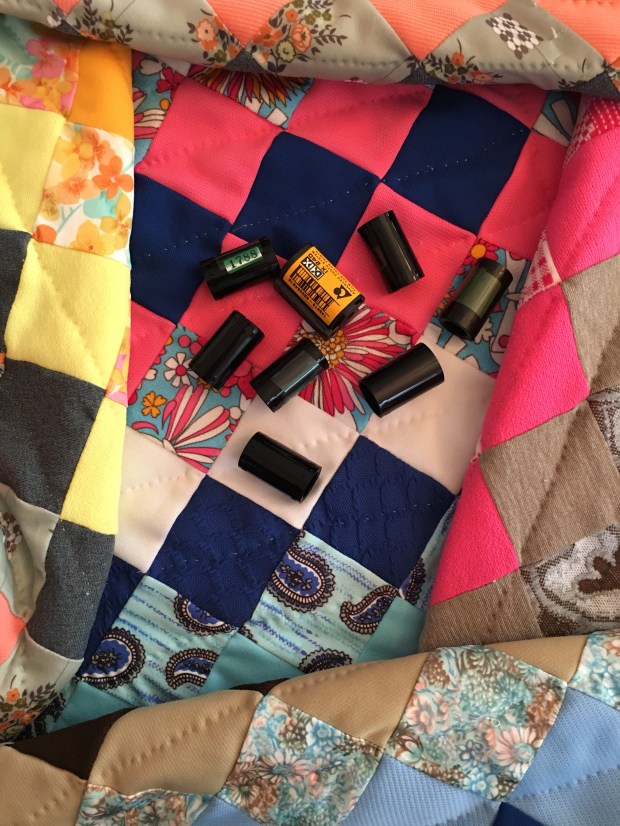
Some time ago, I came upon a giant Ziploc bag filled with disposable cameras and rolls of film I’d gathered and promptly forgot about.

I really need to take these to be developed, I told myself.

And I set them aside.

And life kept happening.

And time went by.

Until I wasn’t even sure anymore how old the film was and who’d taken pictures of what.

Last summer I finally found a shop that still does same-day printing on site (do you know how hard that is to find now?). I took my film—thirteen rolls.

When I returned for the pictures, I learned that some of the film had nothing on it. The rolls hadn’t been used or they’d been exposed and the images were lost.

Many of the pictures that did come out were weirdly double-exposed. Scenes of my children when they were little, superimposed over each other, over other people.

Ghostly. Tricks of light, of time.

In the shadows, my grandmother sits with her arm around my younger son. He was three.

Eighteen years ago.

Suddenly my father’s grinning right at me from the childhood room of my older son, who’s twelve and seated beside him on the foot of the bed, playing Nintendo 64.

Daddy’s been gone for sixteen years. Died the month after my youngest started kindergarten. But this photograph turned out clear and bright; Daddy looks happy.

Fragments of life, preserved here and there, telling our stories a piece at a time.

Kind of like Grandma’s quilt.

I left the photos and went to pull it from where it’s safely stored.

Grandma made a quilt for each of her five grandchildren. In mine many of the squares are leftover scraps of material from clothes that my mother and grandmothers wore. The brown-and-white swirled pattern was once a vest and slacks, the silky coral-and-pink floral fabric, a blouse—all made by my mother. These remnants were painstakingly stitched together by my grandmother. Random parts forming a pattern, making a whole.

This old film, this quilt. Tangible memories. Remainders, reminders, of long ago. Pieces of my life, of who I am.

Kind of like DNA.

One of the things I learned with ancestry testing is that everyone can trace their maternal haploid group, because everyone has an X chromosome from their mother. When I read the narrative of my female forebears’ migration thousands of years ago, surviving the Ice Age (for, clearly, some of them did), and who knows what else . . . it was nearly overwhelming. To think of each one going before, through the ages, on and on, all the way to my being here. That even now we are trace-able patterns of each other, a virtual, long-reaching quilt, connected, continually replicating and unfolding through time.

Not being male, however, means that I have no Y chromosome haploid history to trace. This knowledge left me bereft at first. I have no brothers, my father is gone, and with him his Y-history, which forms half of my own, the migratory story of which I cannot know. Like my old film, it is obscured forever.

Yet I carry remnants of them all within me, those ancestors, male and female. I am their remnant, a whole stitched from their infinite parts, the conveyor of their continuum, the next chapter of their narrative.

And so are my children, superimposed over us all.

Like layers of memory upon memory.

As life keeps happening.

As time goes on, and on, and on.
The locket

She stands at the counter, admiring the jewelry. If  Papa were here, he’d get a necklace for me, she tells herself. I know he would . . . I’d keep it in the jewelry box he gave me for Christmas. 

But Papa was gone. Back to the hospital, again. She knew he feared going and she feared it for him, not knowing exactly what treatments he was being given, only that his face was whiter, more hollow, on every return, his blue eyes sadder. 

Her own eyes blur. Wiping away the tears, she finds her uncle, the store owner, leaning over the back of the wooden counter.

“Hello, dear. You like the jewelry, don’t you?”

She nods, tries to smile.

“Tell you what—I’ll give you a piece. Choose the one you like best.”

Her tears flow in earnest then. 

She chooses the locket.

*******

She was fifteen. The year was 1931. A year later, her beloved Papa would commit suicide on his sixtieth birthday, just weeks before she graduated from high school.

I wonder if she wore the locket as she sat by his casket in the living room overnight, or to his funeral.

When I was fifteen, she gave the locket to me:

I open the locket to find a black substance on the left side.

“I thought you said there was a picture of you in here!”

“It’s so old. That picture has turned darker and darker over the years,” she explains.

The image is completely obscured. 

“What did the picture look like, Grandma?” I ask, mourning the loss of it.

“It was a school picture. I had wavy blonde hair. It was pretty.” She smiles slightly as she picks the decayed photographic material out of the locket with Granddaddy’s pocket knife. She rubs the locket with a cloth until it gleams, and then she places it in my hands. 

“I know you’ll take care of it, my dear,” she says. 

As I clasp it, she draws me into her arms. I lean against her like I did when I was smaller, breathing in the light fragrance of her Avon cream sachet. 

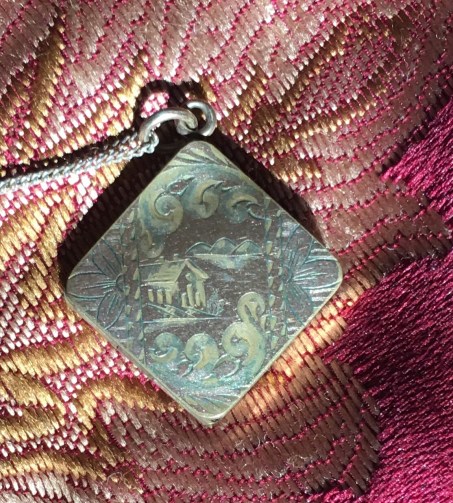
The locket is around 87 years old now. It’s made of brass, remarkably shiny, unmarred, despite its age. The front surface is finely etched with antiquated swirls and flowers, and if you look very closely, in the center there’s a house with a little fence and mountains in the background along the horizon.

Grandma, what a prophetic symbol for you, in so many ways.

The Great Depression was a year underway when her uncle gave her the locket. In 1936, my grandmother married my grandfather. My father was born ten months later. To me, the house on the locket represents their rural North Carolina homeplace;  it’s where Grandma’s heart was when Granddaddy, unable to “make a go of it” with tenant farming, sharecropping, and odd jobs, found employment almost two hundred miles away at the Newport News shipyard and moved his family. He was working there when Pearl Harbor was attacked.

Grandma was expecting her second child that year:

We stayed in an upstairs apartment and it was so hot. I could look through the window to see the ice truck making deliveries. People couldn’t get refrigerators because of the war; if you had one, it didn’t have a motor. We used them like iceboxes. I’d stand at that window thinking,  I’d give anything for a piece of that ice right now . . . . 

And she longed to go home.

Those mountains on the locket’s background symbolize numerous obstacles, hardships, trials, everything from the loss of her father to the Depression and the war (her brothers served in the Army and the Marines) to the ten years she did live back home, raising the children while my grandfather commuted from the shipyard on weekends. It was hard, all of it. She endured. The brass locket shines almost like gold—beyond the things of home, beyond every mountain to be scaled, hope always shines bright, not dimming over time. My grandmother’s faith would be challenged; she’d outlive two of her three children, but her faith would hold.

Home, endurance, overcoming, hope, faith, love. All of these are her legacy to me.

And the stories.

All old things have a story. Grandma’s locket is a tangible reminder of the stories she lived and told to me. It even opens like a book for pictures or tiny mementos to be placed inside; pictures of my two boys when they were babies are in it now.  The locket is the story of who I am, where I have come from, where I am going. I like to think that as the generations rise and fall, the locket will be passed down again and again, and that our stories will go on, and on, and on.