Good-bye, mighty Nik

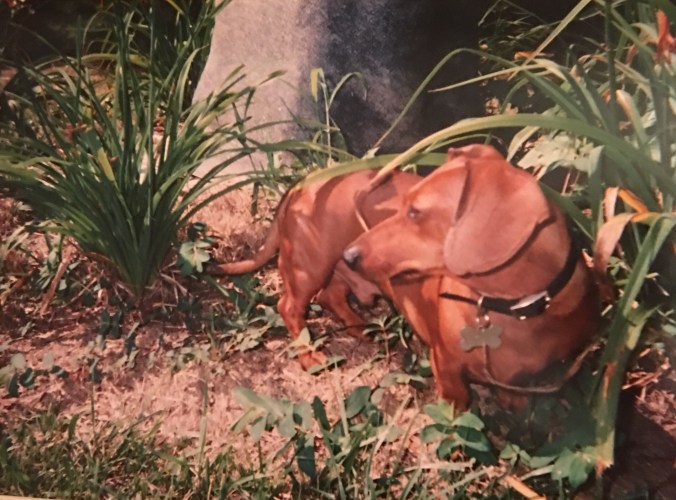
Nikolaus, 2004. Age 2. 

Dear Nikolaus,

I write to celebrate you and your long, long life.

To thank you for the joy you brought and the love you gave for so many years.

To ask your forgiveness.

When you first came to our family, we were elated.
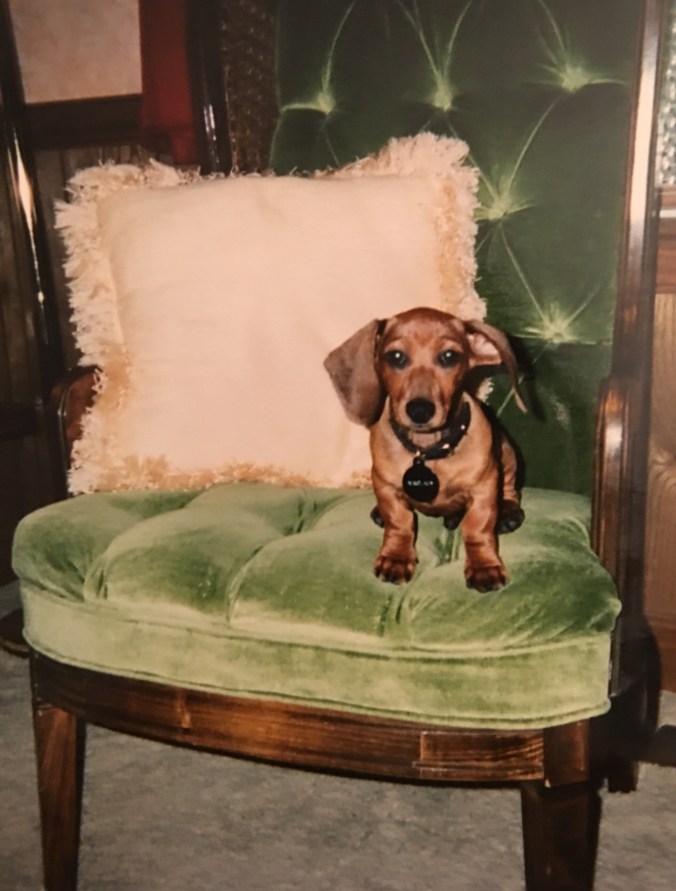
April 2002. Age 3 months.

You see, we’d been looking for a little dog because we had a little boy who wanted one so badly. Big dogs frightened him.

But you were perfect.
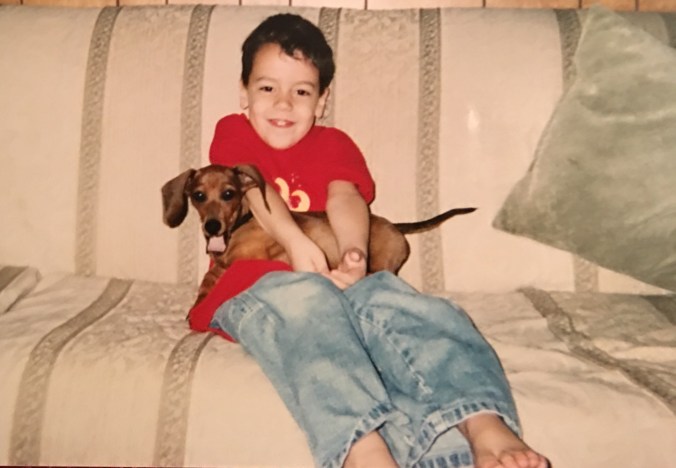
April 2002. Nikolaus age 3 months. Cadillac Man age 4.

And so you grew up together.

You weren’t always easy, but you were always, always loved. Despite the countless accidents in the house and that time you snuck a chicken strip off of little Cadillac Man’s plate and ran for all you were worth with your booty. Not to mention how you figured out a way to climb on top of the furniture to get the boys’ Valentine and Easter chocolate. And ate it all, leaving only the wrappers behind. More than once. How did you do it and not get sick?

We began to think, all things considered, that you might be immortal. After all, you outlasted legions of other pets. The boys began to joke about you plotting the demise of every other dog, for they came and went throughout the years, but you remained. No one questioned your alpha status. Not even the dogs seven times your size, when you took their rawhides and their pillows for your own. They just sat, blinking in respectful disbelief, at your Napoleonic powers.

There’s so much to say, for we shared so much together. I am thankful for my special place in your little heart. How, when you were young and strong, you’d jump up on the couch to curl up beside me or to crawl in my lap. For the hours I spent working on the computer and you were snuggled behind me, between my back and the chair. I loved you and your deep, abiding warmth, always near, just being. Just together.

How the boys loved you. How they laughed as we tried to teach you to roll over, to sit and beg, the two tricks you’d pull off multiple times in succession just to get one treat.

How much comfort you gave them when they were hurting, from boyhood to manhood. They held you in their arms, but you, well—you were holding their hearts all along.
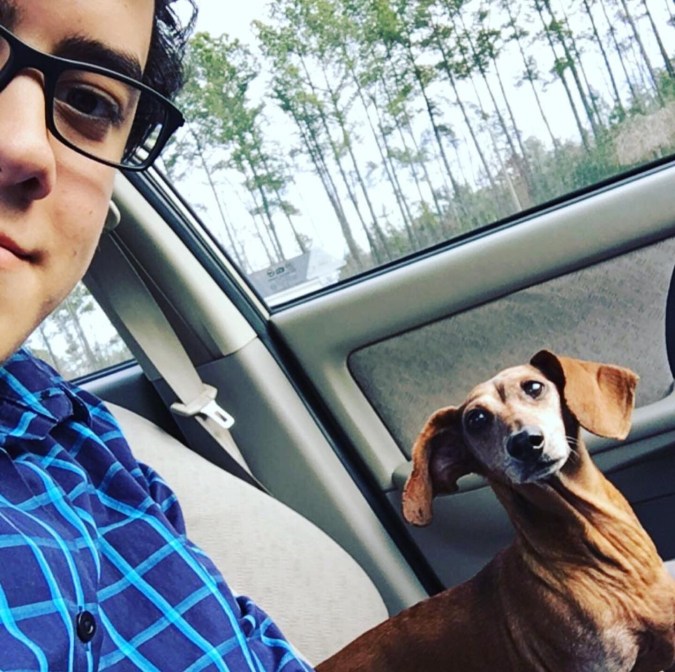
January 2017. Cadillac Man, age 19, celebrating Nik’s 15th birthday with a car ride.

Time is no friend, is it, old sweet Nik. Not when it takes your youth so that you can’t jump anymore but have to be picked up and carried. Not when it turns your face and paws so white. Not when it takes your sight, your hearing, even your ability to understand exactly where you are and what’s going on.

Here’s what I marvel over: That you tried to run through the grass like always, even when you couldn’t see. That you could still find me in bathroom getting ready for work each morning. That you never forgot where your treats were, or that you should get one after coming in from outside, even when it had to be broken into small pieces for you to chew. I knew you could only find them by smell; that’s why I put your broken-up treats on the kitchen rug, so you wouldn’t push them all across the floor trying to get them into your mouth.

I marvel over your ever-voracious appetite, how you ran for your bowl every morning, even if we had to guide you just a bit.

And I worried when you started losing weight.

May 2018. Age 16. 

The vet said your blood work was amazing for a dog of your age; never saw the like. Said your heart was strong. Said things like cancer can make a dog lose weight despite plenty of food, and it wouldn’t show in the blood. Gave you the pain medicine which made you sleep but also tore your bowels up so that we couldn’t give it to you anymore.

And still you rallied, although every day you got thinner and thinner.

Cadillac Man watched you staggering and falling in the yard.

Mom, he looks like a skeleton. He’s just going in circles. 

Mom, it may be time.

Mom, I just got on the scales with him. He’s under seven pounds.

Three weeks before, you were about nine pounds.

When you were a young dog, you were nearly twenty pounds.

On Saturday, when I gave you your last bath, I could see every vertebra on your back, could feel every knob on your tiny tail. For the first time in your life, you sat in the bathwater, too weak to stand.

When we wrapped you in your “Happiness is a Dachshund” blanket to take you to another vet, I didn’t know it was going to be good-bye.

I didn’t.

I thought maybe another medication would help. Or another suggestion. You’d made it so far, so well, until then. The regular vet said your heart was strong, so . . .

The new vet said:

I can’t fix the blindness.

I can’t fix the deafness.

I can’t fix the severe cognitive impairment.

You can run tests to see why he’s losing the weight, but it would only be for academic purposes. Just to know. He’s a very old, weak dog.

Cadillac Man looked at me, holding you in his arms:

Mom, there’s hardly anything left of him.

How to let you go like this, when you’d been so utterly trusting and loving your entire life?

You looked at me with your tired, cloudy eyes, and I wasn’t sure what you were seeing. Maybe me. Maybe not.

I couldn’t know how much pain you felt; you never complained. You just kept going, for it’s all you knew to do.

I loved you. I struggled then, I struggle now with the decision, but I believe the boy—the man—who loved you best knew what was best.

And so we stroked your sweet head when you breathed your last—one tiny sigh, of contentment, of resignation, of release—utterly, utterly peaceful.

And I take comfort where I can find it. When I read about euthanizing suffering pets, when I talk to others who’ve been there, I don’t question the logic. Of course no one wants to watch their beloved endure prolonged suffering. When I think of your ravaged little body, I know you couldn’t bear much more. Your determination, your will, was astounding. That’s where I struggle. That’s why I write. It’s a matter of the spirit, see.

I write to celebrate our long run together. Sixteen years.

I write to thank you for your unconditional love, and to tell you that mine is just as unconditional. I love you still, even now that you’re gone.

I write to thank you for the joy you brought to two young boys for so long. You’re indelibly written on their hearts, as long as they live.

I write to say I’m sorry. For all the times I lost my patience, for the times I could have made more time, for being part of that last, anguishing decision. But if you were going to go, I was going to be there with you, all the way.

And I ask your forgiveness, because the weight is so hard to carry. But old age and sickness are hard to carry, too, aren’t they.

For something so little, you are so mighty, Nik.

I imagine you always will be.
Roses in the smoke

Red rosebud

Rosebud. Jan SoloCC BY-SA

By the chain link fence of our backyard, a rosebush grows. 

It’s really growing in our neighbors’ backyard, but, according to my mother, there’s an agreement that the roses hanging over into our yard are ours, and the roses on the neighbors’ side are theirs. 

So, early one Sunday morning, my mother ushers my sister and me out to the fence. In one hand my mother holds pair of shears. In her other hand is a cigarette. Salem. Menthol Fresh.

“Pick out the rose you want to wear,” she says. “From the ones on our side.”

The roses are vivid red with a hot pink tint. Some are wilting. Some are big and full. Velvety. Their fragrance is heavy in the air. 

“This one!” says my sister, pointing to a large bloom.

That one might fall apart while you’re wearing it. Find one that’s not all the way open yet.”

Why did she tell us to choose?

We finally select tight rosebuds that my mother thinks are acceptable. She puts her cigarette in her mouth and clips the two buds. Then she clips a third one that’s partially open.

“Why are you cutting three roses?” I want to know.

My mother blows a cloud of smoke into the air. Menthol and tobacco mingle with the scent of roses. “One’s for me. Grannie is living, so I’ll wear a red rose to church for Mother’s Day, too.” 

She has three straight pins in her sleeve. She removes one to pin my sister’s rose to the front of her dress. 

I am thinking about Grannie. Her mother is not living. “What color rose will Grannie wear, then?”

White,” says my mother, pinning my red rosebud to my dress.

I am sorry for Grannie, her mother being dead, having to wear a white rose. One day my mother will wear a white rose on Mother’s Day. The thought floods me with sadness. The colors make me wonder—why?  Why red for living mothers and why white for dead mothers?

Is red for the blood?” I ask.

My mother, in the midst of pinning her own rose, leans in. She can’t hear well. Sometimes she doesn’t catch everything other people are saying. “What?”

Do people wear red for living mothers because they still have blood in them and white for dead mothers because when they die there’s no more blood?”

My mother frowns. An upside-down V appears between her eyebrows as she looks at me. I can tell she heard me and that she doesn’t understand the question. Before I can try again, she says, “All right, we’re ready. The bus should be here any minute. Let’s go wait out front.”

We ride the bus to church because my mother doesn’t drive. She never learned how. And Daddy is asleep because he’ll be getting up to go to work while we’re at church.

We stand out front, my mother, my sister, and me, wearing matching dresses that my mother made, with our three red roses pinned on, waiting for the church bus. It’s really an old school bus, now painted navy blue and white. My mother lights another cigarette. My sister plays with her necklace—a tan-and-white rabbit’s foot on a piece of yellow yarn around her neck—and I think about colors. Red and white. Living and dead. Blood and no blood.

Good thing we have our own red rosebush for Mother’s Day, or what would we do?

It would be many years before I wondered what color rose a person might wear for a mother in an altered state. As in the case of, say, addiction. As in, if the relationship had disintegrated because of it, because the mother is consumed. Because it happens, somewhere, to somebody, every day. What is the color of dysfunction? Of existing, but not really living? Surely not a blend of red and white, for pink is too cheery. Gray? Does a gray rose even exist in nature? If it did, why would anyone wear it as homage to a mother?

One would just not wear any rose at all, rather than wearing one the color of ghosts, of shadows, of clouded memories, of the mists of time, even if the sun occasionally breaks through to shine on what was good, as on a rosebush blooming along a chain link fence and a bud like a drop of blood on a little girl’s dress, even as swirling smoke envelops it, before the ashes fall.

Blowin’ in the wind

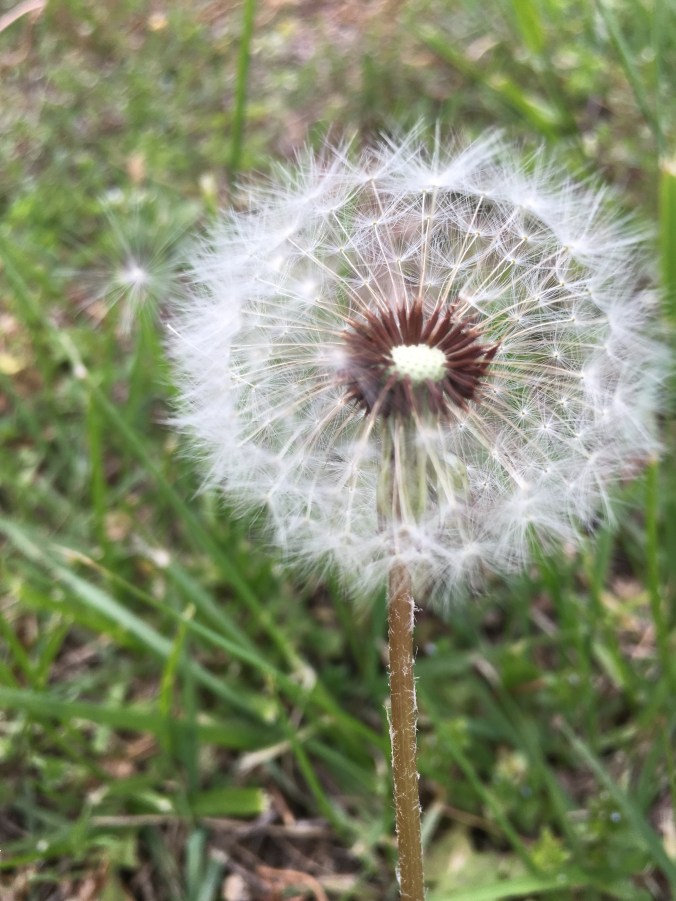
Yesterday, while outside with my old dachshund, Nikolaus, I saw this old dandelion.

It stood trembling in the soft spring breeze, holding its seeds tight under its parachute sphere, and I thought Any second now they’ll be blowing in the wind.

Which reminded me of the song.

When I was a child my parents had a stack of record albums, and in it was Peter, Paul and Mary’s In the Wind. Only now do I wonder which of them purchased it, for my young father and mother seemed more representative of the fifties than the sixties. No beads and long hair or tie-dye. Daddy wore a crew-cut all of his adult life. My parents were . . . just parents. Pretty mainstream. I don’t know how old I was when I first heard the album, but as a child I played it over and over on the old stereo, a huge, bench-like piece of furniture on four legs that took up half the length of the living room wall.

Bob Dylan’s “Blowing’ in the Wind” was one of my favorites, mostly because Peter, Paul, and Mary’s harmony was as haunting as his lyrics. But it wasn’t the song I loved most on the album.

That was “Stewball.”

It’s about a racehorse, the underdog, and how a man laments betting all of his money on “the gray mare” and “the bay,” how he wishes that he’d bet on Stewball, who somehow managed to win the race.

The ballad’s content is mournful—Oh, the hoot owl she hollered, and the turtledove moaned, I’m a poor boy in trouble, I’m a long way from home—but the instrumentals jingle along, almost incongruous with the words. Perhaps not as incongruous as me, less than ten years old, swinging as hard as I can, round and round on a tire swing that Granddaddy hung from a pecan tree in the yard of my father’s childhood home, singing at the top of my lungs: Oh, Stewball was a racehorse, and I wish he were mine, he never drank water, he always drank wine . . . .

So long ago.

Funny how songs can weave their way through chapters of our lives, as they do through movies. There are stories to be told about the poor choices of adults, and the consequences, with “Stewball” playing in the background.

Nik the dachshund makes his way back to me, staggering in the grass. At sixteen he’s unsteady on his feet and blind; he plows into the old dandelion. Instantaneously the perfect white sphere dissolves, the seeds go airborne.

The answer, my friend, is blowin’ in the wind

The answer is blowin’ in the wind.

Maybe it’s answers I seek.

Maybe they’re seeking me.

I do not know.

But I do know that ideas are everywhere, blowing in the wind; I sense them and I know they’ll land, somewhere, sometime, that they’ll take root and grow. If I write them, they’ll spawn more and more ideas.

I gather Nik in my arms, careful of his old, fragile bones, and go back inside the house, humming.


The tree I’d be

Cypress trees.jpg

Sunlit Cypress. Teresa PhillipsCC BY-SA

A few days ago,  I happened upon this captivating tweet:

I am well on the way to becoming a tree myself. I put down roots. I sigh when the wind blows. My sap rises in the spring and I turn towards the sun. Which tree would I be? Definitely a walnut tree.

-Roger Deakin, journal entry for April, quoted by writer Robert Macfarlane, Twitter, 04/04/2018

Macfarlane then asks: “Which tree would you be and why?”

—A cypress.

That was my immediate thought.

But why?

After all, one of my favorite scents is Fraser fir (the predominant Christmas tree in North Carolina). I vacuum the stubby needles at holiday’s end and try not to empty the canister for as long as possible, because the fir fragrance fills the air with every subsequent use. The trees of my childhood are dogwood, pine, live oak, magnolia, sweet gum. I have early memories of sun-dappled sidewalks covered with “helicopters”—one-winged seeds, or samaras—that spiral down from maple branches. I tossed the helicopters again and again, as high as I could, to watch them swirl like propellers. Crape myrtles lined my grandparent’s yard; I climbed their smooth trunks, sat in the crooks of their branches, countless times.

Why does cypress come to mind first, then?

Poets and writers, you know when an image appears so vividly that it holds some significance begging to be explored . . . .

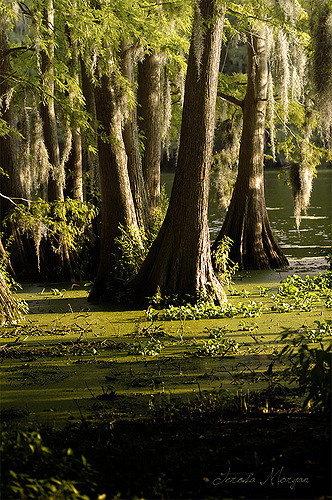
For starters, my image is of Taxodium distichum, more commonly known as a bald cypress, or, my preferred name, a southern-cypress tree.

It’s rooted in the swamps of the southern United States, where my roots are. A tree at home in water, in rivers. I grew up in a place called Tidewater, entered the world in a hospital named for its proximity to water: Riverside.

My first recollection of the word cypress was my grandparents’ reference to a place on beyond where they lived, where the little dirt road curved past canals and thick woods that had grown to obscure stately houses: up Cypress Swamp, they’d say. Grandma’s best friend from first grade, who grew up to marry Grandma’s brother, was from Cypress Swamp. As a child, standing on the dirt road, looking through the treetops, if the sun was right, I could glimpse a bit of one old, abandoned house—a roof of cypress shingles.

The word sounded poetic to me even then: cypress. Like a whisper. Like something inviting. Maybe magical.

Although, through the ages, a cypress was usually associated with funerals and mourning. My affinity for the tree is clearly fused to my eastern North Carolina heritage, a reminder of the generations that have gone before me. My family tree, so to speak. It is ancient. Maybe nothing encapsulates that so well as this passage from Our State magazine, in which the author chronicles his boat journey on a river through a cypress forest:

 Many of the trees here must have witnessed those long-vanished species. They would have nodded over Native Americans in dugout canoes. They would already have been tall when the Lost Colony was lost, when the Mayflower sailed, when Attila the Hun was on the move. A few might have stood when Christ was born.

-T. Edward Nickens, “In Search of Methuselah,” Our State, June 8, 2016.

They live for so long, cypress trees, due to their ability to withstand storms; they thrive despite adverse growing conditions. Cypress wood is hard, strong, water-resistant—hence those shingles on the old country houses still standing as a forest  grows up around them. Those hand-hewn shingles sheltered the life therein. Like Noah’s ark, made of gopher wood from an unknown tree that some researchers speculate to be . . . cypress.

I cannot say the adversity, the storms, in my own life are any greater or worse than those weathered by other people I’ve known. I can only say that I’m still here. I view the cypress not as a funeral tree but one that preserves, celebrates, and affirms life; that, ultimately, is the whole reason why I write, why this blog exists at all.

On a fanciful note: Earlier I mentioned the word cypress sounding magical. When I was a child I loved the Chronicles of Narnia. I still do. In these books, C.S. Lewis borrowed from Greek mythology to depict dryads and hamadryads, the spirits of trees that took the form of young girls with their particular tree’s physical characteristics: a birch-girl dressed in silver, another with hair like long, willowy branches. Does a cypress call to me, then, because I am tall (5’8″ in bare feet)? That’s taller than the average American woman (5’4″) but not dramatically so. There must be something more, then, as to why the cypress chooses me, something unique to the tree and to me, other than our having southern roots in watery regions.

The knees.

In cypress forests, knobby projections stick up from the water. Theory has it that those “knees” help the tree breathe, enabling it to take in more oxygen. I don’t know how much truth lies in that theory, but I can tell you this: For my entire childhood I suffered from asthma and the only way I could sleep at night, the only way to breathe, was by curling up in a ball with my knees drawn up under me.

So, yes, my knees helped me breathe.

*******

In the old places

where the water stands still

they live on

holding all their stories

not evergreen

but ever-enduring

reassuring

reaffirming.

With every breath

drawn on their knees

they whisper,

“Remember.”

Real

and ethereal

—if I were a tree

a cypress

I’d be.

Cypress trees - pink

“When we are present in each moment, the past gently rolls up behind us and future slowly unravels before us.” echorooCC-BY

Relics

Mom's empty room

Mom’s empty room. The_DoodlerCC BY_SA

So many stories 

in every room

in every thing.

A lifetime packed

tight in every closet

in every drawer

for even in the time

of abundance 

the memory of deprivation

remained.

A lifetime of love

recorded in cards and letters

all saved 

even poems 

I don’t remember writing.

The photos of my children

so carefully preserved

growing up all over again

here in my hands.

Their father captured 

as a  little boy

in black and white

long ago.

His own father in uniform

smiling, alive

his olive-green dress hats

sealed in a bag 

on a shelf 

deep in her closet.

The ghost of holidays past

pulled from the attic 

with childhood toys

long forgotten.

Tarnished silver in the kitchen

and a fine layer of dust

on the crystal. 

Cookies in a jar

grown stale 

maybe in hopes of

grandchildren coming.

Things with no explanation

only wonder 

as to what they are

and what they’re for. 

So many stories

in rooms once beautiful

in every thing crammed

holding on, holding on

in the hidden places.

A lifetime packed

with living

and loving.

Decades of

acquiring

prospering

overcoming

remembering

all dismantled 

and disposed of

in the space of

a single afternoon.

The locket

She stands at the counter, admiring the jewelry. If  Papa were here, he’d get a necklace for me, she tells herself. I know he would . . . I’d keep it in the jewelry box he gave me for Christmas. 

But Papa was gone. Back to the hospital, again. She knew he feared going and she feared it for him, not knowing exactly what treatments he was being given, only that his face was whiter, more hollow, on every return, his blue eyes sadder. 

Her own eyes blur. Wiping away the tears, she finds her uncle, the store owner, leaning over the back of the wooden counter.

“Hello, dear. You like the jewelry, don’t you?”

She nods, tries to smile.

“Tell you what—I’ll give you a piece. Choose the one you like best.”

Her tears flow in earnest then. 

She chooses the locket.

*******

She was fifteen. The year was 1931. A year later, her beloved Papa would commit suicide on his sixtieth birthday, just weeks before she graduated from high school.

I wonder if she wore the locket as she sat by his casket in the living room overnight, or to his funeral.

When I was fifteen, she gave the locket to me:

I open the locket to find a black substance on the left side.

“I thought you said there was a picture of you in here!”

“It’s so old. That picture has turned darker and darker over the years,” she explains.

The image is completely obscured. 

“What did the picture look like, Grandma?” I ask, mourning the loss of it.

“It was a school picture. I had wavy blonde hair. It was pretty.” She smiles slightly as she picks the decayed photographic material out of the locket with Granddaddy’s pocket knife. She rubs the locket with a cloth until it gleams, and then she places it in my hands. 

“I know you’ll take care of it, my dear,” she says. 

As I clasp it, she draws me into her arms. I lean against her like I did when I was smaller, breathing in the light fragrance of her Avon cream sachet. 

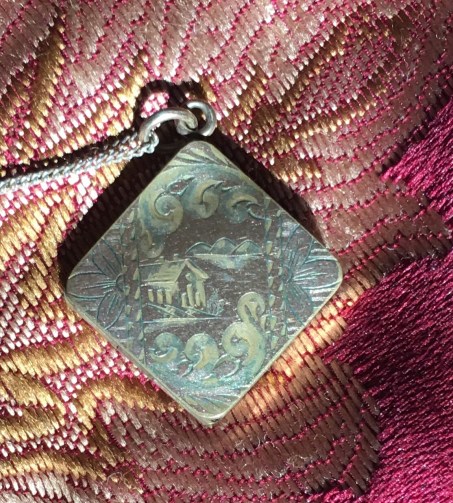
The locket is around 87 years old now. It’s made of brass, remarkably shiny, unmarred, despite its age. The front surface is finely etched with antiquated swirls and flowers, and if you look very closely, in the center there’s a house with a little fence and mountains in the background along the horizon.

Grandma, what a prophetic symbol for you, in so many ways.

The Great Depression was a year underway when her uncle gave her the locket. In 1936, my grandmother married my grandfather. My father was born ten months later. To me, the house on the locket represents their rural North Carolina homeplace;  it’s where Grandma’s heart was when Granddaddy, unable to “make a go of it” with tenant farming, sharecropping, and odd jobs, found employment almost two hundred miles away at the Newport News shipyard and moved his family. He was working there when Pearl Harbor was attacked.

Grandma was expecting her second child that year:

We stayed in an upstairs apartment and it was so hot. I could look through the window to see the ice truck making deliveries. People couldn’t get refrigerators because of the war; if you had one, it didn’t have a motor. We used them like iceboxes. I’d stand at that window thinking,  I’d give anything for a piece of that ice right now . . . . 

And she longed to go home.

Those mountains on the locket’s background symbolize numerous obstacles, hardships, trials, everything from the loss of her father to the Depression and the war (her brothers served in the Army and the Marines) to the ten years she did live back home, raising the children while my grandfather commuted from the shipyard on weekends. It was hard, all of it. She endured. The brass locket shines almost like gold—beyond the things of home, beyond every mountain to be scaled, hope always shines bright, not dimming over time. My grandmother’s faith would be challenged; she’d outlive two of her three children, but her faith would hold.

Home, endurance, overcoming, hope, faith, love. All of these are her legacy to me.

And the stories.

All old things have a story. Grandma’s locket is a tangible reminder of the stories she lived and told to me. It even opens like a book for pictures or tiny mementos to be placed inside; pictures of my two boys when they were babies are in it now.  The locket is the story of who I am, where I have come from, where I am going. I like to think that as the generations rise and fall, the locket will be passed down again and again, and that our stories will go on, and on, and on.


Blanket

I am more tired than I realized.

I wake up early every day, around 3:30. Not intentionally; I just do. Instead of lying awake or drowsing for another couple of hours, I get up and write. It’s the perfect time, before my menfolk and canines begin to stir.

My early mornings are a logical reason to be tired.

And spring break is still a week away. The last mile is always the hardest . . . .

And I am twenty-five days into a thirty-one day writing streak, the Slice of Life Story Challenge, which requires an extreme level of thought-immersion and attention to the minutiae around me (everything is a writable moment). My receptors must be wide-open all the time. This, however, is a good kind of tired. Even though I am mentally composing while I’m sleeping.

And I am fighting an allergy or a cold; I feel it lurking around my edges. My boys, when they were small, used to say, “I am catching up to a cold.”

And it’s been a long winter. There may be a few snowflakes tonight. Spring hasn’t fully sprung. There’s still a lot of darkness.

And my family marks a year of losing loved ones, young and old, sudden and by inches with dementia. My husband, his sister, and I need to finish cleaning out their mother’s house.

The dogs, knowing I’m the mom of everything, trail my every step. Henry wriggles like a worm, with an insatiable need for pats, for attention, and even poor old Nikolaus, his eyes like clear marbles full of misty clouds, is still able to scamper behind me in hopes of a treat.

And so, I’m tired.

Yesterday, being Saturday, I did something I almost never do:

I finished my post and went back to bed.

My husband, who’s now been up for a short while, reading in the study, comes looking. “Oh, you’re back in bed?”

“Just for a little while,” I say.

“Okay.” He closes the door.

I pull the blankets up to my chin. So cozy. I drowse. I hear bits of blog posts echoing in my brain.

The door opens. Older son. Henry’s so-called “dad.”

“Are you sick, Mom?”

“No. Just resting.”

“Oh, okay.” He goes to fix his breakfast. He loves a big breakfast. His brother won’t eat until lunchtime.

Snuffling outside the door. Henry. He usually begins to grumble-half-whine to come in and snuggle to me, or to sleep on my bed if I am getting ready for work. Today he must sense something. He goes away. Unusual.

Distant clanking in the kitchen. Muffled voices. Footsteps in the hallway.

The door opens. Younger son, Cadillac Man.

“Mom?”

“Yes?”

“Are you okay?”

“Yes. Just resting.”

“Okay. Lowees.” This is how he first said ‘I love you’ when he was a baby. Lowees. It immediately became part of the family lexicon. We all say it to each other. His father reminds me again and again that Cadillac Baby said it to him first.

“Lowees,” I say.

I can’t stay here long. None of them will be able to take it. There’s too much to do, anyway. There are places to be.

But I pull the covers partway over my head, sinking into the warmth, the softness, savoring the moment, grateful for the web of words knitting itself from random scraps in my mind, for the abiding blanket of love wrapped over and around my life.

Cadillac man

img_4381

When he was little, he spent hours lining up his Hot Wheels just so.

“What are you doing?” I asked.

“It’s the parking lot at church,” he told me. Car to car, he explained who each owner was according to where they parked every Sunday morning.

He’d matched his toys to the real cars by the types of spokes and wheels.

A mother can be worried and fascinated at the same time.

Around the age of six, he announced: “I’m going to get a Cadillac when I grow up.”

“Oh, you are?” I responded, attempting to keep a straight face.

He nodded his head emphatically. “Yes. A blue one.”

His grandparents drove a blue Sedan de Ville. My husband’s stepfather bought it new in 1989, with forty miles on it.

I could understand the appeal. My boy was obsessed with cars. When I was growing up, I loved my grandparents’ car, too: a vivid red 1964 Ford Galaxie 500 (see A long time ago in a Galaxie far, far away).

The boy has always known exactly what he likes and doesn’t like, what he wants and doesn’t want. There are no proverbial shades of gray with him. He loves dogs. He loves music, especially old gospel songs. I joke that he was born seventy-five years old and he has never disagreed. When he fell in love with Cadillacs at age six, it was forever.

He began collecting Cadillac memorabilia, knew all the latest models and years. He knew the old ones, too.

“Ma-Ma and Pa-Pa say the Cadillac goes to me when they’re gone,” he said, his big brown eyes aglow, around age ten.

The de Ville was, at that point, twenty years old.

“I’m glad they want you to have it,” I tell him, even as I think Buddy, by that time the old car won’t be worth having . . . 

Pa-Pa, a jolly, larger-than-life Scotsman, took meticulous care of his Cadillac, but after his death in 2014, it just sat in the driveway. Undriven. The seasons came with their ravages, year after year: summer’s blazing sun, autumn leaves gathering layer upon layer, winter’s snow and ice, spring’s thick coating of pollen.

Ma-Ma died last fall. We began cleaning out the house, my husband’s childhood home.

Our boy said, “It’s time to get the Cadillac.”

My husband and I looked at each other.

We looked at the de Ville.

It looked forlorn, awful.

But, to honor Ma-Ma and Pa-Pa’s promise to their little grandson long ago, we decided to see what could be done.

We had the car towed to the place where Pa-Pa bought it almost thirty years before. With a new battery, it fired right up, despite four years of sitting completely idle. It got new brakes, new fluids, new tires, and a much-needed bath.

The service rep called my husband: “You’re not going to believe it’s the same car. Everyone here thinks it ought to be in the showroom.”

We were skeptical . . . but the rep was right.

The boy—now a man—drove his father and me to the dealership to get the Cadillac, to bring it home.

It sat in the service area, waiting, gleaming, as if age and time had no meaning.

Touching the hood lightly with his fingers, our son whispered, “I wish Pa-Pa could see it.”

He took the wheel. His dad rode shotgun beside him.

I followed behind, marveling, as my son, at last, drove his shiny blue Cadillac down the country back roads into the setting sun.

Somewhere over the rainbow

skies are blue

and the dreams that you dare to dream

really do come true.

I note that when Judy Garland sings this line in The Wizard of Oz, she’s leaning on a big wheel.

*******

On the de Ville’s front grille is a medallion with the Roman numeral VI. Our son learned that this is a Heritage of Ownership emblem given to Cadillac owners for each vehicle. 

This was Pa-Pa’s sixth Cadillac.

Heritage emblems are not given anymore.

Fatherlove

Corgi

“Waiting …” jmcmichaelCC BY-SA

When I write personal narrative, memoir, and even realistic fiction across elementary grade levels, I usually give students choices of topic for the writing I’ll model. Many times they’ve chosen for me to write about my dad not wanting any pets when I was growing up, despite my desperate begging for them.

Students rejoice when I overcome my dad to get a dog or a cat.

One of the things I haven’t fully explored with the children is why my dad didn’t want pets. Truth is, it took years for me to fully understand . . . 

That’s where I’m going today.  

To set the stage, here’s a modeled excerpt, the scene when my mom, my sister and I have brought not one but TWO puppies home from our neighbors’ house across the street. It’s getting time for my father to arrive from work, and he has no idea we have these puppies:

“Will he make us take them back?” my sister whimpers. She has her puppy, Bagel, wrapped in a pink doll blanket. She cradles him in her arms like a baby.

“I don’t know,” says Mom. “We’ll have to wait and see.”

She sort of sticks her chin out when she says that.

The three of us sit in the living room, waiting, and when I hear the car door slam, I jump. I hold my puppy, Onyx, so close I can smell his puppy breath.

He’s home! What will he say? Will he yell?

I can hear his work shoes coming up the steps. I watch the doorknob turning . . .

Here he is, in his blue uniform with the white hard hat on his head, his big, gray lunchbox in his hand. He looks at us.

He sees the puppies.

He wrinkles up his face: “What in the . . . ”

“Surprise, Daddy!” yells my sister, holding Bagel up high in the air. “We got you some puppies!”

Suffice it to say the man knew when he was outnumbered. And defeated.

Bagel, the collie-colored, long-haired dachshund mix, was still with us when I got married.

As was Moriah, my black cat: 

Free kittens.

Take one.

The sign stood on a chair beside a disheveled guy leaning against the wall at the college bookstore entrance. This guy—another student, I guess—held a cardboard box in his arms. Kittens! I hurried over to look inside.

Only one dark, little shape huddled in the box.

“Is that the last kitten you have?” I asked.

“Yeah,” he replied. “No one wants her because of her tail.”

“What’s wrong with her tail?”

The guy scooped the kitten up and showed me her backside. She didn’t really have a tail, just a stump.

“What happened to her?” I wanted to know.

“She was born this way. The only one in the litter like this.”

The tiny black kitten looked up at me with her big yellow eyes.

She meowed.

She rode on my shoulder as I drove home wondering exactly how to approach Daddy.

“Please,” I said, clasping her close to my heart, where she purred against me. “No one else wanted her. I’ll keep her in my room.”

You’re allergic to cats!” he thundered. “Find somewhere for her to go!”

I didn’t, and once again, my poor father was defeated.

Moriah developed an endearing habit of running up the leg of my jeans and my shirt to my shoulder, where she liked to ride while I walked around. 

 One day, my father roared from the bathroom: “FRRAAAANNCESSSS!”

My whole first name. 

Yeah.

Had to be something really bad.

I flew down the hall to find him hunched over the bathroom sink. He’d been shaving. White cream all over his face.

When he shaved, he never wore a shirt.

Moriah, watching him, had decided his shoulder looked inviting.

She ran up his leg and his bare back to his shoulder, where she was now hanging precariously by her nails. Embedded in Daddy’s pink skin.

GET-THIS-CAT-OFF-OF-ME!” shouted Daddy. His blue eyes, reflected in the mirror, blazed at me. (Note: He actually said a few  more words than this. I’ve chosen to censor.)

I extracted my cat and we hid for days, until Daddy’s scratches healed.

Two years later, when I was about to be married, the apartment where I’d be living had a no-pet policy. I couldn’t take Moriah.

The night before the wedding, I handed her collar to my dad. “She’s yours now, Daddy.”

Here’s the crazy part: He looked pleased. He kind of half-smiled. 

Weeks afterward, my mother told me on the phone: “Your dad buys turkey at the deli for Moriah. He tears it up in tiny pieces and puts it in a dish for her.”

“He—WHAT?” 

He did it for Moriah until she was gone. Then he said, “That’s it. The last of the pets.” 

Until my mother brought home a little Shih Tzu. She named her Bridget.

Daddy grumbled for months, but was soon buying deli tidbits for Bridget, too. 

When I was expecting my first baby, I came home for a visit, and Daddy told me this story: “When you were born, your mom and I had a cat. A big, orange tabby named Tiger. He kept getting in the crib with you and we worried you’d suffocate. I ended up having to take him to the pound. It was terrible. I swore I’d never do that again.”

I looked at his face, this face that had frowned about pets all these years, saw the pain-shadow cross over it.

All this time, I thought he was just being hardhearted. 

One night, Mom called. “Bridget died today,” she said.

“Oh no. Are you okay?'”

“I’m all right. Your dad buried her underneath his camellia bush.”

A pause. Then:

“He cried like a baby. I’ve never seen him sob like that before.”

My throat wrenches. Tears burn like fire.

Oh, Daddy. Daddy. I’m sorry for everything.

And there was one more dog to come, yet another that my mother brought home without warning. A Corgi.

Daddy sighed, complained, vented for weeks on end.

He named her Foxy.

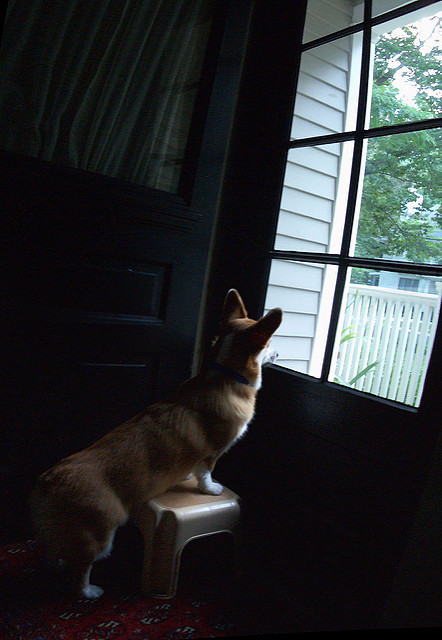
He taught her tricks, played with her every day after work. Foxy knew when to expect him; she sat on the back of the sofa, watching through the picture window, waiting for him to come home.

Maybe it’s a case of saving the best for last, for, out of them all, Daddy loved Foxy best.

He never had to give her up, suffer her loss. 

She suffered his. 

For weeks on end, she sat at the picture window, watching for him. Sighing, whining. Day after day after day, waiting, forever waiting, for him to come home . . . 

Fatherlove.   

Still born

Lost in France WWI

WWI digital collage by jinterwasCC BY

“In this place, time is not measured by weeks, or months, or years, but by deep human experiences . . . .” -Woodrow Wilson, 1915

By Christmas, she’s too weak to get out of bed. She listens to him singing carols with the children in the front room by the fire, his resonant bass filling the house. If the pain would stop, she thinks, I might could play a song or two for them . . .

The piano stands silent as she drifts in and out on the sound of his voice.

He peers in at her. How strangely frail she is, birdlike, lying there with her black hair spread like wings over the pillows, skin as white as the sheets, dark circles around her eyes. Until the lost baby in September—poor, stillborn thing—she’d been tireless, out in the cotton from dawn to dusk, all the while keeping an eye on their three children at the edge of the fields.  

Her strength hasn’t returned, but she’s alive. He is grateful, for he walked the valley of that shadow once before, fourteen years ago. Just down the dirt road, over the canal footbridge, under a stone on the land his father gave for the building of the church, lies his first wife. Nineteen years old, buried in her wedding dress, holding the infant who never had a name to inscribe on the stone:

a place made vacant

in our home can

never more be filled.

A place now filled by a woman who’d been twelve at the time of her predecessor’s passing. 

She opens her eyes. Huge, black eyes that look straight through him, making him shiver.

“Francis. Go get Mama. Please.”

Turning back to the front room, he kneels with the children—ages six, four, and two—and gathers them in his arms. “Listen to Papa. I’m fetching your Grandmama. Stay close by Mama, hear?”

The older girl and boy nod. The two-year-old squirms against him. He hands her to her big sister. “Mind her. Keep away from the fire. I’ll be right back.”

The six-year-old regards him with solemn eyes, big and dark, so like her mother’s. “Yes, Papa.” She grips the little one’s hand, tight.

He grabs his coat and cap. The children watch him through the frosty window, hearing the echo of his boots running over crunchy patches of snow.

They file into the bedroom where she lies with her face turned toward the other window and the winter white world beyond. 

She moans as the pain in her middle cuts like a knife and the whiteness deepens to gray. I am turning inside out. If I didn’t know better, I would think . . . 

Then the darkness swallows everything.

*******

Day blends with night, it all runs together, until a cry shoots through him. He bursts into the bedroom, blue eyes wide with shock.

There, in the quivering circle of red-gold light cast by the kerosene lamp, stands his mother-in-law, her face shining with perspiration. Before he can take it in, she crosses the creaking floorboards to hand him a wriggling, wailing bundle.

How can this be? How can this be? pounds his heart. The baby was stillborn nearly three months ago!

His wife, smaller, paler than ever, watches from the bed, black eyes glittering in the lamplight. “Merry Christmas, Papa, one day late,” she grins. “It’s another girl.”

Who is very much alive, crying for all she is worth, here in his arms.

His instincts kick in. He jiggles the infant and begins to sing, softly, tears spilling down his cheeks.

The newborn and her mother both drift away on the sound of his voice: “Sleep in heavenly peace, sleep in heavenly peace.”

*******

“So, you see,” says Grandma, “I was a twin.”

“How can that happen? Having a stillborn twin but not the other for almost three more months?” I’m hanging on her every word as she makes up her four-poster bed. Through the window of her room, with its tongue-and-groove walls painted a cheery pastel pink, I can see her homeplace just on the other side of Granddaddy’s garden. The tin roof gleams bright silver in the morning sun. For a second, I see it in the icy December of 1915 . . .

She shrugs. “It’s rare, but it happens sometimes, even with animals.”

“But how did she not realize she was still expecting for that long? She’d already had three children, not counting the one she lost!” My  great-grandmother went on, in fact, to have a total of eight children, all of whom I know. Not counting the lost one, of course. Grandma’s twin.

Grandma shakes her head. “There’s no telling. Women didn’t go to doctors like they do now. When she lost that baby, it came early. She just didn’t expect there to be a twin remaining, I guess. Women lost babies all the time. My sister had stillborn twin girls. I was there and saw them. They looked like tiny dolls, not quite finished . . . ”

She says this with a matter-of-factness that I cannot comprehend.

“It’s so mysterious, that you were still born after all,” I say after a bit, following her to the kitchen, where she ties on her apron.

“Oh yes,” she says, flouring the spot and croaker that Granddaddy caught in the creek. “Life is full of mysteries, that’s for sure.”

“You’re kind of a Christmas miracle, then, aren’t you?”

Grandma chuckles, placing the fish in the frying pan where they sizzle and pop, sending up a fragrance that makes my stomach growl.

“Just one day late,” she smiles.

She goes about her work as usual, while I drift away on the sea of her stories, filling in the minor details that have been obscured by time, envisioning these great-grandparents who died before I was born, sensing the tenor of their daily lives, yearning to know more. I halfway expect, as I go out on the back steps to gaze at the empty homeplace, that I might see them in one of the translucent windows, waving to me in recognition.

I have to stop myself from waving back, in case anybody else happens to be watching.

*******

Happy Birthday, Grandma. Your stories live on.

Love always from your and your Papa’s namesake.