The children notice it right away:
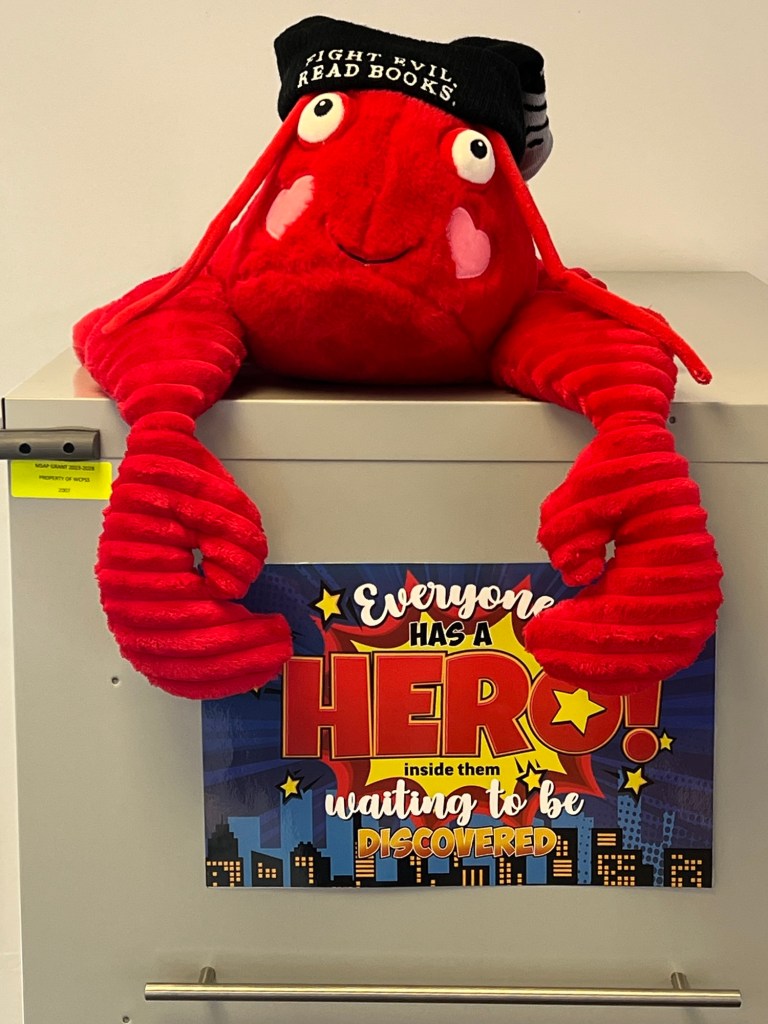
The giant lobster on top of the cabinet in our Heroes’ Hangout reading space.
They are elated:
Look! A lobster! Why is it here? Where did it come from? Look! He has hearts on his cheeks! He’s so cool!
Truth is that a colleague gave the lobster to me when she learned that I sometimes let the smallest, wiggliest students hold onto a stuffie “friend” so they can focus on listening to their volunteer reading a book to them.
But this is what I tell these second graders:
He’s a reading lobster. He wanted to be here in the Heroes’ Hangout.
This sets them off again: What’s a reading lobster?
Well, Friends, you will have to decide that for yourselves… why would a lobster like reading?
More chatter. We may never get to the lesson.
A few days later I remember a hat I have at home. Perfect for the lobster!
I bring it to school and put it on his head.
The kids notice right away: Look! The lobster has a hat! It says ‘Fight Evil, Read Books!’
That’s right, Friends. Maybe he’s a Superhero Reading Lobster.
Maybe we will create a Superhero identity for him and a backstory and possibly write some adventures starring our Superhero Reading Lobster who fights evil by reading books…I mean, anything is possible after Dog Man…
But for now, when my group of second graders finishes their guided self-portrait lesson with me in the Heroes’ Hangout, I say: All right, time to put away your materials and line up at the lobster.
They form a quiet line.
I say, Bye, Friends. Lobster power all the way.
All eleven kids jump up to touch the lobster as they pass by. I watch them walk down the long hallway to their classrooms in a straight line, without a sound.
Not one student has ever asked what I mean by “lobster power all the way.”
That’s how powerful our lobster is.
*******
with thanks to Two Writing Teachers for the March Slice of Life Story Challenge
For more about the Heroes’ Hangout, click here.
 lit bits and pieces