Crows, historically associated with death, are highly intelligent birds with powerful memory. In folklore they convene to determine capital punishment for wrongdoers—a murder of crows, apropos. Yet they mourn their dead and will even place small sticks or other objects around a deceased fellow crow, in a sort of funeral rite.
On Sunday morning, crows perched atop the steeple cross at church as congregants arrived. Harbingers of death? Casters of judgment? Consider the cross, an instrument of capital punishment, particularly of someone “who knew no sin” offering himself as a sacrifice for all the wrongdoing of humankind…For God did not send His Son into the world to condemn the world, but that the world through Him might be saved (John 3:17 NKJV); For our sake he made him to be sin who knew no sin, so that in him we might become the righteousness of God (2 Corinthians 5:21 ESV).
So sit the crows on the steeple cross a judgment passed a death sentence cast yet overturned and overcome so long ago —one wonders what the crows know.
New day. Opening window blinds to a flood of sunlight. Glimpse of pines, grass grown tall overnight (how??), weathered wooden deck railing, old white rocking chair, large cement pots draped in long ivy vines, new tendrils waving, geraniums blazing green and red, interspersed with spiky brown starbursts—oh, time to deadhead.
Within moments, scissors in hand, reaching for exposed bones of skeletal blooms, crisping, decaying, red petals shriveled, let loose, bled away, spent…
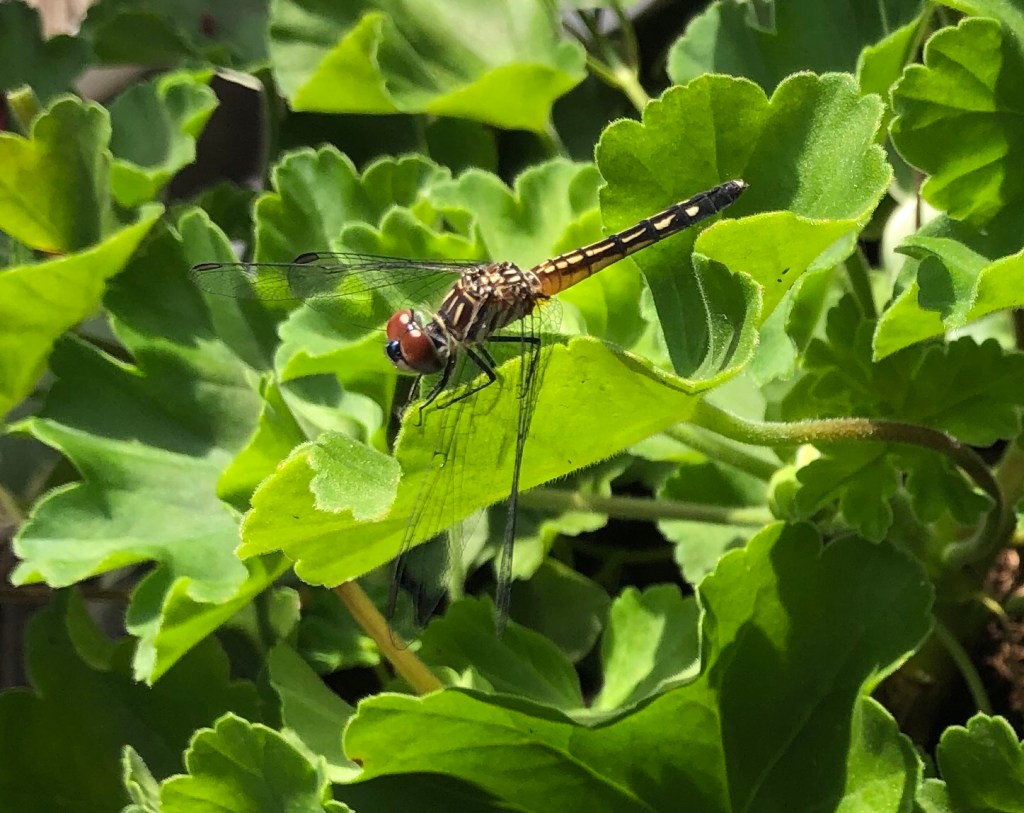
—Oh! Hello. Didn’t know you were here, Dragonfly.
Swapping the scissors for the phone-camera…
How close will you let me get?
—Surprisingly.
You’re small. Maybe two-and-a-half inches. Not like the first dragonflies I ever encountered in my grandmother’s yard when I was a child. Enormous things, terrifying… “They won’t hurt you! They eat mosquitoes”… good thing I didn’t know the old Scandinavian folktales then, how dragonflies come to weigh people’s souls, doling punishment on the bad, stitching children’s eyes closed for telling lies. Instead I learned to see the beautiful in the strange. Living sticks of metallic blue, iridescent gleams against the sunlit grass, darting any which way, impossibly. Air acrobats. —You’re very still. Not blue but yellow with bold black stripes. Clinging to a deadhead. Wonder why. Can’t cut the dying bloom away, not while you’re on it, Dragonfly. Won’t disturb you.
Returning later: You’re still present, resting on a green leaf.
Why should this feel so reassuring?
Maybe because the symbolism of a dragonfly is usually positive. You’re said to be bringers of light, restoring joy when it’s waning. Just as those bright geranium blooms are waning. Many new buds are already evident. Growth from within. The ability to change, transform, adapt—that is what we humans say about you dragonflies, as you begin life submerged in water (most of your lives being lived there) yet you eventually take to the air and learn to fly. By then the time remaining to you is short. Seems you make the most of it. Maybe you are harbingers of the soul. Not in judgment, but in self-realization, mental and emotional maturity, acceptance. A call to wisdom. A recurring word for me, of late.
Whatever motif lies written in iridescent ink on dragonfly wings, my grandmother knew it was good: You eat mosquitoes. You will not hurt me. You’re helpers. Protectors.
Sitting so still, amid decay juxtaposed with new growth… an inexplicable stab of delight, vibrant little messenger from nature, oblivious of your mission, perhaps, of nudging, not judging, human souls toward our own betterment … oh, and do you know? Could you know? In human lore… geraniums represent unexpected meetings.

 lit bits and pieces