Car poem: Galaxie Ride

with thanks to Susie Morice for the car poem inspiration on the Ethical ELA Open Write today

Galaxie Ride

One thing I knew
from the beginning:

We were a Ford family.

Granddaddy could recall
his first glimpse 
of a Model T.

Daddy always spoke
with a trace
of yearning for 
the white Thunderbird
he gave up
after I was born.

I came along in the era
when cruising the Earth
was not enough;
governments sought
to be the best
at hurling humanity
into space.

In the hazy gray memories
of my early days, 
one bright pop of color
stands out:

Grandma’s car.

Ford Galaxie 500
fire-engine red
rocket-sleek
aerodynamic
meant for racing

curious choice
for a grandmother.

She loved it.

Granddaddy bought it used
never imagining, I suspect,
that it would carry us
through three decades.

No power steering
—that silver steering wheel, 
a full cardio workout—

no AC

—sweltering in southern summers:
when I was twelve 

I left a stack of 45 rpm records
on the rear window dash
and they melted, 
rippling up
just like ribbon candy.
Grandma would tuck a Kleenex
into her cleavage
to absorb the sweat—

seats trimmed in red leather
upholstered in scratchy red fabric
studded with silver dots
—I like to think they were stars—

I cannot remember seatbelts.

Over the years
the red fabric
faded to pink
and began to split.

By that time I’d learned to drive
having practiced
with the old red Ford
on the old dirt road
of my father’s childhood home.

Grandma said:
“Honey, if you can drive this,
you can drive anything”

—and she was right.

The Galaxie and me. Grandma took this photo. Can you guess her favorite color-?
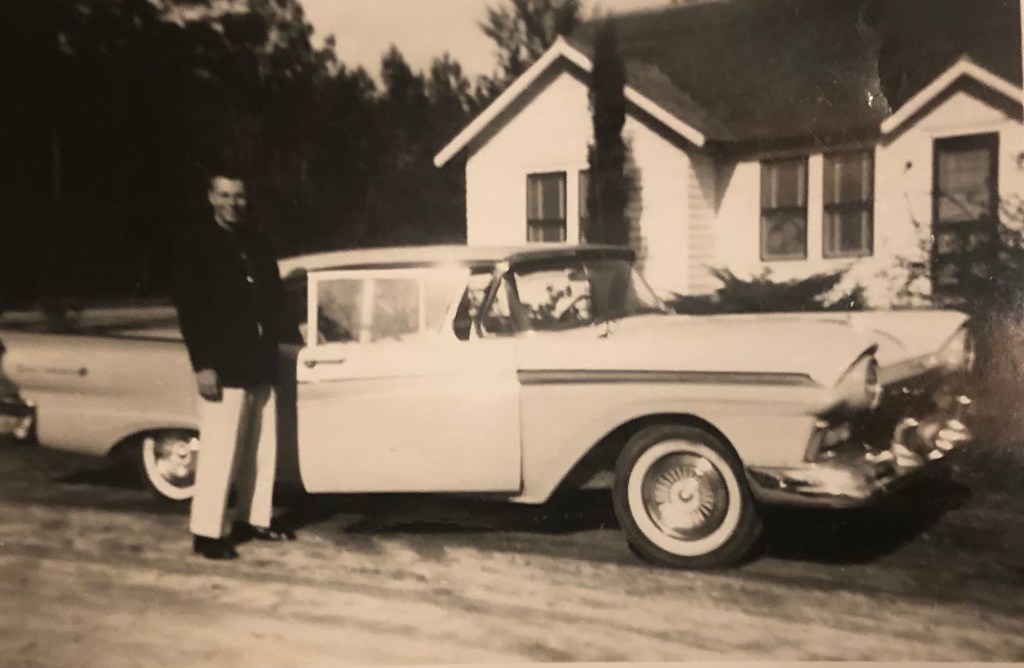
Daddy with his pride and joy. I believe the T-Bird had a red interior.

A long time ago in a Galaxie far, far away

Galaxie

Truly wonderful the mind of a child is. – Yoda

A long time ago in a Galaxie far, far away . . .

A little girl clutches Mama Bear and Papa Bear. Baby Bear has accidentally been flushed down the toilet.  Clad in a mod red pantsuit instead of a long white dress, and with hair too short for cinnamon buns on the sides of her head, the little girl is nevertheless a princess of sorts, if not a rebel. Yet.

“Stand right there and smile,” says the little girl’s grandmother, who snaps a picture. The little girl really cannot not see the camera, as the sun is in her eyes. She smiles anyway.

Behind her stands the Galaxie  – a 1964 Ford Galaxie 500 that the little girl’s Granddaddy bought, used, for her Grandma. The exterior of the car is red. The interior is red, the fabric of the seats trimmed with silver cord.  The Galaxie doesn’t have power steering or air conditioning. In the summer its windows must stay rolled down if the people inside are to survive. Once it lost a hubcap and the girl’s Granddaddy had to run after it in the city streets.

Yet the Galaxie represents power, things far beyond the little girl. Ford Motor Company named it for the Space Race before the success of the United States over the Soviet Union, which came to pass in 1969, when Neil Armstrong and Buzz Aldrin walked on the moon. The little girl has no memory of this event but likes watching Star Trek with her dad: “Beam me up, Scotty.” She sings The Jetsons theme song:  “His boy, Elroy . . . .” She loves the Jetsons’ dog, Astro. Space gets up close and personal in March of 1970, around the time this picture is taken. A total eclipse occurs in the southeastern United States. The little girl’s family and all the neighbors run out of their apartments in an excited frenzy to watch it. A hush, a stillness, falls over them as the bright day goes as dark as night. The sun disappears,  becoming a mere halo around the huge, black moon. 

“Don’t stare at it,” says Grandma, drawing the little girl close. “It will hurt your eyes.”

The little girl stares anyway, because it is so strange to see the sun go dark.

The world was changing fast. So was my universe. In the year following the eclipse, my grandfather retired. He’d been a shipbuilder since World War II. “We turned out ships in three months in during the war,” I recall him saying, “when it used to take a year.” The war had been over for twenty-five years and it was time to go home; my grandparents packed everything, loaded the Galaxie, and returned to the remote outskirts of Aurora, North Carolina – a tiny town named after the Roman goddess of the dawn. I thought at first it was named for Sleeping Beauty.

My summer voyages began. There on the old dirt roads where my dad ran and played as a child, I learned how to drive with that Galaxie. It was, after all, more indestructible than the Death Star. It was still running after the birth of my first child. My grandparents finally gave it away to the man who hauled trash off for them.

It’s probably running still, somewhere.

Which is more than can be said of our spacecraft.

slice-of-life_individualEarly Morning Slicer