Dig the past

Way back on Day 10 of this current Slice of Life Story Challenge, I had a lot of fun playing around with a prompt asking what the first line of my autobiography would be. I really prefer the idea of memoir…my definition: Mining one’s memories for the stories that matter most, digging in the storied strata of one’s past.

I came up with this “opening line” for it:

My father named me for his mother, and that was the beginning of everything.

Truth.

From the moment I entered this world, my grandmother and I were bound together by blood, love, and namesakery. Long after she’s left it, our bond remains unbreakable.

Were I ever to write an extended memoir, her stories would be layered throughout. I am part of them; they are part of me.

She would say, You were named for me like I was named for my Papa. I loved him so. He was very religious, sang in the choir every Sunday. He had a beautiful bass voice…he used to keep bees when I was young and I’d help him get the honey.

She was sixteen in March of 1932 when her Papa, Francis, died by suicide. On his sixtieth birthday. I don’t know the whole story but what little I do know, I shall keep for now. Grandma told me they brought him home in a wooden casket lined with black oilcloth and that she sat up with him all night before the burial.

The point is that my grandmother’s stories made me hungry to know as much as I could about her childhood, daily life long ago, how people endured such hard times. Many didn’t. The old cemeteries tell stories of their own.

I asked her about the 1919 influenza epidemic: I don’t remember it. I was little. I do remember people talking about “hemorrhagic fever” and Mama saying she made big pots of soup for the neighbors who were sick. Papa carried it to them and left it on their porches. He wouldn’t go in because he didn’t want to bring the sickness home.

I asked her about meeting my grandfather: Oh, we always knew each other. He’s nine years older than I am and he and Mama used to pick cotton together…

Granddaddy would say: We’d all see who could pick the most cotton and it was always Lula [Grandma’s mother] or me. That was before the boll weevil came along and people started planting tobacco.

Grandma said: When tobacco came along, I was a looper…you had to be careful. That juice was sticky and would stain your clothes; it was hard to get out…using a wringer washing machine or washboard, I might add.

The setting of all this is a tiny community called Campbell’s Creek, established around 1700, way down east in the far reaches of Beaufort County, North Carolina. It’s part of Aurora although the actual town is five miles away. Most of the town is now in serious disrepair and the place is so remote that when I happen to encounter people who’ve been there, they typically say something like “I thought I was going to the end of the world.”

It is one of the places I love best on this Earth. The beginning of everything…Aurora is Latin for “dawn,” you know.

My grandparents, Columbus St. Patrick and Ruby Frances, were born here in 1906 and 1915, respectively. They married during the Great Depression. Their first home was a tenant house; their first child, my father, was born there. Granddaddy was a sharecropper. He plowed fields with mules. He was skilled with farm tools that people seldom use now, like an adze. This would give him a unique advantage when he “couldn’t make a go” of farming and went to Virginia to find a job as a shipwright, just as war broke out and ship production went into overdrive. When the war was over, he tried his hand at a number of things, but he had two more children to provide for; he went back to the shipyard until he retired.

All of his life, Granddaddy was a farmer at heart: I can remember when we ordered chickens by mail and they’d be delivered in cages by horse and buggy. I was three or four when I saw my first automobile…

That would have been around 1910. A Model T.

Time was, he’d say, in his country dialect bearing faint traces of Elizabethan English, that the whole family could go off for a week to visit somebody and you didn’t have to lock your house or barns because nobody would bother them. People looked out for each other. There won’t no nursing homes. When somebody was sick we all took turns helping out.

Grandma said: I was sitting with a friend’s mother. She’d been sick awhile and we all knew her time was near. She hadn’t spoken a word in days, hadn’t moved or responded to anyone. She was just lying there in the bed when all of a sudden she sat up and opened her eyes. She started laughing: “Can you hear them? Can you hear them?” Her face just glowed...it had to be angels. A little while after, she was gone.

I grew up on these stories and so many more.

My summers were spent learning things that I wasn’t even aware I was learning, things that will drive my interests for the remainder of my days: story, history, culture, nature.

Faith.

And science.

I’ve written much about the little dirt road that ran past Granddaddy and Grandma’s house. It’s one of my life’s greatest metaphors. I can recall, in the 1970s, when it was covered with gravelly “rejects” from phosphate mining, Aurora’s biggest industry since 1964. Granddaddy and Grandma were so excited for their grandchildren to come digging in the road to find sharks’ teeth—some were quite large — coral skeleton, and various fossilized bones of sea creatures. Someone of official status must have soon realized the value of these rejects and they weren’t scattered on the old dirt road anymore. Instead, they were taken to a newly-created fossil museum in town. Today, children from all over come to dig for fossils they can keep, and they can learn about the history in the little museum. There’s even an annual fossil festival at the end of May; last year I went for the first time with my seven-year-old granddaughter.

This excerpt is from an article in the April 2023 edition of the magazine Our State: Celebrating North Carolina:

Beneath our state’s soil and waves is a lost world waiting to be discovered—a geologic trove we claim as our own…about 50 years ago, coral specimens were found in drilling samples near present-day Aurora. They were sent to the Smithsonian Institution, whose scientists soon visited—and identified the area as one that proclaims the most prolific fossil record of the Miocene (2.3 million to 5.3 million years ago) and Pliocene (5.3 to 2.6 million years ago) marine life on the Atlantic coast.

About fifty years ago… I’d have been a child playing in the gravel on the old dirt road, collecting shark’s teeth, unware of the true treasures of my life.

The Aurora Fossil Museum, writes the author, “continues to keep the past alive.”

It’s analogous to to me: Scientists finding bits of ancient creatures, trying to piece them together to understand stories of this “lost world,” and how I hold to bits of story from this same place, the lost world of my grandparents.

Generations rise and fall…layer upon layer of story strata settling in their wake.

I am a remnant of their world. From early childhood Grandma infused me with story, unknowingly turning me into amateur oral history exacavator, archivist, curator…the stories still live in me.

My father named me for his mother, and that was the beginning of everything.

Imagine my delight when I learned last year that the Aurora Fossil Museum had been approved for an official historical site license plate with the NCDMV. I applied for one right away….it finally came, a couple of months ago. I’m among the first to have it:
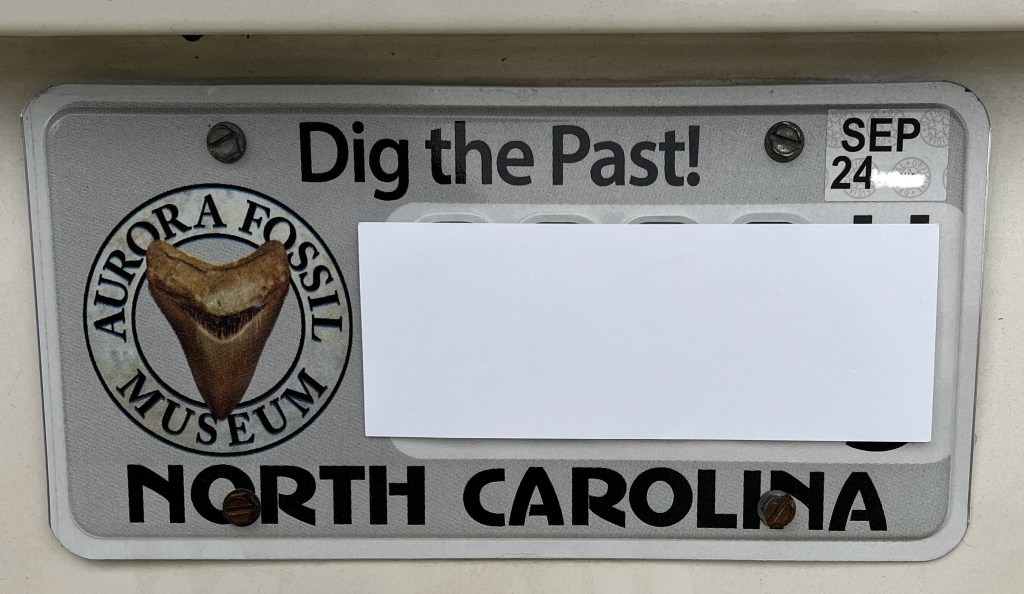
I imagine Granddaddy’s beaming face. I hear Grandma’s typical expression of surprise: My land!

Dig the Past! the license plate reads.

I do it every day that I live. I go on mining my memories for stories, working their meanings out bit by bit, trying to preserve them for the priceless treasures they are.

Keeping the past alive. For the future. For right now.

That’s what memoir is for.
*******

Composed for Day 30 of the Slice of Life Story Challenge with Two Writing Teachers

Science poem: Existential Dance

For Monday’s VerseLove on Ethical ELA, host Brittany Saulnier extended this invitation: “Today, write a poem inspired by science and perhaps, whimsy…The challenge is to ensure the reader can simultaneously glimpse the scientific concept you were inspired by and a universal truth.”

As always, my thoughts turn to nature. It is always teaching; are we heeding its lessons? Nature’s messages don’t come on words but from its own rhythms and coding. I write much of birds. It is said that they are they last living dinosaurs. Maybe even now they are the impetus, in their always-inspirational way, for my digging deep to see what I might find…

Existential Dance

sea and earth
earth and sea
complicated
choreography

streams of movement
building higher
freeform deposits
wetter, drier

life rising, falling
layer on layer
it’s all timing, timing,
the dragon-slayer

everything alive
to remain, must eat
until nothing remains
but remains under feet 

strata with volumes 
lined on a shelf
stories kept secret
unto itself

sea and earth
earth and sea
consolidated
choreography

streams of movement
releasing the store
freeform deposits
washing ashore

when miners come
millennia later
scratching their heads
no translator

for what they’re seeing
drawn from the earth
looking for phosphate
to be stunned by girth

of ancient teeth
from a creature long gone
scientific name:

Megalodon

(meaning “big tooth”)
—what great irony
this turns out to be
last laugh of earth and sea

monster-shark teeth
unearthed in a way
with a side effect:
workers’ tooth decay

everything alive
to remain, must eat
until nothing remains
but remnants…of teeth

sea and earth
earth and sea
conspiratorial
choreography

Carcharocles Megalodon Tooth. 5.4 inches long, 4.4 inches wide.
Excavated from Lee Creek Mine, Aurora, North Carolina, USA.
Public domain.

My grandparents lived on the outskirts of tiny Aurora, North Carolina, home to the largest phosphate mining and chemical plant in the world (miningtechnology.com archive). In the 1970s, prior to the establishment of the Aurora Fossil Museum, “rejects” or unwanted gravel material from mines were scattered on the many dirt roads around the area. As a child I walked in these rejects along the old dirt road by my grandparents’ home, finding bits of coral skeleton, shark’s teeth, possibly some Megalodon teeth, and fossilized eardrums and vertebrae of log-extinct creatures. Now visitors can dig through this material in the fossil pits at the Museum, which will host its annual Fossil Festival May 26-29.

The April 2023 edition of Our State Magazine contains an article by Katie Schanze about Aurora and its fossils: the area “produces the most prolific fossil record of Miocene (2.3 million to 5.3 million years ago) and Pliocene (5.3 million to 2.6 million years ago) marine life on the Atlantic coast.”

It was by chance that I stumbled across references elsewhere stating that one of the detrimental effects of phosphate mining is tooth decay from prolonged exposure to fumes of chemicals used in the process. What irony, I thought, tooth decay caused by mining something used as fertilizer to grow food, while simultaneously finding preserved teeth of one of the mightiest sea predators ever to have lived…which likely went extinct due to loss of food.

*******

with thanks to Brittany Saulnier for the poetic inspiration on Ethical ELA
and to Two Writing Teachers for the Tuesday Slice of Life Story Challenge
and Our State: Celebrating North Carolina, Vol. 90, No. 11

Eternal summer: memoir poem

with thanks to Jennifer Guyor Jowett for the Open Write invitation on Ethical ELA today: “Share your summertimes with us, whether it’s within the memories of your childhood or the place you are in right now. Take us there. Include sensory details to evoke the spirit of your summer.”

I have written lot about my childhood summers. Today I try a bit of reframing and recapturing the magic…

*******

Eternal Summer Reigns

Daughter of Eve from the far land of Spare Oom where eternal summer reigns around the bright city of War Drobe, how would it be if you came and had tea with me?

—Mr. Tumnus to Lucy, The Lion, the Witch and the Wardrobe

I live it every day of my life, summer.

By some great magic I am still a child
returning to my grandparents’ house
so deep in the country some people say
it’s at the end of the Earth

for me, ever the beginning

a place of woods, holding their secrets close
a place of enchantment, outside of Time
a place of belonging, of sacrifice

where ghosts of the past live again
in Grandma’s stories

there’s her Papa, tending bees
never getting stung
her Mama, picking cotton
and dipping snuff

her brothers and sisters
(eight in all)
playing softball
or piling in the goat-cart
to be pulled by a white mule
named Jenny

there’s my grandfather and his brother
courting my grandmother and her sister
gathering at friends’ houses
singing and make taffy

my father, being born
in a tenant farmer’s house
—Cotton-Top, they call him,
for the color of his hair
when he is a toddler

babies born into the family
some stillborn
(Daddy’s voice…Would have been
so interesting to see
what my double first cousins
would have looked like
if they’d lived)

—I live them every day,
the stories.

I am the stories.

Every day I am a child
unpacking my suitcase
for the summer
welcoming the ghosts
walking the old dirt road
eventually covered with gravel
from phosphate mining rejects

bits of ancient history
crunch beneath my feet:
shark’s teeth, some tiny and sharp,
some as big as my small palm;
coral skeleton, white chunks
embossed with lacy flower designs;
whale eardrums, curiously curved fossils
—with these, whales heard
their own stories, too
now, they are 
part of mine

and above all, above all
from the surrounding woods, bending near
keeping their secrets close
the crescendo and decrescendo
of cicadas

the true song of summer
and the sun
and living
and dying

and returning.

By some great magic I am still a child
still listening, still living summer every day
and forever
in that sound.

My grandmother in the summer of 1959, years before my birth. This is the setting of my idyllic childhood summers to come, beginning a decade and a half later. I would stay for a couple of weeks each year and never wanted to leave. Grandma fostered my love of reading, writing, and story. She drove me to the tiny county library at the beginning of my summer visits and helped me haul out the armloads of books I selected. She saved magazines, Mini Pages, and National Enquirers all year long for me.

We walked the old cemetery in the clearing diagonally across from where she sits in this photo and the graveyard of the church around the bend, where her parents are buried. As we read the stones, the blazing sun casting our shadows across them, Grandma told me the stories.

The fossils in the gravel of the poem were real. I found handfuls of them in the road here when I was a child.

Cicadas are an ancient symbol of immortality and resurrection. I write of them often because of their connection to this place. Their loud, rattling chorus was ever-present in the background of my childhood summers; the sound remains one of the most comforting on Earth to me. It’s a call of the sun, love, belonging, and home. There’s a myth about the goddess of the dawn, Aurora, asking Jupiter to grant immortality to her lover, which he did, only the goddess forgot to ask Jupiter to also grant her man eternal youth. Her beloved continued aging until Aurora finally turned him into a cicada. If you look closely at depictions of Aurora, you will see the cicada. Why tell this story here? This morning, before the dawn, before the cicadas woke to sing, I saw Jupiter shining high beside the moon. Then I sat down to write to this prompt of summer celebration, reliving halcyon childhood moments with my grandparents at their home, a place where my generational roots run deep in the earth, where my father grew up…an old, far place in the east, named Aurora.

For me, ever the beginning. Eternal summer reigns.

*******

thanks also to Two Writing Teachers for providing a place to share our stories – for we ARE our stories

Why I Write 2018

Fossil - Aurora

Pterorhytis conradi fossil murex snail shell, Croatan Formation, Lower Pleistocene. James St. JohnCC BY

It has been said that we are the sum total of our experiences (B.J. Neblett).

Our experiences are our story. Who we are. And why.

We are, therefore, our stories.

I write to tell mine.

I write because stories lie buried within me. I write to dig them out, to examine them, to find their value.

I write because ideas continually deposit themselves on top of one another like fine sediment in my mind. I am always sifting, sifting, finding the bits with meaning, determining how these random pieces connect to one another, for they surely and always do.

I write because my words will remain when I do not, imprints of my time on Earth. In the summers of my childhood, I walked little country roads covered with rejects from a local phosphate mine, gravel of shell and coral skeleton from epochs as old as Time itself. As my shoes crunched over this gravel I sometimes discovered primeval treasures—sharks’ teeth, whale ear bones, vertebrae—remnants of life gone before, lying there in my own shadow.

I write because I also walk upon all the books, all the words I’ve read in my lifetime. Within these layers upon layers of ever-deepening strata, too, lie treasures: phrases, emotions, images—again, remnants of life gone before, stowed away in the depths of my mind like the fossil bits in my childhood pockets. I carry with me always the impressions of other writers, the echo of their voices.

I write because I hear the echo of shoes scurrying in hallways, young voices calling my name: When I stop and turn, the children are there, eyes bright, faces glowing, asking a breathless question: “When are you coming to write with us again?”

I write to help them find their own treasures within, because their voices, their experiences, their stories matter; their existence matters, and they need to know it.

I write to preserve. To leave a record of those I’ve loved who’ve gone before, to celebrate those living and loving now. To share little fragments of hope, of peace, of pressing on, of rising above. My stories are my fossils, with or without value to the few who find them. No matter. They have immense value to me while I live them. They are my writing identity. My human identity.

I write because humans think and remember in story, because humanity is defined and connected by story. The sum total of our shared experience.

I am a storyteller.

And so I write.

*******

Another writing celebration: This is my 200th post published on Lit Bits and Pieces.