Just the right word

Ninja

Happy Go Lucky 393. D-KarissaCC BY

In the midst of writing realistic fiction with third grade, I am stuck on a word.

We are studying how using events from our own lives can bring fiction to life. I once had a yellow parakeet that kept opening the door of its cage to fly around the house. This is the basis for the piece I’m modeling for the students. My story concerns two brothers that the students have named –  it opens like this:

Tweety Bird sat inside his cage on his swing, rocking back and forth. He lifted one yellow wing, preened it, fluffed all of his yellow feathers, and went back to swinging.

As if he didn’t know Jake was watching.

“You don’t fool me, Bird.”

Tweety blinked his purple eyes at Jake and kept on swinging. 

“Jake,” Mom called from the kitchen, “did you get the mail for me like I asked you to?” 

“No, ma’am,” Jake replied. “I’ll go now.”

As Jake left the living room, he turned back toward the birdcage. He shook his finger at Tweety:

“You better stay put. I am going to figure out how you keep escaping from your cage.”

With that, he walked through the front door.

As soon as the door closed behind Jake, Tommy popped up from behind the sofa, wearing his Batman costume, mask, cape, and all.

Tommy looked to the left.

He looked to the right.

Tommy snuck very bat-like over to the cage.

The problem with that last sentence isn’t snuck vs. sneaked, alas. That’s a discussion for another day; snuck is acceptable and I like the sound of it here better than sneaked.

No, the trouble is with another word.

“I am having a problem with the word bat-like, ladies and gentlemen. Tommy can’t sneak bat-like over to the cage because, well, bats don’t sneak. The word doesn’t work here. I’m trying to think of a better word, but I’m stuck.”

Like a wave, expressions of deep thought sweep over the sea of little faces, replacing that of delight over the Batman image. Little brows furrow. These third-graders frequently seem like forty-year-olds; we were discussing once how drivers do not pay enough attention and this is why car accidents occur. One student sighed: “People these days . . . .”

“Maybe you could try cat-like,” suggests a student.

“True – cats sneak a lot. That’s much better, but I am not sure I want to mix cat and bat here. I mean, having Tommy as Batman sneaking like a cat? What do you think?”

Heads tilt. “Yeah, it’s not quite right,” agrees another student.

A hand goes up: “How about with stealth?”

All the heads turn toward this student.

I blink.

“Wow, that’s pretty impressive. What a great word. I could say Tommy snuck with stealth over to the cage. What do you think?”

Faces are contemplative. Another student: “What about Tommy snuck stealthily over to the cage?”

It’s not really grabbing any of us – I can see the doubt on their faces.

Stealthily is an amazing word. Here’s the thing. I want a word that really helps paint the picture in the reader’s mind, that really captures the movement Tommy is making so that the image is clear to the reader. It needs to be connected to a noun, something else that sneaks, something better than a cat.”

A boy’s face lights up: “I know – a Ninja!”

It’s magic, the way all the faces light up. “Yes!”

“That’s perfect!” I cross out bat-like and write Ninja-like:

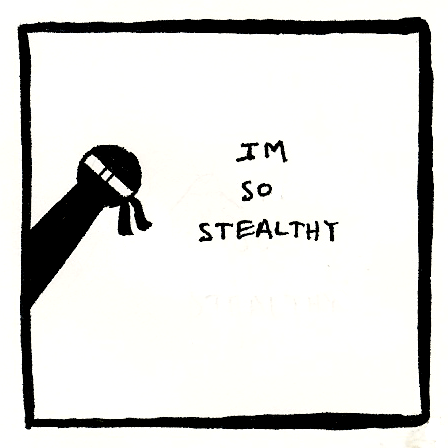
Tommy snuck Ninja-like over to the cage.

“Can you see the action in your mind, exactly how Tommy is moving toward the cage?”

Heads nod vigorously. A couple of the kids strike Ninja poses.

“I have to thank you all for your help, because I never would have thought of using Ninja. It’s just the right word.”

The students, looking like young sages, get back to work on their own writing. The hum of their brains is nearly audible.

They make another artistic suggestion later on, as my modeled story progresses:

Right before their eyes, Tweety, clinging to the bars on the front of the cage, used his beak to lift the cage door so that it fell open.

Tweety looked to the left.

He looked to the right.

And he flew out of the cage!

“Go, Tweety, go!” screamed Tommy, jumping up and down so that his Batman cape flapped.

A hand: “Mrs. Haley, if Tommy is pretending to be Batman, he could pretend that Tweety is Robin. He should say Fly, Robin, fly!

“Yessssssss!” says the class in unison.

That suggestion changes the shape of the entire story, for it provides the motivation for Tommy, as Batman, to let Tweety out of the cage in the earlier scene.

“You, ladies and gentlemen, are extraordinary writers!” I am as excited as they are with this new layer in the narrative.

With knowing smiles, they bend back over their own pages, pencils in hands.

********

Here’s the Tweety tale in its entirety, should you want to read it: The Escape Artist

slice-of-life_individualEarly Morning Slicer

Suncatcher

Sun angel

Sun angel. Sheila SundCC BY

 Into each life some rain must fall
But too much is falling in mine
Into each heart some tears must fall
But some day the sun will shine
Some folks can lose the blues in their hearts
But when I think of you another shower starts
Into each life some rain must fall
But too much is falling in mine.

-Allan Roberts

Yesterday morning the sun beckoned from among striated clouds, streaking the sky with silver and gold. Birdsong—it’s a brand-new spring. The scent of fresh-cut grass from the day before lingers, and nothing takes me back to my childhood and my father quicker than that sweet green fragrance.

Even as the sun shone, a soft rain pattered down.

In my heart, in the hearts of my community, too much rain is falling.

Yesterday we buried a young lady who grew up here, was one of us, was an only child and grandchild. She was a college freshman, eighteen, a year younger than my second son, his childhood playmate and lifelong friend. She went to church with us all of her life, sang in the choir, and was beautiful. She caught the light and scattered it like a faceted gemstone quietly scatters tiny, vivid rainbows on objects close by.

Death, when it comes suddenly to someone so young and full of promise, can only be likened to a great ripping apart.

She is ripped away.

The church was full and overflowing an hour before the service. People stood around the walls of the sanctuary, packed the fellowship hall, lined every hallway on both sides throughout; a huge crowd waited outside because there was no more room.

My husband officiated. He was at the hospital the day this child was born. He ended the eulogy with a little twist of Shakespeare: “Good-night, sweet princess; and flights of angels sing thee to thy rest.”

As the crowd walked to the burial site, the sun shone for all it was worth. The clouds were gone; a warm breeze ruffled dresses, suit jackets, hair.

Even so, the rain will fall within us for days and days to come, yet it doesn’t mean that our little suncatcher won’t keep catching and scattering the light in the quiet way she always did. More light than ever is reflected in the myriad drops of rain, like iridescent droplets of diamonds quivering with celebration that she lived, that she was a gift.

She will always be.

slice-of-life_individualEarly Morning Slicer


O. Henry

O. Henry grave 

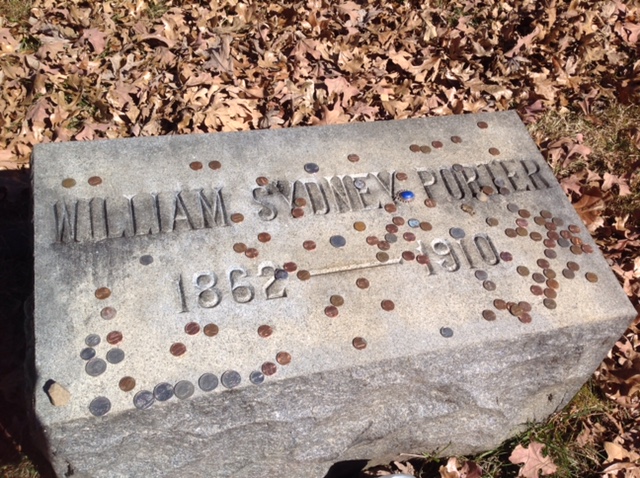
Fall comes early in Asheville, North Carolina. The air is chilly when I get out of the car at the cemetery to visit the grave. I think of winter coming, of Christmas, of this writer’s most famous work. I take a picture, marveling at the coins spread over the gravestone. As I turn to go, a frigid wind gusts, scuttling leaves over the ground and across the driveway.

Leaves . . . I remember that story.

O. Henry’s headstone is covered in coins, mostly pennies, which usually add up to $1.87 –  the amount of money that Jim and Della had at Christmastime in his famous short story, “The Gift of the Magi.” This shortage of money is why Jim sold his gold pocket watch to buy combs for Della’s beautiful hair, and why Della cut and sold her hair to buy a platinum fob chain for Jim’s prized watch. Their sacrificial love for one another has made the story an enduring classic.

There is another story of O. Henry’s that I love almost as well.

I remembered it as I planned to write “Oh, Henry,” yesterday’s post about my son’s dog. I should write about O. Henry next, I smiled to myself. A little word play with the titles. How enticing.

That’s when I thought about the fallen leaves blowing over the writer’s grave.

I scrounged up my old paperback copy of O. Henry’s short stories and reread “The Last Leaf.”

In this tale, two young artists live in a three-story Greenwich Village building. One of them becomes sick with pneumonia. She watches the leaves dropping from an ivy vine against the wall just outside of her window, convinced that she will die when the last leaf falls. To her astonishment, the last leaf hangs on through high wind and rain. To make a short story shorter, the leaf remains because an old artist in the building crawled up a ladder in the dark of a raw November night and painted it on the wall with the vine. The girl begins to recover and the old man, Behrman, dies of the pneumonia he catches from being out in the weather while painting that night.

The old artist had always wanted to paint a masterpiece and never pulled it off – but the last lines of the story have the roommate telling the recovering girl about the leaf: “Didn’t you wonder why it never fluttered when the wind blew? Ah, darling, it’s Berhman’s masterpiece – he painted it there the night the last leaf fell.”

Self-sacrificial love at work again – but there’s more to it.

That leaf symbolized hope, sparking the desire to strive, to overcome. The old artist’s small gesture inspired the young artist to keep living.

This leaves me thinking, in the course of our days as teachers, as writers: Are we not the artists who paint the pictures of possibility, of hope, in the minds of others? Do we spark in others a desire to strive, to reach for what’s beyond their grasp, or to hang on only long enough until this, too, shall pass?

Our masterpieces may never be world-famous; they may be as simple as knowing the right word, the right idea, the right vision, the right story, and sharing it when it is most needed. Inspiration leaps from one heart to another, creating something to hang onto, outlasting high winds and rain. We may never see the full effect of our work, but that’s all right.

We paint the leaves where we can.

I close my old paperback book.

O. Henry, I am so thankful you were here.


slice-of-life_individualEarly Morning Slicer


Forgotten

Forgotten

Forgotten Sounds Pt.II. Marco NurnbergerCC BY

Memory makes us. If we couldn’t recall the who, what, where, and when of our everyday lives, we wouldn’t be able to function. – “Memory Basics,” Psychology Today

This week, I remembered a poem I wrote as a teenager.

Some of the lines returned to me, complete and clear.

I couldn’t recall other lines at all.

I wrote the poem after a dream. In this dream, I was with a group of young people around my own age in a deserted beachy area with trees. We had reunited there on a hazy afternoon when the light is most golden, just as the sun begins to set, and with great joy, we began singing.

Except that I really did not know these people, this place, this song. In the dream I knew I was supposed to know all of these things, and I didn’t. I was meant to belong, to be a part, and I couldn’t. The sense of mounting sadness over the desperate attempt to remember the significance of these people and the words to the beautiful song so that I could join in was overwhelming.

The dream haunted me so that when I woke, I wrote the poem.

Remembering my poem for the first time in years, I wanted to reread it, to recapture the lines that were missing in my memory. I could envision the little stapled booklet I made, could actually recall other poems I wrote in it, word for word.

I couldn’t find it.

I searched everywhere I thought the booklet ought to be – I could not remember where I put it.

Things like this become compulsions for me. The more I searched without success, the more determined I became to find the missing poems.

At some point I realized the many layers of irony folded into this situation: I wrote a poem about forgetting something I could not remember in the first place, because I wanted to remember the experience; not remembering all the lines compelled me to read it again, and I forgot where I put it.

I began to think about what dementia patients must feel like.

But I kept looking, and yesterday, in a box of old notebooks, in a planner under some loose papers, I found it:

Forgotten Remembrance

My mind, it plays a melody

That it hasn’t ever heard

A voice sings in my memory

But remembers not a word

Faces I don’t recognize

Are singing this with me

Sadness streaming from my eyes

Such a haunting harmony

I hear the music chiming there

And then again it’s gone

Hidden in my mind somewhere

Chiming off and on

I ought to know this tune

These words I’ve sung before

I’ll try to learn them very soon

So I can sing them more

I can’t remember this refrain

I’ve forgotten it this far

My mind cries out to know this strain

And what the lyrics are

But all I know is sorrow

A deep and dark despair

I’ll cry and cry tomorrow

For what was never there.

At last. My mind can rest now.

I certainly can’t end on such a dark note, so today I pay tribute to the vital, mysterious power of memory, how it makes us who we are; to writing, which preserves who we are at various points in our lives and sets us free from whatever haunts or hurts us; and to the foresight of my young, rather gothic self for having grasped it.


slice-of-life_individual


The coaching tree

Coaching Tree Lg

Early in the school year, my instructional coaching colleagues and I attended district training where participants were tasked with creating an image to explain the coaching process.

My group thought for a moment.

“You know, coaching is an organic thing,” I said. “Or at least it should be. We all know it takes time to develop relationships and trust. It’s about honing practices, sure, but this is a growth process for us as well as for our teachers. We grow together to reach goals.”

A colleague said, “Yes! I’m seeing a tree, branching out . . . .”

In a few minutes we’d sketched the tree. We began to label it, recognizing coaching elements that correlated to parts of the tree. The more we worked, the faster the ideas came.

Relationships are key in coaching, the foundation, but certain things must feed the relationships before the process can begin. These roots are trust, the human connection, listening, collegiality, safety, empathy, and support. Coaches must meet teachers where they are and be willing to plug in with what teachers want to accomplish – it’s not as much about seeing the work as it is seeing a fellow human being. The vision develops from there, and needs to be a shared one.

The trunk of the tree symbolizes this togetherness with inspiration from Shel Silverstein’s The Giving Tree. Near the bottom of our tree, we placed a little heart: Coach + You. The heart of coaching is just that – having a heart for each other.

A solid, thriving coaching relationship branches out into nearly endless possibilities, aspirations, and directions, such as goals, the 4 Cs (communication, creativity, critical thinking, collaboration), encouragement, self-modifying learners, reflection, growth mindset and learner agency.

My coaching colleagues and I stood looking at our work, feeling pretty happy with our Coaching Tree.

“We need to put the sun in,” said a colleague. “The sun is the climate, of course – a warm climate conducive to coaching is necessary for the process to work. That’s where administration comes in.”

We put the sun in.

At this point, something struck me – “Trees bear fruit! What is the ultimate goal of coaching, the payoff? What’s the fruit of our labor?”

We created a basket then, and labeled it The fruit of our combined efforts. It holds apples: Love of learning, data, increased student achievement, teacher fulfillment, students graduating college or career ready. 

As teachers are fulfilled and productive, we desire to branch out into new areas. The growth continues. As students achieve, as they go on with their lives, some will go into the teaching field and the cycle begins anew.

At the close of the training, small groups presented their work to the whole assembly of coaches. The other groups had designed diagrams, cycles, or flow charts, all of which artistically, appropriately encapsulated the continuous reflective coaching cycle of support.

My group was the only one to present the coaching process as a living thing, something organic.

We were startled by the enthusiastic applause from our fellow coaches.

Upon returning to school, my colleagues and I recreated the Coaching Tree in the teachers’ lounge. It stands there to encourage, invite, celebrate, and maybe inspire or spark hope when we all need it, a visual reminder that our work is not in vain, that we’re in this together, to help each other along, and the sky is the limit.

slice-of-life_individualEarly Morning Slicer

Baby’s breath

Sleeping child

Angel1. peasapCC BY

The cure for anything is salt water: sweat, tears, or the sea. – Isak Dinesen

Being a light sleeper, he hears the rasping sound in the middle of the night. He gets up, tracing the sound to the baby’s crib. 

She’s not breathing right.

He touches her face; she isn’t feverish. She stirs under his hand, still sleeping, drawing ragged, rattling breaths.

He is young. This is his first child. They are out of town, visiting his sister in the country.

He goes back to bed.

But he carries his baby with him and lies awake all night beside her, to make sure she keeps breathing. He perspires with anxiety – she’s so little. 

Just three months old. 

“It’s asthma,” the doctors tell him later. 

A few years afterward, she has a bad bout of it. He takes her to the doctors, gets medication. She cries and cries, which doesn’t help the breathing.

“I – want – Grandma,” she wheezes, tears dripping off of her chin.

He calls his mother. “She wants to be with you but I hate to bring her when she’s sick.”

He sounds worn out.

“Bring her,” says his mother.

She lets all the housework go. Wrapping her arms around her granddaughter, she sits down in the rocking chair. Back and forth, back and forth she rocks, singing, “Little ones to Him belong, they are weak but He is strong.”

Yes – Je – sus – loves – me – ” the little girl tries to sing, rattling, wheezing, coughing on the words. She can’t get enough air. 

“Don’t try to sing, honey. Just listen to me singing,” says her Grandma.

On and on Grandma sings. The little girl settles, dried tear stains streaking her flushed face. Lulled by the beating of her grandmother’s heart in time with the song and the rocking of the chair, her eyes close at last. Rocking back and forth, back and forth, Grandma sings, tears flowing freely down her cheeks. Be well. Be well. Be well.

The sweat and the tears couldn’t cure asthma.

They represent another kind of healing power.

Self-sacrificial love.

“I was afraid to sleep,” my father told me of the long-ago night he lay awake, sweating, to make sure I kept breathing when my first asthma attack struck at three months.  He would get up countless nights throughout the years when he heard me coughing, to bring me medication or to turn on the vaporizer.

It’s why my grandmother dropped everything to comfort me, always had open arms, always had a song despite the tears. “My heart was breaking the whole time,” she said, recalling the day I begged to stay with her and didn’t have breath enough to sing, the memory resurrecting the tears even after decades had passed.

The memories are theirs, not mine, as I have no firsthand recollection of these events; told to me separately by my father and grandmother, many times over, they are part of my narrative identity.

Sweat, tears. The pouring out of their lives for mine, the pouring of their love into me from the very beginning. I am infused with their strength, their perseverance.

And beyond the power of the sweat and the tears is the power of story.

I remain to tell it.

slice-of-life_individualEarly Morning Slicer

The Writing Spa

Welcome to the Writing Spa.

Please put your things down and help yourself to salt scrub – wash your hands and refresh.

Or have some aromatherapy lotion.

Listen to the soft music, the sound of the ocean with the occasional distant gull.

That fragrance in the air? That’s a pillow mist. It’s called Peaceful.

Yes, it does smell very spa-esque, doesn’t it?

Today we will write. It’s so important that teachers of writing write themselves, with and for students.

Today you write for you.

You have a choice of stations: Refresh, Evoke, Escape. Start wherever you like. If there’s time, we will get to all three; if not, certainly two.

Let me explain.

The Refresh sign bears the Isak Dinesen quote: “The cure for anything is salt water: sweat, tears, or the sea.” Which salt water form grabs you first? Close your eyes and envision a scene where this salt water form played a significant role. Where were you? Who was with you? Get back into the moment – show, don’t tell.

Here’s an example, a time when tears played a healing role in my life ….

The sign at the Evoke station reads: “Nature speaks and wafts her perfumes. Capture it.” This is meant to connect us to the natural world with sounds and scents that lift our spirits and make our hearts rise. Write about any sound or any scent that does this for you, and why it has this effect. Who or what is associated with it?

I chose sound. I wrote about cicadas in the summer and what this evokes for me. I will share ….

The last station is Escape. There’s a place you long to return to – why? Who or what is connected to that place? Capture it in detail so the reader goes there with you. Share the reason for its specialness to you.

Here’s one of my special places. I only went there once ….

The teachers write. Some have tears in their eyes; some stop to look into the distance, far beyond the walls of the room, to different places, conjuring different images in each of their minds. The music is soothing. We are breathing in Peaceful. When it’s time to stop, those who wish to share their writing do so with one another; those who’d  rather not share are willing listeners, ready to give positive responses on the strength of the writing. There are more tears. There are also smiles, even a small eruption of laughter at the humor in someone’s writing.

We rotate and repeat.

For reflection, they write a takeaway for themselves and one for their classrooms. They write on white paper. 

Ball up your white paper. This is the Invigoration piece of the spa – we will now have a snowball fight! Have at it!

Much laughter ensures as teachers throw “snowballs” at one another. We stop; they choose a snowball and open it up to read to a partner. No one knows who wrote what and reflections that strike chords are shared with the group. We go another round. 

I hope you enjoyed your Writing Spa, everyone. However you view yourself as a writer, the goal for today is that you found writing a pleasurable experience. Writing must be pleasurable for teachers to be pleasurable for students. We create the atmosphere for writing in our rooms. Think of ways you might adapt what we’ve done here for your kids – pay it forward.

On your way out, by the door, there’s a basket of chocolate – help yourself to Chocolate Therapy. 

Go forth in writing wellness.

*******

I did two variations of the Writing Spa, one with teachers at my school last December and one on Monday with teachers attending the North Carolina Reading Association Conference. Improving writing instruction has been a major focus at my school for a couple of years, the most frequently-requested area of support. The spa was born from a synthesis of ideas: Teachers, however they feel about writing, need to have enjoyable experiences with it; professional development needs to lift teachers’ spirits; writing is about going deep, tapping the power that lies within us.

You are welcome, if you like, to read my sound and place pieces shared for Evoke and Escape.

I’m still working on my salt water piece.

(I finished itBaby’s breath)

slice-of-life_individualEarly Morning Slicer


Laughing Buddha

Hotei

Hotei Buddha. Shanna RileyCC BY-SA

“Come see what your aunt brought you!” Mom calls. 

My aunt has given me some pretty neat gifts: A shirt with iron-on letters that say Bookworm and a Partridge Family album. She’s a fun person, sometimes, like when she records us singing Olivia Newton-John songs on her tape recorder and says we sound professional, or lets me try on her wigs.

I can hardly wait to see what she’s brought this time. I fly down the hall from my bedroom to the living room.

My aunt is smiling wide. She hands me something wrapped in brown paper, saying: “Be careful -it’s breakable.”

I unroll the wrapping, pull out the breakable thing.

It’s a statue. A little bald man with a big belly and no shirt, wearing only a skirt, with his hands up in the air. He is laughing – at me, I think, because I don’t know what in the heck he is.

He’s also solid pink. A little darker than Pepto-Bismol.

I am confused. 

“I made him in ceramics class,” my aunt says, looking pleased with herself. 

Every grown-up female I know is making ceramics or macrame or decoupage. But I’ve never seen anything like this fat little pink man.

“What is he?” I ask, feeling disgusted, while he laughs at me silently. 

I think about dropping him.

My mother glares at me.

“He’s Hotei. If you rub his belly, he’ll bring you good luck,” says my aunt.

I want to say he needs it for himself, but my mother speaks up:

“Look at what’s underneath.”

I turn Hotei head down. Under the base on which he stands is an inscription:

Made for Fran with love. Aunt E.

I look up at my aunt and see the earnestness in her eyes.

She never married, never had children of her own. When I went to high school, she attended my plays, convinced that I’d make it on the stage in New York City. She directed my wedding, bought dozens of outfits for my first child. When I started trying to write short stories, she asked to read my work.

“You should send this to magazines!” she said, genuine excitement in her voice. “You could be published!”

She didn’t live to see my second child.

Hotei sat on my bedroom shelf for many years, and yes, I rubbed his belly. Some days more than others.

But I didn’t need him for good fortune, not really.

I had my aunt.

slice-of-life_individualEarly Morning Slicer


Where the meaning is

My colleague is weeping.

She’s just read aloud a passage from The Unstoppable Writing Teacher: Real Strategies for the Real Classroom by Colleen Cruz, specifically from Chapter Five, entitled “I’m finding some student writing repetitive and boring.”

In this passage Cruz  relates the story of being observed by teachers who said that some students in the class had chosen “boring … almost shallow” personal essay topics. Cruz confers with one of these students. He’s writing about why Christmas is his favorite holiday – his reasons are the food, the presents, watching videos. As Cruz continues to converse with the boy, she feels pressure building under the skeptical eyes of the observers; the conferring is going nowhere. But Cruz presses on. She keeps talking, feigning enthusiasm: “There’s just so much to say about videos on Christmas. I would love to hear what you have to say about them.”

And then the boy explains that every year on Christmas, after the presents are opened, his mom lets him watch all their previous Christmas videos, when his dad was alive. She can’t endure the videos during the rest of the year, but at Christmas she watches them with her son.

“It’s like we’re all together again,” said the boy.

Like Cruz and the observing teachers in the story, my book study colleagues and I all have tears in our eyes.

I write in the margin of that page: Go deeper and deeper to the meaning. 

I think about a second grader writing realistic fiction. Her first attempt at dialogue was rambling, pointless; the characters were talking but not saying anything. When I mentioned that we can add things from our own lives to make characters think and feel things that we do, to “make it real,” she revised the dialogue to a conversation about a girl who was worried about her new stepfather liking her. When she read it to me, I said, “Wow, your story really came to life there! What made you write about the girl’s worries over her stepfather?”

The child answered, solemnly, “My mom is getting married next weekend.”

I think about a girl describing how she and her grandmother waded through the regular flooding of their impoverished hometown in Viet Nam.

I think about a fifth-grade boy who never liked writing, how he developed an enthusiasm for it with his memoir on making the hard choice to tell the truth after having lied. A girl new to the school wrote about a girl having to move often. The piece opened with the narrator shouting at her mom; the anger was palpable.

A dim recollection of the movie Where the Heart Is flits through my mind – the young pregnant girl pressing a hand against her abdomen, saying, “That’s where the heart is.”

Cruz says students “have a subconscious need to write about particular topics, but they don’t consciously know why.”

Our job, then, as writing teachers, is to help students go deeper to the why, to where the heart, the meaning, is.

slice-of-life_individualEarly Morning Slicer


The storm passes by

Church after tornado 6-18-13

Our phones are popping at the same time:  “Take cover immediately . . . .”

Outside, the wind gusts; objects are striking the building, the windows.

We quickly gather the children who’ve come for Vacation Bible School – there’s about seventy of us in all – and they get down on the floor, balling up with their heads against the painted cinderblocks of the main hallway.

The wind is roaring now. The electricity goes out. The emergency lighting flashes on, bright as spotlights, adding a stark, garish quality to faces and bodies. The fire alarm goes off, a deafening blare, as it’s right above us. A boy with hearing aids rips them out of his ears.

The children are still, silent, as heavy objects strike windows in classrooms – will the windows shatter? For a split second I am tempted to look out and see if Miss Gulch is riding through the air on her bicycle just as she morphs into the Wicked Witch of the West.

Instead I kneel over several children as a shield, leaning my head against the cool concrete wall.

These walls are solid, I think. Safe.

But just around the corner in the fellowship hall is a hutch with a large, framed photo of the church when it was nearly flattened by a tornado twenty years ago.  

Minutes are eternal when destruction is banging on the door.

If we die, I think, at least we are in church.

My husband, the pastor, prays aloud.

The wind soon abates, dies away.  

We go outside to find long strips of vinyl from someone’s home strewn in the parking lot. Big pieces of plywood from who knows where are lying against the building. Shingles are scattered about like fall leaves. The trashcans are way across the graveyard – we trek over to fetch them and we see the gap in the woods where the tornado came through. It cut a path through the cemetery, knocking down a line of gravestones. Silk and plastic flowers, little angel statues and other loose memorials left by families for their loved ones are blown everywhere.

The children retrieve and replace them.

Parents begin arriving, alarmed. Others in the community come to see if everything’s okay.

Just as we are leaving, I turn back toward the church – “Look!”

Arcing up from the woods across the street to the woods behind the cemetery, in the sky directly above the church, a rainbow gleams.

All is well.

slice-of-life_individualEarly Morning Slicer