Another reminder

another dictionary poem:

re·mind·er

/rəˈmīndər/

noun

  1. a thing that causes someone to remember something.
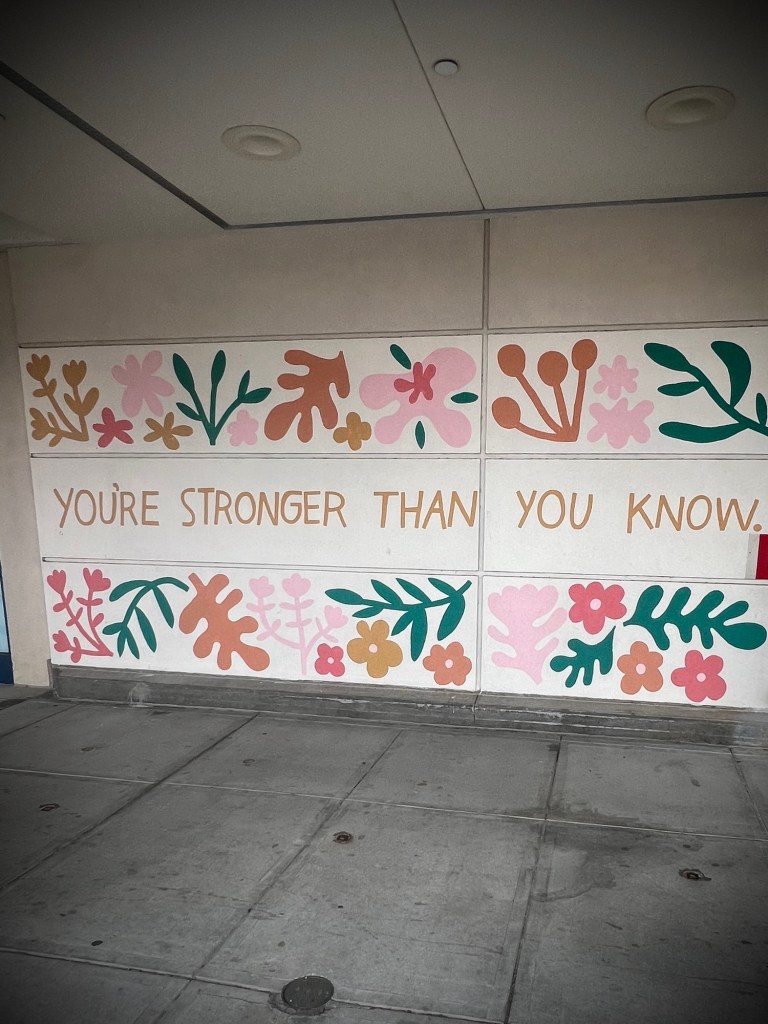
  2. the writing on the wall of a downtown strip mall.
  3. a much-needed message in the midst of challenge.

Message on the wall of a downtown strip mall
right in front of my parking space

And, a blitz poem:

Here in Mind

You’re stronger than you know
You’re still here
Here to to tell your story
Here to play
Play the day away
Play with words
Words have power
Words build worlds
Worlds without
Worlds within
Within the realm of possiblity
Within your reach
Reach for the sky
Reach and you shall grasp
Grasp at straws
Grasp the truth
Truth slices deep
Truth can set you free
Free to believe
Free to be
Be fair
Be kind
Kind to all
Kind of a mess
Mess up
Mess becomes art
Art of living
Art of healing
Healing the hurt
Healing one another
Another day
Another time
Time to sleep
Time to rise
Rise and walk
Rise above
Above the clamor
Above the earth
Earth gives and reclaims
Earth keeps turning
Turning to mush
Turning the key
Key to the map
Key change
Change direction
Change your mind
Mind over matter
Mind your words
words
matter

*******
with thanks to Two Writing Teachers for the March Slice of Life Story Challenge

Note: Here’s my dictionary poem from earlier in the challenge.
The blitz is meant to be quick bursts of thought. Here’s a link on how to create a blitz poem. The rules are a little complex, even for the title; but once you get going it almost writes itself.

I dedicate this blitz to my fellow Slicers.

Rainbow reminder

a pantoum

At the rainbow’s appearing
just stop to savor;
all the cares of this troubled world,
you can endure.

Just stop to savor
how the light bends into glory.
You can endure
the storms of life.

How the light bends into glory!
Look up and be awed.
The storms of life
for a moment, disappearing.

Look up and be awed—
all the cares of this troubled world
for a moment, disappearing
at the rainbow’s appearing.

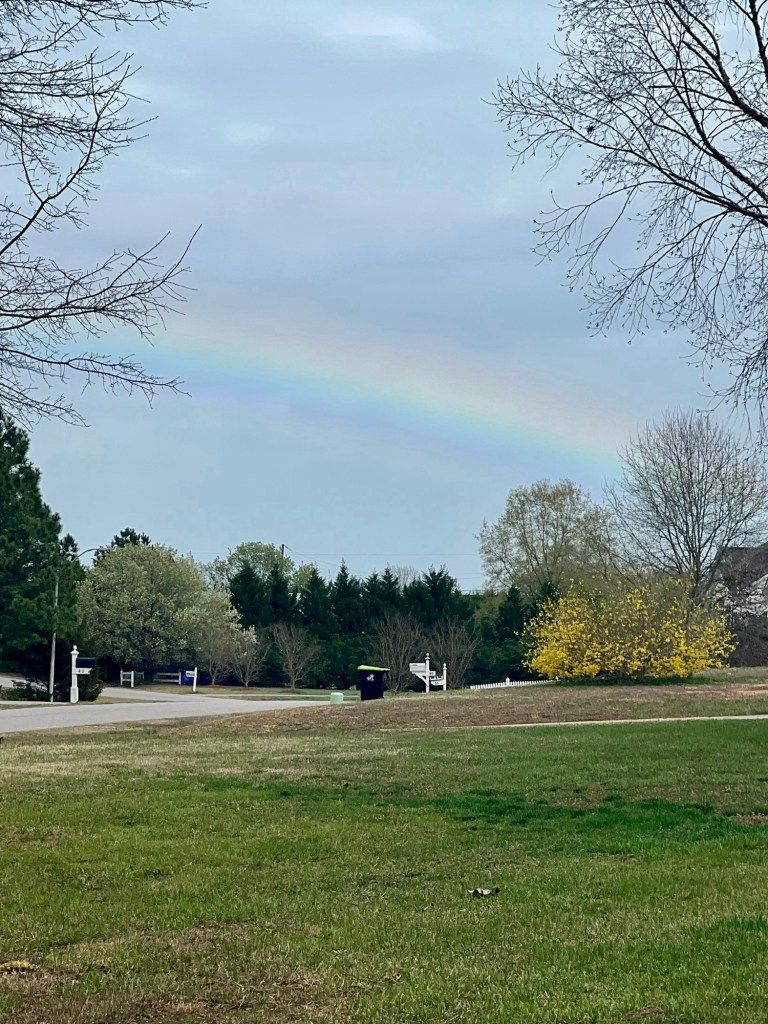
Rainbow over my neigborhood after a storm last week.
Note the forsythia beginning to bloom.

*******

with thanks to Two Writing Teachers for the March Slice of Life Story Challenge

Birdlove legacy

If you’ve read my blog for a bit, you know I love birds.

It’s an inherited love.

Or maybe a contagious love.

Either way: I got it from my grandmother.

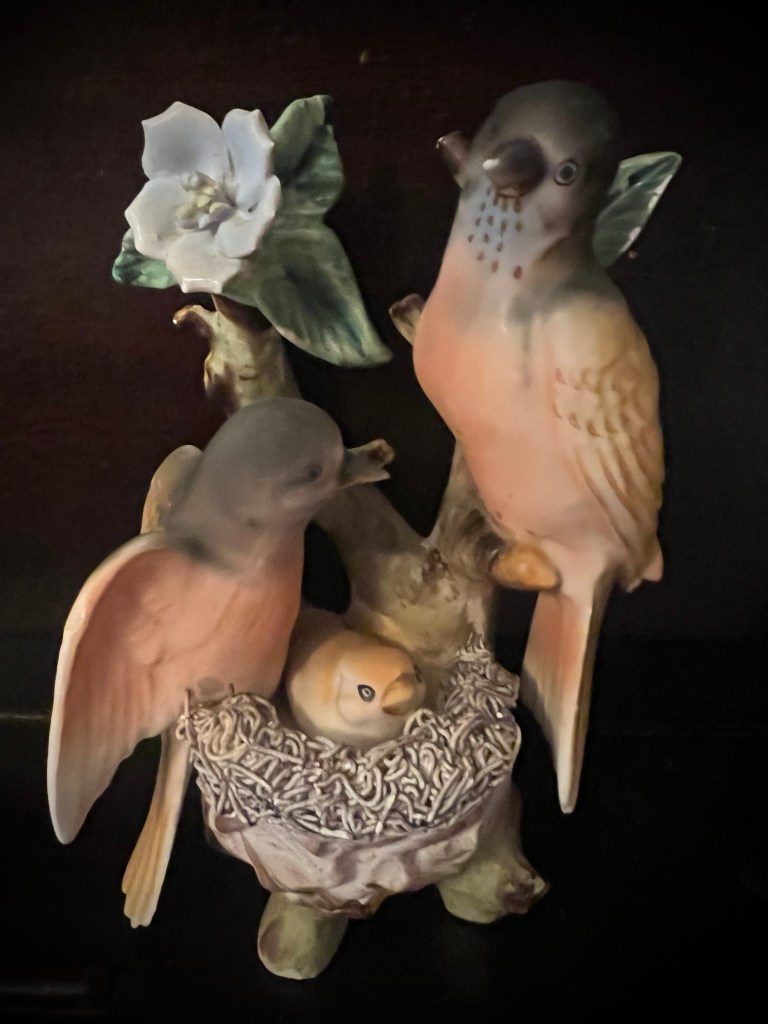
Some of my earliest memories are of sitting on her lap as she read to me, and one of the books was about birds and their nests. From shelves on her apartment walls, bird figurines looked over us like sentinels. Silent witnesses. “Ornaments,” she called them. One resembled a pair of robins. She lifted me up countless times to peer into their ceramic nest, to marvel at the baby bird inside:

This vintage 1960s figurine is exactly like Grandma’s. Her “ornament” went to someone else in the family but I found this one online a couple of weeks ago. It’s in perfect condition and now sits atop Grandma’s piano in my living room.

There’s another I hadn’t thought about in a while…until my recent sightings of bald eagles, to my great awe and consolation during a brief time of despair.

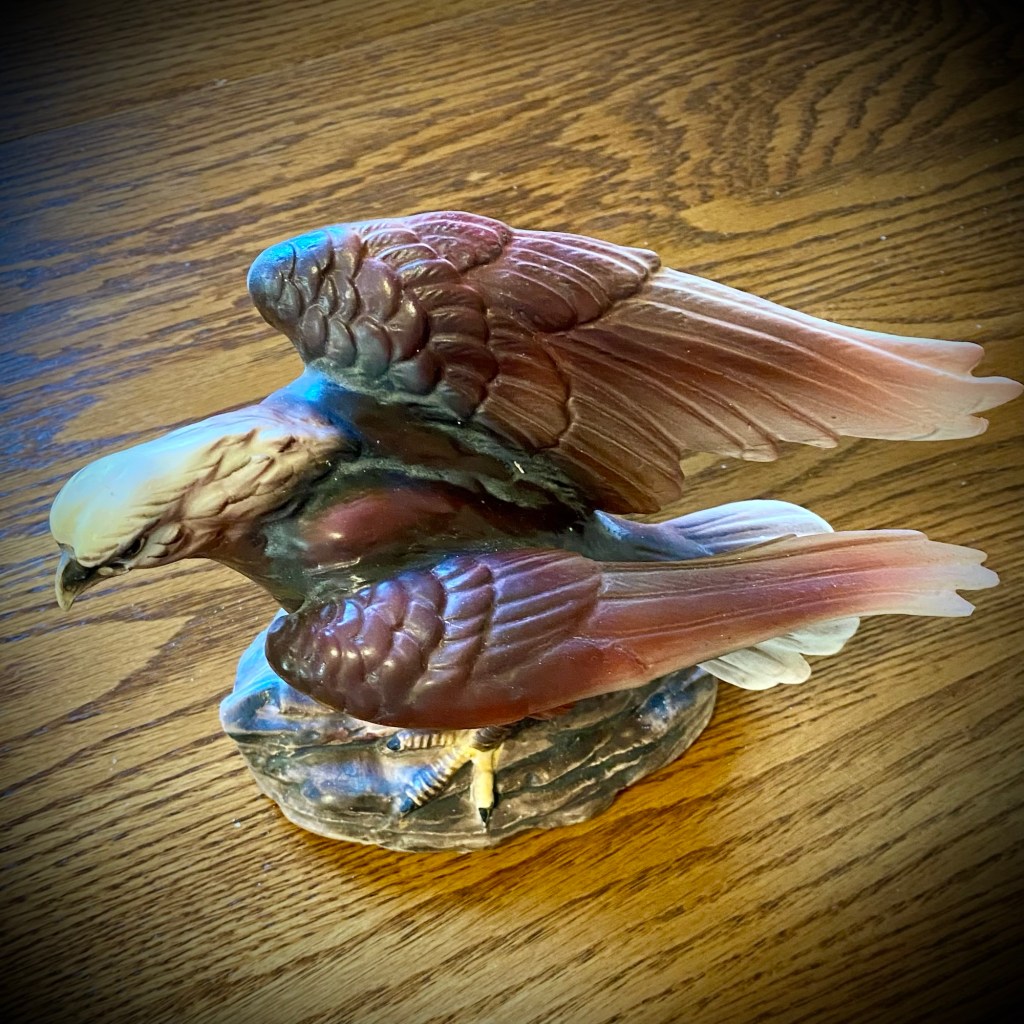
Grandma had an eagle ornament…whatever became of it?

I texted my aunt.

She has it. She told me that Grandma wrote on the underside: One of my favorites!

My aunt texted this photo. She said: The eagle is yours.

An unexpected, deeply meaningful gift. I am learning that the eagle comes out of the blue, when needed most. Even in my dreams. This past week I dreamed of taking a journey and high in the trees along the roadside were eagles’ nests; I could see white heads above the rims, peering down. Even in the dreamworld, I was awestruck. I woke feeling rested and strengthened. And watched over.

My granddaughters haven’t seen my bird nest ornament yet, and Grandma’s eagle is a way off still. But every spring, my girls stand beside me, marveling over the hummingbirds at the feeder. We watch Mama and Papa Bluebird darting in and out of the birdhouse with insects in their beaks, feeding hungry babies. I’ve held my granddaughters up to see real baby house finches in the nest on the wreath of my front door…which won’t happen this season, as the wreath has been removed. Micah learned to mimic me around age two, when I held her in my arms at the kitchen window; putting her tiny finger to her lips, she’d whisper: Shhh. Watch. Birds.

She is three now. She will remember.

Just as I do.

For a moment, I see Grandma’s smile, radiant as springtime sun. I feel her arms lifting me up for the wonder of seeing that baby bird in its ceramic nest, with its parents standing guard.

And I am quite sure I hear a faint rustling of wings, nearby.

*******

with thanks to Two Writing Teachers for the March Slice of Life Story Challenge

Hey, Beaver

On Sunday I wrote a poem about my weekday commute being my “breathing place.”

The poem starts like this:

Along the road
among the trees
the wild things live
and wait for me

That day, we had torrential rains in our neck of the woods.

The next day, as I drove to work, right smack in the middle of the road, a wild thing was waiting for me, all right.

Well, hey, Beaver:

Covered in mud and what looked like bits of bark, the Beaver considered me (or my car, anyway) for a moment before carrying on with its business. Building, I suspect. Possibly home repairs. Maybe it just needed a breathing place for a minute, too…a break from all the dam work.

(Sorry, y’all – couldn’t resist having a little pun).

*******

with thanks to Two Writing Teachers for the March Slice of Life Story Challenge

A poem of pride

On Wednesday, a team of students from the Aquinas College School of Education hosted the final March Open Write at Ethical ELA. Jacob Rottier, Bonfils Matenga, Zee Simpson and Brynn Reams offered this process for composing a “nonet of pride”:

  • A traditional nonet is written in nine lines – from nine syllables to one syllable. 
  • Today we will be writing in words instead of syllables.
  • You can either do 9 to 1 or 1 to 9 words.
  • Your nonet poem should reflect something you’re proud of. So you might have your first two lines be:

I
Am Proud

These young people wrote of their accomplishments, the attaining of their dreams, overcoming odds…beautiful inspiration, all the way.

I thought for a bit. What am I proud of? My sons. My granddaughters. My grandparents. My husband. I am fiercely proud of them all… how to choose just one? What about my work? A professional or personal achievement? Having lived this long? My banana pudding cake? It was kind of amazing…

I grew restless. Maybe I needed to write something unexpected, something different. Inspiration to write is sometimes just so elusive…

And then I knew.

My nonet of pride:

I’ll Say It Just This Once

I
am proud
of my writing
although it isn’t perfect
and doesn’t have to be…
it is always stirring inside me
waiting to be born, and I’m reborn
with the crystallization of every word from ideas
—this is me, living life exponentially, when I write.

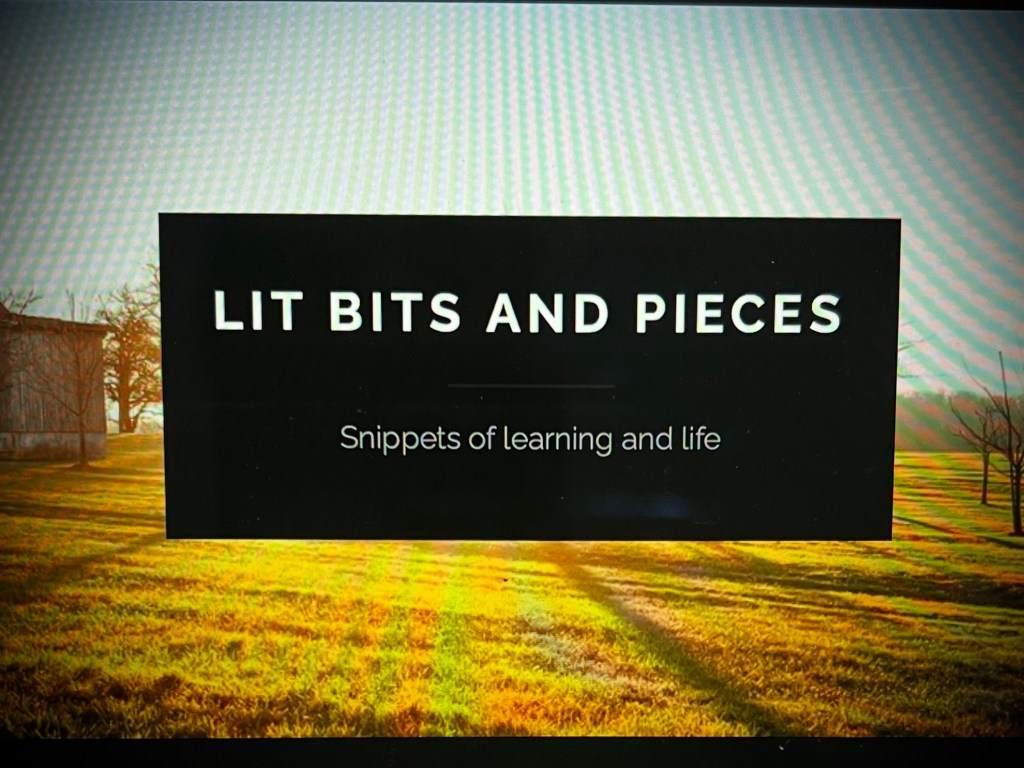
My blog header. This theme happens to be called “Hemingway Rewritten.”

*******

with thanks to two Writing Teachers for the March Slice of Life Story Challenge

Dictionary poem

Katrina Morrison hosted the March Open write at Ethical ELA on Tuesday.

Her invitation: I am calling [this] a“Dictionary Poem.” If anything can define and expound upon the meaning of a word, it is poetry…pick a word to take apart and put back together in a poem. Begin with the dictionary definition of the word. Obviously, some words will offer multiple meanings. Craft your poem however you will. After the definition, expound upon the word’s meaningthe vicissitudes of life may direct you to write a haiku or a villanelle or free verse today.

I will NOT be attempting the villanelle again anytime soon; I wrestled that form to the ground on Saturday and haven’t recouped the stamina yet to give it another go. I went with an acrostic, because the word “shards” stays in my mind, and I keep turning it around and playing with it anyway, to find out all it wants to tell me. I love this word, so…the poem:

Defining

shard

  (shärd) also sherd (shûrd)

n.

1. A broken piece or fragment, as of pottery or glass.

2. Zoology A tough scale or covering, such as the elytron of a beetle.

Dictionary.com

The Poet’s interpretation:

shards

plural

sharp-edged fragments of memory, or

seeking healing among remnants, despite suffering

Somewhere in the shattering
Healing awaits, disguised
As sharp points
Ready to draw yet more blood…
Dare to touch the memories. Discover
Scattered diamondlight, all around.

Image: beasternchen. Pixabay.

*******

with thanks to Two Writing Teachers for the March Slice of Life Story Challenge

Behold the dragon

On Monday, Dave Wooley hosted the March Open Write at Ethical ELA. He invited participants to compose small ekphrastic poems inspired by art, “to capture essential moments that are reflected in, or alluded to, in the work of art. Or, perhaps, how in reflecting upon a work of art, that might become a spark for a related idea that could be explored in the burst of a short poem.”

The key, of course, is selecting the artwork. Dave chose statues.

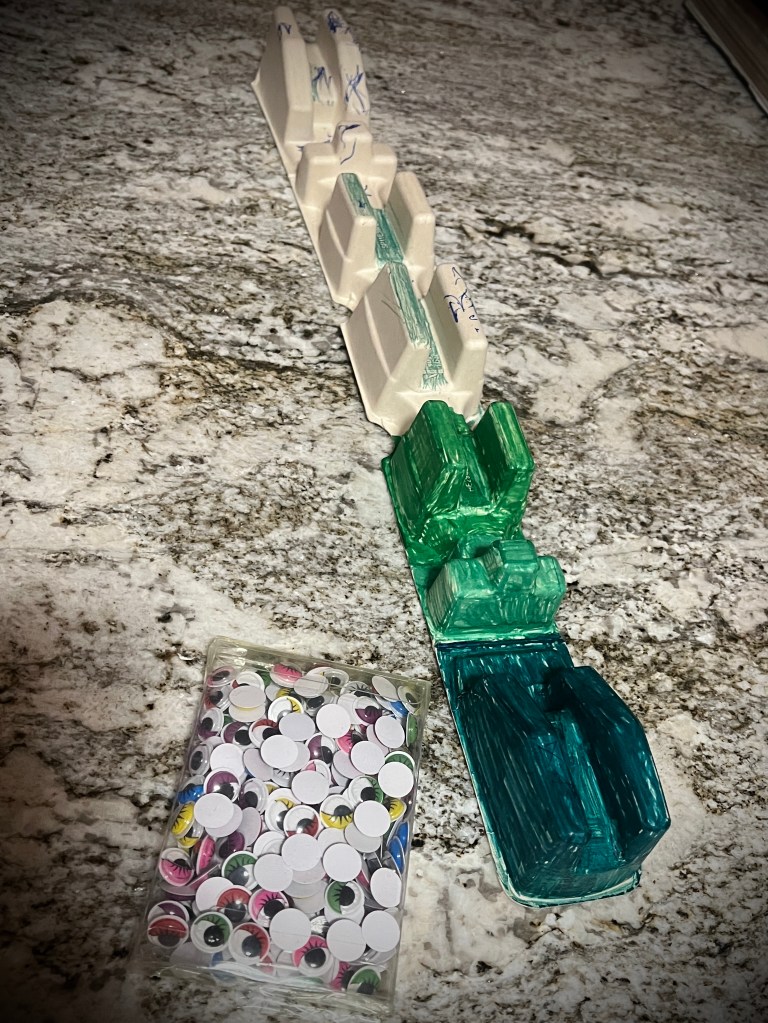
I chose a work of art in progress…

Envisioners

Segmented cardboard
pulled from a shipping package
is now repurposed

by the magicians
(known as my two granddaughters)
with markers in hand

a dragon rises
from their creative efforts—
Franna provides eyes.

The masterpiece in the making

*******
with thanks to Two Writing Teachers for the March Slice of Life Story Challenge

A place to breathe poem

On Sunday, Dr. Sarah Donovan, founder of Ethical ELA, hosted the March Open Write. She invited participants to write about a place you go to breathe and know that everything will be okay.

She offered these opening lines as a model, from poet Christine Hartman Derr in “A Place to Breathe”:

Off the path,
behind some trees,
a clearing sits
and waits for me.

Dr. Donovan asked two questions to prompt our thinking:

  • Where or what are the places that wait for you?
  • Where are the places and who are the people around which you can simply be?

I write of my “breathing place” all the time: my drive through the countryside, to work and home again.

Here’s my poem.

Breathing Place

Along the road
among the trees
the wild things live
and wait for me

They do not know
about things like grace
or that they are
my breathing place

When they appear
as I drive by
my spirit soars
eagle-high

My heart, it sings
oh, glory, glory
for their presence
in life’s story

Peace descends
and folds its wings
—I breathe the breath
of wild things

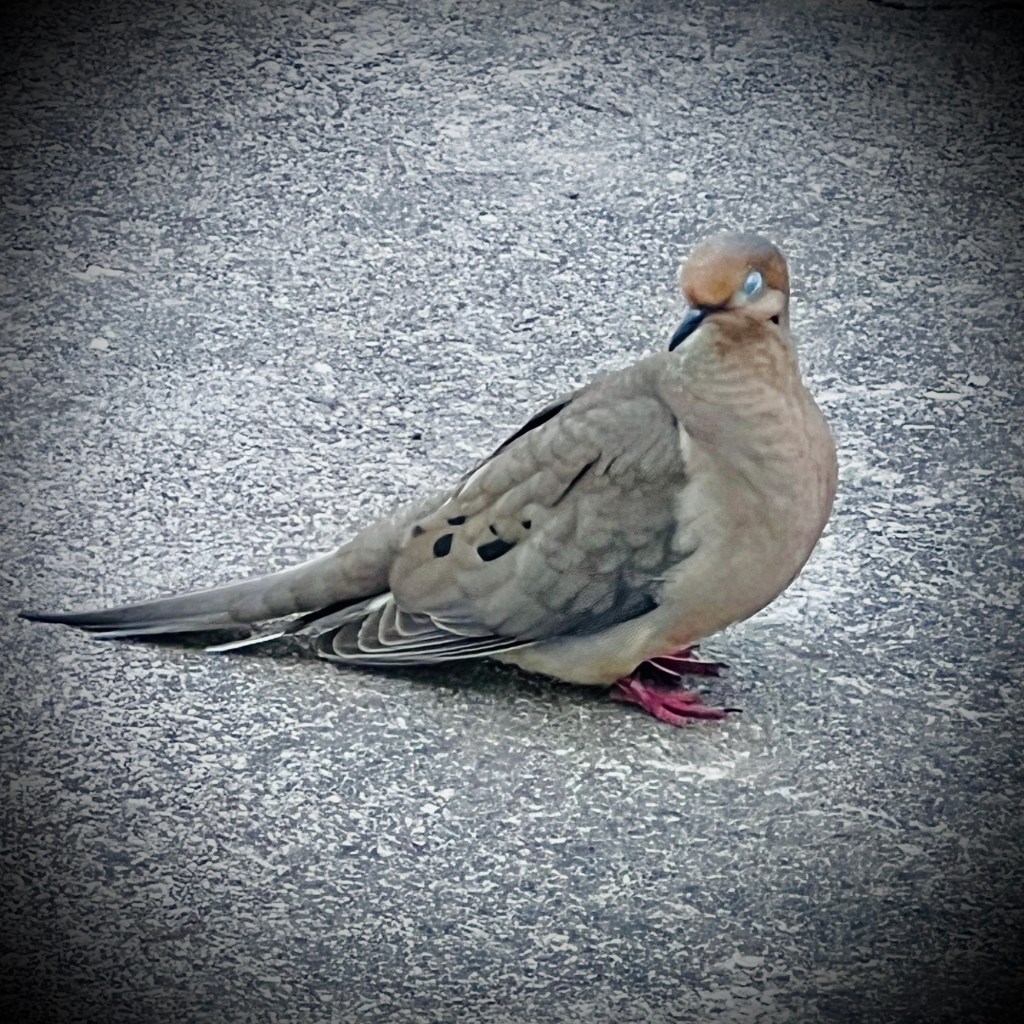
Mourning dove, resting in my driveway

*******

with thanks to Two Writing Teachers for the March Slice of Life Challenge

My own St. Patrick

In 1906, Theodore Roosevelt was president, Upton Sinclair published The Jungle, and the San Franciso earthquake killed around three thousand people. The Panama Canal was under construction and Cuba had its first president. Susan B. Anthony died that year. Lou Costello, Estée Lauder, and Anne Morrow Lindbergh were born.

In the far reaches of eastern North Carolina, a farm woman named Claudia Amanda Victoria delivered another of her ten children. A boy. She would have only two girls; one would die of diphtheria at age four.

But this baby boy would be hardy. He would outlive them all.

She named him Columbus St. Patrick.

Some folks called him Columbus. Those who knew him best called him Lump.

I called him Granddaddy.

As I grew up listening to the old stories, I tried to imagine living in his era. Seeing an early Ford Model T. Mail-ordering live chickens, delivered in wire cages by horse and buggy. Raising ducks that wandered off to the swamp on a regular basis, only to be herded back home again to eat bugs in the garden and to provide eggs for breakfast. Learning to plant and to harvest, to be in tune with the rhythms of the earth, following the steps of that ancient choreography, the seasons.

He was five when the Titanic sank, seven when World War I began. His older brother, Jimmy, served in the Great War and returned; I would know him and his wife Janie in their old age. They lived in a little tin-roofed house along one of the many dirt roads of my childhood summers. Jimmy and Columbus had a brother who drowned long before my time. Job Enoch. One brother accidentally shot and killed another on the porch of the family home. I knew their sister Amanda, who had a high-back pump organ adorned with brown-speckled mirrors in her house. The organ sounded and smelled of ages and ages past…but she could play it, and she could sing.

Columbus didn’t sing, but he loved country gospel songs and bluegrass to the end of his days.

And Columbus St. Patrick loved Sunday School. He had perfect attendance for years, garnering long strings of pins awarded to him. He did not enjoy regular school. He quit in the fourth grade to work on the farm. Later in life he had some regrets about this. But his father walked out on the family and Columbus rose to the role of provider.

He participated in community hog-killings, with the farm wives taking the backbone to flavor collard greens. The pork was preserved in barrels with salt brine. Some of the folks enjoyed scrambling hog brains into their breakfast eggs.

Columbus St. Patrick worked hard. He plowed fields with mules. He took part in the making of molasses, which required several people. Mules walked in a circle, harnessed to poles attached to large grinder where sugarcane was fed to extract the juice. The juice would be collected and heated in trays over a fire, skimmed numerous times until it became rich, blackstrap molasses. At the end of a meal, he sopped his biscuits in molasses, and poured his hot coffee in the saucer to cool it.

He competed with a scrappy little woman named Lula for the honor of being the community’s top cotton-picker. She often beat him.

Lula would be widowed when her husband Francis hung himself in the woods. One of their daughters would find his body.

Columbus St. Patrick’s youngest brother married another of those daughters.

Columbus made some time to hang out with the young people, attending taffy-making parties in their homes and driving groups of friends to the movies in town…all the while noticing Lula’s daughter with the wavy blonde hair and straight posture. There was a certain spark about her.

She considered him her mother’s friend. The “older” set. She was nine years younger and she had her eye on the preacher’s son, who would surely follow in his father’s footsteps: How wonderful, to be a preacher’s wife!

It didn’t happen. Desires of the heart sometimes come to unexpected fruition: I would be a preacher’s wife, a half-century later.

This daughter of Lula’s ended up marrying a farmer: Columbus St. Patrick. They planned to wed in September but he had the mumps. And so it came to pass in mid-December instead.

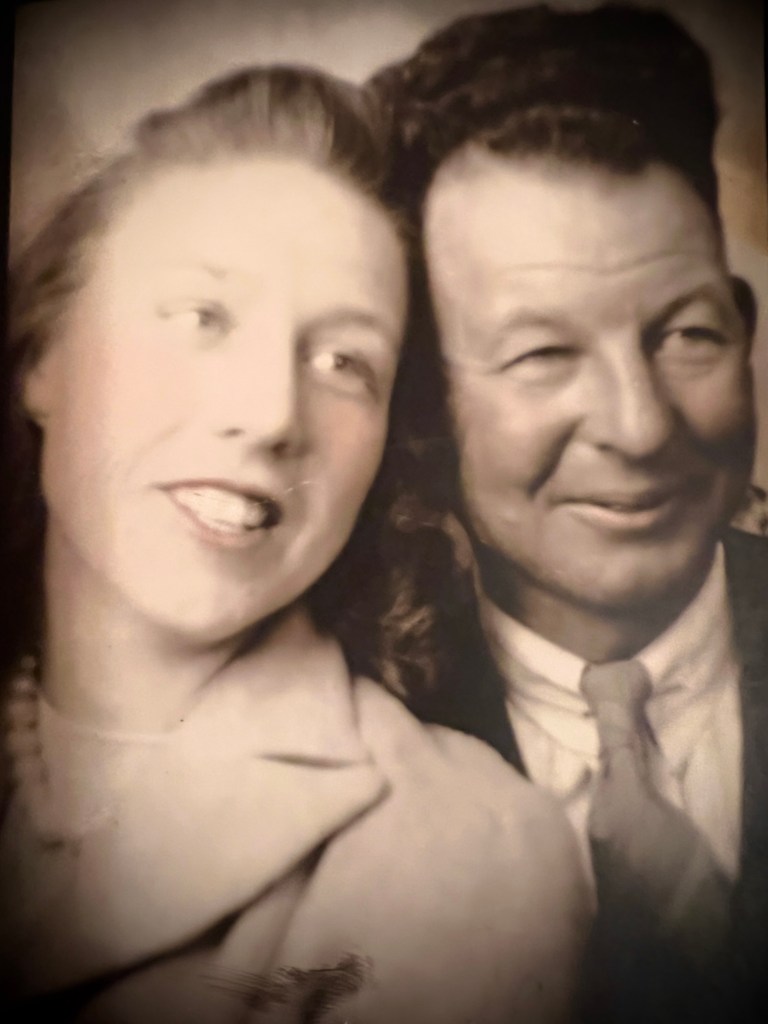
My grandparents.

Here’s a photo taken sometime early in their marriage:

Ruby Frances and Columbus St. Patrick, circa 19371938.
She would have been around 23. He would have been 31 or 32.
If this photo was taken prior to October 1937, my father was not yet born.

They would endure the Great Depression and the second World War with a small child. My father. When Columbus St. Patrick couldn’t make a go of tenant farming and sharecropping, he traveled to the shipyard nearly 200 miles away with a group of men from down home. He was working there, building cradles for ships, when Pearl Harbor was attacked. Suddenly U.S. ship production went into overdrive; the Yard turned out ships in three months versus the usual year.

He would try, after the war, to make a living farming, painting, and doing other handyman jobs. By that time there were three children to care for. Columbus opted to go back to the shipyard, staying in a boarding house during the workweek and coming home to see his wife and children on the weekends.

For ten years.

His son (my dad) became senior class president and entered the United States Air Force after graduation. The oldest daughter was a high school basketball star; Columbus St. Patrick nailed peach crates to posts out in the yard for her to practice. By the time his youngest daughter was ready for high school, he’d had enough of separations. He moved the family to an apartment near the shipyard.

Hilton Village, built between 1918 and 1921, is the first federal wartime housing project in the U.S. It was created for shipyard workers. These quaint, English-style rowhouses would be the setting of my first memories. I would awaken in the dim gray morning at my grandparents’ upstairs apartment and my grandmother soothed me back to sleep while my grandfather, having risen at four, made his own breakfast before going to work. On Sundays, his day off, he took me to the playgound behind the Methodist church.

I felt as safe as I ever have in life, walking hand-in-hand with him.

He retired after I started school and lived another twenty-nine years. He saw my children. He survived the removal of his bladder after a cancer diagnosis. My grandmother would empty the urostomy bag and dress his stoma (surgical opening) every day until his death.

They would lose their middle child, their basketball star, to multiple sclerosis in her fifties. She died on Good Friday; they buried her on Easter Sunday. Their son (my dad) was just recovering from bypass surgery after his first heart attack. He would not survive the second, but Columbus would not be here to suffer the loss of his son.

Granddaddy died of lung cancer under hospice care, at home his own bed, as he wanted, on a fine spring day. He refused morphine in favor of keeping his mind clear. And it was, to the very end.

St. Patrick’s Day rolls ’round again and stirs all the memories. They spring to life, as rich and sweet as molasses that Granddaddy and I sopped with our biscuits. He was always embarrassed by the oddity of his middle name. I am proud of it. I have loved it all my life, just as I’ve loved him. Fiercely. I have learned many a valuable lesson from Columbus St. Patrick: Treat people well. Help those in need. Money doesn’t buy happiness (back in the old days, he said, nobody had any money but everybody was happier). Love your family. Love your neighbor. Get a dog to love. Work hard. Persevere. There’s always a way. Tend the earth. Do your duty. Spend time with children, for they are precious. Go to church. Trust in the Lord. Return thanks.

One day, he said, we will meet again in a better place. I am looking forward to it.

Me, too, Columbus St. Patrick.

Me, too.

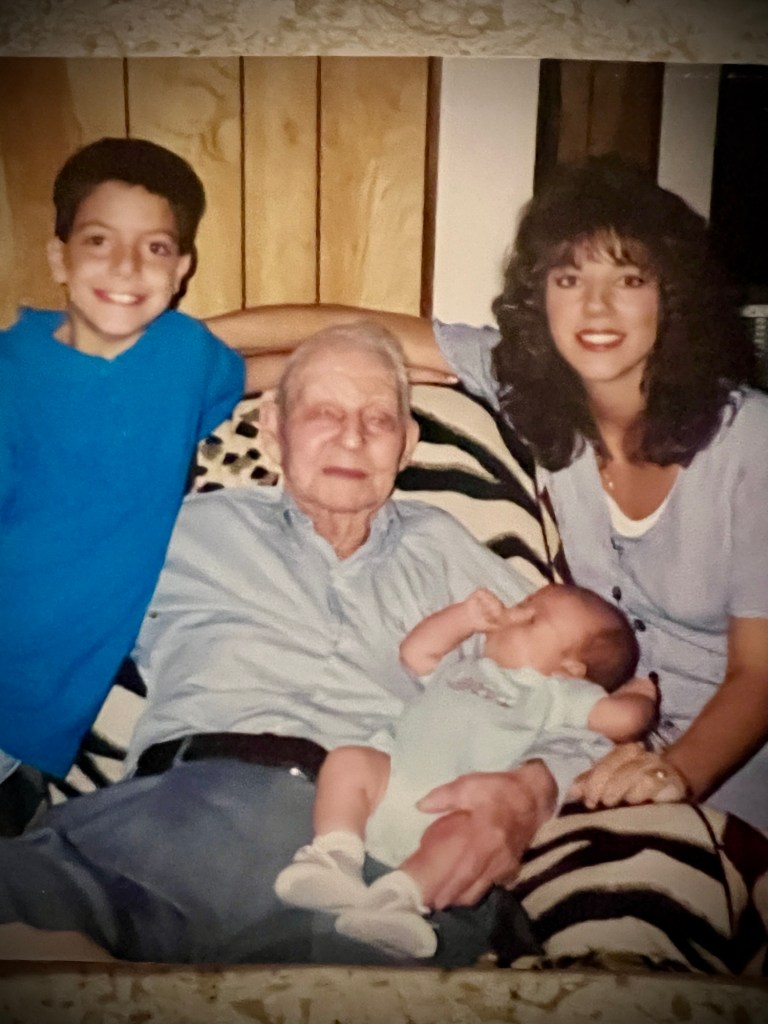
My boys and I visiting Granddaddy for his 91st birthday, 1997.
My youngest was six weeks old.

*******

with thanks to Two Writing Teachers for the March Slice of Life Story Challenge
Grace upon grace

Yesterday Leilya Pitre opened the March Open Write over at Ethical ELA with an invitation to compose poetry inspired by the Ides of March.

The Roman calendar confuses me, with all the backward counting. An “ide” is one day before the middle day of the month. For March, that’s the 15th – yesterday’s date. Leilya gave several poetic form suggestions: villanelle, free verse, limerick. She prompted participants with a choice: 1) Write with “an air of inevitability and doom…mirroring the idea of a foretold fate,” or 2) “Write a poem that celebrates a moment of change or transformation, akin to the original meaning of the Ides of March as a day of transition in Roman history.”

A day of transition…hmmm.

Change.

What needs to change more than the human heart?

I confess to wanting to run for my life at the idea of writing a villanelle (see how much the very word looks like “villain”?). The form is deadly! And there’s only one Dylan Thomas. Nobody else can rage, rage at the dying of the light quite like him. And so I opted for free verse, my default form.

Crickets. Nothing. No ideas on ides.

And so I returned to the villanelle – drat it all! – with “an air of inevitablity and doom,” for sure.

But then: Two repeating lines came to me. I started a rhyme search. A villanelle takes a pile o’ rhyming words. Not all of them will work. One of my favorite images re-materialized in my head: the “golden rim.” Yes. Let us drink from the golden rim of the goblet…no, chalice. Yes. What are we drinking, and why? What’s the point? What does it mean?

Have you ever heard that what you need is there, right within your reach, if you just look?

In this case, what I needed was literally right there within reach: the bracelet on my wrist. You’ll see.

Here’s the poem. Still tinkering with it.

Gratiam pro gratia

As evening descends in shadows dim
Let’s toast to ceasefire of life’s fight:
Drink, my love, from the golden rim.

The face of the morrow will be less grim
—See, our ashen embers retain the light
As evening descends in shadows dim.

Toss off your cloak with fraying trim.
Kneel by me, pray, well we might—
Drink, my love, from the golden rim.

There sparkles yet a priceless gem
Within the pocket, glittering bright
As evening descends in shadows dim.

Hold my hand — let’s sing a hymn
Before we take our earthly flight.
Drink, my, love, from the golden rim.

Sweet chalice of life, abrim,
Despite this darkest night…
As evening descends in shadows dim,
Drink, my love, from the golden rim.

My poem’s title is Latin for the words on my bracelet. An excerpt of John 1:16: from the fullness of Christ, we have received “grace upon grace.” I wear it as a reminder to give grace, having received it in such abundance. I purchased the bracelet at a coffee shop called Charis (“Grace”) which has a wall plastered with customers’ prayers written on tiny slips. The owners donate a portion of proceeds to organizations that are working to make the world a better place. Our time here is short. Let us be about this work, in communion with one another, giving each other grace.

*******

with thanks to Two Writing Teachers for the March Slice of Life Story Challenge