Angels

There are times in life when a theme chases you, and you find you need to write about it.

Such is the case today.

Angels.

They keep reappearing.

There’s the neighborhood rooster I wrote about on Sunday, and the ancient Muslim belief that a rooster crows because it has seen an angel.

There’s the memoir Angela’s Ashes that I returned to for my St. Patrick’s Day post, wherein author Frank McCourt’s mother keeps having babies and his father says an angel brings them, specifically the Angel of the Seventh Step, where he claims to have found Frank’s newest baby brother. Young Frank starts looking for the angel. When he wakes in the night, he goes to check the seventh step: Sometimes I’m sure there’s a light there and if everyone’s asleep I sit on the step in case the angel might be bringing another baby or just coming for visit…I’m sure the angel is there and I tell him all the things you can’t tell your mother or father for fear of being hit on the head or told to go out and play.

There’s my husband’s sermon series over the last months, in which he mentioned times of trial, temptation, suffering, and the appearance of ministering angels, with this repeated exhortation that I scribbled down on two different Sunday order-of-worship bulletins: Look for the angels.

There’s his sermon this past Sunday, which referenced the greedy soothsayer, Balaam, and his donkey which refused, three times, to not travel down the road where the increasingly irate Balaam was trying to direct it, because the donkey could see the angel of the Lord there with a drawn sword when Balaam could not; and haven’t we all experienced, in some way or other, animals seeing what we can’t? (Remember the rooster…).

There’s another book I pulled off my shelf this week, The Art of Comforting, in which author Val Walker tells of being diagnosed with premature ovarian failure; she will never have the child she’s longed for. Shortly afterward she’s laid off from her job in a massive downsizing. As her husband goes away on a business trip, she cries for the loss of the life she thought she’d been destined to live: “My angel books and angel music could no longer comfort me. I prayed to God to send me a real angel. I was ready for a bona fide spiritual visit from heaven.” To her shock, the doorbell rings…chiding herself for thinking it could really be an angel, she answers it to find a “small, sweaty man in a filthy T-shirt and muddy shoes. He must have been one of the laborers working on my neighbor’s lawn…” and with him is a golden retriever, staring at her, wagging its tail.

Turns out the man has come to ask, in broken English, if this is her dog (it’s not). He then asks for water for the animal; it’s a terribly hot day. Walker gives a bowl of water to the dog. She offers a glass to the man. The visitors leave together, and she reflects: Just ten minutes earlier, desperate enough to go begging to God, I had prayed for a brilliant, glowing angel to come to me…was this stranger my angel? I don’t know. But I do know that in witnessing his beautiful kindness toward that dog I was reassured that comforting still existed on earth…always remember, comfort is all around us. We are never alone.

I’m not sure the man was the angel, either.

I’m pretty sure the dog was.

Then there are experiences much closer to home, some of which I shared in yesterday’s post with my “Bad things are going to happen” poem.

There was my husband’s diagnosis of ocular melanoma…shortly after which, while driving and contemplating having his eye removed, he stopped at a traffic light and saw, he says, the brightest flash of white light before him. Nothing was there to cause such a flash. He’d never experienced anything like it before. Optical illusion? Maybe. Stress? Possibly. But he said he was instantly flooded with comfort and knew everything would be okay.

And it was.

Then there was his cardiac arrest on a Sunday afternoon, driving home from the gym. He lost control of his truck; it veered into coming traffic, then crossed back over and ran off the road into a grove of trees…without striking anything. The last thing he remembers, as all went dark and peaceful, are voices saying He’s in trouble. We have to get him off the road.

Angels?

You decide.

As for me, I realize the words were written on my heart long before I scribbled them in the Sunday bulletins. I know, whatever the days may bring, or how long the darkest night may seem, in times of my greatest need, I’ll heed my preacher’s advice:

Look for the angels.

They’re all around us.

backlit Golden Retriever“. theilr. CC BY-SA 2.0.

*******

Composed for Day 26 of the Slice of Life Story Challenge with Two Writing Teachers

Works cited:

McCourt, Frank. Angela’s Ashes: A Memoir. New York, Scribner, 1996. (Pages 102-107)
Walker, Val. The Art of Comforting: What to Say and Do for People in Distress. New York, Penguin, 2010. (Pages 241-244)
Jewels

On March 17th I typically write a post contemplating my obscure Irish roots while celebrating the novelty of my grandfather’s middle name: St. Patrick. Yes. For real. No one knows why, my down-east North Carolina Methodist Granddaddy hated it, and by my lifetime he’d legally changed it to the initial S.

I love the uniqueness of it. I cannot let the day pass without saying that Columbus St. Patrick Brantley’s name remains a treasure to me, a jewel in my family’s living memory, a perpetual mystery in our supposed non-Catholic history.

Here is where I diverge from my norm to chase, not a name, but a word: jewels. In keeping with the day, of course. The first jewel I’m after is brilliant language, and the Irish are rich in that. It glimmers in every bit of their wit, storytelling, poetry, and song.

In 1996, Frank McCourt’s memoir Angela’s Ashes burst upon the world and won the Pulitzer Prize. As soon as I learned of the book, I had to have it. Reviewers raved about McCourt’s narrative voice: Stunning. Lyrical. Dazzling.

So I got my own copy. From page one…spellbinding. My concepts of writing and memoir were forever changed; McCourt’s Irish voice has never left my head.

Of his many glorious phrases, one that returns to me most often comes from the scene where young Frank is in the hospital recovering from typhoid fever. In the room next door is a girl recovering from diphtheria. They can’t see each other, but she calls out to him. She says she has a book about the history of England with her, if he’d like to read it. He does. Books are treasures to him; his impoverished family doesn’t own any. The girl sends the book to him via the nurse, Seamus, who delivers it most reluctantly, complaining because it’s about England “after all they did to us” and that there “isn’t a history of Ireland to be had in this hospital.”

McCourt writes:

The book has the first bit of Shakespeare I ever read:

I do believe, induced by potent circumstances
That thou art mine enemy
.

...I don’t know what it means and I don’t care because it’s Shakespeare and it’s like jewels in my mouth when I say the words.

Jewels in my mouth…

I knew exactly what he means. I loved Shakespeare from my own first encounter. The last line of Sonnet 73 is the heartbeat of most everything I do in life, certainly of the things I write: To love that well, which thou must leave ere long. Jewels in my mouth, in my heart…the bequest of beautiful language.

McCourt eventually left Ireland for America where he became a high school English teacher. He’d regale his classes with stories of his childhood, and they’d say Hey Mr. McCourt, you should write a book.

So he did.

Angela’s Ashes.

And so the world is changed.

That is the power of story.

That is the second jewel from McCourt: Story. Specifically, writing of your own life.

In his final memoir, Teacher Man, he’s become a creative writing teacher. He’s trying to inspire students to write about their lives when they think there’s nothing interesting to say. He tells them: Every moment of your life, you are writing. Even in your dreams, you’re writing…Dreaming, wishing, planning: it’s all writing, but the difference between you and the man on the street is that you are looking for it…realizing the significance of the insignificant, getting it on paper. You might be in the throes of love or grief but you are ruthless in observation. You are your material. You are writers and one thing is certain: no matter what happens, you’ll never be bored again. Never…nothing human is alien to you.

Jewels. Your words, your story, your every moment. All priceless.

I met Frank McCourt in the winter of 2000 when he visited North Carolina State University. I went despite a falling snow. I took my oldest son with me and we listened to McCourt speak of his books and devastating childhood in Ireland. We listened, and marveled. We listened, and wondered about the story of our own origins on The Emerald Isle.

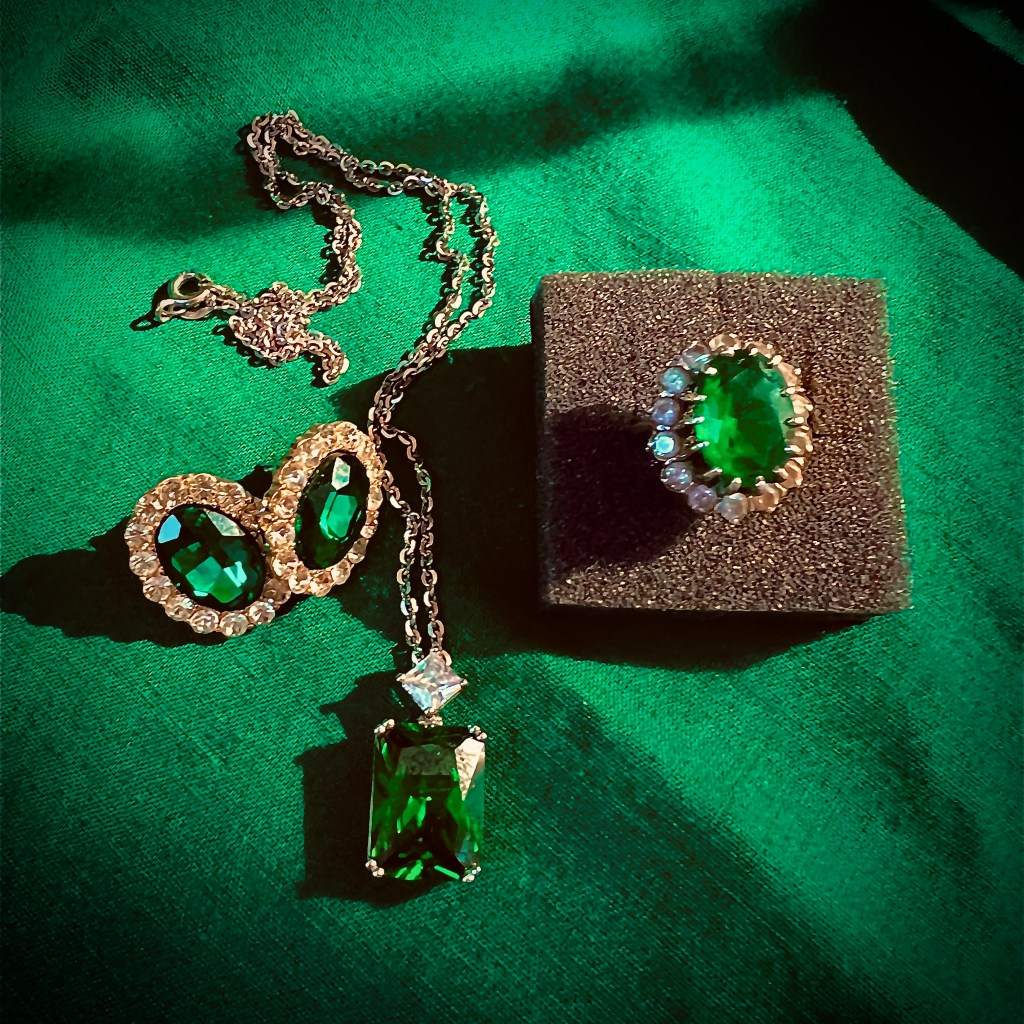
Which brings me to my final set of jewels for today: Christmas before last, my husband gave me a necklace and ring. His sister, without knowing or discussing it with him, gave me earrings. The jewelry, all bearing my birthstone, emerald, are a startling match. My sister-in-law chose the jewelry for me because she loves the color. My husband said, These are to remind you that one day, I’ll take you Ireland.

Where, I imagine, the voices of my distant ancestors still whisper in the wind…perhaps when I go, if I am very still, I might hear them…learn from them…

Until then, and always, I shall be about the excavation of my own story-jewels, with McCourt’s words echoing in my brain and my curious link to St. Patrick forever pulling at my heart.

As for today… here’s to proudly wearin’ o’ the green.

*******

Composed for Day 17 of the Slice of Life Story Challenge with Two Writing Teachers

*******

Works cited:

McCourt, Frank. Angela’s Ashes: A Memoir. New York, Scribner, 1996. (Pages 195-196)

McCourt, Frank. Teacher Man: A Memoir. New, York, Scribner, 2005. (Pages 244-246)

Happy St. Patrick’s

Happy St Pat's

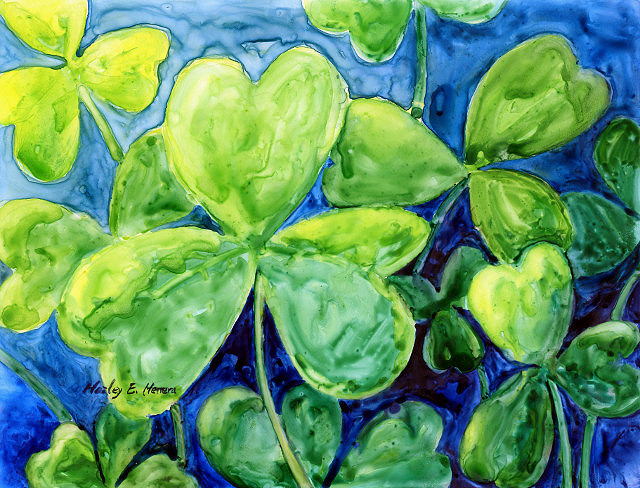
Happy St. Patrick’s Day. Hailey E. HerreraCC BY

Last year on this day, I wrote about being St. Patrick’s granddaughter.

My grandfather, born in 1906 in the far reaches of Beaufort County, North Carolina, was named Columbus St. Patrick. (Read the post if you like).

You’d think our family would be Catholic, celebrating this day with the best of them, but we aren’t and we don’t. What a mystery, his having that name. Legend has it that his grandfather came to America from Ireland, but records are sketchy. One of these days I’ll have my DNA tested by Ancestry.com to prove how green my blood really is (it’s metaphorical, Mr. Spock. Although being related to you would be . . . fascinating).

I love Irish things. My wedding band bears a Claddagh. Hearing an Irish tenor takes my breath, stirs my soul, fills me with an ache, a longing. Whenever I visit New York City, I have to stop by St. Patrick’s Cathedral; I could stay inside indefinitely, savoring the profound beauty, the grandeur, the reverent hush. It’s one of my all-time favorite places. I adored Frank McCourt and met him years ago when he came to speak at North Carolina State University—it was snowing that night. Magical. I have a shamrock growing in a pot on my kitchen table and I even had an Irish Setter once. His name was Dublin. I grew up eating Irish potatoes grown by my grandfather or from the potato sheds of his farming community; Granddaddy’s pronunciation was ishe (for years I thought he was saying ice) potatoes. I’d love to visit Ireland.

I thought, to commemorate this day, that I’d post a lovely quote from St. Patrick and reflect upon it, maybe in verse.

This, however, is the quote I found, and for the life of me (remember the Irish keen sense of humor), I can’t find another one to top it at present.

So, Happy St. Patrick’s Day, one and all—with a special nod to Harry Potter fans:

Do you suppose it’s true, that St. Patrick was a Parselmouth, and his Muggle friends never knew?

~David J. Beard (1947–2016), tweet, 2012 March 17th

saintpatrick