Provision is the title of the prose poem I share here, originally written to a nature prompt on Ethical ELA’s Open Write. A poet-friend suggested turning it into haibun by adding haiku at the end…Voilà.
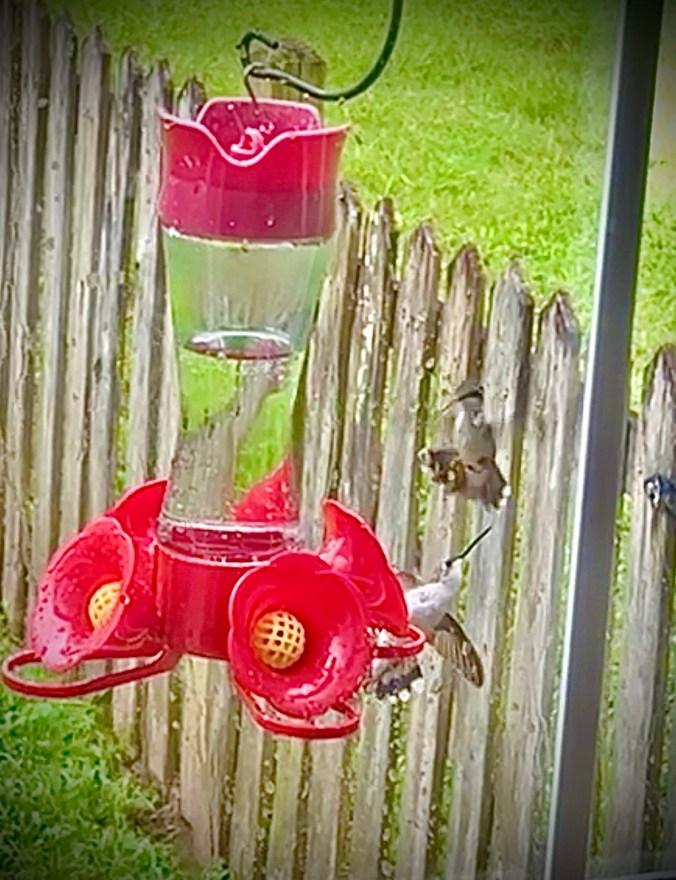
It is July. The hummingbirds are drinking a whole feeder of sugar water a day. My friends say they have no hummingbirds this year and I joke that they are all coming to me. My granddaughters try to help me count, but, in all the frenetic zoomings from window to crape myrtle and every which way, we lose track: Is it seven? Ten? We cannot be sure, even though every bird has different markings. Most are female. One silvery girl has a red dot at her throat. This is somewhat rare, research reveals. I have taken to calling her The Princess. She was here last year. She has come home again to her own realm and it is my great pleasure to serve her. A documentary tells me that every day of life is a combat zone for hummingbirds. I already know this; I am eyewitness to their fierce competition for food. I am occasionally startled by the sound of a tiny body slamming against the window—THUNK! — where the feeder hangs. How is it so loud? How does the body-slammed bird not die? The hummingbird’s awareness and aerial acrobatics are astonishing. Once in a while, a male finds his way to the feeder, his brilliant ruby-throat like nothing else in nature, as long as the light is right. His jewel-fire turns black in shadows. The women soon drive him away. They rule the feeder. I see females sometimes picking near-invisible insects off of its red plastic flowers, likely to carry to their young. I am thinking some of these birds hatched here in our trees last year. We have never had this many before. It is not hummingbird nature to “bring your friends.” They do not have friends. They are individuals. Loners. Warriors. As fierce and resilient as anything in the animal kingdom. They are, in their way, mightier than eagles. And they know me. I step outside to a helicopteresque whirrrr accompanied by loud chips and chitterings…food’s gone! they say, so hurry up, hurry UP. A bird hovers nearby as I rehang the feeder full of fresh, cool sugar-water, condensation already running down the glass, gleaming in the light. They are back at it before I can open the door to go inside. I do not expect their gratitude. Their love. Their allegiance. None of that is possible in this life. Their beauty and perseverance, their very presence, is enough. They perch on the twig-branches of the pines out back whenever I am on the deck, nearly indistinguisable from the pinecones. They are watching me, these tiny winged wonders of sublime iridescence and supreme intelligence. They know me. It is more than enough.
The battle is Yours
—I trust Your sweet provision,
grace in every drop.

 lit bits and pieces