It took me a while to figure out the tiny, nondescript building in the heart of the rundown side of town. I only noticed what it was when I needed it—there, in the tiny window, a tiny sign:
Dry Cleaning.
My first thought: So that’s what that little place is!
Second thought: Time to take that mountain of cleaning . . .
Back at home, I grumbled all the way to the car with my armload. Too much of my family’s wardrobe required dry cleaning. Suits, coats, some of my dresses . . . this is ridiculous, this is IT, I am reading every tag in the future and I am NOT buying anything else that has to go to the cleaners. I could buy several more outfits for what this is going to cost!
The tiny parking lot had only three parking places. A pretty tight fit.
Fortunately, two spaces were free.
I got out of my car, gathered my garment mountain unto myself, and somehow maneuvered through a sliding glass door to enter the shop. I made it to the counter where I let it all go—thunk!
Yes, the weight of the clothing was enough to thunk.
Then, as if by magic—I didn’t see exactly where she came from—a young woman materialized.
“Hello!” she said, smiling at me. “Welcome! I am happy to help you today.”
Her Korean face shone like the sun; I actually blinked. I could feel the warmth she radiated.
She clasped her hands. “Oh, you are such a beautiful lady!”
Tears stung my eyes.
Seriously.
I almost wanted to hide.
I had been feeling—acting—anything but beautiful. I am quite sure my face looked like a thundercloud when I walked in.
“Oh my,” I said, feebly. “Um, thank you.”
She beamed.
She catalogued my family’s clothes, said they’d be ready next Tuesday, and she walked me to my car. When I pulled out of the parking lot, she stood there waving good-bye with fervor.
My first thought: Grandma used to do that. Used to wave after the car when I left, even ran out into the old dirt road to keep waving until she couldn’t see me anymore.
Second thought: How can this lady be so exuberant? Is ANYONE really that happy?
But I realized, as I drove away, that I was smiling, too.
Thus began years of visits to this dry cleaning shop.
Always when I walked in, the young woman dropped what she was doing and flew to meet me: “Beautiful Lady!”
I stopped ruing the fact that I had so many clothes needing to be dry cleaned.
I started taking things that needed mending. A hem come undone, a blouse pulling apart, hateful buttons that fell off of coats because they weren’t sewn on properly to begin with. A zipper that broke, needing to be replaced.
She fixed them all.
Once I took a challenging piece to her. A jacket with torn lining.
For the first time, I saw her brow furrow as she examined the tear.
“Is it fixable?” I asked. “If it’s not, that’s okay.”
She held her head up, sticking her chin out just a bit. “I will fix it. Not on the machine. By hand.”
And she did.
When I picked up the jacket, I marveled at the tiny, perfect stitches. They were machine-precision. I looked at her in awe. Sewing, I’d decided long ago, was just about a lost art. My mother and grandmothers sewed; they made clothes for themselves, my sister and me when we were children, and for others. My mother even crafted a slipcover for a sectional sofa. I can barely sew on a button.
And here in my hands was some of the prettiest handiwork I’d ever seen.
“It’s beautiful!” I said.
My dry cleaning lady smiled, good cheer emanating from her entire being: “It must be beautiful for the Beautiful Lady.”
I swallowed, too humbled for words.
Her habit now was to carry my clothes to the car—she absolutely would not allow me to do it—to hang them and to open the driver’s door for me. And there she stood, waving good-bye to me until I was out of sight.
I had taken to rolling the window down and waving back until I was well down the road.
I met her children as they began learning the business. “Look!” she exclaimed on one visit, as soon as I entered. “Look at this report card!” Her son had received straight As.
“That’s awesome work,” I said to him as he rang me up on the register.
“Thank you,” he said somewhat shyly, handing me my receipt.
“Listen!” said my dry cleaning lady another time. “My boys are taking piano lessons.”
There against the wall by the entrance stood a piano; when did that get delivered to this little shop? The two boys, in turn, sat and played without any sheet music:
The Entertainer.
Fur Elise.
Moonlight Sonata.
My musician son was with me on some of those visits; he listened, nodded his approval, and was invited to play.
He played his favorite.
Amazing Grace.
My dry cleaning lady and her boys nodded.
“Beautiful music!” she clapped, hopping up and down, when my son was done.
“Your boys also played beautifully,” I told her.
“I am taking lessons, too,” she said, glowing with obvious joy. In that moment, I realized just how much I admired her. Her generosity of heart, her effervescence, her genuine zest. The utter freedom with which she honored life—her own as well as others’.
I didn’t know, still don’t know, her back story, whether she was born in America or came here when she was a child. I never met her husband. She labored long hours in and out of that tiny dry cleaning shop, tireless in her dedication to her work, her family, and her customers. She raised three stellar boys, paid for their piano lessons, got that piano for them to practice as she taught them the dry cleaning business after school, and decided to play herself.
I wonder how long she harbored that dream of playing.
One day I walked in and an old man greeted me. When I inquired where my dry cleaning lady was, he explained with a heavy accent: “I am her father. She is gone to open another shop.”
In another town.
That shop will do well, I thought, thinking of her smile, her magnetic energy.
But a great light and warmth had gone from this shop.
I saw her first name written down once and asked her how to pronounce it. She coached me on it until I said it perfectly. I recalled it this week, and looked it up: It’s derived from the old Chinese “Ming,” meaning bright, brilliant.
It’s too perfect. Dead-on. Life is like that, so seemingly random at times, but always, always moving with purpose, like realizing a nondescript shop is a dry cleaners and oh, maybe I should bring that mountain of cleaning, never expecting to come face to face with the most alive human being, whose ability to make another person feel valued is unparalleled, whose very name means brightness.
I’ve been in the presence of greatness in a tiny shop in the heart of the rundown side of town. I needed to be there, but not for the kind of cleaning and mending I thought I needed. For a different and deeper kind: A lesson in blessing others at the hands of one luminous, amazing, incomparably beautiful lady.
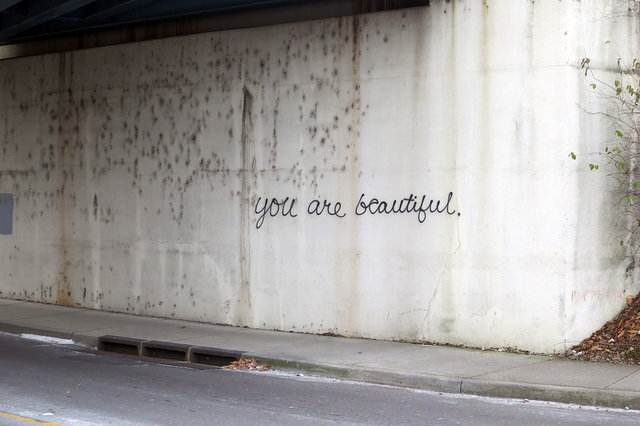
You are beautiful.
If we could all see one another that way, and could say so sincerely, if we honored each others’ lives because we believe it . . . what a different world it would be.


 lit bits and pieces