The brokenness of things: 4

part of a story-poem memoir, when I was nine

The pediatric wing
of the hospital
is quiet
in the gray-blueness
of a June afternoon
easing into dusk

muffled sounds and voices
from the nurse’s station
down the hall

alone in my room
my newly-casted arm
is heavy
and awkward
bent in a Z-shape
so the bones
will knot back together
nicely

on the bedside table
two dozen handmade cards
crayon-decorated
by my fourth-grade classmates
brighten the sterile room
Hope you are feeling better SOON!
I’m sorry about your arm
We miss you

I am feeling
surprisingly loved
in these
long and lonely
moments
of nothingness

until a scream
shatters the
gray-blue stillness

a jolt
of electricity
shoots through
my heart

another child
nearby

the scream rises
and falls
into loud sobbing

it goes on
and on

when the nurse comes
to take my vitals
I ask
Who‘s that, screaming

she replies
while taking my pulse
Another patient
across the hall
he’s five

What’s the matter with him
Why is he screaming
like that

she looks at me
I can see
she’s thinking

His foot was crushed
by a lawnmower
He is frightened
and he has a rough road
ahead of him

would you like
to go see him

it might help him
to not be so
afraid

I’m imagining
a little foot
full of crushed bones
how can doctors
ever put all the pieces
back together

it frightens me

I don’t want
to see

but his screams
are terrible
to hear

Okay
I say
I will go

although my heart
is beating
no
no
no
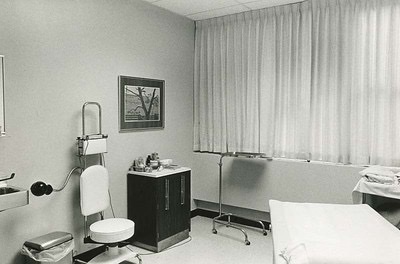
Pediatrics exam roomStanford Medical History Center. CC BY-NC-S
Courage (part one)

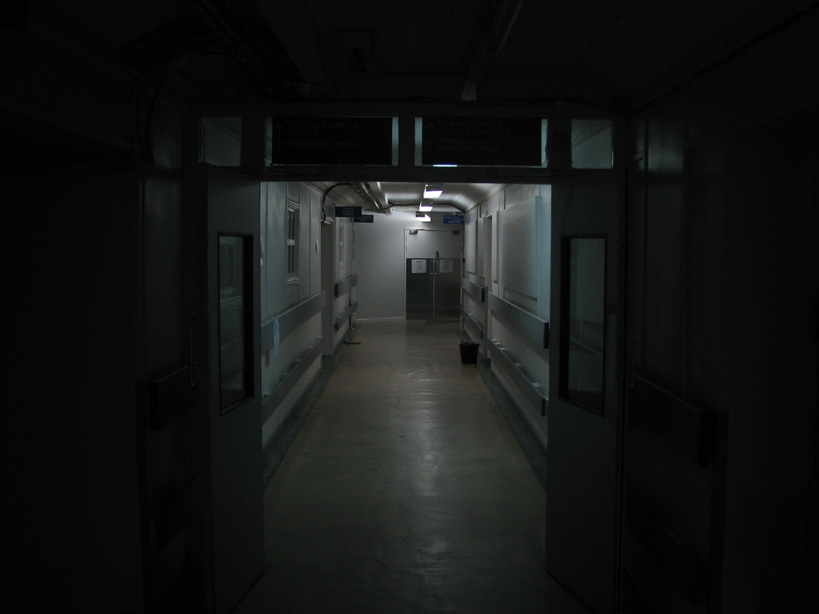
Corridor

Corridor. danie; CC BY

“Do you know why you’re here?” the doctor asked.

When doctors don’t smile, the conversation isn’t going to be good.

My husband, pale but resolute, nodded his head.

Ocular melanoma. We’d never heard of it before.

It’s rare.

He had a freckle on his retina near the optic nerve in his left eye. Probably a birthmark, the optometrist said. We’ll just watch it.

They watched it for six years.

It was growing now, spreading, causing light flashes, changing color, leaking fluid.

The retina specialist looked grim. Maybe a radiation chip could be applied to slow the growth of this thing, but it would still be there. The sclera would have to be cut and peeled up for the chip, which would stay in for seven days.

The research hospital wanted to wait and see what the tumor – not a freckle anymore, but the tumor – would do.

Everything we read online about ocular melanoma said Do not wait. 

There is no cure.

The cancer doctor we consulted said, By the time it’s found, it’s usually metastasized.  Radiation and chemotherapy have no effect. It’s nasty.

My husband looked at me. I could see myself reflected his big, beautiful brown eyes.

He said:

“I want the eye out. As soon as possible.”

The optic nerve is connected to the brain, you see, and the pictures showed the lesion -the tumor – reaching for the optic nerve like a hand reaching for a piece of savory fruit, for juicing.

“Okay,” I said, without even blinking.

We found a surgeon, a highly respected one,  who agreed. “I have to tell you enucleation is an easy surgery to perform, but it’s an extremely painful recovery.”

My husband said: “Let’s do it.”

On the night before the surgery, I kissed his left eyelid. It was the last thing, the only thing, I could do for that beautiful eye which would be no more.

It was a long wait at the hospital. When the orderlies finally came, my husband’s sister, our niece and I told him we loved him, kissed him good-bye. As the gurney rolled down the hallway he was sitting up in his gown, waving at us, grinning from ear to ear in his usual gregarious way.

He knew he would come out of there without an eye, that the recovery would be rough, and he was smiling.

That’s profound courage, I thought. The bravest thing I’ve ever seen. 

I waved back, tears blurring my vision, until he vanished from my sight.

(To be continued tomorrow).

slice-of-life_individualEarly Morning Slicer