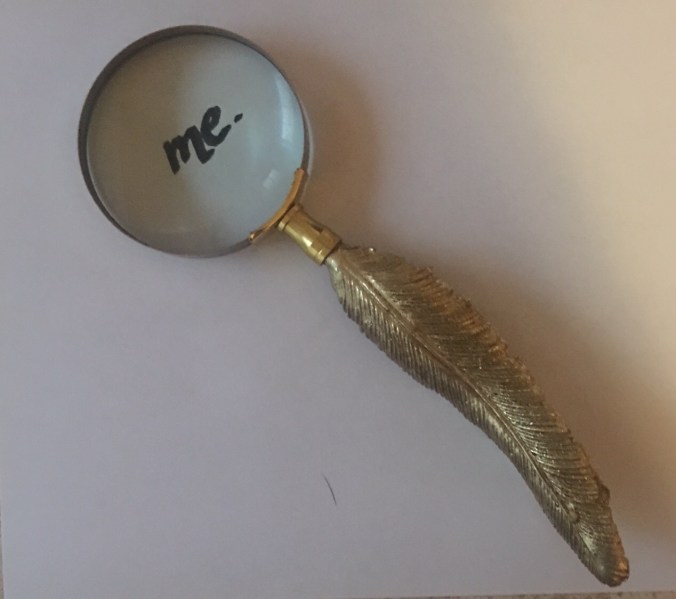
Seeing me

img_4994

Come back to examine this image after you read: In how many ways does it represent the information in this post? 

The big question on Day Three of our Teacher Summer Writing Institute: How do I see myself as a teacher of writing—no matter my grade level or content area? 

The day became a collage of images and symbolism.

Teachers were tasked with using postcards and personal artifacts as metaphors for teaching writing. They used these ideas as springboards into poetry and a means of writing to inform.

Then came the birds.

It began with the fact that 2018 is the Year of the Bird. The National Audubon Society and National Geographic, among other organizations, made this designation to honor the centennial of the Migratory Treaty Act, the most powerful and important bird-protection law ever passed. My co-facilitator posed this question: How do birds inform us? Group answers: They indicate coming changes in the weather, or the quality of the air. Their migration patterns have changed because the climate has changed; the birds are getting confused. That’s a reflection of society and the world, don’t you think? This segued into an activity called “Everyone Has a Bird Story.” For just a couple of minutes, teachers were challenged with a quick write about a bird (everyone really DOES have a bird story of some kind). The teachers gathered in a circle afterward, each reading one line aloud from his or her story, to compose a group bird poem. The effect was funny, strange, and beautiful. The closing question: How might we use this activity to inform student writers?  Answers: It’s a visual way to show students about organization and revision. Students can actually move around so that their poem makes more sense,  or to attain better flow. You can use this activity to physically show students how to group like ideas. It’s an easy way to show students that writing is fun. 

Just as the group broke for lunch, two birds—doves, to be exact—crashed into the windows of our meeting room. Generating both awe and alarm, they hovered, wings flapping, knocking against the glass as if seeking a way inside. A couple of us ran out to guide them away before the birds injured themselves.

Birds, ancient symbols of freedom and perspective, the human soul pursuing higher knowledge, the dove especially representative of peace, love, gentleness, harmony, balance, relationships, appearing at this gathering of teacher-writers as if invoked . . . so much to analyze there, metaphorically . . . .

Following lunch, the group spent time exploring abiding images. These are images that stay with us in our memories (and sometimes in our dreams); they usually have deeper meanings and significance than are obvious at first. One of mine, shared as an example: long, skinny, flesh-colored worms with triangular heads that my grandfather and I encountered when I was a child. He didn’t know what they were (land planarians, I’ve learned), we never saw them again,  and neither of us could have guessed what they have the power to do. They just resurfaced in memory recently; I had to figure out why. Here’s the story of that experience, if you’d like to read it: First do no harm.

Participants were then invited to take virtual journeys in their minds to capture the specific sights, sounds, smells of their favorite places. Others went outdoors to capture the same (see Abiding images for my original experience with this). Whether the journey was real or virtual, everyone encountered something unexpected or fascinating —something so representative of writing itself. The point of collecting abiding images is the intensity of focus, the close examination and capturing of the smallest detail, which might be used later in writing vivid scenes and settings that are necessary in both fiction and nonfiction, as well as for metaphor in poetry. Writers communicate information to readers through images. Teachers must be able to test and try ideas and creative processes—this is called birdwalking—through things like abiding images to inform their teaching and to communicate information to students.

And to write.

At this point teachers could rotate through any or all of three breakouts: Minilessons and content area writing, where they discussed ways to incorporate their new learning to grow student writers, or continuing to work on their own writing with the option of conferring with a facilitator, if desired.

As this vibrant day on writing to inform and “How do I see myself as a teacher of writing?” came to a close, my co-facilitators and I received the most welcome information from our fellow educators who span grades K-12 and all content areas, including ESL and AIG: These have been the most helpful sessions—I have learned so much about writing. There’s so much I want to try with my students! I am excited! How can I find more workshops like this? With most professional development, I am tired before lunch, and the afternoon is a long haul, but with these I go to lunch energized and can’t wait for the afternoon! The breakout sessions, where we choose to work on what we want to, are exactly what we need. Don’t change anything; just keep it coming!

That is like music—or shall I say birdsong?—to our ears.
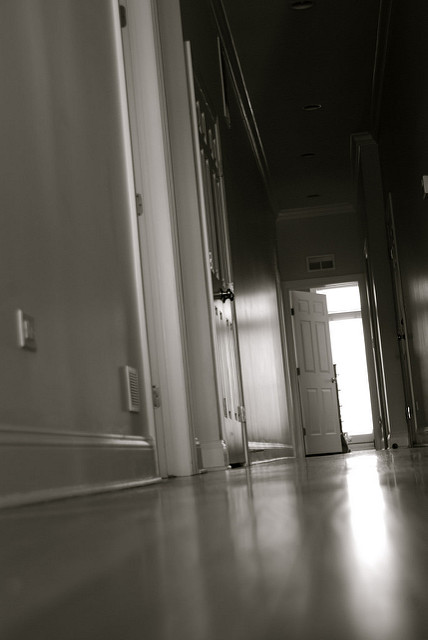
 

The hallway

Hallway

Hallway. DSC_003. ColinCC-BY

A large part of my job involves helping teachers and students grow as writers. I often define writing workshop as an artist’s studio, a place with time to fall in love with the craft of writing.

As I consider my own writing experiences, the image of a hallway forms in my mind. I am actually in this hallway. I can see numerous doors, one of which stands partially open, and through it I can see a window, and beyond that, trees, bright in the golden light of afternoon, probably in late spring or early summer. The branches sway in a breeze, making the leaves dance and beckon, but there is no sound, not from this vantage point. I would have to go through the door and open the window, probably, to hear the rustling, the insects, the birds, to feel the sun’s warmth and taste the laziness of a free afternoon – if, in fact, the afternoon is lazy and free, as it seems to be from where I stand.

Other doors are closed, and knowing that I can open any of my choosing sends a compelling shiver through me – each door leads to a different place, experience, and story. They are all mine to explore, at my leisure. I will never know what’s behind the doors unless I go and open them. Some lead to the past – when I walk through, I can see my family, some of whom are gone now but alive and remarkably young in this place.  They don’t seem to mind at all when I come – in fact, they seem to welcome my visit the same as they always did. If I go farther, I see old friends, classmates, even people I didn’t know well but who are somehow connected to an idea, a moment in time when I learned something or realized that something mattered. My childhood dogs bounce up at the makeshift gate between the kitchen and the living room in their typical greeting; I smell cigarette smoke, the old Kirby vacuum cleaner, the old worn rug; fried chicken also lingers in the air. But I do not want to stay and wander like a ghost here in my childhood home. I can come back another time, anytime I like.

Behind other doors are chairs where I rocked my babies. Here I sit with their soft warmth in my arms, their fuzzy heads nestled against my neck. I feel them breathing, slow, easy, contented in their slumber. I can stay here a while and just be, just rocking, holding one boy for a long time and then the other. I can see them when they are a little older, one always chipper and friendly, the other absorbed in his own thoughts, spending hours lining up his Hot Wheels or taking things apart to put them back together. They are safe and well in this place, so I will leave them here, after I kiss their satin-soft cheeks once more and tell them that I will always love them.

Other doors, I suspect, lead to worlds that I can still create, both real and imagined. I can only see so far in the future; only some things are certain and I will alternately face them and embrace them as they come. I could linger far too long in the imagined worlds, just to see what will happen, to discover the secrets and the magic, knowing all is of it is at my command.

I am surprised by the door that opens straight into the natural world. I have discovered this about myself, that the workings of nature have a strong pull for me. Some of the discoveries are breathtaking, like the iridescence of a dragonfly’s body, the precise blue and orange painted pattern down a caterpillar’s back, the powerfully sweet fragrance of a gardenia, of honeysuckle, and the tiny war-plane drone of a hummingbird’s wings. Others discoveries are not nearly as pleasant – a horseshoe crab decaying on the beach, a tobacco worm (a non-native North Carolina neighbor recoils in horror – “Is that a dragon?“) crawling on my porch rail, a scar on the wood trim by the roof where lightning struck the house. Not pleasant, but fascinating all the same. I had no idea until I started writing that nature spoke so much to me – just now, as I capture these words, the sun bursts forth from behind the clouds beyond my bay window, shining on the laptop and my hands as I type, like a validation, an invocation.

Other doors lead to mysterious places like cemeteries, where time is irrelevant. I don’t know these people, but I look at the stones, the names, the dates; I read the poems on the older, eroding ones, and I want to know: Who were you? What were you like? What was your life like, what did you love, and how did you die? What’s your story?

The most curious thing of all about this silent hallway is that whichever door I open, in whatever order, wherever I go and however far or for however long, I find myself there. Myself as I was, as I am, as I will be.

I give myself a nod.

And I write.


Six-word memoir

Words pour in

“What do you love best? How can you use the things you love to represent you, to describe who you are, in just six words?”

I pause to let the fifth graders think.

“One thing that I love,” I continue, “is the sound of cicadas. Have you heard that sound?”

Hands shoot up. I nod to a girl who replies: “Those bugs that buzz really loud.”

“Yes. Every spring I look forward to hearing the cicadas again – they will buzz all summer long. They remind me of summers spent with my grandparents. The sound was deafening in the thick woods around their home. Hearing cicadas now makes me feel happy and safe, no matter what else is going on. It’s one of the things I love best. So I might try to write my six-word memoir about the sound of cicadas.”

With pencil on paper, using the document camera, I write:

Nature sings to me. I listen.

I see heads nodding.

“I might keep working these six words to see if I can make them represent me better. I might decide to work on another idea. Today you will make a list of things that you love – maybe things you love to do, or favorite objects, or even dreams you have of things you want to do or be – and think about how each thing represents you. Then we will work on capturing and hammering out those descriptions in just six words.”

Off they go around the room, to brainstorm.

I brainstorm, too. What else can I write? What’s another example I can give them?

Well, as far back as I can remember, I loved reading and writing – it’s who I am. It’s what I do. It’s why I’m in this very room this very minute, teaching it.

I think about it all night, and am ready for the next lesson.

“So, ladies and gentlemen, yesterday we brainstormed ideas for writing our six-word memoirs. We thought of things we love and how they might represent us. I thought of something else to represent me. Let me ask you: What do you think represents me? Think about what I do and what you know about me.”

A boy waves his hand: “I know! Harry Potter!”

The class giggles and a few say, “Yessss!”

I laugh. “Excellent. But think bigger than Harry Potter, if possible! Think about who I am and what I do.”

A quiet girl’s hand sneaks up. “You teach reading and writing.”

“There you go. I’ve loved reading and writing all my life. I think this idea might be a great choice for a six-word memoir. It really describes who I am. I have to think now about how to capture this idea in six words.”

With pencil, paper, and the document camera, I write:

I read, I write, I am.

Heads nod – and an image materializes in my mind just then.

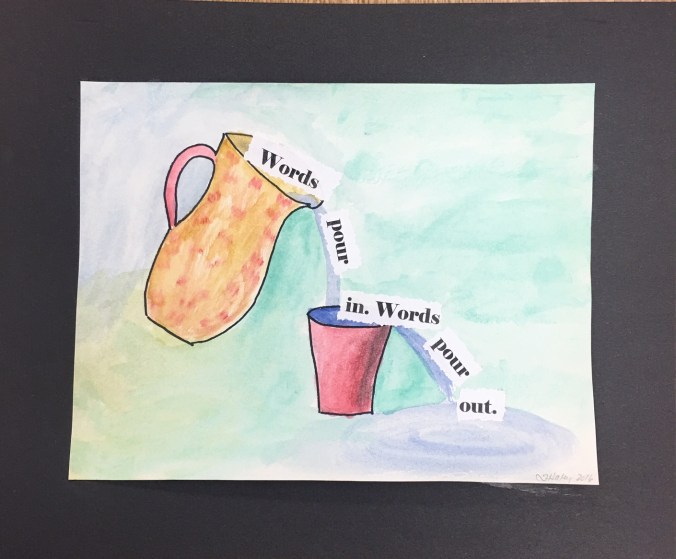
A pitcher, a glass, water pouring . . . .

“I just got an idea of how to make this better!”

I write:

Words pour in. Words pour out.

The children study these words.

“What do you think this means, ladies and gentlemen?”

A boy says, “First you wrote I read, I write, I am and you said you could make it better so I think you mean that if words pour in, you’re reading, and if words pour out, you’re writing.”

Across the room, faces light up.

I smile. “Well done. For a few minutes, share your ideas with your partner and talk about possible ways to begin writing your six-word memoir. Then we’ll all write.”

I listen as the ideas flow in and out, with a hum as vibrant as that of cicadas.

(If you’re interested in reading an earlier Slice on the sound of cicadas: Cicada rhythm)

slice-of-life_individualEarly Morning Slicer