Deeper than data

Moonrise

Moonrise. magnoidCC BY-SA

Papers are spread across the conference room table. The projector shines a graph – a student’s reading assessment history – on a screen. Discussions center on interpreting the erratic data points on a trend line in relation to the aim line toward a goal, the rate of improvement, and whether or not this student is a retention candidate.

A colleague turns to me: “What do you think? You’re the literacy person.”

I consider the numbers, the color-coded risk categories, where this child falls in all of it.

“I don’t know,” I reply. “I haven’t heard this child read.”

Silence. Eyes are on me.

“I need to know what exactly this child is doing during reading, how the child approaches it, feels about it, what the actual strengths and weaknesses are. Until I do, I cannot say what I think. Data is information but it doesn’t tell the whole story, only little pieces at specific points in time. I have to listen to the child.”

I leave the meeting to do just that.

The child is eager to read and turns out to be highly accurate, reading slowly and deliberately; the time that it takes this child to finish reading is why a high risk is indicated on some measures. In fact, the child can read and fully comprehend text above grade level expectation. The only enemy is time, and that’s only an issue in assessing. The desire to read, the ability to self-monitor, and an obvious work ethic so early in life will take this child far.

I think of Brené Brown, professor-author, who says: “I am a storyteller. I’m a qualitative researcher. I collect stories; that’s what I do. And maybe stories are just data with a soul.”

Data is the dust jacket; behind it there’s a story, and in the center of the story is a little soul.

It takes another soul to reach it.

I listen to another child reading with great flow and prosody, to discover that this young reader isn’t making meaning beyond the surface of the text – and struggles a bit even to retell what’s explicitly there. This child, whose data looks near-ideal, “in the green,” is of far greater concern. Supports need to be put in place immediately or this child will fall through the cracks.

On paper – on the dust jacket – this child looks just fine.

A few months ago, as I was printing data reports in the computer lab, I saw a young man walking with a class down the hallway. Subs are getting younger and younger, I thought, gathering my papers and returning to my room to begin analyzing them. Two colleagues joined me at my table.

The young man came into my room, smiling. “Mrs. Haley, do you remember me?”

I look at him. A little face, frowning over a book, springs into my mind. “Yes, I do! Goodness, you’ve grown up!” Mentally, I am counting off years – Good grief, how long have I been doing this?

Turns out he’s not a sub, he’s a high school volunteer. I breathe a little easier about the passage of time. He was one of my first intervention students at this school.

“I am planning to go to college to teach,” he says with a grin. I marvel at his poise. He exudes young professionalism.

“Really? What do you want to teach?”

“Reading. In fifth grade. I think I can help the kids love it. I really didn’t love it until I was in high school and suddenly I couldn’t read enough – I read all the time.”

I am awed. “That’s amazing! I am so glad to know. The kids need you. What a great role model you’ll be.”

One of the colleagues at my table asks: “Was there a particular teacher who inspired you?”

His face – once so little and serious, nearly scowling as he sat at this very table – lights up with a beatific smile.

“Yes. Mrs. Haley.”

My colleagues’ eyes tear up. I cannot even blink, cannot quite process this.

“But – you said you really didn’t enjoy reading until high school,” I manage.

“It took a while,” he laughs. “Reading was hard for me when I was little. I didn’t think I’d ever be good at it. You were the one that gave me the confidence, the one who said I could do it. I kept trying.”

Behind the data is a story. Behind the story is a little soul. A precious one.

Sometimes we never know how the story unfolds once the children go on. We only play a part for a little while, but how priceless is that tiny window.

If data were the whole story, I wouldn’t be a teacher, wouldn’t be writing this now. My parents didn’t go to college; one didn’t finish high school. The odds were against me. But my parents bought books and magazines, my grandmother read to me long before I went to school, and teachers challenged me all along to strive for more.

Another meeting, another table strewn with papers. I stand up. “I have to go now. It’s time for me to read with a student.”

This student and I read every day, if we can. He struggles with vocabulary but his primary issue is lack of confidence – he doesn’t want his peers to hear him.

I am running late. When I find him, he tries to hide a smile.

“I thought you forgot,” he says, as we settle at the table.

“I was in a meeting,” I explain. “I had to leave it.”

Pure astonishment is on his face. “You left a meeting? To read with me?”

“Well, yes. Your reading is important. Let’s get going.”

He looks at me, wide-eyed. “I can’t believe someone would do that.”

“You’re more important than the meeting,” I say.

He smiles in spite of himself.

And he reads.

I listen.
 

Celebrate today

Dogwood

Dogwood. JenniferCC BY

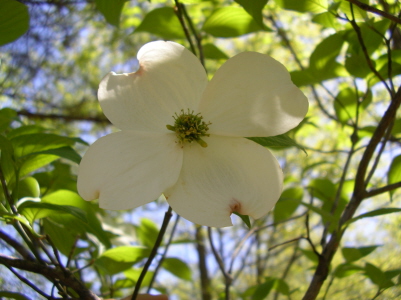
The first day of April – glorious. A sky as blue as it ever gets, hardly a cloud to be seen. Dogwoods and redbuds, bare just days ago, flowering profusely. On the breeze, the scent of blossoms, almost like perfume – winter daphne, I think.

All marking the end of desolation. Nature composes a theme of renewal with color, fragrance, amber light and birdsong.

At the close of the day, I celebrate its beauty. I celebrate the inherent message of hope with the arrival of another spring. Even the news carries a rare inspirational story about a man opening his front door to find his dog, missing for four years, back home on the porch. He sat down and the dog put her head in his lap – what an emotional celebration that must have been.

Today is also the first day of National Poetry month. I have recently discovered a lost booklet of poems that I wrote as a teenager. All things considered, this particular poem struck me as one appropriately celebratory  – winter is over, spring has returned; a lost dog has returned home; my lost poems are found.

I wrote it when I was sixteen. Back then, I called it “Yesterdays.”

Yesterdays are gone

Leaving nothing but memories behind

And, if meant to be, a chance for tomorrow.

So weep no more

For what once was,

For it may be

Once again.

Celebrate today.


Three cheers

Candles

Three is a magic number. Alan LevineCC BY

I love the sound of chimes.

I always have.

There’s something magic in those ethereal tones, something stirring, uplifting, echoing the fairy world, whispering of good things and better yet to come, hinting at happily-ever-afters. Perhaps this is why chimes sometimes play at the end of weddings, their light, airy sound signifying the beginning of a new, hope-filled chapter, the turning of a page.

Come to think of it, when I was little I had read-along books with audiotapes that chimed when it was time to turn the page.

The telephone on the kitchen wall of my childhood home was avocado green with a six-foot cord, and instead of ringing, it chimed. Visitors always said, “There’s the doorbell,” and we always responded, “No, that’s the phone.”

I never knew of anyone else’s phone that chimed like mine.

As a teenager my pulsed quickened at the sound, because I was sure the chiming meant someone was calling for me. It often was. I stretched that cord at least another two to three feet, enough for me to sit on the bed in my room and talk with the door closed. Yes, on the cord.

My smartphone is set to chimes now. When it rings, the melodic tones are like strings of tiny silver plates in the wind.

Perhaps no chime has given me as much pleasure as that of my WordPress app, however.

For me, that’s truly the sound of celebration.

I’ve heard this chime so often in the past month, denoting likes and comments on Lit Bits and Pieces during the Annual Slice of Life Story Challenge with Two Writing Teachers. The chime has come to represent the warmth of this community, the connection of minds, hearts, and kindred spirits, reiterating the power, the magic, of words. I am a first-time slicer and the words of others have borne me far in the completion of thirty-one posts in thirty-one days.

This is the thirty-first post. With it, I cross the finish line – my first cheer.

The WordPress chime also proclaimed two other milestones, two days ago:

Lit Bits 50

I hit the 50-post mark. My second cheer.

Lit Bits Anniversary

Lit Bits and Pieces turned one year old on March 29th, along with my first post. Cheer number three.

When I started Lit Bits and Pieces a year ago, I asked a friend to give me feedback. The friend said: “Hmmm. What’s your niche? Your target audience?”

I said, “I don’t really have a target audience in mind. I just want to write whatever I want to write.”

The friend looked skeptical.

I added, “It’s for human beings.”

To you, Dear Reader, I leave three parting thoughts on this Lit Bits and Pieces celebratory post. Chimes play for you, somewhere in the wind – I hope you hear them as you read:

  • Do, or do not. There is no try. -Yoda
  • Inspire. That means be a life-breather of ideas, tiny notions of stories. – Avi
  • Write.

 slice-of-life_individual31-day-streak-with-border


O. Henry

O. Henry grave 

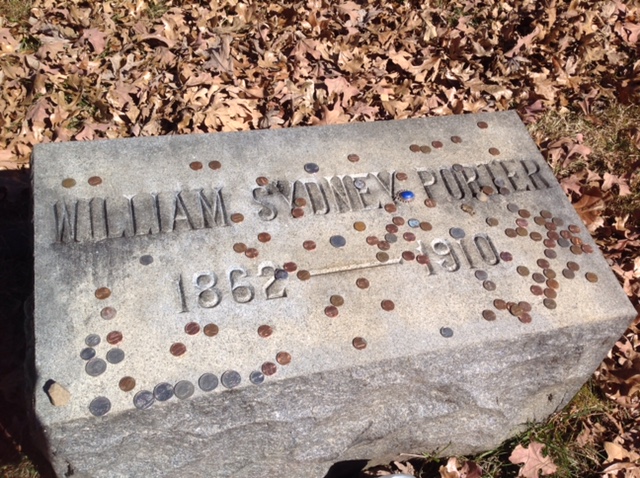
Fall comes early in Asheville, North Carolina. The air is chilly when I get out of the car at the cemetery to visit the grave. I think of winter coming, of Christmas, of this writer’s most famous work. I take a picture, marveling at the coins spread over the gravestone. As I turn to go, a frigid wind gusts, scuttling leaves over the ground and across the driveway.

Leaves . . . I remember that story.

O. Henry’s headstone is covered in coins, mostly pennies, which usually add up to $1.87 –  the amount of money that Jim and Della had at Christmastime in his famous short story, “The Gift of the Magi.” This shortage of money is why Jim sold his gold pocket watch to buy combs for Della’s beautiful hair, and why Della cut and sold her hair to buy a platinum fob chain for Jim’s prized watch. Their sacrificial love for one another has made the story an enduring classic.

There is another story of O. Henry’s that I love almost as well.

I remembered it as I planned to write “Oh, Henry,” yesterday’s post about my son’s dog. I should write about O. Henry next, I smiled to myself. A little word play with the titles. How enticing.

That’s when I thought about the fallen leaves blowing over the writer’s grave.

I scrounged up my old paperback copy of O. Henry’s short stories and reread “The Last Leaf.”

In this tale, two young artists live in a three-story Greenwich Village building. One of them becomes sick with pneumonia. She watches the leaves dropping from an ivy vine against the wall just outside of her window, convinced that she will die when the last leaf falls. To her astonishment, the last leaf hangs on through high wind and rain. To make a short story shorter, the leaf remains because an old artist in the building crawled up a ladder in the dark of a raw November night and painted it on the wall with the vine. The girl begins to recover and the old man, Behrman, dies of the pneumonia he catches from being out in the weather while painting that night.

The old artist had always wanted to paint a masterpiece and never pulled it off – but the last lines of the story have the roommate telling the recovering girl about the leaf: “Didn’t you wonder why it never fluttered when the wind blew? Ah, darling, it’s Berhman’s masterpiece – he painted it there the night the last leaf fell.”

Self-sacrificial love at work again – but there’s more to it.

That leaf symbolized hope, sparking the desire to strive, to overcome. The old artist’s small gesture inspired the young artist to keep living.

This leaves me thinking, in the course of our days as teachers, as writers: Are we not the artists who paint the pictures of possibility, of hope, in the minds of others? Do we spark in others a desire to strive, to reach for what’s beyond their grasp, or to hang on only long enough until this, too, shall pass?

Our masterpieces may never be world-famous; they may be as simple as knowing the right word, the right idea, the right vision, the right story, and sharing it when it is most needed. Inspiration leaps from one heart to another, creating something to hang onto, outlasting high winds and rain. We may never see the full effect of our work, but that’s all right.

We paint the leaves where we can.

I close my old paperback book.

O. Henry, I am so thankful you were here.


slice-of-life_individualEarly Morning Slicer


The coaching tree

Coaching Tree Lg

Early in the school year, my instructional coaching colleagues and I attended district training where participants were tasked with creating an image to explain the coaching process.

My group thought for a moment.

“You know, coaching is an organic thing,” I said. “Or at least it should be. We all know it takes time to develop relationships and trust. It’s about honing practices, sure, but this is a growth process for us as well as for our teachers. We grow together to reach goals.”

A colleague said, “Yes! I’m seeing a tree, branching out . . . .”

In a few minutes we’d sketched the tree. We began to label it, recognizing coaching elements that correlated to parts of the tree. The more we worked, the faster the ideas came.

Relationships are key in coaching, the foundation, but certain things must feed the relationships before the process can begin. These roots are trust, the human connection, listening, collegiality, safety, empathy, and support. Coaches must meet teachers where they are and be willing to plug in with what teachers want to accomplish – it’s not as much about seeing the work as it is seeing a fellow human being. The vision develops from there, and needs to be a shared one.

The trunk of the tree symbolizes this togetherness with inspiration from Shel Silverstein’s The Giving Tree. Near the bottom of our tree, we placed a little heart: Coach + You. The heart of coaching is just that – having a heart for each other.

A solid, thriving coaching relationship branches out into nearly endless possibilities, aspirations, and directions, such as goals, the 4 Cs (communication, creativity, critical thinking, collaboration), encouragement, self-modifying learners, reflection, growth mindset and learner agency.

My coaching colleagues and I stood looking at our work, feeling pretty happy with our Coaching Tree.

“We need to put the sun in,” said a colleague. “The sun is the climate, of course – a warm climate conducive to coaching is necessary for the process to work. That’s where administration comes in.”

We put the sun in.

At this point, something struck me – “Trees bear fruit! What is the ultimate goal of coaching, the payoff? What’s the fruit of our labor?”

We created a basket then, and labeled it The fruit of our combined efforts. It holds apples: Love of learning, data, increased student achievement, teacher fulfillment, students graduating college or career ready. 

As teachers are fulfilled and productive, we desire to branch out into new areas. The growth continues. As students achieve, as they go on with their lives, some will go into the teaching field and the cycle begins anew.

At the close of the training, small groups presented their work to the whole assembly of coaches. The other groups had designed diagrams, cycles, or flow charts, all of which artistically, appropriately encapsulated the continuous reflective coaching cycle of support.

My group was the only one to present the coaching process as a living thing, something organic.

We were startled by the enthusiastic applause from our fellow coaches.

Upon returning to school, my colleagues and I recreated the Coaching Tree in the teachers’ lounge. It stands there to encourage, invite, celebrate, and maybe inspire or spark hope when we all need it, a visual reminder that our work is not in vain, that we’re in this together, to help each other along, and the sky is the limit.

slice-of-life_individualEarly Morning Slicer

The Writing Spa

Welcome to the Writing Spa.

Please put your things down and help yourself to salt scrub – wash your hands and refresh.

Or have some aromatherapy lotion.

Listen to the soft music, the sound of the ocean with the occasional distant gull.

That fragrance in the air? That’s a pillow mist. It’s called Peaceful.

Yes, it does smell very spa-esque, doesn’t it?

Today we will write. It’s so important that teachers of writing write themselves, with and for students.

Today you write for you.

You have a choice of stations: Refresh, Evoke, Escape. Start wherever you like. If there’s time, we will get to all three; if not, certainly two.

Let me explain.

The Refresh sign bears the Isak Dinesen quote: “The cure for anything is salt water: sweat, tears, or the sea.” Which salt water form grabs you first? Close your eyes and envision a scene where this salt water form played a significant role. Where were you? Who was with you? Get back into the moment – show, don’t tell.

Here’s an example, a time when tears played a healing role in my life ….

The sign at the Evoke station reads: “Nature speaks and wafts her perfumes. Capture it.” This is meant to connect us to the natural world with sounds and scents that lift our spirits and make our hearts rise. Write about any sound or any scent that does this for you, and why it has this effect. Who or what is associated with it?

I chose sound. I wrote about cicadas in the summer and what this evokes for me. I will share ….

The last station is Escape. There’s a place you long to return to – why? Who or what is connected to that place? Capture it in detail so the reader goes there with you. Share the reason for its specialness to you.

Here’s one of my special places. I only went there once ….

The teachers write. Some have tears in their eyes; some stop to look into the distance, far beyond the walls of the room, to different places, conjuring different images in each of their minds. The music is soothing. We are breathing in Peaceful. When it’s time to stop, those who wish to share their writing do so with one another; those who’d  rather not share are willing listeners, ready to give positive responses on the strength of the writing. There are more tears. There are also smiles, even a small eruption of laughter at the humor in someone’s writing.

We rotate and repeat.

For reflection, they write a takeaway for themselves and one for their classrooms. They write on white paper. 

Ball up your white paper. This is the Invigoration piece of the spa – we will now have a snowball fight! Have at it!

Much laughter ensures as teachers throw “snowballs” at one another. We stop; they choose a snowball and open it up to read to a partner. No one knows who wrote what and reflections that strike chords are shared with the group. We go another round. 

I hope you enjoyed your Writing Spa, everyone. However you view yourself as a writer, the goal for today is that you found writing a pleasurable experience. Writing must be pleasurable for teachers to be pleasurable for students. We create the atmosphere for writing in our rooms. Think of ways you might adapt what we’ve done here for your kids – pay it forward.

On your way out, by the door, there’s a basket of chocolate – help yourself to Chocolate Therapy. 

Go forth in writing wellness.

*******

I did two variations of the Writing Spa, one with teachers at my school last December and one on Monday with teachers attending the North Carolina Reading Association Conference. Improving writing instruction has been a major focus at my school for a couple of years, the most frequently-requested area of support. The spa was born from a synthesis of ideas: Teachers, however they feel about writing, need to have enjoyable experiences with it; professional development needs to lift teachers’ spirits; writing is about going deep, tapping the power that lies within us.

You are welcome, if you like, to read my sound and place pieces shared for Evoke and Escape.

I’m still working on my salt water piece.

(I finished itBaby’s breath)

slice-of-life_individualEarly Morning Slicer


Laughing Buddha

Hotei

Hotei Buddha. Shanna RileyCC BY-SA

“Come see what your aunt brought you!” Mom calls. 

My aunt has given me some pretty neat gifts: A shirt with iron-on letters that say Bookworm and a Partridge Family album. She’s a fun person, sometimes, like when she records us singing Olivia Newton-John songs on her tape recorder and says we sound professional, or lets me try on her wigs.

I can hardly wait to see what she’s brought this time. I fly down the hall from my bedroom to the living room.

My aunt is smiling wide. She hands me something wrapped in brown paper, saying: “Be careful -it’s breakable.”

I unroll the wrapping, pull out the breakable thing.

It’s a statue. A little bald man with a big belly and no shirt, wearing only a skirt, with his hands up in the air. He is laughing – at me, I think, because I don’t know what in the heck he is.

He’s also solid pink. A little darker than Pepto-Bismol.

I am confused. 

“I made him in ceramics class,” my aunt says, looking pleased with herself. 

Every grown-up female I know is making ceramics or macrame or decoupage. But I’ve never seen anything like this fat little pink man.

“What is he?” I ask, feeling disgusted, while he laughs at me silently. 

I think about dropping him.

My mother glares at me.

“He’s Hotei. If you rub his belly, he’ll bring you good luck,” says my aunt.

I want to say he needs it for himself, but my mother speaks up:

“Look at what’s underneath.”

I turn Hotei head down. Under the base on which he stands is an inscription:

Made for Fran with love. Aunt E.

I look up at my aunt and see the earnestness in her eyes.

She never married, never had children of her own. When I went to high school, she attended my plays, convinced that I’d make it on the stage in New York City. She directed my wedding, bought dozens of outfits for my first child. When I started trying to write short stories, she asked to read my work.

“You should send this to magazines!” she said, genuine excitement in her voice. “You could be published!”

She didn’t live to see my second child.

Hotei sat on my bedroom shelf for many years, and yes, I rubbed his belly. Some days more than others.

But I didn’t need him for good fortune, not really.

I had my aunt.

slice-of-life_individualEarly Morning Slicer


Where the meaning is

My colleague is weeping.

She’s just read aloud a passage from The Unstoppable Writing Teacher: Real Strategies for the Real Classroom by Colleen Cruz, specifically from Chapter Five, entitled “I’m finding some student writing repetitive and boring.”

In this passage Cruz  relates the story of being observed by teachers who said that some students in the class had chosen “boring … almost shallow” personal essay topics. Cruz confers with one of these students. He’s writing about why Christmas is his favorite holiday – his reasons are the food, the presents, watching videos. As Cruz continues to converse with the boy, she feels pressure building under the skeptical eyes of the observers; the conferring is going nowhere. But Cruz presses on. She keeps talking, feigning enthusiasm: “There’s just so much to say about videos on Christmas. I would love to hear what you have to say about them.”

And then the boy explains that every year on Christmas, after the presents are opened, his mom lets him watch all their previous Christmas videos, when his dad was alive. She can’t endure the videos during the rest of the year, but at Christmas she watches them with her son.

“It’s like we’re all together again,” said the boy.

Like Cruz and the observing teachers in the story, my book study colleagues and I all have tears in our eyes.

I write in the margin of that page: Go deeper and deeper to the meaning. 

I think about a second grader writing realistic fiction. Her first attempt at dialogue was rambling, pointless; the characters were talking but not saying anything. When I mentioned that we can add things from our own lives to make characters think and feel things that we do, to “make it real,” she revised the dialogue to a conversation about a girl who was worried about her new stepfather liking her. When she read it to me, I said, “Wow, your story really came to life there! What made you write about the girl’s worries over her stepfather?”

The child answered, solemnly, “My mom is getting married next weekend.”

I think about a girl describing how she and her grandmother waded through the regular flooding of their impoverished hometown in Viet Nam.

I think about a fifth-grade boy who never liked writing, how he developed an enthusiasm for it with his memoir on making the hard choice to tell the truth after having lied. A girl new to the school wrote about a girl having to move often. The piece opened with the narrator shouting at her mom; the anger was palpable.

A dim recollection of the movie Where the Heart Is flits through my mind – the young pregnant girl pressing a hand against her abdomen, saying, “That’s where the heart is.”

Cruz says students “have a subconscious need to write about particular topics, but they don’t consciously know why.”

Our job, then, as writing teachers, is to help students go deeper to the why, to where the heart, the meaning, is.

slice-of-life_individualEarly Morning Slicer


The storm passes by

Church after tornado 6-18-13

Our phones are popping at the same time:  “Take cover immediately . . . .”

Outside, the wind gusts; objects are striking the building, the windows.

We quickly gather the children who’ve come for Vacation Bible School – there’s about seventy of us in all – and they get down on the floor, balling up with their heads against the painted cinderblocks of the main hallway.

The wind is roaring now. The electricity goes out. The emergency lighting flashes on, bright as spotlights, adding a stark, garish quality to faces and bodies. The fire alarm goes off, a deafening blare, as it’s right above us. A boy with hearing aids rips them out of his ears.

The children are still, silent, as heavy objects strike windows in classrooms – will the windows shatter? For a split second I am tempted to look out and see if Miss Gulch is riding through the air on her bicycle just as she morphs into the Wicked Witch of the West.

Instead I kneel over several children as a shield, leaning my head against the cool concrete wall.

These walls are solid, I think. Safe.

But just around the corner in the fellowship hall is a hutch with a large, framed photo of the church when it was nearly flattened by a tornado twenty years ago.  

Minutes are eternal when destruction is banging on the door.

If we die, I think, at least we are in church.

My husband, the pastor, prays aloud.

The wind soon abates, dies away.  

We go outside to find long strips of vinyl from someone’s home strewn in the parking lot. Big pieces of plywood from who knows where are lying against the building. Shingles are scattered about like fall leaves. The trashcans are way across the graveyard – we trek over to fetch them and we see the gap in the woods where the tornado came through. It cut a path through the cemetery, knocking down a line of gravestones. Silk and plastic flowers, little angel statues and other loose memorials left by families for their loved ones are blown everywhere.

The children retrieve and replace them.

Parents begin arriving, alarmed. Others in the community come to see if everything’s okay.

Just as we are leaving, I turn back toward the church – “Look!”

Arcing up from the woods across the street to the woods behind the cemetery, in the sky directly above the church, a rainbow gleams.

All is well.

slice-of-life_individualEarly Morning Slicer

A rising tide lifts all boats

Boats

Fishing boats. karol m. CC BY

At a recent team meeting of K-12 cross-curricular educators dedicated to improving writing instruction, we discussed the Calkins and Ehrenworth article entitled “Growing Extraordinary Writers: Leadership Decisions to Raise the Level of Writing Across a School and a District” (The Reading Teacher, Vol. 70, No. 1, July/August 2016). While takeaways included the need for a shared vision of good writing and good writing instruction, as well as a need for shared expectations and ways to track growth – the reason for the formation of this team – what struck me most was this line on the transformative power of professional development: “It should be focused on strengthening teachers’ methods and spirits.”

Yes. Spirits must rise, I thought. Before we can raise the level of writing, before we can raise the students at all,  we must first raise each others’ spirits. 

The truth is that professional development is so seldom inspirational. For the last year, when I planned professional development in writing for teachers, my driving question was, How can I inspire them? How can they tap into the wellspring of their own power, their own voices, all that matters to them?

When I spoke on this at the meeting, a colleague chimed in: “We have to be the rising tide. If we rise, we’ll raise others with us.”

“Yes – a rising tide lifts all boats,” I responded, recalling those words associated with John F. Kennedy.

I grew up in the Tidewater region of Virginia. I have been on the Chesapeake Bay-Bridge Tunnel when the tide was high, in a storm; as I descended into the tunnel, waves crashed above the entrance and spilled over the car. A layer of salt remained on the windshield when it dried. I’ve seen boats grounded when the tide was low, making the would-be sailors push and pull that much harder to get them afloat. I’ve walked floating docks of marinas on sunny days, feeling the sway of the boards under my feet as boats rocked with the incoming tide, the metal of their moorings and buoys clanking softly, rhythmically, as if coming to life with with the rising flow.

When the tide rises, it lifts everything with it – everything rises.

When our spirits rise, we lift others around us – everyone rises.

That’s so needed in education today.

It’s so needed everywhere.

The power lies within you. Tap into that inner wellspring; let it flow.

And rise.

Note: The one word I chose for for myself at the beginning of this year is Rise. If you’re interested, here’s my little poem: Rise.

slice-of-life_individual