Jewels

On March 17th I typically write a post contemplating my obscure Irish roots while celebrating the novelty of my grandfather’s middle name: St. Patrick. Yes. For real. No one knows why, my down-east North Carolina Methodist Granddaddy hated it, and by my lifetime he’d legally changed it to the initial S.

I love the uniqueness of it. I cannot let the day pass without saying that Columbus St. Patrick Brantley’s name remains a treasure to me, a jewel in my family’s living memory, a perpetual mystery in our supposed non-Catholic history.

Here is where I diverge from my norm to chase, not a name, but a word: jewels. In keeping with the day, of course. The first jewel I’m after is brilliant language, and the Irish are rich in that. It glimmers in every bit of their wit, storytelling, poetry, and song.

In 1996, Frank McCourt’s memoir Angela’s Ashes burst upon the world and won the Pulitzer Prize. As soon as I learned of the book, I had to have it. Reviewers raved about McCourt’s narrative voice: Stunning. Lyrical. Dazzling.

So I got my own copy. From page one…spellbinding. My concepts of writing and memoir were forever changed; McCourt’s Irish voice has never left my head.

Of his many glorious phrases, one that returns to me most often comes from the scene where young Frank is in the hospital recovering from typhoid fever. In the room next door is a girl recovering from diphtheria. They can’t see each other, but she calls out to him. She says she has a book about the history of England with her, if he’d like to read it. He does. Books are treasures to him; his impoverished family doesn’t own any. The girl sends the book to him via the nurse, Seamus, who delivers it most reluctantly, complaining because it’s about England “after all they did to us” and that there “isn’t a history of Ireland to be had in this hospital.”

McCourt writes:

The book has the first bit of Shakespeare I ever read:

I do believe, induced by potent circumstances
That thou art mine enemy
.

...I don’t know what it means and I don’t care because it’s Shakespeare and it’s like jewels in my mouth when I say the words.

Jewels in my mouth…

I knew exactly what he means. I loved Shakespeare from my own first encounter. The last line of Sonnet 73 is the heartbeat of most everything I do in life, certainly of the things I write: To love that well, which thou must leave ere long. Jewels in my mouth, in my heart…the bequest of beautiful language.

McCourt eventually left Ireland for America where he became a high school English teacher. He’d regale his classes with stories of his childhood, and they’d say Hey Mr. McCourt, you should write a book.

So he did.

Angela’s Ashes.

And so the world is changed.

That is the power of story.

That is the second jewel from McCourt: Story. Specifically, writing of your own life.

In his final memoir, Teacher Man, he’s become a creative writing teacher. He’s trying to inspire students to write about their lives when they think there’s nothing interesting to say. He tells them: Every moment of your life, you are writing. Even in your dreams, you’re writing…Dreaming, wishing, planning: it’s all writing, but the difference between you and the man on the street is that you are looking for it…realizing the significance of the insignificant, getting it on paper. You might be in the throes of love or grief but you are ruthless in observation. You are your material. You are writers and one thing is certain: no matter what happens, you’ll never be bored again. Never…nothing human is alien to you.

Jewels. Your words, your story, your every moment. All priceless.

I met Frank McCourt in the winter of 2000 when he visited North Carolina State University. I went despite a falling snow. I took my oldest son with me and we listened to McCourt speak of his books and devastating childhood in Ireland. We listened, and marveled. We listened, and wondered about the story of our own origins on The Emerald Isle.

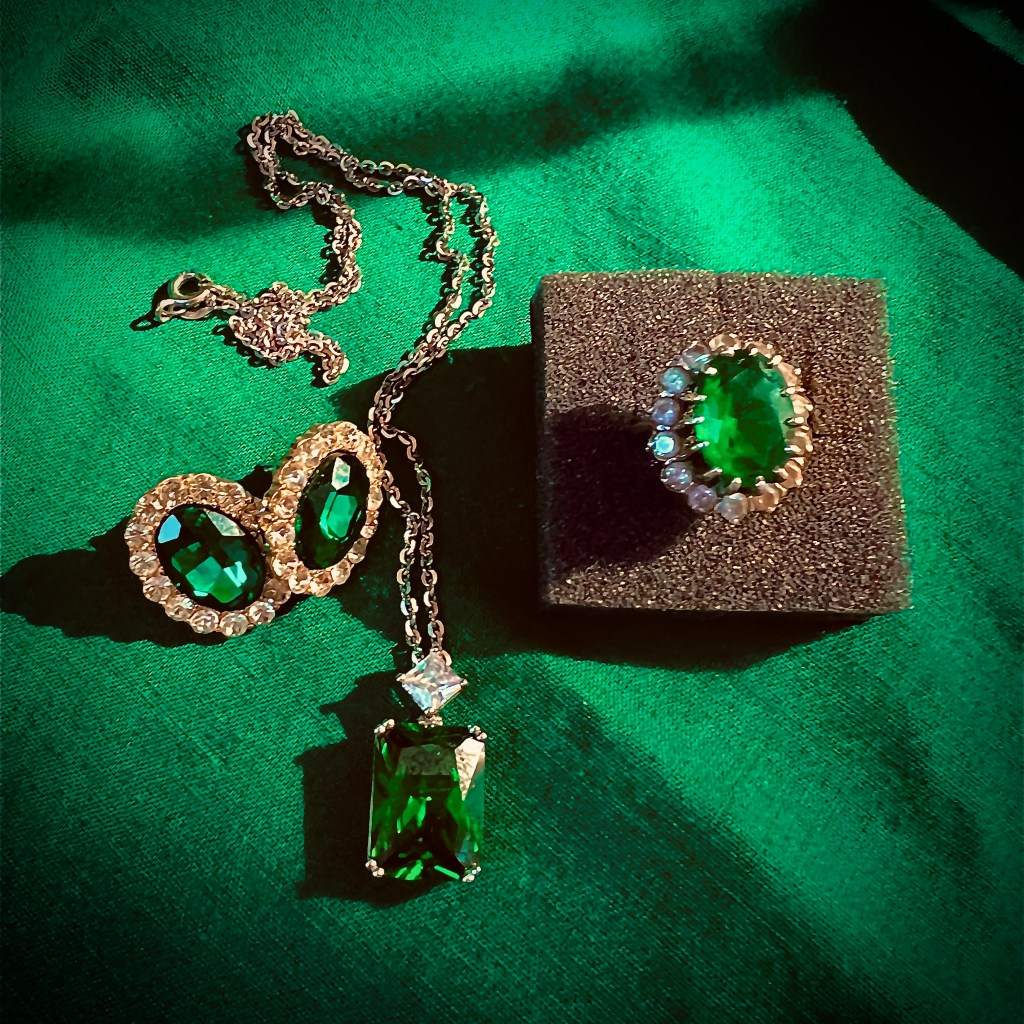
Which brings me to my final set of jewels for today: Christmas before last, my husband gave me a necklace and ring. His sister, without knowing or discussing it with him, gave me earrings. The jewelry, all bearing my birthstone, emerald, are a startling match. My sister-in-law chose the jewelry for me because she loves the color. My husband said, These are to remind you that one day, I’ll take you Ireland.

Where, I imagine, the voices of my distant ancestors still whisper in the wind…perhaps when I go, if I am very still, I might hear them…learn from them…

Until then, and always, I shall be about the excavation of my own story-jewels, with McCourt’s words echoing in my brain and my curious link to St. Patrick forever pulling at my heart.

As for today… here’s to proudly wearin’ o’ the green.
*******

Composed for Day 17 of the Slice of Life Story Challenge with Two Writing Teachers

*******

Works cited:

McCourt, Frank. Angela’s Ashes: A Memoir. New York, Scribner, 1996. (Pages 195-196)

McCourt, Frank. Teacher Man: A Memoir. New, York, Scribner, 2005. (Pages 244-246)
Of foxes, finches, and Franna

Today I celebrate language.

Let me begin with the fox.

Last Friday I arrived at a hotel ballroom for a breakfast buffet in honor of educators and volunteers who had read aloud to children throughout the year. We had concluded a program built on developing positive relationships and instilling a love for reading in the kids.

There at a table, greeting folks upon arrival, sat the fox.

The Poetry Fox, to be precise.

A guy in a furry fox suit, typing away on an old-timey typewriter.

Turns out that if you gave the Poetry Fox a word, he would type a poem for you on the spot.

I nearly forgot the breakfast altogether; I had to stand in line for a poem.

Two women in front of me gave him the words daughter and twins (who are leaving the nest to go to college). Within two or three minutes, Poetry Fox tapped out each poem, stamped his “official” seal on the pages, and read them their poems.

I can hardly describe the looks on these women’s faces. Radiant. Smiling, slightly open-mouthed. Eyes wide, misting. The air about them even seemed to glow…

My turn.

“It’s National Poetry Month,” I said to the Fox.

“Indeed!” he replied with glee.

“As I love reading and writing poetry… that is the word I give you. Poetry.”

“Wow, no one’s ever asked me to write about the word poetry before,” said Poetry Fox. “I get creativity and inspiration but not poetry…okay, let’s go!”

He rolled a sheet of paper in the old typewriter and pecked away.

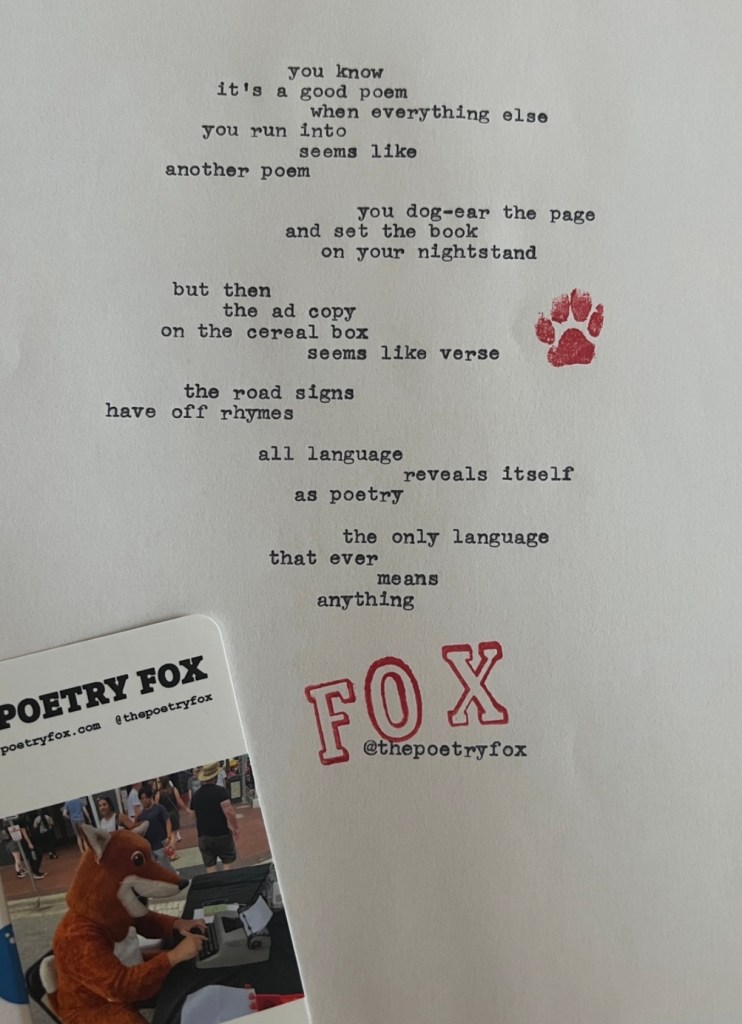
Here’s the poem:

In a word: awe. It’s my life-word anyway… those last lines, especially.

all language
reveals itself
as poetry
the only language
that ever
means anything

The glow of this poem, and the wonder of the Poetry Fox whipping it out on the spot, stayed with me for the remainder of the day…to be honest, it hasn’t left yet.

Early the next morning I was still thinking about poetry being the only language that ever means anything when the sound of loud, melodic chirping echoed through the house. The finches nesting in my door wreath, feeding the hungry babies. In the beginning, before their eyes are open, the babies sense a presence and open their mouths in silent cries for food. They do not yet have voices. They do now. They chorus like tiny Oliver Twists: Food, glorious food! We’re anxious to try it…three banquets a day, our favourite diet! Except that they consume more than three banquets a day; Mama and Papa work hard to keep the babies fed.

I decided to chance a photo when the parents were out fetching… when I neared, speaking quietly so they could hear me coming, the babies fell silent at once. They do not know what I am, but they know I am not Mama or Papa with food and instinct tells them don’t make a sound.

I am happy to report that all are presently doing well (you can see all five baby beaks here):

The baby finches deepen my awe of language and poetry. They are language and poetry to me, with their musical chatter and even in the cessation of it. So tiny and new, but so infinitely wise.

Which brings me to my granddaughter, age eighteen months.

She came that afternoon to stay with my husband and me. We marvel at the new words she’s acquiring every single day, how she studies our faces for responses, how she mimics actions. She now says Grampa quite clearly, to my husband’s utter delight. I’ve tried and tried to get her to say Franna, but she only grins; is she teasing?

But on this afternoon, she stopped playing with her favorite musical toy to walk over to him where he sat in the recliner. Looking up at him, she patted his hand with her tiny one.

Grampa, she said. Grampa.

It was a holy moment. I don’t know how else to say it. She was naming him, claiming him. A sacred act. My eyes welled.

And before I knew it, she was standing before me where I sat on the couch, looking at up me with gleaming brown eyes.

She patted my hand.

Franna, she said.

Pure poetry.

The only language that ever means anything.

*******

with thanks to Two Writing Teachers for the weekly Slice of Life writing share
and Lionel Bart for the song “Food, Glorious Food” in the Broadway musical Oliver!
and Poetry Fox
and the finches
and my beautiful Micah

Translation

with thanks to Jennifer Guyor Jowett for the Open Write invitation on Ethical ELA today:

Think about your reality.
What do you see today?
Ponder the possibilities before you.
Allow a free verse poem to develop.
Begin with the line I see…

*******

Translation

I see the sign
on an office wall

simple black frame
simple black font
on a plain white field

devoid of décor

just words:

Alles ist fertig;
es muss nur noch
gemacht
weden.

I do not read
or speak
this language

but that doesn’t keep
images from
springing to mind:

I see furrows
lush and green against
chocolate loam soil
spread out
like a billowing blanket
to tree-lined ditches

I see my childhood
materializing like a ghost
in the white summer haze

I see the cadence
of cicadas
and storytellers
around the dinner table
long ago
(yes, I see them;

rhythms
have shape
and color

as tentative as candleflame
as sustaining as river
as permanent as earth).

—I see it all
even if
I don’t always know
what it all means.

Eventually
I’ll translate
what I see
into words
on a page
for the knowing.

Everything is ready,
it just needs
to be done.

Essence experiment

My kindred-spirit-blogger-teacher-writer friend Lainie Levin had a fun post this week on a favorite exercise with young student writers: playing with suffixes added to your name, then coming up with a definition of the essence of you. Lainie calls this “nounifying yourself.” Here’s her suggested suffix list:

-itude
-ness
-ility
-age
-dom

-ity
-ship
-sion
-ance/ence

-al
-ation
-iety
-ment

Naturally I had to accept her invitation to compose (read more about her process and see fun student examples in her lively post, Word Play – thank you for this, Lainie!)

Frandom

The quality of maintaining a quiet inner realm despite the world’s clamor, where one’s thoughts are free to be one’s own; typically achieved through experiences with reading, writing, nature, and awe.

A drawing of me by my granddaughter last year: Franna in her Frandom?

On Tolkien

All that is gold does not glitter,
Not all those who wander are lost;
The old that is strong does not wither,
Deep roots are not reached by the frost.
From the ashes, a fire shall be woken,
A light from the shadows shall spring . . . .
—J.R.R. Tolkien

I went to see the movie Tolkien this weekend. My thoughts, while sitting in the darkened cinema, watching it play:

Story is magic.

Reading aloud is magic.

Words are magic.

All are part of writing magic. 

Whatever critics may say of the movie, however accurate it may or may not be in depicting the early life of John Ronald Reuel Tolkien, as a writer, I loved it. For me it beautifully captured the way a writer’s mind works.

When young John Ronald sat by the fireplace, utterly captivated by his mother’s reading and enactment of a dragon, I could relate to how the book and her voice spurred images to life in his mind. How flickering shadows on the walls, thrown by a candle carousel, took on the shapes of  mythological beings, how story played in his brain as vividly as this movie played in mine. I understood how these images stayed with him long after his mother died, after he landed as an orphan in a boarding house, even how they grew nearer, larger, clearer on the battlefields of the first World War while he succumbed to trench fever. I admired the artistry of the shadowy images recurring onscreen as part of Tolkien’s memory, recognizing: That is exactly what images DO. Once they spring to mind, they are THERE. They lurk, they submerge, they resurface. They’re never gone; they settle and swirl about again, waiting, waiting, waiting always, for the solidity of a page.

I loved how the movie emphasized the young Tolkien’s passion for words, particularly in a romantically-charged scene with Edith Bratt, who would become his wife. Tolkien speaks of the beauty of the phrase “cellar door.” He is enraptured by the sound of it. Edith tells him that it is not the sound of  a word that gives it beauty, but its meaning—what the word stands for, all that it connotes. This is reiterated in a scene with Tolkien and Joseph Wright, Professor of Comparative Philology at Oxford, on the mightiness of ships, buildings, civilizations, history, all summed up in a three-letter word: oak. Connotations, connections, deep, deep roots, power . . . in language, in phrasing, in a single word . . . is this not an ancient alchemy that writers come to know? 

And, at the same time, how captivating is the story of an orphaned boy making it to Oxford, himself becoming a renowned professor of philology (the study of the structure and historical development of language, if ever you’re a contestant on Jeopardy!). It’s the story of a man overcoming circumstances and being a genius, the roots of which run back to Tolkien’s childhood, to the Latin his mother taught him, to the stories his mother read aloud to him.

—Story.  The apogee of language, of words. The ultimate form for which language and words exist. The creative force, perhaps, that calls them, drives them . . .

In the final scene of the movie, Professor Tolkien sits at a desk before an empty page and begins to write a now-famous line. I’ve read his own account of this: he was grading examinations, mind-numbing, “soul-destroying” work, when he discovered a blank page in an examination booklet. Without knowing why, he wrote on it: In a hole in the ground there lived a hobbit. This instantly reminded me of J.K. Rowling, how the idea of Harry Potter just “fell into her head” as she was riding a train. The genesis, the magical conception, of story;  it does not exist, but then, inexplicably, in the blinking of an eye, it does, and the world is changed by it. The Tolkien Society relates that after the professor wrote that line out of nowhere, he then needed to know: What was a Hobbit? Why did it live in a hole? To find out, Tolkien began to tell the story to his children . . . and thus, eventually, was born the archetype of all modern fantasy.

The old that is strong does not wither. Deep roots are not reached by the frost. From the ashes, a fire shall be woken. A light from the shadows shall spring . . . yes. It seems to me that in these words of his lies proof that old stories Tolkien began learning as a child remained strong in him; they didn’t wither. They sparked in him an unquenchable fire. Those roots of his love for language, quests, myth, survived the freeze of profound loss. His memories, experiences, the images from his childhood onward, all are the shadows, the ashes, from which his own stories spring.

So it is with writers.

Even if all who write are not Tolkien.

It’s still magic.