The letter

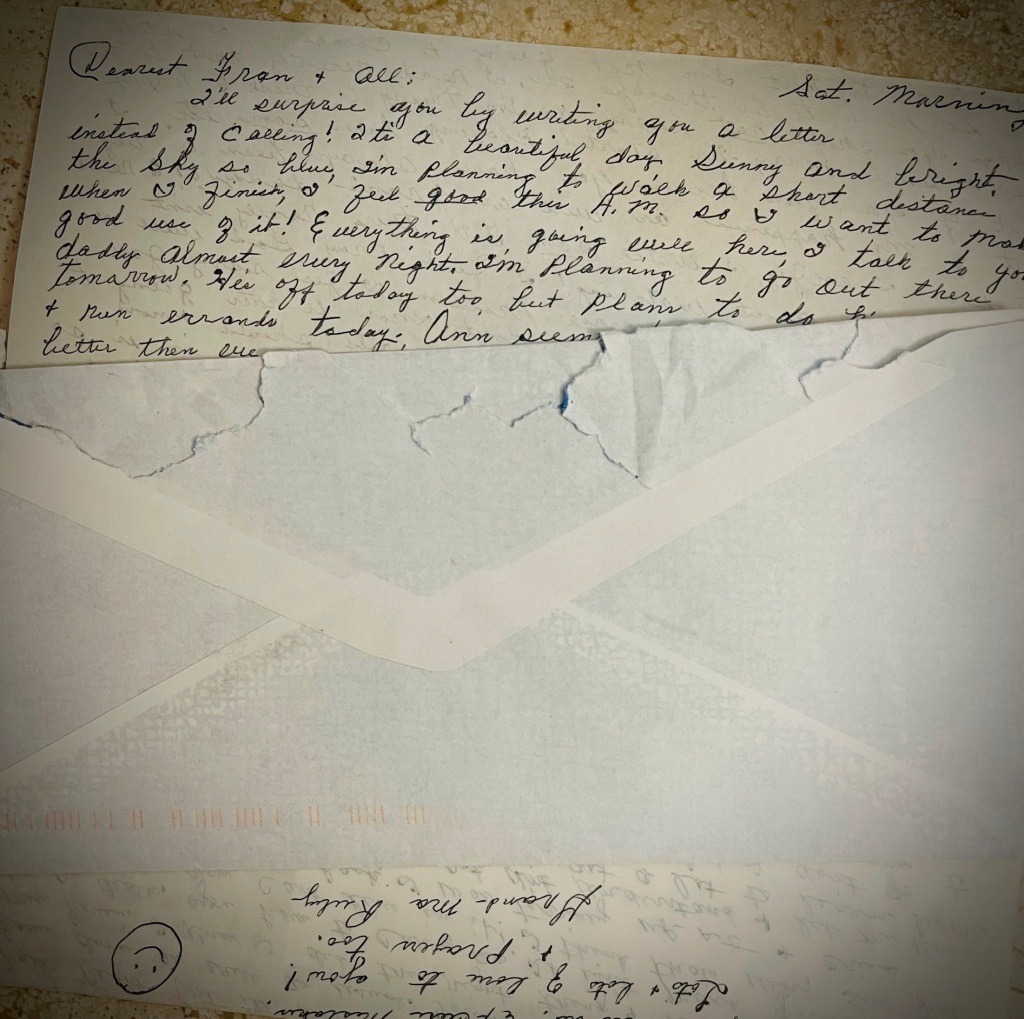
I found it in one of my old Bibles when I was preparing to speak at a women’s conference.

A letter from my grandmother.

Postmarked September 29, 2001…not long after 9-11. In the wake of what seemed the end of the world.

She wanted to surprise me with a letter. She’d written dozens to me throughout all the years we lived in two different states, since I was six. In her eighties, however, her fine penmanship had begun to look shaky on the page. She had taken to making phone calls more and more.

She writes of the beautiful day: sunny and bright, the sky so blue. I’m planning to walk a short distance when I finish and feel good…

She writes of family, that she talks to my daddy every night, and tomorrow she will see him. She writes that my mother seems to be doing good, better than we even thought! I no longer remember the context of this statement; my mother was frequently in poor health, in body and in mind.

She writes of my Aunt Pat’s moonflower, presently blooming, and asks if I remember her moonflower growing around the stump of Granddaddy’s pecan tree by the old dirt road and that she once had another by the pump house…its runners grew on the pump house, shrubs nearby, and the fence.

For a minute, I am there, walking in long ago, seeing the profusion of white blooms, breathing their perfume…

Then she tells me not to worry about her. She had given up her house and had come to live with my aunt; at 85, unsteady on her feet and occasionally falling, she could no longer live alone. She writes: I have accepted it, like a death. You have to carry on.

She admits to crying a lot at first. Then: I’m not going to complain. I still have so much to be thankful for. I read recently that to be happy, you should act happy, so I’m trying to think happy thoughts and smile more…I think of you often because you have always been a big part of my happiness as well as Grand-daddy’s!

She read books; she played tapes of gospel music; she prayed for God to see fit to take care of our world problems. She writes of violence and violent people not knowing what being happy is.

She misses her piano, her most-prized possession. She says that since she couldn’t take it with her when she gave up the house, she’s glad I wanted it: I hope it will bring much happiness to you and the boys.

She would never know that my youngest would learn to play on that piano, that he would become a phenomenal musician, that he would learn to sing all the harmonies in gospel songs, that he would eventually obtain a college degree in this, that he would lead choirs.

She writes that she hopes to see me and the children soon, even if for a little while, knowing I’d go visit my parents, too. She so wanted to spend time with my children…

She closes with her love and prayers too.

Two tiny notes are included also, one for each of my children, then ages twelve and four. In the note to the youngest she mentions hummingbirds…they will soon be flying to a warmer climate but will come back at Easter.

As I hold these written treasures in my hands, savoring every word, a little shadow flickers at the kitchen window. A hummingbird, coming to my freshly-refilled feeder.

A year to the day after Grandma wrote this letter, my father would die suddenly. The flood of grief would overwhelm her; dementia would soon settle in, and she would be in a nursing home for four years until her death at age 90.

I reread of the beautiful day, sunny and bright, the sky so blue, that she’s talking to my father every night, that my mother’s doing better than anyone ever expected… I reread her words of acceptance and carrying on, of her great love and prayers for me. I think about how these buoyed me through every day of my life…even now.

I fold the letter back into its old envelope. I finish my lesson for the women’s conference, on learning the unforced rhythms of grace.

I carry Grandma’s letter with me.

I carry on.
*******

with thanks to Two Writing Teachers for the Tuesday Slice of Life Story Challenge

Letters

img_2699

It’s a neither-here-nor-there day in June, the middle of the year, not exactly warm but not really cool, either. The blinding noon sun makes for dark shade under the trees while an intermittent breeze stirs the new leaves, dappling the sidewalks with moving shadows. People come and go from assorted shops, crossing the cobblestone street. Their voices are muted, distant. I concentrate on guiding my husband’s steps over the uneven pavement. Still adjusting to having just one eye, he struggles with depth perception and will stumble, so he grabs hold of my arm. The restaurant where we’re headed for lunch is just ahead and I am fantasizing about the she-crab soup when I happen to glance to my left, and that’s when I notice something unusual.

There, nestled close to a house entrance, in the flickering light and shadows, is an old letter box.

I’ve walked here many times and haven’t seen it before.

It appears to be wrought iron, standing on a pedestal. Ornate. I can’t tell how old it is; probably a replica, fittingly weathered.

It captivates me completely.

I forget my soup, my husband; his hand slips away. I wonder what stories might surround this vintage mailbox.

I can almost see a woman in long skirts, shawl pulled tight in one hand, a poke bonnet enshrouding her face, a creamy parchment envelope clutched in her other hand. A letter to her husband, off in battle:

The garden is thriving. I’m putting up quarts of snap beans and pickles, and soon I’ll be about the fig and pear preserves. The cow is sickly, however. I don’t think she’s long to be with us. I pray that your cough is better than when you last wrote. I think of you every passing hour, marking them with determined delight, as each one that passes brings your return that much closer. Baby and I miss you desperately. You will not believe how she’s grown in your absence, or how like you she is, so full of confidence. It shines in her eyes, which are your eyes, always reminding me . . . .

Or maybe there’s a barefoot girl in a long white gown, loose hair rippling over her shoulders, sneaking from upstairs to leave a letter just before daylight, darting back inside before the roosters crow and before a young man on a horse clip-clops down the street. He dismounts, goes to the box, finds what he’s waiting for—a time and a place. She’ll be there. He folds the letter, tucks it inside his shirt pocket, against his pounding heart, just as he remembers he shouldn’t be seen here. In one swift motion, he’s astride the horse and down the cobblestone street, fog closing in after him.

Maybe there’s a portly, mustachioed man in an overcoat, golden watch chain glittering against his vest, retrieving a notification that all his investments are gone. He staggers back against the house, slides down, collapses in a heap on the sidewalk.

Or a black-haired boy in breeches mailing a scrawled envelope: Santa Claus, North Pole. He isn’t asking for anything for himself: Dear Santa, This year can you please bring my Christmas present early? It isn’t really for me. It’s for my Mama and Papa. My baby brother only lived three days and they’re so sad. I didn’t even get to play with him or teach him how to play ball or take him for a ride in the goat-cart. If you could, please, Santa, could you bring a new baby brother? Or even a sister? Or can you ask God to send one soon, so Mama will not cry anymore?

Or . . . .

“Are you coming or not? Why are you just standing there?” My husband has gone several paces without me and has had to come back.

“Oh!” I start, my reveries vanishing. “I, um, just wanted to take a picture of this old mailbox.” Out with my phone. Center, snap. Done.

“Okay. Let’s go. I’m starving,” I say.

But it’s not she-crab soup I’m now hungry for, or food at all. I am craving the character of people who knew how to persevere, who could not have imagined sending and receiving messages on devices within seconds and growing impatient even with that. People who didn’t have the entire world at their fingertips but who read the world in a different way, with a wisdom born of living close to nature. People who knew how to read one another, who knew what mattered most, who had to wait for it, who kept on living in the meantime lives that were far richer with much less.

For everything that is gained, I muse, how much is lost.

For a time, then, I leave the mailbox behind me, but it remains in my mind, an image even clearer than the one on my phone. It pulls at me like an ancient lodestone draws iron. Every time I pass by now I will have to look and make sure it’s still there. I need for it to be. I want to step into the silence, into the moving shadows, to discover what messages await me there, to marvel over whence they come.

slice-of-life_individual