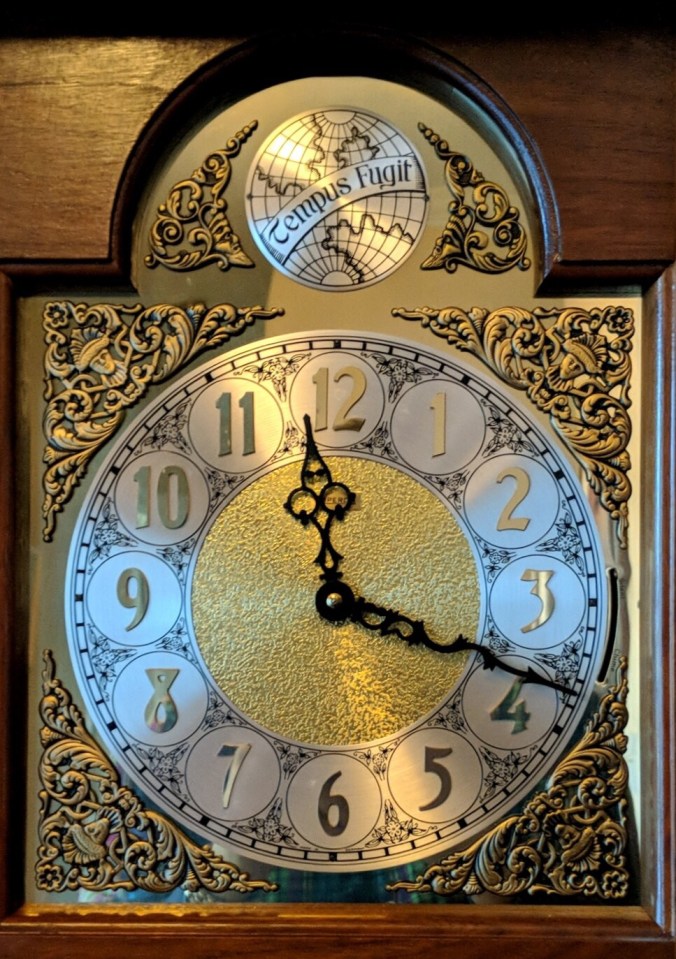
Tempus fugit

Tempus Fugit

(Time Flies)

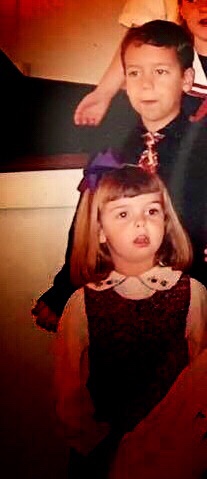
They should still be preschoolers

singing in the children’s choir

round-faced cherubs, both

ever so serious.

Time flies.

Or

children on vacation

tasting salt on their tongues, brine in the wind

with sand on their toes, in their hair

eating pickles from a jar.

Time flies.

Or

teenagers at Bojangles’

laughing, cutting up

marching in the band, going to the prom

still singing the old hymns together.

Time flies.

Or

college kids, going their separate ways

friends temporarily parted

by finding their own paths, until

one ended on a fresh spring night.

Time flies. 

She wrote that he was part

of her favorite childhood memory.

On the eve of her funeral, he dreamed

he heard her singing

of the ocean.

Time flies

Time flies

Time flies.

*******

One year ago today, my younger son (the Cadillac man) lost his childhood friend in an accident. 

She was eighteen. 

Cadillac man shares his writing!

A few days ago, I wrote about my son, the Cadillac man. I call him this for his lifelong love of the brand, especially his grandfather’s 1989 Sedan de Ville, which was bequeathed to him. I wrote how the Cadillac man hates writing and only did what was necessary all through school, to my despair.

Sometimes the smallest things shift the universe in mighty ways. During my month-long daily Slice of Life Story Challenge, Cadillac man read my blog post from our dog Henry’s perspective and was inspired, for the first time in his twenty years, to write a story.

“I wonder,” he said, “if I can write a post from Nik’s perspective. To see if I can actually do it.” 

He DID do it.

Then he said, of his own volition (wonders never cease!), “Mom, you can put it on your blog if you want to.”

Here’s what you need to know: Nik is our very old dachshund. We got him as a puppy when Cadillac man was only four. The old man in this story is my husband (“WHAT?” my husband howls with laughter—he’s loud, all right—”Old man? Really?”). The boys are Cadillac man and his big brother. Then there’s me.

Note the recurrence of Darkness. Cadillac man says to tell you that for Nik, “the Darkness” is being confined to a crate, the worst thing of all to him. The “something wrong” is my husband’s diagnosis of ocular melanoma two years ago, resulting in the loss of his eye. 

Today, I celebrate my son’s writing. Again I say: When you finally show up for the writing, the writing shows up for you, and gets you through. 

Published with permission from Cadillac man:

Nik’s Perspective

“Nikolaus, get back on your bed!”

The old man was screaming again. This was nothing unusual. He always seemed to be screaming at something. Whether it was at the people in the glowing window, or in the box he holds to his head, he screamed at everything. I don’t even think he’s angry most of the time; he just seems to be perpetually screaming.

The difference now is that I can barely hear it.

In January, I celebrated my sixteenth birthday. Sixteen years of life, celebrated in one short day.

When I was born, the first Human I had was an elderly lady, not much older than me in human years now. I don’t remember much about her, but I remember the Darkness. The closed-in Darkness that haunts me to this day. I still have to endure it occasionally, but it’s nothing like it was. The Darkness was always there; it enveloped me and I couldn’t leave it until the mesh door was opened, and back then it was only open for eats.

My first vivid memory was when I met them. The loud old man, the (then) teenager, the (then) toddler, and her. Oh, how I loved her. She always filled my bowl just right, she always gave the treats I loved, and she was the warmest lap to nap on. She was also the one who took me to the white place, which was almost as bad as the Darkness. The white place was where these humans poked and prodded me and gave me the needle. But if I was a good boy, which I always was, she, the teenager, or the toddler would give me a treat.

Most of my time was spent with the two He’s, the teenager and the toddler. I vividly remember nights spent curled up in their arms. Those were the warmest places. I felt safe there. I’ve seen the teenager grow into a man, leave the home, make a life for himself, and come back. And I saw the toddler grow into his 20s. I saw him through every hardship, every death, every break-up, and every victory. I remember his long sleepless nights as he stayed awake holding me for warmth, as I am a very warm dog. I remember the sudden screaming at night that would scare me to death at first, but I got used to it and eventually learned how to wake him up when it happened.

I remember all the other associates I had over the years. Some left to find other families, and some left when their time down here was no more. There was Duke, the tough yellow one with whom I worked the first six years of my life, until heartworms took him way too soon. There was Toby, who came after Duke, who was a bit older than me. He was a great partner until he just didn’t wake up one morning. There was Phoebe, Godiva, Tex (I’m not convinced he was even a real creature of this earth). There was Natalie, whose tenure here was ended after an altercation left me with a bloody nose.

Then came the dark day. I don’t understand exactly what it was; perhaps I never will. All I remember was the loud old man coming home, looking defeated and unsure. I remember being in the big room with the glowing window, which wasn’t glowing at that time. I couldn’t understand what was going on, but suddenly the whole room fell completely dark, like the Darkness had gotten control of the Humans. I knew there had to be something wrong with the old man. I had never really liked him. He was loud and scary. But I knew I had to do the right thing. I spent that whole day curled up next to him, which I rarely did. He seemed so calm and so quiet that it worried me.

The old man is back to his old self again, with the exception that I don’t think he can see very well anymore. But for that matter, neither can I.

My only way of finding out where I am or who I’m with is by smelling. I can’t find my bowl on my own anymore, but every morning they still fill it just right, and I eat every bite. I can’t walk up the steps to the room where I sleep, but the toddler-now-20-year-old still carries me up there every night. There are two other associates who do most of the comfort and protection work for me. There’s Banjo, the loud boisterous one who stays outside and protects from intruders, and Henry, who stays inside with me and tries his best to make me stay in my bed, even if it gets on my nerves. They both will carry my torch of comfort and protection long after I’m gone, I have no doubt. The Humans are in good hands with these two.

These humans were my life. I spent years as their comforter, their walking partner, their protector, and their friend. They saved me from the Darkness that could’ve endured my entire life. And as I sit here, just waiting, all I can hope for is that I saved them from their Darkness, too.

-Nikolaus Haley, expert red dachshund

Fatherlove

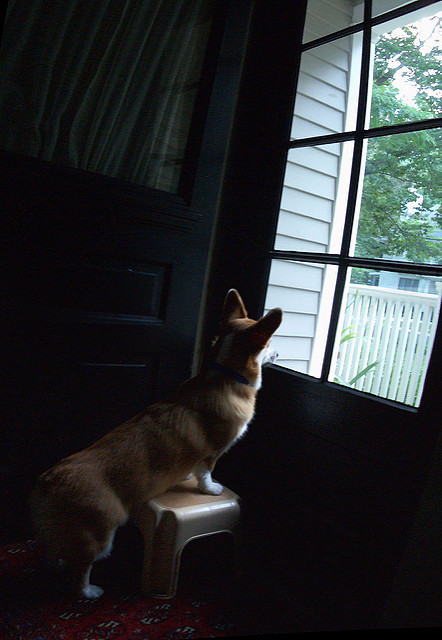
Corgi

“Waiting …” jmcmichaelCC BY-SA

When I write personal narrative, memoir, and even realistic fiction across elementary grade levels, I usually give students choices of topic for the writing I’ll model. Many times they’ve chosen for me to write about my dad not wanting any pets when I was growing up, despite my desperate begging for them.

Students rejoice when I overcome my dad to get a dog or a cat.

One of the things I haven’t fully explored with the children is why my dad didn’t want pets. Truth is, it took years for me to fully understand . . . 

That’s where I’m going today.  

To set the stage, here’s a modeled excerpt, the scene when my mom, my sister and I have brought not one but TWO puppies home from our neighbors’ house across the street. It’s getting time for my father to arrive from work, and he has no idea we have these puppies:

“Will he make us take them back?” my sister whimpers. She has her puppy, Bagel, wrapped in a pink doll blanket. She cradles him in her arms like a baby.

“I don’t know,” says Mom. “We’ll have to wait and see.”

She sort of sticks her chin out when she says that.

The three of us sit in the living room, waiting, and when I hear the car door slam, I jump. I hold my puppy, Onyx, so close I can smell his puppy breath.

He’s home! What will he say? Will he yell?

I can hear his work shoes coming up the steps. I watch the doorknob turning . . .

Here he is, in his blue uniform with the white hard hat on his head, his big, gray lunchbox in his hand. He looks at us.

He sees the puppies.

He wrinkles up his face: “What in the . . . ”

“Surprise, Daddy!” yells my sister, holding Bagel up high in the air. “We got you some puppies!”

Suffice it to say the man knew when he was outnumbered. And defeated.

Bagel, the collie-colored, long-haired dachshund mix, was still with us when I got married.

As was Moriah, my black cat: 

Free kittens.

Take one.

The sign stood on a chair beside a disheveled guy leaning against the wall at the college bookstore entrance. This guy—another student, I guess—held a cardboard box in his arms. Kittens! I hurried over to look inside.

Only one dark, little shape huddled in the box.

“Is that the last kitten you have?” I asked.

“Yeah,” he replied. “No one wants her because of her tail.”

“What’s wrong with her tail?”

The guy scooped the kitten up and showed me her backside. She didn’t really have a tail, just a stump.

“What happened to her?” I wanted to know.

“She was born this way. The only one in the litter like this.”

The tiny black kitten looked up at me with her big yellow eyes.

She meowed.

She rode on my shoulder as I drove home wondering exactly how to approach Daddy.

“Please,” I said, clasping her close to my heart, where she purred against me. “No one else wanted her. I’ll keep her in my room.”

You’re allergic to cats!” he thundered. “Find somewhere for her to go!”

I didn’t, and once again, my poor father was defeated.

Moriah developed an endearing habit of running up the leg of my jeans and my shirt to my shoulder, where she liked to ride while I walked around. 

 One day, my father roared from the bathroom: “FRRAAAANNCESSSS!”

My whole first name. 

Yeah.

Had to be something really bad.

I flew down the hall to find him hunched over the bathroom sink. He’d been shaving. White cream all over his face.

When he shaved, he never wore a shirt.

Moriah, watching him, had decided his shoulder looked inviting.

She ran up his leg and his bare back to his shoulder, where she was now hanging precariously by her nails. Embedded in Daddy’s pink skin.

GET-THIS-CAT-OFF-OF-ME!” shouted Daddy. His blue eyes, reflected in the mirror, blazed at me. (Note: He actually said a few  more words than this. I’ve chosen to censor.)

I extracted my cat and we hid for days, until Daddy’s scratches healed.

Two years later, when I was about to be married, the apartment where I’d be living had a no-pet policy. I couldn’t take Moriah.

The night before the wedding, I handed her collar to my dad. “She’s yours now, Daddy.”

Here’s the crazy part: He looked pleased. He kind of half-smiled. 

Weeks afterward, my mother told me on the phone: “Your dad buys turkey at the deli for Moriah. He tears it up in tiny pieces and puts it in a dish for her.”

“He—WHAT?” 

He did it for Moriah until she was gone. Then he said, “That’s it. The last of the pets.” 

Until my mother brought home a little Shih Tzu. She named her Bridget.

Daddy grumbled for months, but was soon buying deli tidbits for Bridget, too. 

When I was expecting my first baby, I came home for a visit, and Daddy told me this story: “When you were born, your mom and I had a cat. A big, orange tabby named Tiger. He kept getting in the crib with you and we worried you’d suffocate. I ended up having to take him to the pound. It was terrible. I swore I’d never do that again.”

I looked at his face, this face that had frowned about pets all these years, saw the pain-shadow cross over it.

All this time, I thought he was just being hardhearted. 

One night, Mom called. “Bridget died today,” she said.

“Oh no. Are you okay?'”

“I’m all right. Your dad buried her underneath his camellia bush.”

A pause. Then:

“He cried like a baby. I’ve never seen him sob like that before.”

My throat wrenches. Tears burn like fire.

Oh, Daddy. Daddy. I’m sorry for everything.

And there was one more dog to come, yet another that my mother brought home without warning. A Corgi.

Daddy sighed, complained, vented for weeks on end.

He named her Foxy.

He taught her tricks, played with her every day after work. Foxy knew when to expect him; she sat on the back of the sofa, watching through the picture window, waiting for him to come home.

Maybe it’s a case of saving the best for last, for, out of them all, Daddy loved Foxy best.

He never had to give her up, suffer her loss. 

She suffered his. 

For weeks on end, she sat at the picture window, watching for him. Sighing, whining. Day after day after day, waiting, forever waiting, for him to come home . . . 

Fatherlove.   

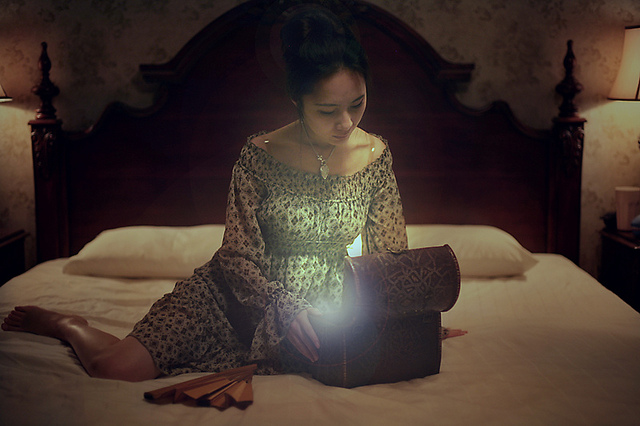
Memory box

Memory box

Memory Box. AntaraCC BY

This weekend I caught a bit of an interview with Jon O. Newman, a senior judge of the U.S. Court of Appeals for the Second Circuit. Judge Newman has written a memoir entitled Benched. The subtitle is rather epic, something you should experience on your own . . .

What caught my attention, however, was the Judge’s statement that “everyone should write memoir, for your children, your grandchildren.” He went onto say how valuable a person’s memories are to the successive generations, especially for the unique knowledge they impart.

These statements were both invigorating and validating to me for a number of reasons.

First: I’ve been writing a good bit of memoir here on Lit Bits & Pieces. It may well be my favorite thing to write. When I am composing a piece, it’s almost like I have “street view” of moments and people as they were long ago; I can see it all from so many angles, from within and beyond my childhood self.  Judge Newman said, “The more you write, the more detail you will remember.” It’s astonishing, really, the little things I begin to recall, one after the other, once I start writing. The images return in startling clarity. I write in scenes, small moments. I tell writing teachers that memoir is really small moments on steroids, all pumped up and full of meaning.

Secondly: I write these pieces of memory because they hover so vividly, begging a landing place, and because I truly love the time-travel. They’re meaningful to me, so I try to preserve them as best I can. What’s astonishing is the response I sometimes get from a  reader; I never anticipated such deep chords would be struck. It leaves me, every time, in wordless awe at the power, the “magic,” of writing.

Lastly, having watched my mother-in-law and grandmother suffer the ravages of dementia — and the loss of their dignity — I write to celebrate the human brain at its most glorious, the triumph of the human heart over its darkest moments, the joy and the story of lives well-lived.

In this way, my blog serves as a memory box for me, homage to those who’ve gone before, and perhaps a gift to those who come after. As the photographer of the beautiful image at the top of this post wrote: We should save part of our memories in a box . . . we may need it later . . . 

Tonight I celebrate memory. My own and the bright fragments given to me by those I loved — those I still love, for in truth, when I write, they are ever so near.

To love that well

Drema Gaye Spencer

Drema Gaye Spencer. Her first name means “reverie,” or dream. Her middle name, “merry, lighthearted.” Her surname is Old English for “guardian,” “object of awe,” “dispenser of provisions.”

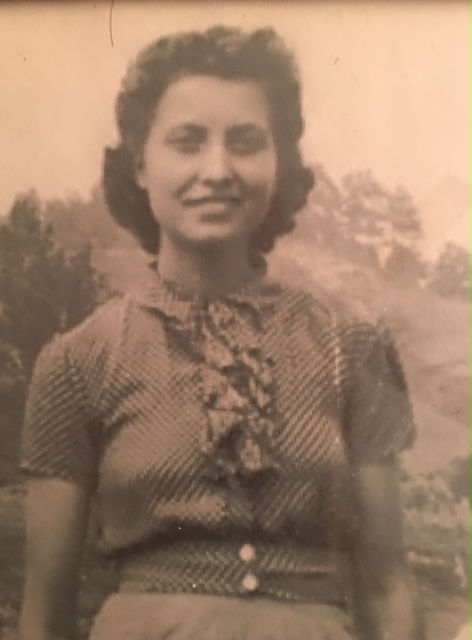
She stands on the precipice between childhood and womanhood, facing the camera directly, her hooded eyes steady and confident. She does not know it yet, but she will be like the mountains framing her background, where she and her seven siblings loved to run, calling to each other across the distance, teasing, playing jokes, laughing with wild abandon at their own mischievous humor. As intense pressure, heat, and time formed the ancient Appalachian coalfields, so the course of her life would forge an internal fuel, the deep, burning drive to keep going under the weight of crushing adversity.

It’s the early 1940s. World War II is in full swing; her three brothers have enlisted in the Navy. The family has survived the Great Depression in the place it struck the hardest, where the economy has always been precarious. When she arrived with the January snows of 1926, her coal miner father hadn’t had steady work in a year due to frequent safety shutdowns; the West Virginia Office of Miner’s Health Safety and Training references nearly 700 fatalities for 1925.

She’s just a teenager with a head full of dreams for the future.

Maybe she could teach English literature and composition—What fun that would be! Maybe I’ll even visit England one day.

Innately musical, singing harmony with her sisters in church, she also harbors aspirations for the stage. She knows she has true dramatic and comic talent, which, along with her natural beauty, lands her roles in high school plays. Her blue eyes sparkle: Well, I AM a good actress. Very good. Eventually, of course, I’ll get married and have children. I do want children . . . Sometimes she can almost see their little faces, these someday-children. I hope one’s a boy with brown eyes.

So she looks at the camera and smiles, the mountain beneath her feet, her childhood behind her and her whole future lying ahead.

But I, being poor, have only my dreams; I have spread my dreams under your feet; Tread softly because you tread on my dreams.

-William Butler Yeats

The reality is that just a few years after this photo was made, she married a man who would be killed in a mining accident, leaving her with a toddler and a baby at twenty-three.

Several years afterward, she married a widower, an Army man with two older children. Eventually they had a boy and a girl together.

Her boy with brown eyes.

When her husband completed tours of duty in Korea and Vietnam, she cared for the six children by herself.

When the brown-eyed boy was four, he developed acute bronchitis, necessitating an emergency tracheotomy. His temperature spiked to 107 after surgery. The nurses packed the child in ice. The hospital doctors told her that her little son might not make it. She sent for his father, away at Army summer camp; a police escort was dispatched to meet him at the airport. As the boy drifted in and out of consciousness, she sat by his oxygen tent, praying, weeping.

The boy survived.

She wrote him a letter on the inside back cover of a book of Bible stories.

4:00 a.m. In hospital.

Dearest . . .

When you are well and safe at home again, I’ll read you this little note I’ve written to you during the hours I sat by your bed and watched you sleep so soundly . . . Mommy and Daddy have been so scared . . . We love you so much, our little son . . . Little angels have been all around your bed since you have been sick and Jesus sent them to watch over you and keep you . . . soon all the suffering and fright you have had will pass from your little mind but Mommy will always remember and thank God for giving you back to me.

Your Mother

She could never speak of the ordeal without tears.

Staggering losses were yet to come.

When the brown-eyed boy was twelve and his sister nine, and all the others grown and on their own, her Army man died suddenly, instantly, with a heart attack.

Widowed twice—each time with a boy and girl at home to care for.

Love bears all things, believes all things, hopes all things, endures all things.

-I Corinthians 13:7

When her sobbing son asked, “Who’s going to take care of us now?” she wrapped him in her arms.

“God will. And I will.”

And she did.

Survival ran in her veins like coal beds through the Appalachians. She dug deep within herself, tapping into the hardy DNA passed down by her ancestors, into the wellspring of her faith, into the fierce love for her children, and carried on. When her son was consumed with fear of something happening to her, she said:

“I have prayed and prayed that nothing will happen to me until you’re grown. And I am convinced that God will allow it.”

For the next ten years, she poured herself into her children and her home.

Still she laughed. Still she sang. She called her brothers and sisters, who still teased each other with jokes old and new. She gardened. She arranged flowers. She organized a women’s political group, taught Sunday School, went to her son’s basketball games all through high school.

She managed, and managed well.

When her son said he found the girl he wanted to marry, she gave him her blessing and the diamond engagement ring that his father, the Army man, had given her.

The brown-eyed boy—now the man—gave the ring to me on my twentieth birthday, long, long ago.

For the boy who lived (apologies, J.K. Rowling) is my husband; the woman in the photograph is my mother-in-law.

When I came to know her, I first admired her elegant, impeccably-kept house, which she was forever redecorating. And the food, the food, oh, the food! Her table always looked like something from Southern Living, down to the coordinating linen napkins and rings. Her iced tea was always blissfully sweet and there must always, always be lemon slices with it. I came to appreciate her ever-present wit, her spunky humor, her fashionable attire. Being well-put together was a priority to her. I browsed her bookcases on every visit, knowing she’d have a new bestseller for me to devour. I was instantly at home in her home.

When she was sixty years old, a third man proposed to her. She hesitated. “I’ve buried two husbands. I don’t want to bury a third.”

But he was a good man; she took a chance on him. For the next three decades, they celebrated the coming of grandchildren and the first great-grandchildren.

Three years ago, she was widowed for the third time.

There were no children at home to care for now.

She was, for the first time in her nine decades, alone.

With housekeeping being too much for her, it was time to go to the home of one of the children or to assisted living.

And her genes, or her Appalachian roots, or the rising dementia—or all three—kicked into overdrive.

She would not go.

The house had become her whole identity. It was where she’d provided for the last of her children. It symbolized her strength, her ability to survive. This was her mountain; she would not be moved. She dug in her heels. Deep.

Until the stroke.

After surgery, when her family was allowed to see her in intensive care, she greeted us with a smile. “I can’t believe I’ve had a stroke! Can you believe it?” she said, as if she were sitting in the den at home, making everyday conversation, even as the nurses watched her monitors. Blue eyes sparkling as bright as ever, she reached out her warm hand to grasp mine. “Hey, you’ve got a birthday coming up. We’ll have to celebrate.”

I held her hand, marveling.

She rebounded for a short while, working hard at her rehab, thinking she could go back home. She couldn’t. She went into a nursing home instead, for, as the weeks wore on, her strength waned.

So did her mind.

The one thing that waxed bright and hot was her fighting spirit. She grew more determined to go home, even as she grew weaker, less hungry, more and more tired.

Do not go gentle into that good night,
Old age should burn and rave at close of day;
Rage, rage against the dying of the light.

-Dylan Thomas

She raged. She burned within like a coal seam fire, until her energy was spent at last.

Lying in her nursing home bed, she stood on the mountains again, seeing her brothers and sisters in the distance. She called their names over and over—only the ones who’d already died. She carried on conversations with them.

“I can’t go on up,” she told these siblings that the rest of us couldn’t see. “Not just yet.”

She knew us, called us by name when we last gathered with her, at Thanksgiving. Within the hour, she couldn’t recall who we were, or why we were there.

Still she sang.

There is coming a day, when no heartaches shall come

No more clouds in the sky

No more tears to dim the eye

All is peace forevermore

On that happy golden shore

What a day, glorious day, that will be . . . .

“My throat hurts,” she said. “I can’t sing any more.”

“It’s okay,” said her children. “You don’t have to.”

They moistened her lips and mouth with water.

And still she sang.

If we never meet again this side of heaven

I will meet you on that beautiful shore.

And then she sang no more.

She rested a while, then, with her eyes closed, turned her face toward her brown-eyed son, my husband.

“Where do you live?” she asked.

“North Carolina,” he replied, smiling through his tears.

“Oh, my son lives there,” she said.

“Yes. I am your son.”

She opened her eyes the tiniest slit. “Well. You’re all grown up.”

It was the last thing she said to him.

I have prayed and prayed that nothing will happen to me until you’re grown. And I am convinced that God will allow it.

A few days later, my husband, his younger sister, and my son, the youngest grandchild, sat by her bedside all morning, watching her labored breaths. Finally they told her, “We’re going to go eat lunch, Mom, but we’ll be right back.”

The minute they finished eating, the nurses called. “The time is near.”

They came. They took her hands.

She took two labored breaths, and was gone.

She’d waited for them to have their lunch. To the very last, making sure her children had what they needed.

She never taught school.

She was never an actress of renown.

She never made it to England.

She lived one of the most extraordinary lives I’ve ever known.

The diamond on my finger shines as bright as it ever did; I can only hope that a portion of her strength, her courage, her wisdom has passed on to me along with it.

I look at her teenage photo, contemplating all that she will endure.

All that she did endure, and need endure no more.

That time of year thou mayst in me behold
When yellow leaves, or none, or few, do hang
Upon those boughs which shake against the cold,
Bare ruin’d choirs, where late the sweet birds sang.
In me thou see’st the twilight of such day
As after sunset fadeth in the west,
Which by and by black night doth take away,
Death’s second self, that seals up all in rest.
In me thou see’st the glowing of such fire
That on the ashes of his youth doth lie,
As the death-bed whereon it must expire,
Consum’d with that which it was nourish’d by.
This thou perceiv’st, which makes thy love more strong,
To love that well which thou must leave ere long.
-Shakespeare, Sonnet 73

She loved as deep, as far, as long as she possibly could, with every ounce of her being. That is what I will remember most, her fierce, fierce love. It burns on, and on, and on, bright and warm, forevermore.
Why I Write 2017

The Light is On

The Light is on. Susanne NilssonCC BY-SA

Write the things which thou hast seen and the things which are, and the things which shall be hereafter.

Revelation 1:19

I write to celebrate the strange adventure of life.

I write to relive moments too precious to forget.

I write to light the way for the children, so that they will find their own writing paths.

I write to clear the clutter in my mind, to ease the ache in my soul – and to encourage others to do the same.

I write to set my imagination free, to create worlds, to discover what happens there.

I write because characters pop into my head and need a place to be.

I write because mental images materialize, insisting that they have meanings, and that their meanings matter.

I write because I am a warrior. I will defend what I believe.

I write because I believe writing is a transcendent, transformative force.

I write to celebrate having loved and been loved

because love and words never die.

I write because words are in my life’s blood, always flowing, arranging, rearranging, singing a story

that really has

no end.

*******

 Another celebration: This is the 100th post on Lit Bits and Pieces.

Between the moon and New York City

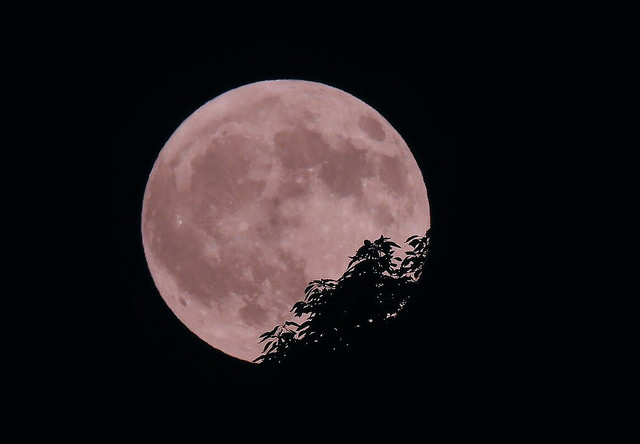
Harvest moon

Harvest moon. patrick pearceCC BY-NC-ND

I have to get to work early. Several teachers have asked for help, and I need to prepare. It’s sometimes all or nothing in the life of a literacy coach.

I rue the hour, but I quickly realize a perk.

A gift, even.

Against the pre-dawn October sky, the full moon is enormous. Breathtaking. As I drive the back country roads, it looms just ahead of me, darting in and out of trees as I round curves

Oh, the Harvest Moon! So beautiful, I think.

The moon is oddly big and bright. I knew it was full when I woke up, as the bedroom was bathed in ethereal, silvery light even with the blinds drawn. There’s something deeply magnetic in its intensity this morning, beyond its size. I shiver. The first autumn chill is in the air. It’s the time of year when strange things are afoot, stirring the dying leaves, whispering of time past.

Do you remember.

Something dormant wakes with a jolt, rushes back – the electricity of being young, on the cusp of a major life event, with the unknown stretching before me. I’m like a racehorse at the starting gate, quivering with anticipation, ready to break free, to run for all I’m worth.

I blink, and the overpowering moon transports me right back.

I am nineteen and I believe I can be an actress.

I really do.

After several years of high school plays and local theater productions, plus a year of college theater courses to my credit, I’ve decided I want more than the traditional education route. I’m chasing a dream: I’ve applied to the American Academy of Dramatic Arts in New York City.

They’ve scheduled my audition.

In a rather surreal haze, I catch a train in my Virginia hometown to meet my older cousin, Dan, in Washington, D.C., where he lives. The next morning, we hop on Amtrak to New York.

I’ve been to the Big Apple once before, with my high school drama club. The proximity and height of the buildings almost suffocated me: “There’s hardly any sky to see,” I told a classmate. I then learned why it’s nicknamed The City That Never Sleeps. All night long I heard traffic, voices, sirens.

This time I know what to expect.  This time I am pulsing with energy, ready for my moment – a racehorse pawing the ground at the gate.

This train isn’t moving fast enough.

Dan is wildly excited about my audition: “You’re the maverick of the family,” he tells me.

I look at his earnest green eyes. For a moment, I fear I’ll disappoint everyone. Our aunt, our mothers’ unmarried sister, has given me a framed picture of a harlequin holding a rose, sitting on a crescent moon amongst stars in the sky. This reminds me of you, she wrote on the back. Somewhere between the moon and New York City.

Lyrics to “Arthur’s Theme,” of course. The song by Christopher Cross, subtitled “Best That You Can Do”:

When you get caught between the Moon and New York City
I know it’s crazy, but it’s true
If you get caught between the Moon and New York City
The best that you can do,
The best that you can do is fall in love.

My spinster aunt means it as an encouragement for me to do my best, believing I’ll succeed on the stage. I understand this just as much as I understand I’m not about to be falling in love.  At nineteen I am decidedly jaded. I don’t want a boyfriend and have secretly sworn off relationships. Guys my around my age, I’ve learned, are not to be trusted. I do not have time to waste on them.

“What do you have to do for the audition?” Dan asks, as the ugly backsides of major East Coast cities zip by the train windows.

“A dramatic piece and a comedy piece,” I tell him. “For the dramatic, Alison’s monologue from Look Back in Anger, after she’s lost a baby. For the comedy piece I’ve spliced together Babe’s lines from Crimes in the Heart. Dark, Southern humor. Really hilarious.”

His eyes glow. “You have to perform these for me!”

Once we are settled in the city, I do. It’s my final rehearsal.

Dan is delighted. “You’re going to make it. I just know it.”

I’m not sure, but I think I detect tears in his vivid eyes.

The hour comes. After a short conversation with Academy officials, I step onto the empty stage. There’s no spotlight. It all feels quite ordinary.

I give the monologues all I’ve got, full rein to the electric charge coursing in my veins – the best that I can do.

The faces of the Academy people are inscrutable. They shake my hand:

“Thank you. We will inform you of our decision by letter within a few weeks.”

I stumble back into the shadows of Madison Avenue where I barely recognize my cousin.

“How did it go?”

“Okay, I think,” I tell him, and only then do I realize how violently I’m shaking.

“I am so proud of you!” His smile is magnificent as he wraps me in a bear hug.

Now we can roam the fabled streets at our leisure. It’s January and utterly freezing, but we don’t let that stop us from going to the top of the Empire State Building where our carefully-styled hair stands on end in the frigid gale. In a tiny restaurant, I have my first cappuccino – a frothy, cinnamon wonder. At a nondescript shop we buy teal scarves that are at least four feet wide and about eight feet long. We loop them around our necks multiple times.

Dan says, “Have you noticed how people are looking at us? They think we are somebody – they’re trying to figure out if we’re famous.”

He is right. I catch our reflection in the shopfront glass – we can pass for ’80s pop stars.

That bright image is a freeze-frame. The rest of my memory curls like fog around the edges of it.

Dan was also right about something else.

A couple of weeks later, I pulled an envelope bearing the Academy’s return address out of a stack from the mailbox. My hands shook so that I could hardly open it.

I cried.

I was on my way to New York City for real. To live, to make my way, to do what I loved best.

I didn’t have a dime to my name or any idea how I’d manage to find a place to live in New York, come August; all I knew was that in the meantime I needed to keep performing. I went to the next community theater audition, for Whose Life Is It Anyway? I walked through the door and instantly spotted, across the room, sitting in a chair, the handsomest man I’d ever seen. Black hair, brooding dark eyes, classic features – if we’d been living in the 1940s, this guy could double for Tyrone Power.

He looked up, saw me, and smiled.

If you get caught between the Moon and New York City
The best that you can do,
The best that you can do is fall in love.

I was going to New York.

I didn’t want a boyfriend.

We both got parts in the play.

This was the end of January.

In May, he gave me his mother’s diamond engagement ring.

We were married in August.

The Academy said I had a year, if I wanted, to enroll.

Within the year, my young husband told me he was called to the ministry.

If you get caught between the Moon and New York City . . . .

There are Things Meant to Be and Things Not Meant to Be, I hear myself whisper.

At least, I think that’s myself whispering.

I blink – and here I am, three decades and two grown boys later, still married to the same preacher man, driving to work, pondering how to help teachers and students, while a magical moon dips in and out of the trees. I am in rural North Carolina, a far cry from New York City. Never made it to Broadway, except as a member of the audience.

But, as Shakespeare wrote, All the world’s a stage, and all the men and women merely players; they have their exits and their entrances . . . .

I wonder what Dan would say now about my being the family maverick. He’s been gone for years. His exit came so early; he died at thirty-four.

I drive on under the Harvest Moon, noting how the darkness is no match for its spellbinding brightness. I am flooded with gratitude for all I’ve been given, realizing that the autumn of my life has not even begun.

Yes, Moon. I remember.

And so I play my part – the best that I can.

slice-of-life_individual

The song

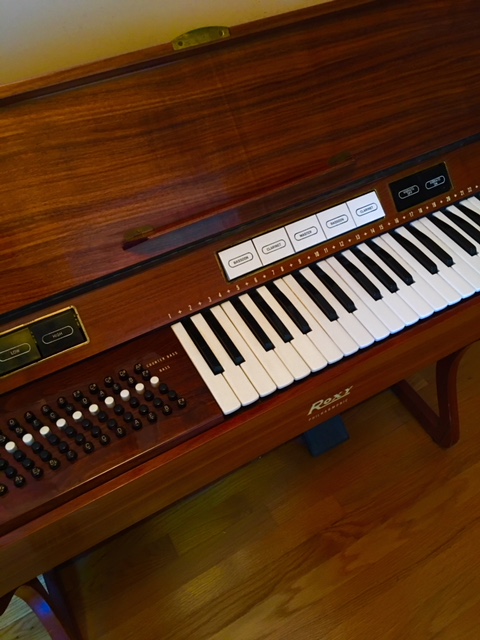
Grandma's organ

I love Granddaddy’s and Grandma’s apartment. The walls are knotty pine and the floors are made of a different wood; they shine under Grandma’s braided rugs.  There’s a booth curving around a table in one corner. It makes me think of the ice cream shop where we sometimes go for milkshakes. This booth is where Granddaddy, Grandma and I eat supper. Sometimes we have jelly doughnuts or apple turnovers for dessert; Grandma is very fond of apple turnovers and so I am I. There’s an odd, glass-less window between the bedroom and the “front room,” as Grandma calls it. I call it the living room. Grandma has curtains on this weird window and I can remember, dimly, my aunt holding me in her arms on one side as Grandma pulled the curtains apart on the other, crying “PEEK-A-BOO!” We all dissolved with laughter. A fancy ashtray with a curved handle that’s either a ram or a goat – some horned, leaping  animal – stands on a tall, thin pedestal beside my grandfather’s worn leather recliner, but no one ever smokes here.

Many wonders exist in this cozy place, but one of the prettiest is Grandma’s organ.

It’s made of polished wood, with curved legs. It stands gracefully against the front room wall, under shelves of family mementos and photographs.

Grandma knows how to play it. She has a piano down home in the country, but it was too big to bring to the apartment. When Granddaddy went to work at the shipyard during the War, my grandmother had to leave her piano behind. So, he bought her this organ one Christmas. 

He knew how much she loved to play.

One afternoon she says, “I will teach you.”

I am nervous and excited at the same time – I have never touched this organ.

Grandma opens the top. She lowers the little stand that holds a book. She has a booklet of hymns and one of Christmas songs; she places the Christmas book on the stand.

“Watch and listen,” she says, her blue eyes soft and bright. “This is my favorite.”

She plays “Silent Night.”

She sings, and I know the song. I sing some of the words with her:

Sleep in heavenly peace, sleep in heavenly peace.

“Now it’s your turn,” she says.”See these numbers? That’s what you play with your right hand. These circles with letters are the chords – you play the buttons with your left hand.”

She takes my hands in her own. 

5,6,5,3 – Si – i -lent night

5,6,5,3 – ho – o -ly night

She puts my fingers on the right keys, pressing the white “C” major button until we switch – gracious! – to “G” and “F.”

I am very slow – it seems a lot to do at one time.

But Grandma guides me, and soon I have played a song.

A whole song.

“Now try it on your own,” she says.

I labor. My keys and my chords are not exactly in sync, but I play. I am playing the song by myself!

Grandma sings behind me. Her voice carries me on.

She hugs me when I finish; I smell her Avon Cachet cream, light and clean.

Her eyes glisten with tears, but she’s smiling.

It was the first of many lessons I’d learn from my grandmother. In those days before I started school, I thought the white major buttons sounded like a wedding; all the minor and diminished buttons sounded like something in haunted houses.

Pretty much the theme music of life – celebrations and dark, mysterious moments. Sometimes I would play the buttons by themselves, listening to the happiness and strangeness of the chords.

I made my own stories out of these sounds.

I realized, decades later, the legacy my grandmother left me: There was always a song of hope and faith in the heart to carry me through the darkest times. That being a wife and mother often meant sacrifice. She was the quintessential teacher, without being formally trained – my foray into the music she loved followed the perfect I do, we do, you do pattern.  She guided my fingers on the keys, my feet on the path, my heart on the things that matter most.

Above all, she believed in me.

There’s no greater gift to a child.

When I was in the sixth grade, I was invited to attend a summer program for gifted students in writing, drama, and photography.

My father couldn’t afford the fee.

Grandma paid it. “Children need to have a chance to do things that matter to them,” she said, with a startling ferocity.

Much later I learned that she wanted to take piano lessons when she was in her early teens and that her family couldn’t afford them during the Depression. A young minister’s wife, however, taught my grandmother how to play.

In everything I do, she’s still there behind me, singing, urging me on, never far away. She is gone, yet she isn’t; her song sings in my soul, in time with the beating of my heart. I am who I am because of her.

Today my youngest son – a college student and music minister – plays her piano and sings the old songs. Her organ stands in my foyer – the first thing that people see when they come to my home.

Her legacy lives, from generation to generation.

I often think how thrilled she’d be to hear my boy’s beautiful playing and singing. “Oh, how my Grandma would love to hear this,” I tell him.

Even as I say the words, I know she knows.

I loved you at your darkest

At your darkest

August. Days of sweltering, snaky heat. Yet he donned a black tuxedo with a black-and-silver striped ascot and got to the church on time. 

In a back room, her bouquet of pink roses dripped on the front of her white gown, creating panic amongst the bridesmaids, but it didn’t stain. 

The morning’s thunderstorm cleared and the sun was shining for all it was worth when the ceremony began at 1:00. 

At 1:10 the preacher pronounced them husband and wife.

When they left the church hand-in-hand, the summer day was blinding – they shielded their eyes and made a run for it.

We’ve been running ever since, really.

For over three decades now. (I was a child bride. Well, sorta.)

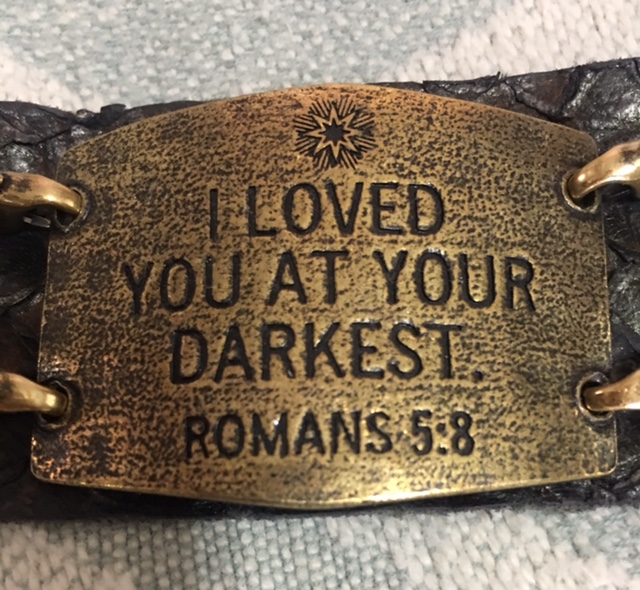
As we mark another anniversary this week, I consider one of my favorite gifts from him, a bracelet he bought a couple of summers ago. We were at the beach for a few days, trying to get away from the daily demands, the stresses and strains – a lot was going on in life at the time. We went into a shop, and I saw it –  a band with a metal plate reading I loved you at your darkest.

It pierced my heart, those words. The incredible forgiving, trusting, reliable power of them. The surety.

“Do you like it?” he asked.

I nodded, for I didn’t trust my voice at the moment.

And so he bought it. I wore it out into the brilliant August afternoon, holding tight to his hand.

We’ve come through many darknesses – losses of people we loved, various setbacks, our own inner dark sides. Seeing each other at our worst.

But we’ve also seen the best in each other.

Growing older means acknowledging that there are darknesses yet to come – watching his mother’s decline with dementia is a daily reminder. We will not always be as we were, as we are now. Our summer is brief.

Grow old along with me! The best is yet to be, wrote Robert Browning.

It’s the togetherness, the commitment, the laughter at silly stuff, the embrace in the hardest moments, that drive the darkness away. The sacrifices. The faith that the sun will rise again tomorrow, and with it, hope. Abiding gratitude for every day.

It’s never the darkness that we carry with us anyway. It’s the knowledge that we walked through it together, to come out on the other side. Our minds, our hearts hold to what is good, what is bright. It propels us onward. Makes the entire journey worthwhile.

Especially when the journey almost wasn’t.

On the evening of our first date, I called to tell him I couldn’t go. I had a raging fever; I was being admitted to the hospital for tests.

“I am sorry,” I said into the phone, tears stinging my eyes. “Please don’t give up on me.”

“I won’t ever give up on you,” said his voice, strong and sure.

He never has.

I loved you at your darkest.

I did, I do, I always will.

Thank you.


In-between places

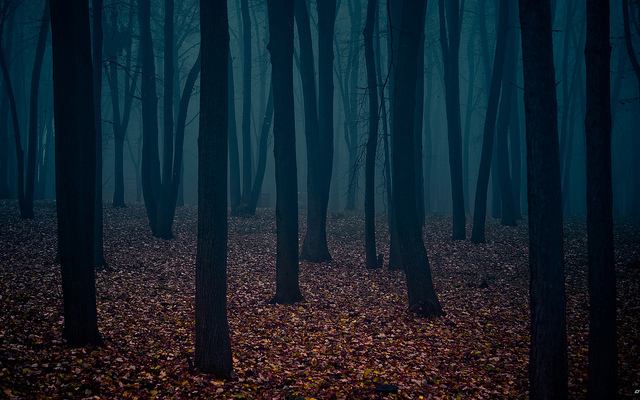
Gloomy forest

Gloomy forest. gorchakov.artemCC BY

I read the final page and close the cover. The idea of being separated from someone you love intensely, whether by distance, time, or circumstances, comes with a stab so sharp that it almost isn’t bearable.

Never mind that The Time Traveler’s Wife is fiction. The frequent separation of Claire and Henry, especially their final one, is crafted with this piercing truth, the longing for the “in-between” period to be over so that the characters can be together again. Sometimes the interim lasted for years.

While Claire and Henry usually had the advantage of knowing the duration of their separations thanks to his time traveling, the rest of us don’t get such clear glimpses of the future. We have to endure the various in-between stages of our lives, not knowing how long they’ll last, not being able to speed up time, not knowing the outcome, often having little or no control.  These in-between places are often laced with deep aching, a sadness and desperation at being apart from someone we  love. Existence is as flat and barren as a desert. The emptiness is huge, frightening; we want to rid ourselves of it before it consumes us. The scope of this in-between-ness is too much for us. The loss cannot be dealt with as a whole but only lived through in chunks  – a day, maybe just an hour, at a time.

There are in-between places other than those of relationships. The loss of a job, long illnesses, hardships, disasters – all can be dark places that sap our strength, sometimes with no foreseeable guarantees that all will end well. Living in these situations is like navigating a dark, unfamiliar forest. Not knowing which way is the shortest or best way out, we often go in pointless circles without realizing it.

I recall an in-between place that’s quite different. It’s remained in my mind since I was a child, on my first reading of The Magician’s Nephew.

It’s called The Wood Between the Worlds.

In the attempt to move from our current world to another by wearing magic rings, two children land in a sort of “connector” place. Here’s how C.S. Lewis describes it:

It was the quietest wood you could possibly imagine. There were no birds, no insects, no animals and no wind. You could almost feel the trees growing . . . a pool every few yards as far as his eyes could reach. You could almost feel the trees drinking the water up with their roots. This wood was very much alive. When he tried to describe it afterwards Digory always said, “It was a rich place: as rich as plum-cake.” 

Digory discovers that he’s not frightened, excited, or curious. He’s forgetting why he’s there and what he knew of his own life, even his mother, who’s dying.

If anyone had asked him: “Where did you come from?” he would probably have said “I’ve always been here.” That was what it felt like – as if one had always been in that place and never been bored although nothing had ever happened. As he said long afterwards, “It’s not the sort of place where things happen. The trees go on growing, that’s all.”

Not the sort of place where things happen, but things go on growing around us while we are numb, sleepy. Who among us hasn’t experienced this?

Digory has an epiphany nevertheless – he tells his companion, Polly:

That’s why it’s so quiet and sleepy here. Nothing ever happens here. Like at home. It’s in the houses that people talk , and do things, and have meals. Nothing goes on in the in-between places, behind the walls and above the ceilings and under the floor, or in our own tunnel. But when you come out of our tunnel you may find yourself in any house. I think we can get out of this place into jolly well Anywhere!

Digory is right. The rest of the book deals with the results of his and Polly’s choices, both wise and foolish, but suffice it to say that they get out of The Wood Between the Worlds to witness the birth of a brand-new world.

Narnia.

Here’s another illustration, not out of fantasy.

My family once decided to travel from Raleigh, North Carolina to Boston by train. There was a problem with the train at the first segment of the trip – it had to be made by bus. Arriving at a different station, we boarded the train at last.

What we didn’t realize is that the train would stop at every major station on the East Coast even when no one was getting off or boarding. Long into the night we rode, stopping in deserted stations, sometimes for an hour or more. Bleary, exhausted, regretting our choice of transportation, we wondered how long this train would sit in this place where nothing was happening, and why.

I fell asleep.

The first light of dawn woke me. I looked through the train window at gray nothingness to see a shoreline slowly materializing. After having come through the unsightly backsides of major cities for most of the trip, this was unexpected. The sky turned pink, the sea rose-gold and sparkling, with the rising of the sun.

It was breathtaking, one of the most glorious sights I’ve ever seen.

After nineteen (eternal) hours on the train, we arrived in Boston.

The trip home was longer, as another train’s battery died and our train had to deliver a new one to them.

The point is that while the in-between places are static, and we often arrive in them for indeterminate stretches of time, they do serve a purpose. We can rage at the nothingness there, fervently railing at the passing of time, or sink into numb paralysis for the duration. Or we can see the in-between places as connectors, the temporary segue from one phase of our lives to another. Away from the energy, the hustle and bustle of life in this world, the in-between place may be one of needed rest, one of learning, reevaluating, recharging, restoring, until the path becomes clear and we can move on with living where the action is.

The next destination may not look like what we imagined.

It could, in fact, be far more glorious than we ever dared to hope.

Reflect: What in-between places have you experienced in life? What stories can you tell about enduring and getting through to the other side? If you are in an in-between place now – strength to you. It is temporary.  Reorient yourself; think, and begin preparing for what is waiting for you just ahead – be ready to meet it.

And write!