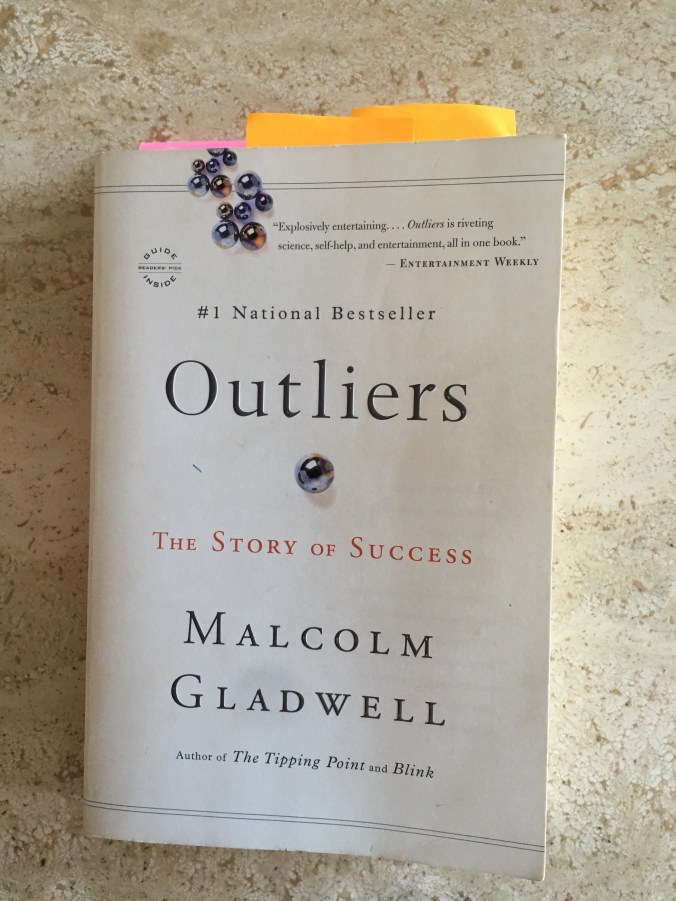
Malcolm Gladwell is one of my favorite writers.
In Outliers there’s a chapter entitled “The Ethnic Theory of Plane Crashes” in which Gladwell states: “The typical accident involves seven consecutive human errors.”
He’s writing of Korean Air, which had a disproportionately high number of plane crashes before the airline “turned itself around.”
Gladwell says that the seven errors are the result of a lack of communication and teamwork, not a lack of technical skill or flying knowledge. One or two errors doesn’t lead to disaster; the trouble is that they keep happening, and this compounding causes the crashes.
I am thinking that making seven consecutive human errors can lead to other kinds of accidents.
Such as the one I had last week.
A quick setting of the stage: My school participated in a county-wide book drive for students who don’t have books at home. We collected 1500 books. I had to count and store the books until they could be delivered to the drop-off location; a colleague helped me in this effort. We used a lot of boxes, as overfilling would make them too heavy to lift. The only place to store so many boxes was under a stairwell, where they waited, sealed and ready, for a member of the PTA board who graciously offered to pick them up for us.
Now, I test the theory: Were there seven consecutive errors in communication and teamwork that led to my accident? Here’s what happened:
- The PTA person never gave me a time for picking up the books.
- Another person volunteered to help pick up books. I wasn’t told this.
- When the person I wasn’t told about showed up, the receptionist sent the custodial staff to move the boxes of books from the stairwell. I wasn’t told this, either.
- I went to investigate why the boxes were being moved. The custodial staff said they didn’t know this person who had arrived for the books.
- The person turned out to be a very helpful parent, but, having to unravel what was going on, and not expecting the books to go that day, I couldn’t remember where I put the form with the book count. This parent needed to take it to the people at the drop-off. Where was that form?
- My colleague said she taped it to one of the boxes. But which box? It had to be found. Simply making a duplicate form could result in an incorrect, doubled amount at the drop-off.
- I rushed into the stairwell, under the staircase. I moved box after box. When I couldn’t find the form, preoccupied with where it might be, and with the parent already there to get the books, I stood up in a hurry—and bashed the top of my skull against the bottom of the staircase.
Hard enough to knock me down.
Hard enough for my teeth to smash together.
Hard enough to chip a crown.
I say an accident involves seven consecutive human errors in communication and teamwork, all right.
The aftermath: My mouth hurt the most at the time. When I finally checked the top of my head, I couldn’t even find a tender place where it struck the staircase. No concussion. No bleeding at all. And the crown was replaced by a gracious dentist who was willing to take me, a complete stranger, as an immediate emergency case.
I’m fine.
The missing form?
It was on my table the whole time, right where I left it.
 lit bits and pieces