Finch elegy

I forbore
checking the finch nest
in the wreath
on the door

after three
maybe four
little finches hatched

in the cold

I knew that February
seemed too early
for laying

that sustained
freezing in March
could take a toll

but I heard Mama
and Papa House Finch
chattering all along
with babies’ bright voices

until a day or so ago

they’ve fledged and gone
already
, so
I told myself

when it is warm,
I will check the nest

(don’t disturb them
in this cold)…

Today, it is warm
like spring should be

with the earth bathed
in watercolor pastels
a blossom-spattered mosaic
after soft rainfall

and so I came to see
if the fledglings had gone
at last

not prepared
for what I found

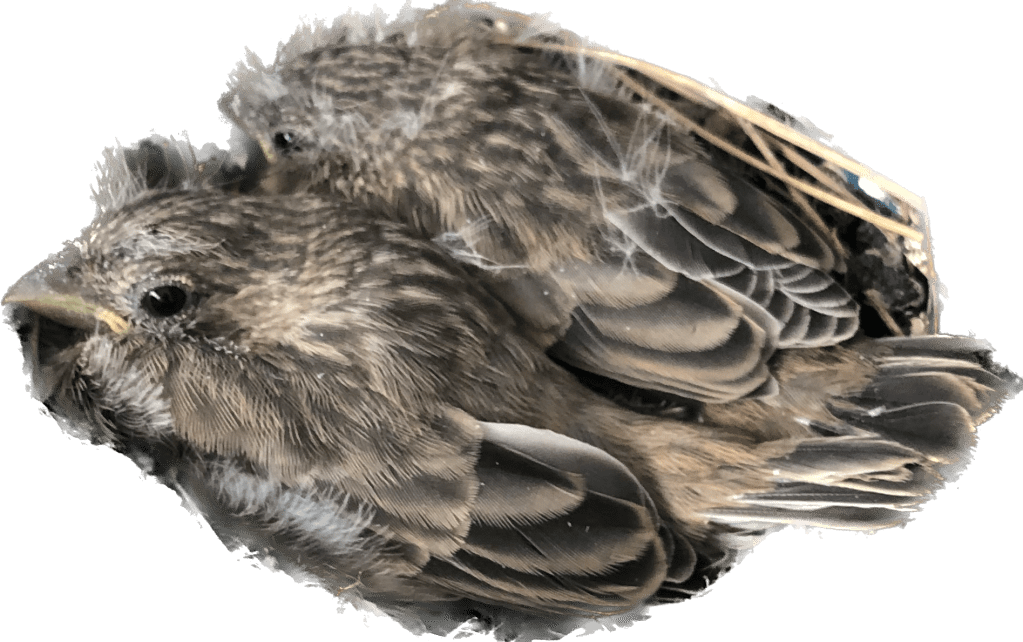
one
hanging backward
over the front
of the nest
open mouth and closed eyes
pointing to the sky

another
wedged in back
against the door
essentially fused
into the nest itself

they are
too tiny
and new
and perfect
to be dead

but they are
they are

seems
a sibling or two
must have made it
to the skies

but these
sweetest little wings
I’ve ever seen
shall never rise

so now I lay
these lost ones
down for keeps

rip away the
beautiful nest
and sweep
and sweep

in silence
where there was
so recently
such happy song

not knowing what
went wrong

(and never will)

it is just
The Way of Things

nevertheless
my heart wrings
in two

and cries


A couple of my hardy finch fledglings in a previous year

*******

with thanks to Two Writing Teachers for the monthlong Slice of Life Story Challenge

March snow

haiku story

gray Sunday morning
in spite of springing forward
it begins to snow

first time all winter
big white flakes now descending
on riotous blooms

purple-pink redbuds
bright yellow forsythia
pollen-laden pines

suspend certainty
while birds rush in, unafraid
of crystallized grass

momentarily
melting away in soft earth
—seems a sheer delight

to countless robins
hopping with newfound vigor
and the cardinal

on a blood-red blaze
toward the bare crape myrtle
where his mate awaits

and dark-eyed juncos
living up to their nickname
ground-flitting snowbirds

while papa house finch
forages in the clover
on the old dog’s grave

for seeds he’ll carry
to mama finch on the nest
incubating eggs

bluebird on the gate
ruffles his blue-flame feathers
in exultation

two crows come and go
strangely silent, for they know
the benediction

Carolina wren
hidden somewhere in the pines
sings Holy Holy

the earth’s aflutter
with myriad wings and things
returning blessing

in spite of the snow
life springs forward, brightening
gray Sunday morning

2020-0417_CentreCoPA_WestMain_Eastern Bluebird in the snow -01amOBX. CC BY-NC 2.0.

*******

with thanks to Two Writing Teachers for the monthlong Slice of Life Story Challenge


Koala life lessons

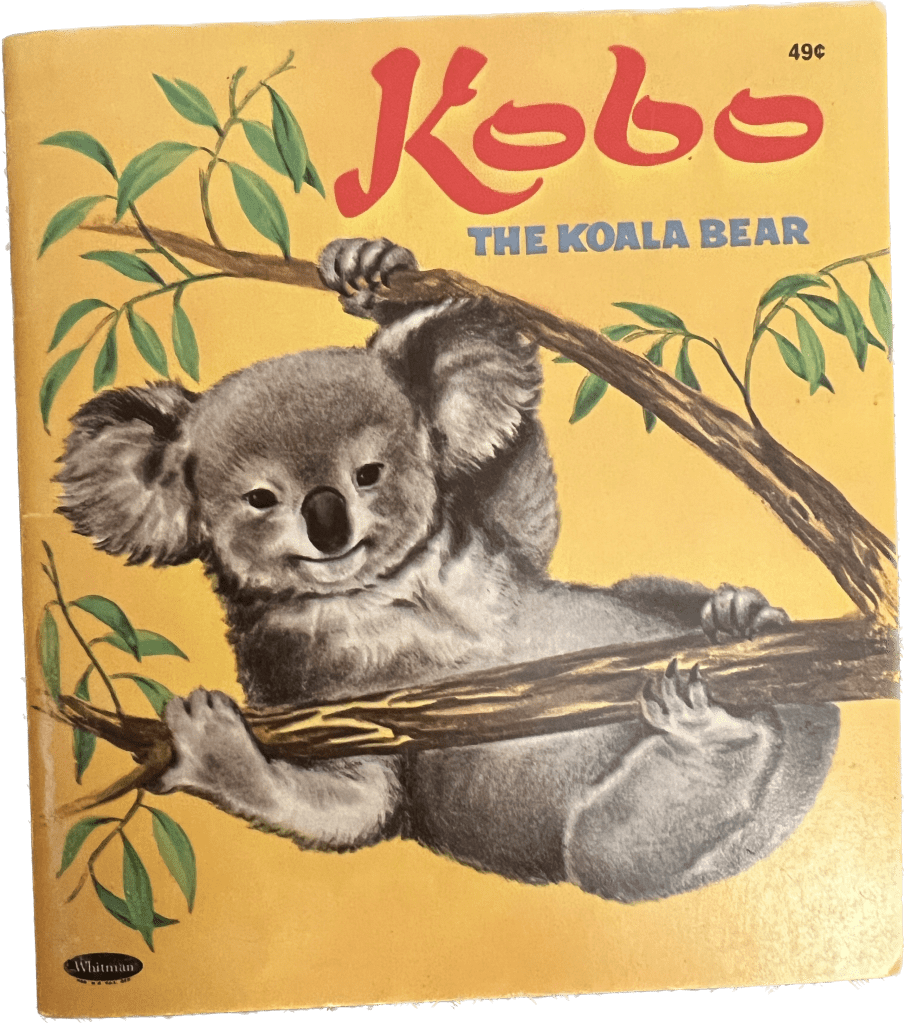
One of my earliest memories is sitting on my grandmother’s lap while she read to me. I recall several of those old books, a favorite being the story of a koala.

I don’t know what happened to the original book, but a few years ago I found a vintage copy online and ordered it.

First of all, check out the 1968 price: 49¢. And secondly…yeah, koalas aren’t bears. Many a year passed before I realized this.

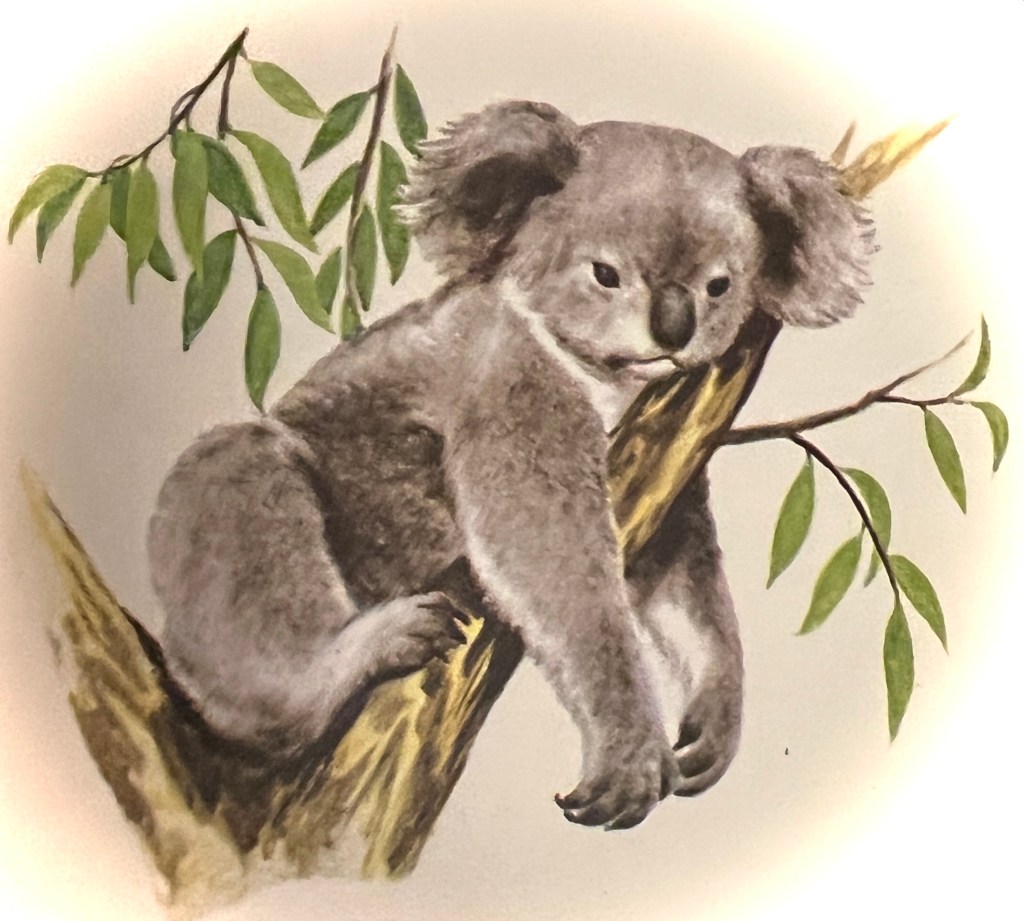
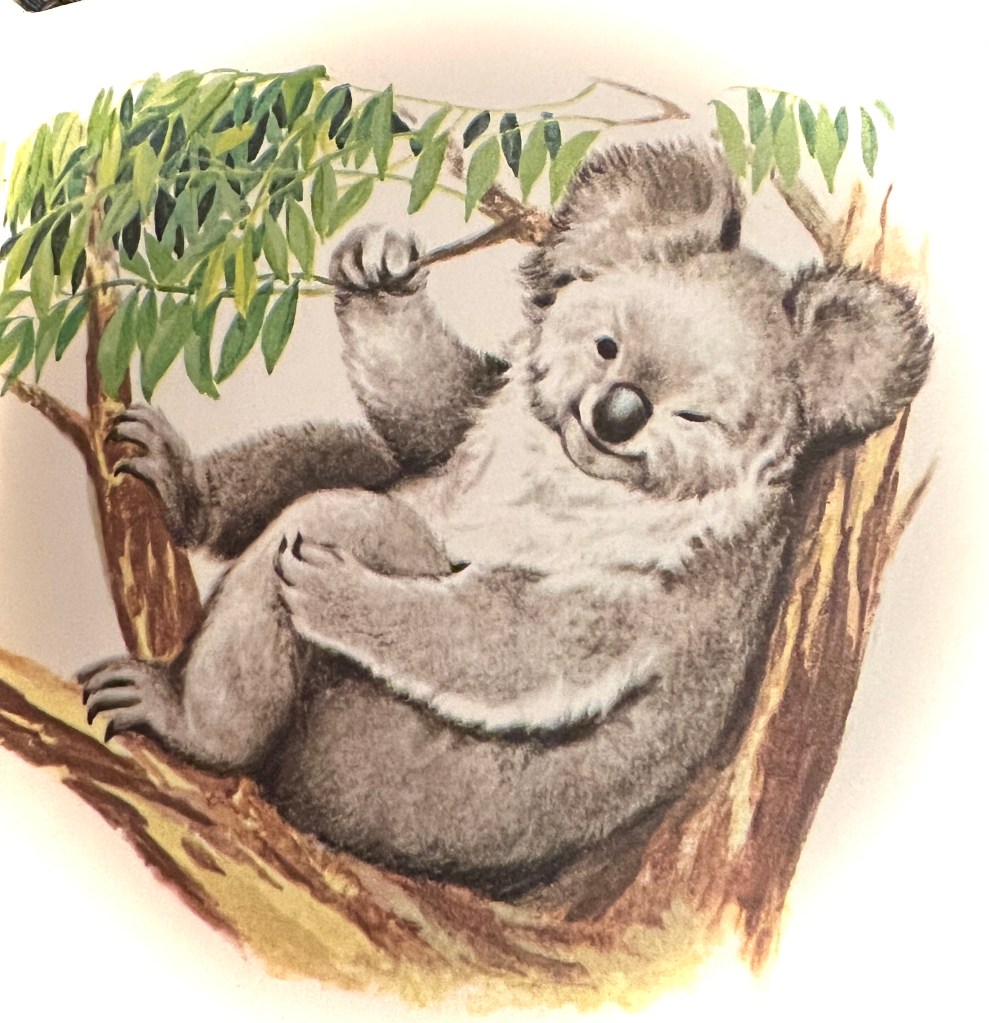
I loved Kobo the koala who sings to himself in rhyme and the story of what happens when he grows tired of living in trees, eating only “leaves for breakfast and leaves for dinner. It’s a wonder to me I’m not getting thinner.”

Kobo decides he will find a new home. Off he saunters (the vocabulary is so rich) for quite an adventure.

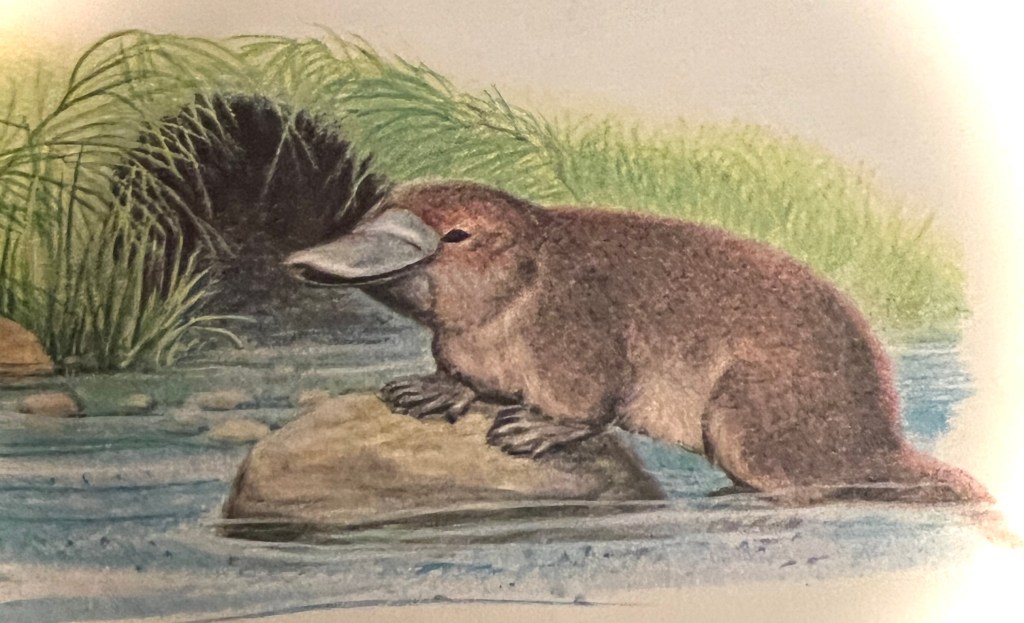
He encounters a platypus, another animal I loved at first sight. Kobo meets a number of other creatures: a kangaroo, a kookaburra, and Dingo, the wild dog who chases him back to his tree. Kobo learns in the end that his tree is exactly what he needs; he would not be happy living like the other creatures or having to eat what they do.

This is where Kobo belongs.

So all my life I’ve known where koalas live and what they need to eat…here is what I’ve learned about them in recent years:

They have fingerprints like humans.

They are the only living (extant) member the family Phascolarctidae.

Koala comes from indigenous language meaning “no-drink” or “no-water,” for these animals don’t drink much due to their exclusive eucalyptus-leaf diet. To see one drinking water isn’t a good sign.

In the times of drought and fires destroying their habitat, koalas have approached humans, begging for water.

Koala numbers are in decline due to deforestation, brushfires, vehicles, and yes…dogs.

In some parts of their eastern Australia home koalas are considered endangered.

I can’t help thinking how Kobo’s story would be so different, written today…he couldn’t return home if home is gone.

Of course koalas aren’t alone in this. I see it here on the other side of the world, with more and more land being cleared for neighborhoods. Not so long ago a white-spotted fawn came running through the yard to crash into my house, hard enough to dent the siding and leave a little patch of blood, before pivoting on its gangly legs and streaking back across the lawn to the woods. I never knew what became of it or its mother.

Then there are trees themselves, living things that actually communicate and work together to survive, until they are gone.

And then there are people. Refugees. Borders. Wars. One cannot go home when home is gone…

And children, so needing that sense of belonging…for our childhoods follow us all of our lives.

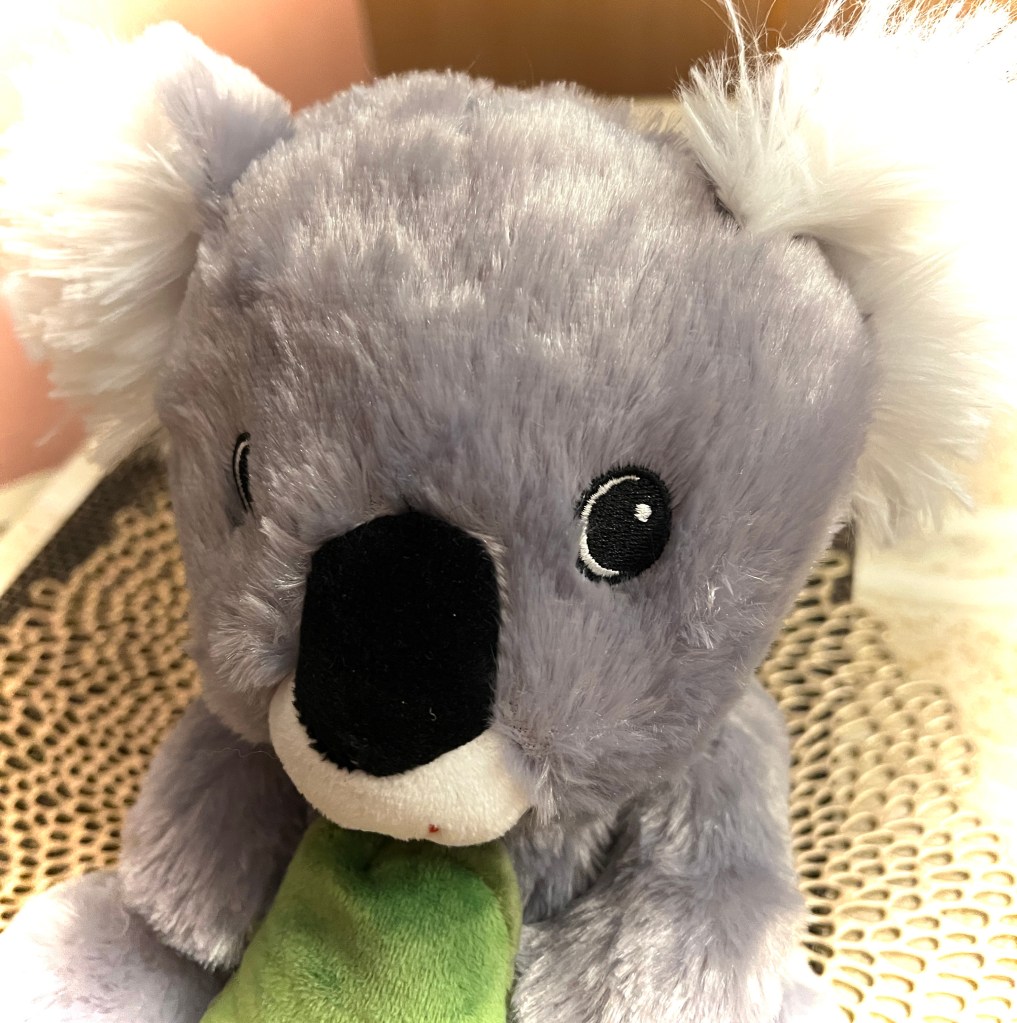
I suppose that was what was in my mind when I saw the stuffed koala at the store the other day and bought it to keep at my house for my granddaughters to play with when they come. Memories of my own grandmother. The books. The love. The sense of being wanted, valued, sheltered.

Micah, sixteen months old, immediately noticed it sitting atop the toybox in the living room on her next visit. Her face lit up. She toddled over to the koala, picked it up, and hugged it close. “Baby,” she said. “Baby.”

She is a baby herself.

But she already knows something about caring.

Kobo himself might say it’s the beginning of finding the way home, before too much is lost.

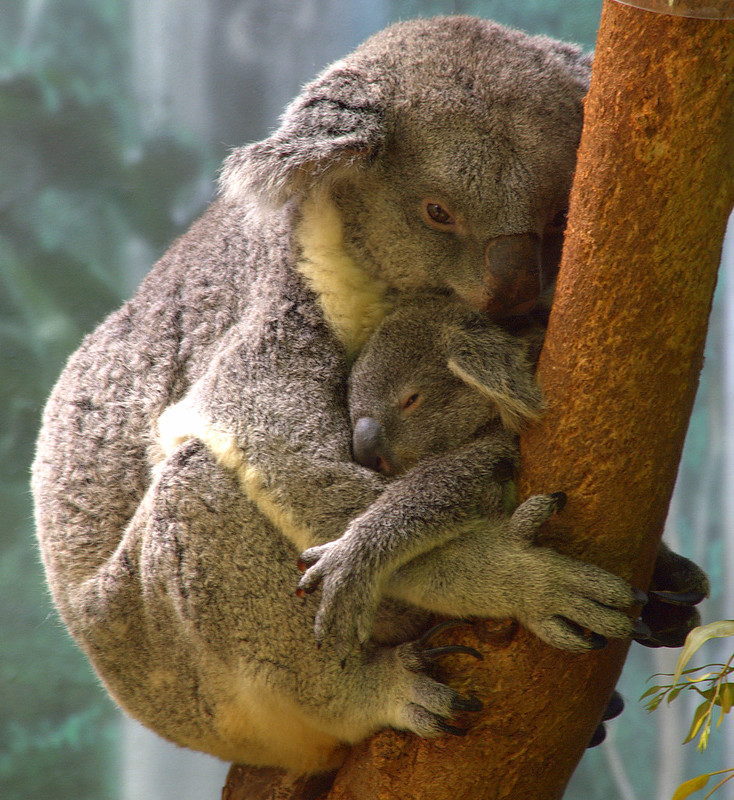
Mother and Child. jimbowen0306. CC BY 2.0.

********

with thanks to Two Writing Teachers for the monthlong Slice of Life Story Challenge

and to Kobo the Koala Bear, written by Marjory Schwaljé, illustrated by Katherine Sampson

and to Grandma, for all the reading
and belonging

Eavesdropping

a pantoum

Under the eaves
a porch
on the porch
a chosen door

a porch
sanctuary
a chosen door
from the other side, I hear

sanctuary:
father finch feeding nesting mother
from the other side, I hear
a song of love

father finch feeding nesting mother
on the porch
a song of love
under the eaves

Short clip of my house finches, which return every spring to nest in my door wreath (the finches don’t know that I purposely put out the twiggy grapevine wreaths they like best). Crank the volume to hear their beautiful voices. You might even catch a glimpse of wings as the father flies off to fetch more food for the mother. He will feed her until their little blue eggs hatch and then they’ll both feed their babies. In listening, it’s easy to understand how “charm” became the collective noun for finches and why they are said to symbolize joy.

House finches have an interesting history. From the Audubon Field Guide:

“Adaptable, colorful, and cheery-voiced, House Finches are common from coast to coast today, familiar visitors to backyard feeders. Native to the Southwest, they are recent arrivals in the East. New York pet shop owners, who had been selling the finches illegally, released their birds in 1940 to escape prosecution; the finches survived, and began to colonize the New York suburbs. By 50 years later they had advanced halfway across the continent, meeting their western kin on the Great Plains.”

also this, from the House Finch Overview, Cornell Lab of Ornithology:

“House Finches feed their nestlings exclusively plant foods, a fairly rare occurrence in the bird world.”

These are things I have learned. I continue to learn the lessons of the finches as they fill my home and heart to overflowing with a rare, almost-otherworldly joy.

House Finch mosaic. wolfpix. CC BY-ND 2.0.

*******

with thanks to Two Writing Teachers for the monthlong Slice of Life Story Writing Challenge

Skitterings

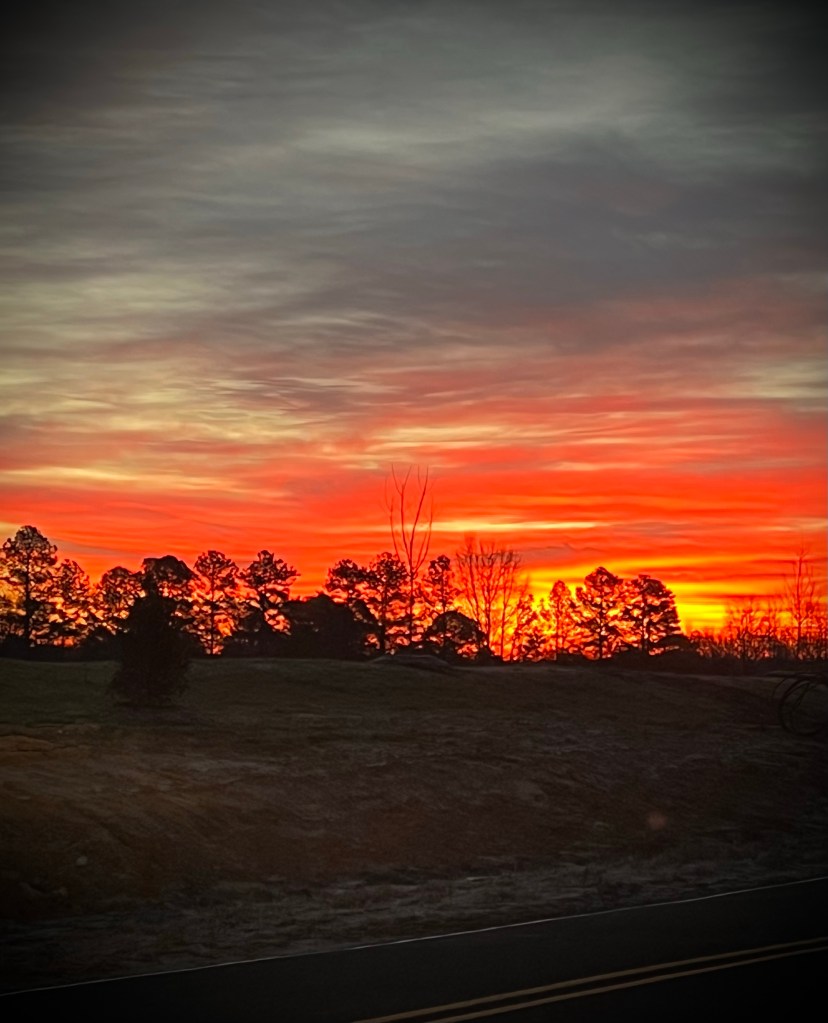
Winter morning, below freezing, ground covered with thick layer of frost like unto snow. Oyster-gray sky streaked with clouds aflame with sunrise. Breathtaking colors. I drive to work, looking for magisterial hawks perched on power lines. None to be seen. At the corner where the patch of woods has been cleared, old tobacco barns are melting into the stubble, overlaid with a thin veneer of crystal. So beautiful, I say aloud. Something pure remains in the devastation. I cannot think of what. I drive on, pondering destruction and human hunger for it.

In the new rose-light little birds skitter up from the wood-edged fields. What type of birds they are, I cannot determine, just upward movement and wings. A strange line plays in my head: This day your life will be required of you. I suppose it’s born of constant murder in the news and too much reading, this very morning the strange coincidence of Diana, Princess of Wales, attending the funeral of Princess Grace of Monaco, who died from injuries sustained in a car crash. Did the struggling Diana sense any foreshadowing?

Why am I even thinking of these things during such a glorious dawn?

A shape swoops from the right, directly in the path of my car…surely a bird. I hear no thunk. I see no skittering escape in my rearview mirror.

The bird—if in fact it was—must be caught in the grille of my car. This happened once, long ago, when I was driving a different vehicle: I discovered a dead cardinal hanging partway under the car. Why, why do they fly so low?

I will have to stop and check. There’s nowhere to pull over on these winding backroads frequented by too-fast drivers and farm equipment.

There’s a tiny church tucked in the woods up ahead, past the intersection. Steep driveway, deserted area, but I have to get out and look.

Nothing ensnared on the wide chrome grille of my old car. Beneath the grille, however, are unscreened compartments and there, on the dark, recessed shelf, is a bird.

Alive and moving around. Gray, orange, and cloud-white, like the morning.

Oh, bird.

I take off my heavy black cardigan, wrap it around my hands, and reach in.

Gently, gently… then a soft, warm weight is in my sweatered hands. I make sure to cover its wings to avoid panicked and possibly injurious flapping. Its head is gray. Small gray beak opens and closes without a sound. Its eye, turned toward me, has a faint purplish hue, slightly reminiscent of my pet parakeet when I was six. The gray back and pale-orange coloring on the breast had me thinking robin, but now I can see it’s not. I don’t know what kind of bird this is.

Oh, little bird. I am sorry. As if my speaking will help, somehow.

I cannot stand here gawking at it. The creature has survived the trauma of my car; I don’t want it to die from terror of me.

I think of being in the hands of God.

Please don’t let it die, I pray. Is this a selfish prayer? I don’t know how badly the bird is damaged.

And what am I going to do with it now.

The woods…I skim for a sheltered spot. I step in the leaves and a sudden sound startles me: a rabbit goes skittering away, its big white cottontail bobbing against the sepia scenery. I had no idea it was there. What else is here that I cannot see—? I am shivering. I find a small ridge of leaves and pine straw by a bit of barren brush and there I lay the bird.

The bird turns itself from side to breast, facedown. There’s a bit of white edging on its tail feathers. I wish for to something cover it. The morning is so cold. My sweater might entangle its legs; scraping pine straw over it might alarm it.

I will go. I will not stay to see the outcome. It will recover, or it won’t. I recall the woodpecker that flew smack into the glass wall of the school where I work; it landed on its back in the flowerbed mulch and lay so still I was sure its neck was broken. Within a moment, it managed to flip itself right side up, ruffled its feathers, and flew off—zip!—as if nothing had happened. The robin I extricated from the grille of my sister-in-law’s car, having traveled miles down the interstate at 70+ mph, hopped around my backyard for a day before it flew away. Birds are hardier than they look…at least robins and woodpeckers are.

Still.

Should this pretty little bird die or recoup…it will be in its own natural setting.

In the hands of God. Not a sparrow will fall to the ground apart from the Father...

It is hard, yes, to leave it there and walk away. But I have done so before. With people whom I loved very much.

It is Yours.

Back in the car, I circle the tiny church named for St. John, heading on toward crystal-coated fields and misty-mirror ponds and the work that lies ahead. The little bird will never know that I will remember it, that it’s now part of me, stuck to my soul as long as I live. I know it and that is enough on this cold, fiery-sky morning, orange and gray, breathtaking glory tinged with, but not diminished by, loss.

“If I take the wings of the morning and dwell in the uttermost part of the sea, even there your hand shall lead me, and your right hand shall hold me.”Psalm 139:9-10 (my favorite of the Psalms). This is the view leaving my neighborhood.

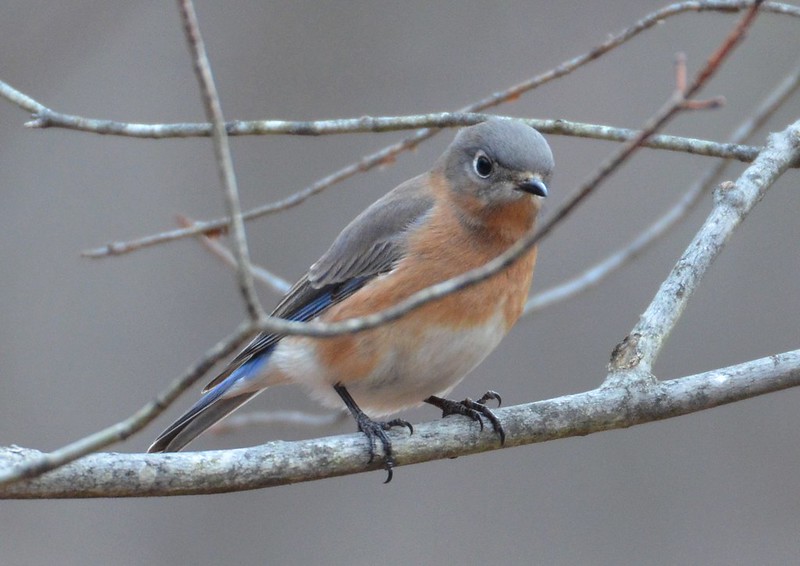
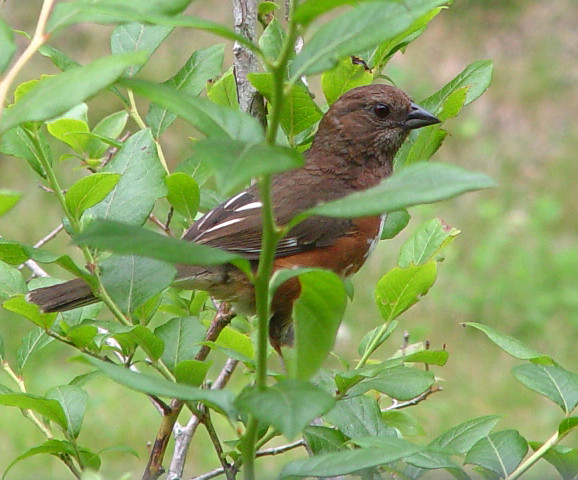
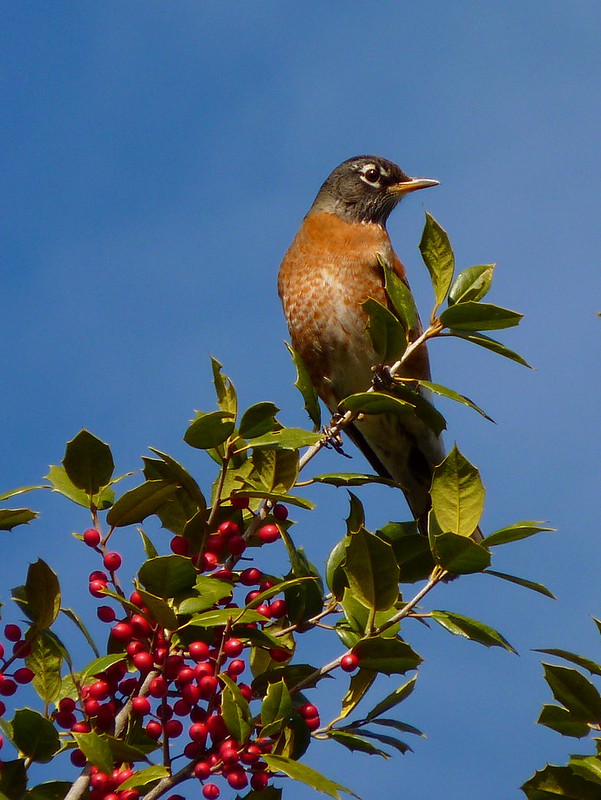
As best I can determine: My unexpected passenger was a female eastern bluebird.

DSC_3019e eastern bluebird–female. jjjj56cpCC BY-NC-SA 2.0.

*UPDATE, May 2023:

I’ve used the Picture Bird ID app to identify my mystery bird as a female Eastern Towhee.

Eastern Towhee.
Autumn wings haiku

Familiar cheeping
at dusk, out on the front porch
-can it really be?

Opening the door
a fluttering of feathered wings
-the finches remain?

Should I be so blessed?
I shall need to buy some seed
for the frost has come.

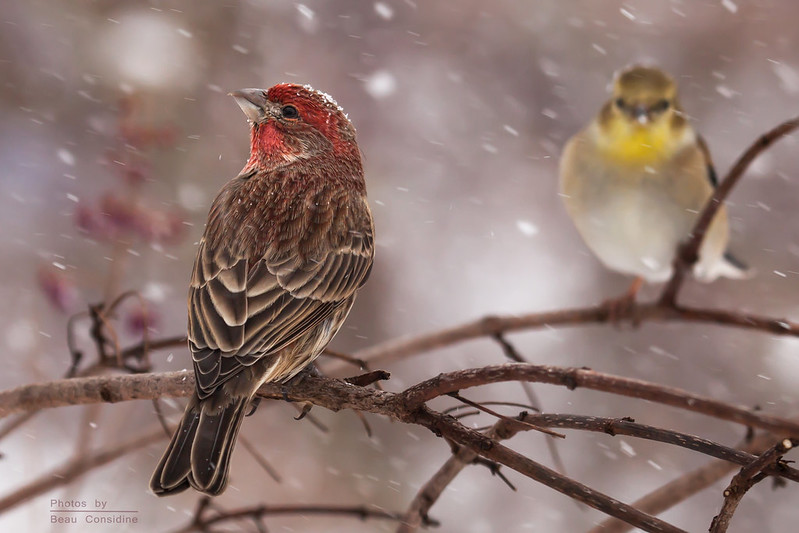
House Finch with Goldfinch. beaucon. CC BY-NC 2.0.

House finches are regular nesters in my front door wreath from Eastertime through the summer; I have not been aware of their remaining so close by in the autumn months. They aren’t nesting now and as yet I haven’t ascertained where exactly they’re living, only that it’s somewhere near the porch. I see them fly when we pull up in the driveway, and when we open the front door. I can’t even get a good look at them; they’re being evasive.

Their presence lifts my spirit immeasurably: Take heart, be of good cheer, we are still here… the fluttering of wings was so near my face when I opened the door in the dark after hearing the familiar bird voice. It wasn’t alarming. Out in the yawning chasm of night flew the little bird, with my soul tethered to it by inexplicable hope.